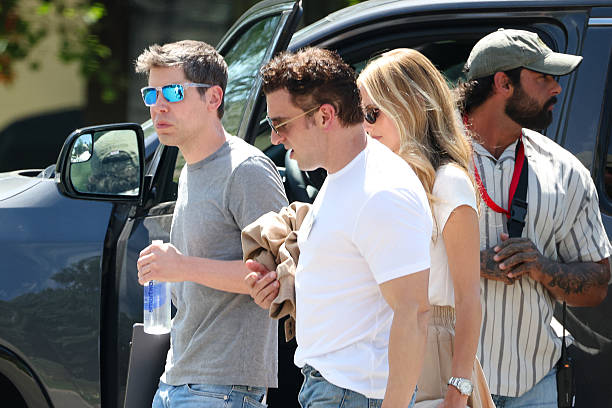
OpenAI (OPENAI) CEO Sam Altman agreed with Nvidia (NVDA) CEO Jensen Huang that open models are important to help the U.S. win the artificial intelligence race.
“I want the US to win in AI both in open-source and proprietary models, and
If you buy books linked on our site, The Times may earn a commission from Bookshop.org, whose fees support independent bookstores.
Eddie Huang has never felt lighter. Last month, after his debut novel, “Come Undone,” finally released, something shifted.
“I have a family. I feel healed,” he said over coffee and short ribs in Santa Monica hours ahead of a live talk with Ottessa Moshfegh, the bestselling, critically acclaimed author of Huang’s favorite book, “My Year of Rest and Relaxation.”
“People always write me off as a personality or a multi-hyphenate,” he said. “It’s a nice way of saying I’m not really good at anything. But I didn’t have any of that this time.” He leaned forward, serious. “I have to be honest. I do think the Knicks are a big, big part of it.”
His beloved Knicks winning the championship, he said, kept him from spiraling over the book. In person, Huang subdues his ironic braggadocio with polite eye contact and rolling belly laughs at his own jokes. For years, audiences have watched Huang resist whatever box you put him in. His particular brand of cultural fluency — a rapid-fire mix of food, fashion, basketball, politics and pop culture — is what made the “Gua Bao Bad Boy” impossible to categorize.
For most of his career, Huang has seemed constitutionally incapable of standing still. Chef. Memoirist. TV host. Filmmaker. Lawyer. Comic. Podcaster. His first book, “Fresh Off the Boat,” became the longest-running network sitcom centered on an Asian American family, even as Huang publicly distanced himself from the show. Since leaving post-fires L.A. for New York, he’s reopened Baohaus — returning to the kitchen that built his career. Waiting for him at home after the book tour is his wife, Natashia Perrotti, and their 2-year-old son.
Now there’s “Come Undone,” fiction that Huang called his most honest — and vulnerable — work to date.
“It’s sort of this next-gen auto fiction type thing that is creating its own rules,” Moshfegh said ahead of their Q-and-A. “It made me think about my own appreciation for the experience of male heterosexuality and how much it’s been commodified.”
The book follows Hubie, a globe-trotting food-show host drifting through Chateau Marmont, Madeo, Nobu and other “dirtbag L.A” (as Huang coins) spots. He meets Janine, his equal in appetite and id, sending him into a tailspin of yearning and loops of Sky Ferreira’s “Everything Is Embarrassing” on sadboi walks. The “two walking red flags” decide to try to make it work.
Huang called the novel an “autofictional riddle.” The puzzle isn’t especially difficult if you’ve followed his relationship with Perrotti, who co-hosts their podcast, “Canal Street Dreams.” Marrying a writer, she’s learned, often means finding out what he feels by reading it. “We’ll get into a fight,” she said, “and I’ll wake up to a Substack article about it.”
It’s also part of the private life she’s since conceded. “It’s annoying,” she added. “But now I can read it, and maybe understand him a little bit better. He’s trying to communicate through the writing, like sending somebody a song and saying, ‘I want you to listen to these lyrics.’”
The novel goes further, drawing from experiences the couple has never discussed publicly. In the novel, Hubie and Janine’s relationship pivots after an ectopic pregnancy ends in loss. Perrotti said the scene is fictionalized but mirrors a similar experience they had early in their own relationship.
“It brought us closer together,” she said. “It was the catalyst for us realizing we were serious.”
Before Huang could finish the book, the life he was writing about had to fall apart. “This book was very much about breaking up with your family to start your own,” he said. “There was a lot of anger in the book that had not been resolved.”
By the end of 2024, Huang had stopped speaking to his mother. The break followed what he described as a blowup at a Cheesecake Factory. It also unlocked the ending he’d been chasing.
Eddie Huang.
(Jason Armond / Los Angeles Times)
Looking back, Huang thinks the earlier versions failed because he was still arguing with her. He’s still trying, in some way, to communicate with her through his writing. “If there’s one person I wish would read the book,” he said, “it would be my mom.”
There were other chapters he had to close the book on, mainly Hollywood. His foray into fiction coincided with the writers’ strike, drying up all his income and future projects. That same year, he became a father. “I had to accept and realize that my value was not in making money,” he said. “Because for three years, I couldn’t.”
He recalled a particular low point researching life insurance policies. “I had to rebuild my whole self. Really love myself despite not being able to offer anybody anything.”
That new certainty didn’t make Huang any less willing to pick fights. Last year, as his documentary “Vice Is Broke” — an autopsy of the media company behind “Huang’s World” and its eventual bankruptcy — awaited release, Huang said distributor Mubi shelved the film after he boycotted the company over Sequoia Capital’s investment in an Israeli defense technology startup. (Mubi denied this and said it still planned to distribute the film.)
The ghost of Vice still lingers in today’s media ecosystem in what he called our “era of cartel journalism:” creators navigating a world of blurred incentives and corporate interests. He traced this instinct to challenge those systems back to Socrates’ “gadfly” — the person whose job was to annoy power. “As a writer, you should be challenging people,” he said. “If your memoir can be turned into a sitcom, it probably wasn’t challenging.”
Eddie Huang.
(Jason Armond / Los Angeles Times)
After the 2025 L.A. fires drove his new family back to New York, Huang went back to cooking. He worked pop-ups, reopened Baohaus and found himself alongside line cooks half his age. In March 2025, he rewrote the novel in five days. That same month “was the first month I didn’t overdraft my credit card,” he said, with the majority of his income today coming from the restaurant. It’s allowed him to make films, write books and walk away from deals he doesn’t believe in. “Being a chef is the anchor that allows me to maintain my artistic integrity.”
For years, comparisons to Anthony Bourdain followed Huang everywhere. The two eventually became friends.
“He was one of the few people who was as advertised,” Huang said. “Nicer and more generous in person. And wounded.”
Bourdain is the only real person who appears in “Come Undone” under his own name.
When Huang mentions him, he stops talking. He covers his face. Tears come.
“I don’t believe in God,” he said, “but I asked the universe why for many, many years.”
Bourdain’s suicide, he said, was one of the reasons he walked away from “Huang’s World” in 2018. At the time, few people understood why. “It was Tony. It was family. It was everything.”
Eddie Huang.
(Jason Armond / Los Angeles Times)
Now, looking back, Huang thinks he was writing “Come Undone” toward a different ending than the one he’d imagined.
“This book is a guy saying, ‘I don’t want to be like my biological father,’” he said. “And, in the most respectful, loving way, I don’t want to go out like Tony.”
He paused. “I needed to name the sadness in me. I needed to allow myself to be loved.”
Huang is already writing another memoir about getting back into the kitchen. Still, he said, these days, he’d rather write fiction.
Rudi, an L.A. native, is a freelance art and culture writer. She’s at work on her debut novel about a stuttering student journalist.
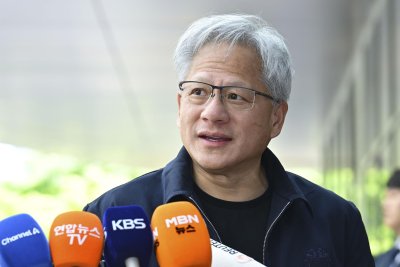
Nvidia Corp. CEO Jensen Huang speaks to reporters after arriving at Gimpo International Airport in western Seoul on Friday. Photo by Yonhap
Nvidia Corp. Chief Executive Officer (CEO) Jensen Huang said Friday that he views robotics as the next major growth sector in South Korea, adding that the domestic market is well-positioned for growth.
Huang, a central figure in the global artificial intelligence (AI) boom, made the remarks after arriving at Gimpo International Airport in western Seoul aboard his private jet for a four-day visit.
“(South) Korea has many sectors to invest in. Robotics is going to be the next major sector,” Huang told reporters, adding that the Korean “market is doing very well.”
Asked whether he had brought any gifts for South Korea, Huang responded with a smile.
“Did I bring any gifts for Korea? I brought a lot of business for Korea,” he said. “I have some surprises.”
The trip comes less than a year after Huang’s previous trip to South Korea in October, which coincided with the Asia-Pacific Economic Cooperation (APEC) CEO Summit in the southeastern city of Gyeongju.
During that visit, Huang drew widespread attention when he joined Samsung Electronics Chairman Lee Jae-yong and Hyundai Motor Group Executive Chair Euisun Chung for a late-night meal of Korean fried chicken and beer, commonly known as “chimaek.”
One of the most anticipated events during Huang’s visit is an informal dinner with SK Group Chairman Chey Tae-won, LG Group Chairman Koo Kwang-mo and Naver Chairman Lee Hae-jin. Hyundai Motor Group’s chief who had earlier been expected to join the group has since confirmed he will be unable to attend.
Together, the companies represented at the gathering span nearly every layer of the AI value chain, including semiconductors, data centers, AI models, software and robotics.
Huang is also set to hold talks with executives from the gaming industry, AI and robotics startups, university researchers and students, according to industry sources.
“Because Korea is a manufacturing center of the world, we can apply the robotics technology, the physical AI technology that we invent here for the industry,” he said.
He further said Nvidia will partner with domestic manufacturing firms in robotics and AI.
“The manufacturing of semiconductors will become increasingly robotics and increasingly AI driven in the future, and so we have a great opportunity to partner with the semiconductor companies here as well,” he added.
Later in the day, Huang visited an internet cafe in Seoul and met with esports players, including gaming superstar Faker.
“This is the birthplace of esports,” Huang said, emphasizing that Korean gamers have long been among the world’s most competitive players who are using Nvidia’s graphics processing units (GPUs).
Nvidia’s GeForce graphics cards are designed to deliver the high frame rates demanded by professional gamers.
Huang is also expected to meet Krafton Executive Director Chang Byung-gyu and other senior executives from the gaming company, though the exact schedule has yet to be confirmed.
The two companies are expected to discuss potential cooperation involving Nvidia’s RTX Spark platform for premium Windows laptops, as well as physical AI technologies.
Earlier this year, Krafton established a robotics subsidiary called Ludo Robotics.
During his stay, Huang is also expected to meet Science Minister Bae Kyung-hoon to discuss cooperation in AI, including the supply of GPUs.
Details regarding the timing, venue and agenda of the meeting are still being finalized.
Copyright (c) Yonhap News Agency prohibits its content from being redistributed or reprinted without consent, and forbids the content from being learned and used by artificial intelligence systems.
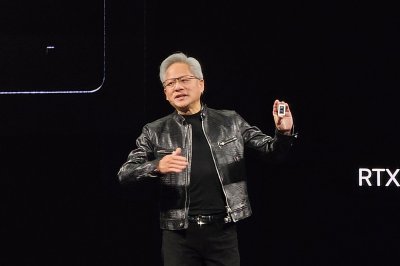
Jensen Huang, CEO of U.S. chip giant Nvidia Corp., will visit South Korea later this week, industry sources said Thursday. Huang is seen here speaking at conference in Taipei on June 1. Photo by Yonhap
Jensen Huang, chief executive officer (CEO) of U.S. chip giant Nvidia Corp., will visit South Korea later this week for a series of meetings with the heads of major conglomerates and researchers that could pave the way for broader cooperation in artificial intelligence (AI) and robotics, industry sources said Thursday.
Huang is scheduled to arrive at Gimpo International Airport in western Seoul aboard his private jet on Friday afternoon for a four-day visit, following his appearance at the Computex trade show in Taipei, the sources said.
During his stay, Huang is expected to meet with leading business figures, as well as executives from the gaming industry, AI and robotics startups, university researchers and students.
On Friday evening, he is expected to visit a Korean barbecue restaurant in Seoul’s Seongsu neighborhood for a gathering with SK Group Chairman Chey Tae-won, Hyundai Motor Group Executive Chair Euisun Chung, LG Group Chairman Koo Kwang-mo and Naver Chairman Lee Hae-jin.
Industry observers expect the participants to discuss a wide range of potential cooperation areas between Nvidia and South Korean companies, including high-bandwidth memory (HBM), AI data centers, autonomous driving, robotics and physical AI.
During his previous visit to South Korea in October, which coincided with the Asia-Pacific Economic Cooperation (APEC) CEO Summit in the southeastern city of Gyeongju, Huang drew widespread attention when he joined Samsung Electronics Chairman Lee Jae-yong and Chung for a late-night meal of Korean fried chicken and beer, commonly known as “chimaek.”
On Sunday, Huang is expected to meet with Kim Taek-jin, CEO of NC Corp., a South Korean gaming company, they said.
While the agenda has not been disclosed, discussions are expected to focus on cooperation in gaming and AI.
On Monday, Huang is also expected to hold a closed-door meeting with executives from South Korean AI and robotics startups in Seoul.
The meeting would mark the first known occasion on which Huang has met with robotics startup founders in South Korea.
The Nvidia chief is also coordinating plans to visit the country’s top-notch Seoul National University’s AI institute and robotics research center.
Separate from the visits, Huang has reportedly expressed interest in meeting directly with university students.
Huang is reportedly meeting Krafton’s Executive Director Chang Byung-gyu, and other senior managers from the company, though the exact dates have yet to be confirmed, the sources said.
The two companies are likely to discuss gaming partnerships related to Nvidia’s RTX Spark, a type of semiconductor designed for premium Windows laptops, as well as physical AI.
Krafton has founded a robotics company called Ludo Robotics early this year.
Copyright (c) Yonhap News Agency prohibits its content from being redistributed or reprinted without consent, and forbids the content from being learned and used by artificial intelligence systems.