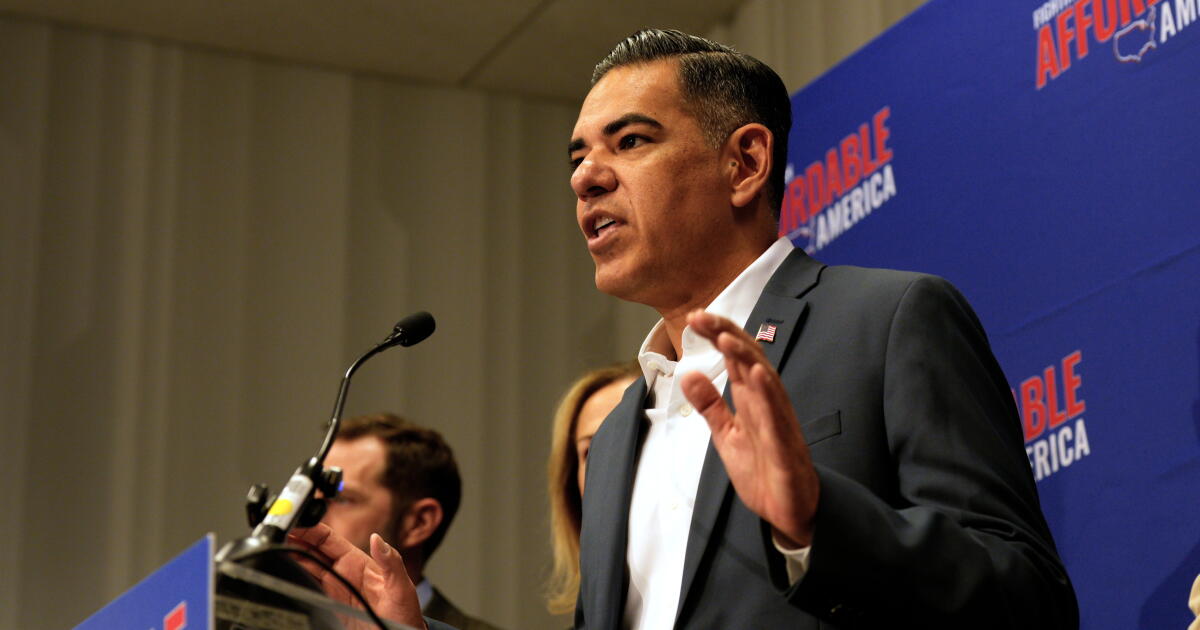
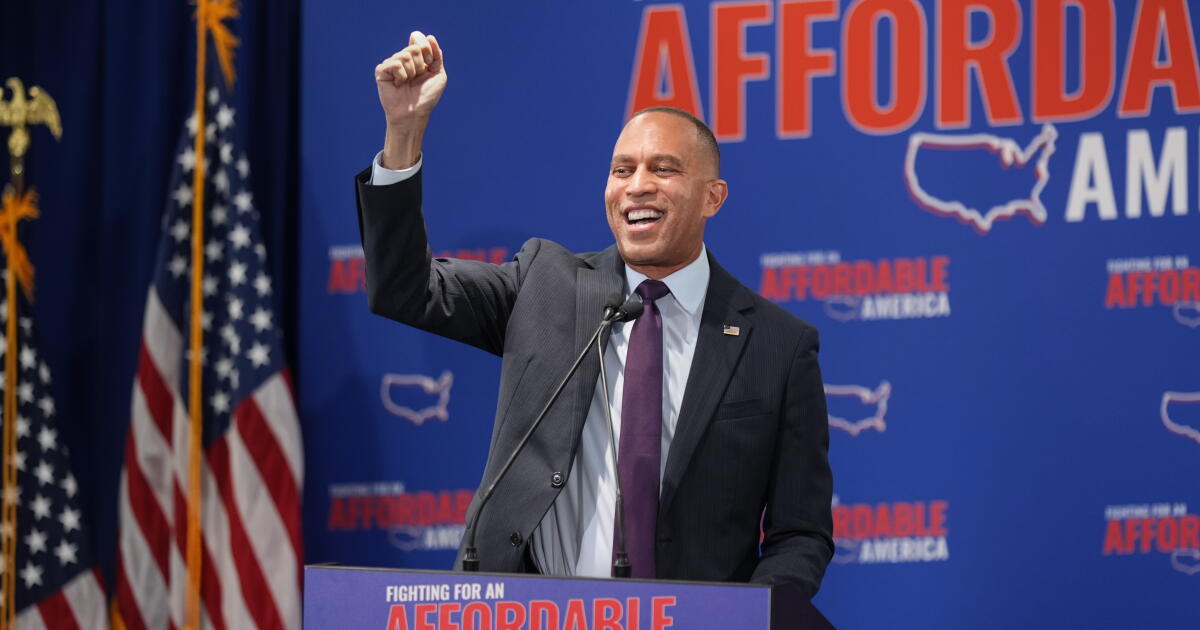
WASHINGTON — House Democratic leaders are placing an early emphasis on healthcare as they discuss their immediate priorities upon the swearing-in of the new Congress on Jan. 3.
Early votes in the House next year are expected to focus on boosting Medicaid and restoring an enhanced tax subsidy that is designed to lower the cost of Affordable Care Act health plans for millions of enrollees.
Democrats are also promising swift action on legislation to stop the war with Iran and to reverse some of President Trump’s tariffs.
“We’re going to get out of the gate fast,” said New York Rep. Hakeem Jeffries, the Democratic leader who is in line to become the next House speaker.
The legislative flurry carries enormous stakes for Democrats as they seek to translate their sweeping victories in the midterms — their numbers will exceed 250 in the 435-member House — into achievements that deliver on their promises to lower the cost of living.
Obstacles for the Democratic agenda
Passing those bills should not be a problem with such a large Democratic House majority. Getting them signed into law most certainly could be.
A 60-vote threshold in the Senate looms for the legislation, as does a potential presidential veto. Trump on election night posted a photo on his social media site of a red hat with a simple message on it: “Veto.”
Following those early votes, Jeffries said five working groups are developing plans to put forward bills that would lower costs in areas such as housing, energy, groceries and caregiving.
Rep. Ted Lieu (D-Torrance) said Democrats will at some point take up legislation dealing with artificial intelligence and data centers. He is part of a group of lawmakers working on a document that will lay out some of the priorities for Jeffries to consider.
“House Republicans last year made a conscious decision to let the AI industry run wild, and that was a bad decision politically and a bad decision on policy,” Lieu said. “Two things will change next term. We will hold public hearings on AI. We will pass legislation, reasonable guardrails on AI, and specifically data centers.”
A return to past political fights
Democrats are trying to reverse Medicaid changes that are expected to cut more than $900 billion from the program over a decade. The Republican-approved cuts helped offset some of the costs of Trump’s big tax and spending cut bill that was signed into law last year. The Medicaid changes in the bill imposed new administrative requirements and added conditions for eligibility, including work requirements.
Some of the most substantial changes have yet to take effect. Still, enrollment in Medicaid has dropped by about 5 million, or about 7%, since July 2025, when the bill was signed into law, according to KFF, a health policy research and news organization.
Reversing those cuts would probably require Trump and the Republicans to abandon the hard-fought changes they made to cut entitlement spending in their signature tax bill. It’s an unlikely proposition.
The effort to extend enhanced tax subsidies for certain enrollees in ACA plans has also been debated and voted on in the current Congress. The measure passed the House with some Republican support but stalled in the Senate.
There also have been numerous war powers votes regarding Iran — 14 in the Senate and six in the House.
Gridlock may be on the horizon
Senate Majority Leader John Thune (R-S.D.) said going into the election that a Democratic majority in the next Congress would amount to “two years of paralysis.”
“I don’t think that’s good for anybody,” Thune said.
But Democratic leader Chuck Schumer of New York is insisting that his party will push its agenda with or without the Republican president’s help.
“If he vetoes it, it will show the divisions. As much as we didn’t want to shut down, when we shut down the government for a month over healthcare, people knew we were on their side,” Schumer said in an interview with the New York Times’ podcast “The Daily.”
Schumer said he believes Democrats can gain some Republican votes on restoring the enhanced subsidies for ACA plans. When asked if he was hearing from Republicans expressing a willingness to work with him on legislation, he replied: “They’re never so definitive but, yes, I am getting initial signs that way on certain issues, not on every issue.”
While the prospects for getting any of the early priority bills over the finish line are uncertain, the votes in Congress will help frame the choices voters will face during a presidential election in 2028.
Tensions within the new majority
Progressive groups call the agenda outlined by Jeffries a good early start, but they have much greater expectations for Democrats this Congress.
“It’s perfectly fine if the Senate and the House are unified and Donald Trump is standing in the way because that sets up another tidal wave election in 2028,” said Adam Green, co-founder of the Progressive Change Campaign Committee, a Democratic-aligned group that backs progressive candidates and policies.
At the same time, he said Schumer cannot be content to let bills die in the Senate because of the 60-vote threshold.
“It will require the Democrats to get rid of the filibuster,” Green said. “There’s no doubt about it.”
He said there’s a disparity because Republicans’ top priorities — tax cuts and Supreme Court justices — can get through with simple majorities. But the Democratic Party’s top priorities require 60 votes to overcome a filibuster.
“The only question is will the American public trust Democrats enough to keep giving us more power or will this week’s gains whittle away because we do nothing? That’s why the filibuster is a threshold question,” Green said last week.
Schumer, in an interview with the Associated Press last week, would not say whether he would try to eliminate the filibuster.
“The focus has got to be on getting things done,” Schumer said. “That’s all I am saying.”
In a memo to fellow members of the Congressional Progressive Caucus, Rep. Greg Casar (D-Texas) said Democrats also need to target what he called “powerful forces outside of government.” Examples he cited were corporations using Americans’ private data to adjust their pricing based on a consumer’s personal data and AI companies that he says are putting jobs and lives at risk.
“By focusing not just on the Trump administration but also on big corporations and billionaires, we will show the American people we are not just anti-Trump but also pro-worker and pro-consumer,” Casar said.
Freking writes for the Associated Press. AP writer Mary Clare Jalonick contributed to this report.