The deciding game between the Philadelphia Phillies and Atlanta Braves played silently on the Dodger Stadium scoreboard Thursday as Dodgers players practiced below.
The Dodgers were less than 48 hours away from the first pitch of the National League Division Series. The “2026 Postseason” decals had been freshly painted up the baselines that afternoon. All that was left to be decided was their opponent — the winner of the game serving as the backdrop of their intrasquad scrimmage.
About a half an hour after the Dodgers cleared the field, the Braves advanced to the NLDS with a 6-2 win over the Phillies. The Dodgers and Braves will open the best-of-five series at Dodger Stadium on Saturday at 1 p.m. PDT.
“We are the team to beat,” veteran utility player Kiké Hernández said. “We are the team that you have to go through. And that’s all nice words and everything, but we got to take care of business on the field. But I feel great about my team.”
The Dodgers are the reigning back-to-back champions and are aiming to become the first National League team to win three World Series in a row.
“Obviously it’s there, but it’s not something we’re really focused on,” veteran third baseman Max Muncy said of the three-peat chase. “We’re trying to focus on ourselves getting ready this week, paying attention to whoever we might be playing and just trying to get ready for a postseason series the same way we’ve always gotten ready for it.
“We don’t need to be adding any extra pressure onto ourselves. We’ve been saying that for a long time. When you talk about three-peating, you’re putting that extra pressure on it that doesn’t need to be there. Winning a World Series is already hard enough as it is. So for us, we’re just trying to focus on what we have ahead of us and without the added noise to it.”
So, how did the Dodgers get ready for the postseason? Their bye week consisted of wild-card watch parties, batting practice, live pitching — from a long list of arms on Wednesday, especially — and an open workout Thursday that culminated in a scrimmage. Right-hander Tyler Glasnow, who’s penciled in to start Game 4 of the NLDS if necessary, started for the home team Thursday.
“Instead of showing up, checking a box to work out, then eject, I think that sacrifice from friends, family, it’s important,” manager Dave Roberts said. “We’re at the home stretch. We’re in the playoffs, and so I think that the more guys spend time with one another, it just lends itself to just more togetherness.”
Dodgers manager Dave Roberts, left, talks with third baseman Max Muncy during practice Thursday.
(Mark J. Terrill / Associated Press)
The Dodgers have figured that out over five postseasons in this format. This is their fourth with a bye — after going through the wild card last year. And they introduced the watch parties in 2024.
“You’ve earned the bye and you should take that time to rest and recover,” Muncy said. “But you don’t want to give guys too much time to be at home and get that taste of what it might be like. That really worked for us back in 2024. You get guys here to the field. You’re not forcing anyone to do anything but you’re making all the guys hang out together for extended periods of time when they could be at home enjoying family time — which is great for everybody but not when you know what’s coming for us ahead.
“You’re going to be facing a team that’s already been through the fire. They’ve already been through the emotions. They’ve already been through the roller coaster which is the postseason. It’s hard to go from an at-home setting to trying to find a way to flip the switch.”
The Braves have, indeed, been through the fire. They claimed the No. 3 seed with a 94-68 record and the NL East title. They took Game 1 of the wild-card series against the Phillies but lost Game 2 in extra innings, forcing a winner-take-all Game 3.
Leslie Jones was 14 when her father broke the news to her: “We’re moving to Los Angeles.”
For the actor and former “SNL” cast member, leaving her Memphis hometown felt like the end of the world. “I lost every bit of my s—,” she recalls. “I cried and begged him, like, ‘Please don’t take me away now.’” She’d just become friends with the popular kids at her high school. Plus, she was in the marching band — a rifle twirler — which in the South basically means “you’re a jock, you’re a star,” she says, laughing.
In Sunday Funday, L.A. people give us a play-by-play of their ideal Sunday around town. Find ideas and inspiration on where to go, what to eat and how to enjoy life on the weekends.
Despite her resistance, Jones’ father stood firm: “He was like ‘I can’t let you stay here in Memphis. You’re not going to do what you need to do with your life,’” Jones says.
Though she hated L.A. at first, she eventually found her footing and joined the basketball team at Lynwood High School. She grew to love the city and now splits time between L.A. and New York.
“[My dad] was really strategic and smart and I’m really glad he did it,” she says.
Jones’ latest project is hosting HGTV’s “Roast My Rental,” a reality show in which she visits some of America’s worst-rated short-term vacation rentals and attempts to transform them within 72 hours, alongside designer Jasmine Roth.
One of her Airbnb pet peeves: when owners put out items that are too personal. “Sometimes they want to put their personal linens in there. They’ve got pictures in there. Like why are your pictures in my room? I don’t want to know who’s renting to me,” she jokes.
Jones, who is also in the middle of a comedy tour, shared what her Sunday Funday in L.A. entails.
This interview has been lightly edited and condensed for length and clarity.
1 p.m.: Sleep in ’til the afternoon then make a big cup of tea
Sunday is the day I know that I can sleep in. I don’t schedule anything on Sundays and Mondays. I’ll probably get up around 1 or 2 p.m. because I stay up until about 3 or 4 a.m. I’m a comedian so we have late hours. Then I’ll come out my room, which is a freezer — it’s literally 59 degrees because I gotta sleep in the cold — to warm up.
I’ll make me a big cup of tea. I’ve got those big “Friends” cups. My favorite is ginger tea. I’ll pick a lemon off my tree to add to it. Then I’d lay on the couch and figure out if I’m going to watch something on TV or play a video game. I play the dumbest games. What has me in a choke hold right now is “Brilliant Sort.” It’s almost like jigsaw puzzle, but it’s electronic. It’s so f— relaxing and I play it for hours. It’s bad now because I’ve been spending money on it and my accountant was like “Hey, you’re spending a lot of money on a video game.” I said “Well, it’s not crack” and they were like “What?” [laughs]. I might have end up deleting this f— game.
3 p.m.: Brunch at the Waffle
About an hour later, I’d figure out what I want to eat. Sunday is the day I eat anything I want. I don’t like to call it a cheat day. I always order from this place called the Waffle in Hollywood because they’ve got this biscuit sandwich with a whiskey glaze and bacon. It’s good as f— and then I get my egg over medium. I always order it with a blood orange-flavored Pellegrino over some ice. Wooooo.
5 p.m.: Watch an action movie
On Sundays, I really like to watch movies. I’ll go on Apple TV or another streamer to find something to watch. If not, I’ll watch “SVU” all day. Some days I can watch serious stuff, but I really like a good action movie like all of the “Fast & Furious” films. I know people talk about them but I f— love “Fast & Furious.” I love “Mission: Impossible.” I love all of the Marvel movies.
7 p.m.: Order dinner from all my favorite spots
Usually I order food from my cook when I’m at home and she’ll make like a week’s worth of food. But if I don’t, I’ll order in. If I want a really good steak, I’ll go to the Nice Guy. I spoil myself on Sundays because I might get a steak from there, a salad from Tender Greens and a lemonade from Cheesecake Factory. The key is getting one driver and telling them, “I’m going to order something else, do you want to go get it?” because then you can give them a big tip. I might not eat until like 10 or 11 p.m. though.
11 p.m.: Catch a second wind
During the day, I probably took a nap so my brain is activated around 11 p.m. to midnight. If my friends call me and say they want to go out, I might go to this karaoke night hosted by Project Studio that my friend Neff took me to. There’s good drinks and a good DJ. I like to go see live music too. I recently saw Olivia Dean [at the Crypto.com Arena]. If there’s a Sparks game on a Sunday, I will go. If not, I’ll stay home and I’ll be up until maybe 4 or 5 a.m. just watching TV, playing my game, doing nothing [laughs].
MAJOR railway lines are closed due to a gas leak leaving commuters stranded in rush hour – with the disruption expected to last all day.
Passengers are urged not to travel between Reading and Swindon as engineers frantically attempt to fix the issue, while other routes are seeing significant delays.
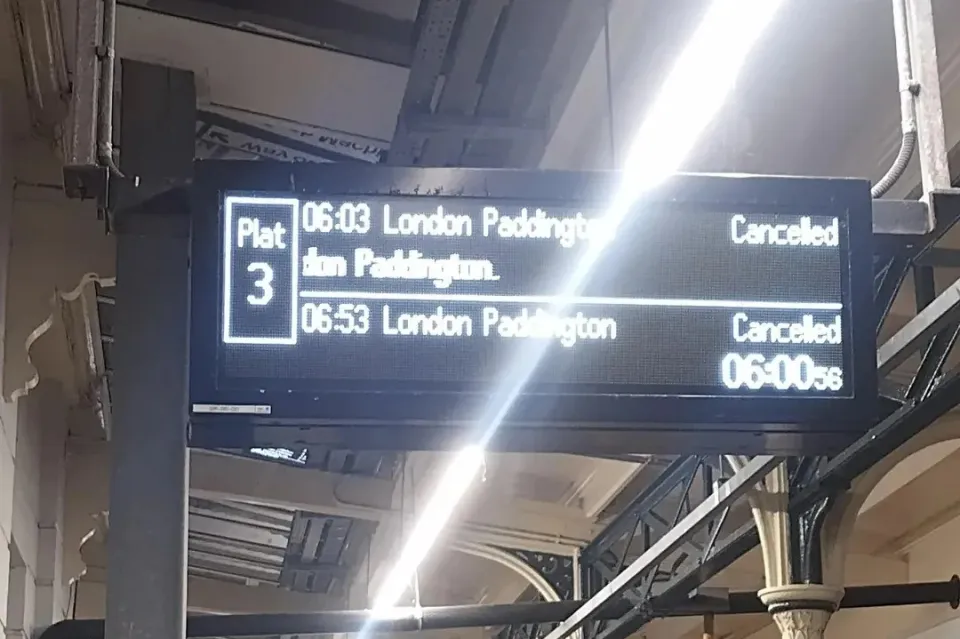
Trains to Paddington from Reading cancelled at 6am this morningCredit: RedditThe station is among those affectedCredit: Getty
The gas leak close to railway land at Didcot Parkway in South Oxfordshire is expected to cause severe disruption throughout Wednesday.
The Reading-Didcot section of the route is the gateway from Paddington towards Swindon, Bristol, Bath, South Wales, Cheltenham and other parts of the West Country.
Sign up for the Travel newsletter
Thank you!
Diversions are in place but Great Western Rail is cancelling some services outright because trains can’t get through Reading-Didcot.
A total of 72 services to and from Didcot are cancelled, while 39 have been axed at Oxford and 45 at Reading.
One social media user posted a photo from Swindon showing trains to Paddington cancelled at 6am.
They wrote: “Apparently there’s been a gas leak around Didcot Parkway so they’ve cancelled most of the services, and no replacement bus services running either.
“The staff at Swindon reckon this will last all day and probably tomorrow.”
Another person responded: “Absolutely ridiculous… not good enough.”
GWR is running roughly one train an hour Paddington-Bath/Bristol via a diversionary route – a fraction of the normal capacity.
It has warned only to travel if absolutely necessary.
Replacement buses are running between Swindon, Didcot and Reading but Network Rail says capacity won’t be enough for everyone.
CrossCountry is also telling passengers not to travel between Reading and Oxford – with one person responding to the company’s X post with: “Thanks for ruining my whole day.”
Network Rail said: “Engineers from gas distribution company SGN are on site working to rectify the problem as quickly and safely as possible.
“Network Rail and train operators are working together to manage the impact on passengers, but normal services cannot operate until the leak has been repaired because the railway falls within the safety exclusion zone.
“Severe disruption is expected to long-distance services that would usually travel through Didcot, and passengers are being warned that trains able to run either side of the affected area will be extremely busy.
“GWR will continue to operate as many trains as possible either side of the incident.”
GWR expects to be able to operate services between:
Reading and London Paddington
Swindon and Cheltenham Spa
Swindon and Chippenham/Bath/Bristol
South Wales to Bristol Temple Meads
Worcester and Oxford
An hourly service between London Paddington and Bath/Bristol via an alternative, diversionary route
Oxford and Didcot
An hourly service Bristol Temple Meads and Didcot
Usual timetabled services that do not run between Reading and Didcot
A limited bus replacement service will operate between Swindon, Didcot and Reading
There’s an alternate universe where Taylor Tomlinson is a young adult fantasy author holed up in a cabin miles from civilization.
“ I don’t know if you have some sort of backup career or backup life that you go to in your head when you’re overwhelmed or fed up with your career or whatever process you’re in,” she asks in the lobby of the Four Seasons Hotel Denver ahead of a two-show night. “That was in the back of my head, [I was] like, ‘Well, I could just move to the woods and write books.’”
In this world, she’s a 32-year-old comedian with four Netflix stand-up specials and a two-season stint as the host of late-night game show “After Midnight.”
Her manager told her that people would probably be more interested in her memoir before a series centering on magic and dragons, so she started writing her own story two years ago.
A self-diagnosed workaholic, Tomlinson spent 10 years constantly moving. From a combination of mold exposure and severe burnout from filming “After Midnight” on weekdays and performing in different cities on weekends, she fell ill for months and was forced to take a break.
In that time, she wrote “Actually, Nevermind.” Coming out Tuesday, the autobiographical essay collection delves into the aspects of life that she changed her mind about since her mother died when she was 8 years old.
“Actually, Nevermind” opens with an eclectic mix of three quotes from “Anne of Green Gables” by Lucy Maud Montgomery, celebrated writer Joan Didion, and the 2001 Anne Hathaway-led comedy film “The Princess Diaries.” Tomlinson wanted a combination of funny and serious excerpts capturing grief, but also a quote about evolving as a person.
In the classic coming of age novel “Anne of Green Gables,” a young Anne Shirley states, “I’m not a bit changed — not really. I’m only just pruned down and branched out. The real me — back here — is just the same.”
That’s the essence of Tomlinson’s realizations in her book — she’s growing into herself but that girl who started performing stand-up shows on the church circuit at 16 is still in there.
Tomlinson has a bit from her first Netflix special “Quarter-Life Crisis” about your 20s being a period to “fish trash out of the lake before it freezes over.” She asks how I’m enjoying my 20s, to which I bluntly reply, “It’s a nightmare.”
“ My 20s were a nightmare, too, and I was waiting to be 30, and I was like, ‘When I turn 30, I’m going to be solidified and great.’ And then I turned 30, and it was like the last two years I have probably changed just as much, if not more, than I did in my 20s,” she says. “It’s been much rockier than I anticipated.”
In speaking with her friends, she realized they also felt a disconnect between the lives they envisioned for themselves and their realities. Tomlinson channeled that uncertainty into a jumping-off point for her book.
She reflected on when she began questioning the trajectory of her life and traced it back to her mother’s death.
“ I didn’t know if I was even going to write about my mom at all when I first got the book [deal] because I was like, ‘Well, I talked about it in ‘Look At You,’ and I’ve talked about it in interviews,’ but that’s the thing about losing a parent or any big traumatic grief event is you’re always getting hit by waves of it, and then you’re always untangling it,” she says.
In creating “Actually, Nevermind,” Tomlinson pored through her mother’s diary, deciding to include a few excerpts in the finished book. For most of Tomlinson’s life, she regarded her mother as a flawless, devout Christian whom she desperately yearned to impress.
Drawing on her mother’s diary, estrangement from her father and complex sibling bonds, Tomlinson confronts impossible standards, relinquishes parentified guilt and reframes what family means after loss.
(Sela Shiloni)
Her mother married young, so she tried to hit that milestone, too.
“I didn’t manage it and self-sabotaged a lot,” she says. “Now, I’m grateful that I didn’t get married young, but at the time it was all I wanted because I wanted to fit in and I wanted to be someone she would’ve liked, someone she had things in common with.”
Through reading her mother’s diary entries, Tomlinson began to heal from the impossible standards she set for herself to follow in her mother’s footsteps.
“ She was sort of this perfect, infallible character in my brain for so much of my childhood, so it was helpful to read about her being like, ‘I’m nervous about getting married. We got pregnant on accident,’” Tomlinson says. “There’s stuff I didn’t include about arguments she had with my dad in college. It was just very human, and it was very encouraging to go, ‘Oh, it wasn’t like this perfect frictionless decision for her.’ It’s not like she just nailed it and did everything perfectly.”
One of Tomlinson’s largest shifts in perspective was no longer feeling parental responsibility toward her three younger siblings.
“ I went from their sister to a weird half parent figure when I was still a kid,” she says. “And I made all these missteps because I was also a kid. And then young adulthood was confusing because I had been waiting for everyone to get old enough to be friends with me.”
Now, Tomlinson’s siblings all take care of each other in their own ways. She refers to them as her “soul mates” and feels guilty wishing for a romantic partner when she already has three lifelong best friends.
While Tomlinson remains close with some of her mother’s relatives, she has been estranged from her father for five years. She writes about the sadness of not speaking to someone you feel so alike, but she doesn’t go into extreme detail about cutting ties.
“ There’s some things you just want to keep for yourself, you know?” she says. “You don’t want every painful private detail about who you are and what’s happened to you available to Google because it just makes you feel like you’re a raw nerve walking around, and you can’t get it back once you’ve shared it.”
“And you want something to say on a fifth date,” she jokes.
After processing the heartache of losing another parent in a different way, Tomlinson allowed herself to miss the good memories with her father and assuage any longing for revenge.
In her essay “I’m Gay Now,” Tomlinson explores her bisexuality and the transition from chasing male validation to feeling comfortable in herself. She came out at around 28 years old. Part of what took her until then was feeling the need to prove that she deserved to identify as queer.
In essays on sexuality, faith and ambition, she trades the pursuit of perfection for hard-won self-acceptance, exposing a more vulnerable offstage self still learning to do her best.
(Sela Shiloni)
“ I think that’s just a theme throughout my entire life,” she says. “I felt like I needed to earn the label of comedian. I felt like I needed to earn the label of queer. I needed to earn love.”
Her brother helped her understand that she didn’t have to achieve the title — she’s always been gay.
With all of her adulthood realizations, Tomlinson also reflects on what she wishes she could tell her younger self. Talking to a 16-year-old Taylor, she writes, “The most valuable thing about us cannot be all the things we haven’t done.”
“ So much of my childhood was like, ‘Don’t drink, don’t do drugs, don’t have sex. Don’t step out of line,’” she says. “I wanted to experience things more than I wanted to be this pure version of myself that was performing for the Lord.”
“Actually, Nevermind” is a reflection of Tomlinson when she puts down the microphone, and she is nervous for readers to see that side of her.
“ I feel pretty good about me on stage. Me in the room, I feel really insecure about,” she says. “I’ve gotten to a place where I feel pretty confident about taking up like 45 minutes to an hour and a half of your time. Eight hours, I think, is what the audiobook is. I’m like, ‘Eight hours is a lot more than that.’ So it’s been a real test of confidence.”
After years of chasing perfection, Tomlinson says she finds comfort in knowing that she may never be the world’s greatest anything.
“ In my 20s, I think I was always trying to be the best,” she says. “And now I’m like, ‘I’m going to do my best.’”
Joy Ryan, 96, has visited six continents since getting her first passport at 91, but she must follow her doctor’s advice to do the same routine every hour on long-haul flights
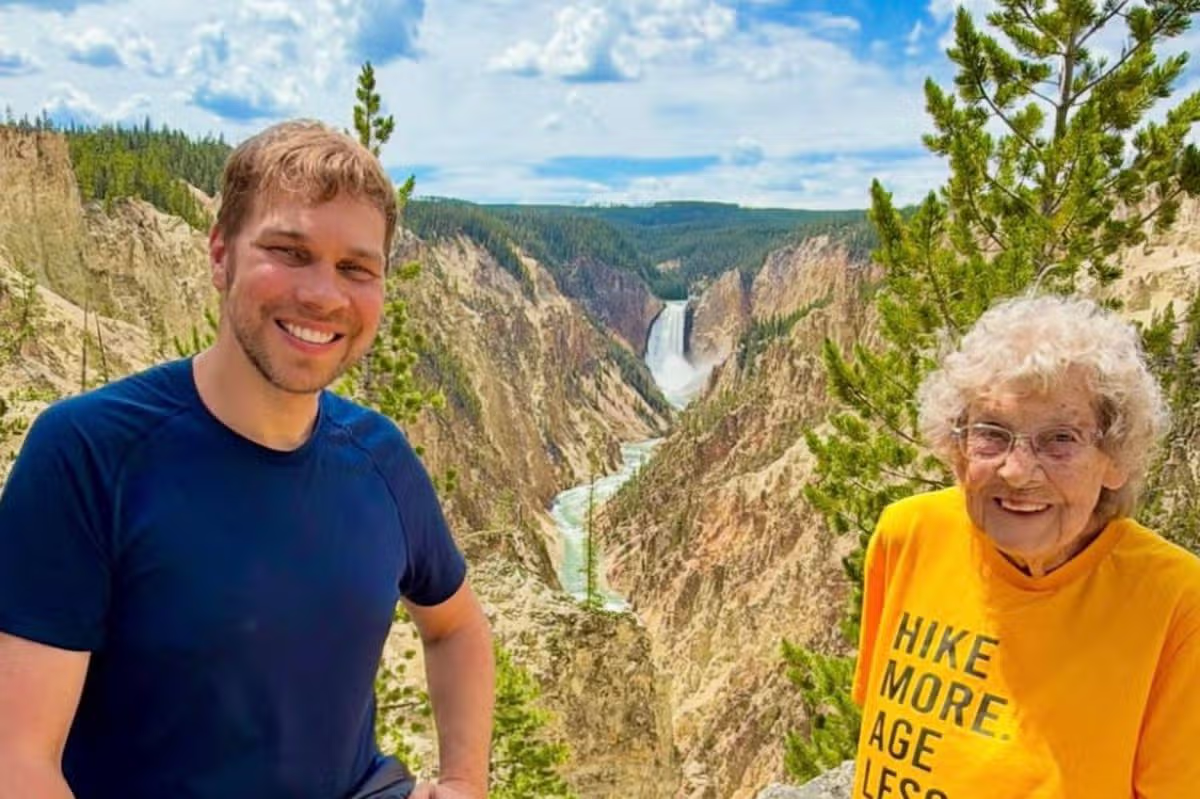
Joy Ryan, pictured with her grandson Brad, has visited six continents (Image: grandmajoysroadtrip/Instagram)
A 96-year-old grandmother who didn’t get her first passport until she was 91 has still found the time to visit six continents. Joy Ryan shared one of the biggest issues with long-haul travel in her advanced years as she has to follow strict doctor’s orders.
Since first travelling abroad, Joy has explored destinations including Kenya, the Galapagos Islands and Antarctica. But her adventures come with a health concern: long-haul flights increase the risk of blood clots, something she has experienced before.
Flights lasting more than four hours can increase the risk of deep vein thrombosis, with the risk rising further on journeys lasting more than eight to 10 hours. For Joy, following her doctor’s advice to keep moving is an important part of her travels.
The grandmother, from Duncan Falls, Ohio, USA, and her grandson Brad are set to visit Thailand, Australia and South Africa later this year.
Her passion for travel began long before she needed a passport. Joy had originally planned to see the world with her husband, but he died just months into his retirement in 1994.
Two decades passed before another opportunity arose. She hadn’t even seen a mountain before joining Brad on an overnight trip to the Great Smoky Mountains, along the Tennessee-North Carolina border.
Brad had been struggling with depression after starting vet school and hoped spending time in nature with his grandmother would help his mental health.
That overnight stay grew into a mission to visit every US national park. Along the way, Joy discovered her favourite destination: American Samoa.
The US territory in the South Pacific sits almost 5,000 miles from America’s west coast. Joy was determined to visit its national park, and got her first passport ahead of the trip, reports the Express.
Speaking to the Daily Telegraph, she said: “You just feel comfortable because everybody’s so friendly. They don’t have much, but they share it with you.
“They take care of their elders, too. There are no nursing home. They take them into their homes and keep them, and then, when they pass away, they bury them in the front yard so they’re still looking after them.”
Now 96, Joy says it is remarkable to witness how differently people communicate around the world, even when she cannot understand them.
The pair’s Instagram account, @grandmajoysroadtrip, has more than 115,000 followers. Joy shares their adventures there, along with dating advice.
Brad’s book Grandma Joy and Me: A Journey of Healing, One National Park at a Time was published earlier this year.
Jet2 passengers with flights before midday can check-in and drop off their luggage during a four-and-a-half hour window the day before their trip at 12 UK airports
09:26, 13 Sep 2026Updated 09:26, 13 Sep 2026
Jet2 passengers can drop their bags off the day before their flight at 12 airports (stock)(Image: Bloomberg via Getty Images)
Jet2 has confirmed a rule allowing passengers with flights before midday to check-in and drop off their luggage a day earlier.
Passengers usually have to arrive at their departure airport at least two hours before their flight and queue at check-in desks to get boarding passes before dropping off luggage.
However, Jet2 offers a twilight check-in service at 12 airports across the UK which allows passengers to bypass this process the night before, making morning departures less stressful.
Not only can passengers save valuable time on the day of their flight, they can also avoid having to wait in long check-in queues to drop off bags.
Jet2’s twilight check-in service is only available to passengers with flights due to depart before midday at the 12 airports listed below.
If you have an eligible flight, you can use the free twilight service within a four and a half hour window the evening before your morning flight and drop your bags off between 4.30pm and 9pm.
Passengers must also check-in for flights online any time from 28 days and no later than 24 hours before their flight via Jet2’s website or app.
Explaining how the service works, Jet2 said: “Check in online. You need to do this no later than 24 hours before your flight, but to make sure you don’t miss out, we recommend you check in as soon as online check-in opens, 28 days before you travel.
“Drop your bags at the airport. One person in your party can drop off up to six people’s bags. Simply take your luggage to the airport between 16:30-21:00 the evening before your flight. Don’t forget your boarding passes and passports!
“Sail straight through to security. On the morning of your flight, bypass check-in and head to security. Relax and enjoy your getaway!”
UK airports where Jet2’s twilight check-in is available
Boxer Fernando Vargas Jr. was arrested on suspicion of DUI following a multi-vehicle collision at a Universal Studios Hollywood parking lot, according to law enforcement and multiple media outlets.
California Highway Patrol responded to the incident on Thursday after receiving a call at 7:51 p.m.
CHP confirmed to The Times that one arrest was made at the scene for “suspicion of DUI.” No other injuries were reported at the scene.
Reports by KTLA confirmed that the 29-year-old was the individual arrested after officers observed “signs of alcohol impairment from Vargas” and conducted a DUI investigation.
Officers took him to the CHP Central Los Angeles Area office. The case will be submitted to the Los Angeles city attorney’s office for possible charges.
Hours before the arrest, Vargas posted a video to Instagram of himself and a woman inside a vehicle, who appeared to be in the passenger seat, TMZ reported.
The super welterweight boxer is the oldest son of two-time middleweight world champion Fernando Vargas. The famed Mexican American fighter from Oxnard — who at one point was the youngest U.S. national amateur champion — also faced legal troubles of his own for his role in a 1999 assault case.
Since fighting his first professional match in 2020, Vargas Jr. himself has built a steady record in the ring with 15 knockouts in 17 wins. His last bout was during the Canelo Alvarez-Terence Crawford card in September 2025, where he lost to Irish boxer Callum Walsh.
Gaza City, Gaza Strip – For more than four hours, Hajj Rabhi al-Fairi, 79, has been standing outside his home in Gaza City with his children and neighbours waiting their turn to use a small generator.
The generator’s owner pours in the fuel, starts a timer and switches on the machine.
Recommended Stories
list of 4 itemsend of list
Each family gets a few minutes to operate a pump that pushes water up to a storage tank on the roof, before the generator moves on to the next house.
For al-Fairi and his neighbours, this is how they get water.
“We have an old water pump, but there is no electricity to run it. We have to rent a generator,” al-Fairi tells Al Jazeera.
Since the family returned to their home in October 2025, after fleeing a month earlier during Israel’s assault on their neighbourhood, the generator has become a familiar sight on the streets of Nassr.
When it arrives, residents gather around it, each carrying a jerrycan of diesel to operate the machine, which they have to pay for themselves.
“We came back and found the place a tragedy,” he says.
Their neighbourhood and home were badly damaged from years of Israeli bombing, with no municipal electricity or water supplies functioning. The family depends on an old pump – but without electricity, it cannot bring water up to the rooftop tank.
Each family needs only about seven or eight minutes to fill up their tanks, but with the number of flats in their building, the generator needs to be rented for about an hour.
The cost has also risen. Al-Rabhi says families used to pay about 80 to 90 shekels ($26-30) to rent a generator for an hour. At different times, the price has risen to about 100 or 120 shekels ($33-40) an hour, excluding the cost of diesel.
A generator passes through a northern Gaza neighbourhood [Abdelhakim Abu Riash/Al Jazeera]
A generator on wheels
Khalil Abu Ouda, 39, takes a machine mounted on a horse-driven cart from one house to another. The generator’s metal body is covered in black soot and grease, and white smoke rises from the engine when it operates.
At each house, Abu Ouda connects long electrical cables to the water pump. The cables stretch across the street as neighbours gather around the machine to wait their turn.
“Go on, switch it on,” someone calls.
For Abu Ouda, this machine is both a service for the neighbourhood and an essential source of income for his family.
He says there are very few small, mobile generators, like his, left in working condition in Gaza. Many have broken down, while spare parts are difficult to find or too expensive to source due to Israel’s siege.
Mechanics are also expensive to hire, while fuel and engine oil are increasingly scarce and costly.
“If I could, I would lower the price as much as possible,” he says.
At the same time, demand has never been higher.
“People are under pressure and they need water. If I stayed working until morning, I would keep working,” Abu Ouda says.
To cope with the demand, he often works for 10 to 12 hours a day, putting pressure on himself and the machine.
“But this is our livelihood. There is no alternative,” he said.
When the home stops providing
With most Palestinians in Gaza having no home or losing their possessions due to Israel’s genocidal war on Gaza, they have to rent or hire items or services for the most basic household chores.
This includes washing clothes, something once done at home but now impossible to do with no power.
Earlier in the war, Abeer Ghorab, 52, used to wash everything herself. Now she gathers clothes from her tent and takes them to a nearby laundry, where they can be washed and dried in far less time and with less effort.
“When these laundries started opening, they gave us some relief,” Ghorab said.
The difference is particularly important in winter, when heavy clothes, blankets and bedding can take time to dry.
“In winter, the tracksuits are heavy. They need another day to dry,” she said. “When I bring them here, they wash and dry them for me, and I get them back clean and dry. That really helps.”
Abeer Ghorab, 52, a displaced Palestinian woman, takes her clothes to a commercial laundry, paying to wash and dry them as water and electricity remain scarce [Abdelhakim Abu Riash/Al Jazeera]
But due to a limited income, Ghorab cannot afford to use this laundry service every day.
Before the war, Ghorab had a washing machine, a refrigerator and regular electricity at home.
“Things we once took for granted have become dreams. Now we have to pay for every little thing we used to do at home.”
The loss of the household
Across Gaza, the infrastructure that once allowed families to carry out everyday tasks at home has been severely disrupted.
A recent United Nations assessment found that 91 percent of surveyed households experienced moderate-to-high water shortages in early August.
A separate damage assessment by the authority found that 107,941 of the 178,632 housing units inspected – about 60 percent – were severely damaged, destroyed or otherwise considered uninhabitable.
Water systems, electricity, sanitation and household appliances, which families relied on to manage daily life, have also been disrupted.
For families living in damaged homes, tents or makeshift shelters, everyday tasks must be paid for.
A laundry adapting to shortages
Fadi Abu Shawarb, 23, has worked at his family’s al-Hurriya laundry for six years.
Residents now rely on communal washing machines for cleaning clothes [Abdelhakim Abu Riash/Al Jazeera]
Before the war, the business relied on large, 50kg (110lb) washing machines for carpets, blankets and other heavy loads. But due to the high cost of operation, these machines are far too expensive to run.
“We started replacing the 50kg machines with 25kg ones because there is not enough electricity,” Fadi says. “There are no solar panels, no reliable power, and the generators are always breaking down.”
Most of his customers are displaced families who lack electricity, water or washing machines at home.
The laundry now handles about 20 to 30 loads a day, with clothes-washing among the most in-demand services.
A load costs six shekels ($2) when the laundry can use solar power and 12 shekels ($4) when it relies on a generator.
But even that is hard for people to pay. “People’s situation is difficult,” he says.
For Ghorab, the laundry is only one of the many expenses she now has to budget for.
“I feel like I’m going through a difficult time,” she says. “I have to pay for every little thing in my day, and with how difficult things are, it’s hard to keep up with everything.”
Sure, the U.S. tennis star advanced to his second U.S. Open semifinal in epic fashion, knocking off defending champion Carlos Alcaraz in a five-set marathon that did not end until 3:33 a.m. ET Wednesday.
It was during his on-court interview afterward, however, that Shelton committed a bit of a faux pas while discussing the match that ended later than any other in tournament history.
“I’m just hoping that my best friend and my sister over there don’t have to be at work at 6 a.m. in three hours,” Shelton said following the 6-7 (5), 6-1, 6-3, 1-6, 7-6 (10-7) victory. “It’d be huge from their employers to let them have the day off today.”
Shelton certainly didn’t have to give a shout out to two of his loved ones for hanging in there for the entire 4 hours 28 minutes … but since he did, there’s one other person Shelton probably should have mentioned as well: soccer star Trinity Rodman, who also was sitting courtside throughout the match. TV cameras showed her laughing and apparently saying, “What about me?”
Shelton and Rodman have been dating for more than a year, after going Instagram official in May 2025. They are seen in the stands at each other’s sporting events when their schedules allow.
For the record, Rodman apparently did have to work hours later. The U.S. national team and Washington Spirit player posted a video later Wednesday morning on TikTok that showed her inside a gym with the caption, “Yes, I’m at training now.”
She doesn’t seem to hold a grudge over her boyfriend’s omission, though. Rodman posted a video on her Instagram Story of the match’s aftermath, with the caption, “The moment belongs to Shelton!”
And Shelton actually did include Rodman in that moment, with the two of them making eye contact and flashing his signature “dialed-in” hand motion to each other as he celebrated.
Rodman’s schedule with the Spirit hasn’t allowed her to attend all of Shelton’s matches at Flushing Meadows, but she has been to at least three. For his Round 2 victory against Hubert Hurkacz, Rodman wore a black crop top that read, “I ❤️ my boyfriend.”
For the quarterfinal, Rodman carried a Shelton figurine, possibly as a good luck charm.
Shelton will face fellow U.S. player Frances Tiafoe in Friday’s semifinals.
1.Palm Canyon Drive.(Christopher Reynolds / Los Angeles Times)2.A metal sculpture of a serpent by artist Richard Breceda.(Luis Sinco / Los Angeles Times)
This lonely San Diego County desert town, about 50 miles from the nearest Starbucks, deserves the attention of anyone who really wants peace and quiet. It’s home to perhaps 4,000 year-round residents, star-struck by night, startling at dawn, surrounded by the largest state park in California, Anza-Borrego Desert State Park.
Dark skies, aimless days and spring wildflowers draw many people. But fall visitors can hike the park’s Borrego Palm Canyon Trail (3 miles round trip) or the narrow canyon known as The Slot. Keep an eye out for bighorn sheep and dozens of metal artworks by sculptor Ricardo Breceda scattered around town, especially the 350-foot-long sea serpent (along Borrego Springs Road), which has become a community mascot.
Check out: The town’s biggest party of the year, Borrego Days, is coming Oct. 17-18. And its seasonal Farmers Market returns to Christmas Circle Community Park on Nov. 6.
Distance: A 4-hour drive from L.A. (154 miles from L.A. City Hall, via Google Maps).
TELLURIDE, Colo. — Standing ovations at film festivals are a rite: part appreciation, part obligation, part a need to stretch your legs after sitting for a couple of hours.
But for an audience to explode and roar their approval in the middle of a movie? That rarely, if ever, happens.
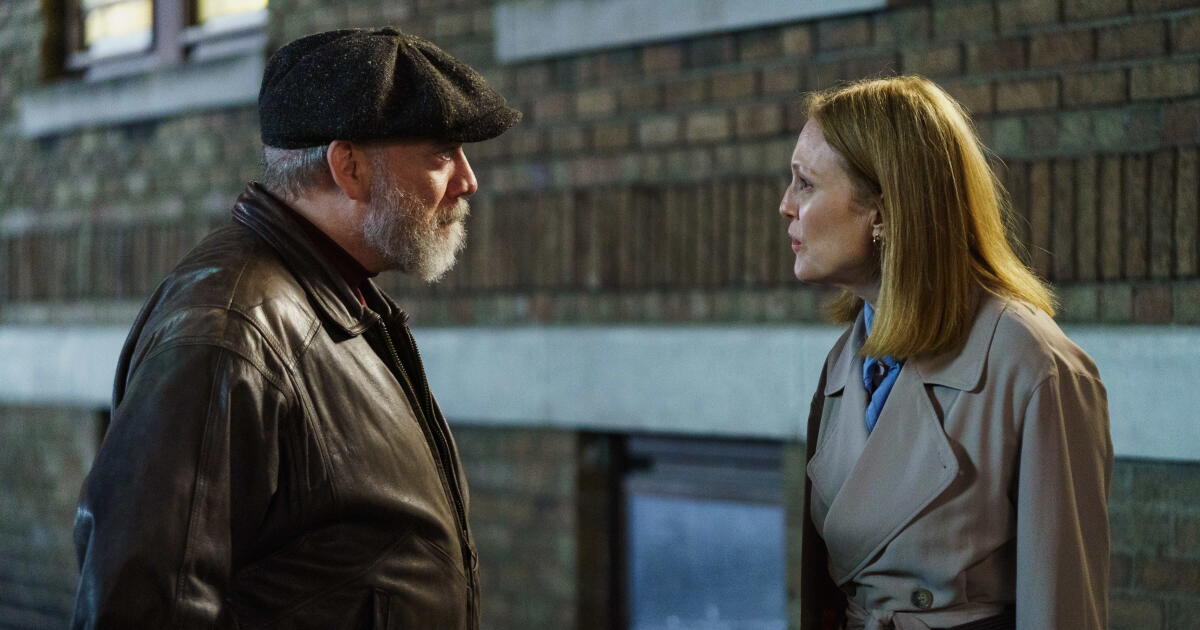
Except it did, midway through the Telluride Film Festival world premiere of Jesse Eisenberg‘s delightful comedy “The Debut.” The applause followed a scene between Julianne Moore and Paul Giamatti that took its audience on such an exhilarating journey that there was almost no choice but to cheer in admiration, as if to say: What did we just see?
Sitting in the theater, Eisenberg, producer Emma Stone and Paul Giamatti looked at each other and asked themselves the same question but for a different reason.
“It was hard to process and, at the same time, just so affirming,” Eisenberg told me a couple of hours after the premiere.
The next day, sitting down to grab a quick bite with Moore and Giamatti, that giddy feeling had not dissipated, though, truth be told, they knew this scene was an all-timer from the moment they read it.
Let’s set the stage for you in a way that won’t spoil this constantly surprising film when it arrives in theaters in December and starts piling up acclaim and awards for all concerned.
Moore plays Mona, a meek, thoroughly unseen wife and mother who impulsively decides to audition for a community theater production of a musical titled “Nosy Neighbors,” despite having no experience apart from singing in the church choir when she was 13. The director Jerry (Giamatti) cuts her tryout short, sending her home, only to relent when the woman he’d already cast (Bernadette Peters!) drops out and he has nowhere else to turn.
Mona is, as Moore puts it, a “nice lady.” But she’s not a natural performer. She can’t get into character playing Miss Danielle, the show’s tough, toolbelt-wearing building super. So Jerry takes Mona aside because that’s what he does. As her cast mates note, “He’s going to drag you through the s— and the mud and you have to be ready for the s— and the mud.”
It turns out, though, that Jerry is the one who isn’t ready for what’s about to happen. Sitting in a chair on the theater stage, Jerry holds an envelope containing cash, telling Mona that it’s her job to make him hand over the rent. It’s an acting-class exercise designed to make you listen, react and dig into your character’s truth. Moore begins with a whisper and builds to a roar as Mona improvises a manic rant that involves rats and the plague.
Suffice to say, Jerry hands over the rent.
“When I read that scene, I stood up, put my iPad down and started doing laps around my dining room table,” Moore remembers. “I couldn’t believe how beautiful it was. I was just like, ‘Oh my God!Aaaaaaagh!‘”
“It was five pages long,” Giamatti marvels. “Jerry just needs Mona to be better. And then he sees that maybe she could actually be kind of great. He cracks her open and he’s like, ‘Oh wow, who is this lady? Who the hell is this?’ The funny thing about that scene is s— like that happens in classes.” He turns to Moore. “Did that ever happen to you?”
“I had an audition for a university, actually, where they threw chairs in front of me while I did the monologue and made me climb over the chairs,” Moore says, laughing. “I look back on that now. I was 18 years old and I was like, “What?’ Yeah. It was really strange. They’re trying to get you to react authentically and be alive.”
She smiles at Giamatti. “Hopefully when you get to be our age, you don’t need that.”
Though the scene has Mona improvising, it was performed as written, down to every last pause.
“Everyone keeps asking if we improvised and I’m like, ‘Hell, no,’” Moore says. “Jesse’s like the Coens. Everything’s there on the page.”
Adds Giamatti, “It’s incredibly specific. You follow his punctuation. The commas matter in his writing.”
“What’s so f—ing delightful about about working with Paul is that his sense of timing and rhythm is so tight,” Moore continues. “That scene is a set piece that requires you to work in tandem and you need somebody to hit it back with the same intensity and the same speed.”
When Eisenberg first met Moore, he told her flat-out, “I don’t want you to worry about this scene.” He knew it was a bear, with pages and pages of lines, so he told her he’d have a teleprompter on set.
“That section, all that crazy s— she goes off on, that would be really hard,” Giamatti says.
“And I was like, ‘Phew, that’s fantastic,’ because I knew all I would do would be to worry about all those lines and be so scared,” Moore says. “But because he said that to me, I never worried. And I didn’t need the teleprompter.”
They shot the scene in one morning, just Moore and Giamatti alone on the stage with the rest of the crew downstairs in the video village. There was an energy on set, spiked by an unusual number of visitors (“People knew,” Giamatti says) and then they went to work.
“I remember the first time you really hit that speech and they called cut, I just couldn’t stop grinning,” Giamatti tells Moore. “And I reached out and just kind of held you for a second because I was like, ‘That was amazing.’ I wanted to convey just how great it was, what you were doing.”
Moore beams. “I just love him. Just love him, love him, love him. I have so much gratitude for Paul.”
“To watch you be a bad actor was so hilarious and then you would you would modulate it and change it,” Giamatti continues. “Watching her was the experience that Jerry was having. It was such a joy.”
The scene is the beginning of a simpatico relationship between Jerry and Mona, mentor and protege, predicated on the power of imagination and how it can make outcasts feel seen and heard.
“Everyone wants to be known as who we are, even though it’s so scary for us to really reveal it,” Moore says. “There’s a real mind-altering power in just being yourself.”
BRITS are facing huge queues and delayed trains after an operational issue has caused problems at the border.
Le Shuttle – previously called Eurotunnel Le Shuttle – has warned passengers not to arrive early in Folkestone for their train.
Passengers are being forced to wait hours for their trains due to ongoing Le Shuttle issuesCredit: PA
This is due to huge ongoing delays.
In a statement, they said: “Due to an operational issue, you may experience longer waiting times than usual.
Sign up for the Travel newsletter
Thank you!
“Please do not arrive more than two hours before your booked departure.”
The website warns of departure delays of approximately four hours from Folkestone to Calais, while the return Calais to Folkestone has delays of three hours.
However on the website, a 11:24am departure from Folkestone to Calais has now been scheduled for 4:45pm, with this having a knock on effect for the rest of the departures today.
The latest update on the website is for the 3:24pm departure which will now leave at 6:45pm.
A Calais to Folkestone train scheduled for 4:36pm is now set to depart at 7:51pm.
According to local media, one traveller said their train was delayed by 3.5 hours.
Another wrote on social media: “I am on my way to the terminal for a train at 8:24.
“You are running 4.5h late! How can I cancel my trip and get a full refund?”
A third said there were “hundreds of delayed people waiting to board”.
It isn’t clear what has caused the issue or when it will be fixed.















![A generator passes through a northern Gaza neighbourhood [Abdelhakim Abu Riash/ Al Jazeera]](https://i0.wp.com/occasionaldigest.com/wp-content/uploads/2026/09/873A2309-copy-1789208507.jpg?w=640&ssl=1)
![Abeer Ghorab, 52, a displaced Palestinian woman, takes her clothes to a commercial laundry, paying to wash and dry them as water and electricity remain scarce. [Abdelhakim Abu Riash/ Al Jazeera]](https://i0.wp.com/occasionaldigest.com/wp-content/uploads/2026/09/873A2195-copy-1789208594.jpg?w=640&ssl=1)
![Residents wait for a mobile generator to reach their homes so they can pump water, paying by the hour to use the machine [Abdelhakim Abu Riash/ Al Jazeera]](https://i0.wp.com/occasionaldigest.com/wp-content/uploads/2026/09/873A1950-copy-1789208427.jpg?w=640&ssl=1)