hotter

When Paris is hotter than Mecca: How Europe’s heatwave compares globally | Climate Crisis News

Paris and other European cities are experiencing temperatures above 40C (104F), reaching levels normally seen across the Middle East.

A blistering heatwave has gripped much of Europe, prompting the highest-level red alerts in parts of the United Kingdom, France, Spain and Italy.

Authorities have warned of health risks, wildfires and travel disruptions as extreme temperatures persist.

Recommended Stories

list of 3 itemsend of list

With temperatures approaching record highs, officials have taken emergency measures, including a localised alcohol ban in parts of France under red alert, nationwide heat warnings in Germany and the cancellation of a World Cup fan zone screening in Madrid, where temperatures hit 39C (102F).

Why is it so hot in Europe?

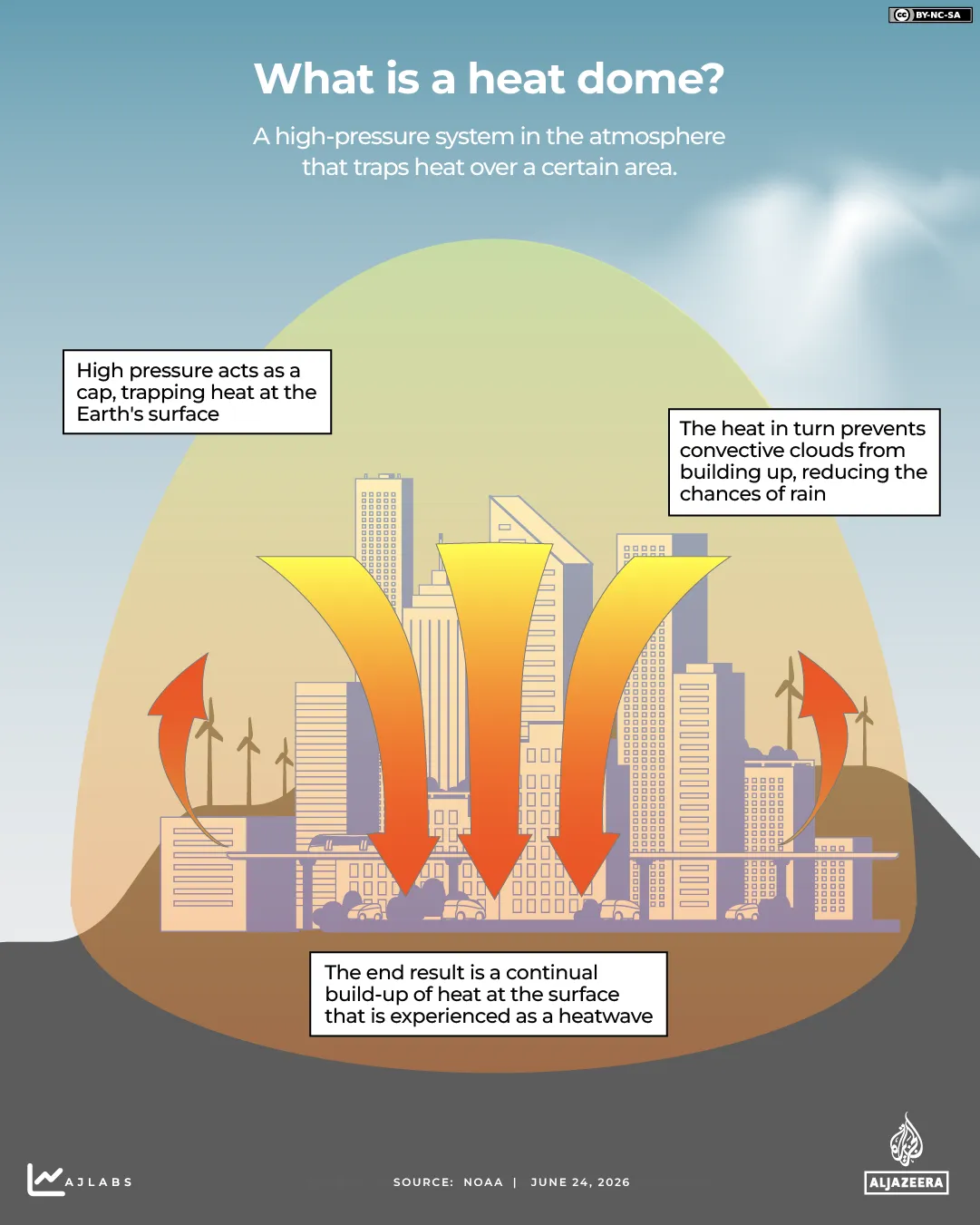
A persistent area of high pressure, known as a heat dome, has trapped hot air over Western Europe, bringing clear skies, weak winds and prolonged sunshine. Hot air moving north from North Africa has added to the extreme temperatures.

interactive- Heat dome-june24-2026-1782302509
(Al Jazeera)

Unusually warm seas around the UK, Ireland, France and the western Mediterranean have also helped keep coastal areas hot, especially at night. Coastal waters around Spain have reached record warm levels, according to Spain’s port authority.

In the worst-affected areas – western France, England and Wales – daily average temperatures have soared more than 12C above the 1991-2020 baseline, according to Copernicus data.

interactive-Europe is hotter than usual -june24-2026 copy-1782302382
(Al Jazeera)

Scientists say the early-season heatwave is part of a broader warming trend. Europe is the world’s fastest-warming continent, with temperatures rising by approximately 0.56C per decade since the mid-1990s, more than double the global average.

Climate change is making heatwaves more frequent, more intense and likely to occur earlier and later in the year.

How hot are European cities today?

To contextualise the temperatures Europe is dealing with, Al Jazeera looked at the maximum temperatures in five European capitals on June 24 and compared them with cities across the Middle East, North Africa and Asia, where high temperatures are more typically experienced.

Europe is particularly vulnerable – much of its housing and infrastructure was not built for prolonged extreme heat, and only about 20 percent of European homes have air conditioning.

The graphic below shows how European cities’ maximum temperatures today compare with some other cities around the world:

interactive-How hot are European cities today-june24-2026 -1782302387
(Al Jazeera)

How is temperature measured?

The temperature you see on the news or the weather app on your phone relies on a network of weather stations positioned around the globe.

To ensure accurate readings, weather stations typically use specialist platinum resistance thermometers placed inside shaded instruments known as a Stevenson screen.

Measurements are taken at a standard height of 1.25-2 metres (4-6.5 feet) above the ground. This provides a reading that reflects the air temperature that people actually feel.

INTERACTIVE How temperature is measured-1782301089
(Al Jazeera)

There are two well-known scales used to measure temperature: Celsius and Fahrenheit.

Only a few countries, including the United States, use Fahrenheit as their official scale. Most of the world uses the Celsius scale, named after Swedish astronomer Anders Celsius, who invented the 0-100 degree freezing and boiling point scale, although originally inverted, in 1742.

Why does the temperature feel hotter than the forecast says?

Air temperature alone often doesn’t match how hot it feels to your body. That is why forecasts report a “feels like” temperature, which adjusts air temperature based on factors like humidity, wind speed and sun exposure.

INTERACTIVE Why does the temperature feel hotter than the forecast says-1782301086
(Al Jazeera)

Humidity

Humidity measures how much water vapour is in the air. This moisture slows the evaporation of sweat, so your body can’t cool itself as effectively.

Wind speed

In hot weather, a light breeze can help evaporate sweat, making it feel cooler.

Sun exposure

Even if the thermometer reads the same, direct sunlight adds extra warmth, which is why shaded areas feel cooler.

Source link

UK is hotter than Ibiza – this English beach will transport you to the party island

Right now, the White Island is 30C, whereas parts of the UK could reach 40C this week. Now seems like the perfect time to head to the beach for a little cooling dip

As everyone who’s been to Ibiza likes to tell you, the Balearic island is more than just Pacha, 50 euro glasses of Prosecco, and ecstasy tabs. It’s also very pretty.

Ibiza’s coast is defined by turquoise waters, dramatic pine-forested cliffs and hidden sandy coves. The most visually stunning spots are scattered across the island, with top-rated options including the sunset views at Cala Comte, the lush nature of Cala Saladeta, and the iconic rock formations at Cala d’Hort.

Right now, the White Island is 30C, whereas parts of the UK could reach 40C this week.

In Cornwall, the thermometer is bopping around the mark, making a trip to the coast a tempting prospect. Happily, there is a beach that shares many of the qualities of those on the comparatively chilly Ibiza.

It sits beneath towering cliffs that shield it from the wind, with stunningly clear waters that prove ideal for swimming and snorkeling.

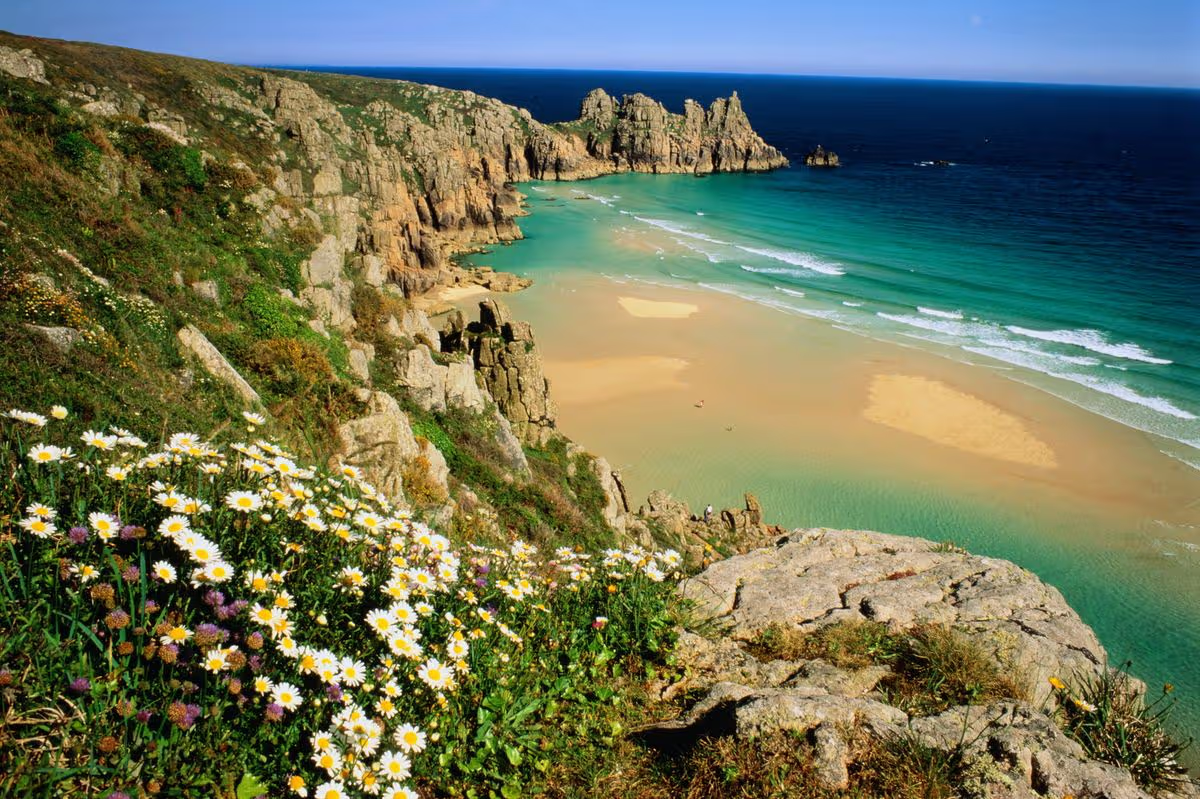
Porthcurno has pure white sand with gorgeous turquoise waters to match. It has the ability to transport you to paradise.

The sand is made up of seashells pounded to powder by the sea over millions of years, which is partly responsible for the beautiful colour of the water. Porthcurno’s south-facing direction, flanked by high headlands, provides natural shelter from the wind and weather, giving the beach its own near-microclimate. The towering cliffs on either side make it easy to find a sheltered spot even on the most blustery of days.

The renowned open-air Minack Theatre is carved into the cliffs above, meaning you can enjoy a Shakespeare play with a sea view.

The theatre was the vision of one woman who decided to carve a clifftop theatre at the bottom of her garden. It’s well worth the climb up the cliff path, if only for the view back down over the bay. You need to book tickets in advance for performances.

The best time to visit is mid to low tide. At low tide the beach widens dramatically, and you can walk to nearby Pedn Vounder. As the tide retreats from Pedn Vounder, a golden sandbar rises out of the turquoise sea creating a shallow lagoon pool. It’s visible for around two hours either side of low tide, according to Cornish Secrets Anywhere We Roam

In the late nineteenth century, Porthcurno became the British connection point of the world’s very first international telegraph cable, stretching all the way to India. In the inter-war period, the cable office briefly became the busiest telegraph station in the world, capable of transmitting up to two million words a day. The Porthcurno Telegraph Museum is right there and well worth a visit.

Driving is by far the easiest way to get to the beach, with public transport options sadly limited. It takes about 25 minutes from Penzance or 45 minutes from St Ives. The car park fills up quickly on peak days, so arrive early or late.

Dogs are banned from the beach between 15 May and 30 September, between 10am–6pm. RNLI lifeguards patrol from mid-May to the last weekend of September.

One visitor wrote on Tripadvisor the beach was “absolutely breathtaking. The most amazing beach beautiful white sand and turquoise sea. Breathtaking views and definitely one of the best beaches you will ever find.”

Another said: “Spent the day here, it’s just like being abroad, clear blue skies water, perfect sandy beach and so peaceful. No arcades, no boats, no noise, just gorgeous.”

Source link