hostile

‘Hostile, but hooked’: What’s behind the US-China trade truce extension? | Trade War

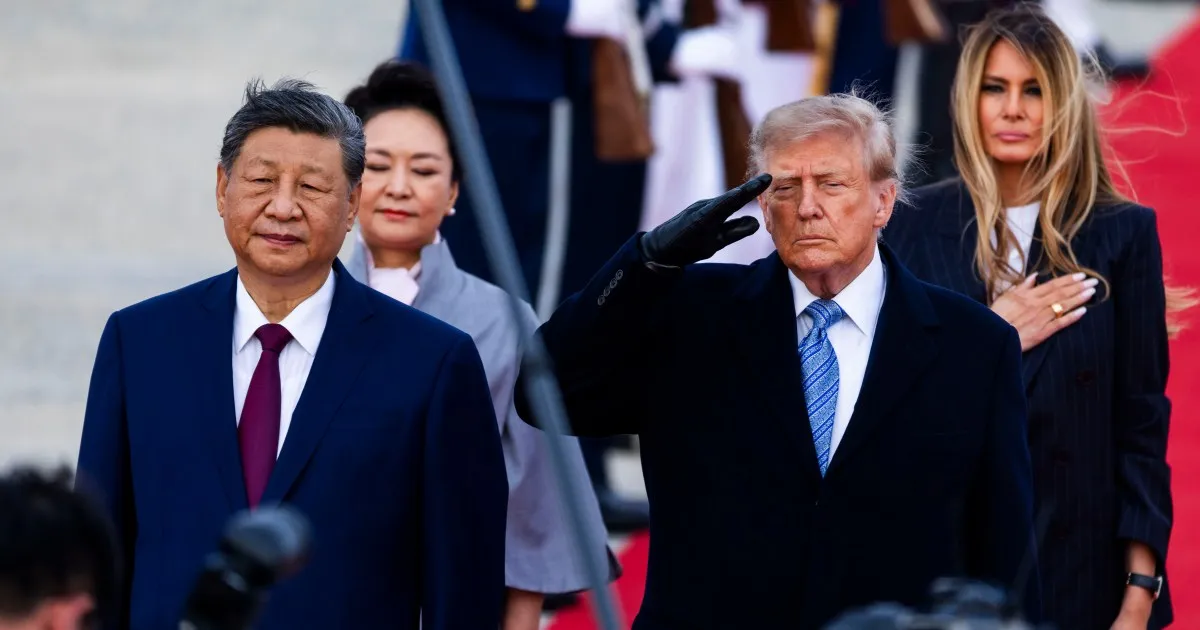
The red carpet was rolled out, and a trade truce was extended. Yet, beneath the pomp and pageantry of Chinese President Xi Jinping’s state visit with US leader Donald Trump on Thursday, Washington and Beijing remain locked in a much deeper strategic rivalry.

Xi arrived in Washington, DC on Wednesday evening for talks on Thursday, and Trump was there to meet him personally on the tarmac.

Recommended Stories

list of 4 itemsend of list

The meeting was the first state visit by a Chinese leader to the US in 11 years. But it is also the third time in less than a year that the two men have met face to face, as the two powers remain uneasily gridlocked in competition over AI, rare-earth metals, the question of Taiwan, and the Iran war.

Overhanging it all is the paused, but simmering, trade war between their two nations.

Almost as soon as Trump began his second term in the White House in January 2025, up went tariffs on Chinese goods as he accused China of facilitating the flow of fentanyl, a deadly drug, to the US. Beijing responded with its own levies, then restricted exports of valuable rare-earth metals which are crucial for the development and manufacture of everything high-tech, from smartphones to fighter jets. At one point, tariffs were heading towards 150 percent before being paused to allow time for talks.

Finally, the two leaders called a truce on the sidelines of the Asia-Pacific Economic Cooperation (APEC) summit in South Korea on October 30, and they met once more, in May, when Trump travelled to Beijing.

As Xi landed in Washington on Wednesday this week, the Trump administration announced that the two countries had agreed to extend an October 2025 truce which had offered some respite from the punishing tariffs, produced an agreement from China to buy more soyabeans from the US and delayed the ban on rare-earth exports from China until January 10. The prospect of a much-longed-for trade deal appeared to be in the air when US Treasury Secretary Scott Bessent told Fox News he had met Chinese ‌Vice Premier He Lifeng before Xi’s visit to “see if we could ⁠do a bigger deal as opposed to just a series ⁠of smaller things”.

But analysts have, for the most part, shot down such hopes. Beyond tariffs, they say, the simmering conflict between the two powers now encompasses new US sanctions on buyers of Russian oil – namely China – and sweeping investment and research restrictions, never mind the intensifying race for dominance in artificial intelligence.

“The two-month extension isn’t a bridge to a grand bargain – it’s a temporary sandbag holding back a structural flood,” Beijing-based Einar Tangen, a senior fellow at the Center for International Governance Innovation, told Al Jazeera.

Theatrics or continued thaw in tensions?

In fact, the truce is little more than “transactional theatre” – an attempt at good optics before the upcoming US midterm elections – Tangen said.

Trump’s deeply unpopular war on Iran has already inflicted severe damage to his chances in that vote. Democrats are leading in the polls amid concerns about the rising cost of energy, triggered by the war which the US started. Trump ultimately needs wins on other issues.

The current truce with China serves a purpose, therefore, but is fragile enough to be undone the moment political utility shifts for Trump, Tangen said.

“Success in January won’t be measured by what is solved, but by whether the knot is left tight enough to hold, but not kill,” said Tangen.

Phillippe Le Corre, professor of international relations and Asian studies at France’s ESSEC Business School, said the length of the truce extension indicates clearly that a more permanent deal remains out of grasp.

“The extensions are getting shorter and shorter, which means they haven’t found a common ground on many issues,” Le Corre told Al Jazeera.

“The two-month extension is a terrible outcome for the US. Nothing is resolved, and many Damocles’ swords are still hanging over Washington’s head,” he added.

Trump’s entire China policy, Le Corre argued, is in fact short-sighted. “That is bringing the world a lot of uncertainty,” he said.

Some analysts are more hopeful, but not much. Sun Chenghao, a fellow at the Center for International Security and Strategy at Tsinghua University in Beijing, described the extension of the trade truce as a “useful interim step”. It shows that both sides want to preserve the recent easing of tensions, which is meaningful progress, he said.

“From China’s perspective, a sustainable agreement needs reciprocal benefits and greater policy predictability,” Sun told Al Jazeera. “Additional purchases cannot indefinitely compensate for uncertainty over tariffs, technology restrictions and market access.”

The extension’s value, however, will depend on whether it produces “concrete commitments” from Beijing and Washington, Sun added.

A game of ‘economic chicken’

There is motivation to get a deal done, analysts say. Any escalation in the US-China trade war will be costly for both sides.

But there is some way to go. A Congressional Research Service report in July 2026 noted that Chinese goods exported to the US still face tariffs of 36.5 percent, while US goods entering China are taxed at 31 percent.

Any higher, and they will raise import and manufacturing costs in the US, squeeze margins and increase pressure on consumer prices, said Sun. They would also hurt US farmers and industrial exporters, he added, just as the US faces pressure from the rising costs of its war on Iran, which have pushed it into a record national debt of $40 trillion two years earlier than expected.

“Washington is playing a high-stakes game of economic chicken with a $40 trillion debt load, an inflationary sword of Damocles, zero fiscal cushion to absorb a truce collapse and a dependence [on] Chinese industrial and manufacturing inputs,” Tangen said.

US consumers and the economy in general will find it tough to survive yet another inflationary shock from renewed tariffs “at a time when the federal budget already operates like a high-wire Ponzi scheme”.

Then there is the AI race, which no one can afford to lose. According to Jon Bateman, a senior fellow at the Carnegie Endowment for International Peace, a partial “decoupling” of US and Chinese technology ecosystems is under way. US policymakers have pushed to become less dependent on Chinese tech and “to secure America’s technological future in the context of a rising China”, Bateman writes.

But that will not help if there is a collapse in valuations of companies in the AI sector, which currently drive global stock markets. An AI valuation collapse, Tangen warned, “could trigger a financial tsunami that makes 2008 look tame – making technological decoupling meaningless as the world is plunged into a depression”.

Despite the trade war and Trump’s tariffs, China’s trade with other countries has risen sharply, with the country registering a $1.2 trillion global trade surplus last year. But an escalation of the trade war with the US would nevertheless spell increased pressure on export orders, employment in exposed industries and business confidence, said Sun.

Beijing does hold one crucial ace card – it is sitting on 60 percent of the world’s known deposits of rare-earth minerals, said Le Corre. It processes 90 percent of them, too. These are the metals that all countries need supplies of for semiconductors, technological components and the manufacture of weapons, to name but a few. Last year, China began to make use of that leverage by restricting exports of five of the 12 rare-earth metals it mines in April. Then, in October, it prepared to restrict seven more – until the trade truce happened. Plans for the export restrictions are not shelved, however, merely on hold.

“[China] understood this over the past year and they are certainly not going to give up on this,” said Le Corre.

“Washington is hostile, but it is hooked,” Tangen said. “You cannot threaten China with secondary sanctions on energy while desperately needing its rare-earths to fuel your military-industrial base.”

A drawn-out path to durability

The path to a lasting US-China trade deal will be long and rocky. First, any new tariff reductions will need more coverage and duration, said Sun.

For a deal to last, it would also require “more predictable licensing and actual deliveries of rare earths and critical minerals; restraint in expanding technology restrictions; and market access reflected in regulatory approvals and completed transactions”, he said.

A durable agreement also needs regular consultations and a process for resolving complaints. If all this can be hammered out then, just maybe, there might be a chance, Sun said.

Tangen and Le Corre were less optimistic, however. “The US view of China as an existential threat has to change before there can be solutions,” said Tangen.

Le Corre, meanwhile, said that while China is a long-term planner, “durable is a word that can hardly be associated with Trump.”

The existing trade truce also risks breaking down if there are new unilateral tariffs, broader technology or mineral restrictions, or disputes over whether commitments have been fulfilled, said Sun.

Tensions over Taiwan, which China claims as its own territory, but for which the US approved an $11.1bn arms sale in December last year, could also trigger a breakdown in trade relations, the analysts said.

“Taiwan remains the ultimate low-probability, catastrophic-impact tail risk – where a single round of arms sales can snap a multibillion-dollar trade truce in an instant,” Tangen noted.
Source link

Arab News | Trump threatens EU over ‘hostile’ Canada association plan

WASHINGTON: US President Donald Trump threatened on Wednesday to cut trade with the European Union after the bloc proposed to make Canada its first ever associate member.

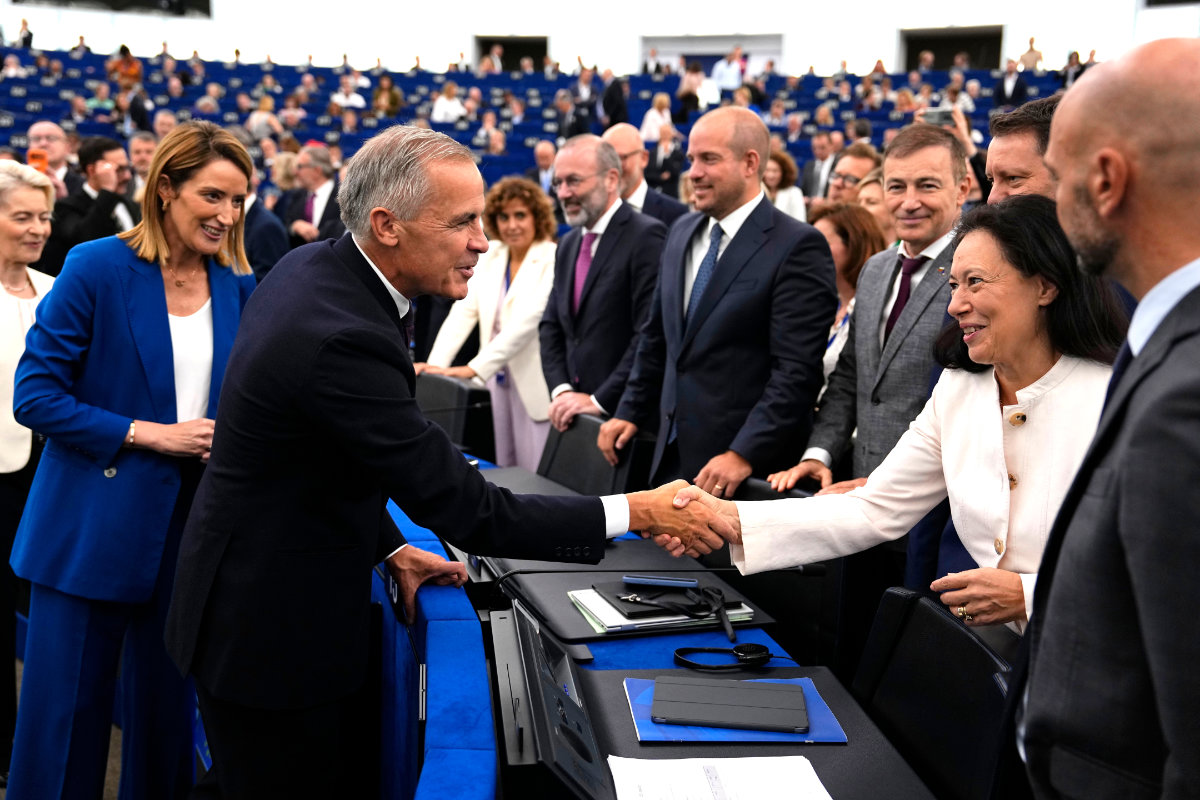
EU chief Ursula von der Leyen raised the prospect a day before Canadian leader Mark Carney was due to address the European Parliament.

Her pitch comes as both Canada and the European Union seek to pivot away from an aggressive United States under Trump’s leadership.

“I think it’s laughable,” Trump told reporters when asked about the plan.

“If they do that, if I think it’s at all a hostile act, I will put very serious tariffs or stop trading with Europe, on many things.”

He added: “If it’s a good intention, that’s fine. If it’s a bad intention, we’ll put very heavy tariffs on Europe, which is a possibility.”

Von der Leyen pitched closer cooperation on tech, defense and energy to Carney, who became the first non-European head of government to attend the annual “State of the European Union” speech.

The German told the European Parliament in Strasbourg that, as democracies face a “fracture in the international rules-based system,” Brussels and Ottawa needed to pull closer together.

“I would like to work with you on opening the door for Canada to be the first associate member of the EU,” von der Leyen told the Canadian premier, drawing a standing ovation in the chamber.

A broader alliance

Carney has been pursuing closer ties with the European Union as Canada gets drawn ever deeper into a trade war with the United States.

He is set to address the parliament on Thursday, with his visit meant to act as a catalyst ahead of an EU-Canada summit in Montreal next month.

Von der Leyen said it was time to move from cooperation based on trade to a broader “alliance for the future” and “bring the relationship with Canada to the highest level possible.”

“We will work on intelligent manufacturing. We will create a tech alliance. We will integrate defense industrial bases. We will make the Arctic a flagship joint project,” she said.

She listed energy, critical minerals, batteries, AI, cyber and economic security as other fields of cooperation.

“This is a partnership not against anyone else, but for our common strength,” she said.

But both the EU and Canada have been buffeted by tariffs and territorial threats from the US and competition from China.

“In a more dangerous and divided world, Canada is forging stronger relationships with trusted partners,” Carney’s office said in a statement.

What’s in a name?

While EU treaties do not envision the possibility of becoming an “associate member,” the idea was first floated by German Chancellor Friedrich Merz this year for Ukraine.

Under that plan, which met a cold reception from a country pushing for full membership, Ukraine would have been allowed to attend the bloc’s summits and have a representative in the European Commission.

It would have also benefited from parts of the EU budget, but without full voting rights.

“We don’t really know yet what it means,” said Tobias Cremer, a center-left European lawmaker from Germany and the main sponsor of a resolution urging stronger EU-Canada cooperation, after von der Leyen’s “associate membership” pitch.

Under EU rules, member states have to approve any form of partnership with a third country and it was unclear how much support von der Leyen’s proposal would receive from capitals.

Brussels and Ottawa already enjoy a considerable level of cooperation.

The CETA free-trade agreement that abolished almost all tariffs has been credited with boosting trade in goods and services by more than 80 percent since 2016.

And this year Canada became the first non-EU country to join a flagship defense loan program.

Carney later flew to Britain for his first meeting with new UK Prime Minister Andy Burnham.

They attended a football match between Everton and Wolverhampton together before Carney’s return to Strasbourg for his Thursday speech.

Source link

Cisco accused of fostering a hostile workplace for Muslim and Arab employees | Business and Economy News

The United States Equal Employment Opportunity Commission (EEOC) has found that the networking technology company Cisco may have violated the civil rights of Middle Eastern and Muslim employees amid a wave of anti-Arab and anti-Muslim comments on internal messaging platforms at the company.

In June, the EEOC, which is tasked with enforcing the US’s anti-discrimination laws, said Cisco subjected its employees to a hostile work environment, according to a letter of determination obtained by Al Jazeera.

Recommended Stories

list of 4 itemsend of list

The letter, which was first reported by Politico Pro, stemmed from a complaint filed with the EEOC in December 2024 by a group of Cisco employees called “Bridge to Humanity” (B2H), who had been voicing concerns that the company’s technology was provided to the Israeli military for use in Israel’s genocidal war on Gaza.

Several months earlier, the group of employees had sent a separate open letter calling on the San Jose, California-based company to stop providing its technology to the Israeli government. The document was signed by more than 1,700 of the company’s more than 86,000 employees.

In its December complaint filed with the EEOC, the employees alleged that Cisco had removed the open letter from an internal site and that it was “under review”, and that subsequently, many of the signatories were harassed. Among the allegations was a remark that one employee had told another to “quit living”.

The employees also alleged that Cisco had not responded to their complaints until they created a 76-page report cataloguing the hate comments they had been subjected to in an internal messaging group called Connected Jewish Network.

The report, which was provided to Cisco’s Employee Relations and Ethics offices, according to documents made public by The Guardian, outlined the waves of hate comments. In one of these, from November 2023, an unnamed employee had said that “Israeli passersby killed 2 members of a Palestinian family in Jerusalem this morning, and I for one am extremely grateful.”

“These Cisconians have, among other things, repeatedly glorified violence, joked about sending people to their deaths, likened Palestinians and those with opposing viewpoints to animals, labeled Palestinians, Arabs, and Muslims as murderous, violent terrorists, joked about respecting a person’s gender identity,” the 76-page report said. It added that the Connected Jewish Network was not even a “safe space for all of our Jewish colleagues”.

The EEOC’s determination said that the company had retaliated against one unnamed staffer for “her involvement in pro-Palestine efforts by terminating the individual”.

‘Important step’

The employees’ complaint with the EEOC was filed by Legal Aid at Work, a nonprofit legal services organisation.

“The EEOC’s determination is particularly significant because it appears to be the first time in any legal context where a governmental or judicial finding has sided with Big Tech workers who have collectively organised to fight for corporate accountability around their employers’ sales of their technology to Israel,” Christopher Ho, director of the national origin and immigrants’ rights programme at Legal Aid at Work, told Al Jazeera.

Advocacy groups like the Council on American-Islamic Relations (CAIR) praised the decision.

“The EEOC’s finding is an important step toward accountability and a reminder that federal civil rights protections apply equally to Muslim, Arab, Palestinian, and other employees who speak out about Palestine,” civil rights managing lawyer Jeffrey Wang at CAIR’s San Francisco Bay-area chapter said in a statement.

“Employers have a legal responsibility to address harassment and discrimination fairly and consistently. Workers should not have to fear retaliation or a hostile work environment because of their religion, national origin, or association with protected communities.”

According to reporting by The Guardian, although the EEOC issues its determination in June, the agency’s mediation with the company has “not gone anywhere”.

Legal Aid at Work told Al Jazeera that it has also submitted a complaint against Cisco to the National Labor Relations Board (NLRB) and the California Labor Commissioner.

“[The complaints] allege, respectively, that Cisco unlawfully interfered with our clients’ federally protected right to engage in concerted activity to improve working conditions, and unlawfully interfered with their right to engage in political activities that is protected by the California Labor Code. Both these complaints are still pending at the respective agencies,” Ho said.

Al Jazeera reached out to the EEOC for comment.

“Under federal law, both charges filed with, and charge inquiries made to the EEOC are confidential. The EEOC can neither confirm nor deny the existence of any charge or charge inquiry,” an EEOC spokesperson said.

Cisco did not respond to Al Jazeera’s request for comment.

Source link

North Korea rejects U.S. ‘hostile’ policy, vows to bolster nukes

North Korea on Monday condemned the “hostile policy” of the United States and vowed to continue bolstering its nuclear arsenal. In this October 2025 photo, leader Kim Jong Un attends a military parade in Pyongyang. File Photo by KCNA/EPA

SEOUL, Aug. 31 (UPI) — North Korea on Monday condemned what it called the United States’ continued “hostile policy” and vowed to keep bolstering its nuclear arsenal despite U.S. President Donald Trump’s recent overtures to Pyongyang.

In a statement carried by the official Korean Central News Agency, a spokesperson for the Foreign Ministry accused Washington of maintaining a confrontational stance toward North Korea in both “rhetoric and behavior.”

“The Trump administration has thus fully reconfirmed its invariable hostile policy to wantonly violate the sovereignty, political system and security interests of the DPRK through the ‘denuclearization’ racket, ‘human rights’ smear campaign and military threat,” the statement said, using the official acronym for North Korea.

“It is pointless to expect any detente in the region,” it added.

The statement comes amid a push from Trump to restart direct diplomacy with North Korean leader Kim Jong Un, with whom the U.S. president has touted a “very good relationship.”

Earlier this month, Trump ordered Seoul and Washington to curtail their joint Ulchi Freedom Shield military exercise, citing its cost and saying the drills sent an “inappropriate and hostile” signal to Pyongyang. The exercise was subsequently shortened by almost a week.

Despite the move, the U.S. State Department last week reaffirmed its commitment to the “complete denuclearization” of North Korea in a statement to Yonhap News Agency.

The United States, South Korea and Japan also confirmed last week that their annual Freedom Edge trilateral military exercise will be held Sept. 7-11 in international waters east and south of South Korea’s Jeju Island.

The Foreign Ministry spokesperson called the multi-domain exercise a “threat to the DPRK and regional countries.”

North Korea routinely denounces joint military drills as rehearsals for an invasion and has carried out weapons tests around major allied exercises.

The spokesperson said North Korea’s nuclear status, which has been enshrined in its constitution, could not be “weakened nor diluted” by repeated U.S. calls for denuclearization.

“Our nukes serve as an absolute guarantee for defending its sovereignty and the nuclear weapons in possession of the DPRK and their sustained bolstering are the most responsible and correct option for ensuring regional peace and security,” the statement said.

“There is no change in our policy toward the U.S. to respond to its invariable hostile policy with the toughest stand to the last,” it added.

Source link