Is President Trump holding the Kennedy Center hostage? The allegation has been made at least twice, most recently by John F. Kennedy’s niece Kerry Kennedy, and earlier by Rep. Joyce Beatty (D-Ohio), an ex-officio member of the board, who has sued to keep Trump’s name off the building.
The Merriam-Webster dictionary defines “hostage” as, “a person taken by force to secure the taker’s demands.” Swap, “person” for the “Kennedy Center” and “taker” for “Trump,” and you have a pretty straightforward “yes.”
The ongoing Kennedy Center dumpster fire points to an unusual presidential obsession with the nation’s premier performing arts venue that dates back to Trump’s first term when he became the first sitting president in history to twice miss the annual Kennedy Center Honors.
In his second term, Trump turned that snub upside down by firing the board and strong-arming his way into being named chairman. If he expected to be welcomed into the arts community with open arms, he was gravely mistaken. His takeover resulted in a wave of high-profile cancellations that ultimately led to a massive dip in ticket sales. The exodus became even worse when the Trump-appointed board voted to add Trump’s name to the building late last year. The reaction, it seems, injured the president’s fragile ego and incurred his wrath.
By early February the president announced he would close the center for a two-year, $257-million renovation. Calling the historic venue “dilapidated,” Trump said he would be the one to restore it to glory. Behind the scenes another story was unfolding, and six months later the Washington Post reported that “ticket sales and fundraising collapsed” after Trump’s name was added to the building, “even as the center’s leaders publicly touted a financial turnaround.”
This week saw chaos at the venue that even the most seasoned journalists struggled to keep up with as the board voted to close the building on the same day that a federal judge upheld an order that Trump’s name could not be restored to its facade after he ordered it removed in late May.
Trump took to social media to decry the decision, threatening to withhold his support for the renovation and noting that the center could be “ripped down” if he wasn’t formally honored with his name on the building. Despite a preliminary injunction barring the venue from closing, people were kicked out of the building and barricades erected in the name of public safety that same day.
Those prone to hyperbole might be tempted to call this presidential tantrum disguised in procedural clothes a constitutional crisis. Or you could just say that Trump has taken the Kennedy Center hostage. The taker wants his name on the building, and the center will not be released for renovation or reopening if that doesn’t happen.
In the meantime an image of Trump on Air Force One was captured that shows him holding a large placard that reads, “Kennedy Center DEMO[LISHED],” leaving concerned parties to wonder just what exactly the chairman of the board has in mind. Is he using a Sharpie at this very moment to slash a line through the image at the center on that board, or is it just a prop to be trotted out in a cruel bit of future social media hazing?
Getting lost in all the drama: a beloved arts venue has gone pointlessly dark, and the people who loved it are heartbroken. If no one is inside to hear the wind whistle, does it make a sound?
I’m Arts editor Jessica Gelt, willing to rustle up a ransom. This is your arts and culture news for the week.
You’re reading Essential Arts
Our critics and reporters guide you through events and happenings in the SoCal arts scene. In your inbox every Friday.
By continuing, you agree to our Terms of Service, which include arbitration and a class action waiver. You agree that we and our third-party vendors may collect and use your information, including through cookies, pixels and similar technologies, for the purposes set forth in our Privacy Policy such as personalizing your experience and ads.
The week ahead: A curated calendar
FRIDAY
Oliver Lee Jackson: Form Follows Feeling The Bay Area painter, sculptor, and printmaker’s work, created over decades, is inspired by the human figure in its composition and structure. Opening reception, 6-8 p.m. Friday; 10 a.m.-6 p.m. Tuesday-Saturday. Lisson, 1037 N. Sycamore Ave. lissongallery.com
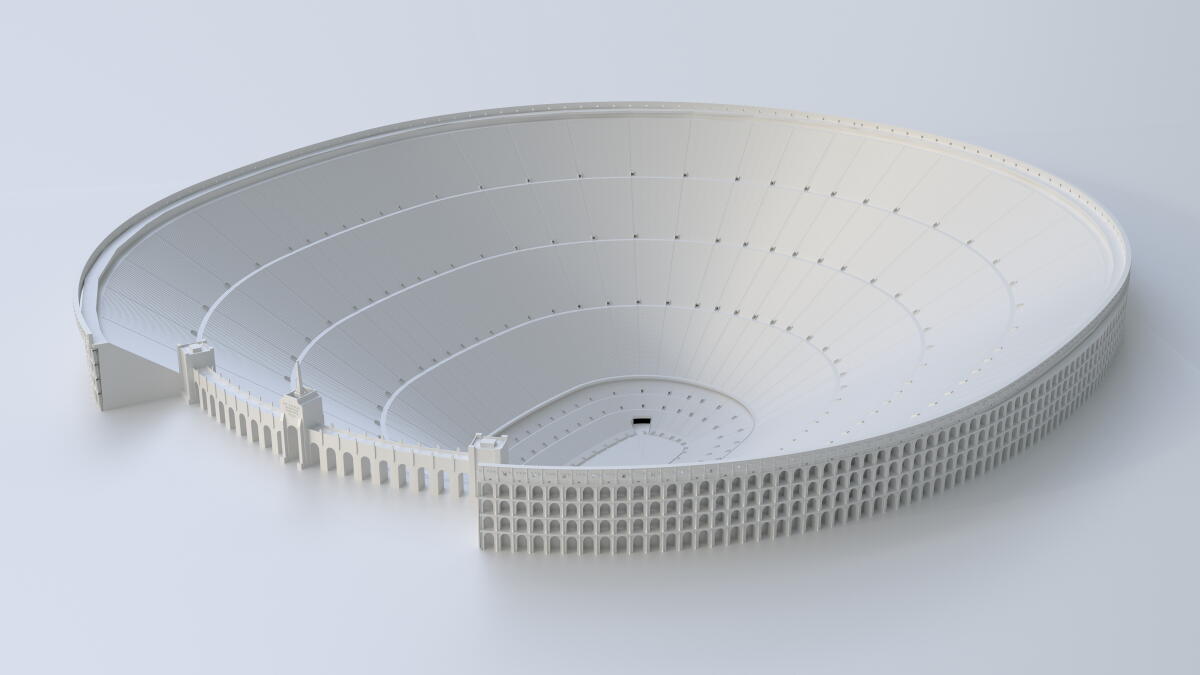
“Vitruvian Figure (Los Angeles Memorial Coliseum),” 2026, 3D model by Paul Pfeiffer.
(Paul Pfeiffer/Perrotin)
Paul Pfeiffer: Olympia In new work focused on Los Angeles, the artist explores the intersection between media, spectacle, architecture and the body ahead of the city hosting the 2028 Olympic Games. Opening reception, 6-8 p.m. Friday; Pfeiffer in conversation with Britt Salvesen, 3 p.m. Saturday; exhibition, 10 a.m.-6 p.m. Tuesday-Saturday, through Nov. 7. Perrotin, 5036 W Pico Blvd. perrotin.com
SATURDAY
“Couple walking, Park Avenue,” 1960.
(Estate of Roy DeCarava)
Roy DeCarava: the sound i saw The exhibition presents more than 130 images created between the late 1940s and 1960s, depicting the photographer’s intense interest in the relationship between the visual and the aural. Accompanying the exhibition, in the gallery next door, will be “SIDE B: the sounds,” a listening room featuring DeCarava’s personal playlists and favorite jazz album. Opening reception, 6-8 p.m.; exhibition runs through Oct. 31. David Zwirner Gallery, 606 and 6166, N. Western Ave. davidzwirner.com
Sutton Foster The two-time Tony winner and TV star performs Broadway hits and standards with Pacific Jazz Orchestra, featuring new arrangements by conductor Chris Walden. 8 p.m. The Soraya, 18111 Nordhoff St., Northridge. thesoraya.org
Mia Middleton: Summoning Cleo New work by the artist explores interpreting familiar forms through a surreal lens. Opening reception, 5-7 p.m. Saturday; exhibition runs through Oct. 24. Roberts Projects, 442 S. La Brea Ave. robertsprojectsla.com
Mrs. Warren’s Profession Real-life mother and daughter Cyndy Fujikawa and Nell Murphy star in this production of George Bernard Shaw’s 1893 play about a Victorian woman coming to terms with how she built a business empire. Directed by Michael Rothaar. Opening night, 8 p.m. Saturday; 8 p.m. Thursdays, Fridays and Saturdays; 3 p.m. Saturdays and Sundays (check website for exceptions), through October 25. Pacific Resident Theatre, 707 Venice Blvd, Venice. pacificresidenttheatre.org
Grammy Award-winning composer and bandleader Arturo O’Farrill and Afro Latin Jazz Orchestra open the Segerstrom Center for the Arts’ Jazz series.
(John Abbott)
Arturo O’Farrill & Afro Latin Jazz Orchestra The pianist and composer, a six-time Grammy winner, and his ensemble kick off the Segerstrom Center for the Arts’ 2026-27 Jazz series with Afro-Cuban rhythm, modern jazz harmony and big-band sounds. 8 p.m. Segerstrom Center for the Arts, 600 Town Center Drive, Costa Mesa. scfta.org
Other Places An alternative art fair devoted to contemporary art spaces and projects, plus workshops, readings, talks and performances. Noon-7 p.m. Angels Gate Cultural Center, 3601 S. Gaffey St., San Pedro. opaf.info
Karma The gallery presents solo exhibitions by painters Randy Wray (“Hothouse”) and Felipe Suzuki, one featuring vivid abstractions, and the other, work created through the lens of memory . Opening reception 6-8 p.m. Saturday; 10 a.m.-6 p.m. Tuesday-Saturday, through Oct. 24. Karma, 7351 Santa Monica Blvd. karmakarma.org
SUNDAY
Alexander Apóstol “Regime: Dramatis Personae” (2017), a series of black-and-white portraits of archetypal figures in both populist and authoritarian governments, uses photography to analyze the intertwining of art and political power in Latin America. 11 a.m.-5 p.m. Tuesday, Wednesday and Friday; 11 a.m.-8 p.m. Thursday; 11 a.m.-6 p.m. Saturday-Sunday; through Jan 3, 2027. Museum of Contemporary Art, 250 S. Grand Ave., downtown L.A. moca.org
Textile Alchemy: The Art of Reiko Sudō and NUNO More than 100 limited-edition textiles, along with numerous objects, including drawings, sketches, raw materials, tools, mock-ups, and prototypes, are part of the largest retrospective ever of the Japanese designer’s work created with her textile collective and other collaborators from throughout Japan, Through March 7, Los Angeles County Museum of Art, Resnick Pavilion, 5905 Wilshire Blvd. lacma.org
TUESDAY
The entrance of the Lucas Museum of Narrative Art in Los Angeles in Exposition Park.
(Ron De Angelis/For The Times)
Lucas Museum Of Narrative Art Where else will you see Luke Skywalker, Vincent Van Gogh, Norman Rockwell, Gordon Parks and Charles Schulz under one roof? The new museum officially opens Tuesday, featuring 100,000 square feet of space spread across more than 30 galleries, exhibiting a mind-bending range of visual storytelling. Check out our full coverage. Public opening, 10 a.m.-5 p.m. Tuesday; regular hours, 10 a.m.-5 p.m. Mondays, Wednesdays and Thursdays; 10 a.m.-5 p.m. Fridays; 9 a.m.-9 p.m. Saturdays; 9 a.m.-5 p.m. Sundays. Lucas Museum of Narrative Art, Exposition Park, 3800 S. Vermont Ave. lucasmuseum.org
THURSDAY
Bilal The Grammy Award-winning singer-songwriter delivers a blend of soul, funk, and jazz. Queens-born R&B musician Yaya Bey is the opening act. 8 p.m. Carpenter Center, 6200 E. Atherton St., Long Beach. carpenterarts.org
Each Other’s Hands: Trans Mutual Aid, 1966—1996 Oxy Arts, Occidental College’s community-based arts hub, presents an exhibition featuring the work of six L.A. artists. curated by Umi Hsu. The opening reception marks the launch of the 2026 CIRCA Queer Histories Festival hosted by One Institute. Opening reception, 7 p.m. Thursday; 11 a.m.-4 p.m. Monday-Saturday. Oxy Arts, 4757 York Blvd. oxyarts.oxy.edu
Arts Anywhere
Robert Wilson and the Civil Wars The newly remastered 4K version of Howard Brookner’s 1987 documentary, the essential yet long elusive film about the 1984 L.A. Olympics Arts Festival, can finally be streamed courtesy of Criterion Channel. It is everything LA28 doesn’t want you know. criterionchannel.com
— Mark Swed
Culture news and the SoCal scene
Christian Barillas, Melinda Page Hamilton and John Lavelle in “The Visit” at Pasadena Playhouse.
(Jeff Lorch)
Pasadena Playhouse opened a new production of Swiss dramatist Friedrich Dürrenmatt’s revenge tragicomedy “The Visit,” and The Times got in on the action. Contributor Jenelle Riley wrote a preview about how the new show features more than a dozen creatives behind the Playhouse’s production of Peter Shaffer’s “Amadeus” earlier this year, including director Darko Tresnjak and actor Jefferson Mays. “Amadeus” was a major hit, so Artistic Director Danny Feldman welcomed the team back with open arms.
Meanwhile, Times theater critic Charles McNulty attended opening night and declared the play a refreshing success (with a few caveats), and expressed “gratitude for the high-level production, gratitude for making the case for why the play still matters, and gratitude for the opportunity of allowing us to make up our own minds about whether the work earns its designation as a modern classic.”
Castulo Guerra as Tlahtoani Klion in a dress rehearsal ahead of its premiere of “Antigone: In the Language of the Kings” by the Latino Theater Company at the Getty Villa.
(Ariana Drehsler/For The Times)
McNulty also headed to the Getty Villa for its annual outdoor theater production. This year, the Villa’s outdoor stage marks its 20th anniversary with a co-production with Latino Theater Company of Sophocles’ “Antigone,” reimagined to take place in pre-conquest Tenochtitlan and performed in English, Spanish and Nahuatl. “If the drama is oversimplified, it nonetheless makes for a gripping spectacle,” McNulty writes.
Finally, a very busy McNulty checked out out a revival of José Rivera’s “Marisol” in an Open Fist Theater Company production at Atwater Village Theatre. The play originally opened in the early 1990s around the same time as Tony Kushner’s “Angels in America,” and McNulty says this new staging is gratifying because it allows a new generation to “embrace the play’s kinetic freedom.”
There are as many acrobats as actors in “Water for Elephants,” which is running at the Hollywood Pantages Theatre through Sept. 27 before heading to Segerstrom Center for the Arts (Nov. 10-22, with stops in Portland, Seattle, Reno, Sacramento, Tempe, Fresno and Eugene in between). Contributor Jenelle Riley headed backstage before opening night to watch the high-stakes performers warm up with poles, hoops, ropes and more. When the curtain raises, there’s a real circus onstage.
Enjoying this newsletter? Consider subscribing to the Los Angeles Times
Long Beach Opera will perform its 2026-27 season aboard the Queen Mary.
(Allen J. Schaben / Los Angeles Times)
Long Beach Opera announced its 2026-27 season, which is slated to be performed aboard the historic Queen Mary. First up: three works by composer Georges Aperghis, with vocal performances from coloratura soprano Habin Kim. Next: soprano Amanda Forsythe and Opera Prima in a performance of “Tormento Seicento.” Four additional productions include: an Anna Schubert recital, Peter Brook’s “Impressions of Pelleas,” Handel’s “Tolomeo” and Ana Sokolović’s “Svadba.”
The Jewish Federation of Greater Los Angeles and Daniel Gryczman, the federation’s board chair, sued Pasadena’s Norton Simon Museum for the return of the diptych “Adam and Eve,” a pair of 16th century masterpieces by Lucas Cranach the Elder. The suit was one of two filed in the state “since California and Congress passed a pair of laws bolstering U.S.-based claims to Nazi-looted artwork around the world,” reports the Times’ Kevin Rector.
“High-stakes” psychological thriller American Hostage has finally landed on Prime Video.
Hayley Anderson Screen Time TV Reporter
12:16, 20 Sep 2026
American Hostage is now available to stream on Prime Video(Image: PRIME VIDEO )
American Hostage is the “harrowing” drama fans have been waiting for starring Mad Men and Land Man icon Jon Hamm.
Prime Video released the intense eight-part series that tells of a “high-stakes” kidnapping in 1970s Indianapolis on on Sunday (September 20).
A beloved radio reporter is thrown into a “life or death crisis” when a kidnapper, who continues to point a shotgun at his hostage, demands to speak to him live on air.
With listeners intensely tuning in to their ongoing conversation, the pressure is on as the radio presenter must try to talk down the kidnapper before it’s too late.
Is American Hostage based on a true story?
What makes this new Prime Video drama even more exciting is the fact that it is based on a real-life story.
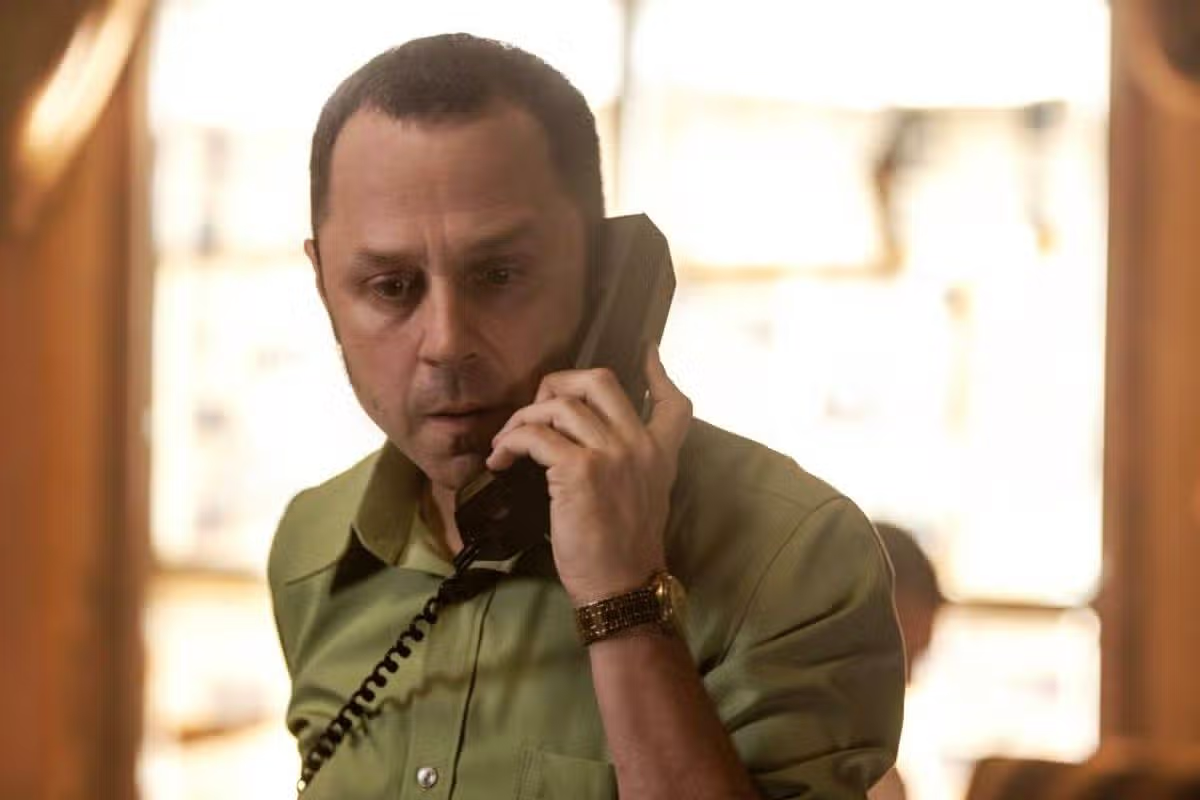
The radio reporter in question is Fred Heckman (played by Jon Hamm) with American Hostage telling his “harrowing true story” of what happened between him and kidnapper Tony Kiritsis (Giovanni Ribisi).
In real-life, Kiritsis’ victim Richard Hall was an executive at Meridian Mortgage Co which loaned him money three years prior to buy land and set up a shopping centre.
Kiritsis claimed that Meridian steered shops and business owners away from the centre, so he was confronted with the prospect of closing down and forced to default on the loan.
In an act of revenge, Kiritsis took Hall as his hostage and tied a wire around his neck attached to a shotgun that would go off if he made any sudden movements.
Kiritsis then stated that the only person he would talk to was radio personality Fred Heckman of WIBC so he could vent his feelings about Meridian live on air.
He released Hall on February 10, 1977, after holding him hostage for 63 hours.
Kiritsis was charged with kidnapping, armed extortion and armed robbery but was acquitted by reason of insanity and spent the next decade in psychiatric care.
American Hostage is based on the first season of the scripted podcast of the same name from Shawn Christensen and brought to life for the small screen by Netflix ’s The Night Agent creator Shawn Ryan.
American Hostage is available to watch on Prime Video
A solitary man believes he’s been wronged by a vast, overarching system. Feeling helpless to take it on directly, he picks up a gun and violently confronts the most powerful person he can think of who embodies his grievance.
It is a chilling dynamic that keeps repeating itself in American culture, and one at the heart of “American Hostage,” a dramatic miniseries making its debut Sunday on MGM+.
The eight-episode series re-creates the true story of Tony Kiritsis, an Indianapolis man who, in 1977, kidnapped Richard O. Hall, a mortgage broker whose family Kiritsis blamed for his own financial hardships.
The standoff lasted 63 hours, during which Kiritsis kept a shotgun attached by wire to Hall’s neck, and it became a national media spectacle. Throughout the crisis, Kiritsis made live calls to Fred Heckman, a local AM radio news broadcaster, pleading to listeners for the justice he believed he was due.
A half-century after this incident, not even the creators and stars of “American Hostage” can say for certain why we find stories like this so compelling — or why they keep happening in real life.
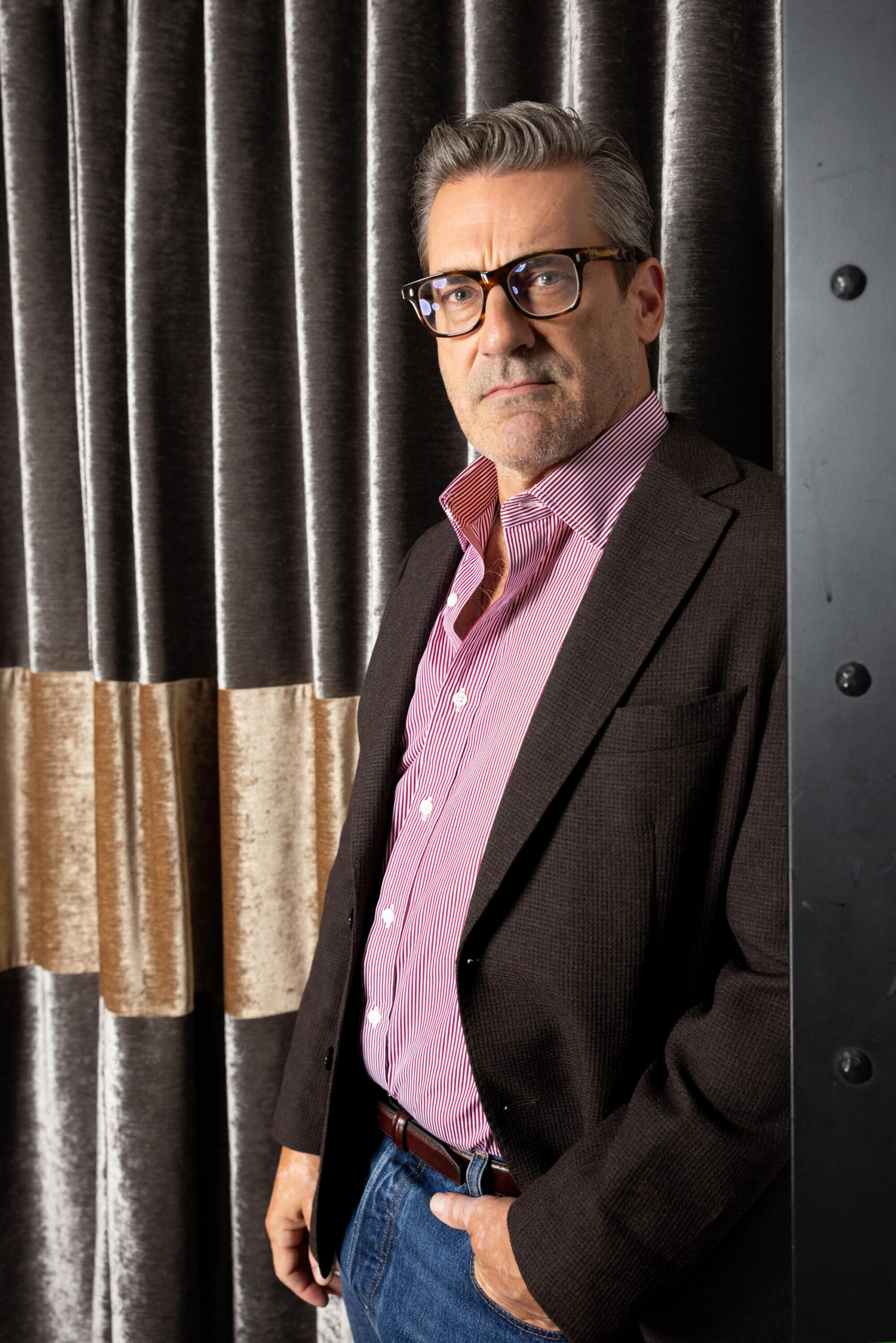
“We haven’t quite figured this situation out,” said Jon Hamm, who plays Heckman in “American Hostage” and is one of its executive producers.
Jon Hamm plays Fred Heckman, a radio news broadcaster, in “American Hostage” and is an executive producer.
(Jason Armond/Los Angeles Times)
The “Mad Men” star — no stranger to period pieces — said that beneath its retro production values and wide lapels, “American Hostage” is fundamentally about how people who feel voiceless in our society fight to be heard, even if the means is violence.
“There’s a lot that really resonates in the current media landscape and culture 50 years down the road, that people can still really connect with,” Hamm said.
Hamm and his colleagues hardly need to argue that point when the nation has been fixated on the case of Luigi Mangione, who in August pleaded guilty to federal charges in the December 2024 killing of Brian Thompson, the chief executive of UnitedHealthcare.
Though work on “American Hostage” had begun before Mangione’s crimes and the show was not inspired or motivated by them, series co-creator Shawn Ryan said that audiences have a boundless fascination with these types of stories — with or without any counterparts in current events.
“Dramatically, it’s always very interesting to see somebody do the wrong thing for the right reason,” Ryan said.
The TV series originated with a 2022 scripted podcast, produced by Criminal Content and also called “American Hostage,” on which Hamm also played the role of Heckman. It told of how Kiritsis, an Army veteran, enacted the kidnapping on his belief that the Hall family had swindled him on his mortgage — a loan for land where he had hoped to build a shopping center.
While Kiritsis sought to use Hall’s life as a bargaining chip for prosecutorial immunity, he also portrayed himself as an underdog taking on powerful financial interests. On the other end, Heckman wrestled with the moral predicament of giving airtime to a potential murderer while hoping to keep Hall alive. (Hall survived the ordeal and Kiritsis, acquitted of his crimes by reason of insanity, was later institutionalized.)
In the spring of 2022, Hamm approached Ryan, the creator of TV thrillers like “The Shield” and “The Night Agent,” with the idea of adapting the “American Hostage” podcast into a miniseries.
Ryan created the TV adaptation with Eileen Myers, a collaborator of his on shows like “Last Resort” and “Mad Dogs.” They both saw in the source material a story that was a combination of classic 1970s films like “Network” and “Dog Day Afternoon.”
(In a parallel development, Kiritsis’ story was also adapted into the Gus Van Sant film “Dead Man’s Wire,” which was a box-office disappointment earlier this year.)
Ryan and Myers said they were fascinated with how the American news media covered the kidnapping in instantaneous fashion and in an era long before the internet. In the 1970s, Ryan said, “There were fewer journalists and they were better and more trusted, and if Walter Cronkite said something, you believed it.”
Shawn Ryan, Jon Hamm and Eileen Myers executive produce the TV adaptation of “American Hostage.” Hamm approached Ryan, who brought in Myers to co-create and co-showrun the series.
(Jason Armond / Los Angeles Times)
The question that journalists like Heckman were confronted with, Myers said, was, “Do you allow a man who’s got a shotgun to somebody’s head dictate the terms of whether you’re going to put them on the air or not?”
Hamm, who has played alluring if ultimately disreputable characters on “Mad Men” and now Apple TV’s “Your Friends & Neighbors,” said he appreciated that “American Hostage” gave him a character who an audience can feel good about rooting for.
“I thought, I’m 55 years old,” Hamm said. “I was close to Fred’s age when this all went down. It was fun to play somebody morally conflicted that is actually on the good side.”
With some hesitation, Hamm pointed to the career trajectory of Bryan Cranston, who followed his celebrated heel turn on “Breaking Bad” with projects like “All the Way,” the play and TV film about President Lyndon B. Johnson.
“I don’t want to draw a comparison that’s stretching the bounds of reality,” Hamm said, “but Bryan went from Walter White to LBJ. You go, ‘All right — he’s still morally conflicted, but at least he’s on the right side of things.’”
“American Hostage” also benefited from the casting of Giovanni Ribisi (“Saving Private Ryan,” “Avatar,” “Sneaky Pete”), who brings a blend of volatility and humanity to the role of Tony Kiritsis.
Hamm recalled how Ribisi was in the midst of shooting another project — the upcoming Prime Video miniseries “The Greatest,” about Muhammad Ali — when he agreed to do a reading for “American Hostage” over Zoom.
“He brings value to every project he does, and he’s picky, as he should be,” Hamm said. “He’s a phenomenal DP — he might just go be a camera person or something if he wants to do it. So we were lucky to get him.”
Giovanni Ribisi plays Tony Kiritsis, the man who kidnapped Richard O. Hall. “So we were lucky to get him,” Hamm said.
(Steven Ackerman / MGM+/Sony Pictures Television)
There are of course unavoidable parallels between the stories of Kiritsis and Mangione, including the fact that both men were celebrated as folk heroes by some people who identified with their broader resentments.
But Hamm drew a crucial distinction between the two cases: Mangione “killed a guy,” he said. “He shot a man in cold blood. Like, I don’t care how good your point is. That’s not how we do it.”
Going back to the Boston Tea Party, Hamm said, every era of American history has had its dissidents who feel “wronged and done over by a system that is stacked against you” and are willing to take aggressive actions against it.
Hamm said that feeling persists and thrives today. “I think this is a big part of the rise of Trumpism,” he said. “I think this is a big part of the rise of the MAGA mentality, of ‘I have been done wrong and no one is hearing my complaints.’”
When those feelings go unaddressed for long enough, Hamm said, people will come to accept a certain amount of lawlessness from the figures they feel can solve their problems.
“We have a guy in the Oval Office right now who thinks that the laws don’t apply to him and a Supreme Court that said, ‘Yeah, they don’t — you can do whatever you want,’” he said.
For supporters of President Trump, Hamm said, “I think it’s fun for them to be able to flout the law and say, ‘Who cares?’ and all the things that they’re currently saying, but it’s not the principles that we were founded on.”
Hamm and Ryan make no secret of the fact that they’d like to keep “American Hostage” going as an anthology series and explore more of what Hamm called “these watershed moments of American life, to see how they rippled and how we got here from there.”
One could certainly imagine other events that would fit the show’s interest in real-life hostage crises that became media spectacles — the 1974 abduction of Patty Hearst; the 1963 kidnapping of Frank Sinatra Jr. — though Hamm kept any specific plans for the series close to the vest.
Perhaps the upper limits they face are the hours in a day to make and to broadcast the show.
“We’re living in great times right now for television,” Hamm said. “There’s so many opportunities to tell stories. Almost too many.”