LAFD testimony details missed chances to fully put out Lachman fire
Jacob Ulibarri spent about six hours on New Year’s Day last year squashing hot spots where the Lachman fire had burned.
The rookie Los Angeles firefighter arrived sometime after 7 a.m., when the smoky areas were all over and easy to see. By the time the next crew swapped with his that afternoon, they were scarcer: “One every 30 minutes, roughly,” Ulibarri recalled.
At that point, Battalion Chief Martin Mullen, who was running the mop-up operation, had walked three laps around the perimeter of the fire. He recalled one hot spot he saw at about 10 a.m., which crews hit with water. Later in the afternoon, Mullen did his fourth and last loop and left the area for good.
He decided to leave the hoses out overnight, just in case.
Over the next two days, a series of communication failures and questionable decisions led crews to leave the area prematurely, with embers from the small Jan. 1 fire later reigniting into the devastating Palisades fire. A firefighter picking up hoses on Jan. 2 found crackling, red-hot coals in the dirt and warned colleagues that a more thorough mop-up was needed. Also that morning, a captain cautioned his chief that it was too soon to pick up the hoses. In yet another missed opportunity, crews apparently did not walk the entire perimeter of the burn scar after a caller reported smoke in the area on Jan. 3.
Because of the holiday, some were filling in for others outside of their normal assignments. Firefighters said they adhered to the LAFD’s strict chain of command and did not question higher-ups, while those in charge had fuzzy memories or shifted responsibility to others.
The revelations, contained in the sworn testimony of a dozen firefighters earlier this year as part of a lawsuit filed by Palisades fire victims, corroborate previous reporting by The Times and call into question the LAFD’s repeated claims that commanders left the fire “dead out.” More than a year later, with much of the Palisades still in ruins, LAFD leaders have refused to explain how or why the breakdowns occurred.
The LAFD employees mentioned in this story either could not be reached or declined to comment.
In a statement Monday, LAFD spokesperson Stephanie Bishop pointed to the alleged arsonist charged by federal prosecutors with deliberately setting the earlier fire. “The Lachman and Palisades Fire incidents would not be matters of discussion had this individual not allegedly initiated the original fire,” she said.
“It is important to allow the legal process to proceed without external influence or speculation. Offering running commentary on depositions outside of the courtroom risks compromising witness testimony, affecting the integrity of evidence review, and impacting ongoing judicial proceedings. We stand by the investigation conducted by the ATF,” Bishop added, referring to the Bureau of Alcohol, Tobacco, Firearms and Explosives.
Around 6 a.m. on Jan. 2, 2025
At the end of his 24-hour overtime shift, Mullen handed the reins to Battalion Chief Mario Garcia, recommending that the incoming chief scope out the fire perimeter.
“I told him I left him hose lines in place overnight. You need to walk that and make sure there’s nothing going up on there,” said Mullen, whose regular job is managing the LAFD’s 106 fire stations and 30 or so other buildings.
Before Garcia set foot on the burn scar, he put word out to station captains about the plan for the morning: Pick up hoses.
At Fire Station 19 in Brentwood, Capt. Alexander Gonzalez got a text from the chief’s aide, directing him to bring a “plug buggy” — a pickup truck used to carry equipment — “to help pick up hose.”
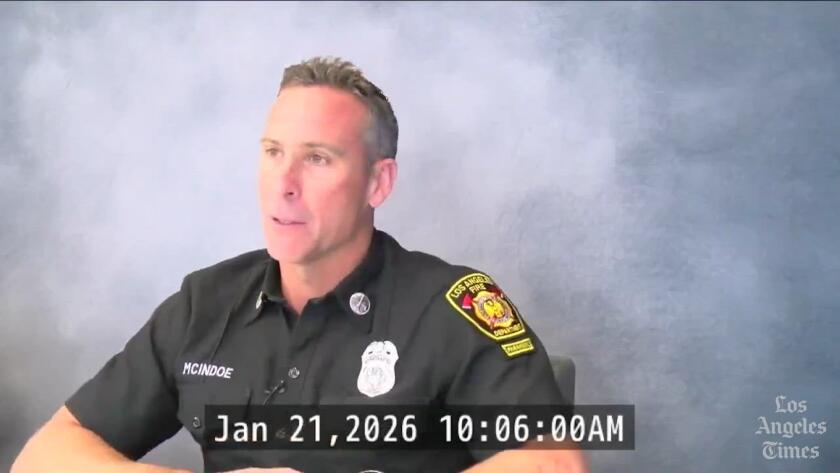
The plan reached Capt. David Sander at Fire Station 23 in the Palisades and Capt. Michael McIndoe at Fire Station 69.
McIndoe had reservations.
He told the chief’s aide that he thought the hoses should stay out longer. He had seen the forecast that day — a National Weather Service alert had warned of weather conducive to wildfires — and handling any lingering hot spots would be easier with hoses in place. The aide told him to take it up with the chief.
So McIndoe shared his concerns with Garcia over the phone.
Garcia “said something along the lines of, ‘OK. Let me go check it out, and then I’ll get back to you,’” McIndoe testified.
But the orders for the morning never changed.
8:30 a.m. on Jan. 2, 2025
After a briefing at Fire Station 23, Scott Pike and his partner took their ambulance to a cul-de-sac near the burn area. They spotted some hose dangling over a retaining wall covered in ivy.
An engine crew threw a 20-foot ladder to get over the wall. Soon, Pike said, they got another call and left.
“We were kind of making jokes, like, ‘It’s on us,’’’ recalled Pike, a firefighter normally assigned to a station in Sunland.
He grabbed his brush jacket, helmet and gloves and climbed over. He decided to hike to the end of the hose line — he was feeling good and thought he’d get a workout in.
Pike followed the main line — called the trunk line — which had hoses branching off in other directions. About 100 feet in, he saw where grass had burned. He navigated through culverts and climbed a steep hill of about 300 feet before hitting a hiking trail.
When he got to the end of the line, at about 8:45 a.m., he noticed a handful of smoky areas in heavier brush, and a hand line that wasn’t cut properly.
One ash pit was so hot he didn’t want to touch it, even with gloves. So he kicked it with his boot, exposing red-hot coals. He heard crackling and smelled smoke. He looked around, and there were no other firefighters.
We shouldn’t be picking up hoses, he thought to himself. Instead, we should be filling the hoses with water to do a more thorough mop-up.
He pinched the hose, directing any residual water to the ash pit. It steamed and crackled. He felt defeated when he only got a couple of gallons out, which wasn’t enough.
He slowed down, in case the pickup plan were to change because of his observations, and was relieved when more crews began hiking over.
“Hey, guys, are you seeing what I’m seeing?” Pike told a couple of firefighters. He was working an overtime shift away from his usual fire station, so he didn’t know them. “Like, maybe we should be charging these lines instead of picking them up.”
Since they were already there, he figured, some extra mop-up could save them work down the line if the fire were to reignite.
The firefighters shrugged him off and seemed eager to finish the assignment.
“They were like, ‘Yeah, I see what you’re saying,’ And then it was like, ‘We’ll tell one of the skippers. We’ll tell one of the captains.’ But, like, in the meantime, people were just very much like, just get the hose picked up,” Pike testified.
Shortly after, he saw a captain and raised the same concerns.
“That’s how I approached him, is like, ‘Hey, Cap … We have hot spots in general. We have some ash pits,’” Pike said. “That’s an alert to double-check the whole area and maybe we need to switch our tactics.”
Pike testified that it was not his job “to overstep and tell him what to do. He earned that rank.”
The captain suggested possibly bringing hand tools or a backpack filled with water up the hill to extinguish any hot spots.
Pike went back to picking up the hose while awaiting new orders, which never came.
The LAFD has declined to say whether the captain has been identified. Pike believed the captain was from Engine 69, which would have been McIndoe. But McIndoe told The Times he did not speak with Pike that day.
McIndoe said he also came across a smoldering ash pit during the couple of hours he was on the hill.
He retrieved a backpack with water from his engine, sprayed into the ground with a couple of gallons of water and dug up the dirt with his hand tool until he was satisfied it was cool.
At one point, he saw Garcia, the battalion chief, and brought up their earlier conversation.
“I just went up to him, and I said, ‘Hey, I hope you don’t think I’m just trying to get out of work,’” McIndoe said. “And he said, ‘No, that’s — that’s fine.’ Something along those lines, and that that’s all I can really recall.”
He said he was trying to tell Garcia that he believed “that the hose should stay up a little bit longer.”
By the time Gonzalez, who was backfilling that day at the Brentwood station, got to the scene, the operation was well underway, with half the hose already down the hillside.
“When I got there, it was just, it’s like a big daisy chain of hands pulling hose off and getting it down to the street. And rolling it, hosing it off and loading it into the plug buggy,” he testified.
He did not see smoldering that day. He testified that he went about 200 to 300 feet up, to where piles of hose were being dropped. “The next person brings it back down and that was it,” he said.
Some firefighters on hose pickup duty that day have not been deposed in the lawsuit. Aside from McIndoe and Pike, the four other firefighters who testified that they were at the burn scar on Jan. 2 said they did not see smoldering.
Garcia testified that at the burn scar, no one raised any concerns with him about the hose pickup. Nor did he see any need to leave the hoses at the site.
At 1:35 p.m. on Jan. 2, Garcia texted two higher-ups: “All hose and equipment has been picked up.”
Around 4:30 p.m., Garcia walked the area again with his aide to see if they had left any equipment behind. He saw no issues.
“We both walked the whole area,” Garcia said. “We went separate directions, but covered the whole area, and there was nothing that would bring any concern.”
11:51 a.m. on Jan. 3, 2025
Shortly before noon, someone called the LAFD about a grass fire in the burn area.
Engineer Edward Rincon, who had been on Engine 23 retrieving hoses the day before, pulled up to the same cul-de-sac. Once again, his crew threw the 20-foot ladder over the retaining wall. As on the previous day, he never entered the burn scar. He stayed with the engine while the captain and two firefighters went to scope out the area. He set the volume high on his radio to hear if they needed anything.
On the other side of the wall, Capt. Cesar Garcia walked for what he said was more than a couple of football fields, while the two firefighters went to different peaks to look around for smoke or fire.
“Everything is completely burned. I don’t smell anything. I don’t see any smoke. I don’t see any fire,” he testified.
He canceled another engine that was assigned to the call.
Firefighter Michael Contreras said he also didn’t see smoke. He said he could not see the entirety of the burn scar from his vantage point. He also said he did not suggest to his captain, Cesar Garcia, that they walk the whole perimeter.
“Is there a reason you did not?” a plaintiffs’ attorney asked.
“Again, would not be my lane to tell him that, you know,” he said.
Battalion Chief Mario Garcia was on duty again that day. Like Rincon, he stayed with his vehicle. Cesar Garcia said the chief pulled up a live feed on an iPad from two cameras on the mountain, which showed no smoke or fire.
An incident report shows they spent about 34 minutes on the call.
On the morning of Jan. 7, LAFD records show, a captain on duty in the Palisades called Fire Station 23 and told colleagues: The Lachman fire had started up again.