In Australian writer-director Adrian Chiarella’s knotty roller coaster of a feature debut “Leviticus,” about a demon tormenting a pair of queer teenage boys, the fear is more insidious than the external threat of a violent bigot or shunning parent.
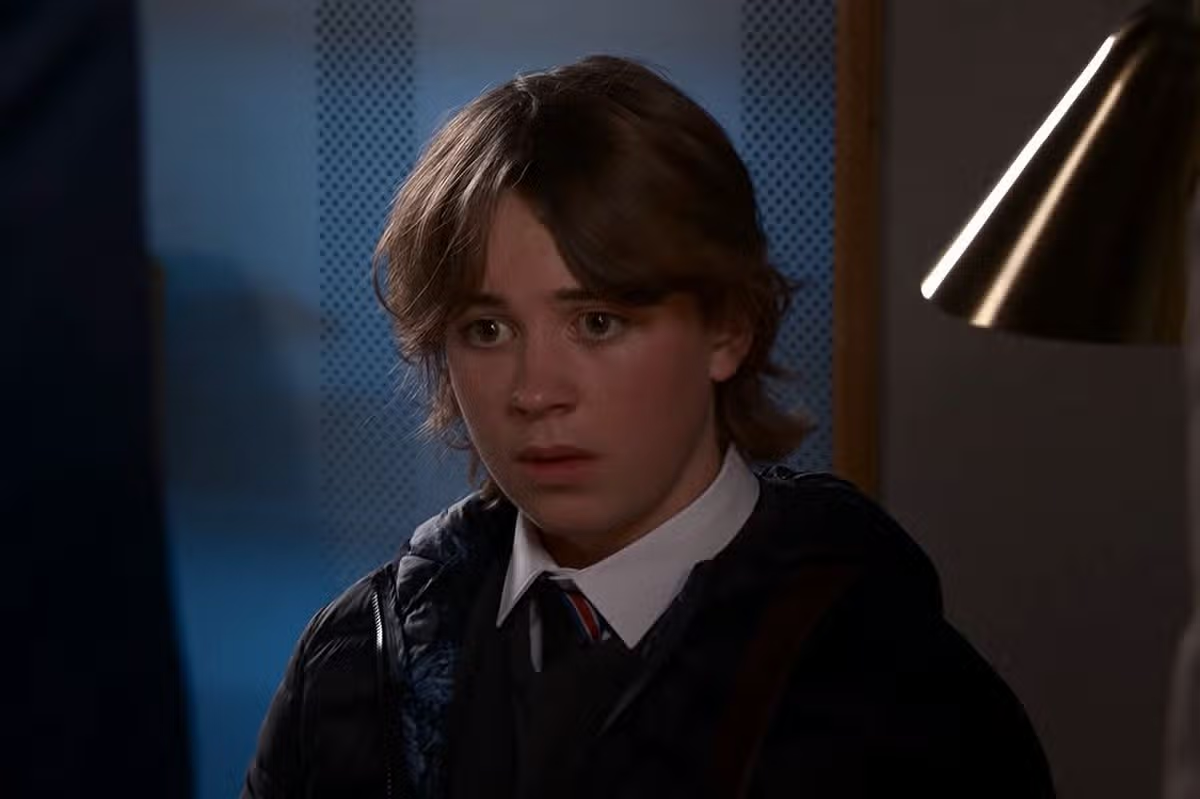
In an abandoned mill in their blighted industrial town, quiet new kid Naim (Joe Bird) and brash hunk Ryan (Stacy Clausen) allow a friendly, mischievous connection to turn into something more. But when Naim later secretly observes his new crush fiercely locking lips with another classmate, Hunter (Jeremy Blewitt), son of a leader in the tight-knit church that Naim’s single mom (Mia Wasikowska) just joined, hurt gets the better of Naim’s instincts and he secretly informs on the pair.
The church’s punishment, however, delivered in front of the congregants, is an eerie ritual performed by a gaunt, severe visitor (Nicholas Hope). Called a “deliverance healer,” his fire-and-brimstone method — making incarnate the title’s Biblical book, regularly used to justify anti-LGBTQ viewpoints — leave Ryan and Hunter writhing in agony. Afterward, Naim, sensing he might have unwittingly set into motion something awful, notices bizarre behavior in the stricken-looking Ryan. When they try to furtively rekindle their passion, it becomes violently clear they are not alone. Or even, it seems, themselves.
The feeling that nowhere is safe is a durable horror concept, the backbone behind such classics as “Nightmare on Elm Street” and “It Follows.” In “Leviticus,” which is expertly paced by editor Nick Fenton, it comes with a flair for open-space unease and unexpected claustrophobia that puts director Chiarella in a long line of savvy Australian mood-setters like Peter Weir and Fred Schepisi. These filmmakers knew how to fold tactile dread into a worthy narrative, rather than treat genre as if it were a kit with instructions.
But most urgently and bleakly, Chiarella is giving religious-based conversion therapy its devilish due as a warping of the soul designed to sow distrust in one’s own desires. He’s careful, however, not to tell a tale that would speak to homophobes. As distressing as their circumstance is, Naim and Ryan are unmistakably positioned as heroic lovers, not victims-to-be. Chiarella takes time between bouts of danger to show affection and intimacy that, in defiance of teen-slasher formula, isn’t immediately penalized with sadism. But their fraught relationship will decidedly keep you nervous, so score one for multilayered storytelling.
Points, too, for the solid casting, from the leads’ tricky pivoting from openness to caginess, to the criminally underseen Wasikowska, who navigates maternal complexities of worry and compassion that confound easy pigeonholing. If anything, the movie could have used more of her, although it’s better overall that “Leviticus” prioritizes Naim and Ryan as queer protagonists caught in a chilling loop of escape and reunion. We already know what’s out there, ready to do harm. This movie’s nail-biting, sorrowful power comes from what internalized destruction looks like.
‘Leviticus’
Rated: R, for bloody violent content, language, some sexual content and teen drug use
The 28-year-old was on a six-week trip when she was involved in an accident in the motorhome she had hired
Emma Blood was badly hurt in the crash(Image: SWNS)
A Brit’s dream holiday turned into a nightmare after a horror motorhome crash left her unable to walk. Emma Blood, 28, was travelling in Western Australia when the collision left her trapped, seriously injured and facing a year-long recovery.
The hospitality worker from Milton Keynes had travelled to Australia on March 19, 2026, with plans to spend six weeks exploring. Inspired by stories from other travellers, she teamed up with three women she had met through a travel group and hired a motorhome to travel around and live in while exploring the region.
Just nine days into the trip, on March 29, Emma and the three women were travelling towards Margaret River when she lost control of the motorhome, due to slipping on the Western Australia mud roads, and crashed into a tree. Two passengers suffered minor injuries, but Emma was trapped from the waist down in the wreckage and had to be cut free by firefighters.
She was then airlifted to Perth Trauma Hospital, where she spent 10 days before flying back to the UK to continue her recovery. She said: “There are still a lot of blank spaces in my memory, I’m not sure whether I lost consciousness or whether it’s just a trauma response.
“I recall the moment of impact, when the vehicle struck a tree on the driver’s side where I was sitting. The force of the crash pushed everything forward, and I ended up trapped from the waist down.”
While the other passengers escaped with relatively minor injuries, Emma suffered devastating damage to her leg. One passenger required stitches to her face, and another was left with a bruised finger, but Emma faced a far more serious outcome.
Emergency services were alerted after her phone automatically contacted them following the collision. Upon arrival, a fire crew had to cut Emma free before she was airlifted to Perth Trauma Hospital.
Doctors discovered she had broken her femur in three places. She underwent emergency surgery lasting around six hours, during which surgeons inserted an intramedullary nail – a metal rod fixed inside the bone with six screws to stabilise the fractures.
Emma said: “I remember being in and out of consciousness, having scans and being moved around the hospital. It felt like something out of 24 Hours in A&E or Casualty, being rushed about.
“One of the most difficult moments was definitely standing for the first time after surgery. It was terrifying because I had no control over my leg, at first they thought there could be spinal injuries but it turned out to be okay.”
Complications continued when doctors discovered her haemoglobin levels had dropped dangerously low, resulting in a blood transfusion several days later. Emma spent 10 days in the hospital in Australia before her father flew out to help bring her home.
She said: “I couldn’t have travelled back on my own, I needed someone with me the whole way. If my dad hadn’t come to pick me up, I would have had someone to take me who I didn’t know.”
After arriving back in the UK on April 8, she was admitted to Milton Keynes Hospital for around another week before continuing her recovery at home.
In the early stages of recovery, Emma could not move her injured leg without using a strap around her foot and required assistance with everyday tasks, including showering.
She said: “It felt like I had lost all independence. I have been told a full recovery could take up to a year, but I am making great progress.
“My older brother is helping me, he’s a sports physiotherapist and thanks to him I progressed from a walking frame to two crutches, and now I only rely on one.”
She spends time in the gym every day, rebuilding strength and mobility and recently celebrated a major milestone by getting back behind the wheel of a car.
She said: “Driving again was huge for me, both physically and mentally. Although the accident cut short my dream trip, I will go back to finish it.
“There is still a lot of trauma attached to what happened, but for now, I am going to focus on getting back to my full health and independence.”
The Scream movie series is one of horror’s most successful franchises and has seven films under its belt
17:36, 17 Jun 2026Updated 17:37, 17 Jun 2026
Horror movie star reveals surprising amount they still make from hit 1990s Scream film(Image: Gh0st/YouTube)
A star from the horror film franchise Scream has revealed the surprising amount he still earns from one of the movies.
Back in 1996, the Scream series kicked off with its first instalment. Directed by Wes Craven, the film followed Sidney Prescott and her friends being targeted by a sadistic killer who donned a black cloak and white mask: Ghostface.
Due to the first film’s success, several more movies followed including a sequel in 1997, and a third instalment in 2000. Then, after 11 years Scream 4 was released in 2011.
And more recently, the slasher franchise was brought back in 2022 for a fifth movie and 2023 for a sixth. This year, a seventh film was released which became the highest-grossing film of the series so far.
The satirical whodunnit was a huge hit thanks to a clever script penned by Kevin Williamson and Wes Craven’s direction, while the characters’ awareness and acknowledgement of horror film clichés was uncommon at the time. Scream helped to revive interest in the teen slasher genre.
And this week, a star from Scream 2 revealed his residual pay from the film 29 years after its release. Actor and comedian Craig Shoemaker appeared in the sequel, Scream 2 – which made $172 million at the box office.
Craig played the role of ‘Artsy Teacher’ in the instalment. Taking to his Instagram, he shared a photo of his residuals cheque which revealed he made a total of $34.09.
He captioned the post: “In 1999 | was cast in the role of the film professor in the sequel of the original Scream movie, Scream 2, where I lead a conversation in class about film sequels. The residuals keep rolling in, baby! What should I buy with my 34 bucks?”
Content cannot be displayed without consent
The latest Scream movie, Scream 7, was released earlier this year. The film shifted the focus back to the original final girl, Sidney Prescott – played by Neve Campbell and her teenage daughter Tatum, played by Isabel May.
Neve didn’t appear in the sixth Scream film in 2024, which starred Jenna Ortega and Melissa Barrera as sisters who discover a serious connection to one of the original Ghostface killers, Billy Loomis.
Neve announced she would be stepping away from the 2024 Scream film after a dispute over pay. She said in a statement: “Sadly, I won’t be making the next Scream film. As a woman I have had to work extremely hard in my career to establish my value, especially when it comes to Scream.
“I felt the offer that was presented to me did not equate to the value I have brought to the franchise. It’s been a very difficult decision to move on,” Neve added.
She continued: “To all my Scream fans, I love you. You’ve always been so incredibly supportive to me. I’m forever grateful to you and to what this franchise has given me over the past 25 years.”
Memorizing your lines seems like such a foundational part of an actor’s job that there wouldn’t be much to say about it. Yet when a group of performers recently got onto the topic during The Envelope’s Emmy Limited Series / TV Movie Roundtable, it turned out everyone had their own way of doing it. And all were eager for tips and tricks, whether it be an app, a line-drilling coach (“Can I have that number?”), writing down the first letter of each word or even writing a monologue backward.
“We have to share tools, guys,” said Camila Morrone, who plays a bride-to-be who learns her fiancé’s family dark secrets in the horror thriller “Something Very Bad Is Going to Happen.” “It’s funny that we all have such different methods.”
Joining Morrone were Jamie Bell, who stars in “Half Man,” about the extremely dysfunctional, toxic relationship between two stepbrothers; Linda Cardellini, who appears in “DTF St. Louis” as a dissatisfied woman caught in a dangerous love triangle; Michael Peña, who plays a detective assigned to the case of a missing child while his own boundaries are tested in “All Her Fault”; Andrew Rannells, who is a man coming to terms with his own life while helping to plan a funeral in “Miss You, Love You”; and Constance Zimmer, who channels the mother of Carolyn Bessette Kennedy in “Love Story: John F. Kennedy Jr. and Carolyn Bessette.” Read on for more excerpts from our conversation.
The Envelope’s 2026 Emmy Limited Series / TV Movie Roundtable: Constance Zimmer, left, Michael Peña, Linda Cardellini, Andrew Rannells, Camila Morrone and Jamie Bell.
How do you watch TV? A home theater screening room or a tablet on the go?
Morrone: When I see people on a plane watching on their phone, I’m like, “Do you know how many people worked on that?”
Zimmer: I can barely watch one on an iPad because I still feel guilty about not getting the full effect.
Cardellini: I can’t watch on my phone or an iPad. It starts to hurt my eyes. And I like to binge. I don’t like one at a time. I like to save it up, and I like a binge. I don’t have the patience.
Morrone: Oh, I love one at a time. I want to wait till Sunday night, order my favorite food, maybe have a friend come over … Guess our theories of what’s going to happen. I did that with “White Lotus” this year, and I was looking forward to every Sunday at 7 p.m.
Bell: I catch usually about 10 minutes of whatever my wife has fallen asleep to. And then I’ll get into that, and then I’ll watch a lot more episodes while she’s asleep. And then she’ll wake up, and we’ll be completely out of sync in terms of what we’re watching.
Jamie, “Half-Man” is such an emotionally intense show, and it seems like that would be a really hard head space to exist in. Are there things that you do for yourself to maintain your own sanity?
Bell: Me and Richard [Gadd], who wrote the show, are big soccer fans. So I brought a soccer ball to set a lot, and just whatever space we’re in, we just kick a ball to each other every now and then. So, a lot of that wasn’t even us really speaking to each other, but just passing a ball backwards and forwards, which was quite a nice way of just taking our minds off of whatever scene we were doing and still enjoy the space with each other and do something that was physical that didn’t really require us jumping [around] too much.
Camila, “Something Very Bad Is Going to Happen” is also a very intense show. It’s not so much a scream queen kind of horror; it’s this foreboding horror. Was that a difficult space for you to exist in?
Morrone: I think there’s an underappreciation for horror performances. I think some of the most incredible performances, especially by women, have been done in the horror genre. And I think it’s a really specific thing to do because if you’re playing only one level of horror throughout an eight-episode series, I think it’s incredibly boring. And I think I had this notion of like, “God, I don’t want to do these jump scares,” and kind of the cliches of what we imagine horror is like. But horror can be really deep and really internal, and I think there’s a lot of ways in which horror and fear manifest. And I think it was interesting to try and find levels to it and to have the audience come with you, but not dramatize or exaggerate an emotion.
Michael, in “All Her Fault” you are playing someone who could be a much more conventional detective character, but reveals more layers. Was there a moment in your career when you realized, whether it was going for certain roles or not going for certain roles, where you wanted to break out of feeling like a sidekick character or more stereotyped characters? Was there a moment where you made an effort to start going for a different kind of role?
Peña: Back when I started acting, the breakdowns for actors, it was like “Caucasian only,” “Caucasian only,” “Caucasian only,” and we weren’t allowed to audition for those. And it was only until the 14th part that it said, “Open to other ethnicities.” So there’s like a thousand of us going for the 14th place. Ten years of that, you kind of think, “I guess I’m meant to be a supporting character.” But then my mom, right before she died, what she said is, “If you’re going to do that, just make it real. What’s the best you can do with that part?” I said, “Make it a three-dimensional character.” She’s like, “Just do that.” And she’s like, “Nobody remembers your bank account.” And I was like, “Oh, these are two good pieces of advice, Moms,” and so that’s what I did. And with “Crash,” he was a gangster and I was like, “Screw it. I’m just going to do the work and try it out, and all the stuff that I was learning in acting class, I’m going to apply it to this particular role.” And I was happy with the work, so then I kept doing that.
For the rest of you, was there a moment where you had to make a decision about the kind of career that you wanted for yourself and the kind of roles you were going to go up for?
Zimmer: Sorry. It just makes me laugh because we have no control, as actors, over where they believe that we belong. I wish that we could say, “I’d like to try this now,” but it’s basically where they believe they would like us. And then you get put into an area, or a path, or a box, and you can’t get out until somebody else decides, “Hold on. We’re going to give you that shot to try this, even though it’s not necessarily what you normally do or are known for.” Then it takes that for everybody to go, “Oh, you can do this, too?” And it’s like, “Yeah, that’s my job.” My job is to do a lot of things, not just one role, or one type of role.
Rannells: You’d like to think that you’re more in control of those decisions, but sometimes things just happen.
Constance, as Ann Messina, Carolyn Bessette’s mother in “Love Story,” you have this speech that you give at their wedding dinner. It’s such an incredible scene, and I’m wondering, what was it like for you when you first read that in the script?
Zimmer: That monologue was actually my audition.
Peña: Oh, I love when that happens like that.
Zimmer: So I knew it very well, getting on the set with it. I think that I only saw two scripts out of nine episodes, and they were just the ones I was in. And I remember my team saying, “This might be it. We don’t know if there’s anything else that you’re going to do on the show.” And I said, “If this is the only thing I do, it’ll be worth it,” because it was so layered and it was so well-written by Connor Hines and Juli Weiner, I was kind of like, “This is all that matters anyway.” So, to be able to feel like I could pour the entire character into one moment in time, it allowed me to try and give her as much as possible because I was like, “This might be it.” So when I read it, I was like, “Oh, OK. That’s like those five-page monologues that you don’t get very often to do for one character in one episode.”
Linda, your character on “DTF St. Louis” has this habit of saying, “No way, José,” and it’s oddly catchy. And she also is always asking people to speak up. Is it difficult to take what seems, on the page, maybe like tics or weird habits and make them feel natural?
Cardellini: That was the great challenge of it, and it’s the beauty of [Steven Conrad’s] writing. Like we repeat “Jamba Juice,” or “Quality Inn,” or “Garden Suites,” all these little phrases, or “Snag it.” It’s so fun to find a way to make that seem like it is natural to you. I remember I had a long monologue audition, and in there I talk about, “No way, José.” I wasn’t sure what the tone was — it’s such a specific tone when you watch the show, and it’s very Steve Conrad. And I didn’t know what it was before I met him and before you could see the show in action. So getting through that and chewing through that in my audition, doing these versions of “No way, José” that I thought felt really, really natural to me, I was like, “This is how I would say it. This is how I’m going to do it. If my sense of humor matches his sense of humor, if our tones match, then I’ll get this role. And if they don’t, then somebody else will do it beautifully in that other way, whatever that is.” Luckily that was like a marriage of tone and thought, and then those things start to come naturally. And then you want to say them more often than they’re written. There’s not a lot of improv in the show, but we would all just joke around and say it to each other.
Andrew, so much of “Miss You, Love You” is just you and Allison Janney together —
Rannells: Just sitting in a house. Just talking.
What was the rehearsal process like? How did the two of you prepare for these very long dialogue scenes?
Rannells: We rehearsed it like a play, which was really fun, and I’ve never really … I mean, we did that, I guess, with “Boys in the Band” a little bit. We had done it on Broadway and then we all kind of still knew it from when we actually filmed it. But Allison and I rehearsed it like a play, and we would just run lines like little theater nerds. It was exciting because I’ve never — to get on set and to be able to say, like, “We can do the first 25 pages just because we’ve already memorized it.” And we did for Danny Moder, the [director of photography]; we did our little play for the crew one day. Which was really fun because you don’t normally get to work like that. It’s like in little segments. And [writer-director] Jim Rash just let us run it in a way that felt really satisfying to get to do. Because sometimes when you just do little pieces of things you’re like, “I can’t quite get the arc of this, and I don’t really know.” You’re doing inserts, and you’re like, “This doesn’t feel like acting.”
Zimmer: And you’re doing it out of order, so you’re like, “Wait, I’m playing the end before I’ve even played the beginning, but I don’t even know what my beginning is.”
Cardellini: It becomes detective work.
Rannells: Shout-out to Allison Janney. It turns out she’s good at acting.
Linda, what was it like working with an intimacy coordinator in shooting what certainly look like they could have been very awkward scenes in “DTF”?
Cardellini: I like an intimacy coordinator. I think it’s wonderful. I think they’re there if you would like to use them. Everybody I’ve ever worked with in that capacity has been so helpful and considerate, and I think it’s just a nice resource to have. And we had a great one on “DTF.” … One of the first scenes I ever shot was me where I have to, we call it “weight placement,” on Jason’s face. And we were scheduled to shoot that much later, but it came up the —
Rannells: That was your first day?
Cardellini: That was our first scene together, really placing your weight on somebody in a way where you just don’t want to hurt somebody’s face. I mean, you don’t want to suffocate somebody. There’s a lot of things that could happen. But it was handled so beautifully. And Jason, of course, is so wonderful, and we had such a great time doing the scenes because we just would laugh — they’re funny. The scenes, more than even being sexual, are so awkward and bizarre and filled with these strange little kinks that it becomes funny, in a way, although you treat it with dead seriousness. But Steve Conrad had a beautiful economy about what he was shooting, and he would storyboard. It was never just like, “Oh, be intimate and go for it, and we’ll see what we use.” It was, “This is the part of your body we’re going to use right here. This will be the shot. It’s this frame. We’re not going to do any more than that.” So you never felt like you were in the Wild West doing this passionate thing that felt uncomfortable. … Because, of course, going into something like that, reading the script, you’re thinking, “It’s a little nerve-racking. How am I going to do these things?” It was much easier than I could have ever imagined.
Constance, your character in “Love Story,” she embodies the other side of the glamour and the fame and the story that we all think we know. And in a lot of ways I can’t help but connect it to your character from “UnReal” in that it creates this really interesting perspective on fame. These roles, do they make you think about that, as well? Do you start to consider your own relationship to fame and your character’s relationship to fame?
Zimmer: Ann, [and] working on “Love Story” in general, really brought the price of fame to the forefront and how it can tear people apart and down and away from who they were before they became famous. And I think, in this particular story, Carolyn never set out to be famous. That was like the last thing she wanted. The scenes with me and Sarah Pidgeon, who plays Carolyn Bessette, were very much about, “How do I remind you that everything is going to change, and you are going to change?” So it made the mama bear really show up. And sadly, it’s hard to do the research about all of that and see how much media was to blame. I hate to say it, and it’s tough, especially for a woman: They really tore her apart. It definitely makes you look at things and go, “Wow, it’s so interesting what we all give up.” This is our craft. We do this as actors, yet when we step outside of our craft and our roles, we are judged on such a harsh level. We’re here for the work and to make and show these characters so that maybe you can see a little bit of yourself, or maybe it can help you with grief, or laughter, or whatever. But then, outside of our work, we are judged almost worse about how we’re aging, how we’re not aging, what we look like, what we don’t look like. It’s the hardest part, I think, of what we do.
Would the rest of you agree with that, that in some ways, it’s not the work that you’re doing, but it’s this other job that exists outside of your work, the fame aspect of it? Does that become a bigger challenge than you expect?
Rannells: So much of the promotion of things that you work on now hinges on your participation in like, “Post this picture” or “Do this video” or “Do this thing.” And that’s stuff that you just don’t think about when you say, “I want to be an actor.” You don’t think about, “Do I have to do a collab with the network?” I don’t want to do that. That’s not part of my job, but it is part of your job. That is part of it now. So that’s a tricky aspect of it that I didn’t expect.
Morrone: The other side of that coin is that there’s independent films that I’ve done, that nobody would have ever seen had I not been the poster child on social media, being like, “I love this film. Please, watch this film. This is how to watch this film.” So, then again, it can also be a really beneficial platform. And it’s such a complicated relationship because, I mean, I grew up with social media. I don’t ever remember not having a form of social media. And I wish I could be like the cool actors who aren’t on it. They’re much more mysterious.
Peña: Jamie’s not on it.
Bell: I mean, it’s not a conscious choice. I’m just not on it.
Jamie, both you and Linda have been acting since you were quite young and, in some ways, have grown up on camera. How do you know what of yourself to hold onto, what you allow the public to see? Is that something you , at some point in your career, had to make a decision about how much of yourself you were going to give away?
Bell: I’m quite a boring person. I’m a dad. When I’m not working, I’m just dad and school running and that kind of thing. And also, I enjoy working. So most of my time is spent either trying to get the next job, or thinking about the next job, or just really working hard on that because I enjoy that. So I really don’t think about any of that other stuff. And I’ve been quite fortunate in that no one is particularly interested in banging down that door anyway …which I’m quite relieved about, honestly, because I feel like I get to work in a space where I’m just coming and playing the part, and I’m going home. That’s all I’ve ever done is since I was like 12 or 13 years old, and I still enjoy that. I still enjoy that thrill of going to work and playing the character. And I have incredibly high expectations of myself and all those things. I self-flagellate a lot on the way home, like, “Why didn’t you do it like that?” I stress myself out about that kind of stuff, but I still go back the next day going like, “God, maybe I’ll get it today.” And that excitement still exists. And I think mostly that’s because I don’t have this other side of stuff that is distracting me from anything.
Cardellini: When I first started, I wondered if I would ever make a living at it. And to be able to have had it as my job and to have a job that I love and, like you said, show up and just be excited to do the work and be excited to be around other people who do the similar work or behind the camera… It’s such a beautiful community that I feel very grateful that I’ve been able to grow up doing what I love. I mean, I wouldn’t have guessed that it could have lasted this long. And people always said, like, “Oh, when you get to a certain age, it gets terrible for women.” And I still feel like I’m still learning and growing and doing new things, stuff I’ve never done before. So I just try to turn down my worry and just be so grateful in the moment, which is not always easy for me because I can live with a lot of anxiety. But thinking about it and listening to everybody here right now, I just am very grateful to have a seat at the table, literally and figuratively.
I’d imagine for all of you that you’re probably never quite sure what roles you do that are going to be the ones that hit in a certain way. Do you ever know what movies are going to land with audiences?
Peña: I think I’ve done OK in that department where if I read something and it really moves me, I just want to be a part of it. I mean, they had their own success, in a way. “Eastbound & Down” was so funny. When I read the character, I was like, “Oh, this is a really cool character.” And now the meme… There’s a fart meme. Man, I swear to God, we shot that 15 years ago, and literally I do a fart noise, and I say, “How long have you been with her?” It sucks now because I’m like, “That’s all they know me for. Not ‘Crash,’ not ‘World Trade Center,’ not all the movies that were nominated, this and that.” It’s the fart noise.
Rannells: Is that going to be your In Memoriam thing?
Peña: Can you imagine? Let’s watch a clip here of Michael —
As we talk about these past projects you’ve been a part of, it just leads to the question of how the business of being an actor, the nature of this as a job, has changed for you over the years.
Rannells: When I started, and I started in the ensemble of “Hairspray” on Broadway, I never expected that I would ever get a job on television. That just seemed very far away. So the fact that I get to do it and that I have a tiny bit of control over what I get to do is a real gift because it was very unexpected. My first TV job, I was a headless stripper on “Sex and the City.”
Morrone: What episode?
Rannells: It wasn’t a Halloween episode. They just didn’t shoot my face. But I remember filming it and being like, “I can’t imagine this will ever happen again, that I’ll be on a set, or doing a TV show,” So it’s still sort of a surprise anytime I get a job that I’m like, “Someone’s going to pay me to do that, to make faces.”
It seems like everyone in Hollywood right now is talking about artificial intelligence. For all of you, is that something that you are thinking about for yourself? Have you experimented with it at all?
Morrone: I really want to believe that people will always choose us and real emotion, and that the audience is really smart and they want to see real humans and real life experiences and raw emotion. And I pray that that’s the case. I have a lot of hope in humanity, in that case.
I don’t know what it means for us in the near future. I know that we have to protect ourselves. I actually was working with Patricia Arquette, she directed me in a film called “Gonzo Girl.” And she is so hyper-aware of all of this and looking into all her contracts. So was Jamie Lee Curtis. I got the opportunity to talk to her about AI. And they were so knowledgeable and like, “Go back and look at everything that you’ve done the last 10 years, and review everything, and make sure that they can’t use your likeness in the future.” I mean, it’s something that we really do have to be aware of.
Peña: I don’t think that it’s going to be a threat because it’s working off of a database and whatever has been uploaded onto that particular AI. So, just for s— and giggles, I was like, let me see if it can write some jokes. So, I’m like, “What would Peña say in this one?” I was like, “Lame.” All the jokes sucked, and they were recycled jokes. And I was like, “OK, cool. That gives me hope.”
LUKE Evans caused the Tony Awards audience to blush and sent social media spiraling after performing in a scandalously skimpy Frank-N-Furter costume live on CBS.
The Beauty and the Beast actor left little to the imagination, wearing just a tiny black jockstrap, a leather corset and sky-high heels for Sunday night’s Rocky Horror Show performance.
Sign up for the Showbiz newsletter
Thank you!
Luke Evans performs a number from The Rocky Horror Show during the 79th Tony Awards on Sunday, June 7, 2026Credit: APThe actor performed as the iconic cult-classic character, Dr. Frank-N-FurterCredit: Getty
During the 79th Tony Awards held at Radio City Music Hall in New York City, the ceremony paid tribute to the hit Broadway revival of The Rocky Horror Show.
Luke, 47, emerged through a cloud of smoke to perform his starring role as the iconic Dr. Frank-N-Furter with glam-rock chaos in full force.
He completed the sexy look with fishnet stockings, elbow-length gloves, dramatic stage makeup and the crystal-covered corset before launching into a raunchy rendition of the track Sweet Transvestite alongside the cast.
At one point during the performance, the Welsh actor spun around to flash the crowd in the barely-there costume while grinding across the stage and dramatically whipping off a velvet cape to reveal the jockstrap underneath.
The raunchy performance instantly sent social media into a meltdown as viewers praised Luke for fully committing to the campy cult-classic character.
“Luke Evans shaking his d**k and a** on stage at the Tony Awards while wearing his slutty Rocky Horror Frank-N-Furter costume…this is what Pride Month is all about!” one fan wrote on X.
Another viewer joked: “I did NOT expect Luke Evans in six-inch heels and a corset at the Tonys but now I never want him to take it off.”
A third person posted: “Broadway Luke Evans might be his most powerful form yet.”
Most read in Entertainment
Luke Evans wore a jockstrap, tights, and a corset for an electrifying performanceCredit: APLuke dazzled the crowd as Dr. Frank-N-Furter for the Rocky Horror Picture Show performanceCredit: Getty
Luke has been starring as Frank-N-Furter in the Broadway revival of The Rocky Horror Show since previews began earlier this spring, with the production officially having its opening back in April at the Hudson Theatre.
The actor previously admitted he spent months preparing physically for the demanding role, which includes elaborate choreography, live vocals and multiple quick-change costume moments throughout the show.
Frank-N-Furter, the provocative alien scientist at the center of Rocky Horror, was originally made famous by Tim Curry in the 1975 cult-classic film adaptation.
Now, Luke has made it his own, putting a darker and more seductive spin on the iconic role.
Luke Evans, pictured here before undergoing his Rocky Horror transformation, poses on the Tonys red carpetCredit: GettyLuke Evans, left, and Amber Gray perform Time Wrap from Richard O’Brien’s The Rocky Horror Show’ at the TonysCredit: AP
While Luke may be stirring up conversation on Broadway these days, the actor has spent years building an impressive resume across film, television and theater.
Many fans recognize the star as the villainous Gaston in Disney’s 2017 live-action Beauty and the Beast opposite Emma Watson, where his booming musical vocals and cocky swagger made him a standout.
He also starred as Bard the Bowman in The Hobbit trilogy and played the sinister Owen Shaw in Fast & Furious 6 before later reprising the role in the franchise’s spinoff projects.
On television, Luke has taken on darker dramatic roles in projects including The Alienist, Nine Perfect Strangers and Hulu’s true-crime miniseries Nine Bodies in a Mexican Morgue.
Broadway audiences, meanwhile, have long known Luke for his powerhouse stage vocals.
Before his Hollywood breakthrough, he starred in major London West End productions including Rent, Miss Saigon, Avenue Q and Piaf.
His turn as Frank-N-Furter in The Rocky Horror Show marks Luke’s splashiest return to the stage in years – and judging by the positive Tony Awards reaction, audiences are fully embracing his comeback.
Internet culture is showing up in a big way in theaters, as low-budget horror films “Backrooms” and “Obsession” led this weekend’s box office and beat out big franchise films like “Star Wars: The Mandalorian and Grogu.”
A24’s “Backrooms” topped the charts with $81.5 million in the U.S. and Canada in its opening weekend, according to studio estimates. The film is directed by 20-year-old YouTuber Kane Parsons, who based it on his internet series of the same name.
“Backrooms,” which reportedly had a production budget of about $10 million, stars Chiwetel Ejiofor as a furniture store owner who finds a mysterious portal in his basement. The film made a total of $118 million worldwide.
In second place was Focus Features’ “Obsession,” which hauled in $26.4 million in its third weekend in theaters, up 10% from the previous weekend’s total. The film, which had a production budget of less than $1 million, has now grossed $104.7 million domestically for a global total of $148 million.
“Obsession” director Curry Barker is also known for his YouTube sketch comedy channel.
The success of two YouTube-native filmmakers at the box office indicates the growing power of the platform — and online culture as a whole — in attracting audiences to cinemas.
Walt Disney Co. and Lucasfilm’s “The Mandalorian and Grogu” fell to third place this weekend with a domestic gross of $25 million. Lionsgate’s musical biopic “Michael” ($11.7 million) and Sony Pictures’ family comedy “The Breadwinner” ($7.5 million) rounded out the top five at the box office, according to Comscore data.
OFF the coast of Northumberland is a remote, tidal island that you’ll have to time right to visit – as it is cut off from the mainland twice a day.
Called Lindisfarne, or by its other name, Holy Island, it might be familiar to fans of horror movies.
Sign up for the Travel newsletter
Thank you!
The tidal island of Lindisfarne is cut off from the mainland twice a dayCredit: GettyThe island was used a backdrop for the movie 28 Years LaterCredit: Shutterstock Editorial
Follow The Sun’s award-winning travel team on Instagram and Tiktok for top holiday tips and inspiration @thesuntravel.
The island off the coast of Northumberland was used to film post-apocalyptic film, 28 Years Later, which came out just last year.
The 2025 movie was about a group of survivors of the rage virus living on a small island starring actors like Jodie Comer, Aaron Taylor-Johnson and Ralph Fiennes.
Filming spots included the tidal causeway and Lindisfarne Castle which attracts thousands of visitors every year.
The National Trust took over the property in 1944 and it has been open to the public ever since.
Inside the castle, visitors can explore the different rooms, including a dining room, a kitchen, and bedrooms, as well as the upper battery, which has panoramic sea views.
The island has been the backdrop for ITV’s Vera tooCredit: Alamy
In addition to exploring the interior of the castle, there are plenty of other things to see.
Entry to the castle is £14.30 for adults and £7.20 for children (between 5-17).
The island is also referred to as Holy Island, and it got its nickname after becoming the centre of Anglo-Saxon Christianity in the 7th century.
It was home to saints and it’s considered a very religious place.
But for those who want to move away from its history, there’s plenty to do on the island, like visit its coffee roastery, Pilgrims Coffee.
The business first set up in a yurt, but now even has a cosy cafe on the island too serving up caffeine hits and homemade cakes.
St Aidan’s Winery is where locals can try locally made Lindisfarne MeadCredit: Alamy
Another spot to visit is St Aidan’s Winery, where Lindisfarne Mead is made, and visitors to the island can pop in for tastings and browse the shop that sells its wine and beer.
The island has around 160 permanent residents, but it does have places for visitors to stay from hotels to holiday lets.
For seal spotting, head to the harbour or the sand flats around Lindisfarne National Nature Reserve where there are thousands of grey seals especially between February and October.
To get to Lindisfarne, you have to cross the causeway from the mainland which is only accessible at low tide from the town of Beal.
While the tides can be predicted, holidaymakers will need to check the crossings on the day on the Northumberland County Council website.
Top Gear was suspended before the BBC announced in November 2023 that it would not be returning “for the foreseeable future” but now insiders say it is returning
At its peak on BBC Two, it enjoyed audiences of around 7.5million and spawned multiple books, DVDs and a tour. (Image: BBC/Justin Leighton)
Four years after the horror crash that saw Freddie Flintoff suffer life-changing injuries, the car show Top Gear is being brought back by the BBC according to insiders.
In 2022, Freddie’s life was changed after a car crash while filming BBC1’s Top Gear at Dunsfold Aerodrome in Surrey left him with devastating facial injuries. He underwent extensive reconstructive surgery led by maxillofacial surgeon Mr Jahrad Haq. Freddie is believed to have been paid £9million compensation.
The popular series was suspended before the BBC announced in November 2023 that it would not be returning “for the foreseeable future”. However, Prime Video has since announced a reboot of The Grand Tour, the motoring show hosted by Clarkson, May and Hammond after they left Top Gear.
A new presenting team will replace former hosts Andrew Flintoff, Paddy McGuinness and Chris Harris. BBC Studios has already started work on the reboot, which could be aired next year — half a century after the show launched in 1977.
An insider told The Sun: “BBC bosses are keen to revive Top Gear because they have never filled the space it left behind and so many viewers hanker after a motoring show. And it’s not just in Britain that the programme is much loved, it is a brand in its own right and watched by millions around the globe.
“Which is why it wasn’t just important to satisfy the needs of petrolheads, but also, specifically, fans of Top Gear. They’ll be thrilled to hear it is returning.”
The search is already under way for new presenters for the show.
Hosts over the years
The show’s most successful period came with Jeremy Clarkson and the little-known Richard Hammond and James May — plus the mysterious Stig — from 2002 to 2015.
There was a brief period from 2016 when DJ Chris Evans and Friends star Matt LeBlanc took over. Then in 2019, former England cricket captain “Freddie” Flintoff and comedian Paddy signed up to present alongside motoring expert Chris.
While the BBC insider said the show “is returning” the Beeb and BBC Studios, who produce the show, said they had no updates on whether the show was returning.
A spokesman for BBC Studios said: “The Top Gear brand continues to thrive across digital, publishing, and global formats. As a commercial producer, we’re always exploring new ways to develop the brand and reach audiences by leveraging such iconic IP.”
INVESTIGATORS think Towie star Jake Hall died from a horror chest injury caused by broken glass.
Jake, 35, suffered head wounds after allegedly turning aggressive and trying to harm himself during a party at the £200-a-night Majorcan villa he was renting.
Sign up for the Showbiz newsletter
Thank you!
Jake Hall, 35, died in a Majorca villa after a chest injury caused by broken glassCredit: Shutterstock
Sources close to the investigation said the worst injury the reality star suffered was a chest wound from a shard of glass after smashing into a door.
The insider said: “The thorax injury was the one emergency responders at the scene felt was the most traumatic one and most likely to have been fatal.”
Jake’s autopsy is expected to take place today in the Majorcan capital Palma, but the results will not be publicly released.
Some believe it was ignored when the Oscar awards were handed out that year
15:08, 30 Apr 2026Updated 15:13, 30 Apr 2026
I Saw the TV Glow: Justice Smith stars in trailer
A favourite of an Oscar winning filmmaker can now be streamed on Netflix.
In the latest update of the streaming platform’s library, a 2024 horror fantasy title said to become a generation’s favourite cult movie. I Saw The TV Glow is now available to users of the platform.
The film stars Justice Smith and Jack Haven as Owen and Maddy, two dispirited teenagers who bond over a late night Buffy The Vampire style show called The Pink Opaque, which offers up a vision of a supernatural world beneath their own. However, following traumatic events, the lines between the show and reality soon begin to crack.
It boasts an impressive 85% on website Rotten Tomatoes and earned many rave reviews although it was overlooked on the awards circuit. Something which lead to one critic claiming that “the Oscars and Golden Globes criminally overlooked” the film. However it did manage to receive praise from Hollywood royalty.
Acclaimed director Martin Scorsese singled it out as one of his favourite films of that year. In an interview with AP in late 2024, the maker of Goodfellas and The Wolf of Wall Street, said: “There was one film I liked a great deal I saw two weeks ago called I Saw the TV Glow.
“It really was emotionally and psychologically powerful and very moving. It builds on you, in a way. I didn’t know who made it. It’s this Jane Schoenbrun.”
Scorsese was not alone in his praise as Rolling Stone magazine declared it is ‘Gen Z’s new favourite cult movie.’ Many fans also joined in with their recommendation.
Most admitted to feeling deeply affected by the film, as one said: “This movie hit me hard. Resonated with me so deeply I had to cry through the credits, ruminating on my own life. I think anyone who grew up as an outcast/weird kid, especially in a suburb will relate to the film and characters struggles.”
Get Netflix free with Sky
This article contains affiliate links, we will receive a commission on any sales we generate from it. Learn more
Sky is giving away a free Netflix subscription with its new Sky Stream TV bundles, including the £15 Essential TV plan.
This lets members watch live and on-demand TV content without a satellite dish or aerial and includes hit shows like Stranger Things and The Last of Us.
Another added: “This film reminded me of the first time I saw Donnie Darko. It left me thinking and needing to watch it again. This film is entirely metaphorical and does not follow an obvious straight forward plot line. It will make you think and try to discern what every scene means and I enjoy that style of filmmaking.”
While another predicted its future status: “A future cult classic that deserves to be seen on the big screen, but it was fitting I saw this with a smattering of others in a matinee. It’s a movie that can change your life if you let it, and is somehow also about the danger of letting media change your life. It walks a delicate balance and is a wholly original work of pastiche filmmaking.”
Someone else stated: “The first time I watched this movie, I couldn’t take my eyes off of the screen. I was mesmerised. while it may not be a movie for everyone, I Saw the TV Glow really touched me in a deep personal space. I Saw the TV Glow is, for me, truly a masterpiece.”
While some disagreed the film should not be considered pure horror, others claimed it was in the right territory. As one person said: “Some REALLY like REALLY good plot twists. It was actually disturbing, I have not gotten creeped out or disturbed at a movie for a while until I saw this. This movie by far has to be THE BEST horror movie of 2024. One more thing this is my opinion but the plot twist was WAY better than The Sixth Sense.”
DC Studios released its first trailer for “Clayface” on Wednesday, giving audiences a glimpse of the gruesome origins of the shape-shifting Batman villain.
Set to an eerie rendition of the Flaming Lips’ “Do You Realize??,” the teaser flashes among various images of up-and-coming Hollywood actor Matt Hagen (portrayed by Tom Rhys Harries) before and after a violent encounter as the camera slowly zooms toward his haunted eyes and bloody, bandaged face as he is recovering on a hospital bed.
The clip also includes footage of Hagen’s clay-like, malleable face, which he appears to gain after some sort of scientific procedure.
According to the DC description, “Clayface” will see Hagen transformed into a “revenge-filled monster” and explore “the loss of one’s identity and humanity, corrosive love, and the dark underbelly of scientific ambition.”
“Clayface,” set for an Oct. 23 release, will be the third DCU film to hit theaters since James Gunn and Peter Safran took over DC Studios and reset (most of) its comic book superhero franchise. The studio’s upcoming slate also includes “Supergirl,” which will hit theaters June 26, as well as “Man of Tomorrow,” the sequel to Gunn’s 2025 blockbuster “Superman,” announced for 2027.
Who is Clayface?
Clayface is a DC Comics villain usually affiliated with Batman. The alias has been used by a number of different characters over the years, but they all usually possess shape-shifting abilities due to their clay-like bodies. Created by Bill Finger and Bob Kane, the original Clayface was a washed-up actor turned criminal who first appeared in a 1940 issue of “Detective Comics.”
Matt Hagen was the name of the second Clayface, who first appeared in an issue of “Detective Comics” in the 1960s. He was the first to have shape-shifting powers, which he gained after encountering a mysterious radioactive pool of protoplasm.
Other versions of Clayface have been introduced in various media since.
Who is in ‘Clayface’?
The upcoming film stars Tom Rhys Harries as rising Hollywood actor Hagen. The cast also includes Naomi Ackie, who is seen in the trailer, reportedly as the scientist Hagen turns to for help following his disfigurement. Also set to appear are David Dencik, Max Minghella and Eddie Marsan, as well as Nancy Carroll and Joshua James.
Who are the ‘Clayface’ filmmakers?
Director James Watkins, known for horror films including “Speak No Evil” (2024), is helming “Clayface.” The script was written by prolific horror scribe Mike Flanagan (“The Haunting of Hill House,” “Doctor Sleep”) and Hossein Amini (“The Snowman”).
The producers are Matt Reeves, Lynn Harris, James Gunn and Peter Safran. Exective producers include Michael E. Uslan, Rafi Crohn, Paul Ritchie, Chantal Nong Vo and Lars P. Winther.
How’s Lee Cronin doing? Fine. You know, still making movies. This one’s his third feature. Somebody — perhaps it was Lee Cronin himself, probably not — wanted us to know that his latest project, “Lee Cronin’s The Mummy,” was no mere mummy movie. Certainly not the one you have in mind: bandaged dead guy, ominous hieroglyphics, maybe Brendan Fraser. This is not that mummy movie. This is “Lee Cronin’s The Mummy.”
As for what that possessive credit means, we’re still in a haze. Cronin’s previous outing was “Evil Dead Rise,” a sequel heavily devoted to the gooey game plan mapped out by Fede Alvarez’s 2013 rethink of Sam Raimi’s gross-out comedies. In our current moment, when horror seems to be mining an especially rich vein (we’ve even seen an Oscar go to an unforgettable witch in “Weapons”), Lee Cronin represents the safe old ways of dutiful stewardship, getting the job done for a generic night out.
There are worse sins in the world. And sometimes the best way to introduce an ancient Egyptian curse is via a prologue that’s tonally very much like the one in “The Exorcist.” Who is the spooky, smiling woman beckoning to a young girl at the edge of her garden? No matter. The kid goes missing and, eight years later, her American family, since relocated to suburban New Mexico, is still feeling the loss: TV reporter Charlie (Jack Reynor), his haunted wife Larissa (Laia Costa) and their two semi-surly children, Maud (Billie Roy) and Sebastián (Shylo Molina).
When their precious Katie (a game Natalie Grace) is somehow returned to them, though, nearly catatonic with wrinkled, desiccated skin and gnarly toenails that would make a pedi technician shriek, it’s hard to blame them for feeling euphoric. Working from his own screenplay, Cronin barrels over the gaping plot holes — a doctor might have some thoughts here — and gets to the good stuff with the family at home in squirm-inducing close quarters, a live-in demon resting in her bedroom.
“Lee Cronin’s The Mummy” works best as a variation on Ari Aster’s career-making “Hereditary,” slicker and less guilt-ridden, with Grace’s Katie prone to jaw-snapping clicks and faraway looks, a spin on Milly Shapiro’s hypnotic turn as a doomed host. Eventually, things get more obvious: a levitating wheelchair, some skittering around on the ceiling. If Cronin does have a signature — more of a penchant, really — it’s for juicy gore, Katie’s skin peeling off in sheets. She goes to town on her own teeth.
All these moments are good for audience groans and there’s an enjoyable bad movie here for the seizing — that is when Cronin isn’t steering the action back to Egypt for an underpowered mystery thread involving a one-dimensional Cairo detective (May Calamawy) pursuing the root of the trouble. Why deploy a plummy archaeology professor (Mark Mitchinson) if you’re only going to give him a single scene to cut loose? He’s the kind of character who usually makes it to the big finale.
The film is tangled in its mess of references: a possession thriller that also wants to dish out some grainy video footage à la “The Ring” or “Bring Her Back” along with the expected mouth-to-mouth vomiting. Ironically, an honest-to-goodness mummy movie consumed with exotica (the first one from 1932 was released in the wake of the global mania over King Tut’s tomb) makes a lot of sense right now, with America straying into foreign deserts.
Was that in mind at any point? You’d have to ask Lee Cronin. It’s his movie and these are his mummy issues.
‘Lee Cronin’s The Mummy’
In English and Arabic, with subtitles
Rated: R, for strong disturbing violent content, gore, language and brief drug use