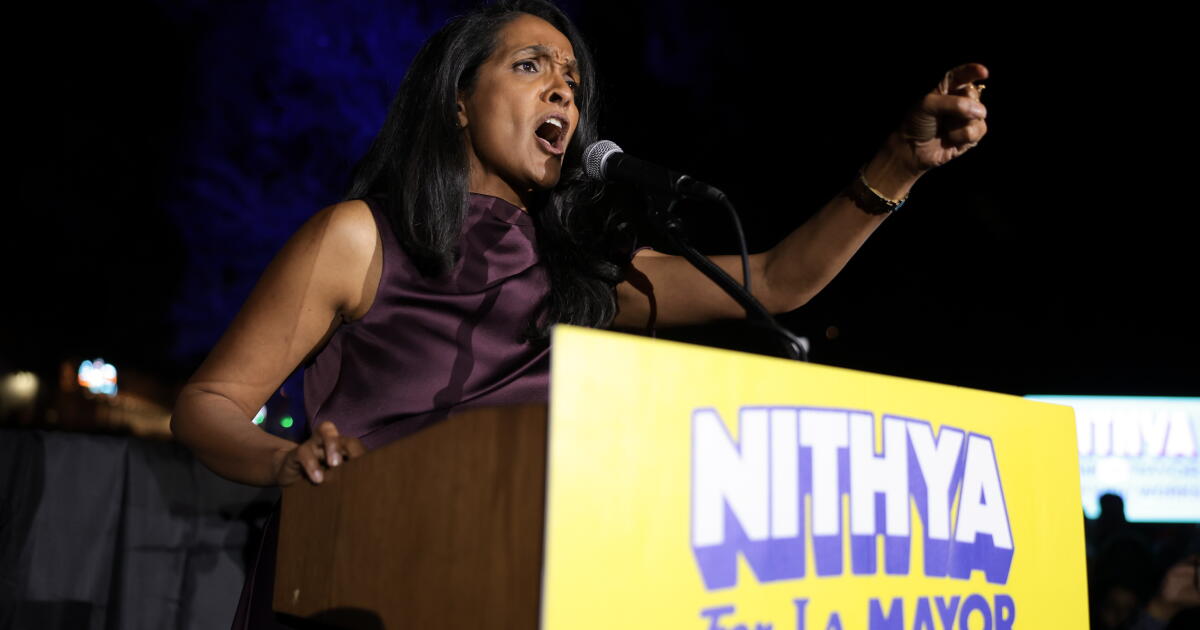
She’s got political savvy, good timing, or both. And she’s about to become Mayor Raman
Robert Martinez, a retired IT guy, stepped out of the Eagle Rock Rec Center polling place Tuesday afternoon and said he had just filled in a ballot bubble not for L.A. Mayor Karen Bass but for challenger Nithya Raman.
“You know, I’m not really thrilled about her, either,” Martinez said, but he told me what a lot of people have been telling me.
He wanted a change.
“I saw what happened these last four years,” Martinez said, citing the continuing homelessness epidemic and the broken-down condition of the city, “and I’m hoping something different goes on this time.”
He and thousands of others were ready to roll the dice, and meanwhile, Raman began to catch fire with young progressives who were voting for her rather than against Bass.
Some votes are still being tallied, but it’s now clear that Raman will be the next mayor of Los Angeles.
And that will be remarkable, and fun to watch, for a number of reasons.
She will take over despite every single one of her City Council colleagues having endorsed Bass, which is like the least popular kid in class getting elected school president.
She will take over despite having flip-flopped on several major issues, including Bass’ signature homelessness strategy, which Raman willingly implemented until just recently.
She will take over despite having unexpectedly rescinded her endorsement of Bass and eliciting whispers in and out of City Hall that she couldn’t be trusted.
She will take over despite having lukewarm support from the very organization through which she began her rise, the Democratic Socialists of America.
Raman is either a political savant or someone with really good timing, or maybe a little of both.
Everybody in L.A. knew that Bass was mortally wounded, and ripe for a takedown, but it was Raman who had the killer instinct, a trait that could serve her and the public well, putting everyone in city government on notice.
The mayor, having spent her entire adult life in public service, had made the worst decision of her career by leaving town in January 2025 despite conditions that led to the incineration of Pacific Palisades.
And she had made homelessness her marquee issue with scant progress to show despite throwing billions at the problem.
The mayor’s unfavorability rating was so epic, “undecided” voters were neck in neck with supporters of either Raman or Bass, and even the knuckleheaded former TV reality star Spencer Pratt looked like a solid contender in the primary.
But winning the election may turn out to be much easier than fixing City Hall.
Roads and sidewalks are falling apart. The Palisades rebuild is a maddeningly long work in progress. The homeless count tops 40,000. New housing takes forever. The cost of living swallows paychecks. The budget for just about everything is tight, and more of it will go to parks with the passing of the measure to set aside more for greenery. And the ‘28 Olympics are coming our way.
“You have all of these wicked problems that are difficult to solve in a perfect scenario, and [even more] in a governmental system as tangled and confused as L.A.,” Cal State Northridge political science professor Tom Hogen-Esch told The Times’ Jennie Jarvie.
Tangled and confused is an understatement. Homelessness does not get solved without the help of the county, which generally oversees mental health services and drug intervention and rehab.
On the bright side, it’s possible that L.A. will be able to wrangle more federal assistance now that the bloated carcass of President Trump’s political career is floating in the reflecting pool on the National Mall.
And Raman will have two key allies in City Controller Kenneth Mejia, who monitors and critiques City Hall’s many inefficiencies, and in Los Angeles County Supervisor Lindsey Horvath, who is a potential candidate for the new position of county executive.
“You’re right. It is daunting,” Horvath said of the countless challenges. “But I don’t think it was a secret to Nithya when she got into the race.”
Raman’s campaign, Horvath said, was about building power by acknowledging the exasperation of voters rather than building traditional coalitions in what has been an unresponsive political establishment.
“Whether or not you like each other, or formally agree or disagree, when people are able to accomplish change that the public is longing for, everybody wants to be a part of that win,” Horvath said.
Among City Hall’s problems has been a mummified tolerance of arthritic leadership and the rusted machinery of basic services. Raman, for better or worse, might be inclined to push-start the old jalopy, oil the gears and throw department heads overboard if they don’t deliver.
Early on as a council member, Raman told me she was sorting out the fragmented response to homelessness, having identified overlapping services, a lack of accountability, and broken lines of communication and coordination. In her district, homelessness has declined, and she has called out Bass for the high cost, slow pace and low returns of the mayor’s efforts.
“I know this about Raman,” Horvath said. “She is not afraid of a tough conversation.”
She’s definitely going to have them. As a YIMBY who favors greater housing density, there will be pushback in some neighborhoods. And her opposition to bans on homelessness in certain public areas (she prioritizes solving problems rather than relocating them), will test patience. As reflected in the relatively tight election, nearly half of voters are a bit wary about whether Raman would move the city’s policy and philosophy orientation too far to the left.
In San Francisco, according to USC political science professor and pollster Christian Grose, Mayor Daniel Lurie’s popularity has dipped a bit since he took office in 2024 and tackled issues similar to those in L.A., but it remains high. Grose said Lurie won immediate support and high marks among both moderates and progressives by cleaning streets and moving people indoors while also working on longer-term problem-solving.
Raman could conceivably try that formula, Grose said, and take advantage of what figures to be a honeymoon period with voters who are hungry for change. The question will be whether the honeymoon turns into a longer romance.
In Pico-Union, retired airline attendant and interpreter Aurora Corona has seen some neighborhood improvements of late. But she has long been unhappy overall with the lack of progress on homelessness, trash and infrastructure issues like broken street lights.
“It’s not working,” Corona said, telling me she visits other cities that are in better shape and wonders why L.A. can’t sort through its bureaucratic sclerosis. She doesn’t put all of that on the mayor, though, and said that after considering Raman, she voted for Bass even though she wants to see a shakeup.
“Whoever it is, I’d like to see some changes for the better,” Corona said.
In Studio City, Jon Manzanares and neighbors spent five years reporting encampments and myriad problems at an abandoned property. They tried city departments and got no help, and they tried Raman’s office repeatedly, with the same result.
In September, a fire at the abandoned property spread to an adjacent house, and finally, Raman and Bass both showed up and blamed each other.
“Between Bass and Raman, I wasn’t happy with either,” Manzanares said.
He wants a mayor who does a better job of getting homeless people whatever help they need, who respects the frustrations of taxpayers, and who demands more accountability regarding all the money thrown at various entrenched problems.
“I ended up voting with Raman,” Manzanares said. “I feel like Bass had her shot and didn’t do much with it.”
And now it’s Raman’s turn.
Good luck to her, and to nearly 4 million Angelenos hungry for change.
steve.lopez@latimes.com