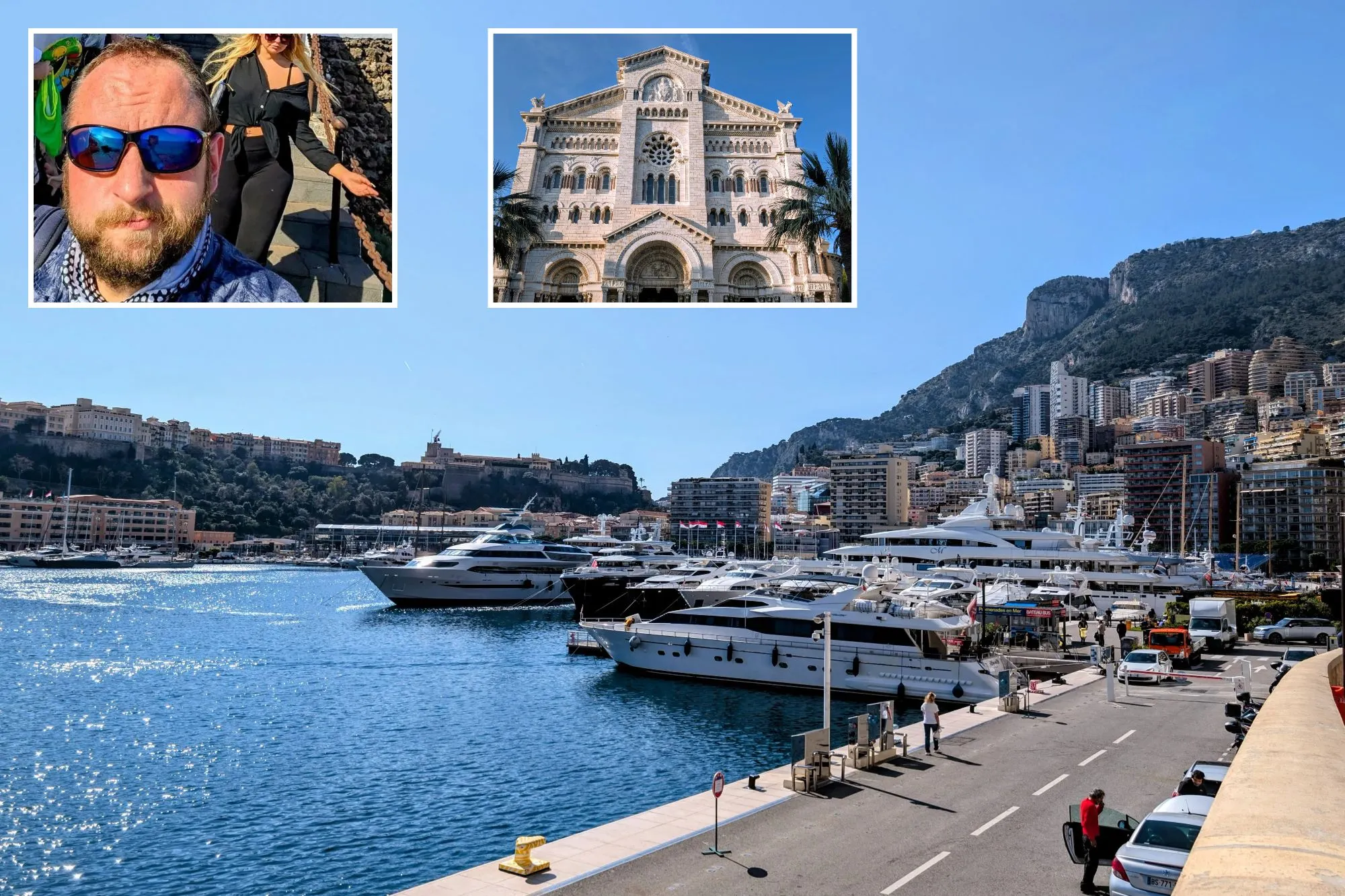
A MAN has revealed how he managed to visit two countries in two days for under £100 – and was back in time for work the next morning.
Aleksander Sikora, 41, wanted to visit both Nice and Monaco on his two days off.
Sign up for the Travel newsletter
Thank you!
Aleksander Sikora managed to visit two countries in one trip for under £100Credit: SWNSHe spent his first day exploring Monaco before going to NiceCredit: SWNSHe made sure to visit the free attractions to keep costs downCredit: SWNS
The dad-of-two, who lives in Farnham, Surrey, bought easyJet return flights from Gatwick to Nice for just £48 which departed on Friday, March 13, and returned the next day.
His pre-trip costs included £13 parking, and be paid £19 for a hostel in Nice before departing as well.
After arriving in Nice, he went straight to Monaco by train (£6) to explore the sights of the famous ‘microstate’ – known for its beautiful buildings and wealth.
He visited the area around Monte Carlo’s casino and saw the Promenade des Champions – golden footprints of award-winning footballers.
Aleksander said: “I went to The Cathedral of Our Lady Immaculate, which was free to enter, and I went to the Prince‘s Palace of Monaco on the hill.”
Aleksander fuelled up throughout the day on a packed lunch be brought with him, although did splash out on some pizza from a local market stall.
He got a train back to Nice – squeezing in a visit to the Notre-Dame de Nice in the dark – where he slept and then had breakfast at the hostel the following morning.
The £19-a-night cost amazingly even included a breakfast of croissants, baguettes and coffee for the bargain price.
Aleksander said: “I am from Poland and somehow one of the other men in the hostel was too.
“Another of the men from the hostel suggested to go to the Russian Orthodox Cathedral so the next day that was what I did.”
Entry was free there too, so he explored after stocking up with more snacks and drinks from a local supermarket.
He walked up to the Colline du Chateau, which offers panoramic views of Nice, and took in the sights.
Aleksander then visited a museum to get some more history of Nice, before a gentle walk back to the airport.
He said: “That was another six miles or so, but I just looked around the streets, chilled out and relaxed.
“I put my headphones in, and just thought about nothing, enjoying my break from work.”
After spending his second day exploring Nice, he got back to the airport to catch his 9pm flight back to Gatwick – and was in bed by 11:30pm, ready for work the next day.
He said it was the best way to see as place – as long as you don’t mind a lot of walkingCredit: SWNSHis hostel even included breakfastCredit: SWNS
Aleksander, a retail employee trainer, said: “I saw a lot of historical things, if you like that kind of history it’s great.
“I studied history for three years, it’s a passion of mine and there is lots to discover.
“I walked around 30 miles in two days, but I don’t mind. I just relaxed and enjoyed it.”
And the entire trip cost around £100 thanks to Aleksander’s savvy travelling methods and bringing his own food.
He added: “The main beauty of the trip was the architecture, all the different cultures.
“You can’t compare them but every place is unique, and you can find beauty everywhere.
Full cost of Aleksander’s trip
Return flight ticket – £48
Car park Gatwick – £13
Night in Nice with breakfast – £19
Train from Nice to Monaco – £6
Train from Monaco to Nice – £5
Half a pizza in Monaco – £3.50
Croissant & Coffee in Nice – £3
Supermarket water and snacks – £2
= £99.50
He was back in time for work the next dayCredit: SWNS
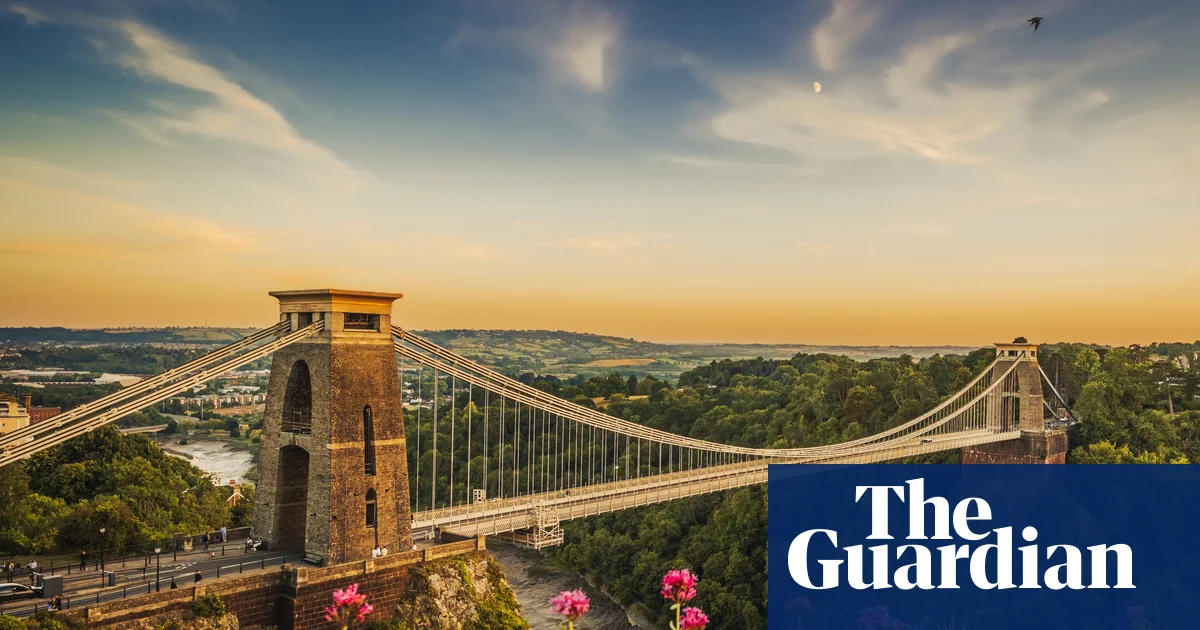
I always take friends on an afternoon walk when they visit Bristol, to experience the swift changes in scenery: starting at the tobacco warehouses of Cumberland Basin before ascending from the muddy banks of the River Avon up into Leigh Woods, a national nature reserve. As well as possible animal sightings like peregrine falcons and roe deer, the woods are an important site for whitebeam trees, with several species only growing here. It’s easy to spend a full afternoon crisscrossing the trails before walking over Brunel’s famous suspension bridge for a well-deserved coffee at the Primrose Café in Clifton village. Tor Hands
Profile
Readers’ tips: send a tip for a chance to win a £200 voucher for a Coolstays break
Show
Guardian Travel readers’ tips
Every week we ask our readers for recommendations from their travels. A selection of tips will be featured online and may appear in print. To enter the latest competition visit the readers’ tips homepage
–
A seal colony on a Cumbrian island
South Walney has an ‘end of the world feel’. Photograph: Rebecca Alper Grant
South Walney nature reserve (£3 adults, £1 children) has an end-of-the-world feel. You drive through industrial Barrow-in-Furness to reach a windswept island that’s home to Cumbria’s only seal colony and a multitude of migrating seabirds. Curious seals surface as you gaze across the water towards Piel Castle, which can be reached by foot at low tide. More seals can be observed from the immaculately kept hides, full of hand-drawn illustrations, local history and specimens of skeletons and shells. There is even a livestream seal cam for a closer look. Rebecca Alper Grant
Dartmoor’s way of the dead
Bellever Forest, starting point of the Lych Way. Photograph: Michael Howes/Alamy
Across Dartmoor’s torn spine, the Lych Waydrags its long memory westward. Moor folk once hauled their dead like felled trunks, boots sinking in peat’s cold hunger. Wind gnawed faces raw; streams stitched ice through bone. Wheel ruts scarred earth, a ledger of grief. Farms emptied into distance, toward stone prayers waiting. Ravens watched slow processions darken the moor. Ten miles north, Ted Hughes’s memorial stone listens, weather-drunk, to their passing weight, and silence rooting deeper than time beneath heather, where footsteps fade yet pulse on, buried but breathing in Dartmoor’s black remembering heart that never loosens them. John Chrimes
A cemetery now full of life in London’s East End
Photograph: Katharine Rose/Alamy
Tower Hamlets Cemetery Park is a truly magical place. Not your typical local nature reserve, and not your typical Victorian-era cemetery, this now deconsecrated space is truly a haven for human and non-human visitors. The site attracts an impressive array of flora and fauna thanks to its carefully “managed wildness”– an essential respite in London’s East End. Wander at your own pace or join the Friends (the charity which has carefully defended and managed the space since the 1990s) for a tour covering topics ranging from foraging and fungi to women’s history and grave symbolism. LR
Coastal birding and a castle in Dumfries
Caerlaverock Castle. Photograph: Paul Williams/Alamy
The Dumfries and Galloway coast is a beautiful but often overlooked gem among Scotland’s natural offerings. Caerlaverock national nature reserve on the Solway Firth is a highlight, with its protected wetlands serving as a seasonal home for thousands of migrating birds, including geese, plovers and waders. It lends the place a year-round charm, even in the cold winter months. And if birdwatching isn’t your thing, you can still enjoy the excellent walks and cycle paths, stunning views and a rare sense of peace. Make sure to check out the nearby Caerlaverock Castle (from £6.50 adults, £3.90 children), with its picturesque setting – and unique triangle shape! Allan Berry
Historic sailing on the Norfolk Broads
Traditional wherry boat on the Norfolk Broads. Photograph: Chris Herring/Alamy
We were holidaying in the Broads national park when my husband told me that my birthday present was a day out on a historic wherry yacht. At the boatyard in Wroxham, an enthusiastic crew showed us round the boat, and within a few minutes we were watching the huge gaff-rigged sail rise up the mast. We sipped our tea, gliding silently past the reeds, and stopped for a guided tour of Bure Marshes national nature reserve. Lunch was a picnic on Salhouse Broad, and a treat was a cornet from the ice-cream boat. A perfect day on the water for £60 each. Allison Armstrong
London’s hidden wetlands
Photograph: Jennika/Stockimo/Alamy
Not many Londoners know that there is a real treasure of a nature reserve just 20 minutes from the city centre by tube. The Walthamstow Wetlands is a protected area, easily reached via Tottenham Hale railway/tube station. I often spend a day there with a picnic, a bird guidebook, a flask of coffee and a pair of binoculars. Birds come to the site to feed around the 10 areas of open water and marshland. Swifts and little ringed plovers arrive in spring. Much-travelled black-tailed godwits can also be seen and there’s even the chance of spotting a peregrine falcon. Enjoy the circular bird walk, viewing platforms and hiding areas. There are also weekly guided bird walks starting from the tube station from early spring. It’s free to enter and wander around the nature reserve. Trees and wild fauna abound everywhere you go – a brilliant oxygen overload after the traffic fumes of central London. Joe
Hampshire’s alluring lagoons
Photograph: Richard Donovan/Alamy
I only meant to stop briefly at Titchfield Haven national nature reserve (£6.50 adults, £3.50 children), but it drew me in for the entire afternoon. Tucked between river and sea, it feels a world away from the busier south coast. I wandered slow, winding paths through reed beds and lagoons, pausing in a hide where a sudden flash of electric blue revealed a kingfisher. As the tide shifted, the landscape subtly changed and the light softened across the water. Nothing here shouts for attention, and that’s the magic of it – a place where doing nothing feels completely absorbing. Diane
Lakeside magic in Eryri (Snowdonia)
Sunrise on the Carneddau mountain range above Llyn Crafnant reservoir. Photograph: Steve Robinson/Alamy
Near Trefriw in the Eryri national park, there is a scenic walk around Llyn Crafnantreservoir. You can also walk over to Llyn Geirionydd from Llyn Crafnant to swim in the lake or paddleboard; it can get a little busy in the summer but it still feels like a little bit of a secret spot. For a big hike, you can walk down from here, past Crimpiau mountain, to Capel Curig, taking you from the Conwy valley to the Ogwen valley. Bethan Patfield
On safari in Kent
Photograph: Rob Read/Alamy
The approach to Elmley national nature reserve (£10 adults, free for up to two accompanying children) is thrilling: precious saltmarsh habitat sandwiched between the elegant Isle of Sheppey road bridge and the looming hulk of a paper factory across the Swale estuary. The reserve’s safari-like access drive is surrounded by bubbling curlews, darting hares and patrolling marsh harriers, while lapwings cavort just feet from the car. As well as being the UK’s only privately owned national nature reserve, Elmley is also the only one you can stay overnight, so you can sip a drink outside your cosy hut or yurt while short-eared owls hunt for small mammals and barn owls glide silently past. Watching the wildlife action unfold on your own personal savannah is magical. Cathy Robinson
Profile
Readers’ tips: send a tip for a chance to win a £200 voucher for a Coolstays break
Show
Guardian Travel readers’ tips
Every week we ask our readers for recommendations from their travels. A selection of tips will be featured online and may appear in print. To enter the latest competition visit the readers’ tips homepage
The medieval town boasts cobbled streets, Tudor architecture and rich history – including the reportedly ‘haunted’ Inn that dates all the way back to 1420
The street is at the heart of the town(Image: Getty)
Preserved precisely as it was during mediaeval times, this picture-perfect town boasts a rich history, which is vividly displayed through its stunning architecture.
Nestled in East Sussex, Rye is a hilltop town featuring cobbled streets, charming buildings and a deeply-rooted history. Many buildings remain untouched to preserve their original character, serving as key attractions for the town’s tourism and heritage.
Just two hours from London, this scenic destination isn’t quite a seaside location, but it’s near enough to provide the perfect stopping point between your journeys to the coast.
Indeed, over the years the town has shifted further inland, due to changing coastlines, and whilst no longer on the waterfront, it was once home to a bustling port, now reclaimed by nature.
During mediaeval times, when the town was firmly established with its layout and architecture, it served as a major seaport and ‘cinque port’, which helped to protect against French invasions.
Today it provides the ideal day trip with independent shops, boutique hotels, delicious food spots, and historical landmarks.
Mermaid Street
This charming high street in Rye is frequently described as one of the most attractive in the entire country, with beautifully constructed buildings positioned along a delightful cobbled lane.
One visitor said on TripAdvisor: “A very quaint cobblestone street from the early mediaeval times; some of the buildings were outstanding and well worth a visit and walk up the hill.”
Another visitor commented: “Mermaid Street was definitely one of the highlights of our trip to Rye, and I recommend you set aside at least half an hour to explore this stunning street and take some great photos.”
This charming lane features timber-framed houses from centuries past, many of which enjoy protected status to preserve their historical significance.
Several of the properties, for instance, display plaques bearing distinctive names, including The House with Two Front Doors and The House Opposite, and tourists frequently stop to take photographs outside them.
Whilst it remains a picturesque, Instagram-worthy spot today, it was previously quite the opposite, regarded as one of the town’s most deprived areas. An 1891 census showed it had a notorious reputation as a rat-infested street where more than 70 children crammed into cramped homes, generating a chaotic environment in the locale.
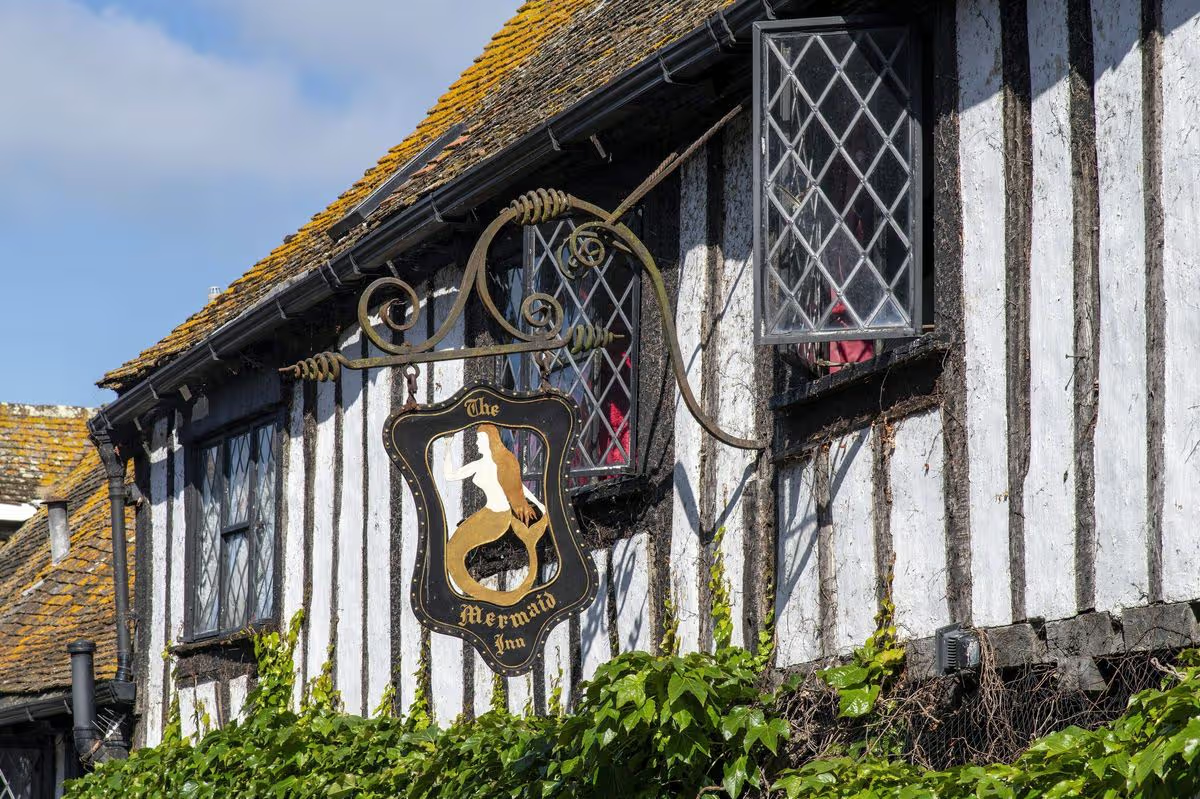
Situated at the very centre of the road, and believed to have given the street its name, is the Mermaid Inn, a hotel that’s been described as one of Britain’s most haunted.
Haunted Hotel
Spanning more than 600 years, this establishment, which offers bed and breakfast accommodation, is a genuine historical treasure, complete with spine-chilling tales to match.
The Mermaid Inn boasts cellars originating from 1156, whilst the structure itself dates to 1420, providing an authentic step back in time for guests and day-trippers alike.
With its sloping ceilings, creaking floorboards and labyrinth of staircases, the building is brimming with character and has been modernised to accommodate an excellent restaurant and two bars, alongside a spacious patio.
For visitors not planning an overnight stay, exploring indoors remains an option. Fortunately, on the final Sunday of each month the proprietor provides a guided tour through the historic rooms as you journey back through the centuries.
After visiting the hotel, one guest said: “We have stayed at the Mermaid Inn a few times before and have never been disappointed. If you go to Rye, you really have to stay at The Mermaid.
“As soon as you walk into this place, you feel the atmosphere of its history, a real step back in time, a time to leave the fast pace of life behind as you enjoy this wonderful place, a feeling of privilege of actually staying there.”
Yet it has a reputation of another kind entirely, thanks to its considerable age, having witnessed countless visitors pass through its doors, while others seemingly refuse to depart, as their spirits linger on.
Multiple rooms are believed to harbour various ghosts, each with their own unique tales, and some guests actively request these particular rooms for precisely that reason.
Take Room 19, the Hawkhurst room, where a guest once reported encountering a gentleman perched on her bed, dressed in period attire. Meanwhile, Room 1 is haunted by a lady in white, or grey, who prefers to sit in a chair beside the fireplace – her favoured haunting location.
In fact, their website catalogues every spectre said to inhabit its premises and the tales that have evolved over time as guests continue to report eerie encounters during their stay. One such instance is tied to room 10, with Fleur De Lys.
The website reveals: “Several years ago, a bank manager and his wife were awakened to find a man walking through their bathroom wall and across the centre of the room. They were so frightened that they spent the rest of the night downstairs in one of the lounges and made the porter bring all their luggage downstairs, plus their clothes.”
The most affordable place for a week-long holiday has been revealed – and it’s a stunning beach resort town that’s perfect for a summer escape
This article contains affiliate links, we will receive a commission on any sales we generate from it. Learn more
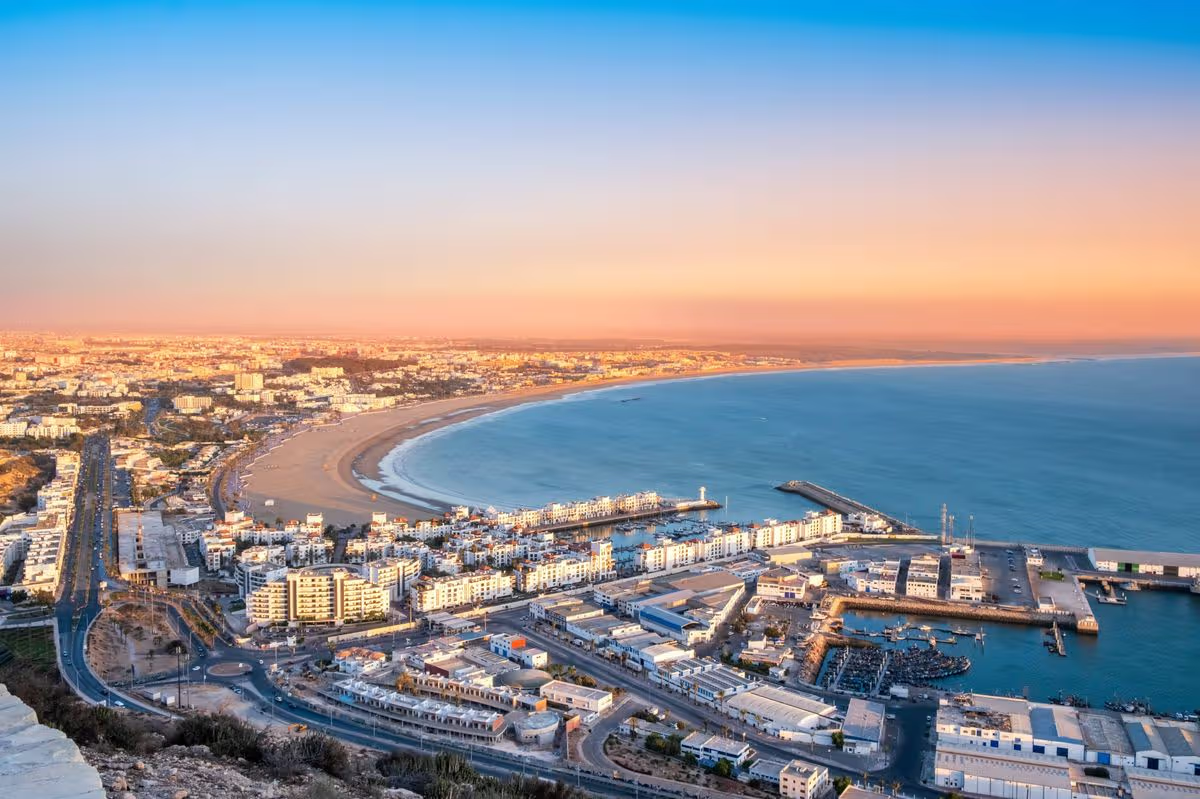
This beautiful resort town so famous for its beaches(Image: Julia Lavrinenko via Getty Images)
With the arrival of warmer weather, it’s time to start planning your summer getaways. If you’re pondering where to jet off to this year, there’s one destination that should be on your list.
This breathtaking beach resort town has been crowned as the most budget-friendly spot for a week-long holiday. A seven-day stay in this picturesque town will set you back £230 all-inclusive.
This research is courtesy of online travel agent loveholidays who have identified the cheapest locations for a break.
Taking the top spot is Agadir in Morocco. Renowned for its laid-back coastal atmosphere, this stunning resort town is the ideal summer retreat.
It’s situated on the western coast of Morocco, five hours from the capital city of Casablanca.
The town nestles near the base of the Atlas Mountains and boasts a population of over half a million people.
It’s celebrated for its gorgeous beaches – Plage d’Agadir in the city centre and the equally enchanting Plage Aourir to the north, both offering wonderfully soft sands and warm temperatures.
The climate is mild throughout the year, with winter temperatures averaging 20.5°C, but in the summer months, it climbs into the mid to high 20s – perfect for a sun-soaked getaway, reports the Express.
If you book a package hotel between the June 1 and August 31, you can secure an all-inclusive stay for as low as £33 per person per night.
If Morocco doesn’t tickle your fancy, there are plenty of other destinations to choose from. Coming in second place for the most affordable are the Costa Dorada at £381 and Murcia at £399.
Lanzarote and Goza in Malta also present extremely cost-effective choices if you’re seeking some sunshine.
Al Murray, chief marketing officer at loveholidays, stated: “Our ranking shows that a week of summer sun doesn’t have to carry a premium price tag.
“Whether it’s the beaches of Agadir or firm favourites like Costa Dorada and Lanzarote, all offer incredible value for money; a top priority for British holidaymakers.
“By highlighting these affordable hotspots, we’re helping travellers plan ahead and secure a summer getaway regardless of their budget.”
Travelling with kids can be stressful, but a new data analysis has revealed some of Europe’s most child-friendly city breaks which offer accessibility and plenty to keep kids entertained
The city is a family-friendly choice(Image: Getty Images)
With the Easter break, May half-term, and bank holidays coming up, many parents will be looking for ways to keep the kids entertained. While you might not have considered taking younger kids on a city break, it can be a fun option if you’re looking for a short break.
That’s why LateRooms has put together the Family Breaks Index– a data analysis that pulls together information that’s of interest to people travelling with young children, such as flight and transfer times, walkability, accessibility for those bringing pushchairs, and the child-friendly attractions on offer.
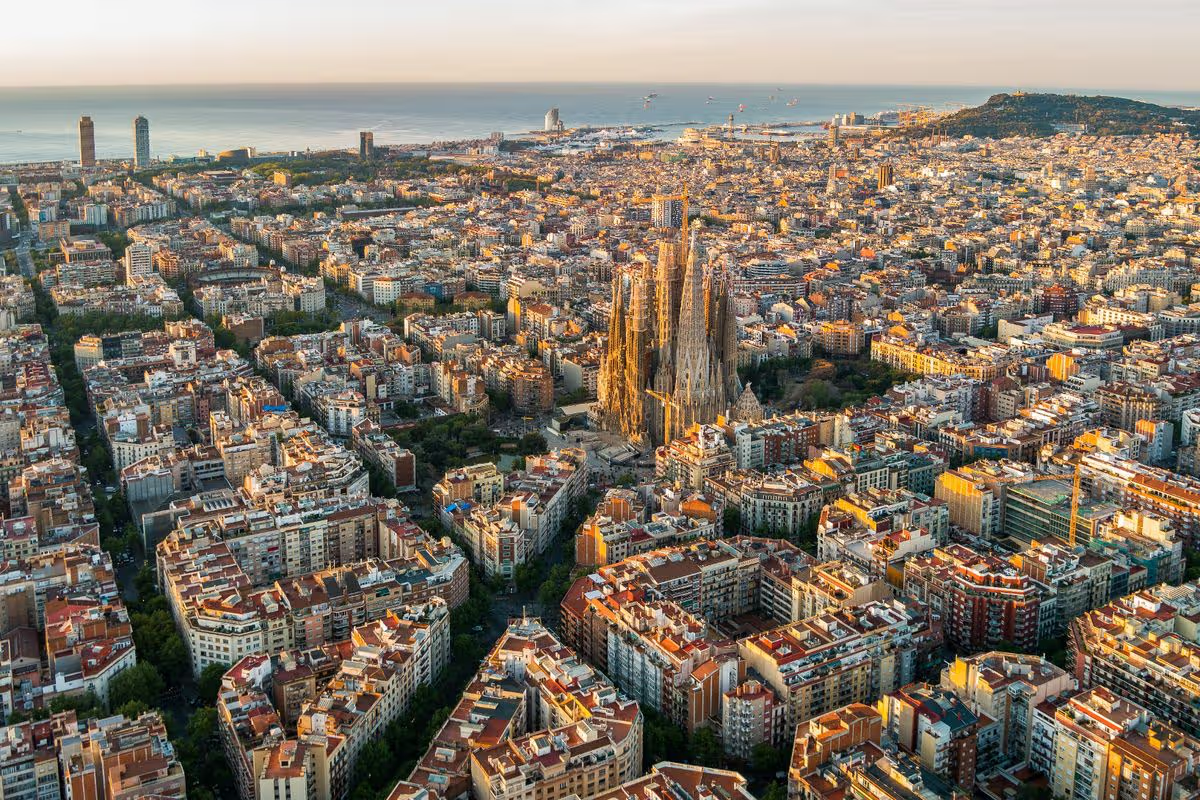
Coming in at number three is a Spanish city that has long been popular with Brits for city breaks, and its short flight time and easy walkability have seen it score highly for family trips too.
Barcelona flights are just over two hours from the UK, and on arrival, visitors can hop on the airport train to the centre, which takes just 25 minutes. This makes it ideal for people travelling with young children who wouldn’t be able to do a long journey.
The city has a flat, walkable centre, with many major tourist attractions just a short walk apart. This means it’s easy to navigate with a buggy, and little legs won’t get worn out from a day of sightseeing.
According to LateRooms, the city has about 400 family-friendly attractions, so you won’t have to deal with kids complaining they are bored. To start, there are classic tourist attractions such as the Sagrada Família and Gaudí’s unique and colourful Park Güell, both of which are impressive enough to keep kids enthralled.
Kids love science museums, and Cosmocaixa is an unforgettable day out. One of Barcelona’s largest museums, the entire experience is interactive, full of engaging activities that teach kids about the creation of the cosmos. The museum takes visitors on a journey through the natural world, from the past to the present.
Tibidabo Amusement Park is a great place to see views of the city and enjoy charmingly old-fashioned fairground rides. It’s set on a hill that overlooks Barcelona, and as you ride the Ferris wheel or drop rides, you can enjoy seeing the city below.
A dream day out for kids could well be the Museu de la Xocolata, the chocolate museum, where you can see huge sculptures made from chocolate, including kids’ TV and film characters. It also runs chocolate tasting and making workshops, and once you’ve explored, you can indulge your sweet tooth at the café with a rich and creamy hot chocolate.
One advantage of Barcelona over other city breaks is that it also has a beach nearby, so you can explore the city in the morning and let the kids swim or build sandcastles in the afternoon. The seaside neighbourhood of La Barceloneta is popular with families thanks to its access to a long sandy beach, and it has its own metro station, making it easy to get around the city.
In May, flights to Barcelona start from just £27 one way based on flights from London-Luton with Wizz Air. The weather in May often hits highs of 23C with little rain, making it an ideal time of year to explore.
A pretty UK town packed with independent shops, cosy tearooms and acres of green space, has been named as the ‘most welcoming’ destination, and after a visit, you might never want to leave
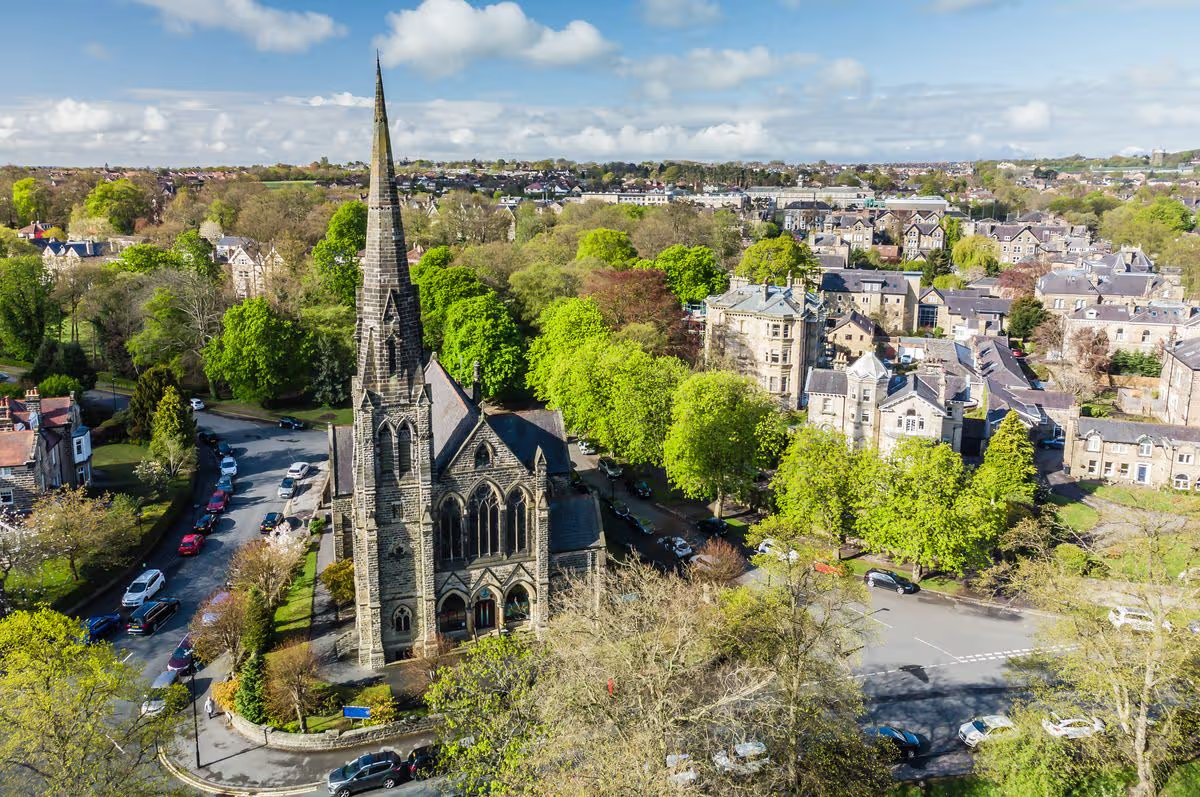
This pretty UK town has been named as the ‘most welcoming’(Image: Getty Images)
There’s a list of beautiful UK towns that offer an idyllic day out, whether that’s taking a stroll along their meandering rivers or exploring their cobbled streets lined with medieval architecture.
Yet there’s one that’s been named the ‘most welcoming town’ of them all, thanks to warm charm you’ll struggle to find anywhere else.
Harrogate, in North Yorkshire, is a Victorian spa town known for its mineral springs, 200 acres of green space at The Stray park, cosy tearooms, independent boutiques, and, famously, the home of Yorkshire Tea. It has often been hailed as one of the happiest places to live and has once again secured the title of the most welcoming town in the UK.
Thanks to its warm and friendly atmosphere, hospitality, and repeat visitors, Harrogate was named the UK’s most welcoming destination in Booking.com’s 2026 Traveller Review Awards. It’s even thought that its tea heritage and charming tearooms could have something to do with its ranking, as a quarter of Brits associated a visit to the Yorkshire town with a cosy cup of brew.
Whether it’s a warming cuppa in one of their tearooms, cafés, hotels, or even pubs, the town’s history can’t be ignored, as it’s where the black tea blend of Yorkshire Tea has been produced by the Bettys & Taylors Group since 1977. It’s also home to the delightful Bettys Café Tea Room, offering afternoon tea in the imperial room of freshly baked scones and, of course, their signature tea.
But that’s not the only tearoom in this town. There’s also Jenny’s Tea Shop, Mama Doreen’s Emporium, and another Bettys Café Tea Room, just on the outskirts of the town.
Yet, away from its brews, streets are lined with boutiques, with Montpellier Quarter boasting more than 50 independent shops, bars, restaurants, antique shops, and art galleries. There’s also Cold Bath Road, which offers more eateries and shops, all while paying homage to the town’s spa heritage.
Harrogate is known as the ‘English Spa’ thanks to its mineral springs, which were discovered in the 16th century. It quickly became known as a wellness destination, thanks to its open green spaces, spa treatments, fresh air, and famed waters.
Today, there are original Turkish Baths for a relaxing treatment and the Royal Pump Room Museum for a closer look into the town’s spa heritage. Harrogate has remained known as a spa town and continues to attract visitors seeking to unwind from the stress of everyday life.
The town is characterised by Victorian and Georgian buildings, some of which make up its collection of hotels, and there are plenty of B&Bs available in the area. That’s when you can tear yourself away from the ample green spaces, with its position on the edge of the Yorkshire Dales National Park, a haven for avid walkers.
With acres of pristine landscapes, Harrogate is home to beautiful parks and tranquil gardens that offer scenic strolls during the warmer months. One of its most popular attractions, which welcomes around three million visitors a year, is the Grade II-listed Valley Gardens, featuring various areas to admire.
Whether you’re looking for a day out away from the city or a weekend escape, you might just feel at home in Harrogate. Plus, it’s nestled just over a 20-minute train journey from Leeds and half an hour from York, making it even more convenient.
Ryan Pearson, regional manager for UK and Ireland at Booking.com, said: “Booking.com’s Traveller Review Awards celebrate destinations that consistently deliver exceptional hospitality, and Harrogate has earned recognition as one of the UK’s most welcoming towns for this specific reason.
“Guests frequently praise the town’s friendly, attentive hosts and genuinely warm atmosphere, which makes visitors feel instantly at home. While Harrogate charms with its historic spa buildings, elegant streets, and beautiful surrounding countryside, it’s the town’s authentic, personable hospitality that inspires repeat visits and rave recommendations from travellers.”
Do you have a travel story to share? Email webtravel@reachplc.com
Most people think you can’t walk without an Achilles tendon. Jo Giese begs to differ, especially since she hikes without one.
The L.A. hiker, journalist and community activist shares her journey of recovery in her new 240-page book, “You’ll Never Walk Alone: A Hiker’s Memoir of Adventure, Tragedy, and Defying the Odds” (Amplify Publishing). Giese outlines how one fall down the stairs led to eight surgeries and a relentless search for answers for how she could return to the trails she loved.
“The reason I wrote the book is to inspire others,” Giese said, “that if you’re given a grim diagnosis — and it certainly doesn’t have to be your left Achilles — you do not have to accept it.”
You are reading The Wild newsletter
Sign up to get expert tips on the best of Southern California’s beaches, trails, parks, deserts, forests and mountains in your inbox every Thursday
By continuing, you agree to our Terms of Service, which include arbitration and a class action waiver. You agree that we and our third-party vendors may collect and use your information, including through cookies, pixels and similar technologies, for the purposes set forth in our Privacy Policy such as personalizing your experience and ads.
Like many of us, Giese’s love of the outdoors started early. At age 5, she regularly took walks alone from her family’s home on Lake Washington Boulevard in Seattle. Wearing a frilly pinafore dress and Mary Jane shoes, she’d walk a few blocks to Seward Park, pausing at the playground, where she’d persuade someone to push her on the swing. That wasn’t the main goal of the trip, though.
“There is a path that leads up into the middle of the peninsula in this old growth forest. The canopies of the trees are two and three stories high. You’re just walking in this green wonderland,” Giese said. “And then after I finished walking all the way up as far as I wanted to go, I’d come back, and I’d walk back along [the route] and go home.”
The cover of “You’ll Never Walk Alone”; and a photo of author Jo Giese.
(Amplify Publishing; Dan Fineman)
Giese has been a walker and hiker ever since, falling in love with waterfall hikes in particular. Giese and her husband, Ed, split time between their house near L.A. and a home in Bozeman, Mont. They hike in the Santa Monica Mountains when they are home in Southern California, but Giese isn’t picky.
“I mainly hike anywhere I am,” Giese said.
That includes an epic vacation “jumping out of helicopters in New Zealand … in my late 60s,” she said. But neither that adventure nor any other is how Giese got injured.
It was a rainy night in late November in L.A. Giese was upstairs when her friend Lana arrived, and not wanting her friend to get drenched, Giese raced down the stairs to open the front door.
“I miss the bottom two steps, and I literally go flying horizontally,” Giese said. “My husband heard the crash. He came running, and I said, ‘Go let in Lana. She’s getting wet!’”
The trio immediately rushed to a nearby urgent care, where an X-ray showed a complete rupture of Giese’s left Achilles tendon, a thick band of tissue that attaches a person’s calf muscle to their heel bone.
Giese quickly called an orthopedist whom she’d seen for a simple knee procedure. He told her to come to his office the following day at 8 a.m. At the appointment, the doctor said, “‘I can do this. I did [an]
Hikers dressed in Dodger Blue gather for a group photo midway through a hike at Griffith Park on March 24, 2024.
(Brian van der Brug / Los Angeles Times)
Achilles repair 20 or 30 years ago. I can do this,’” Giese recalled.
Giese at Point Dume.
(Jo Giese)
In hindsight, it’s clear she should have found someone who’d done an Achilles repair “20 or 30 minutes ago,” she said. But the relief of not having to wait for surgery mixed with the shock of the moment made Giese and her husband impulsive.
“We were so frightened then — I’m in a wheelchair, and I’m all black and blue and bruised. I cannot walk. And there is someone in front of me who says he can do this,” Giese said. “And that should be a lesson to anybody.”
After the surgery to reattach her Achilles, her doctor left for a two-week vacation while Giese was at home recuperating, studiously following the doctor’s after-care guidelines. At her follow-up appointment, the nurse was unwrapping the bandage when the doctor observed, “That’s necrotic.” At the time, Giese didn’t know that word essentially meant “dead.”
The doctor immediately blamed her, saying it was from an ice burn. Both she and her husband knew that wasn’t true. Another doctor would later suggest that the surgeon introduced the infection during that first surgery.
“I don’t think I’d been so scared since my encounter with a bear,” Giese wrote in her book.
Exactly 49 days from her accident, Giese was scheduled for another surgery (with a different doctor) to debride the wound and reattach her Achilles. It was supposed to take several hours. But less than an hour into surgery, her physician told Ed that Giese’s Achilles had died. Soon, he asked Giese if she wanted to see what was left of the largest and strongest tendon in the body.
It looked like “a nasty little caterpillar that had turned fetal, curled in on itself, and died in a sea of black-and-green muck,” Giese wrote.
Next, Giese needed a skin graft to cover the wound from the previous surgeries. After that, she returned to her doctor’s office — 114 days after her accident — where her doctor removed the bandages from that third surgery and suggested something revelatory: that Giese should put her left foot down, putting her whole weight on it.
“My naked left foot — heel and five toes — made intimate contact with a floor, a cold linoleum floor, for the first time since this medical journey had begun four months earlier,” Giese wrote. From here, she walked her first 20 steps.
But recovery would come in fits and spurts. About a month later, Giese wanted to attend a festival while in Austin, Texas, only to find the 10 blocks of booths and vendors too daunting. She went back to the hotel and screamed, “I cannot walk!”
From here, she demanded better care. Giese was tired of hearing medical professionals say they’d never encountered someone without an Achilles. She wanted to find someone who was experienced with complex muscle injuries.
Her search ended 274 days after her accident when she learned about the Center for Restorative Exercise in Northridge. Giese felt dubious about another physical therapist, though. She’d already been to three physical therapy clinics, and “those had been a waste of time, energy and hope,” she wrote. But here, she was met with science and intentionality.
Taylor-Kevin Isaacs, the clinic’s co-founder, told Giese that she had other muscles still intact that could help her walk again, and she luckily hadn’t suffered any nerve damage, Giese wrote in the book. She spent the next 2½ years working with the center’s staff, which included receiving acupuncture, shockwave therapy and scar tissue massage, which was so painful “you could have heard me screaming from where you are,” Giese said.
After she completed care at the center, Isaacs nominated Giese for an award she won — an Oboz Footwear “Local Hero” award in 2024.
On the photo shoot for the award, Giese hiked with a photographer along a trail to Ousel Falls, a 50-foot waterfall in Big Sky, Mont.
It had been five years since her accident, and Giese thought back to a medical appointment in Montana the first summer after her fall. A physical therapist that Giese had been working with for about a month asked her to walk about 50 feet across the room.
“I hate to be a Debbie Downer,” the therapist said, “but you’re going to be compromised for the rest of your life.”
At that point, Giese told me, all she had was hope — that she’d get better, that she’d walk again.
Here at the waterfall, Giese told the photographer they should take the steps down to the splashdown area for a better shot. She was ready, navigating black ice like she’d done many times before the accident.
“My thought was, ‘If only that person could see me now,’” she said. “This person who said, ‘You’re going to be compromised the rest of your life, and you have to accept it.’ I thought, ‘No, I don’t.’”
3 things to do
Hikers dressed in Dodger Blue gather for a group photo midway through a hike through Griffith Park on March 24, 2024.
(Brian van der Brug / Los Angeles Times)
1. Have a home run of a hike in L.A. The Dodgers Blue Hiking Crew will host an intermediate hike at 6:30 a.m. Sunday at Griffith Park. Participants are required to wear hiking or trail shoes or boots. The group’s hikes are usually six miles and last about three hours. Register at facebook.com.
2. Clear the trail near Ojai Los Padres Forest Assn. will host a workday from 8 a.m. to 3 p.m. Saturday along the Potrero John Trail. Volunteers will meet at the Cozy Dell Trailhead before carpooling to the work site. The trail features jagged rock formations, a perennial creek and bigcone Douglas fir. Register at lpforest.salsalabs.org.
3. Wander through nature’s wonders in Whittier The California Native Plants Society San Gabriel Mountains chapter will host an easy hike from 9 to 11 a.m. Sunday through Sycamore Canyon in the Puente Hills. Cris Sarabia, conservation director for the Palos Verdes Peninsula Land Conservancy, will educate hikers on plants along the trail, both native and nonnative species. Participants should wear long pants to protect against poison oak. Register at eventbrite.com.
The must-read
Sturtevant Falls, a 55-foot waterfall, in Big Santa Anita Canyon in the San Gabriel Mountains.
(Jaclyn Cosgrove / Los Angeles Times)
Perhaps you’re reading this from a dark room, blinds drawn, fan blowing, praying for a return to spring. That’s definitely the scene where I’m writing to you! Whenever L.A. experiences an intense heat wave, I feel a little trapped. That’s why this week I updated our list of the best hikes around L.A. that will offer you shade and, in most cases, streams and rivers where you can cool down.
Please take good care, though. Hike before 11 a.m., stay hydrated and only cross creeks when you feel safe doing so.
Happy adventuring,
P.S.
Our recent weather pattern — heavy rains followed by intense heat waves — has meant wildflower season came earlier than expected in several regions of Southern California. Times contributor Jessie Schiewe outlines in this guide the hiking areas where you’ll most likely find recent blooms. For example, Towsley Canyon in Newhall, an area I have yet to visit, is likely a spot where you’ll find bright orange poppies. Want to learn a quick hack that I use to better ensure I will see blooms? Search iNaturalist, a citizen science app, for the flower you’d like to see, using the filter option to only view posts from the last two weeks. If users have recently posted, for example, about spotting poppies, your chances are higher that you will too. Keep on reading The Wild, and I promise I will keep giving you my secrets of outdoors reporting!
For the Record: Last week’s edition of The Wild said decentralized seed banks would be built by procuring seeds from L.A. County nature centers. A decentralized seed bank will be developed to procure seeds for and by L.A. County nature centers.
For more insider tips on Southern California’s beaches, trails and parks, check out past editions of The Wild. And to view this newsletter in your browser, click here.
A charming UK village has found a newfound status, thanks to celebrity chef Gordon Ramsay highlighting it as his coastal escape, with golden beaches and a booming food scene
16:48, 19 Mar 2026Updated 16:50, 19 Mar 2026
Gordon Ramsay has thrown a Cornish village into the spotlight(Image: Getty Images)
A small UK village has been thrown into the spotlight as the nation’s most searched holiday destination, all thanks to Gordon Ramsay.
Just last month, the Netflix series Being Gordon Ramsay was released, following the celebrity chef as he opened his latest venture, comprising multiple restaurants, at 22 Bishopsgate in London. While the foot of the series showed Ramsay in a professional light, it also offered a glimpse into life at home with his family and on holiday in Cornwall.
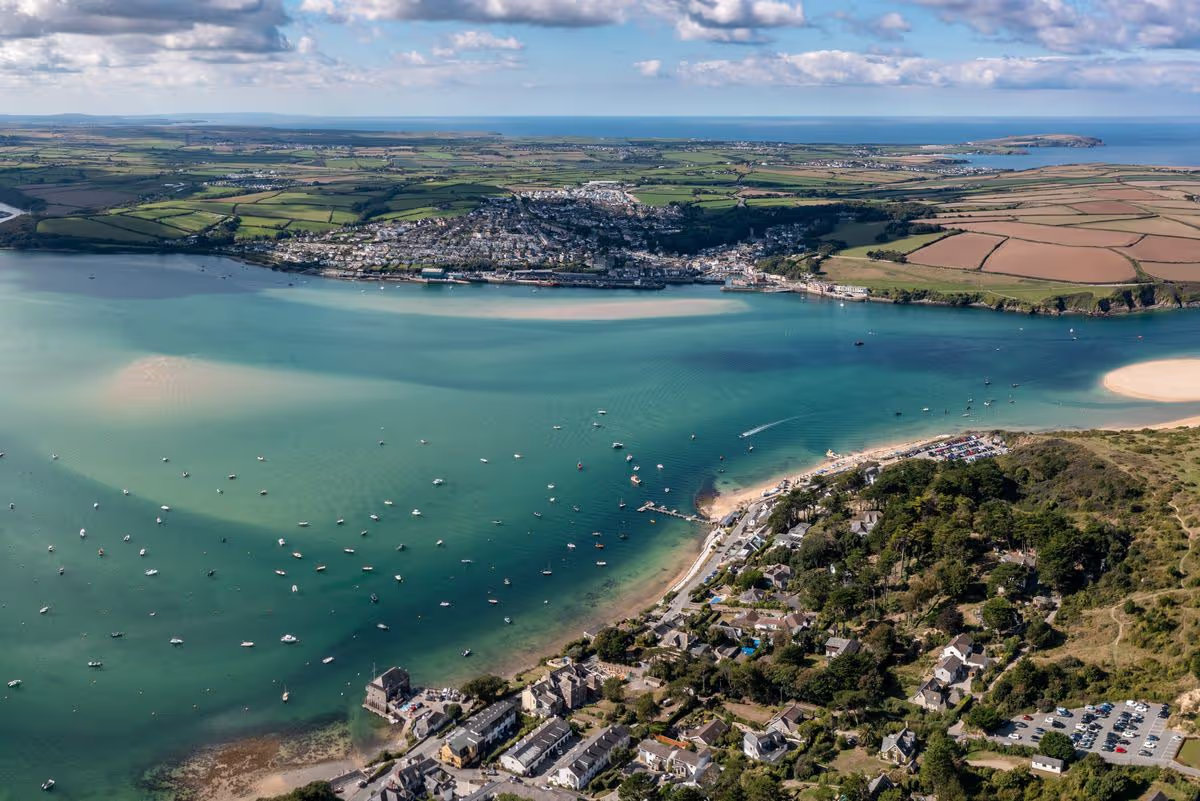
Used as his London escape, Ramsay showed viewers around his Cornwall holiday home, set in the charming village of Rock. This prompted a surge in searches around the village, situated on the Camel Estuary in north Cornwall, with fans asking, “Where is Rock in Cornwall?” and inputting “Rock Beach Cornwall.”
Elliot Walker, editor of local travel guide Cool Cornwall, said: “We always knew Rock was pretty special. But its appearance in a top TV show has dramatically boosted its fame and appeal. It’s wonderful to see more people discovering what those of us in Cornwall have quietly cherished for years.”
It was an unusual spike in attention for the village, yet one well deserved, thanks to its stretches of golden-sand beaches, thriving food scene, and status as an uncrowded haven. It’s just across the blue waters from the holiday hotspot of Padstow, and has been hailed as one of the UK’s most beautiful coastal areas.
Thanks to its position on the Camel Estuary, with its sheltered, calm blue waters, Rock is a popular spot among sailing enthusiasts and those looking to enjoy further watersports. Often dubbed the “Saint-Tropez of Cornwall”, it’s no wonder that Ramsay has chosen the coastal destination as his holiday home retreat for years, and even purchased a staggering £9.65 million neighbouring property.
“Anyone who visits Rock will understand why Gordon Ramsay has chosen this as his out-of-London retreat. The estuary views, dune-backed sandy beaches, lovely coastal walks, watersports such as sailing and wakeboarding, as well as several great restaurants and pubs, make this a truly special place to spend time,” Elliot added.
To help prospective visitors make the most of a trip to the stunning coast of Rock, Cool Cornwall has published a local guide to the area, with the best things to see and do. From exploring Daymer Bay, rockpooling at Greenaway beach, to climbing Brea Hill and dining at celebrity chef and friend of Ramsay, Paul Ainsworth’s The Mariners restaurant, there’s more than enough to enjoy during a weekend or week escape.
Elliot noted that Rock is a “wonderfully laid-back, naturally beautiful destination with real soul”, that he hopes visitors will enjoy past its newfound celebrity status. “Rock has been quietly doing its own thing for years, and it will carry on doing so long after the cameras have moved on,” he added.
“If the documentary is what brings people here for the first time, brilliant. But we’d love them to stay a little longer, explore a little further, and leave with a genuine feel for what makes this corner of Cornwall so special.”
Cornwall, which attracts millions of visitors every year, has long been an escape for Brits seeking a seaside holiday, with promises of golden-sand beaches and turquoise waters. The county has even attracted attention from film and television productions, with the likes of Poldark and James Bond using the beautiful UK coast as a backdrop.
“Cornwall is no stranger to appearances on screen,” Elliot said. “Each time there is a boost in searches for the locations featured and an influx of visitors. Rock is simply the latest example of that.”
Do you have a travel story to share? Email webtravel@reachplc.com
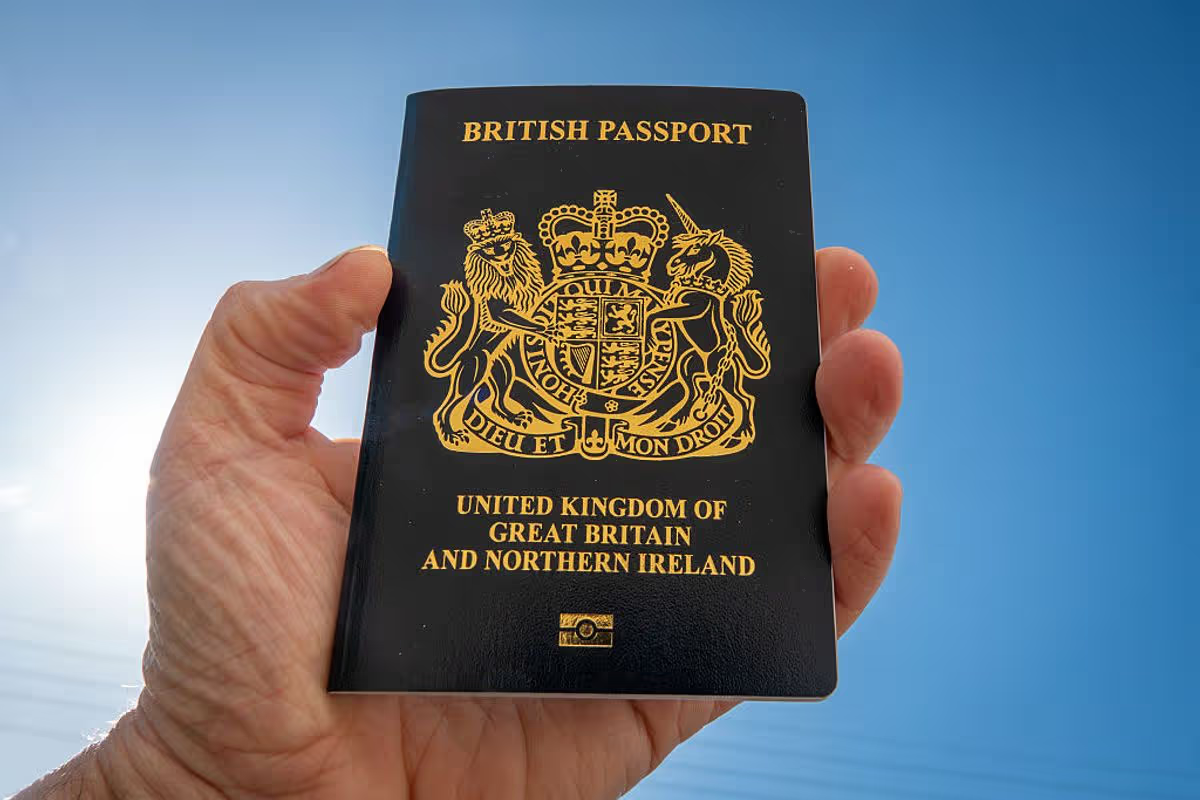
FOR the first time ever, renewing a British passport is set to cost more than £100.
That makes it one of the most expensive in the world – so if you want to avoid the rising costs, here’s how you can do it.
Sign up for the Travel newsletter
Thank you!
Renewing a British passport will cost even more from April 2026Credit: AlamyThe fee for a standard adult passport will increase from £94.50 to £102Credit: Alamy
From April 8, 2026, the fee to renew a passport online for adults will rise from £94.50 to £102.
The standard fee for children will see a £5 increase, from £61.50 to £66.50.
Postal applications will go up from £107 to £115.50 for adults and £74 to £80 for kids.
The charge for a next-day premium service made from within the UK will rise from £222 to £239.50.
The Home Office said that the price increase is to “move towards a system that meets its costs through those who use it, reducing reliance on funding from general taxation.”.
If you need to update your passport, but don’t want to pay the increased fees, there are a few ways to avoid them.
First of all, apply before April 8, 2026 so your renewal will cost the current rate of £94.50.
Second, don’t apply for a renewal by post as this will increase the fee by £13.50.
And if you’re trying to avoid high costs, apply with ample time and don’t opt for next-day premium service as this hikes up the price by over £100 compared to online renewal.
The Home Office say that the fees “contribute to the cost of processing passport applications, consular support overseas, including for lost or stolen passports, and the cost of processing British citizens at UK borders.”
It also added that last year 99.7 per cent of applications last year that needed no further information were processed in under three weeks.
Those who still have a burgundy passport need to check the expiry date on their passports, as Brits are still being caught out.
You’ll need to have the passport renewed exactly six months before the expiry date to make sure you can still travel.
For example, if your passport was issued in June 2016, but your expiry date says September 2026, that expiry is incorrect.
Instead, your passport will expire 10 years past the start date – making the real expiry June 2026.
A POPULAR holiday destination just a few hours from the UK is getting a huge new £960million airport expansion.
Mohammed V Airport in Casablanca, Morocco is currently expanding its airport with a new terminal which will be able to handle up to 20million passengers a year.
Sign up for the Travel newsletter
Thank you!
Mohammed V Airport in Casablanca, Morocco, is getting a new terminalCredit: Je-découvre
The new terminal will be ‘H’ shaped and is expected to be operational by 2029, in time for the 2030 FIFA World Cup.
It will have three levels with shops, green spaces and an airport hotel.
In addition, the terminal will be connected to Morocco‘s high-speed rail (LGV) network with links to Kenitra and Marrakech.
According to Architects’ Journal, the terminal will feature “sweeping undulations of the roof [evoking] the waves and movement of the Atlantic”.
The project also includes a 3,700-metre runway, which will run alongside taxiways and a new 42-metre-tall air traffic control tower.
British architecture firm, RSHP – who designed London’s Millennium Dome and Heathrow Airport’s Terminal 5 and control tower – will design the new terminal at Mohammed V Airport.
Ivan Harbour, senior design director at RSHP, said: “The airport will be a celebration of light, warmth and human scale, undulating from grand central spaces to intimate and calming oases, a memorable experience for all travelling through it.
“It will be a state of the art, responsible, building that interprets and celebrates the landscape of its place to create a graceful threshold between Casablanca and the world beyond.”
The airport currently has two terminals and serves around 11.5million passengers each year.
Royal Air Maroc flies direct to Casablanca from London Heathrow with flights starting from £178 one-way.
Though, with the airport expansion there could be more services to the UK in the future.
Casablanca’s main attraction is the Hassan II Mosque, one of the largest mosques in the world.
It also has a popular seaside promenade with lots of hotels and restaurants as well as Habous Quarter (known for its Moorish-style architecture, olive souks and bookstores) and the Old Medina with traditional markets.
The city is pretty cheap as well – a three-course meal for two usually costs around £23.74, while a beer is less than £3.
And the famous 1942 film Casablanca was also set in the city during World War II.
Despite mostly being filmed in studios in California, the film depicts the bustling city of Casablanca when it was used by people fleeing Nazi-occupied Europe.
It is expected to be completed by 2029 in time for the 2030 FIFA World CupCredit: Je-découvreIt will feature three levels, with shops and green spacesCredit: Je-découvre
Ahead of the busy Easter and summer holidays, the cost of a UK passport application, online and postal, are set to increase, with prices soaring above £100 for the first time
Cost of UK passport to exceed £100 for first time(Image: Getty )
The cost of all passports will significantly increase from next month as the Home Office confirms proposed plans.
The Home Office has proposed an 8 per cent increase in UK passport prices, which could see an adult pay out over £100 for the first time. The price of a child’s and a pensioner’s passport will also increase, with the changes set to be implemented from Wednesday, 8 April.
The Home Office said it will “move towards a system that meets its costs through those who use it, reducing reliance on funding from general taxation”. The fee increases are subject to Parliamentary approval.
The Home Office said in a statement: “The new fees will help the Home Office to continue to move towards a system that meets its costs through those who use it, reducing reliance on funding from general taxation.
“The Government does not make any profit from the cost of passport applications. The fees contribute to the cost of processing passport applications, consular support overseas, including for lost or stolen passports, and the cost of processing British citizens at UK borders.”
From April 8, the cost of a UK adult passport, for standard online applications, will rise from £94.50 to £102. Meanwhile, postal passport applications could rise from £107 to £115.50 for adults.
How much is a passport for children?
The standard fee for a child’s passport, for online applications, could increase from £61.50 to £66.50, while a postal application could rise from £74 to £80 for children.
How much is a pensioner’s passport?
A standard, 32-page concessionary passport is available free of charge for those who were born on or before 2 September 1929 and at the time of their application, hold any British nationality.
The government said: “Customers who naturalised or registered as British nationals will still qualify regardless when they naturalised or registered.”
While the passport is free, there may be some delivery charges to return the passport or to send any supporting documents.
Will next-day services increase?
While it’s always advisable to apply for a new or replacement passport as early as possible, a next-day premium service is available in the UK. However, the new fees from 8 April could see this rise from £222 to £239.50.
How much will overseas UK passports cost?
Those applying overseas for a UK passport online can expect a rise from £108 to £116.50 for adults and from £70 to £75.50 for children. Meanwhile, overseas paper applications will increase from £120.50 to £130 for adults and from £82.50 to £89 for children.
The last time the price of a UK passport increased was on April 10, 2025, when they rose by around 7 per cent. An adult passport soared from £88.50 to £94.50, while a child’s online application increased from £57.50 to £61.50.
Before 2025, there were increases in April 2024 and February 2023.. However, the price surge in 2023 was the first increase in five years.
The government advised that anyone needing a new passport should apply well in advance, as the renewal process can take up to three weeks in the UK or longer during peak travel periods. For more information or to apply for a new or replacement UK passport, you can visit the government website.
Do you have a travel story to share? Email webtravel@reachplc.com
The FCDO has issued numerous warnings and advice for British citizens planning to travel to, or already in, affected countries. The latest was issued earlier this afternoon and covers 31 countries
Israeli and US strikes on Iran over the past three weeks triggered a response that has grounded thousands of flights, killed more than 2,000 people and caused flight paths and ship routes to be shut down.
The FCDO has issued numerous warnings and advice for British citizens planning to travel to, or already in, affected countries. The latest was issued earlier this afternoon and covers 31 countries.
“Escalation in the Middle East has caused widespread travel disruption, including airspace closures, delayed and cancelled flights. Your travel plans may be affected, even if your destination is not in the Middle East,” the advice reads.
The FCDO advises that before travelling, UK passport holders:
check travel advice for any countries or territories you are transiting through
check for the latest updates from your airline or tour operator before travelling
review your travel insurance policy for coverage before you travel
monitor local and international media for the latest information and sign up for travel advice email alerts
Countries with updated advice
Singapore
Vietnam
Phillipinnes
Tuvalu
Laos
Thailand
Uzbekistan
New Zealand
Bangladesh
Australia
Indonesia
Brunei
Japan
Georgia
Tajikistan
Nepal
Maldives
Fiji
Malaysia
India
Papa New Guinea
Cambodia
South Korea
Samoa
Solomon
Tonga
Nauru
Vanutu
Marshall Islands
Kiribati
Sri Lanka
More than 1,300 people in Iran have been killed during the war. Israeli strikes against the Iranian-backed Hezbollah militant group in Lebanon have displaced more than 1 million people — roughly 20% of the population — according to the Lebanese government, which says more than 1,000 people have been killed. Israel says it has killed more than 500 Hezbollah militants.
In Israel, 15 people have been killed by Iranian missile fire. Four people were also killed in the occupied West Bank overnight by an Iranian missile strike, according to officials. At least 13 U.S. military members have been killed.
Iran announced the execution of three men detained in January’s nationwide protests, the first such sentences known to have been carried out, the judiciary’s Mizan news agency reported.
Today, three weeks since the war began, Iran intensified its attacks on oil and natural gas facilities around the Gulf.
The strikes, in retaliation for an Israeli attack on a key Iranian gas field, sent fuel prices soaring and risked drawing Iran’s Arab neighbors directly into the conflict. Tehran’s targeting of energy production further stressed global supplies already under pressure because of Iran’s stranglehold on the Strait of Hormuz, a strategic waterway through which a fifth of the world’s oil is transported.
Since the U.S. and Israel launched the war on Feb. 28, Iran’s top leaders have been killed in airstrikes and the country’s military capabilities have been severely degraded. Still, Iran — now led by the son of the supreme leader killed in the war’s opening salvo — remains capable of missile and drone attacks rattling its Gulf Arab neighbors and a global economy dependent on the energy they produce.
I visited a unique British city which has plenty of character, a liberal vibe and a thriving art scene, but it’s often overshadowed by its posher neighbour
The city’s Castle Park is a relaxing place to spend time in(Image: Katie Oborn)
Britain boasts numerous cities waiting to be explored, and it’s remarkable how distinctive each one is, moulded by its heritage, residents, and surrounding terrain. I recently returned to a British city I’ve visited before, and whilst much has evolved in this vibrant metropolis over the years, it frequently gets overlooked because of its more celebrated neighbour.
I’ve been travelling to Bristol for several decades now, and the city conjures up warm memories of the Lakota nightclub from the late 1990s – the night spot is still open.
This urban centre has always possessed a rebellious “soul” with an independent spirit – and in recent years, the Green Party have effectively assumed complete control of Bristol City Council. During my visit to the city, I was struck by how spotless it was in the shopping area – and also how welcoming locals were.
As with everywhere else I’ve travelled to recently, there appears to be substantial construction underway in Bristol as the need for new housing continues to surge, but the city also boasts some striking, well-maintained period buildings.
I observed that many of the historic structures in Bristol were constructed from the same stone as those in the neighbouring city of Bath – and Bristol is frequently overshadowed when compared to the more conventionally picturesque city of Bath.
Nevertheless, Bristol possesses its own distinctive appeal and a progressive atmosphere, the city has a multicultural population alongside a flourishing arts culture, as well as some excellent retail and culinary destinations.
Bristol’s historic structures, constructed from a honey-hued limestone (referred to as Bath stone), contrast strikingly with the contemporary cityscape, whilst numerous modern buildings in Bristol have been decorated in vibrant colours, enhancing its distinctive charm.
A trip to Bristol can often prove more budget-friendly than Bath, and the city boasts excellent transport connections including a train service to London taking merely one hour and 30 minutes.
During my visit to Bristol I was accommodated at the Clayton Hotel on Broad Street, this four-star establishment occupies what was formerly a historic printworks location – with the structure dating back to approximately 1900.
The hotel’s striking Art Nouveau facade was created by William James Neatby, who served as the principal designer at Royal Doulton throughout the late 1800s to the early 1900s.
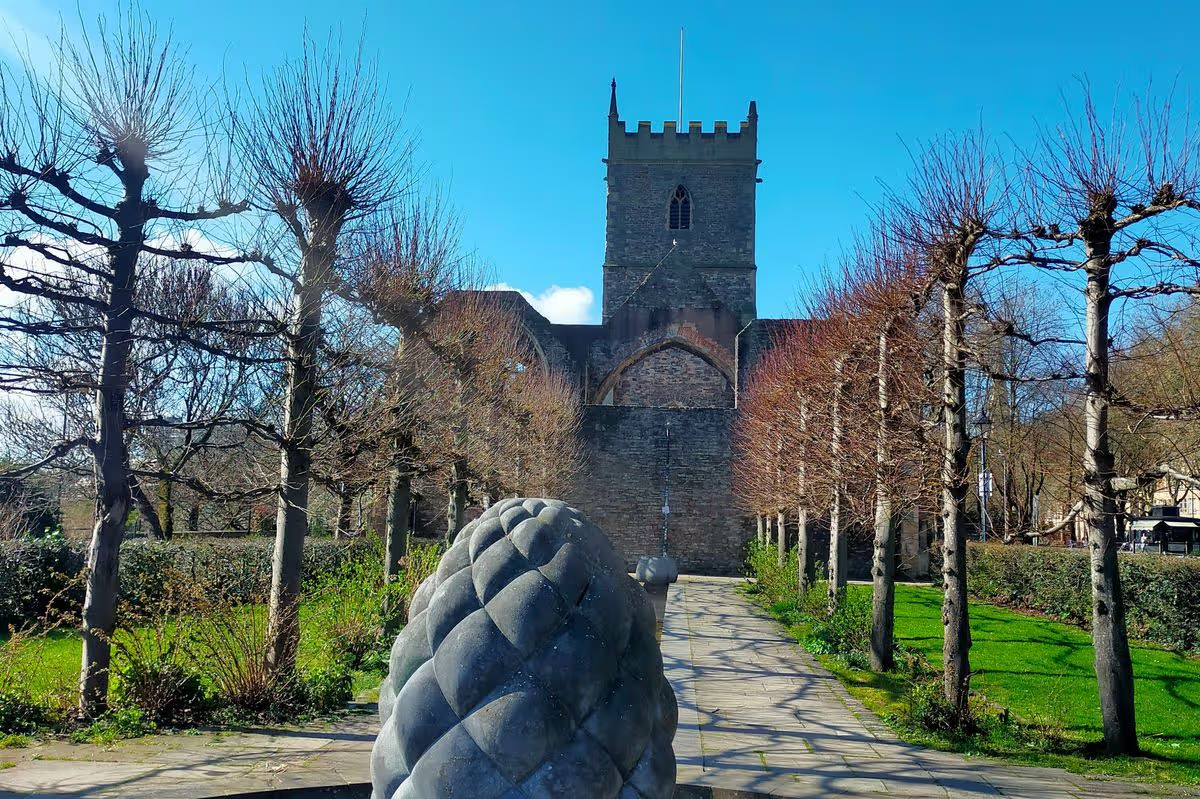
Broad Street itself proved fascinating, as upon exiting the hotel and glancing right, positioned just at the street’s end stood an ancient church, St Johns, which I’ve since learnt originates from medieval times and sits within the original city walls.
Visitors can pass through an archway of St Johns church (Nelson Street) to reach a main thoroughfare and considerably newer section of the city, creating the genuine sensation of travelling back in time; this district comprises Bristol’s old town.
Stumbling upon remnants of Bristol’s historic quarters is captivating, and nestled within the charming Castle Park in the city stands another church (St Peter’s) which traces its origins to the 11th century, encircled by a Physic Garden – and spending time here allows you to envision the lives that once unfolded in centuries past.
Today, Bristol city centre sits just 30 minutes from Bristol Airport with regular buses and coaches ferrying passengers back and forth – and there are rail connections or coaches to South West locations including Cornwall or Devon.
Many people mistakenly believe that Bristol sits within Somerset, but the city and its surrounding areas are actually an independent county corporate, established as far back as 1373, with a present-day unitary authority council.
The About Bristol website put it clearly: “Bristol is the largest city in the south west of England, with a population of approximately half a million.
“The city lies between Somerset and Gloucestershire and has been politically administered by both counties in part at various times. However, Bristol is historically a county in its own right and is properly entitled the City and County of Bristol.”
So what makes Bristol “better” than Bath, well there’s the Banksy claim to fame and the Banksy trail – and I’ve encountered a couple of these iconic works on previous trips.
Then there’s the nightlife. During this visit I attended an experimental gig at Strange Brew and the vibe was edgy yet inviting (that encapsulates Bristol perfectly I’d say).
Bath is undeniably a beautiful city to explore, but it exudes an air of affluence, whereas Bristol, rich in its own history, has a more down-to-earth vibe – and there are far fewer tourists to navigate around.
Indeed, Bristol made headlines in 2020 when a historical contentious bronze statue of Bristol-born slave trader Edward Colston was defaced and toppled during an anti-racism protest nearly six years ago – and this certainly raised some eyebrows at the time.
Those involved were making a stand and delivering a significant message, despite many labelling the statue’s toppling as vandalism at the time.
This act by protesters will also be etched in history as those responsible spotlighted Colston’s involvement in the Atlantic slave trade, in a manner that brought it to the attention of a wider audience – and I believe Bristol will always possess a rebellious spirit, it’s simply the nature of the city.
TURKEY has urged tourists that the country is still safe to visit, after seeing a slight drop in tourism.
The country has not been part of the Iran crisis, and the majority of Turkey – including the tourist resorts – remain safe to travel.
Sign up for the Travel newsletter
Thank you!
Turkey officials are urging the country is still safe to travelCredit: GettyPlaces like Antalya, Istanbul and Bodrum have no travel warnings in placeCredit: Getty
Despite this, On The Beach confirmed that they had experienced a drop in demand for destinations like Turkey.
But tourism authorities in Turkey have since confirmed that tourism is “still normal” across the country, which welcomed more than 4.2million Brits last year.
The Ministry of Culture and Tourism of the Republic of Türkiye has teamed up with Türkiye’s Tourism Promotion and Development Agency (TGA) to reassure tourists.
They confirmed that “holidays to Turkey are operating as usual, and nothing has changed”.
They added: “Every resort, hotel, excursion and experience is operating as booked – and there have been no closures, disruptions or government-issued restrictions on tourism activity anywhere in the country.”
Not only that but they said “no Turkish airport has been subject to closure, restriction or rerouting due to regional events”.
This includes the popular airports of Istanbul, Antalya Bodrum and Izmir.
And there are some super cheap Turkey holidays on sale right now.
You could spend a week all-inclusive at a Turkish holiday resort for just £199 each, which includes your seven night stay, return flights and your food and drink.
The cheap deal is staying at Ares Dream Hotel in Antalya, according to loveholidays.
Or spend a month for nearly half the cost than the average rent in the UK (£1,368), with a 28-night, all-inclusive stay from £619pp.
Even the summer holidays have cheap deals with seven nights at Hotel Linda in Kas from £469pp in August.
The current UK Foreign Office advice is that all of Turkey is safe to travel to, excluding the border with Syria.
Other bits of travel advice is to always carry around some form of photo ID such as a passport when travelling in Turkey.
Smoking is also banned on all public transport, as well as at bars, restaurants and cafes.
It’s not just Turkey that has seen a drop in tourism due to Iran, despite being safe to visit.
Egypt is seeing a drop in numbers, as well as Cyprus following an RAF base attack.
THE seaside city of Agadir has been revealed to be the most affordable break for summer 2026.
A week basking in the Moroccan sunshine can cost as little as £24 per person per night between June and August – not to mention it has great weather and direct flights.
Sign up for the Travel newsletter
Thank you!
The coastal city of Agadir is the cheapest summer holiday break for 2026Credit: Gettyloveholidays has found that seven-nights in Agadir cost £230 per person on averageCredit: Alamy Stock Photo
loveholidays has found the cheapest getaways for summer holidays between June 1 and August 31, 2026.
Agadir has come in first place with seven-night breaks costing on average £230 per person, or £33 per person per night.
The Moroccan city along the southwestern coast is surrounded by the Anti-Atlas mountains, but also has a six-mile long urban beach with golden sands.
It’s an ideal destination for Brits as the flight time is less than four hours.
The city is known for having hot weather too, and according to BBC weather, Agadir will reach highs of 27C next week.
Looking on the loveholidays website, Sun Travel found some even cheaper deals for seven-night breaks in June, for as little as £24 per person per night.
The three-star Appart Hotel Igoudar, which offers child-free stays, has seven-night breaks from £169 per person.
The hotel has Kasbah-style apartments which is just steps away from the beach.
There’s an outdoor swimmingpool area too, and one dedicated to children.
Departing on June 3, 2026 breaks start from £169 per person – or £24 per person per night.
Or going away on August 24, 2026, across seven-nights start from £219 per person.
Stays at the three-star Appart Hotel Igoudar in June start from £24 per person per nightCredit: loveholidaysClub Al Moggar Garden Beach even has its own private beach and a huge swimming pool
Another great pick is the Club Al Moggar Garden Beach which has its own private beach and a large swimming pool.
Going away from June 3, 2026 for seven nights including breakfast and flights starts from £239 per person – or £34 per person per night.
She said: “The Moroccan city is home to the country’s largest market, Souk El Had, as well as a bustling harbour and modern marina.
“Rebuilt following a devastating earthquake in 1960, the sprawling city nestles against the Atlantic Ocean and its palm-lined wide roads feel more Miami than Morocco.
“At Taghazout Beach, hordes of eager surfers took to the sea before I’d even finished my morning coffee.
“As a novice surfer, I opted to watch those riding the waves, while my companion made friends with the stray dogs and hawkers selling Moroccan breads.”
Another spot Kara visited was the Wall of Remembrance, which commemorates the lives that were lost in the earthquake in 1960.
Souk El Had is where you’ll find 3,000 shops selling lots of items from clothing to candles, souvenirs and gifts.
Closely behind Agadir in terms of affordability is Costa Dorada in Spain where average seven-night stays cost £381 per person on average.
loveholidays’ most affordable destinations this summer…
loveholidays has revealed the top 10 most affordable destinations for a seven-night summer getaway – and the average price…
LOOKING for a day out in the capital for less? Thanks to Sun Superdays, we are offering Sun readers up to £10 off tickets to London’s most iconic attractions.
Take your pick from four top attractions, including the London Eye, Madame Tussauds London, SEA LIFE London and The London Dungeon.
Sign up for the Travel newsletter
Thank you!
Enjoy unparalleled 360-degree views of the city on the London Eye
Join Sun Club for just £1.99 a month — don’t miss out.
If you fancy a spot of sightseeing, step inside the greatest view aboard the iconic London Eye.
Enjoy unparalleled 360-degree views of the city as you rotate through the breathtaking skyline above South Bank.
See all your favourite landmarks from every elevated angle during a relaxing 30-minute rotation, spotting the Houses of Parliament, Buckingham Palace, and even Windsor Castle on a clear day.
Come face to face with your favourite stars at Madame Tussauds LondonCredit: Jonathan Short
For those who would rather rub shoulders with stars, step through the world-famous doors of Madame Tussauds London and immerse yourself into the world of superstars as you attend the ultimate fame experience.
Get closer than ever to A-listers like John Boyega and Dwayne ‘The Rock’ Johnson, perform with Drake and Dua Lipa, or attend a private audience with Their Majesties King Charles III and Queen Camilla.
See sharks, rays and penguins all in the heart of London
Alternatively, you can dive into an underwater adventure at SEA LIFE London. Come face to fin with your favourite creatures including sting rays, jelly fish, sharks, turtles and more.
Journey through incredible themed zones such as Coral Kingdom and Open Oceans. Soak up fun facts about marine life and learn about conservation and SEA LIFE’S mission to protect the ocean and its creatures.
Or if you are feeling brave, the London Dungeon offers a uniquely thrilling journey into the city’s darkest history.
Bringing together an amazing cast of theatrical actors, special effects, stages, scenes and thrilling rides.
Each showcasing hysterically horrible history across a series of immersive shows, including the Torturer, sinister witch trials and many other spine-chilling shows.
HOW TO BOOK YOUR TICKETS
There are two ways to unlock the savings and book your tickets:
Sun Club:
Join Sun Club for £1.99 per month or £12 for the year to claim this offer and many more.
Go to the Offers Hub and find the Sun Superdays page.
Follow the steps on this page to book your tickets from 11am on Monday, March 23.
Sun Savers:
Download the Sun Savers app or sign up at sunsavers.co.uk. Go to the Offers and click “Click Collecting” on the Sun Superdays page.
Pick up The Sun and collect TWO Sun Savers codes. We will print one code daily in the paper between Saturday, March 21 – Friday, March 27.
Go to the Offers section and find the Sun Superdays page and follow the steps on this page to book your tickets from 11am on Monday, March 23.
Join Sun Club for just £1.99 a month — don’t miss out.
18+ UK only (exc. IoM & CI). Sun Savers multiple code collect 21/03/26-27/03/26 or subscription to Sun Club or Digital Newspaper required. Book by 22/04/26. Offer valid for ‘up to £10 off’ tickets at selected London Merlin UK attractions. Pricing varies, £10 off adult tickets and £7-£4 off child tickets. Exclusions may apply. Subject to availability. Non-transferable & non-refundable. Online access required. New customer offer: £1.99 per month or £12 per year unless you cancel at least seven days before your next billing date. Full T&Cs apply, see sunsavers.co.uk or club.thesun.co.uk/sun-club.
THE world’s best airlines for this year have officially been revealed, and a British airline has made the list.
The World’s Best Airlines for 2026 by Airline Ratings have been announced with the no.1 spot going to Qatar Airways.
Sign up for the Travel newsletter
Thank you!
Qatar Airways has been named the best airline in the worldCredit: Getty
AirlineRatings.com’s awards focus on the inflight product and passenger experience, and airlines are awarded based on the experience onboard, as opposed to public opinion or votes.
Airline Ratings stated: “Qatar Airways has again taken the top spot, driven by a consistently strong onboard offering.
“Generous meals, extensive entertainment and, most importantly, clear value for money set it apart.”
And a major British airline has also featured on the list: Virgin Atlantic featured in 13th position.
The British airline currently flies to 32 locations across five continents, including Cape Town in South Africa and Los Angeles in America.
The airline is also launching two new routes this year from London Heathrow to Seoul in South Korea, with daily flights starting on March 29.
There will also be a new seasonal service to Phuket in Thailand, beginning on October 18.
Which? named Virgin Atlantic as one of the best airlines in the world earlier this year as well, placing them third best.
The airline achieved a 79 per cent overall score for customer satisfaction.
Which? commented: “Virgin Atlantic is your best choice for a transatlantic trip – with five stars for customer service.
“Like Emirates, it won’t automatically cancel your return flight if you miss your outbound flight.
“This makes it one of only two Which? Recommended Providers for long-haul economy airlines.”
British airline Virgin Atlantic was also named in the rankings, placing 13thCredit: Getty
Airline Ratings also ranked the best low-cost carriers in the world, with easyJet ranking 8th, Wizz Air ranking 9th, Ryanair ranking 11th, Jet2 ranking 12th, TUI ranking 13th, and Vueling ranking 19th.
Sharon Petersen, CEO of AirlineRatings.com, said: “It was a tight competition at the top, but Qatar’s value proposition, combined with a superior economy product and award-winning business class, secured that top position once again.
“One of the standout movers this year is Taipei-based STARLUX Airlines.
“With strong cabin service, high-quality catering, and modern interiors, it is rapidly establishing itself as a premium competitor, particularly as it prepares to expand into Europe later this year.”
Full list of world’s best airlines
THESE are the world’s best airlines according to Airline Ratings:
DISNEY is launching another cruise ship next year – with some first time princess appearances.
In 2027, Disney Cruise Line will be launching its ninth ship called the Disney Believe.
Sign up for the Travel newsletter
Thank you!
Disney Cruise Line is launching a new ship next year called Disney BelieveCredit: Disney Cruise Line
The ship will be the fourth ship in the Wish class, joining Disney Wish, Disney Treasure and Disney Destiny.
It will be themed on “dreamers and doers who dare to pursue their own happily ever after”.
On board, stories that will be featured will be from Disney, Pixar, Marvel, and Star Wars.
Each Wish class ship features its own theme, for example Disney Wish is enchantment-themed, Disney Treasure is adventure-themed and the Disney Destiny is heroes and villains-themed.
Disney Believe will be ‘promise and possibilities-themed’.
Disney Cruise Line stated: “Onboard the Disney Believe, powerful tales of characters who believe in themselves and their dreams will come to life in exciting new ways.
“From the mystical worlds of Encanto and Frozen, to the wishing wells of Snow White, to the depths of the sea with Moana and The Little Mermaid, there are endless stories waiting to be discovered and new chapters ready to unfold onboard.”
These characters already feature onboard some of the Wish class ships, with an Arendelle dining experience onboard the Disney Wish.
However, Snow White currently does not feature prominently on any of the current Wish class ships.
The Disney Believe is expected to launch in late 2027.
Disney also announced last month that the Disney Wish ship will be coming to the UK next year.
The ship will sail from Southampton on three to seven-night European sailings.
Entering through the Grand Hall, passengers will meet famous Disney princes and princesses.
Inside each stateroom, passengers will find spacious wardrobes, sprawling beds and a theme specific to a Disney character.
Disney Believe will be promise and possibilities-themedCredit: Disney Cruise
When it comes to food on board the ship, guests won’t be short for choice, with market-style buffet options and immersive dining adventures, such as Arendelle: A Frozen Dining Adventure.
As for other entertainment, passengers can head to West-End style shows including Disney Seas the Adventure, where passengers follow Goofy on a journey sailing the ship.
For a thrilling adventure, head on the Disney AquaMouse ride, which features lighting, special effects and scenes of Mickey and Minnie on different adventures.
And the ultimate night for the whole family is Pirates’ Night, where Captain Jack Sparrow takes a fateful leap from the ship’s funnel.
Parents wanting some time to themselves can check their kids into either the full-service nursery or kids and teens clubs before exploring the ship’s adult-only spaces such as the Senses Spa & Salon.
The cheapest sailing is a three-night Belgium cruise from Southampton, sailing to Zeebrugge (Bruges) in Belgium costing from £1,633 for two people.
In other cruise news, here’s the ultimate family cruise – it has a water roller coaster, a private island and an onboard beach club.
Before taking any travel trip, it’s vital that you’re aware of any rules that are in place for the country you’re visiting, as a harmless habit can catch you out and land you a hefty fine
There’s a strict travel rule in this popular European destination (Image: Getty Images)
Jetting off abroad is always exciting, but if you’re visiting a popular European destination, there’s a little-known rule you need to be aware of.
Taking photos while wandering the quaint streets of a European town or capturing snaps of the city’s famed landmarks comes second nature to holidaymakers when exploring somewhere new. And afterwards, many tourists look forward to sharing their snaps on social media, but this harmless habit could land you in trouble, alongside a hefty fine.
Travellers planning a trip to Germany are being warned about the country’s strict rules on taking photos in public and sharing them on social media. While tourists have every right to take photos while visiting Germany, there are regulations on publishing or sharing images of people without their consent, even if the photo was taken in a public place, under the Art Copyright Act (KUG).
Simon Hood, a travel expert and Executive Director of John Mason International, explained: “Taking a photograph of a stranger and publishing or distributing this without their permission is illegal in Germany. Even if a person’s face is not in the picture, if they can be recognised by their tattoos, clothes, or the context of the photo, this is still disallowed.
“The regulations are complicated, for example, posting photos of strangers at public events such as parades, sports events and demonstrations are allowed, as long as they are not specific photos of the crowd. The Federal Court of Justice judge cases individually and ultimately determines what is and isn’t unlawful.”
Fines for sharing an unauthorised image online can range from £850 (€1,000) upwards, Simon added. “With this in mind, it’s best to ask those in-frame before posting a photo that includes them.”
Family Law Attorney Stephen Bardol explained the rule further: “From a family law perspective, this topic is often underestimated, especially when children appear in photos. Many assume that posting a photo of someone else is a harmless act, such as during travel, holidays or at family celebrations. But the fundamental rights of the image and privacy protection in Germany are often highly violated here.
“If a person can clearly be identified in a photo, posting the photo is no longer a decision for the person posting the photo, but rather a consent, privacy and interference with the fundamental rights of others.”
Stephen added that the situation can become much more complex when children are involved. He said: “The fact that a child cannot fully understand what the publication of their photo on the internet implies, eg, where it will be accessible, for what period of time and who will have access to it, and most of all the possibility that the picture will be shared or re-published by other users, means that the protection of children is greater than that of adults.”
He advised: “Tourists who are visiting Germany should be careful when taking photos, especially of families with small children. Posting a photo of a square where the families are only visible in the background is one thing, but posting a photo of a single child or a single family is an entirely different matter.”
Do you have a travel story to share? Email webtravel@reachplc.com
THERE could be trouble ahead for those who have booked holidays to far-flung destinations as airlines are warning of even more flight cancellations.
The rising price and shortage of jet fuel caused by the Iran crisis means airlines may be forced to axe longer journeys.
Sign up for the Travel newsletter
Thank you!
Certain airlines have already announced axing of flightsCredit: AlamyScandinavian Airlines System said it would be cancelling 1,000 flightsCredit: Alamy
Following the closure of the Strait of Hormuz, the price of jet fuel has risen sharply from $90 (£67) per barrel to as much as $200 (£150) per barrel – with oil traders now also expecting a shortage of it in the coming weeks.
As a result, there’s a rising risk of airlines cancelling services especially to long-haul destinations.
This is because airlines heading to far-flung places may not have enough fuel for the return journey.
The Times reported that the problem could even go on until summer quoting an industry source that said it could “take up to six months to get back to normal” – which sees us through to August.
The airline will see roughly a five per cent reduction in its services which works out to around 1,100 flights.
Following suit, Scandinavian Airlines System (SAS) announced that it would be cancelling 1,000 flights.
Certain countries, like Vietnam have now warned that flights could be cancelled from April, affecting the Easter break.
Meanwhile, China and Thailand have halted exports of fuel to maintain their own supplies – which in turn will affect airlines operating in other countries.
Closer to home, Brits could be affected as some of its jet fuel is imported from the likes of Kuwait, Saudi Arabia and the UAE.
International Air Transport Association said that “Europe is among the most exposed, with 25–30 per cent of its jet fuel demand originating from the Persian Gulf.”
Meanwhile, Watson Farley & Williams, the energy, infrastructure and transport law firm, said: “If airports and airlines’ stocks of fuel are depleted for any length of time, airlines will cease to be able to fuel their aircraft and will have to reduce their operations.
“This may have far-reaching consequences.”
This implies that there could be a knock-on effect for airlines later on, too.
It added that “further flight cancellations can be expected, even by airlines operating from home bases where there is a reliable supply of fuel.”
Certain UK airlines are less affected for now because they have secured some of their fuel at a fixed price for a certain amount of time.
The line at Holbox during the midweek lunch hour has become a cultural sensation, a queue of locals and visitors trailing past the automatic doors and around the parking lot like devotees angling for the latest iPhone series or limited-release sneakers. Believe the lauds, including ours when we named Holbox as The Times’ 2023 Restaurant of the Year. Gilberto Cetina’s command of mariscos is unmatched in Southern California – his ceviches, aguachiles and tostadas revolutionary in their freshness and jigsaw-intricate flavors. The smoked kanpachi taco alone — clinched with queso Chihuahua and finished with salsa cruda, avocado and drizzles of peanut salsa macha — is one of the most sophisticated things to eat in Los Angeles.
Holbox could be considered for the top ranking on its own strength. But in a year when disasters tore at our city, honoring the power of community feels more urgent than ever. Cetina’s seafood counter doesn’t thrive in a vacuum. Holbox resides inside the Mercado La Paloma in South L.A. The mercado is the economic-development arm of the Esperanza Community Housing Corp., a nonprofit organization founded in 1989 that counts affordable housing and equitable healthcare among its core missions. When the mercado was in the incubation stage, Esperanza’s executive director Nancy Ibrahim interviewed would-be restaurateurs about their challenges and hopes in starting a business. Among the candidates was Cetina’s father, Gilberto Sr., who proposed a stall serving his family’s regionally specific dishes from the Yucatán. Their venture, Chichén Itzá, was among the eight startups when the mercado opened in a former garment factory nearly 25 years ago, in February 2001.
Step into the 35,000-square-foot market today, and the smell of corn warms the senses. Fátima Juárez chose masa as her medium when she began working with Cetina at Holbox in 2017. Komal, the venue she opened last year with her husband, Conrado Rivera, is the only molino in L.A. grinding and nixtamalizing heirloom corn varieties daily. Among her deceptively spare menu of mostly quesadillas and tacos, start with the extraordinary quesadilla de flor de calabaza, a creased blue corn tortilla, bound by melted quesillo, arrayed with squash blossoms radiating like sunbeams.
Wander farther, past the communal sea of tiled tables between Holbox and Komal, to find jewels that first-timers or even regular visitors might overlook.
Taqueria Vista Hermosa, run by Raul Morales and his family, is the other remaining original tenant. Order an al pastor taco, or Morales’ specialty of Michoacan-style fish empapelado smothered in vegetables and wrapped in banana leaf. The lush, orange-scented cochinita pibil is the obvious choice next door at still-flourishing Chichén Itzá, but don’t overlook crackling kibi and the brunchy huevos motuleños over ham and black bean puree. The weekends-only tacos de barbacoa de chivo are our favorites at the stand called Oaxacalifornia, though we swing through any time for the piloncillo-sweetened café de olla and a scoop of smoked milk ice cream from its sibling juice and snack bar in the market’s center. Looking for the comfort of noodles? Try the pad see ew at Thai Corner Food Express in the far back.
The everyday and the exquisite; the fast and the formal (just try to score a reservation for Holbox’s twice-a-week tasting menu); a food hall and sanctuary for us all. Mercado La Paloma embodies the Los Angeles we love.
I have never managed to score a reservation to Bar Cecil, the restaurant that opened in April 2021 as an homage to Sir Cecil Beaton, the famously flamboyant British photographer, designer, author and all-around Renaissance man who died in 1980. It remains, almost comically after five years in business, the most difficult place to book a table in the Coachella Valley. Long ago I made my peace with lining up before the restaurant opens at 5 p.m. and starting early at the unreserved 12-seat bar, or slipping in between 6:30 p.m. to 7:15 p.m. when the first wave of bar seating turns over. We all show up, whenever we can, for potent drinks and chef and partner Gabriel Woo’s menu, a worldly mix of Continental swagger, global-minded modernism and California realness.
In January, the same team branched out with Beaton’s at Bar Cecil, a posh affair next door that flips the script on the restaurant: more cocktail-centric, mostly snacky food you stretch into a meal. Tufted red velvet cascading from the ceiling drives the louche vibes. The mid-20th-century-era sketches and prints adorning the walls are significant enough that the staff composed a booklet full of descriptions and biographies. (You’ll need a phone light to read through it.) There’s an enclosed terrace where VIPs seeking privacy tend to hang out as the night wears on. Precision-engineered cocktails cover the spectrum of tastes: not-too-sweet Singapore slings, a sharp-tongued Vesper with lemon oil, a retro-chic grasshopper blending Creme de Menthe and pandan for a nightcap. I have always been fascinated that certain Hollywood hangouts serve pigs in a blanket, and here they are, mustardy and easy to down one after another alongside shrimp cocktail, duck-meat bao, oysters, fries and, of course, caviar. Beaton’s also takes reservations but walk-ins, however variable the wait, are welcome. Try your luck. This is absolutely the place to be in Palm Springs right now.