These stunning destinations are exempt from the new system launching in April.
14:45, 31 Mar 2026Updated 14:45, 31 Mar 2026
These countries will not use the Entry/Exit system(Image: Getty)
Following months of preparation, the new Entry/Exit System (EES) will finally be implemented across the Schengen area from April 10.
The new EES will require all non-EU nationals travelling to 29 European countries to register their biometric data, such as a facial scan and fingerprints, rather than receiving a traditional passport stamp. Numerous popular holiday destinations including Portugal, Italy and Spain will be impacted by the new system.
However, there are 14 countries (15 including the UK) outside the Schengen Area and therefore not implementing the new travel system.
Laura Evans-Fisk, head of digital and engagement at eurochange, anticipates a surge in travellers heading to non-Schengen countries as a consequence, reports the Express.
She said: “The introduction of this new border control system may be off-putting to some people who want to book last-minute trips this Easter, especially those who like to keep travel as fuss-free as possible.
“I think we should expect to see an increase in Brits travelling to countries that are exempt from the legislation over the next few months – including the Easter and summer holidays.”
For those looking to sidestep the hassle and make their travels a little more straightforward, Laura has identified three fantastic holiday destinations that will be unaffected by the EES, meaning British tourists can explore freely without the need to provide biometric data.
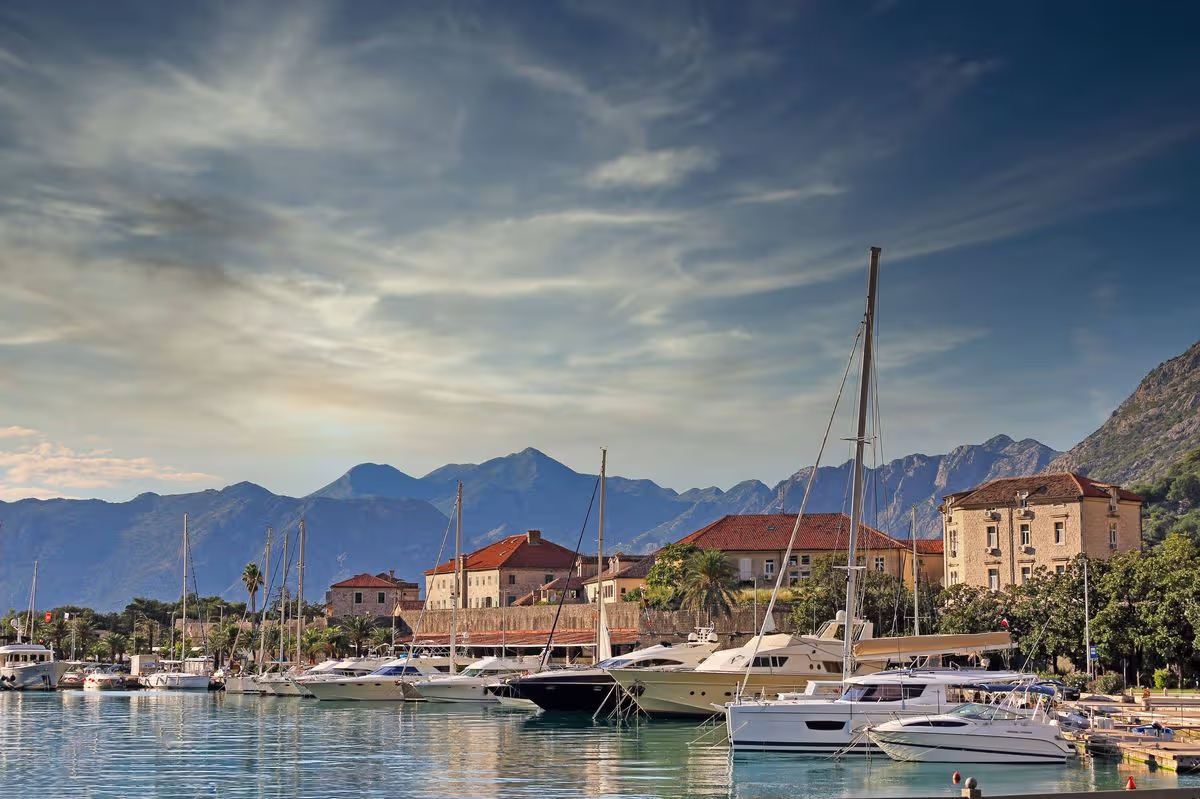
Kotor, Montenegro
She explained: “Montenegro is quickly becoming one of the most popular up-and-coming destinations in Europe. A less crowded alternative to Croatia, it offers similar quaint towns, gorgeous beaches and a stunning coastline, but it is around 20-30% cheaper.”
For instance, accommodation in Montenegro begins at £23 per person per night, while a three-course meal will cost you £31.78.
Kotor sits on the coast, boasting stunning beaches and a relaxed atmosphere, ideal for unwinding. Laura remarked: “This is a great spot if you’re after a chilled, slow-paced holiday, without having to pay huge prices.”
Tirana, Albania
This vibrant capital city is brimming with culture and a food lover’s dream destination. Laura noted: “One of the best ways to explore is by taking a stroll through the streets, following the eccentric street art, graffiti and murals.
“Remember to order Albanian favourites, Fërgesë Gjize (baked cheese with peppers) and Trilece (a tasty pie made with sponge cake and three different kinds of milk) for dessert.”
Sarajevo, Bosnia
Laura said: “It is one of the only places where you can visit a Mosque, a Catholic church, an Eastern Orthodox church and a synagogue in one place.
“Tucked inside a long, thin valley and surrounded by forested mountains, the city has a picture-perfect backdrop. Its broad mix of cultural influences means its architecture is also absolutely beautiful, and its restaurant scene is an eclectic mix of Turkish and Bosnian-inspired offerings.
“And, with prices averaging just £30 per person for a three-course meal, your money really does go far here.”
IF YOU are looking for your next holiday spot, then you could head to a European city two hours from the UK that has just got new flights from a major airport.
Budget airline easyJet has launched flights from Manchester Airport to Montpellier in France.
Sign up for the Travel newsletter
Thank you!
easyJet has launched new flights to Montpellier in FranceCredit: GettyThe flights to the French city will operate twice a week on Mondays and FridaysCredit: Getty – Contributor
The flights will operate twice a week on Mondays and Fridays, throughout the summer season and cost as little as £26.99 per way.
The historic city of Montpellier is found in southern France, around six miles from the Mediterranean Sea.
The city is often dubbed one of the sunniest in France thanks to boasting an average of 300 days of sunshine per year.
The city’s Mediterranean climate means that it has mild winters and hot, dry summers.
Because the city has a lot of sunshine, there is a lot to do outdoors in Montpellier including heading to the medieval Old Town where you will find narrow, winding streets with historic townhouses and a number of independent boutiques.
Another highlight of the Old Town is heading to Place de la Comédie, which is a lively square with the Three Graces fountain.
You can also head to Saint-Pierre Cathedral which dates back to the 14th century and has a fortress-like appearance.
In the Antigone district, which is mostly pedestrianised, has lots of fascinating architecture to explore, including copies of famous Greco-Roman sculptures.
For a mix of nature and history, venture to the Botanical Garden, which is the oldest one in France, founded back in 1593.
The garden features a bamboo forest, orange trees, a lotus pond where you might spot some carp and a greenhouse with a myriad of cacti.
You can even make a wish in the wishing tree called Phallaire.
If you fancy a nice walk, head to the Saint-Clément aqueduct.
Built in the 18th century, the dual-level aqueduct is responsible for the fountains littered across the city.
The city benefits from over 300 days of sunshine a yearCredit: Getty
Each Tuesday and Saturday, you will also be able to catch a market at the foot of the aqueduct.
If you don’t mind heading slightly out of the city, then there are a number of chateaux you can explore, including Château De Flaugergues – a 19th-century chateau with Flemish tapestries and pretty gardens.
It costs £9.98 per person to visit.
The city has a number of hotels to choose from, including Pullman La Pléiade Montpellier Centre, which costs from £166 per night.
The hotel can be found in the centre of the city and features a panoramic rooftop pool and restaurant.
Alternatively, you could head to the Radisson Blu Hotel for £107 per night, which also boasts an outdoor pool as well.
When out and about in the city, you can expect to spend about €55 (£47.75) on a mid-range three course meal for two and between €4 (£3.47) and €5 (£4.34) for a beer.
The flights cost from just £26.99 per wayCredit: Getty
Kevin Doyle, easyJet’s UK Country Manager, said: “We are really pleased to be celebrating our inaugural flights to the fantastic city of Montpellier, just a stone’s throw from the Mediterranean coast.
“By introducing new connections from Manchester on our unrivalled leisure network, customers from across the northwest can now enjoy even more choice this summer to book and travel with ease.”
Stephen Turner, Chief Commercial Officer at Manchester Airport, said: “Montpellier is not currently served by any other airline so passengers planning a holiday to the south of France this summer will have even more choice of destinations when flying from Manchester.
“We’re sure this new route will prove extremely popular.”
A BRAND-NEW sleeper train route has launched in Europe – and Brits can very easily hop onboard from Paris.
European Sleeper will connect three cities in 15 hours and you can spend the journey tucked up in a cosy cabin.
Sign up for the Travel newsletter
Thank you!
Brits can easily join the sleeper train from Paris and head to BerlinCredit: europeansleeperYou can hunker down on this sleeper train that’s just launched to three European citiesCredit: europeansleeper
For anyone wanting city breaks without the fuss of taking flights, this is a great solution.
The sleeper train links Paris, Brussels and Berlin.
So anyone from the UK wanting to join the service can simply head to Paris Gare du Nord – which is where the Eurostar from London St Pancras gets in.
The sleeper service runs three times a week and one-way tickets from Paris to Brussels from £21.70.
If you do the whole journey, tickets can still be as little as £52.08.
The route departs on Tuesdays, Thursdays and Sundays.
There are various different tickets available, the cheapest are for “like-minded people travelling on a budget”.
Literally called ‘budget’, passengers who opt for this option get a seat in a six person compartment which starts from €59.99 (£52.08) – for a one-way journey from Paris to Berlin.
A classic cabin is “ideal for small groups, families and solo travellers.”
It can seat up to five people and has compact couchette beds with sheets and blankets – it has private options available too.
One-way tickets start from €79.99 (£69.46)
Comfort cabins are, as the name suggests, more comfortable than the other two options.
It’s a three-person compartment with private options available if you want to travel in style.
Larger cabins have actual beds that are made up for its passengersCredit: europeansleeperThe route from Paris to Berlin in 15 hoursCredit: Getty
It comes with a mattress, sheets, duvet and a separate seating area.
Sun Travel found one-way tickets from €119.99 (£104.21).
To add on breakfast, which is a hot drink, juice, yoghurt with granola and crackers with various toppings, it’s an extra €14.00 (£12.16).
The Comfort Plus cabins are the most premium, and also have three beds and a separate seating area.
Passengers also get towels, toiletries, breakfast, mineral water and a welcome drink included.
One-way tickets start from €159.99 (£138.95).
From July 13, 2026, a stop in Hamburg will be added to the route.
Here’s another sleeper route launching this year…
European sleeper has also launched a route between Brussels in Belgium and Milan in Italy…
However, the anticipated launch date of the train has been pushed back from June 18 to September 9, with tickets available to book from March 17.
The train will operate from Brussels on Mondays, Thursdays and Saturdays and from Milan on Wednesdays, Fridays and Sundays.
From Brussels, the train will leave at 5:56pm each time, stopping in Cologne at 10:07pm, Zurich the following day at 6:42am and finally arriving in Milan at 11:30am.
From Milan, the train will leave at 5:30pm each time, stopping in Zurich at 10:35pm, Cologne the following day at 7:59am and finally Brussels at 11:10am.
Other stops on the route include Liège in Belgium; Aachen in Germany; Arth-Goldau, Göschenen, Bellinzona, Lugano and Chiasso in Switzerland and Lake Como in Italy.
Tickets for a shared classic compartment start from €49.99 (£43.31) one-way.
Alternatively, you can book a private space from €179.99 (£155.96) either in a classic compartment for up to five people or a comfort compartment for up to three people.
ROYAL Caribbean’s massive new cruise ship is launching next year – and new images have revealed what you can expect onboard.
Hero of the Seas is the fourth Icon Class Ship, and set to cost a huge $2billion (£1.5billion) to build, it will break a number of records.
Sign up for the Travel newsletter
Thank you!
Royal Caribbean has revealed it’s new cruise ship Hero of the SeasCredit: UnknownIt will have nine pools onboardCredit: SuppliedYou can book the three storey treehouse roomCredit: Supplied
The ship will have nine swimming pools – the most ever at sea – including a Caribbean themed one and the biggest swim up bar at sea.
Coconut Cove will be the newest pool, while The Hideaway will be home to the two adult-only pools.
Category Six is be the biggest waterpark at sea, with two new family raft slides as well as the first funnel raft slide at sea.
The kid-friendly waterpark Splashaway Bay will have new features too.
Skywalk-zip line attraction Crown’s Edge will return, as well as the Flowrider surf simulator, golf courses and rock climbing walls.
When it comes to eating and drinking, there are 28 to choose from including the new jazz-themed Orleans Parish Supper Club.
Otherwise there will also be the food hall stalls at the AquaDome market, as well as Italian, steakhouses, seafood and Mexican options as well.
Don’t forget the Royal Promenade neighborhood’s restaurants, bars as well, along with the 30,500 plant Central Park.
Otherwise when it comes to live shows there is the Royal Theatre and the biggest ice arena at sea, Absolute Zero.
One of the most exciting new additions to the ship is the Ultimate Family Treehouse room option.
The three-deck treehouse includes a rooftop terrace over the side of the ship as well as a private hot tub.
Two of the floors will be for teens, with two main bedrooms, ensuites, and abalnies.
The suite even has direct access to Surfside, a family-friendly neighbourhood with cooking classes.
The sailings will include seven night sailings from Miami from August 2027, including stays at the private Perfect Day at CocoCay island.
Room prices are yet to be revealedCredit: SuppliedSwim up bars will also be onboardCredit: Supplied
Royal Caribbean boss Michael Bayley said: ““Icon Class truly set a new standard for family vacations, and Hero of the Seas takes that vision even further.
“With more water, more thrills and more choices for all ages, we’re continuing to build on what our guests love about Royal Caribbean and delivering the experiences families are looking for when vacationing together.”
Holidays are not yet on sale but you can sign up for the waitlist to be contacted as soon as they are on April 2.
As the fourth ship of the Icon Class series, it will be a similar size to their others too.
She said: “Imagine taking Paris’ Eiffel Tower or The Shard skyscraper in London and tipping them on their side. Icon is even longer than they are high.
“While The Shard soars 1,016ft into the sky, Icon of the Seas eclipses that at 1,198ft long – the poor Eiffel Tower pales in comparison at just 984ft.
“The ship is cleverly divided into eight distinct neighbourhoods, with more than 40 places to eat and drink on board.
Our favourite travel essentials
*If you click on a link in this box, we will earn affiliate revenue.
Sleep headphones These soft sleep headphones make listening to music much more comfortable, particularly when you are trying to sleep. Built in are two mini speakers that connect to Bluetooth, saving you that horrible discomfort that comes with traditional headphones.
Underseat cabin bag This perfect underseat cabin bag will become your best friend on flights. Plain black, collapsible and barrel-shaped, this bag is designed to slide perfectly into those pesky luggage-sizers at the airport gates. Save yourself the extra baggage fee and come prepared.
Waterproof mobile phone pouch Keep your phone bone-dry and your hands free with this handy waterproof pouch. If you’re splashing in the sea or jumping on a paddle board, your tech will stay safe from splashes. The touch-sensitive screen means you can still snap selfies, too.
Eye mask Trying to sleep on a brightly-lit plane is next to impossible, but napping becomes much easier with one of these. Eye masks can be useful when travelling with kids who need to sleep, as they block out all the light and distractions.
“Of course the ship’s Adventure Ocean kids’ clubs will keep the little ones happy while you enjoy the sun, and families will also have a ball together visiting the arcades, laser tag, minigolf and the largest ice rink at sea.”
Mark and Judy opted to visit the hotspot off-season and could be seen enjoying a leisurely stroll through the main strip “days before the tourists arrive”, but the destination could face a struggle this summer
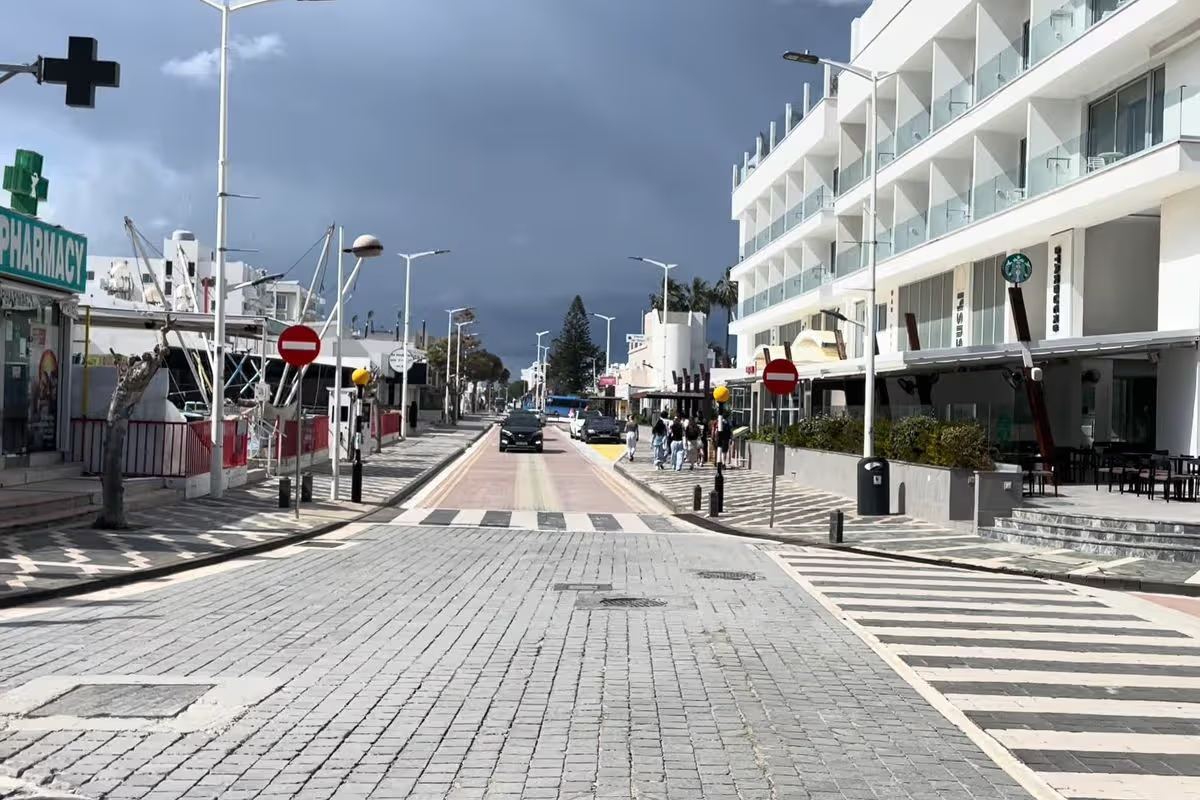
Mark and Judy took a stroll through the main strip ‘days before the tourists arrive’(Image: Gypsy Souls/YouTube
)
Two sun-seeking Brits who visited a holiday hotspot facing a decline in tourism have remarked that they’d “return in an instant”. Mark and Judy were recently blown away by the peaceful, crowd-free scenes greeting them in the eastern Cypriot resort town of Protaras.
Protaras is known for its crystalline waters, breathtaking beaches and booming nightlife, being just a short, 17-minute drive from the premier European party capital of Ayia Napa. Mark and Judy opted to visit the hotspot off-season and could be seen enjoying a leisurely stroll through the main strip “days before the tourists arrive”.
In a recent vlog for their YouTube channel, Gypsy Souls, they kicked off proceedings by mentioning that local businesses were starting to “open up for the season”, with Mark remarking that they were “coming out of hibernation”. Setting off in search of a drink to beat the heat, the pair departed from their location near a fountain and a prominent Protaras sign.
Judy gave viewers a lay of the land, pointing out Easter egg statues and highlighting the nearby Capo Bay Hotel and the route to the stunning Fig Tree beach. As they made their way down the street, Judy noted that the businesses in sight were “quite closed”, but they detected the welcoming aroma of food and heard “tunes thumping”.
Hotel bookings to the country have fallen 40% after the recent conflict in Iran, but the couple said the emptiness they witnessed was simply down to it being off-peak.
Judy went on to explain that their viewers had recommended some bars to them. But, seemingly highlighting a downside to off-season travel, Judy sadly pointed out that some weren’t yet open. Not to be disheartened, though, she noted that some still were, specifically the Greenery.
Once they reached the end of the road, Mark and Judy turned around and headed back, drawing the viewers’ attention to more closed businesses on the other side of the street. Judy said: “We’re hoping that by the time we go, some of these will start to open. So, as we come into the end of our time here, hopefully, they should all start to open, and you’ll be able to see the transformations.”
Mark and Judy eventually found their way to the Greenery, where Mark enjoyed a pint and they shared a kebab and chips. Summing up their off-season experience, they told the Mirror: “We had a wonderful holiday and would return in an instant.” As Cyprus prepares for the looming holiday season, however, reports indicate that many tourists will be avoiding the Mediterranean island this year.
Hotel bookings are reportedly down by 40% as US and Israeli-led military action in Iran continues. As part of the so-called Operation Epic Fury, the two countries launched a bombing campaign against the Middle Eastern nation on February 28, with the conflict still ongoing.
In response, Iran launched widespread retaliatory strikes on its Gulf neighbours and blocked passage through the Strait of Hormuz, a key shipping lane for 20 per cent of the world’s oil and liquefied natural gas (LNG). Earlier this month, a pro-Iranian militia launched a drone attack on RAF Akrotiri, a British base in Cyprus.
AirDNA figures show that cancellation rates for short-term rentals in Cyprus surged from about 15% before the conflict to as much as 100 per cent in the days after the war began. According to the Daily Mail, about a third of Cyprus’ tourists are British travellers, with four million international visitors travelling to the island in 2025 in total.
Chris Webber, head of holidays and deals at TravelSupermarket, told the outlet: ‘When global events change holiday plans, we tend to see travellers pivot quickly. The Caribbean is a natural beneficiary. What’s striking here isn’t just the overall jump in searches, but how broadly that interest is spread. Destinations like Turks and Caicos and Tobago aren’t typically where British holidaymakers look first, so to see them surging suggests people are still keen to try somewhere new.”
Selen Ozcan, who has dual citizenship, claims that, despite finally obtaining a British passport, she still puts it to one side while travelling as her original passport is ‘stronger’
Alan Johnson Social News Reporter
13:00, 31 Mar 2026Updated 13:00, 31 Mar 2026
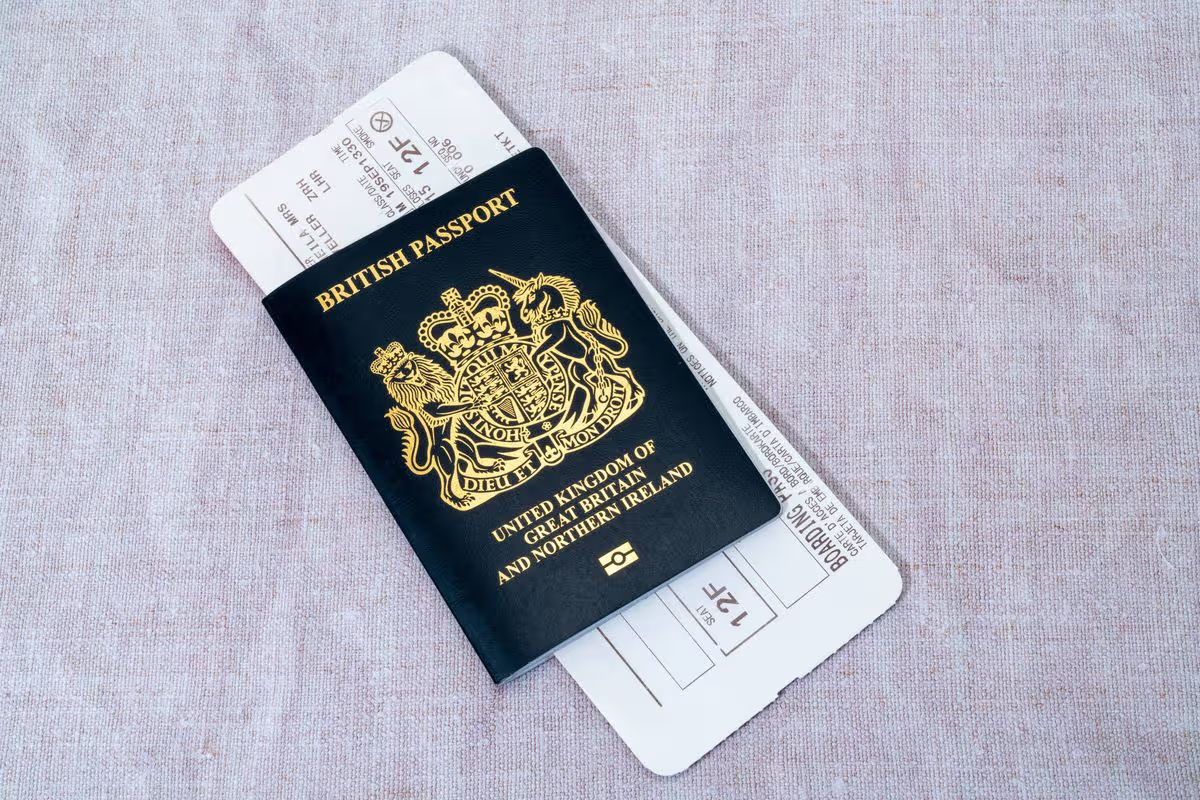
A woman claims her first passport is ‘stronger’ than her British one (stock image)(Image: clubfoto via Getty Images)
A woman who endured a seven-year battle to secure a British passport has shared her clever airport time-saving technique. Selen Ozcan, who splits her time between London and Bahrain, used TikTok to showcase her trick in a brief video.
The travel content creator now possesses dual citizenship, and always keeps her native Romanian passport to hand as well. While navigating security at an airport, Selen posted footage with the caption: “When the immigration line is too long so I have to pull out the stronger passport.” Brandishing her blue British passport, she swiftly moved it aside to display her maroon Romanian one beneath.
During Britain’s membership of the European Union, UK nationals enjoyed the freedom to visit, reside, work, or study in member states without requiring a visa. However, this privilege ceased when the Brexit transition period concluded on December 31, 2020.
Consequently, British passport holders can no longer access the – typically faster – EU citizen border control lanes at airports.
“British citizens also usually need to have their passport stamped upon entry/exit to the EU unless they are family members of EU citizens and resident in the EU,” the Government clarifies online.
Content cannot be displayed without consent
Writing in response to Selen, one TikTok user remarked: “Got my British kid a Romanian passport and now she’s my fast track pass through EU airports haha. My missus is Romanian.”
Another person recounted a similar scenario, saying: “All my UK boys had to wait 15 minutes in a queue at Amsterdam Airport. I skipped all that with my Romanian passport.”
A third commenter argued: “Romania passport is just stronger than UK when entering Schengen and EU. But UK has more access than Romania worldwide.”
While a fourth TikTok user pointed out to Selen: “Travel to USA with Romanian passport and you’ll see the difference between British and Romanian. No offence intended.”
The Henley Passport Index evaluates the world’s passports based on how many destinations holders can enter without needing to obtain a visa beforehand.
“The index is based on exclusive data from the International Air Transport Association (IATA) – the largest, most accurate travel information database – and enhanced by Henley & Partners’ research team,” Henley & Partners clarify.
Covering 199 passports and 227 travel destinations, the index receives monthly updates. Based on Henley & Partners’ figures, Singapore claims the top spot with the “strongest” passport, granting visa-free entry to 192 countries.
Japan, South Korea, and the United Arab Emirates share second position with 187, while Sweden occupies third with 186.
Britain sits in joint sixth alongside Malaysia and Poland, offering access to 183 destinations – actually ranking higher than Romania, which shares 11th place with Bulgaria, at 177.
Passengers arrive to discover their posessions have been left behind as days of walkouts start at sites – full list
12:17, 31 Mar 2026Updated 12:17, 31 Mar 2026
Trolleys to transport suitcases in Terminal T4 of Adolfo Suarez Madrid-Barajas Airport, this Easter, as two ground handling strikes at Groundforce and Menzies airlines hit(Image: Getty Images)
Passengers flying from 13 Spanish airports hit by strike action have landed to discover all their luggage has been left behind, local media has reported. Canarias said the first day of the strike by Groundforce workers, the ground handling operator that services Air Europa flights, resulted in continuous delays across all the airline’s flights and passengers arriving at Canary Island airports without their luggage, having had to leave it behind at their point of origin.
Alternating work stoppages are taking place between 5 and 7 am, 11 am and 5pm, and 10 pm and midnight, the first day of the strike affected 13 Spanish airports, three of them on the islands of Gran Canaria, Lanzarote, and Fuerteventura, where delays occurred throughout the day. These delays did not originate at the island airports but rather on flights arriving primarily from Madrid, Barcelona, and Bilbao, with delays approaching an hour.
Airports impacted are Barcelona-El Prat, Madrid-Barajas, Ibiza, Palma de Mallorca, Gran Canaria, Tenerife, Fuerteventura, Bilbao, Lanzarote, Alicante, Valencia and Malaga. The Groundforce strike is scheduled for this Wednesday (April 1) and Good Friday (April 3), with the possibility of becoming indefinite.
Because the aircraft operate on a network, delays accumulated throughout the day, causing significant disruptions to flights departing from the three affected airports in the archipelago. At major airports on the Iberian Peninsula, such as Madrid, Barcelona, and Bilbao, planes departed without luggage in their holds throughout Monday, leaving many passengers arriving at their destinations without their belongings.
It’s worth remembering that the most affected route is Madrid-Gran Canaria, on which Air Europa operates seven flights daily. According to Orlando Robledano, secretary of the aviation sector at the UGT union, the strike’s impact on Canary Island airports has been reduced due to the minimum services imposed by Groundforce on all Lanzarote Airport employees. Even members of the works council received this notification requiring them to comply with these minimum services, making it impossible to achieve the level of participation required for a strike of this nature.
This, coupled with the fact that domestic flights at Canary Island airports are protected and must be serviced regardless of delays, meant that the problems were less severe at the islands’ airports than at those on the mainland. Other affected airports include Alicante, Valencia, Palma de Mallorca, Ibiza, and Málaga.
Hosteltur reported that strikes at Canary Island airports during the peak days of Holy Week, between Maundy Thursday (April 2) and Easter Monday (April 6) may be called off as workers at Menzies—who provide check-in, boarding, and baggage services to airlines such as Norwegian, EasyJet, and British Airways—along with the works council and their union representatives from UGT, are close to reaching an agreement to call off the strike that was set to affect nearly 3,000 of the group’s employees in Spain, 600 of them in the Canary Islands.
At least six planes took off from Madrid-Barajas Airport on Monday without their passengers’ luggage due to an indefinite strike by the ground handling company Groundforce. On this first day of the strike, disruptions are being reported at all airports, although the most significant impacts are felt in Madrid and Barcelona, according to union sources, Telecinco reported.
Passengers report long queues and checked baggage left on the tarmac during the first day of the strike The indefinite strike by Groundforce ground staff began this Monday at Barcelona Airport, with protests taking place at three different times. The affected services are all those related to ground handling.
Long queues were reported at Barcelona’s El Prat Airport, where Alberto García said: “There have been some delays, and some planes have even departed with very little luggage. It was the protesters themselves who informed passengers that their bags would not arrive on time.
“The unions continue fighting for their objective and are demanding that the company comply with the wage agreements stipulated in the collective bargaining agreement.” At this time, many people have seen their flights significantly delayed or have had their luggage left behind.
In Madrid, people have had to wait for extended periods to check their luggage. Some report waiting for “four or five hours.”
Many planes, especially those arriving from Madrid, “are arriving without luggage, and the problems are spreading,” a UGT spokesperson told Europa Press, adding that “there is no guarantee that luggage will arrive.” The delays “affect not only direct flights but also many connecting flights, since passengers arrive without their luggage and therefore miss their next flight.”
HOT cross buns; sticky, sweet, delicious and a sign that Easter is on its way – but where did the original bun come from?
Ironically, the origins are in my stomping ground of St Albans, so I went to see where it all began – and you can still buy a classic bun now.
Sign up for the Travel newsletter
Thank you!
The hot cross bun originates in St Albans – and you can still buy them todayCredit: Ricky Barnett PhotographyYou can enjoy an old school hot cross bun outside the historic St Albans AbbeyCredit: Sophie Swietochowski
In trying times, nothing quite provides comfort like a freshly-baked bun.
That was certainly Brother Thomas Rocliffe’s thinking when he handed out his humble creation to the poor and disgruntled townspeople of St. Albans back in 1361, a couple of decades before the Peasant Revolt.
The 14th century monk had just invented a treat that would become a symbol of Easter for hundreds of years to come: the hot cross bun.
The original recipe relied on a traditional bread dough, laced with exotic spices and dried fruit, which was then rolled into balls and scored with a cross symbol ahead of baking.
Today, the buns we see in supermarkets feature a piped cross, not scored, and they are a little more sweet and cake-like in flavour, relying primarily on cinnamon for spice.
If you’re keen to sample the traditional version, though, Brother Thomas’ original recipe is still being baked today within the same centuries-old walls of St Albans Cathedral, where it was first concocted.
The ingredients are a secret, of course, but those heading down this Easter may be lucky enough to uncover them with the help of one of the cathedral’s expertly knowledgeable guides.
“How much did Rocliffe charge?” my guide asks me. “One a penny? Two a penny?”
The answer is still unknown – but just shy of a fiver seems more apt in these times, I tell him.
These buns weren’t just for Easter in Rocliffe’s era. In fact, in the mid-1500s they became an emblem of protection and soared in popularity.
Everyday folk would buy them year round and nail them to their doors under the belief that it would stop their houses from burning down.
Queen Elizabeth I was not amused by such superstitions, though, so banned the sale of the hot cross bun (it’s colloquial name by this point) on all dates except for Christmas, funerals and, of course, Good Friday.
Traditions change over time and now most of the local bakeries in St Albans sell the treat at Easter only, including the cathedral’s Abbot’s Kitchen.
You can still try the original hot cross recipe in St AlbansHead baker Graca at Abbots Kitchen makes 120 buns everyday at Easter timeOther local bakeries sell the sweet treats too – like ProtoCredit: Sophie Swietochowski
Head baker Graca whips up a whopping 120 of these buns a day at this time of year and locals will order in batches – a sign that they’re still adored in these parts.
Round, fluffy and fresh out of the oven, the original Alban Bun is definitely a massive step above the supermarket variations.
I love its breadlike flavour and whack of cardamom. The fact that it’s not overly sweet means you can eat three in a row – what a win.
After tucking into them, make sure to explore the rest of the cathedral.
Daily tours are thoroughly fascinating – and completely free, although donations are heavily relied upon, so don’t forget to pop some cash in the box on your way out.
If you’re looking for even more historic fun to sink your teeth into, the city’s Verulamium Park is brimming with Roman history and the remains of old, slightly battered walls can still be seen as you wander among the greenery.
Make sure to detour for a stroll along the River Ver, too, one of few remaining chalk rivers in the UK.
Then you can reward your efforts with a pint at one of the many cute and quirky pubs.
St Albans is reportedly home to more pubs per square mile than any other city in the UK, so it would be rude not to sample its tipples.
The Boot, in the city centre serves proper ales alongside its Mexican themed food menu, meanwhile Ye Olde Fighting Cocks, at the foot of the cathedral’s hill, claims to be one of the oldest boozers in the country and has a lovely pub terrace.
I wonder if Brother Thomas ever sunk a few in here.
It’s definitely worth trying some of the other bakeries too
Here’s where you’ll find the best buns in St Albans…
St. Albans is not short of excellent bakeries and in the name of good journalism I made sure to try them all.
Here’s two of my other picks.
Proto Artisan Bakery Sticky on the outside, with a glossy glaze, and fluffy on the inside, these buns look more akin to the ones you see in the shops, but are ten times more flavourful.
Baked fresh everyday, they are crammed with a great amount and variety of dried fruit and soft and light in texture, it needs nothing more than a slab of butter.
Glaze Bakery A minutes’ walk from the cathedral’s entrance, this bun is as delicious as the above.
The cross is not piped, but made from laminated dough that puffs up in the oven. The shiny crust is sprinkled with sugar crystals. Owner Oli recommends toasting it and eating with Marmite. BLOB: See enjoystalbans.com or visit @enjoystalbans on social media.
One Friday night last year, Akylah Cox and her boyfriend took a red-eye flight from Pennsylvania to Dublin for a whirlwind adventure. The trip lasted less than 30 hours. They hit up an impressive number of spots: the Guinness Storehouse, the Book of Kells experience at Trinity College, Ha’penny Bridge, Capel Street for thrifting (“I gave myself only 30 minutes to do this, but it had to get done,” Cox says) and the Celtic Nights dinner and show.
They were back home on Sunday and went to work the next day.
She shared her experience on TikTok with the caption, “Was this crazy?!” The responses varied.
“I would be tired the rest of the week,” one person commented with two woozy-face emojis.
“This inspired me!” another said.
“I’m tryna be this level crazy,” commented another.
Akylah Cox and boyfriend Akram Imam in Dublin in February 2025.
(Akylah Cox)
For Cox, who was working full time in engineering and pursuing an MBA while her boyfriend was completing his medical residency, creating an ultra-compacted itinerary was the only possible way to travel. And she loves the practice. On TikTok, she shares her itineraries for “microtrips” — short, usually international trips lasting 24 to 72 hours.
“You can just leave,” says Cox, who lives in Chicago. “You can have that quick break, that quick reset.”
She’s part of a new wave of travelers, particularly Gen Z, opting for these types of trips over extended vacations, according to an AirBnb trend report. Partly fueled by a viral TikTok trend in which people break down how they spent one to two days in another country, young travelers are no longer waiting for spring break or to accumulate paid time off to cross destinations off their bucket lists. A recent Expedia survey found that 25% of Gen Z and millennial travelers said they plan to take a microtrip in 2026, with Toronto; Nassau, Bahamas; and San Juan, Puerto Rico, being the most popular destinations.
“Short trips can fit busy schedules much better than a longer vacation can, which allows more people to explore the world without committing to long absences from work or family,” says Airbnb communications lead Ali Killam. “I think people are really embracing this idea that even brief changes of scenery can really recharge you, your mind and spirit.”
Another driver of the trend could be the fact that younger generations consider travel a top priority in their lives. In 2023, Gen Z and millennial travelers took an average of five trips per year, compared with Gen Xers and baby boomers who took less than four. Gen Zers and millennials allocate an average of 29% of their income for travel, reports the management consulting firm McKinsey & Co. (though a study last year by Savings.com found that a growing number of parents are helping their adult children out financially more than ever). Among younger generations, there’s also a mantra of doing things “for the plot” and taking chances because the future feels uncertain.
“Younger millennials and Gen Z are really creating their own version of the American dream, which I think is really based off of experiences and the memories that you’re able to create,” said N’Dea Irvin-Choy, 30, an L.A.-based content creator who posts about luxury travel, skiing and tennis experiences.
Kareen Hill, 27, of New York, is another microtrip crusader on social media. Since October, he’s been taking trips to explore the food scenes of various cities. In January, he went to London for two days and posted a recap video on TikTok that received more than 1.5 million likes. He now tries to take a trip, either international or domestic, about every two weeks.
“I just realized you do have free will,” says Hill, who works at an airport. “Like why not?”
N’Dea Irvin-Choy at the Eiffel Tower in Paris, left, and Kareen Hill at the Colosseum in Rome.
(N’Dea Irvin-Choy; Kareen Hill)
Beyond convenience, microtrips can also be more affordable than longer trips — an important factor as oil prices rise and airfares are already beginning to surge. With the help of credit card points and a travel credit, Cox’s trip to Dublin was just under $450. She says these quick trips are a “low barrier to entry” to international travel because you only have to plan an itinerary for one or two days. And the more flexible you can be on the timing or destination, the better chance you’ll have at finding deals.
Another benefit is how short trips force you to be intentional about how you spend your limited time. “You can get a lot more done than maybe you think you can,” she said. During a three-day trip to Japan with her mother and grandparents in May (not including the travel time), they were able to squeeze in a food tour and multiple tourist attractions in Tokyo and Mt. Fuji.
Of course, a common concern about microtrips is how exhausting they can be, especially if you’re traveling across time zones. And, yes, the fatigue can be real and travelers should certainly consider their bodies’ limits. But the purpose of these trips is to explore a destination rather than relax, Cox says. Once you’re in that mindset, you can better embrace the experience. “You really don’t have the impact of jet lag because you’re purely running on adrenaline,” she says.
Want to take a microtrip yourself? Here are some tips:
Book the earliest flight possible to your destination and the latest flight back so you can optimize your time, advises Irvin-Choy. Definitely try to opt for nonstop flights.
Make it easy to move around your destination. Hill says it’s best to avoid checking a bag and to pack light. Cox recommends booking a hotel that allows you to store your bag even if your room isn’t ready.
Prioritize your “musts.” For each of her microtrips, Cox uses the same formula: Pick three must-do activities or sights and plan the rest of your trip around those. One of her favorite things to do in any new city she’s visiting is go on a food tour.
Prepare to jump back into the grind at home. Irvin-Choy recommends parking your car at or near the airport, which can sometimes be cheaper than opting for a ride share when it’s such a short trip. You also might want to wear your work clothes on the plane, so you can head straight into work if necessary.
And finally, don’t forget to get some rest during your trip — even if it’s on the plane. “That’s the hardest part when it’s so short,” Irvin-Choy says. “But make sure you get some sleep at some point during the weekend.”
THE North Norfolk Fryer is returning to the tracks this summer.
Onboard, passengers can enjoy chippy tea and ice cream dessert to make it feel like being at the seaside – but on a heritage steam train instead.
Sign up for the Travel newsletter
Thank you!
You can hop onboard a fish and chip train this summer in NorfolkCredit: North Norfolk RailwayTickets start from £87.50 for twoCredit: North Norfolk Railway
The Norfolk Fryer picks passengers up from Sheringham Station in Norfolk and embarks on a 90-minute return journey to Holt.
Onboard, guests will be served up local fish and chips – and to finish, a tub of Ronaldo’s ice cream.
There’s also a bar onboard for anyone wanting to enjoy a tipple.
The trains run from Sheringham to Holt and back with the return journey taking around 90 minutes.
Diners will get to enjoy their chippy tea and countryside views in either the Gresley Buffet Car, which has been fully restored with a 1930s art deco interior or in one of the 1950s British Railways carriages.
A table for two in First Class starts from £87.50 while a table for two in regular seating is £79.50.
There are also options to sit in tables of three or four if you fancy gong as a group.
Seats are bound to go quickly and you’ll need to book in advance on their website.
The trains set off every Wednesday from April 1, 2026 at 6.30PM.
There are other experiences onboard too from sausage and mash dinners, to brunch, cream tea and even gin trains.
For even more fish and chips, fans of the seaside classic should head up to Whitby.
The awards are considered the ‘Oscars’ of the fish and chip industry and at this spot you can eat in or take away their seaside fish suppers.
You can opt for plaice with chipped potatoes, lemon and homemade tartare sauce for £20.95.
Or try out the cod with chipped potatoes, lemon and homemade tartare sauce in three sizes: small for £15.95; medium for £19.95 and large for £21.95.
Then for takeaway, you could grab cod and chips, haddock and chips or scampi and chips all for £13.50 each.
There’s a children’s menu too.
If you fancy a full on stay in Whitby – check out this hotel…
*If you click on a link in this box, we will earn affiliate revenue
Whitby, North Yorkshire With a history of sailors and vampires, a dramatic coastal path, and the very best in pints and scampi, it takes a lot to beat Whitby. Pop in the amusements, eat award-winning fish and chips, and board the all-singing Captain Cook boat tour on the harbour. The Royal Hotel overlooks the harbour with stays from just £68 per room.
Trains will travel from the town of Sheringham to Holt in NorfolkCredit: AlamyFish and chip train is back this summer with trips across the countrysideCredit: North Norfolk Railway
A MAJOR airline has become the first to increase luggage charges in response to the fuel crisis caused by the Iran conflict.
American carrier JetBlue has confirmed that the cost of taking baggage onboard is to go up – and others could follow suit.
Sign up for the Travel newsletter
Thank you!
JetBlue is the first airline to increase luggage fees due to the Iran crisisCredit: Getty
The new costs will see checked bags go up by $4 (£3) for off peak, economy travellers, so will now be $39 (£30).
And the cost for peak economy travellers will go up by $9 (£6.80) so to $49 (£37).
Passengers paying for luggage less than 24 hours before the flight will pay an extra $10 (£7.50).
A JetBlue spokesperson told local media: “Adjusting fees for optional services used by select customers, such as checked baggage, allows us to continue offering more competitive fares.”
But airlines, especially budget ones, could choose to leave the cost of flights alone to remain competitive and instead raise the cost of extra fees.
In the UK, both Ryanair and easyJet have said their fares won’t be affected by the fuel crisis for now.
However, the crisis is being caused by the closure of the Strait of Hormuz – and the longer it continues, the more they will be at risk.
The Strait of Hormuz is one of the world’s most important oil routes, with around 20million barrels passing through every day – roughly 20 per cent of global supply.
Sit on the left when you catch the train from Swansea to Carmarthen, and you can watch huge sandy estuaries unspool outside the window. There’s a curlew standing by the water, an egret-haunted pool in the wetlands, and a boardwalk along the foreshore, part of the 870-mile Wales Coast Path. It has been a six-hour, four-train journey to get here from Essex, but I’ll soon be on foot.
Carmarthenshire has picturesque railways, a network of buses, and some epic long-distance paths, so it makes for an ideal car-free break. The 13-mile Tywi Valley Path (officially opening in time for Easter) will link Abergwili near Carmarthen and Ffairfach near Llandeilo, helping walkers and cyclists access some lovely scenery. I’m visiting just before Saint David’s Day, and there are daffodils everywhere. Carmarthenshire offers a quintessentially Welsh experience, packed with castles, cockles and cawl (stew).
As I set off from Ferryside station, there’s a view of the ruined 12th-century Llansteffan Castle across the estuary. The Three Rivers hotel and spa, where I’m due to stay tonight, is 10 minutes into my walk. I drop off my bag and press on, feeling buoyant. I’m heading for Kidwelly, five miles from Ferryside along a hilly, inland stretch of coast path.
An evening view from Ferryside across the Towy estuary towards Llansteffan Castle. Photograph: Joan Gravell/Alamy
I’m soon winding down through mossy, snowdrop-beaded woods, where primroses glimmer in banks of ferns and bluebells are sprouting. When I walk up to the lane above, sudden sunshine lights the distant sea, and the veiny salt marsh is fretted with silver. Offshore winds have trimmed the trees slantwise, neat as a fresh fade from a stylish barber. The paths are still boggy in places, and there are no other walkers until the final, tarmacked half-mile, where teal and redshank pipe from the mud-banked River Gwendraeth.
Kidwelly Castle (£8.50 adults, £5.90 kids) is a maze of wall walks, spiral stairs and cavernous towers with views across sepia reed beds. Gwenllian, who led a Welsh army against the Normans in the 12th century, fought her final battle nearby. Newest among Kidwelly’s pubs and cafes, Y Barbican opened in November 2025; it offers armchairs and freshly made cakes – worth the uphill walk from the castle.
There’s a regular train service between Kidwelly and Ferryside, but bus 198 runs directly back to my hotel, where I head to the spa. A mural by the pool, painted by owner Jackie Cavill, mirrors the view outside: hilltop Llansteffan Castle, framed by gulls and oystercatchers. Through the windows, the sun sets behind a tall Scots pine.
The Great Glasshouse at the National Botanic Garden of Wales was designed by Foster + Partners. Photograph: Neil McAllister/Alamy
The next morning, I stroll to the station along the low-tide beach. Wintering ducks and geese gather on seaweed-blanketed sandbanks. Today’s destination is the 230-hectare National Botanic Garden of Wales (NBGW), where car-free visitors get 50% off entry (full price £19 adults, £10 kids). It’s an hour or so’s cycle from Carmarthen, mostly on route 47 of the UK’s National Cycle Network. Brompton bikes are available to hire at Carmarthen bus station, but the drizzle is becoming torrential …
Bus 279 runs four times a week from Carmarthen to NBGW, and there’s one due in an hour. Cash-only Pantri Blakeman, up some stairs opposite the bus station, is a great place to wait. There’s a daffs-and-dragons frieze around the walls and a menu offering cockles and bacon on toast with laverbread and leek cawl.
The landscaped grounds of NBGW are cheerful, even in the pouring rain, with blossom, birdsong and thousands of spring bulbs. In the Tropical House, there are banana palms, bugle plants and bright flamingo lilies. Outside, dunnocks hop around heavy-headed hellebores and bullfinches feast on lakeside buds. Several sparrows chirrup noisily from the olives in the world’s largest single-span glasshouse. Designed by Foster + Partners, the Great Glasshouse houses more than 1,000 species of Mediterranean plant, soft fronds of scarlet honey myrtle, yellow-flowered cassia and fresh-scented Christmas heather among them. I just have time for a mustardy rarebit in the cafe before heading back to the bus.
The rain has stopped when I get off near Abergwili and walk the last bit of the Tywi Valley Path, a traffic-free, well-kept stretch of road alongside a former railway track. It leads to the Bishop’s Park, where the oxbow lake and ornamental evergreens attract siskins, goldcrests, grebes and slate-blue nuthatches. The old bishop’s palace is home to Carmarthenshire Museum (free). In Carmarthen, two miles west, I’m staying in the delightfully time-warped Falcon hotel. Close to the bus station, it offers cockles au gratin for dinner and cheese-and-leek sausages with a veggie breakfast.
The next morning, I take bus 280 through green countryside to the colourful market town of Llandeilo, near the eastern end of the Tywi Valley Path. There are views of wooded Merlin’s Hill, topped with an iron age fort, and the dramatic ruins of Castell Dryslwyn (free).
The colourful market town of Llandeilo. Photograph: Garey Lennox/Alamy
Castell Dinefwr (free), in the sprawling Dinefwr park next to Llandeilo, was once home to Lord Rhys, whose peaceful rule led to a flowering of Welsh music and poetry. I drop in to Pitchfork & Provision in Llandeilo, then head through bluebell woods to the hidden Llandyfeisant church, half overgrown with ivy, and the atmospheric castle ruins, on a wooded hill above the River Tywi.
The estate’s 18th-century owners landscaped the park with trees and waterways. A boardwalk among ferns and catkins leads to little waterfalls, slopes of pungent wild garlic, and a bird hide overlooking the lake. I stop to warm up in the National Trust cafe at Newton House (£12 adults, £6 kids), with a garden full of tulips. The guy in the cafe hands out Saint David’s Day postcards with a recipe for Welsh cakes.
Back atPitchfork & Provision, the owner Rachel Mabbitt tells me how the business has expanded from a bakery, founded with a friend during lockdown, to include a popular cafe and deli. A perfectly cooked bowl of vegetable cawl comes with tangy Pitchfork cheddar, and the bara brith (spiced tea bread) is gooey and delicious. It’s a 10-minute walk to Llandeilo station, where trains on the scenic Heart of Wales line stop five times a day (twice on Sundays). The railway rolls towards Swansea past hilly woods, soft reed beds and the winding River Loughor.
All-inclusive breaks are perfect for families who want to go away without worrying about the cost of food and drink at the resort. If you fancy a few days without washing up in May half-term, here are some deals to look out for
This article contains affiliate links, we will receive a commission on any sales we generate from it. Learn more
All-inclusive holidays are an excellent way to escape for half-term(Image: Shared Content Unit)
All-inclusives can be a good option for those who are on a tight budget. While initially booking an all-inclusive holiday costs more, once you arrive, you technically don’t need to spend any extra money. This means you can enjoy your meals, cocktails, and beers without worrying about the bill at the end of the trip.
May Half Term can be a good time to book an all-inclusive holiday in Europe, as you usually get good weather across the continent but not the intense heatwaves that often hit in July and August. While it’s a busy travel time, it’s slightly less full on than the six-week holidays.
Here are a few all-inclusive deals available during half-term week based on two adults, two children sharing. Prices are subject to availability and may change.
Castell dels Hams – Porto Cristo, Majorca – 4 nights from £361 per person
This Majorcan hotel has a 4T rating from TUI and offers comfortable, contemporary accommodation surrounded by countryside. There are three outdoor pools to choose from, and if you fancy a day at the beach, there’s a free daily bus service. If you prefer a livelier break, you can enjoy activities from tennis to volleyball and a great entertainment program that includes a kids’ club and evening entertainment.
During half-term, you can enjoy four nights of AI accommodation in a standard double or twin room from £361 per person. The package includes Ryanair flights from East Midlands Airport and you can book via the TUI website.
Sungate Hotel – Sidari, Corfu – 4 nights from £469 per person
Jet2 is offering a four-night package to lively Sidari in Corfu for £469 per person, which you can book here. The price includes flights from London-Stansted, 22kg of checked baggage per person, coach transfers, and all-inclusive accommodation in a family room.
The Sungate Hotel is just 300m from the beach and has an outdoor pool, buffet restaurant, and pool bar. The weather in Corfu often hits 24C in May, meaning it’s just right for days at the pool or lounging on the beach.
Inter 2 – Salou, Spain – 7 nights from £487 per person
Another Jet2 deal for Spain includes an entire week of as much food and drink as you like, but this time in sunny Salou in Spain. Inter 2 is 500m from the beach and the lively resort town of Salou, so there’s plenty to do. The hotel has two pools and offers daytime and evening entertainment, or you can simply relax and enjoy the sunshine.
Accommodation is in a studio apartment, and your package includes 22kg of luggage and coach transfers from Reus, which take just over half an hour. Prices for seven nights, departing London-Luton on May 25, start at £487, and you can book the package here.
Magic Cristal Park Hotel – Benidorm, Spain – 4 nights from £329 per person
With a flight time of about two and a half hours, Benidorm is ideal for short breaks, and this half-term deal from easyJet Holidays starts at £329 per person. Its all-inclusive offering includes two buffet restaurants and four bars, a seasonal kids’ club, a top-floor pool and roof terrace, a games room, and much more.
Benidorm’s iconic beach is just a 10-minute walk away, and you can wander around and enjoy the colourful sights in this lively resort town. The package from easyJet holidays can be booked here and includes flights from Bristol to Alicante, hold bags, transfers, and accommodation in a standard double room.
Bone Club Hotel Svs – Alanya, Turkey – 7 nights from £367 per person
Enjoy a week in a four-star hotel on an all-inclusive basis for £367 per person this half-term. This package deal, on offer through Thomas Cook, includes Wizz Air flights from London-Gatwick and accommodation in an economy room, although you can upgrade for a small fee. There’s a buffet restaurant, snack bar, pool bar, and even a nightclub where you can enjoy your all-inclusive package.
During the day, enjoy the sunshine by the pool or the sandy beach just a short walk away. You’re also in a great spot to explore the Turkish Riviera, and the resort town of Alanya is full of places to visit, from castles and caves to traditional Turkish baths.
Have a story you want to share? Email us at webtravel@reachplc.com
All passengers without EU passports will be required to have their fingerprints registered and their pictures taken under new rules, and this is likely to cause bottlenecks
02:28, 31 Mar 2026Updated 02:35, 31 Mar 2026
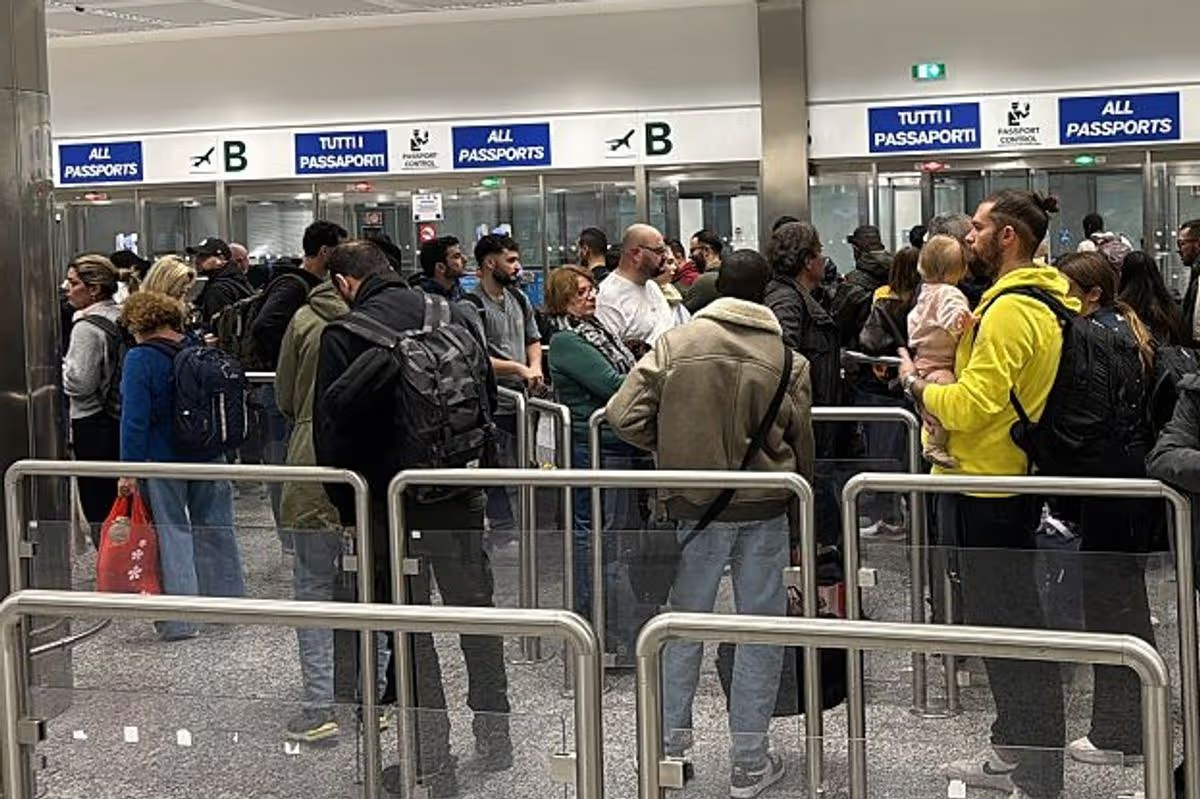
People queue at passport control in Milan, Italy (file image)(Image: NurPhoto via Getty Images)
Brits travelling to Europe over Easter face long delays — up to two hours at times — at border control as strict new entry rules come into effect.
Bottlenecks are expected due to the EU’s new entry/exit system (EES), airports and airlines are warning. Under the rules, all passengers without EU passports will be required to have their fingerprints registered and their pictures taken. These will be captured on first entry into the Schengen zone and then checked at every subsequent entry and exit.
The system, which comes into effect today, requires all non-EU arrivals to undergo the checks. Until now, only 50 per cent of passengers had to be processed at each border point.
Airports Council International (ACI), a trade body, said the latest data from across Europe “shows a continued deterioration in waiting times at border crossing points”. It said waiting times were “regularly reaching up to two hours at peak traffic times, with some airports reporting even longer queues”.
Data released last week showed at least 4,000 holidaymakers have been caught out by the new rule since it was soft-launched in October, after successive delays. During this six-month period, the number of passengers required to undergo checks increased in stages and EU members were able to suspend the system in the event of “operational pressures”.
But now the transition period is ending and passenger processing times is set to increase at border crossings. At larger airports, passengers are directed to kiosks to have their picture and fingerprints taken, although at smaller airports the process is done by an officer.
Speaking to The Times, Olivier Jankovec, the directorgeneral of ACI, and Ourania Georgoutsakou, the managing director of Airlines for Europe, said: “Passengers entering the Schengen area are likely to wait even longer at border control during Easter due to the persisting operational challenges around the EES rollout.
“We reiterate our call on the European Commission and member states to extend the possibility to fully or partially suspend EES —where operationally necessary — during the entirety of the 2026 summer season.
“This flexibility has proven vital in preventing catastrophic operational disruptions during the progressive rollout of the system. If the technical and operational issues with EES are not resolved, this flexibility should remain available during future peak travel periods, such as winter 2026-27.”
EasyJet, the UK’s biggest airline, is planning for its busiest Easter on record, handling more than a quarter more travellers than last year’s Easter weekend. It expects to operate 16,000 flights from the UK over the school holidays, with 5,000 departing during the Easter weekend.
Last week ministers warned that the introduction of EES would present a “significant change for Brits travelling this Easter”. Alex Norris, the minister for border security, said “extra time may be needed, both for your return to the UK and travelling to the EU” and advised passengers to check with their carrier.
A UK seaside town is brimming with charm, with vibrant beach huts lining the golden beach and a high street packed with independent businesses that serves up its famed oysters
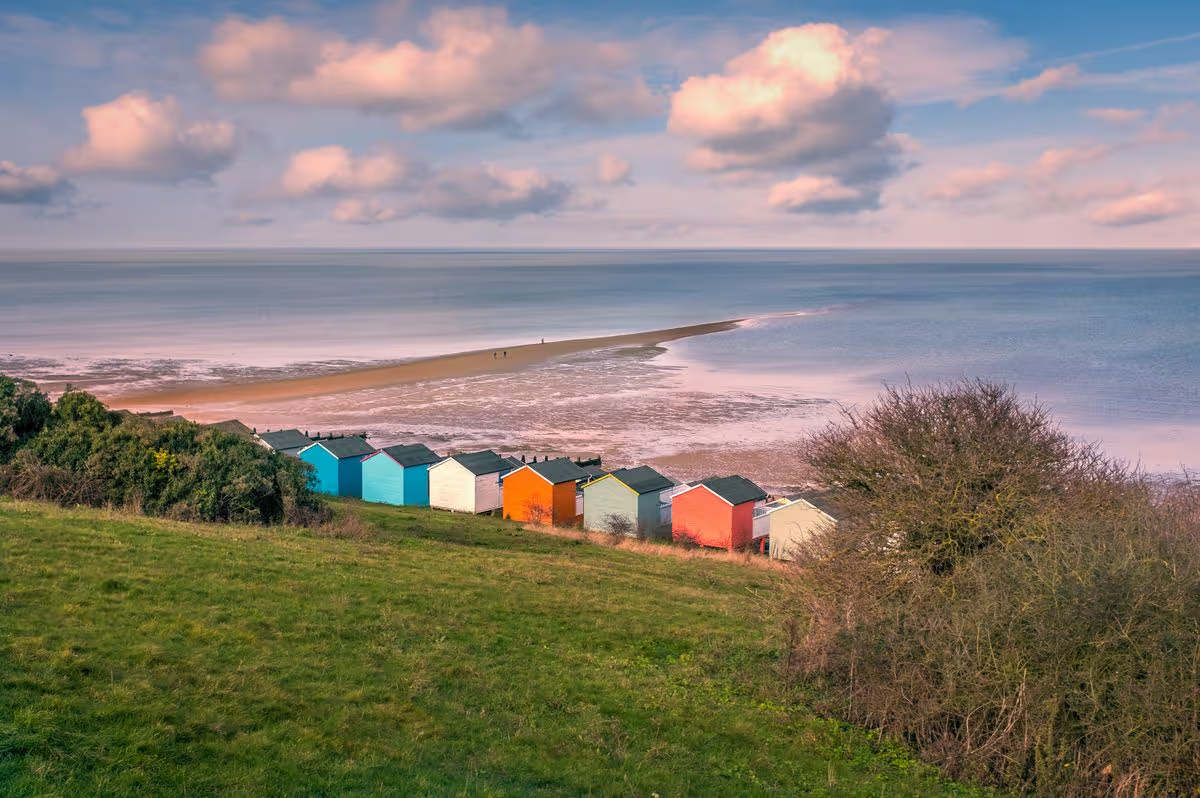
This picturesque seaside town is just a short train journey from London (Image: Getty Images)
A charming coastal town, just a short train ride from London, offers an idyllic day out, adorned with colourful beach huts and an independent high street.
The seaside town of Whitstable in Kent is perhaps one of the best ways to make the most of the warmer weather, with its sprawling beach, thriving harbour and high street brimming with independent businesses. Nestled between Herne Bay and Seasalter, the Kentish town is just over an hour’s train journey from London, making it a favourite among those who want to escape the smoke for a break by the picturesque coast.
The shingle beach is at the heart of this town, with its picturesque pastel-hued beach huts lining the promenade for a quintessential British seaside. While it may lack the pier or rides you might find at other seaside towns, its stretches of golden beach have previously earned it the recognition of the ‘best of the traditional British seaside’ by Beach Guide, thanks to its ‘quirkiness and charm’.
It’s a place where families can spend hours playing along the shore, taking a refreshing dip in the seawaters, or simply walking along its stretching promenade, admiring the colourful beach huts. If you fancy a pint in the sun, there’s the famed Old Neptune pub, with outdoor seating offering views across the coast, and where fishermen take in their daily catch.
Whitstable also has a bustling harbour and is renowned for its oysters. Its heritage of seafood dates back to around 80AD, when the Romans reportedly sent oysters back to Rome because they loved them so much, and the town built a thriving industry based on mollusc business that remains in place today.
A trip to Whitstable wouldn’t be complete without sampling its famed oysters with the acclaimed Whitstable Oyster Company and Wheelers Oyster Bar, providing the perfect spot. But with an array of restaurants nestled around the town, you’ll never be far from fresh seafood, and the town even holds its very own Whitstable Rocks Oyster Festival to celebrate its historic connection.
Away from oysters, the town, which has been dubbed the ‘jewel of the Kent coast’, is also known for its thriving high street. Whitstable has hundreds of independent businesses, from vintage shops and art galleries to cafés, bakeries, hardware stores, and family-run eateries, with just a few chain stores surviving.
A stroll along Harbour Street and the High Street will reveal shopfronts bursting with character, including George’s Whitstable, an authentic Aladdin’s cave that has been a fixture for around 50 years. Some of its other notable highlights include the elegant jewellery shop Pearl Shop, the independent toy shop Buttercup, and Harbour Books.
Whether you’re looking to spend time on the beach, browse around the extensive selection of independent shops or simply stroll around the charming town, a day trip to this ‘oyster paradise’ is well worth it. And with a direct train from London Victoria to Whitstable taking just over an hour, it couldn’t be easier to experience the seaside charm along the Kent coast.
Do you have a travel story to share? Email webtravel@reachplc.com
The bass genius Thundercat has, to his regret, been spending way too much time absorbing bad news on his phone.
“We are cellphones at this point, basically,” he said. “That’s what life feels like. It’s a weird one we’re living through right now, to say the least. You have to try to stay inspired, to keep moving forward. But like, you’re processing absolute hell and war in the background, and you’re still supposed to look cute.”
In Sunday Funday, L.A. people give us a play-by-play of their ideal Sunday around town. Find ideas and inspiration on where to go, what to eat and how to enjoy life on the weekends.
That whipsaw feeling — processing grief and destruction, while doing your song-and-dance to survive, all via the same rectangle — is the backdrop of Thundercat’s new album, “Distracted,” his fifth LP and first in six years. The album is a typically dense and playful showcase for his extravagant musicality, and packed with guests like ASAP Rocky, Tame Impala and Lil Yachty.
But it’s poignantly introspective on tracks like “What Is Left to Say” and “I Wish I Didn’t Waste Your Time.” “She Knows Too Much” has a touching cameo from his late friend and frequent collaborator Mac Miller.
“After [Miller’s] death, there were a lot of questions, a lot of stones left unturned,” Thundercat said. “But this song came to be from the simplicity of making music between friends. It’s a language, a snapshot. It was a beautiful moment between us.”
Thundercat, born Stephen Bruner, grew up in L.A. immersed in the city’s progressive jazz scene, playing with everyone from Kendrick Lamar to Suicidal Tendencies. These are some of the places around Los Angeles that still keep his inner comics-nerd satiated and musical curiosity fed — no matter what bleak news is blowing up his phone.
9 a.m. Find some coffee that slaps
If I notice that I’m doomscrolling, if stuff is getting a little bit too dark and weird and twisted, I’ll put my phone down and go drink some coffee and get way too much energy. I’ll go to the good old boys at Commissary. That’s good coffee.
My day doesn’t always consist of me picking my instrument up, but it’s more like as it feels right. If I’m not intentionally writing or working on somebody’s music, a lot of the time it’s just me. The time between is just as important as the time spent with music, so it’s learning to be OK without my bass in my hands for a second.
But there’s still so much to learn about harmony and melody from that instrument, you know? Nothing makes up for spending time with an instrument and learning it in a different manner. That’s how Larry Graham came up with slap bass. It has no bounds for what you want to create. It’s just about how far your mind can go with it.
Noon. Pick up a comic book
I find myself to be very much like a Lebowski-like character. The things that I enjoy bring me peace, like fashion and comics. The family at Golden Apple on Melrose have been my family since I was a child. The family there has always looked out for me and been avid supporters of my career. They remember my dad bringing me in — I remember the day that Image Comics premiered at Golden Apple. It’s nothing but love and artistry and great people to meet in Golden Apple — they’ve been one of the through lines in my life that has just been consistent. L.A.’s landscape keeps changing, but Golden Apple has been a beacon of nerdisms.
5 p.m. Fun at the movies
I have always been a fan of Universal CityWalk’s AMC theaters, even though they charge ridiculous prices. Everybody’s trying to keep their industry alive in this moment; it’s of one of those grit-and-bear kind of things. But at the same time, the experience that you have there is absolutely golden.
I love seeing movies there, because there’s so much to do around there. There’s a comic store, Halloween Horror Nights, Nintendo Land. There’s a Hot Topic, because I am a goth hoochie daddy. I’ve been going my whole life. I just enjoy going to the movies there by myself or with friends. Sometimes they get bored, because I will keep choosing to do this, but I don’t care, because it is a movie theater that I love. It’s always a joy to have AMC at Universal City Walk.
8 p.m. Sushi that’s a cut above
One of my favorite restaurants in L.A. is a restaurant by the name of Asanebo. It’s a sushi restaurant that is of very high prestige. The chefs there are very loving and caring. They make the most amazing food on the planet. It’s a beautiful environment — one of the best sushi restaurants, I would say, in the world. But it’s about the history for me, and the family that is built there, from the waitresses to the hosts. They treat you like royalty there.
10 p.m. Fun with friends and all that L.A. jazz
Most of the time, I don’t know what the hell is going on. A lot of the time, I would rather just sit on the couch and watch “Star Trek.” I’m not always wanting to immediately get up and just go sacrifice myself to the nightlife.
I really enjoyed growing up playing gigs all over L.A., but a lot of those places don’t even exist anymore. We could play outside the Hollywood Bowl. We’d play at a dive bar or play at a wedding, but my childhood friendships were linked to to the functionality of music in my life. If we were playing at a musty bar or some weird coffee house, it was like, “I get to play with Kamasi [Washington], and they’re going to pay us in sandwiches.”
I enjoyed The World Stage in Leimert Park. Low End Theory at the Airliner — I’d be hanging out with Flying Lotus or Tyler would drop an album and come up to perform. It was about my friends and hanging with the people that I love.
I think as time progresses, I enjoy spending time with my friends — whatever that entails. If it’s going out to a club and all that, seeing a friend perform, my friend Anderson has a beautiful club called Andy’s. There’s a restaurant called Verse, that’s owned by my friend Manny, that serves absolutely amazing food and has live music. It’s just fantastic. They just erected a Blue Note here in Los Angeles, which is awesome.
Where would you go to listen to a song by me and Channel Tres where you can dance on somebody’s butt? I’m still gonna say Andy’s, but I can finish off the night at Living Room. That’s a good place to listen and enjoy the nightlife, just a great club.
A MAJOR holiday park has reopened after a huge £5million revamp with loads of brand new attractions, and what’s even better – you can stay there with The Sun’s new Hols from £9.50 campaign.
You can access these offers early by signing up to Sun Clubfor just £1.99 a month, where members gain automatic access onto the website one day earlier than everyone else, at just past midnight.
Once you’re a member, go to the Sun Club Offers hub and find the Hols From £9.50 page. Follow the link from the offers page, and you can book your break from midnight on Tuesday, March 31.
That’s a whole 24 hours headstart, as the Sun newspaper readers who are collecting tokens get access to the holidays on April 1.
Vauxhall Holiday park’s two to three room caravans sleep up to eight people, while the park also offers apartments and luxury lodges.
Great Yarmouth on Norfolk‘s east coast has long been one of the UK’s top beach resorts for holidaymakers seeking sand and sun.
The town boasts a soft sand beach known as ‘the golden mile’, with plenty of shops, cafes andrestaurantswithin a short walking distance.
Smack-bang on the beachfront is Joyland, a historic amusement park with plenty of classic rides that are sure to fill you with nostalgia.
This colourful family theme park is perfect for little ones, home to mini rollercoasters and the award-winning Super Snails. The attraction is free to enter, with ride tokens costing £3 each.
For older kids, Great Yarmouth Pleasure Beach is sure to go down a treat with an exciting mix of white-knuckle thrills, child friendly rides and even a 4D cinema.
Undoubtedly the star of the show is a traditional wooden roller coaster, which first opened in 1932 and one of only two still standing in the UK.
All the ways to book a holiday from £9.50
There are five routes to book our Hols From £9.50
Book online: Simply collectcodewords printed in The Sun paper up until Wednesday, April 1. Then enter them at thesun.co.uk/holidays to unlock booking from April 1.
Book with Sun Club: Join Sun Club at thesun.co.uk/club for £1.99 per month or £12 for the year. Go to the Sun Club Offers hub and click through to the Hols from £9.50 page. You do not need to collect any codewords or Sun Savers codes. Booking opens for Sun Club members onTuesday, March 31.
Book with Sun Savers: Download the Sun Savers app or register at sunsavers.co.uk. Then go to the ‘Offers’ section of Sun Savers and click ‘Start Collecting’ on the ‘Hols From £9.50’ page. Collect TWO Sun Savers codes from those printed at the bottom of the Sun Savers page in the newspaper up until April 1. Then enter or scan the codes on Sun Savers to unlock booking.
Book by post: Collect TWO of the codewords printed in The Sun each day up until Wednesday, April 1. Cut the codeword out and send it back with the booking form – found in paper onApril 1 or online at thesun.co.uk/holidays.
Book with The Sun Digital Newspaper: Sign up to The Sun Digital Newspaper at thesun.co.uk/newspaper. Then download the Sun Savers app or sign up at sunsavers.co.uk, log in to Sun Savers with your Sun account details (the same email and password you use for your Digital Newspaper) and enjoy automatic access to Hols, without the need to collect Sun Savers codes daily. Booking opens onApril 1.
Great Yarmouth has been one of the UK’s most popular beach staycations for centuriesCredit: Alamy
THE LNER first class lounge at London King’s Cross Station will reopen tomorrow after a plush makeover.
It’s the perfect place to relax with plenty of seating, private booths and complimentary food and drink.
Sign up for the Travel newsletter
Thank you!
LNER has resigned its first class lounge in London King’s CrossCredit: LNERThe six private booths are a new addition to the lounge in the busy train stationCredit: LNER
LNER is the only passenger lounge at King’s Cross Station and it closed a few months ago for an upgrade.
It will reopen on March 31, 2026 with a brand-new look – and it’s very fancy.
Inside is an open plan area with dark red walls and pink coloured furnishings along with elegant lamps and little tables.
New to the lounge are six booths that have been designed to be private and are ticked away from the main lounge.
Guests to the lounge can enjoy the snacks on the curved banquette seating, or nearby tables and chairs.
Thanks to the redesigning of the space, the capacity of the lounge has increased to 122.
Off the back of customer feedback, other additions include more luggage and storage areas and resigned the reception.
There are new screens too for platform information so customers shouldn’t miss their train – even if they’re relaxing in the lounge.
The lounge is on the mezzanine level of King’s Cross stationCredit: Alamy
Colette Casey, Customer Experience Director at LNER, said: “The Lounge has been transformed into a modern, comfortable, relaxing area for our First Class customers to spend time in and enjoy before or after travelling with us, and we cannot wait to hear what they think of the changes.”
There is some disappointing news and that is that most travellers won’t be able to use the lounge as it’s only accessible to first-class LNER ticket holders.
But if you do have one of these tickets, then you can access the lounge from the ground floor located next to Waitrose.
Or head upstairs to the entrance on the mezzanine.
The lounge is open during the weekdays from 7am until 9.25pm.
Saturdays it’s open 8am to 8.15pm and 9am to 8.15pm on Sundays.
There’s also a free family zone with beach huts, a soft play area and a huge train set within London King’s Cross.
It’s right next to the Travel Centre and can be used by families who are booked onto trains departing the station – but it’s not limited to LNER customers.
Inside are four brightly-coloured beach huts complete with tabletop toys and games.
There’s a bespoke Hornby train set, keeping both big and little kids entertained.
And there’s a soft play area with a slide and a tiny black boulder doubling as a climbing frame.
Here’s another secret spot in London St Pancras…
Just opposite Kings Cross within St Pancras is somewhere else that you may not have stumbled upon – and you can get free drinks.
A hidden bar called the Booking Office 1869 is within the St Pancras Renaissance Hotel London.
Each day at 5:05pm, visitors can have a free drink.
According to a TikTok video posted by @thecuriouspixie: “A bill rings, a flame ignites and a bartender will perform a full rum punch ritual.”
This happens at 5:05pm because the hotel originally opened on May 5, 1873, but the booking office opened in 1869 – which is where the name comes from.
A HUGE new multi-million attraction based on chocolate is opening in Europe.
Maison Cailler, in Broc, Switzerland, is the home to Switzerland’s oldest chocolate brand as well as being a museum.
Sign up for the Travel newsletter
Thank you!
The redesigned future Parc Cailler is expected to attract over a million visitorsCredit: Urban ProjectThe historic chocolate factory site is being transformed into a 30,000 m² tourist parkCredit: Urban ProjectNew hotels and rides are part of the plans
And it has has revealed plans for a whole load of new experiences to expand the land.
One of the largest additions are the Cocoa Bean Greenhouses, which will have real cocoa trees for guests to learn about the processes of making of chocolate.
A new tasting hall and shop will become the Emporium, while a flying theatre like ride will let guests go on virtual flights throughout Switzerland.
Original parts of the factory dating back to 1898 are also being restored, with plans to open to the public for the first time as “chocolate theatres”.
And the current Atelier du Chocolate workshop is trippling in size to cope with the current demand.
Set to cost CHF400million (£379million), works could start this year with plans to open by 2030.
All of the new additions will turn the experience into a one-hour experience as long as six hours.
It hopes to more than double tourist numbers, from the current 500,000 to 1.2million a year.
Other plans include a new gondola connecting the attraction to the parking area, as well as new hotels.
President of the Gruyère-Chocolat Association behind the attraction, Olivier Quillet, emphasized that it wasn’t a theme park as they “wont have rollercoasters“.
Instead, he said: “We want to showcase the expertise, tradition, and heritage.
“From the moment they enter, visitors will be immersed in chocolate; they can taste it and watch it being crafted by master chocolatiers.”
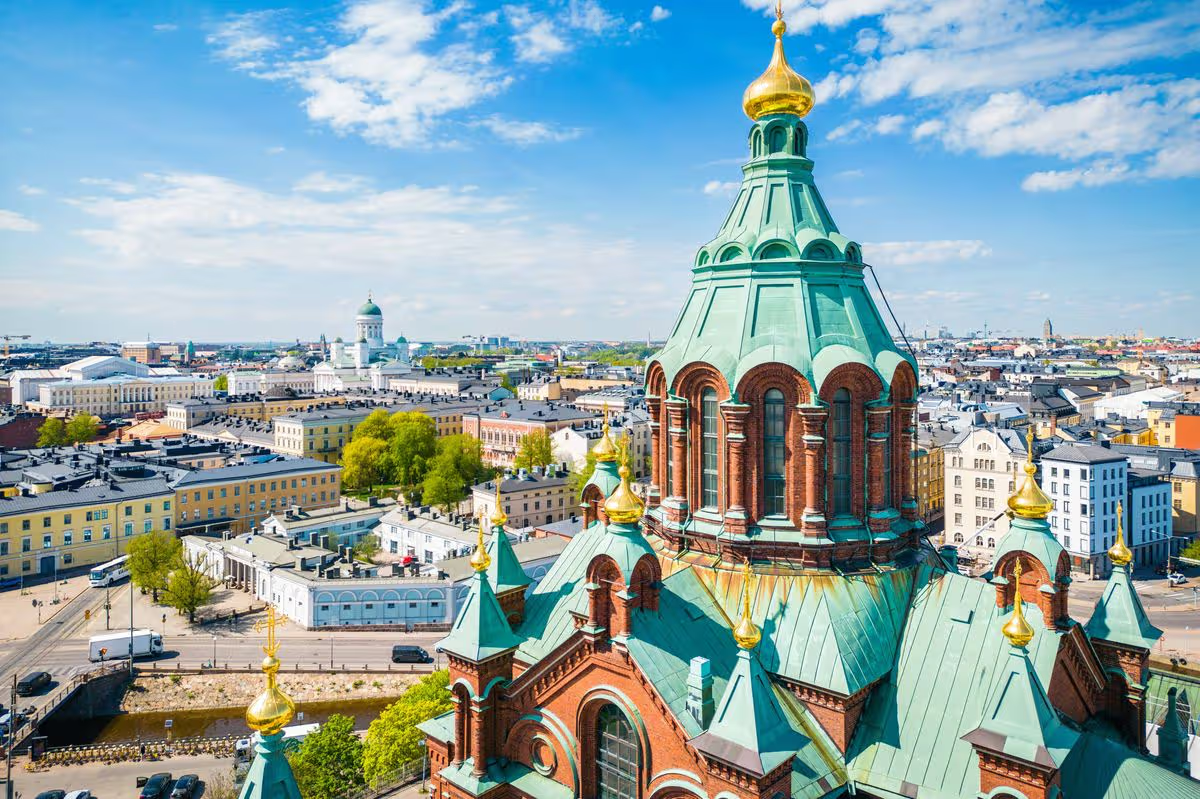
Finland has been crowned the world’s happiest country for the ninth consecutive year in the World Happiness Report 2026, and it’s just three hours from the UK with direct flights from £17
Amy Jones Senior Travel Journalist and Chloe Dobinson
17:00, 30 Mar 2026
Finland made the top spot for the ninth year running(Image: Miemo Penttinen – miemo.net via Getty Images)
The world’s happiest nation has been unveiled, and it’s just three hours from the UK with £17 flights available.
For the ninth year running, Finland, with its varied terrain and exceptional quality of life, has been crowned the happiest country of 2026. The Scandinavian nation claimed top spot in the World Happiness Report 2026, released by the Wellbeing Research Centre at the University of Oxford.
The findings emerged after a survey of approximately 100,000 individuals across 140 nations, with Finland singled out for freedom to make life choices, social support, and life expectancy. Additional factors thought to contribute to Finland’s satisfying way of life include its minimal crime levels, unpolluted environment, and work-life equilibrium, alongside its stunning natural splendour.
The Nordic nation boasts thousands of unspoilt lakes with sparkling waters and captivating woodlands that blanket over 70 per cent of the territory. The varied scenery is genuinely spectacular and undeniably elevates the standard of living for Finnish residents, providing abundant prospects for outdoor pursuits and wellness.
It’s not exclusively those residing in the nation who can discover its marvels. Finland has emerged as a sought-after holiday spot for visitors eager to observe the shimmering northern lights, trek through its remarkable landscape, or sample its extraordinary saunas, with over 3 million scattered throughout the country.
Whilst many associate Finland with its enchanting Lapland winter wonderland, particularly beloved during the festive season, the country is undoubtedly a year-round destination spanning its four distinct regions. From lakeside retreats to woodland escapes and seaside breaks.
Finland’s capital, Helsinki, makes for a perfect starting point for a pedestrian-friendly city break, boasting cutting-edge art galleries, legendary saunas, thriving eateries and stunning Nordic architecture. The city’s peninsula position, encircled by islands, provides convenient access to some of the nation’s finest natural attractions, from woodlands to islands and shorelines.
Direct flights to Helsinki in April start from £17 one-way, according to Skyscanner. Although you’ll need to layer up with temperatures hovering around 8C during spring, the city’s stunning scenery makes it well worth the journey, with countless walking routes through its peaceful, postcard-perfect landscapes.
Additionally, with an exceptionally strong sauna culture, you’re never far from a warming dip after a day’s exploration. Among Helsinki’s most sought-after destinations is Löyly, a striking waterfront sauna and dining venue, housed in a modern Nordic building with seaside panoramas.
Further notable Finnish destinations include Rovaniemi, celebrated as the Lapland gem, and Tampere, offering another stylish urban getaway. There’s also Kuopio for those seeking to retreat to the peaceful lakes, and Turku, famed for its historic castle and waterside dining establishments.
Beyond Finland, other Scandinavian nations, including Iceland, Denmark, Sweden, and Norway, also featured amongst the globe’s happiest countries. Meanwhile, Costa Rica, boasting its tropical climate, rainforests and beaches, secured fourth position, with European destinations commanding the list.
Top 10 happiest countries in the world 2026
Finland
Iceland
Denmark
Costa Rica
Sweden
Norway
Netherlands
Israel
Luxembourg
Switzerland
Do you have a travel story to share? Email webtravel@reachplc.com
An Airbnb stay in someone’s garage doesn’t exactly sound like the height of luxury, but one British lad put it to the test and couldn’t believe what he saw when the shutter went up
Karl Grafton and Julie Delahaye Travel Editor & Commercial Content Lead
16:31, 30 Mar 2026Updated 16:35, 30 Mar 2026
This article contains affiliate links, we will receive a commission on any sales we generate from it. Learn more
(Image: Jam Press/@zacjonesliverpool)
If you tell someone you’ve booked a stay on Airbnb, most people will picture a pretty cottage or cosy flat. However for one UK holidaymaker, he actually booked out someone’s garage for an overnight stay.
Reviewer Zac Jones shared a video of his experience on TikTok, which has since garnered around 2.8million views, after he checked in for a stay at a garage in Bradford.
In the short clip Zac arrives for an evening check-in, standing outside the garage shutters. He phones up the owner who appears to open the shutter remotely. Instead of a grimy garage – which you’d rightfully expect to see – the shutters reveal a brick wall and front door.
Once inside, it turns out that Zac may have lucked out with what could be one of Britain’s plushest garages. He summed up his reaction in two words: “Pleasantly surprised”.
Instead of a car, storage boxes or a general mess that you’d find in most people’s homes, this garage has been decked out with modern flooring, and comes complete with a bed, bathroom with shower and toilet, a sofa, TV and even a fridge and microwave as reported by creatorzine.com.
Zac added: “Someone has put a lot of effort in. It’s got snacks, and tea and coffee-making facilities. Shout out to the owner of this place. This has been one of my most interesting check-ins in a while.”
Content cannot be displayed without consent
As for keeping warm? The room appears to have all the modern comforts you’d need, including a radiator that Zac said was already on, with an extra plug-in radiator for those who might want extra warmth.
The garage in Bradford, West Yorkshire is available for £30 for a night. In the comments, overall people were fairly impressed with the offering. One person said: “For the price, it actually looks good.”
Another viewer added: “30 quid! “I’ve stayed in worse for 100.” A third agreed, describing the property as a “bargain”. However, a few pointed out that the garage doesn’t have windows which would leave them feeling a little closed in, with some questioning the planning permission that would have been obtained to build the room in the first place.
Of course if you are thinking of a stay in Bradford, there are plenty of other Airbnb stays you can book which are entire homes, and not a room in a garage. For a similar price to the £30-a-night garage stay, you can also find hotel rooms from £38 a night with Skyscanner.
Have you got a quirky stay or holiday story you want to share? Email us at webtravel@reachplc.com.
ONE of the UK’s most popular seaside towns is undergoing a £750,000 revamp to its historic promenade.
Brighton has long been a popular destination for holidaymakers but its famous Victorian promenade has been partially closed to the public since 2012 following safety concerns.
Sign up for the Travel newsletter
Thank you!
Brighton’s famous Victorian promenade has been partially closed to the public since 2012 following safety concernsCredit: AlamyBut it is currently having £750,000 spent on it and will reopen later this yearCredit: purcelluk.The structure was originally built to create a sheltered promenade for Victorian touristsCredit: purcelluk.
Now, the promenade is expected to reopen this winter after an extensive restoration project.
Known as the Madeira Terrace, the historic promenade structure stretches 865metres-long with 151 large arches and was built between 1890 and 1897.
Parts of the cast iron railing decorations depict Poseidon – the Greek god of the sea – and Aphrodite – the goddess of love – as well.
The structure is also Grade II listed and thought to be the longest continuous cast-iron structure in the UK.
The first phase of the project includes restoring 28 of the arches between the Royal Crescent steps and Concorde 2, as well as installing a new lift.
The new lift will create step-free access to and from Madeira Drive.
Work on the lift has already begun with the next stage involving 20,000 bricks being placed around a frame that has been built.
Parts of the cast iron structure of Madeira Terrace have already been returned to the promenade after being sent to a specialist foundry for repairs.
The structure was originally built to create a sheltered promenade for Victorian tourists and was designed by Philip Lockwood – the same man behind the Bandstand, also known as the Birdcage, on Brighton seafront.
As wealthy visitors arrived by train, the terrace would allow them to promenade along the beach no matter the weather.
Over the decades it has become a key part of Brighton’s image as well as appearing in a number of productions such as films Wimbledon (2004) and TV series Dr Who.
Councillor Julie Cattell said: “We’re moving forward with very visible and eye-catching elements of the restoration, and I know residents and visitors are enjoying seeing the structure take shape.
“There has been huge interest in the work being done to create the lift and residents will continue to see real progress being made over the coming months.
“It is great that so many people are really captivated and engaged in this project – and have such goodwill towards the work being done.
As wealthy visitors arrived by train, the terrace would allow them to promenade along the beach no matter the weatherCredit: purcelluk.Parts of the cast iron railing decorations depict Poseidon – the Greek god of the sea – and Aphrodite – the goddess of love – as wellCredit: Alamy
“We know Madeira Terrace is a vital part of our city’s architectural heritage and is something people really care about.
“That is partly why we are taking a firm, heritage-led approach.
“Restoring the existing structure does take more time than simply replacing it – particularly with the testing required – but it is the correct approach.
“We’re determined to get this restoration right – and see Madeira Terrace once again become a thriving and important part of our iconic seafront.”
The renovations to the terrace are also part of a wider multi-million-pound project that will develop the area around the Brighton Centre – a conference and exhibition space where previously The Who, Queen and Bob Marley have performed.
The project includes opening a new lift that will create step-free accessCredit: Getty
Dubbed the Waterfront Project, work will expand Churchill Square shopping centre as well as establish a new conference centre and entertainment venue.
In 2024, plans were also submitted to widen the beach in Brighton’s neighbour – Hove.
The plans were later approved for the coastal defense works, which includes widening and adding new pebbles and groynes to the beach.