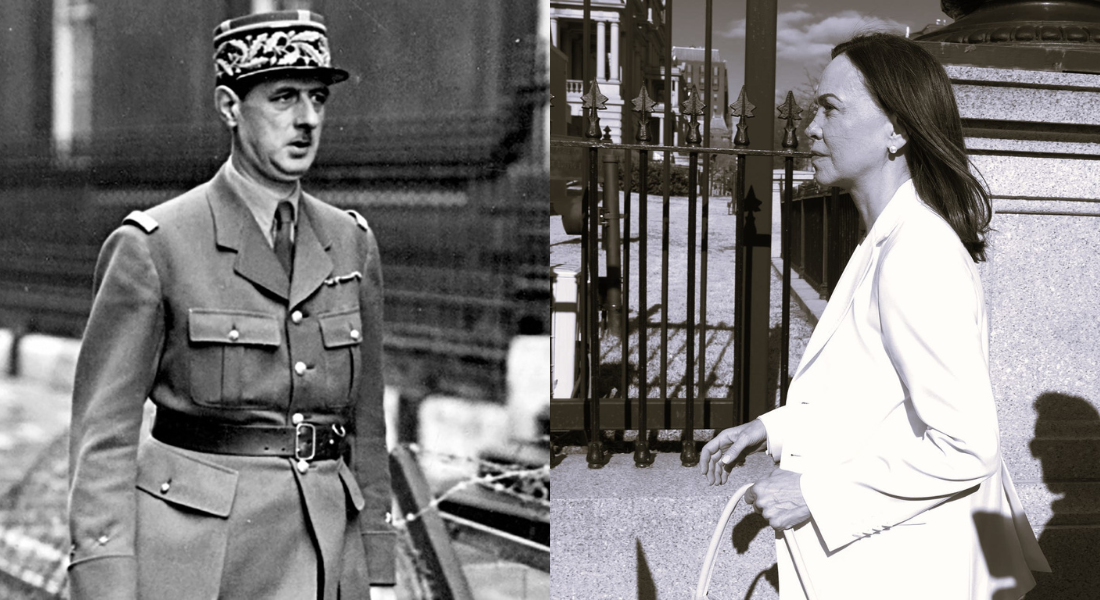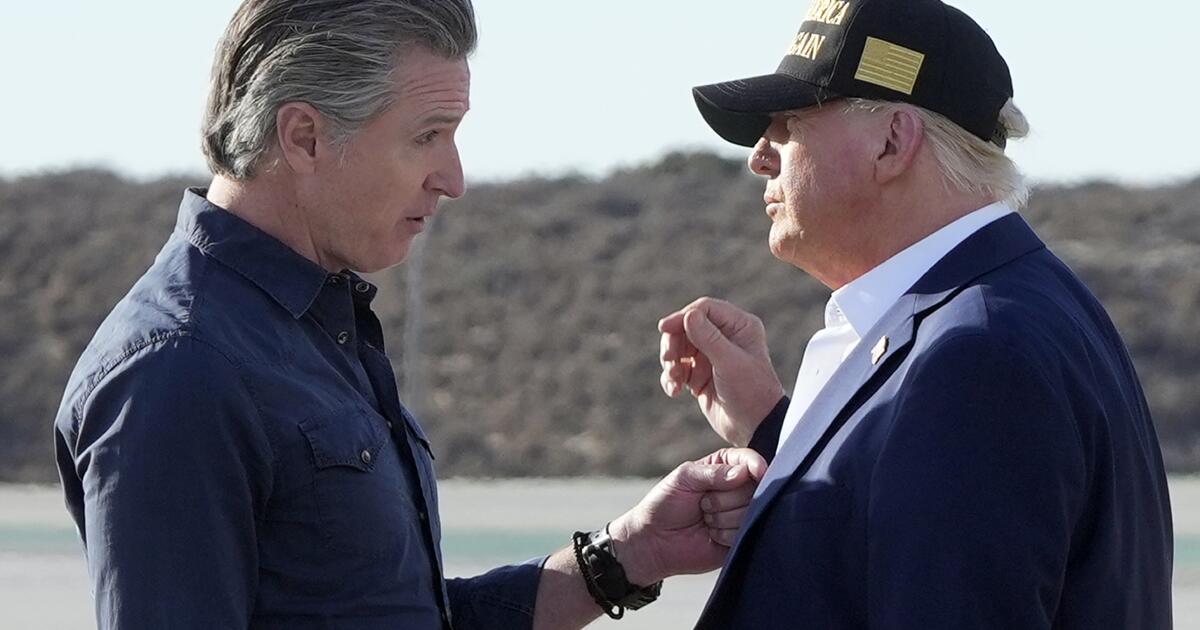
He’s loud, he’s obnoxious and, in a very short time, he’s broken unprecedented ground with his smash-face, turn-it-to-11 approach to the vice presidency. Unlike most White House understudies, who effectively disappear like a protected witness, Vance has become the highest-profile, most pugnacious politician in America who is not named Donald J. Trump.
It’s quite the contrast with his predecessor.
Kamala Harris made her own kind of history, as the first woman, first Black person and first Asian American to serve as vice president. As such, she entered office bearing great — and vastly unrealistic — expectations about her prominence and the public role she would play in the Biden administration. When Harris acted the way that vice presidents normally do — subservient, self-effacing, careful never to poach the spotlight from the chief executive — it was seen as a failing.
Why is that? Because that’s how President Trump wants it.
“Rule No.1 about the vice presidency is that vice presidents are only as active as their presidents want them to be,” said Jody Baumgartner, an East Carolina University expert on the office. “They themselves are irrelevant.”
Consider Trump’s first vice president, Mike Pence, who had the presence and pizzazz of day-old mashed potatoes.
“He was not a very powerful vice president, but that’s because Donald Trump didn’t want him to be,” said Christopher Devine, a University of Dayton professor who’s published four books on the vice presidency. “He wanted him to have very little influence and to be more of a background figure, to kind of reassure quietly the conservatives of the party that Trump was on the right track. With JD Vance, I think he wants him to be a very active, visible figure.”
There were other circumstances that kept Harris under wraps, particularly in the early part of Biden’s presidency.
One was the COVID-19 lockdown. “It meant she wasn’t traveling. She wasn’t doing public events,” said Joel K. Goldstein, another author and expert on the vice presidency. “A lot of stuff was being done virtually and so that tended to be constraining.”
The Democrats’ narrow control of the Senate also required Harris to stick close to Washington so she could cast a number of tie-breaking votes. (Under the Constitution, the vice president provides the deciding vote when the Senate is equally divided. Harris set a record in the third year of her vice presidency for casting the most tie-breakers in history.)
The personality of their bosses also explains why Harris and Vance approached the vice presidency in different ways.
Biden had spent nearly half a century in Washington, as a senator and vice president under Barack Obama. He was, foremost, a creature of the legislative process and saw Harris, who’d served nearly two decades in elected office, as a (junior) partner in governing.
Ohio’s senator had served barely 18 months in his one and only political position when Trump chose Vance as his running mate. He’d “really made his mark as a media and cultural figure,” Devine noted, with Vance’s memoir, “Hillbilly Elegy,” regarded as a kind of Rosetta Stone for the anger and resentment that fueled the MAGA movement.
Trump “wanted someone who was going to be aggressive in advancing the MAGA narrative,” Devine said, “being very present in media, including in some newer media spaces, on podcasts, social media. Vance was someone who could hammer home Trump’s message every day.”
The contrast continued once Harris and Vance took office.
Trump has treated Vance as a sort of heat-seeking rhetorical missile, turning him loose against his critics and acting as though the presidential campaign never ended.
Vance seems gladly submissive. Harris, who was her own boss for nearly two decades, had a hard time adjusting as Biden’s No. 2.
“Vance is very effective at playing the role of backup singer who gets to have a solo from time to time,” said Jamal Simmons, who spent a year as Harris’ vice presidential communications chief. “I don’t think Kamala Harris was ever as comfortable in the role as Vance has proven himself to be.”
Will Vance’s pugilistic approach pay off in 2028? It’s way too soon to say. Turning the conventions of the vice presidency to a shambles, the way Trump did with the presidency, has delighted many in the Republican base. But polls show Vance, like Trump, is deeply unpopular with a great number of voters.
As for Harris, all she can do is look on from her exile in Brentwood, pondering what might have been.
LA28 released the detailed daily competition schedule for the biggest Olympics in history on Wednesday, laying out every event for the 19 days of competition that will feature more than 11,000 athletes across 51 sports.
Along with being the largest in Games history, the 2028 Summer Olympics will be the first to include more female athletes than men. The schedule honors the historic moment for women in sports by showcasing the women’s 100-meter final at the Coliseum as the primetime, marquee event on the first official day of competition on July 15, 2028.
“The reason we’re throwing out the women’s 100 meters on the first day is because we want to come on these Games with a bang,” Shana Ferguson, LA28’s chief of sport and head of Games delivery, said on a conference call. “And likely that race will be among the most watched of all the races in the Games. We just want to start that Day 1 with a massive, massive showcase of the fastest females in the world.”
The women’s 100-meter final will punctuate Day 1 competition that will feature eight women’s finals, the most for a single day at the Olympics. The men’s 100-meter final will follow on Day 2.
Scheduling the women’s final on Day 1 will require the top athletes to run up to three, 100-meter races in one day as opposed to putting qualifying on a separate day as the semifinals and finals. Olympic organizers presented the idea to athlete commissions within LA28 and through World Athletics. While some preferred to keep the status quo for the women’s 100 meter, Janet Evans, LA28’s chief athlete officer, said the majority of competitors simply wanted to know when their races would be so they could plan their training accordingly.
“I think a lot of athletes will be looking immediately at the schedule and planning their training around it,” said Evans, a four-time Olympic gold medalist in swimming. “That was certainly top of mind as we made this decision.”
Making the schedule came with extensive consultation with athletes and international sport federations. Organizers considered the sun position for diving, which will be held outdoors at the Rose Bowl Aquatics Center. They wanted to ensure that fans waiting to enter arenas wouldn’t be left in the sun during a mid-day competition. Weary of heat affecting horses in Santa Anita, they took care to schedule equestrian events for either early morning or evening sessions.
With track and field setting the stage in the first week, swimming competitions traditionally take place first were shifted to the second week to allow organizers to build an indoor swimming pool in SoFi Stadium after the venue helps host the opening ceremony on July 14.
But keeping with Olympic tradition, the marathon will still take place on the final weekend of the Games, with the women running at Venice Beach on Day 15 (July 29), and the men competing on Day 16 (July 30). As one of the final Olympic events, marathon medalists typically receive their medals during the closing ceremony, which will take place at the Coliseum on July 30, beginning at 6 p.m.
The 2028 Games are approaching major checkpoints with less than three years until the opening ceremony. The Paralympic competition schedule will be released later this year. The volunteer program has already opened for community opportunities while applications for Games time volunteers will open in summer of 2026. Olympics ticket registration will open in January 2026.
Fans can begin registering for the ticket lottery in January and purchasing windows for those who are selected in the lottery will begin in spring 2026. Prices start at $28. With concerns about sky-high ticket prices for sporting events such as the FIFA World Cup or the World Series, Ferguson said LA28 will not use dynamic pricing, but didn’t state any specifics about the prices.
Ferguson said the organizing committee has 14 million tickets for the Olympics and Paralympics, which would break the ticket record set by Paris 2024. The biggest Olympics, and the most jam-packed schedule, would warrant that kind of attendance.
“What a great responsibility that is for us,” Ferguson said of hosting the biggest Olympics in history. “The care and concern that went into building this competition schedule — I will tell you that the folks on the team who did it really, truly, had a lot of sleepless nights because they wanted to get this right for every single athlete, regardless of sport.”
LA28 competition dates
Opening Ceremony: July 14 3×3 Basketball: July 17-22, Archery: July 21-28 Artistic Gymnastics: July 15-25 Artistic Swimming: July 25-29 Athletics: July 15-30 Badminton: July 15-24 Baseball: July 13-19 Basketball: July 12-30 Beach Volleyball: July 15-29 BMX Freestyle: July 28-29 BMX Racing: July 15-16 Boxing: July 15-30 Canoe Slalom: July 14-22 Canoe Sprint: July 25-29 Cricket: July 12-29 Cycling Road: July 19-23 Cycling Track: July 25-30 Diving: July 25-30 Equestrian: July 15-29 Fencing: July 15-23 Flag Football: July 15-22 Football (Soccer): July 12-29 Golf: July 19-29 Handball: July 12-28 Hockey (Field): July 12-29 Judo: July 15-22 Lacrosse: July 24-29 Modern Pentathlon: July 15-18 Mountain Bike: July 15-18 Open Water Swimming: July 17-18 Rhythmic Gymnastics: July 27-29 Rowing: July 15-22 Rowing Coastal Beach Sprints: July 24-25 Rugby Sevens: July 12-18 Sailing: July 16-28 Shooting: July 15-25 Skateboarding: July 18-27 Softball: July 23-29 Sport Climbing: July 24-29 Squash: July 15-24 Surfing: July 15-23 Swimming: July 22-30 Table Tennis: July 22-30 Taekwondo: July 26-29 Tennis: July 19-28 Trampoline Gymnastics: July 21 Triathlon: July 15-20 Volleyball: July 15-30 Water Polo: July 12-23 Weightlifting: July 25-29 Wrestling: July 24-30 Closing Ceremony: July 30
Cape Town, South Africa – On an August evening in 1977, 30‑year‑old Steve Biko was on his way back from an aborted secret meeting with an anti-apartheid activist in Cape Town, taking the 12‑hour drive back home to King William’s Town. But it was a journey the resistance fighter would never finish, for he was arrested and, less than a month later, was dead.
Against the backdrop of increasingly harsh racist laws in South Africa, Biko, a bold and forthright youth leader, had emerged as one of the loudest voices calling for change and Black self-determination.
Recommended Stories
list of 3 itemsend of list
A famously charming and eloquent speaker, he was often touted as Nelson Mandela’s likely successor in the struggle for freedom after the core of the anti-apartheid leadership was jailed in the 1960s.
But his popularity also made him a prime target of the apartheid regime, which put him under banning orders that severely restricted his movement, political activities, and associations; imprisoned him for his political activism; and ultimately caused his death in detention – a case that continues to resonate decades later, largely because none of the perpetrators have ever been brought to justice.
On September 12 this year, 48 years after Biko died, South Africa’s Justice Minister Mmamoloko Kubayi ordered a new inquest into his death. The hearing resumed at the Eastern Cape High Court on Wednesday before being postponed to January 30.
There are “two persons of interest” implicated in Biko’s death who are still alive, according to the country’s National Prosecuting Authority (NPA), which aims to determine whether there is enough evidence that he was murdered, and therefore grounds to prosecute his killers.
While Biko’s family has welcomed the hearings, the long wait for justice has been frustrating, especially for his children.
“There is no such thing as joy in dealing with the case of murder,” Nkosinathi Biko, Biko’s eldest son, who was six at the time of his father’s death, told Al Jazeera. “Death is full and final, and no outcome will be restorative of the lost life.”
The Biko inquest is one of several probes into suspicious apartheid-era deaths that South Africa’s justice minister reopened this year. The inquiries are part of the government’s plan to address past atrocities and provide closure to families of the deceased, the NPA says.
But analysts note that the inquest comes amid growing public pressure on the government to bring about the justice it promised 30 years ago, as a new judicial inquiry is also probing allegations that South Africa’s democratic government intentionally blocked prosecutions of apartheid-era crimes.
Anti-apartheid activist Steve Biko is seen in an undated image. He died in police detention in 1977 [File: AP Photo/Argus]
Biko: ‘The spark that lit a fire’
Steve Biko was a medical student and national youth leader who, in the late 1960s, pioneered the philosophy of Black Consciousness, which encouraged Black people to reclaim their pride and unity by rejecting racial oppression and valuing their own identity and culture.
The philosophy inspired a generation of young activists to take up the struggle against apartheid, pushed forward by the belief that South Africa’s future lay in a socialist economy with a more equal distribution of wealth.
In his writings, Biko said he was inspired by the African independence struggles that emerged in the 1950s and suggested that South Africa had yet to offer its “great gift” to the world: “a more human face”.
By 1972, Biko’s student organisation had spawned a political wing to unify various Black Consciousness groups under one voice. A year later, he was officially banned by the government. Yet, he continued to covertly expand his philosophy and political organising among youth movements across the country.
In August 1977, despite the banning order still being in effect, Biko had travelled to Cape Town with a fellow activist to meet another anti-apartheid leader, though the meeting was aborted over safety concerns, and the duo left.
According to some reports, Biko heavily disguised himself for the road journey back east, but his attempts at going unnoticed were to no avail: When the car reached the outskirts of King William’s Town on August 18, police stopped them at a roadblock – and Biko was discovered.
The two were taken into custody separately, with Biko arrested under the Terrorism Act and first held at a local police station in Port Elizabeth before being transferred to a facility in the same city where members of the police’s “special branch” – notorious for enforcing apartheid through torture and extrajudicial killings – were based. For weeks in detention, he was stripped and manacled and, as was later discovered, tortured.
On September 12, the apartheid authorities announced that Biko had died in detention in Pretoria, some 1,200km (746 miles) away from where he was arrested and held. The minister of justice and police alleged he had died following a hunger strike, a claim immediately decried as false, as Biko had previously publicly stated that if that was ever cited as a cause of his death, it would be a lie.
Weeks later, an independent autopsy conducted at the request of the Biko family found he had died of severe brain damage due to injuries inflicted during his detention. Following these revelations, authorities launched an investigation. But the inquest cleared the police of any wrongdoing.
Saths Cooper, who was a student activist alongside Biko, remembers the moment he found out about his friend’s death. Cooper was in an isolation block on Robben Island – the prison that also held Mandela – where he spent more than five years with other political prisoners who had taken part in the 1976 student revolt.
“The news stilled us into silence,” the 75-year-old told Al Jazeera, recalling Biko’s provocatively “Socratic” style of engagement and echoing Mandela’s description of Biko as an inspiration. “Living, he was the spark that lit a veld fire across South Africa,” Mandela said in 2002. “His message to the youth and students was simple and clear: Black is Beautiful! Be proud of your Blackness! And with that, he inspired our youth to shed themselves of the sense of inferiority they were born into as a result of more than 300 years of white rule.”
After initial shock at the news of Biko’s death, “then the questions flowed of what had occurred,” Cooper recalled, “to which we had no answers.”
About 20,000 people, including Black and white anti-apartheid activists and Western diplomats, attended Biko’s funeral in King Williams Town on September 25. The day included a five-hour service, powerful speeches and freedom songs. Though police disrupted the service and arrested some mourners, it marked the first large political funeral in South Africa.
His death sparked international condemnation, including expression of “concern” from Pretoria’s allies, the US and the UK. It also led to a United Nations arms embargo against South Africa in November 1977.
Three years later, the British singer Peter Gabriel released a song in his honour, and in 1987, his life was depicted in the film Cry Freedom, in which Biko was played by Denzel Washington.
Nevertheless, Biko’s stature did nothing to hasten justice.
In 1997, then-President Nelson Mandela visited the grave of anti-apartheid activist Steve Biko, accompanied by Biko’s son Nkosinathi, left, and his widow Ntsiki, third from left [File: Reuters]
‘The unfinished business of the TRC’
Under the apartheid regime, any further investigation into Biko’s death was effectively put to rest for decades following the official 1977 inquest.
Then in 1996, two years after the end of apartheid, the Truth and Reconciliation Commission (TRC) was set up to investigate past rights violations, with apartheid-era perpetrators given the opportunity to disclose their crimes and apply for amnesty from prosecution.
Former security police officers Major Harold Snyman, Captain Daniel Siebert, Warrant Officer Ruben Marx, Warrant Officer Jacobus Beneke and Sergeant Gideon Nieuwoudt – the five men suspected of killing Biko – applied for amnesty.
At TRC hearings the following year, the men said that Biko had died days after what they called “a scuffle” with the police at the Sanlam Building in Port Elizabeth, while he was held in shackles and handcuffs. Up to that point, the commission heard, Biko had spent several days in a cell – naked, they claimed, in order to prevent him from taking his life.
In the decades since, it’s come to light that after being badly beaten at the Sanlam Building on September 6 and 7, Biko suffered a brain haemorrhage and was examined by apartheid government doctors, who said they found nothing wrong with him. Days later, on September 11, the police decided to transfer him to a prison hospital hours away in Pretoria. Still naked and shackled, Biko was put in the back of a van and moved. Although he was examined in Pretoria, it was too late, and Biko died on September 12 alone in his cell.
Despite admitting to beating Biko with a hose pipe and noticing his disoriented, slurred speech, the former officers claimed at the TRC that they had no indication of the severity of his injuries. Therefore, they saw nothing wrong with transporting him 1,200km away.
Eventually, the men were denied amnesty in 1999, partly for their lack of full disclosure of the events that caused Biko’s death. The suspected killers, some of whom have since died, were recommended for prosecution by the commission.
However, like most TRC cases, the prosecutions never materialised.
“The Biko case, along with others, must be viewed as the delayed activation of the unfinished business of the TRC – a matter that is a national imperative if we are to instigate a culture of accountability in South Africa,” Nkosinathi, now 54, said of the reopened inquest into his father’s death.
Though the scope of the Biko inquest has not been publicly stated, Gabriel Crouse, a political analyst and fellow with the South African Institute for Race Relations, worries that it will not examine new evidence, but that its goal will simply be to decisively determine whether Biko was murdered.
If this is the case, it would leave many questions unresolved, he says. For example, who pressured the initial forensic pathologist to declare a hunger strike as the cause of death; who ordered Biko’s killing; and what was the official chain of command?
Demonstrators protest against five former apartheid-era security policemen’s application for amnesty for their part in the killing of Steve Biko at South Africa’s Truth and Reconciliation Commission, in 1997 [File: Reuters]
‘The worms are among us’
Although the Biko inquest has renewed hope among his family that some of the perpetrators of his death will finally be brought to justice, analysts warn that the process may reveal uncomfortable truths about the nation’s past – including possible collusion between South Africa’s current government and the apartheid regime.
Nkosinathi now heads a foundation that promotes his father’s legacy. He points out that it is only pressure on the government that brought about this moment.
Months before the Biko inquest reopened, President Cyril Ramaphosa ordered the establishment of a commission of inquiry into whether previous governments led by his African National Congress (ANC) party intentionally suppressed investigations and prosecutions of apartheid-era crimes.
His move in April came after 25 survivors and relatives of victims of apartheid-era crimes launched a court case against his government in January, seeking damages.
The allegations of probes being blocked go back more than a decade. In 2015, former national prosecutions chief Vusi Pikoli caused a stir when he submitted an affidavit in a court case about the death of anti-apartheid fighter Nokuthula Simelane, in which he blamed the stalled cases on senior government officials interfering in the work of the NPA.
Former President Thabo Mbeki, who was head of state during Pikoli’s tenure, has denied that any such political interference took place. But the judicial inquiry, announced in April and now under way, lists former senior officials among those it considers interested parties.
The inquiry will look at why so few of the 300 cases that the TRC referred to the NPA for prosecution, including Biko’s, have been investigated in the last two decades.
“That it has become necessary to have to look into such an allegation tells much about how the huge sacrifice that was made for our democracy has been betrayed,” Nkosinathi told Al Jazeera.
Cooper believes the delayed prosecutions are a result of a compromise made by the apartheid regime and the ANC to conceal one another’s offences, including alleged cases of freedom fighters colluding with the white minority government.
“It’s justice clearly denied,” Cooper said, adding that he once questioned TRC commissioners about why they had concealed the names of rumoured apartheid-era collaborators who went on to work in the new democratic government. “The response was, ‘Broer, it’ll open a can of worms,’” Cooper told Al Jazeera.
“I see one of the commissioners died, the other is around, and when I see him, I say, ‘There’s no more can of worms, the worms are among us.’”
Like Cooper, political analyst Crouse also believes some kind of “backdoor deal” was struck following the transition from apartheid to democracy in 1994.
Many political actors failed to apply for amnesty, he says, despite prima facie evidence of their guilt. “And so it became very apparent that white Afrikaner supremacists and Black ANC liberationists, some from both camps, had gotten together and said, ‘Let’s both keep each other’s secrets and go forward into the new South Africa on that basis,’” he said.
Pikoli’s 2015 affidavit seems to echo such analysis. In his document, Pikoli recalls a meeting in 2006, where former ministers grilled him about the prosecution of suspects implicated in the attempted murder of Mbeki’s former chief of staff, Frank Chikane. Pikoli does not specify what the ministers objected to but says it became clear they did not want the suspects prosecuted “due to their fear of opening the door to prosecutions of ANC members, including government officials.”
A plea bargain was struck with the suspects while Pikoli was on leave in July 2007, as part of which the suspects refused to reveal the masterminds behind the compilation of a hit-list targeting activists. Pikoli believes a court trial would have forced them to disclose more details.
Priests and ministers lead the procession to the cemetery in King Williams Town for the burial of Steve Biko, on September 25, 1977 [File: Matt Franjola/AP]
‘A stress test’ for democratic South Africa
Mariam Jooma Carikci, an independent researcher who has written extensively about the failure of justice in the democratic era, believes the official inquiry into the hundreds of unprosecuted TRC cases, including Biko’s, is “a stress test” of democratic South Africa’s honesty.
“For three decades we treated reconciliation as an end in itself – truth commissions instead of prosecutions, memorials instead of justice,” she said.
She sees Biko’s ideas continuing to flourish in today’s student movements, for example, in the #FeesMustFall campaign that called for free university tuition and the decolonisation of education in 2015.
“You see his echo in decolonisation debates and student movements, but the truest honour is policy – land, work, education, healthcare – designed around human worth, not investor or political comfort,” Jooma Carikci said.
While the country waits to hear the outcomes of the Biko inquest and the wider TRC inquiry, Nkosinathi Biko remains haunted by constant reminders of his father.
His younger brother Samora, who recently turned 50, looks exactly like Biko, he says, but being only two at the time of his death, “he was unfortunate not to have had memories of his father because of what happened.”
Meanwhile, for the country in general, Nkosinathi sees connections between Biko’s death and the 2012 Marikana massacre, during which police shot and killed 34 striking miners – the highest death toll from police aggression in democratic South Africa.
In his mind, the image of police opening fire on unarmed protesting workers echoes the country’s dark history – a sign that the state brutality that ended his father’s life has spilled over into democratic South Africa.
Steve Biko’s sons Nkosinathi, left, and Samora give a Black Power salute as they sit at home with their aunt, Biko’s sister, Nobandile Mvovo, on September 15, 1977, in their home at King Williams Town [File: AP]
California’s famous chronicler Carey McWilliams once wrote that some see “this highly improbable state” as more illusion than reality. Perhaps that explains its residents’ perpetual efforts to shake things up and break away — either from the national government or each other.
Since 1849, more than 200 efforts have imagined a political do-over to the idea of California as a single, sprawling American state. Every attempt has failed.
“All major social and political movements in this country take time and inevitably have to overcome failures and setbacks before they are ultimately successful,” Louis Marinelli, the latest provocateur with secessionist dreams, told The Times in an email.
What may be most striking is that anyone would assume there’s a shared state identity, when Californians more often have tried to go their separate ways.
State lawmakers sent their first breakup plan to Congress in 1859, but it was squashed by the onset of the Civil War. The equally unlucky, but colorful, Yreka Rebellion of 1941 saw a handful of Northern California counties join grumpy southern Oregonians to propose a new state called “Jefferson.” They threw a big party in Siskiyou County’s biggest town, Yreka, on Dec. 4, 1941.
Three days later, after the infamous attack on Pearl Harbor, secession fever subsided.
(Anthony Russo / For The Times )
As the song says, breaking up is hard to do. There was a 1965 failed legislative effort to create the nation’s 51st state with a dividing line at the Tehachapi Mountains that span Los Angeles and Kern counties, revisited and dismissed in 1978. And then, the early 1990s plan for an advisory ballot measure to gauge voter interest in splitting California into three states.
“I can’t guarantee a perfect world, but I know that divided, more homogeneous Californias will be better than the gridlocks we have now,” Stan Statham, then a Republican state assemblyman, said in a 1993 Times story. Alas, his proposal died in the state Senate.
A 2009 plan would’ve carved California into separate coastal and inland U.S. states, presumably one favored by Democrats and one by Republicans. The idea was recycled in 2011 by state Sen. Jeff Stone (R-Temecula) while he was a Riverside County supervisor.
Few efforts garnered as much attention, or derision, as the 2014 campaign by Silicon Valley entrepreneur Tim Draper to create six states out of California, with names like “Silicon Valley” and “West California.”
No secession effort has answered the practical questions — how to negotiate water rights, divvy up the existing state’s assets, pay for border security, just for starters. Still, it often sparks valuable public policy discussions.
How sustainable is it when the Bay Area’s per capita income is more than double that in the Central Valley? Why is poverty pocketed in a handful of regions? Does California, home to much of America’s recent job growth, get what it deserves from the federal government?
Those concerns may trigger bouts of secessionist fever, but few would dispute that they’re also a good start on a to-do list for California’s state and national leaders as 2017 comes into view.
TODAY is Armistice Day, which marks the signing of the agreement to end the fighting of World War One. It came into force at 11am on November 11, 1918.
Along with Remembrance Sunday, the day honours those who have died in conflicts, with the nation falling silent at 11am.
Sign up for the Travel newsletter
Thank you!
Learn more about our wartime history on the home front, as The Sun’s Head of Travel, Lisa Minot, highlights some amazing places to visitCredit: Hulton Archive – Getty
This weekend the King led commemorations at the Cenotaph in tribute to the servicemen and women who defended our shores.
But there are plenty of other ways to learn more about our wartime history on the home front. Lisa Minot highlights some amazing places to visit.
REMEMBRANCE & COMMAND
The Map Room in the Churchill War Rooms museum, London, UKCredit: Alamy
ALL eyes were on the capital on Remembrance Sunday as the Cenotaph parade saw more than 10,000 veterans march past.
But you can pay tribute to the fallen year-round at the National Memorial Arboretum in Staffordshire.
Set in 150 acres of woodland, there are more than 400 memorials honouring those killed on duty or by terrorism since World War Two. Entry is free. See thenma.org.uk.
A visit to the Imperial War Museum’s Churchill War Rooms is a chilling yet powerful experience.
Hidden beneath Westminster, the underground bunker was where the Prime Minister and his government directed the war effort. The Map Room is exactly as it was in 1945.
Tickets are best booked in advance and cost from £33 per adult and £16.50 for children five to 15. See iwm.org.uk.
Also not to be missed is HMS Belfast, now moored on the Thames near London Bridge.
Explore the nine decks of the ship that fired some of the first shots on D-Day, supporting the landings at Gold and Juno beaches in Normandy.
Bletchley Park near Milton Keynes, Bucks, was where Alan Turing, below, and his team of codebreakers cracked the Enigma and Lorenz ciphersCredit: AlamyTour the historic country house and the rambling huts and discover the achievements of Alan Turing and others through immersive films, interactive displays and faithfully recreated roomsCredit: Alamy
AWAY from the traditional battlefield, explore the impact World War Two had on the homefront and the secret work of those who changed the conflict’s course.
Bletchley Park near Milton Keynes, Bucks, was where Alan Turing, inset, and his team of codebreakers cracked the Enigma and Lorenz ciphers.
Tour the historic country house and the rambling huts and discover the achievements of these brilliant minds through immersive films, interactive displays and faithfully recreated rooms.
Tickets cost from £28 for adults and £19.50 for children age 12 to 17. Under-12s go free. See bletchleypark.org.uk.
The Blitz brought the war to the lives of civilians living in our biggest cities.
Tour the eerie ruins of Coventry Cathedral, destroyed by Nazi bombs.
This year marks the 85th anniversary of the devastating night that left the city in rubble.
Dover Castle’s hidden tunnels were the secret HQ where the Dunkirk evacuation was planned and later used as a wartime hospitalCredit: Alamy
THE south coast of Britain was the UK’s front line in World War Two and the staging ground in 1944 for the liberation of Europe.
Medieval Dover Castle sits above a network of secret wartime tunnels where the 1940 evacuation of Dunkirk was masterminded and later served as a command centre and hospital.
You can join a guided tour of the tunnels before exploring the castle’s rooms and grounds.
Book castle tickets online in advance and save 15 per cent – from £27.20 for adults and £17.20 for children.
There’s also a Dover Bunker escape room that can be booked separately with prices from £30. See english-heritage.org.uk.
The D-Day Story in Portsmouth is the only museum in the UK dedicated to the Normandy landings.
The city was the main embarkation point and the attraction tells the story through personal accounts of those who were there.
It also features the incredible 83-metre Overlord Embroidery and a restored Landing Craft Tank.
Book online for savings, with tickets from £15.95 per adult and £8 per child. See theddaystory.com.
BATTLE BY SEA AND AIR
Discover how RAF heroes shaped history at IWM Duxford, now Britain’s biggest aviation museum packed with iconic aircraft from Spitfires to LancastersCredit: The Times
LEARN the critical role played by the Royal Air Force at IWM Duxford, Cambs – the former RAF base is now Britain’s largest aviation museum.
Its hangars and airfield played a key role in the Battle of Britain, and the base now houses a vast collection of aircraft, from Spitfires to Lancaster bombers, and tells the story of those who flew them.
In Lincoln, the International Bomber Command Centre is a striking memorial to those who lost their lives in the skies.
Its 102ft spire – the height of a Lancaster bomber’s wingspan – is inscribed with the names of the 55,573 men of Bomber Command who lost their lives.
For a World War One focus, Scapa Flow on Orkney is the vast natural harbour that was the Royal Navy’s main base and is most famous for the scuttling of the interned German High Seas fleet in 1919.
“I couldn’t ask for a better horse – Guchen gave me such a great feeling and I will remember this day forever.
“I just wanted to get round safely and repay the trust that Kim and Mat have had in me.
“I am really proud to be the first black British female jump jockey. When I was growing up I looked up to Khadijah Mellah and I hope that now other young people will look up to me as well and know that they can also reach their dreams.”
“I have watched Aamilah progress over the years and I could not be more excited and proud to see her race today,” said Mellah.
“Visibility is so important and I am excited for her to have the opportunity to display her talent and hard work.”
Fellow academy co-founder Naomi Lawson said the organisation was aiming to “ensure that young people from diverse ethnic communities have the chance to shine in the sport”.
She added: “Only around 2-3% of licensed jockeys come from these communities, far below the national average, so we hope that Aamilah is the first of many to come through the ranks and succeed.”
SACRAMENTO — One takeaway from last week’s elections: The role model for California Gov. Gavin Newsom as he runs for president should be New York City Mayor-elect Zohran Mamdani.
Actually, Mamdani should be emulated not only by Newsom but by Democrats running for office anywhere.
Neither Newsom, of course, nor any candidate outside the most leftist burgs in America should wear the label “democratic socialist,” as Mamdani calls himself. That would frighten too many voters.
But what does appeal to voters — and always has in America — is a strong, positive message of hope. People like to think that a candidate understands their daily troubles and has a vision of how to make their lives better.
Mamdani is a 34-year-old Ugandan-born Muslim of Indian descent and a back-bench New York state assemblyman who the political experts would never figure to win a top-tier elective post such as New York mayor. But he has charisma, exudes authenticity and fills voters with hope.
OK, some of his campaign promises are undeliverable, even in liberal New York: free bus service, free child care and city-run grocery stores. But I suspect many voters didn’t take those pledges literally. It was the boldness and commitment to change for their betterment that drew people to him.
It’s a message framework that has been a winner throughout history.
Franklin D. Roosevelt promised “a new deal for the American people” and gave them hope with his radio fireside chats during the Great Depression.
John F. Kennedy offered a “new frontier.” Barack Obama chanted, “Yes we can” and ran on a slogan of “hope.”
They were all Democrats. But Republican founder Abraham Lincoln urged Americans to “vote yourself a farm and horses” and promised them homesteads on the western frontier.
Ronald Reagan declared: “Let’s make America great again.” Then Donald Trump stole the line and ruined it for any future candidate.
Newsom’s spiel has mostly been that Trump is lower than a worm. That has worked up until now. He has established himself as the Democrats’ most aggressive combatant against Trumpism — and the leader in early polling for the party’s 2028 presidential nomination.
Last week, his national party credentials were bolstered after orchestrating landslide voter approval of Proposition 50, aimed at countering Trump-coerced congressional redistricting in Texas and other red states.
Trump is desperate for the GOP to retain its narrow majority in the House of Representatives during next year’s midterm elections. But Proposition 50 gerrymandering could flip five California seats from Republican to Democrat — perhaps helping Democrats capture House control. Newsom becomes a party hero.
“He’s now a serious front-runner for the Democratic nomination,” says Bob Shrum, a former Democratic consultant who is director of the Center for the Political Future at USC.
Political strategist Mike Murphy, a former Republican turned independent, says “the Democratic presidential race in ‘25 has been won by Gavin Newsom. He made a bet [on Proposition 50] and it paid off.”
But Shrum, Murphy and other veteran politicos agree that Newsom at some point must change his script from predominantly anti-Trump to an appealing agenda for the future.
“He has to have an affordability message, for one,” Shrum says. “And he has to connect with voters. Voters just don’t go down a list of issues. FDR, JFK, Obama, they all were very connected with voters.”
Murphy: “He’s going to have to expand from fighting Trump to talking about his vision for helping the middle class. I’d say, ‘The era of Trump will soon be over. I have a way to bring back the American dream and here’s how I’m going to do it.’”
Easier said than done, especially if you’re the governor of troubled California.
“If it’s about a referendum on California, he has a vulnerability,” Murphy says. “He can’t run on ‘California is great.’”
Newsom consistently brags that California is a pacesetter for the nation. But lots of Americans want nothing to do with our pacesetting.
“You can’t have the highest unemployment, highest gas prices and the biggest homeless problem and tell Americans that everything in California is hunky-dory,” says Republican consultant Rob Stutzman. “Because voters don’t believe that.”
But Democratic consultant Bill Carrick, a South Carolina native, dismisses the effect of anti-California attitudes in Democratic presidential primaries.
“The notion that he can’t win in the South and border states, that’s nonsense,” Carrick says. “People who say that are Republicans. They don’t like Newsom or any other Democrat. People who vote in primaries are hardcore Democrats.”
But Carrick acknowledges that an anti-California bias could hurt Newsom in some states during a general election.
Here’s another takeaway from the elections: The Democratic Party is not in the toilet as far as it has been soul-searching since last November’s presidential election.
Last week, Democrats won everything from local commissioner to governor in much of the country. It confirmed my belief that the party’s chief problem in 2024 was a lousy presidential effort.
President Biden didn’t withdraw early enough for the party to hold primaries that would have allowed its nominee to build wide support. And Kamala Harris simply lacked appeal and didn’t inspire.
Democratic voter enthusiasm was contagious this time.
“There was one of the most exciting ground operations I’ve seen in a long time for 50,” says Democratic strategist Gale Kaufman. “Local party clubs, activists, union members all came together.”
Democrats can thank Trump.
“Voters really don’t trust Democrats but they‘re so angry with Trump it doesn’t matter,” says Dan Schnur, a political science instructor at USC and UC Berkeley.
Final takeaway: Trump has morphed into a Republican albatross.
Indonesia has posthumously awarded former President Suharto the title of National Hero, despite his 32-year rule being marked by authoritarianism, mass killings, and corruption allegations. The decision was made by President Prabowo Subianto Suharto’s former son-in-law and current head of state during a ceremony at the presidential palace in Jakarta.
Suharto, who died in 2008, ruled from 1967 to 1998 after toppling Indonesia’s founding leader Sukarno. His era brought economic growth but ended amid the 1997–98 Asian financial crisis and violent nationwide protests that forced his resignation.
Why It Matters
The move has reignited debates over Indonesia’s reckoning with its authoritarian past and fears of historical revisionism. Critics say honoring Suharto risks legitimizing his repressive legacy and signals a troubling return to military-dominated politics under President Prabowo, himself accused of past human rights abuses.
Pro-democracy activists: Condemned the decision as an attempt to whitewash history. Protesters gathered in Jakarta, saying it disregards victims of Suharto’s rule.
Victims’ families: Groups like Aksi Kamisan continue weekly vigils demanding justice for disappearances and killings during the Suharto era.
Government officials: Defended the award, with Culture Minister Fadli Zon claiming Suharto met all requirements and his alleged role in the 1965–66 mass killings “was never proven.”
Political analysts: Warn that the move may embolden Prabowo’s administration to expand military influence and soften public memory of Suharto’s crimes.
What’s Next
The decision is likely to deepen Indonesia’s polarization over how to remember its turbulent past. Civil society groups are expected to intensify calls for accountability for Suharto-era abuses, while Prabowo’s government may continue framing his legacy as one of “stability and development.”
Democracy advocates fear the recognition could pave the way for further rehabilitation of authoritarian figures in Indonesia’s political landscape.
WITH its harbour, picturesque beaches and rugged countryside, the island of Guernsey could be any ordinary holiday destination at first glance.
But scratch below the surface and you’ll uncover the fascinating story of its five-year occupation by the Nazis — and about an an unlikely survivor of the invasion, Timmy the Tortoise.
Sign up for the Travel newsletter
Thank you!
The stunning Petit Port BayCredit: SuppliedThe colourful harbour and of Saint Peter Port, GuernseyCredit: GettyA crowd watches a military vehicle paradeCredit: Supplied
I was keen to learn about it during my adventure on the second largest of the Channel Islands.
So I booked several short guided day trips with Tours Of Guernsey.
Guide Amanda Johns and I ticked off all the key sites, from museums to former bunkers and even a German underground hospital.
This medical centre — which incredibly doubled up as an ammunition store — had to be the highlight, and the extensive dark passages are a must-see for any history buff.
Its underground bunker can only be viewed by private tour.
Restored by Festung Guernsey, with many original features being reproduced using a 3D printer, the walls within are still dotted with German inscriptions, including the Nazi Eagle.
Potato peel pie
It was an honour to pay it a visit the day after Princess Anne was shown around while on the island for the Liberation Day celebrations.
The day marks when Allied troops freed the locals from Nazi rule on May 9, 1945.
One local making headlines during the celebrations was Timmy, 87 — actually a female — who survived Nazi occupation.
Maggie Cull and Timmy the TortoiseCredit: States of GuernseyThe radio room in the Occupation MuseumCredit: AlamyNazis march through Guernsey in 1940Credit: Getty
She was given to Maggie Cull as a christening present in 1941, not long after she and her parents were turfed out of their home by the Nazis.
After all that history I’d certainly worked up an appetite.
Luckily my base, St Pierre Park Hotel, was just a 25-minute walk into St Peter Port, where there are pubs and restaurants aplenty.
Fifty Seven restaurant is set over two floors and has stunning views of Castle Cornet and the coastline.
The menu features steaks cooked fresh on the grill as well as some excellent fish dishes including oven-baked monkfish on chilli linguine.
As you’re by the sea, grab yourself some fish and chips — the restaurant at Les Douvres Hotel dishes up one of the largest portions I’ve ever seen.
On my last night I dined on a special Liberation Day menu at the Old Government House Hotel, close to the harbour.
This 5H property was turned into the German General Staff Headquarters during the war and it still has an old-world feel about it today.
Dominic Perfetti is a 6-foot-7 starting basketball player for St. John Bosco. Even more impressive is that he’s one of the top high school lacrosse players in the nation and has committed to Syracuse.
He became interested in lacrosse when a friend gave him a stick when he was 6 years old. He started fooling around with it and has been playing lacrosse ever since. He got so good that top programs on the East Coast reached out. And he’s been playing for a club team, too.
He’s so tall as a defender that it makes him a unique player.
“I might be the tallest lacrosse player in history,” Perfetti joked.
The LA84 Foundation announced 19 grants valued at $1.78 million to promote youth sports. Compton Unified will expand free after-school sports to 25 campuses. pic.twitter.com/45KZfrrDSI
His size, combined with 6-9 Christian Collins and 7-1 Howie Wu, gives St. John Bosco a formidable trio in basketball. If his team is busy in the basketball playoffs, he’ll also try to play lacrosse simultaneously for the Braves.
He’ll gladly demonstrate his shooting ability in lacrosse if anyone presents him with a stick and ball. And he can dunk, too.
This is a daily look at the positive happenings in high school sports. To submit any news, please email [email protected].
WASHINGTON — Ahead of Tuesday’s election, when Americans weighed in at the ballot box for the first time since President Trump returned to office, a vicious fight emerged among the president’s most prominent supporters.
The head of the most influential conservative think tank in Washington found himself embroiled in controversy over his defense of Nick Fuentes, an avowed racist and antisemite, whose rising profile and embrace on the right has become a phenomenon few in politics can ignore.
Fierce acrimony between Fuentes’ critics and acolytes dominated social media for days as a historically protracted government shutdown risked food security for millions of Americans. Despite the optics, Trump hosted a Halloween ball at his Mar-a-Lago estate themed around the extravagance of the Great Gatsby era.
Marjorie Taylor Greene, a congresswoman who rose to national fame for her promotion of conspiracy theories, took to legacy media outlets to warn that Republicans are failing the American people over fundamental political imperatives, calling on leadership to address the nation’s cost-of-living crisis and come up with a comprehensive healthcare plan.
And on Tuesday, as vote tallies came in, moderate Democratic candidates in New Jersey and Virginia who had campaigned on economic bread-and-butter issues outperformed their polling — and Kamala Harris’ 2024 numbers against Trump in a majority of districts throughout their states.
The past year in politics has been dominated by a crisis within the Democratic Party over how to rebuild a winning coalition after Trump’s reelection. Now, just one year on, the Republican Party appears to be fracturing, as well, as it prepares for Trump’s departure from the national stage and the vacuum it will create in a party cast over 10 years in his image.
“Lame duck status is going to come even faster now,” Erick Erickson, a prominent conservative commentator, wrote on social media as election results trickled in. “Trump cannot turn out the vote unless he is on the ballot, and that is never happening again.”
You’re reading the L.A. Times Politics newsletter
George Skelton and Michael Wilner cover the insights, legislation, players and politics you need to know in 2024. In your inbox Monday and Thursday mornings.
Flying to Seoul last week on a tour of Asia, Trump was asked to respond to remarks from top congressional Republicans, including the House speaker and Senate majority leader, over his potential pursuit of a third term in office, despite a clear constitutional prohibition against it.
“I guess I’m not allowed to run,” Trump told reporters aboard Air Force One. “If you read it, it’s pretty clear, I’m not allowed to run. It’s too bad.”
Less than a year remains until the 2026 midterm elections when Democrats could take back partial control of Congress, crippling Trump’s ability to enact his agenda and encumbering his administration with investigations.
But a countdown to the midterms also means that Trump has precious time left before the 2028 presidential election begins in earnest, eclipsing the final two years of his presidency.
It’s a conversation already brewing on the right.
“The Republican Party is just a husk,” Stephen K. Bannon, a prominent conservative commentator who served as White House chief strategist in Trump’s first term, told Politico in an interview Wednesday. Bannon has advocated for Trump to challenge the constitutional rule on presidential term limits.
“When Trump is engaged, when Trump’s on the ballot, when Trump’s team can get out there and get low-propensity voters — because that’s the difference now in modern politics — when they can do it, they win,” Bannon said. “When he doesn’t do it, they don’t.”
Trump has already suggested his vice president, JD Vance, and secretary of State, Marco Rubio, will be top contenders to succeed him. But an extreme faction of his political coalition, aligned with Fuentes, is already disparaging them as globalists working at the whims of a baseless conspiracy of American Jews. Fuentes targeted Vance last week, in particular, over his weight, his marriage to a “brown” Indian woman, and his support for Israel.
“The infighting is stupid,” Vance said on Wednesday in a post on the election results, tying intraparty battles to Tuesday’s poor showing for the GOP.
“I care about my fellow citizens — particularly young Americans — being able to afford a decent life, I care about immigration and our sovereignty, and I care about establishing peace overseas so our resources can be focused at home,” he said, adding: “If you care about those things too, let’s work together.”
Democratic fractures remain
Some in Republican leadership saw a silver lining in an otherwise difficult night on Tuesday.
The success of Zohran Mamdani, a 34-year-old democratic socialist who will serve as the youngest and first Muslim mayor of New York City, “is the reason I’m optimistic” for next year’s midterms, House Speaker Mike Johnson told RealClearPolitics on Wednesday.
New York City Mayor-elect Zohran Mamdani speaks at Tuesday night’s victory celebration.
(Yuki Iwamura / Associated Press)
“We will have a great example to point to in New York City,” Johnson said. “They’ve handed the keys to the kingdom to the Marxist. He will destroy it.”
Mamdani’s victory is a test for a weak and diffuse Democratic leadership still trying to steer the party in a unified direction, despite this week’s elections displaying just how big a tent Democratic voters have become.
Republicans like Trump know that labeling conventional Democratic politicians as socialists and communists is a political ploy. But Mamdani himself, they point out, describes his views as socialist, a toxic national brand that could hobble Democratic candidates across the country if Republicans succeed in casting New York’s mayor-elect as the Democrats’ future.
“After last night’s results, the decision facing all Americans could not be more clear — we have a choice between communism and common sense,” Trump said at a White House event on Wednesday. “As long as I’m in the White House, the United States is not going communist in any way, shape or form.”
In an interview with CNN shortly after Mamdani’s victory was called, Hakeem Jeffries, the House minority leader hoping to lead the party back into the majority next year, refused repeated questioning on whether Mamdani’s win might hurt Democratic prospects nationwide.
“This is the best they can come up with?” he said, adding: “We are going to win control of the House of Representatives.”
Bannon, too, warned that establishment Republicans could be mistaken in dismissing Mamdani’s populist appeal across party lines to Trump’s base of supporters. Mamdani, he noted, succeeded in driving out low-propensity voters in record numbers — a key to Trump’s success.
Tuesday’s election, he told Politico, “should be a wake-up call to the populist nationalist movement under President Trump that these are very serious people.”
“There should be even more than alarm bells,” he added. “There should be flashing red lights all over.”
A federal grand jury subpoena has been served on the Los Angeles Fire Department for firefighters’ text messages and other communications about smoke or hot spots in the area of the Jan. 1 Lachman brushfire, which reignited six days later into the massive Palisades fire, according to an internal department memo.
The Times reported last week that a battalion chief ordered firefighters to pack up their hoses and leave the burn area the day after the Lachman fire, even though they complained that the ground was still smoldering and rocks were hot to the touch. In the memo, the department notified its employees of the subpoena, which it said was issued by the U.S. attorney’s office in Los Angeles.
“The subpoena seeks any and all communications, including text messages, related to reports of fire, smoke, or hotspots received between” 10 p.m. on New Year’s Eve and 10 a.m. on Jan. 7, said the memo, which was dated Tuesday.
A spokesperson with the U.S. attorney’s office declined to confirm that a subpoena was issued and otherwise did not comment. The memo did not include a copy of the subpoena.
The memo said the subpoena was issued in connection with an “ongoing criminal investigation” conducted by the Bureau of Alcohol, Tobacco, Firearms and Explosives.
It is unclear from the memo whether the subpoena is directly related to the case against Rinderknecht, who has pleaded not guilty.
During the Rinderknecht investigation, ATF agents concluded that the fire smoldered and burned for days underground “within the root structure of dense vegetation,” until heavy winds caused it to spark the Palisades inferno, according to an affidavit attached to the criminal complaint against Rinderknecht.
The Palisades fire, the most destructive in the city’s history, killed 12 people and destroyed thousands of homes, businesses and other structures.
Last week, The Times cited text messages among firefighters in reporting that crews mopping up the Lachman fire had warned the battalion chief that remnants of the blaze were still smoldering.
The battalion chief listed as being on duty the day firefighters were ordered to leave the Lachman fire, Mario Garcia, has not responded to requests for comment.
In one text message, a firefighter who was at the scene on Jan. 2 wrote that the battalion chief had been told it was a “bad idea” to leave because of the visible signs of smoking terrain, which crews feared could start a new fire if left unprotected.
“And the rest is history,” the firefighter wrote in recent weeks.
A second firefighter was told that tree stumps were still hot at the location when the crew packed up and left, according to the texts. And a third firefighter said this month that crew members were upset when told to pack up and leave but that they could not ignore orders, according to the texts. The third firefighter also wrote that he and his colleagues knew immediately that the Palisades fire was a rekindle of the Jan. 1 blaze.
The Fire Department has not answered questions about the firefighter accounts in the text messages but has previously said that officials did everything they could to ensure that the Lachman fire was fully extinguished. The department has not provided dispatch records of all firefighting and mop-up activity before Jan. 7.
After The Times published the story, Mayor Karen Bass directed interim Fire Chief Ronnie Villanueva to launch an investigation into the matter, while critics of her administration have asked for an independent inquiry.
WASHINGTON — The government shutdown has entered its 36th day, breaking the record as the longest ever and disrupting the lives of millions of Americans with program cuts, flight delays and federal workers nationwide left without paychecks.
President Trump has refused to negotiate with Democrats over their demands to salvage expiring health insurance subsidies until they agree to reopen the government. But skeptical Democrats question whether the Republican president will keep his word, particularly after the administration restricted SNAP food aid despite court orders to ensure funds are available to prevent hunger.
Trump, whose first term at the White House set the previous government shutdown record, said this one was a “big factor, negative” in the GOP’s election losses Tuesday and he repeated his demands for Republicans to end the Senate filibuster as a way to reopen the government — something senators have refused to do.
“We must get the government back open soon,” Trump said during a breakfast meeting Wednesday with GOP senators at the White House.
Trump pushed for ending the Senate rule, which requires a 60-vote threshold for advancing most legislation, as a way to steamroll the Democratic minority on the shutdown and pass a long list of other GOP priorities. Republicans now hold a 53-47 majority in the Senate, and Democrats have been able to block legislation that would fund the government, having voted more than a dozen times against.
“It’s time for Republicans to do what they have to do, and that’s terminate the filibuster,” Trump told the senators.
That push is likely to go unmet by Republican senators but could spur them to deal with the Democrats.
Trump has remained largely on the sidelines throughout the shutdown, keeping a robust schedule of global travel and events, including at his private Mar-a-Lago club in Florida. Instead, talks have intensified among a loose coalition of centrist senators trying to negotiate an end to the stalemate.
Expectations are high that the logjam would break once election results were fully tallied in the off-year races widely watched as a gauge of voter sentiment over Trump’s second term. Democrats swept key contests, emboldening progressive senators who want to keep fighting for healthcare funds. Moderate Democrats have been more ready to compromise.
The top Democrats in Congress demanded that Trump meet with Capitol Hill leaders to negotiate an end to the shutdown and address healthcare.
“The election results ought to send a much-needed bolt of lightning to Donald Trump that he should meet with us to end this crisis,” said Senate Democratic leader Chuck Schumer of New York.
Trump sets another shutdown record
Trump’s approach to the shutdown stands in marked contrast to his first term, when the government was partially closed for 35 days over his demands for money to build the U.S.-Mexico border wall. At that time, he met publicly and negotiated with congressional leaders. Unable to secure the money, he relented in 2019.
This time, it’s not just Trump declining to engage in talks. The congressional leaders are at a standoff and House Speaker Mike Johnson (R-La.) sent lawmakers home in September after they approved their own funding bill, refusing further negotiations.
A “sad landmark,” Johnson said at a news conference Wednesday. He dismissed the party’s election losses and said he is looking forward to a midterm election in 2026 that will more reflect Trump’s tenure.
In the meantime, food aid, child-care money and countless other government services are being seriously interrupted. Hundreds of thousands of federal workers have been furloughed or expected to come to work without pay.
Transportation Secretary Sean Duffy predicted there could be chaos in the sky next week if air traffic controllers miss another paycheck. Labor unions put pressure on lawmakers to reopen the government.
“Can this be over now?” Senate Majority Leader John Thune (R-S.D.) said as he returned from the White House breakfast. “Have the American people suffered enough?”
Thune also said there is not support in the Senate to change the filibuster. “It’s not happening,” he said.
Senators search for potential deal
Central to any resolution will be a series of agreements that would need to be upheld not only by the Senate, but also the House, and the White House, which is not at all certain in Washington.
Senators from both parties, particularly the members of the powerful Appropriations Committee, are pushing to ensure the normal government funding process in Congress can be put back on track.
Among the goals is guaranteeing upcoming votes on a smaller package of bills where there is already widespread bipartisan agreement to fund various aspects of government such as agricultural programs and military construction projects at bases.
“I certainly think that three-bill package is primed to do a lot of good things for the American people,” said Sen. Katie Britt (R-Ala.), who has been in talks.
Healthcare costs skyrocket for millions
More difficult, a substantial number of senators also want some resolution to the standoff over the funding for the Affordable Care Act subsidies that are set to expire at year’s end.
With insurance premium notices being sent, millions of people are experiencing sticker shock on skyrocketing prices. The loss of enhanced federal subsidies, which were put in place during the COVID-19 pandemic and come in the form of tax credits, are expected to leave many people unable to buy health insurance.
Republicans are reluctant to fund the healthcare program, also known as Obamacare, without changes, but negotiating a compromise with Democrats is expected to take time, if a deal can be reached at all.
Thune has promised Democrats at least a vote on their preferred healthcare proposal, on a date certain, as part of any deal to reopen government. But that’s not enough for some senators, who see the healthcare deadlock as part of their broader concerns with Trump’s direction for the country.
Mascaro and Jalonick write for the Associated Press. AP writers Kevin Freking, Stephen Groves, Joey Cappelletti and Matt Brown contributed to this report.
For a historian who writes about war, Rick Atkinson is surprisingly optimistic. The Pulitzer Prize-winning author and former journalist — who recently released the second volume in a trilogy of books about the American Revolution — believes that the bedrock of American democracy is solid enough to withstand any assaults on its founding principles.
As the guest of honor at a Sunday night dinner sponsored by the Library Foundation of Los Angeles as part of its biennial Literary Feasts fundraiser, Atkinson was the most upbeat person at the event, which took place just before Election Day. Speaking to about 18 guests gathered around two circular tables carefully laid out on the back patio at the home of fellow writers and hosts Meenakshi and Liaquat Ahamed, Atkinson buoyed the flagging spirits of those certain that the country was currently dangling on the precipice of disaster at the hands of the Trump administration.
Book lovers attend a Literary Feast dinner featuring Pulitzer Prize-winning historian Rick Atkinson at the home of writers Meenakshi and Liaquat Ahamed.
(Jason Armond / Los Angeles Times)
“We’re the beneficiaries of an enlightened political heritage handed down to us from that founding generation, and it includes strictures on how to divide power and keep it from concentrating in the hands of authoritarians who think primarily of themselves,” Atkinson said with the cheery aplomb of a man who has spent the bulk of his time burrowing deep inside archives filled with harrowing stories of the darkest days the world has ever seen. “We can’t let that slip away. We can’t allow it to be taken away, and we can’t allow ourselves to forget the hundreds of thousands who’ve given their lives to affirm and sustain it over the past 250 years.”
The questions and conversation that followed Atkinson’s rousing speech about the history of the Revolution — including riveting details about key players like George Washington who Atkinson noted had “remarkably dead eyes” in order to not give away a scintilla of his inner life to curious onlookers — was what the evening’s book-loving guests had come for.
“We’re the beneficiaries of an enlightened political heritage handed down to us from that founding generation,” said Rick Atkinson.
(Jason Armond / Los Angeles Times)
A total of 40 authors are hosted at salon-style events at 40 houses with more than 750 guests over the course of a single evening, raising more than $2 million for the Library Foundation, which is a separate entity from the public library. Founded in 1992 in the wake of the devastating 1986 fire at downtown’s Central Library, which destroyed more than 400,000 books, the foundation seeks to continue the community-driven mission of the library when funding runs short, including supporting adult education, early literacy programs for children, and services for immigrants and the unhoused.
“I often describe it as the dream-fueling work, the life-changing work,” said Stacy Lieberman, the Library Foundation’s president and chief executive. “Because it’s a lot of the one-on-one support that people will get.”
The Foundation typically raises about $7 million to $8 million a year, with an operating budget of nearly $11 million, so money raised through the Literary Feasts is a significant slice of the funding pie. The feasts began in 1997 and have continued apace every other year since then, featuring a who’s who of literary accomplishment across every genre. Writers past and present include Sue Grafton, Jane Fonda, Ann Patchett, Viet Thanh Nguyen, Abraham Verghese, Scott Turow and Michael Connelly.
Dinner hosts fund the events themselves — no small outlay considering the lavish offerings.
Guests were served steak with roasted carrots, turnips and potatoes.
(Jason Armond / Los Angeles Times)
The Ahameds delighted guests with a tangy grapefruit and greens salad, followed by tender steak with roasted carrots, turnips and potatoes; a dessert of hot apple tart à la mode drizzled with caramel sauce; and plenty of crisp red and white wine. Both hosts are literary luminaries in their own right: Liaquat, a former investment manager, won the 2010 Pulitzer Prize for history for his book “Lords of Finance: The Bankers Who Broke the World” and Meenakshi recently published “Indian Genius: The Meteoric Rise of Indians in America.”
The couple travels in bookish circles and enjoys hosting salons at their home, including one earlier this year in support of New Yorker political columnist Susan Glasser and her husband, New York Times chief White House correspondent Peter Baker. As friends of Atkinson, the Ahameds did their part to introduce him, and later tried their best to entice him to stop taking questions and eat his dinner.
The guest of honor could not be persuaded. There was too much to say. “The Fate of the Day,” which explores the bloody middle years of the Revolution from 1777 to 1780, was released in April, and Atkinson has spent the past eight months touring and speaking on panels with documentarian Ken Burns to promote Burns’ six-part documentary series “The American Revolution,” which premieres Nov. 16 on PBS.
Atkinson is a featured speaker in the series and has been involved with it for about four years.
The dinner featuring Rick Atkinson was one of 40 taking place across town that evening. The events raised $2 million for the Library Foundation of Los Angeles.
(Jason Armond / Los Angeles Times)
The week before the Literary Feast, Atkinson and Burns spoke to members of Congress in Washington, D.C., and also screened a 40-minute clip at Mount Vernon where Atkinson discussed Washington’s unique talents as a general.
“I’ve seen the whole thing several times and it’s fantastic,” Atkinson said of the 12-hour film. “It’s as you would expect: beautifully filmed, wonderfully told, great narrative.”
The country is now more than four months into its semiquincentennial, which Atkinson joked “sounds like a medical procedure,” but is actually the 250th anniversary of the founding of the United States. It’s well known that Trump is planning a splashy party, with festivities and commemorations intensifying over the next eight months, culminating in a grand celebration in Washington, D.C., on July 4, 2026.
Rick Atkinson’s book “The Fate of the Day,” which explores the bloody middle years of the Revolution from 1777 to 1780, was released in April.
(Jason Armond / Los Angeles Times)
“My hope is that as a country, we use the opportunity to reflect on those basic questions of who we are, where we came from, what our forebears believed and what they were willing to die for,” said Atkinson. “I’m optimistic because I’m a historian, because I know our history. No matter how grim things seem in 2025, we have faced grimmer times in the past, existential threats of the first order, starting with the Revolution.”
The politically deflated might also consider World War II — the subject of Atkinson’s Liberation Trilogy — the second volume of which won the 2003 Pulitzer Prize for history. The writer knows his stuff. Guests — and readers — take heart.
This November marks 108 years since the Balfour Declaration, a promise written in London by men who had never walked the soil of Palestine. Authored by Arthur Balfour, the British Foreign Secretary at the time and signed on 2 November 1917, it became the seed of a new state and the undoing of another people. For the Jewish world, it offered recognition after centuries of exile. For Palestinians, it marked the beginning of erasure.
To fully grasp its significance and the controversies surrounding it, it is essential to understand three key concepts that underpin the narrative: Zionism, antisemitism, and Edward Said’s concept of Orientalism. These terms not only illuminate the motivations behind the declaration but also help to elucidate the subsequent century of strife in the region.
Zionism: A Response to Antisemitism in the Quest for a Jewish Homeland
The Balfour Declaration did not emerge from nowhere. It came from fear, exile, and the slow death of faith in Europe’s conscience. In 1882, Leon Pinsker, a Jewish physician, wrote Auto-Emancipation after watching mobs tear through Jewish towns in Russia. Houses burned. Families fled. The pogroms of 1881 ended any illusion that Jews could ever belong in Europe. Pinsker saw what others refused to see: no law, no revolution, no education could protect a people the world had already decided to keep apart.
Safety would come only through self-determination, through land rather than tolerance. A generation later, Theodor Herzl carried that truth into politics through the Dreyfus Affair, when a Jewish French officer was condemned for a crime he did not commit, stripping away Europe’s mask of enlightenment. Even in Paris, the supposed capital of reason, antisemitism ruled the crowd. Watching from Vienna, Herzl understood what Pinsker had already warned: emancipation without equality is another form of captivity. Herzl built what Pinsker imagined. He turned despair into movement, organisation, and speech. Through the Zionist Congresses, he tried to make safety tangible. He pleaded with ministers and kings, searched for land across the globe that could hold both memory and survival. He even wrote to the Ottoman Sultan, Abdul Hamid II, for a homeland in Palestine. He refused.
Still, Herzl kept going. For him, it was not about conquest but about the right to live without permission. By 1917, when Britain issued the Balfour Declaration, Europe’s so-called “Jewish question”, a term used in European discourse to discuss the integration, segregation, or expulsion of Jews, had already revealed the sickness at its core. To Jews, it was a plea for existence. To the imperial powers, it was a strategy, another chance to extend control into the Ottoman world. One side sought a home. The other saw an opportunity. Between them, a promise was made that would change the fate of a land neither side fully understood.
Orientalism and Imperial Hubris
The Balfour Declaration was not only a promise; it was an act of power. Edward Said’s idea of Orientalism helps us see it for what it was, a colonial document disguised as moral duty. Britain spoke of creating a “national home for the Jewish people” in Palestine, yet never paused to ask what that meant for those already living there. In its language, Palestine became an empty space waiting to be claimed, not a land of families, farmers, and memory.
The indigenous Arab population was reduced to a single phrase, “non-Jewish communities,” stripped of name, voice, and history. They were spoken about, not spoken to. It turned people into categories, presence into absence. That is the logic of Orientalism: to see the East not as a living world, but as material to be moulded by Western power and imagination. It is a way of thinking that empties lands of their people and people of their history.
British Strategic Interests and French Complicity
The arrogance that engineered the Balfour Declaration was rooted in Britain’s hunger for power. Behind its moral language lay a simple aim: control. The declaration was issued in the chaos of the First World War, when the British imperial power was fighting not only for victory but for territory. Palestine, with its trade routes and proximity to the Suez Canal, became part of a larger chessboard. The British saw the region not as a motherland for its people but as a prize to be managed.
Diplomacy and Dispossession
The Sykes-Picot treaty had already shown the pattern. Britain and France distributed the Arab world in secret, drawing borders that cut through language and kinship. These lines were not meant to unite but to divide and rule. The Balfour Declaration followed the same logic. It decided the fate of a land without asking its people. In London, it was called diplomacy. In Palestine, it became dispossession. For European Jews, it brought a fragile hope after generations of fear. They saw it as recognition, a long-awaited right to safety and belonging. For Palestinians, the same words felt like a sentence. Their land was discussed in foreign rooms, their future sealed in other people’s languages. What gave one people deliverance took away another’s birthplace. From that moment came a century of struggle. Two people, bound to the same soil, were caught in a story written by the colonial power.
Empire’s Shadow
The promise made to the Zionists through the Balfour Declaration exposed a truth that the imperial power could never admit. Western powers spoke of liberty while deciding who was human enough to deserve it. Their idea of freedom had borders. Beyond Europe, it turned into permission: granted, withdrawn, and traded according to interest. In that imagination, Palestine was stripped of its reality. It ceased to be a land of people and became a metaphor, a stage on which Europe could perform its moral ambitions. The men who wrote the declaration did not see villages, harvests, or prayer calls at dawn. They saw space, something to be promised, parcelled, and redeemed through the colonial idea of moral duty. The Balfour Declaration was more than policy. It was philosophy turned into power, the belief that history could be rewritten without the consent of those who lived it.
The Paradox of Liberation
The result was a century of grief, exile, and resistance that still shapes the region’s every breath. Theodor Herzl’s dream began in anguish. He wanted a shelter for Jews who had none, safety after centuries of persecution. His longing was human and urgent. But like many who lived under colonial rule, he saw the world through its gaze. In The Jewish State, Herzl wrote of building a homeland that would stand as a frontier of civilisation in what he saw as a backward East. This idea mirrored the Orientalist belief that the East was lesser, waiting to be corrected by the West. Herzl used that language to win Europe’s approval, presenting Zionism as a cause aligned with the imperial project. It revealed a deeper paradox: a movement born from the search for safety, adopting the very logic that had long denied it to others. The legacy of that choice lives on. Liberation cannot grow from someone else’s domination, and no people can find peace by inheriting the instruments of colonial power.
Revisiting Said’s Themes
Edward Said’s ideas on Orientalism help reveal what lay beneath the Balfour Declaration. He showed how the colonial system justified itself by turning the East into an object of control, stripping people of voice and history so that their land could be claimed in the name of development. The declaration was one such act. It spoke the language of promise but was written in the logic of empire. Palestine and its people disappeared behind the visions of those who believed they understood the region better than those who lived in it. Through that document, Britain set two peoples on a path of collision. What began as a political statement became a century of exile, fear, and mistrust. For Palestinians, the realisation of Balfour’s promise led to the Nakba of 1948, when hundreds of thousands were driven from their homes, their lives suspended between memory and survival. That wound never closed. Today’s war in Gaza is not separate from that history. It is its continuation.
Conclusion
The legacy of the Balfour Declaration shows how imperial power reshapes entire worlds. It reminds us how Western ambitions, guided by power and wrapped in Orientalist myths about “the East,” can alter the fate of nations for generations. To confront what followed, one must begin with understanding, not slogans. Real peace requires more than diplomacy; it needs a philosophical honesty about history itself. The prejudices that shaped a century of Western policy, the habit of deciding for others, of seeing one people’s freedom as another’s threat, must be broken
Peace will only come when we step out of Balfour’s shadow. Each home destroyed leaves its trace; each life taken leaves a silence that others now carry. The wound belongs to both. Peace is not a ceremony. It is a choice made in the smallest moments: to see, to stay, to listen. When that choice is shared, the land may grow still. Not with conquest, but with recognition.
A famous Civil War-era photo of an escaped slave who had been savagely whipped. Displays detailing how more than 120,000 U.S. citizens of Japanese ancestry were forcibly imprisoned during WWII. Signs describing the effects of climate change on the coast of Maine.
In recent months, a small army of historians, librarians, scientists and other volunteers has fanned out across America’s national parks and museums to photograph and painstakingly archive cultural and intellectual treasures they fear are under threat from President Trump’s war against “woke.”
These volunteers are creating a “citizen’s record” of what exists now in case the administration carries out Trump’s orders to scrub public signs and displays of language he and his allies deem too negative about America’s past.
More than 120,000 people of Japanese ancestry were forcibly relocated and incarcerated in camps during World War II, including these Japanese Americans seen at Manzanar in the Owens Valley in 1942.
(LA Library)
“My deepest, darkest fear,” said Georgetown University history professor Chandra Manning, who helped organize an effort dubbed Citizen Historians for the Smithsonian, is that the administration plans to “rewrite and falsify who counts as an American.”
In March, Trump issued an executive order entitled “Restoring Truth and Sanity to American History” arguing that, over the past decade, signs and displays at museums and parks across the country have been distorted by a “widespread effort to rewrite our Nation’s history,” replacing facts with liberal ideology.
“Under this historical revision,” he wrote, “our Nation’s unparalleled legacy of advancing liberty, individual rights, and human happiness is reconstructed as inherently racist, sexist, oppressive, or otherwise irredeemably flawed.”
He ordered the National Parks Service and The Smithsonian to scrub their displays of content that “inappropriately disparages Americans” living or dead, and replace it with language that celebrates the nation’s greatness.
The Collins Bible — a detailed family history recorded by Richard Collins, a formerly enslaved man — is seen at the National Museum of African American History and Culture in Washington, D.C.
(Kent Nishimura/Los Angeles Times)
That’s when Manning’s colleague at Georgetown University, James Millward, who specializes in Chinese history, told her, “this seems really eerie,” Manning recalled. It reminded him of the Chinese Communist Party’s dictates to “tell China’s story well,” which he said was code for censorship and falsification.
So the professors reached out to friends and discovered that there were like-minded folks across the country working like “monks” in the Middle Ages, who painstakingly copied ancient texts, to photograph and preserve what they regarded as national treasures.
“There’s a human tradition of doing exactly this,” Manning said. “It feels gratifying to be a part of that tradition, it makes me feel less isolated and less alone.”
Jenny McBurney, a government documents librarian at the University of Minnesota, said she found Trump’s language “quite dystopian.” That’s why she helped organize an effort called Save Our Signs, which aims to photograph and preserve all of the displays at national parks and monuments.
The sprawling network includes Manzanar National Historic Site, where Japanese American civilians were imprisoned during the Second World War; Fort Sumter National Monument, where Confederates fired the first shots of the Civil War; Ford’s Theater National Historic Site in Washington, D.C., where Abraham Lincoln was assassinated; and the Martin Luther King, Jr. National Historic Park.
It would be difficult to tell those stories without disparaging at least some dead Americans — such as the assassins John Wilkes Booth and James Earl Ray — or violating Trump’s order to focus on America’s “unmatched record of advancing liberty, prosperity and human flourishing.”
At Acadia National Park in Maine, where the rising sun first hits the U.S. coast for much of the year, signs describing the effect of climate change on rising seas, storm surge and intense rain have already been removed.
McBurney doesn’t want volunteers to try to anticipate the federal government’s next moves and focus only on displays they think might be changed, she wants to preserve everything, “good, bad, negative or whatever,” she said in a recent interview. “As a librarian, I like complete sets of things.”
And if there were a complete archive of every sign in the national park system in private hands — out of the reach of the current administration — there would always be a “before” picture to look back at and see what had changed.
“We don’t want this information to just disappear in the dark,” McBurney said.
Another group, the Data Rescue Project, is hard at work filling private servers with at-risk databases, including health data from the Centers for Disease Control, climate data from the Environmental Protection Agency and the contents of government websites, many of which have been subject to the same kind of ideological scrubbing threatened at parks and museums.
Both efforts were “a real inspiration,” Manning said, as she and Millward pondered what they could do to contribute to the cause.
Then, in August, apparently frustrated by the lack of swift compliance with its directives, the Trump administration sent a formal letter to Lonnie G. Bunch III, the first Black Secretary of the Smithsonian, setting a 120-day limit to “begin implementing content corrections.”
Days later, President Trump took to Truth Social, the media platform he owns, to state his case less formally.
“The Smithsonian is OUT OF CONTROL,” he wrote, “everything discussed is how horrible our Country is, how bad Slavery was, and how unaccomplished the downtrodden have been.”
Even though the Smithsonian celebrates American astronauts, military heroes and sports legends, Trump complained that the museums offered nothing about the “success” and “brightness” of America, concluding with, “We have the “HOTTEST” Country in the World, and we want people to talk about it.”
People visit the Smithsonian Museum of American History on the National Mall in Washington.
(Pablo Martinez Monsivais / Associated Press)
Immediately, Manning and Millward knew where they would focus.
They sent emails to people they knew, and reached out to neighborhood listservs, asking if anyone wanted to help document the displays at the 21 museums that make up the Smithsonian Institution — including the American History Museum and the Natural History Museum — the National Zoo and the United States Holocaust Memorial Museum.
Within about two weeks, they had 600 volunteers. Before long, the group had grown to over 1,600, Manning said, more people than they could assign galleries and exhibitions to.
“A lot of people feel upset and kind of paralyzed by these repeated assaults on our shared resources and our shared institutions,” Manning said, “and they’re really not sure what to do about it.”
With the help of all the volunteers, and a grad student, Jessica Dickenson Goodman, who had the computer skills to help archive their submissions, the Citizen Historians project now has an archive of over 50,000 photos and videos covering all of the sites. They finished the work Oct. 12, which was when the museums closed because of the government shutdown.
After several media outlets reported on the order to remove the photo of the whipped slave from the Fort Pulaski National Monument in Georgia — citing internal emails and people familiar with deliberations who spoke on the condition of anonymity because they were not authorized to comment publicly — administration officials described the reports as “misinformation” but declined to specify which part was incorrect.
A National Parks Service spokesperson did not respond to requests for comment for this story.
But the possibility that the administration is considering removing the Scourged Back photo is precisely what has prompted Manning, and so many others, to dedicate their time to preserving the historical record.
“I think we need the story that wrong sometimes exists and it is possible to do something about it,” Manning said.
The man in the photo escaped, joined the Union army, and became part of the fight to abolish slavery in the United States. If a powerful image like that disappears from public display, “we rob ourselves of the reminder that it’s possible to do something about the things that are wrong.”
New York City – For Zohran Mamdani, it starts and ends in Astoria, the Queens neighbourhood he has represented as a state assemblyman for five years, and where he made his first public address following a shock victory in the June Democratic primary for mayor.
On Monday, the 34-year-old made his final appearance before Tuesday’s election day, standing at a playground at dusk, with children laughing in the background.
Recommended Stories
list of 3 itemsend of list
His message to his army of volunteers, which the campaign has said is made up of more than 100,000: “Leave everything out there on the field”.
“These are the hands that have brought us to this point of making history in this city”, he said, “making history to show that when you focus and fight for working people, you can, in fact, remake the politics of the place that you call home”.
While US President Donald Trump may have gained from deep disquiet over an affordability crisis in the country to win the 2024 presidential vote, Mamdani has argued that it is he and his mayoral campaign that can actually address those challenges in the biggest city of the United States.
Tasnuva Khan in Astoria, Queens [Michael MSantiago/AFP]
Indeed, Trump loomed large on Monday as Mamdani stood before a cadre of cheering canvassers, some clad in the campaign’s ubiquitous yellow beanies, and an equally large horde of local, national and international media.
Just hours earlier, the US president had explicitly endorsed former Governor Andrew Cuomo, saying New Yorkers must choose the “bad democrat” over the “communist”, a false label he has repeatedly applied to democratic socialist Mamdani.
Soon after, billionaire Elon Musk also threw his support behind Cuomo, a Democrat who is running as an independent after losing to Mamdani in the Democratic Party’s primary.
The most recent polls showed Mamdani maintaining a commanding, if shrinking, lead over Cuomo. The late endorsements for the former governor, who has explicitly called on conservatives to jump ship from Republican candidate Curtis Sliwa and support him instead, could also further destabilise an already volatile race.
Still, Mamdani’s supporters on Monday said they hoped their candidate’s speech will be a coda on a campaign that has been widely considered as a rebuke to the entrenched, donor-dominated Democratic establishment that Cuomo is seen to represent.
“I feel amazing right now,” said Tasnuva Khan, who was among the canvassers on Monday, adding that the race had revealed both the power of Muslim voters and the city’s fast-growing Bangladeshi community.
Mamdani would be the first Muslim, first person of South Asian descent, and the first person born in Africa to lead the city, if he wins.
“But I’m trying to stay balanced. What wins elections are votes. As long as we kind of stay focused and reach out to our community members, keep canvassing, knocking on doors, then I think we can definitely deliver,” she told Al Jazeera.
Attendees hold signs that read, ‘Vote for Zohran’, in Astoria, Queens [Reuters]
But Shabnam Salehezadehi, a dentist from Long Island City, Queens, and a Mamdani supporter, said she feared the mayoral candidate’s real challenges would begin after the election.
Winning is just the bare minimum, she noted, but for Mamdani to enact many of his sweeping pledges – free buses, universal childcare, rent freezes for a large portion of city apartments, paid for by increasing taxes on corporations and the wealthy – he must win buy-in from a coalition of both state and city lawmakers.
“I’m really anxious – not so much whether he’ll win or not,” said Salehezadehi, who added she was first drawn to Mamdani for his staunch support of Palestinian rights, a break from the traditional Democratic mainstream.
“I just really hope we have the mandate to show that Zohran Mamdani is the candidate the city vehemently voted for,” she said.
Election day looms
Cuomo also spent the final day of the race cutting across the city, visiting the Bronx, Manhattan and Brooklyn.
In the Fordham neighbourhood of the Bronx, a community representative of some of the minority-dominated working-class areas Cuomo carried in the primary, the former governor stood on a park bench overlooking nearby street vendors.
He decried the “socialist city” New York would become if Mamdani were to win.
“Socialism did not work in Venezuela. Socialism did not work in Cuba. Socialism will not work in New York City,” he said, in what has become a mantra in the final days of the race.
At a subsequent stop in Washington Heights, Manhattan, he replied to a question about the nod from Trump, which comes as Cuomo has already faced scrutiny for sharing many of the same billionaire donors as the Republican president.
“He called me a bad Democrat. First of all, I happen to be a good Democrat and a proud Democrat, and I’m going to stay a proud Democrat. Mamdani is not a communist,” Cuomo said. “He’s a socialist. But we don’t need a socialist mayor either.”
Former New York Governor Andrew Cuomo is seen at a campaign stop in the Washington Heights neighbourhood in Manhattan, New York City [AFP]
But for Gwendolyn Paige, a 69-year-old special educator from the Bronx, the “socialist label” is not what’s deterring her from voting for Mamdani.
Instead, she pointed to the Cuomo legacy. Cuomo’s father, Mario Cuomo, had also served as governor of the state. The younger Cuomo left his post in 2021 amid sexual misconduct allegations.
“Cuomo is the only person who will stand up to the Trump administration,” Paige told Al Jazeera from the Fordham neighbourhood, even as she dismissed Trump’s endorsement.
“Listen, tomorrow, Trump will say something else,” she said. “So, I don’t put much stock in it”.
At least 735,000 voters have already cast their ballots in early voting, just a portion of the 4.7 million registered voters in the city.
Polls will be open from 6am to 9pm on Tuesday (11:00 GMT, Tuesday to 02:00 GMT, Wednesday), with a winner expected to emerge in the hours after. The victor will take office in January.
With just hours until election day, some votes are still up for grabs.
Lisa Gonzalez, a retired Army veteran, pointed to dire times for low-income residents of the US, including restrictions on food assistance benefits (SNAP) included in a bill passed by Trump and Republicans earlier this year.
Trump has further threatened to cut federal funding for New York City and deploy the National Guard if Mamdani is elected.
“I’m still deciding. The stakes feel really high,” she said. “So I’m just gonna be very careful tomorrow when I vote”.
It turned out to be an easy sell for the governor. By the end, Californians appeared ready to send a loud message that they not only objected to the president’s election rigging but practically all his policies.
Trump is his own worst enemy, at least in this solidly blue state — and arguably the California GOP’s biggest current obstacle to regaining relevancy.
Here’s a guy bucking for the Nobel Peace Prize who suggests that the country resume nuclear weapons testing — a relic of the Cold War — and sends armed troops into Portland and Chicago for no good reason.
The commander in chief bizarrely authorized Marines to fire artillery shells from a howitzer across busy Interstate 5. Fortunately, the governor shut down the freeway. Or else exploding shrapnel could have splattered heads in some topless convertible. As it was, metal chunks landed only on a California Highway Patrol car and a CHP motorcycle. No injuries, but the president and his forces came across as blatantly reckless.
And while Trump focused on demolishing the First Lady’s historic East Wing of the White House and hitting up billionaire grovelers to pay for a monstrous, senseless $300-million ballroom — portraying the image of a spoiled, self-indulgent monarch — Newsom worked on a much different project. He concentrated on building a high-powered coalition and raising well over $100 million to thwart the president with Proposition 50.
The ballot measure was Newsom’s and California Democrats’ response to Trump browbeating Texas and other red states to gerrymander congressional districts to make them more Republican-friendly. The president is desperate to retain GOP control of the House of Representatives after next year’s midterm elections.
Newsom retaliated with Prop. 50, aimed at flipping five California House seats from Republican to Democrat, neutralizing Texas’ gerrymandering.
It’s all sleazy, but Trump started it. California’s Democratic voters, who greatly outnumber Republicans, indicated in preelection polling that they preferred sleazy redistricting to an unhinged president continuing to reign roughshod over a cowardly, subservient Congress.
Similar partisan voting was found in a survey by the Public Policy Institute of California. Pollster Mark Baldassare said that “96% of the people voting yes on 50 disapprove of Trump.”
Democrats — 94% of them — also emphatically disapproved of the Trump administration’s immigration raids, the PPIC poll showed. Likewise, 67% of independents. But 84% of Republicans backed how the U.S. Immigration and Customs Enforcement Agency was rounding up people living here illegally.
ICE agents shrouded in masks and not wearing identification badges while traveling in unmarked vehicles — raiding hospitals, harassing school kids and chasing farmworkers — are not embraced in diverse, immigrant-accepting California.
When the PPIC poll asked voters how undocumented immigrants should be handled, 69% — including 93% of Democrats — chose this response: “There should be a way for them to stay in the country legally.” But 67% of Republicans said they should be booted.
The ICE raids were among the Trump actions — and flubs — that helped generate strong support for Prop. 50. It was the voters’ device for sticking it to the president.
“Californians are concerned about the overreach of the federal government and that helped 50,” Democratic consultant Roger Salazar says. “It highlights how much the Trump administration has pushed the envelope. And a yes vote on Prop. 50 was a response to that.”
Jonathan Paik, director of a Million Votes Project coalition that contacted 2 million people promoting Prop. 50, says: “We heard very consistently from voters that they were concerned about the impact of Trump’s ICE raids and the rising cost of living. These raids don’t just target immigrants, they destabilize entire communities and deepen economic struggles.
“Voters saw Prop. 50 as a way to restore balance and protect their families’ ability to work, pay rent and live safely.”
The Trump administration did Padilla a gigantic favor in June by roughing up the senator and handcuffing him on the floor when he tried to query Homeland Security Secretary Kristi Noem during a Los Angeles news conference about ICE raids. Such publicity for a politician is golden.
Padilla became a leading advocate for Prop. 50 while seriously considering a gubernatorial bid. The senator said he’d decide after Tuesday’s special election.
“I haven’t made any decision,” he told me last week. “Sometime in the next several weeks.”
But it’s tempting for this L.A. native, the son of Mexican immigrants who was inspired to enter politics by anti-immigrant bashing in the 1990s.
“I’d have an opportunity and responsibility to be a leading voice against that,” he said. “California can be a leader for the rest of the country on immigration, environmental protection, reproduction quality, healthcare…”
In many ways it already is. But Trump hates that. And California Republicans step in it by meekly following the hugely unpopular president. Prop. 50 is the latest result.
California Republicans can do better than behave like Trump’s wannabe reserve toy soldiers.