historical

Sudan’s historical famine echoes through latest hunger crisis | Sudan war News

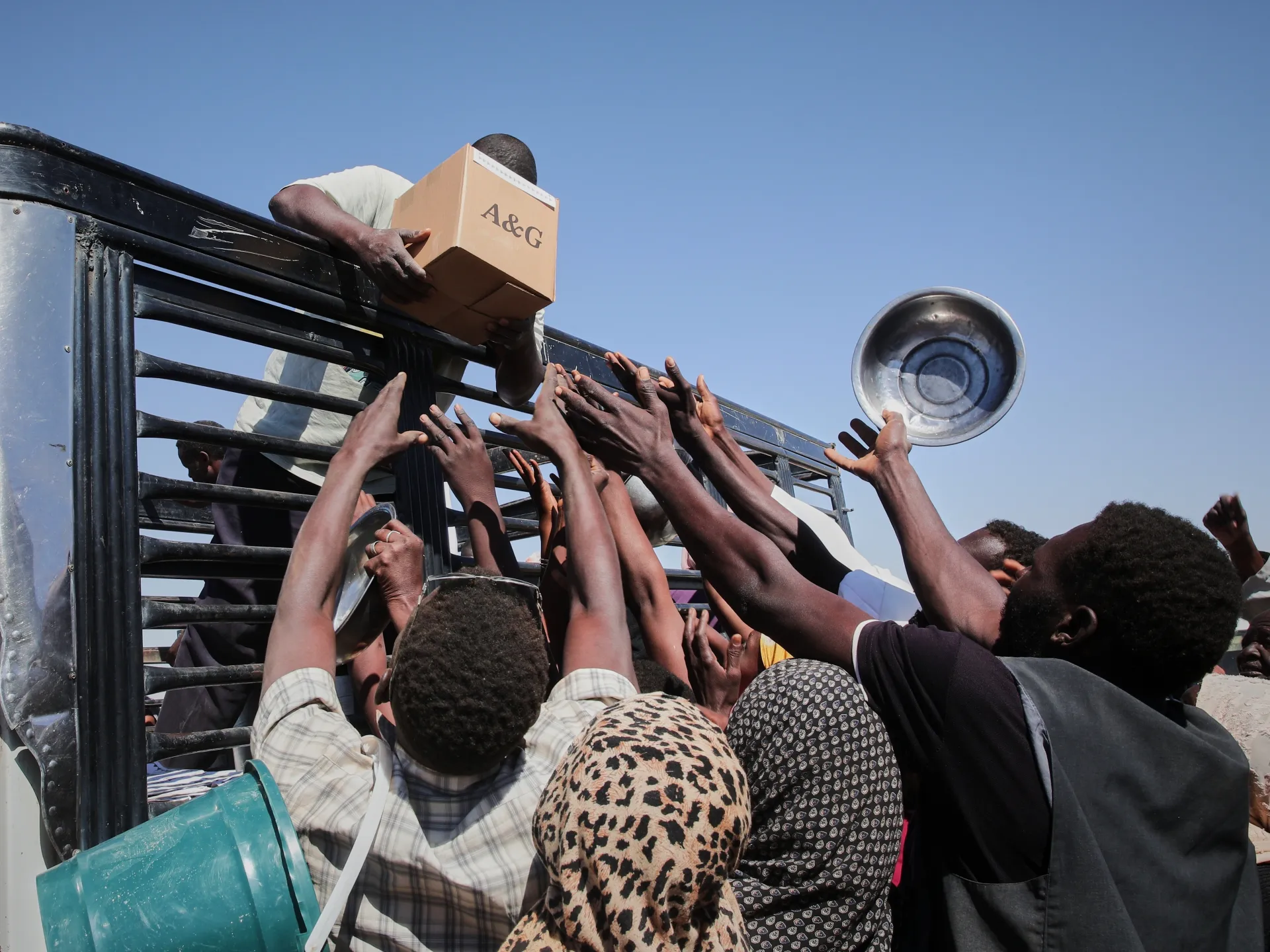
Sudan’s collective memory has long carried stories of famine-induced tragedies. Now, as war pushes the country deeper into a catastrophic food crisis, historians and humanitarian activists fear that some of those horrors are being repeated.

The ongoing war between the Sudanese army and the paramilitary Rapid Support Forces, which erupted in April 2023, has plunged the country into one of its worst modern food crises, with conditions deteriorating sharply since 2024.

Recommended Stories

list of 3 itemsend of list

Sudan has endured severe famines before, often triggered or made worse by drought and other environmental shocks. However, the current hunger crisis, which has triggered famines in Sudan in 2024 and 2025, has been brought on by a man-made factor: war.

Past starvation

One of the earliest recorded major food crises in what is now Sudan occurred in 1684, during the Funj Sultanate. The crisis, which lasted several years, brought severe grain shortages across central Sudan. Historical accounts describe people driven to desperation, and in some cases forced to eat dog meat. The hunger triggered mass displacement, as well as a deadly smallpox outbreak.

Similar climate-driven crises were recorded in 1750 and again between 1835 and 1838 during a period of Ottoman-Egyptian rule, exacerbated by severe drought and low water levels in the River Nile.

The famine most deeply embedded in Sudanese popular memory occurred between 1888 and 1889, during the rule of Khalifa Abdullahi al-Taashi.

Drought, locust infestations and conflict combined to cause widespread hunger and death. Some historical estimates put the death toll at more than one million people, although precise figures from the period are difficult to establish. The crisis was reported to have been so severe that some families shut themselves inside their homes to die rather than going out to beg for food.

Sudan experienced more periods of food shortages during the 20th century. Droughts and poor harvests during the colonial period of the first half of the century forced the authorities at times to import grain from abroad.

Then, in 1984, during the rule of President Jaafar Nimeiri, a devastating drought hit western Sudan, including Darfur and Kordofan, where there were widespread crop and livestock losses, displacing hundreds of thousands of people from rural areas to the capital, Khartoum.

Man-made catastrophe

Unlike many of those historical crises, the current famine is distinctly man-made.

War has disrupted agricultural production and trade, forced farmers to leave their land, and made it difficult to move food and humanitarian aid across the country.

Abdullah al-Tijani, a social historian and humanitarian activist, noted the unprecedented scale of the current disaster.

“Most previous famines were often confined to specific regions, as happened in 1984, or areas in southern Sudan before its secession in [2011], while the capital and major cities continued to have the necessities of life and services,” al-Tijani told Al Jazeera.

This time, he said, hunger and the collapse of basic services have spread across the entire country.

“A comprehensive food crisis has struck the heart of major urban and agricultural centres in the states of Khartoum, Gezira, Sennar, Darfur, and Kordofan, causing millions of citizens to be displaced inside and outside the country,” al-Tijani added.

He pointed to what he described as the “systematic destruction of infrastructure, disruption of large agricultural projects, and targeting of markets, bakeries, and crops, along with disrupting the banking system and communication networks, which isolated entire regions”.

Al-Tijani also cited the “restrictions on humanitarian access and delays in granting transit permits for relief workers”. He accused the warring parties of using control over food supplies as a tool of war, while warning that international funding has fallen short of the size of the crisis.

Lost agricultural potential

The scale of the crisis is stark because of Sudan’s agricultural potential. The country has immense resources, including roughly 200 million acres (81 million hectares) of arable land, abundant water from the Nile, and extensive livestock resources, but Sudan’s potential as a global breadbasket remains unfulfilled.

Mohammed Abdul Rahman, an economic researcher, explained that the current food security crisis reflects a clear development gap, and a longstanding weakness in Sudan’s agricultural sector compounded by war.

“Wars and armed conflicts are among the most influential factors on food production,” Abdul Rahman said, “along with the displacement of farmers from their lands, the absence of political stability and agricultural policies, weak funding and government guarantees, and reliance on traditional farming methods.”
Source link

‘Trespasses’ review: Come for the romance, stay for the historical drama

Premiering Sunday on PBS, “Trespasses,” a four-part adaptation of Louise Kennedy’s 2022 debut novel, is a story of love in a time of choler. Set outside of Belfast in 1975 during the Troubles, it follows a clandestine affair between Cushla Lavery (Lola Petticrew, the serial killer in “Furious”), a 24-year-old Catholic elementary school teacher, and Michael Agnew (Tom Cullen), an older, married Protestant barrister known for defending stone-throwing Catholic youth with an eye to keeping them out of the IRA.

Emptying the thesaurus, press materials stress the hot stuff — “scandalous,” “risqué,” “racy,” “torrid,” “titillating” and “steamy” — and while there is more than a modicum of modest sex scenes, the actual tone of the limited series, as adapted by Ailbhe Keogan and directed by Dawn Shadforth, is quite measured; it runs on talk. That’s not to say, given the setting and the setup, which betokens tragedy as surely as Romeo meeting Juliet, it doesn’t throb with tension, let’s say, three-quarters of the time.

Along with teaching, Cushla works for her brother Eamonn (Martin McCann) at the family bar. The clientele includes Catholics and Protestants, united in their love of whiskey, lately including Michael — whose opposition to extremism grants him the honor of being disliked by both sides — seemingly there expressly, even too expressly, to gaze upon Cushla while he pretends to do crosswords. And she gazes back. Moving through discussions of Malcolm McDowell’s typecasting and group lessons in Irish, led by Cushla, they will go beyond gazing.

She’s a ray of light; he’s magnetically mature. You may or may not buy the mutual attraction the series insists upon, or for that matter, trust the lovers’ motivations. (I think we’re meant at least not to wholly trust Michael, as the older party, with a reputation as a womanizer — I didn’t, anyway.) But you will also be invited to change your mind. Because the camera never leaves Cushla’s side, anything there is to learn we learn along with her, which pays some dramatic dividends and means we’ll be forced to revise earlier judgments, usually for the better.

It’s a dangerous liaison. Michael, who is given to speechifying (and actual speechmaking), declares, “We cannot let the old bigots and the boys with guns tell us how to live … Otherwise nothing will ever change. Hate wins” and, in a favorite refrain, “We must find the bravery to choose freedom over fear.” Cushla, however notes that she comes “from a long line of Catholics that have survived by keeping their heads down and their mouths shut. Having a big opinion like yours, it’s a luxury I don’t have.”

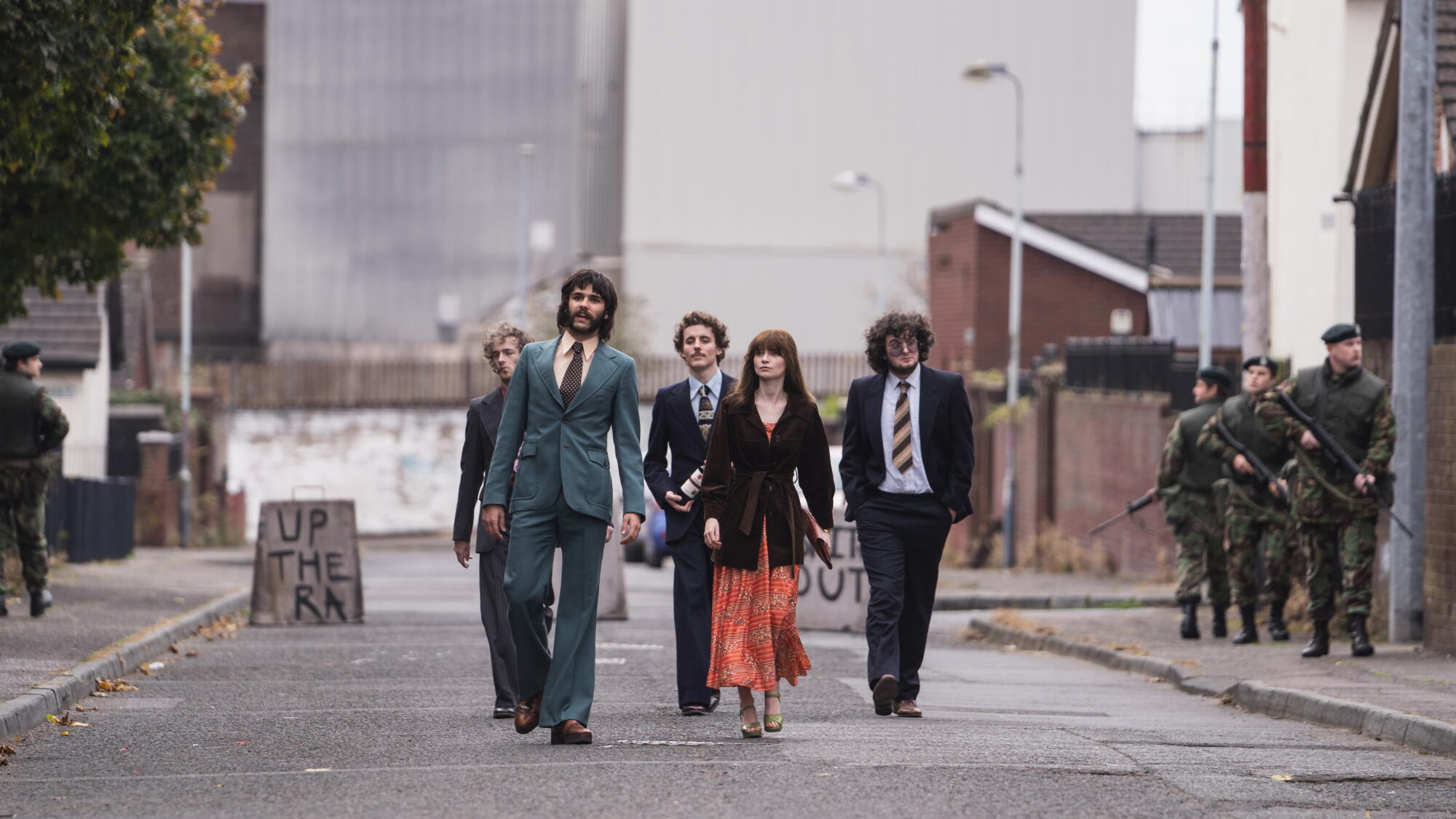
A group of men in suit and a woman in a red plaid dress walk down a street with soldiers carrying arms on the sidewalks.

Gerry Harkin (Oisin Thompson), left, Cushla’s colleague and confidant.

(Peter Marley / Channel 4)

Many shots are framed as if Cushla and Michael are being watched, whether or not they are, though sometimes they are, including by each other. (“They like to let me know they know where I am,” Michael says, when Cushla mentions seeing a patrol car outside his flat.) We’re shown the oppressive presence of loyalist troops, and some anti-Catholic vandalism, and a neighbor reflexively checking his car for a bomb, but the greater violence comes through as background noise on the radio or TV news, or reported by Cushla’s young students.

Fortunately, if no less terribly, there is more to the story, and many of the most compelling scenes have little or nothing to do with Michael. (Every scene is a Cushla scene.) She’s wonderful with her class, and her colleague and confidant Gerry Harkin (Oisin Thompson), who will jump onstage at a school assembly to interrupt a strident, bigoted superior, leading the students in a peace song — “Take away the hate and the violence / Bring love into our hearts.” Viewers will consider his bowl haircut a romantic nonstarter, but there are levels to be revealed.

Cushla may not have the luxury of big opinions, but as an obviously good person, whatever one thinks of adultery, she’s unafraid to go against the grain in support of her student Davy McGeown (Daithi Ó Haragain), whose mother (Emily Taaffe) is Protestant and whose Catholic father, in the child’s words, has been “beat up for loving my mummy.” She’s also supportive of Davy’s bright older brother Tommy (Conlaoch Gough-Cunningham), teetering on the edge after the attack on his father.

Above all, there is Cushla’s mother, Gina, played by Gillian Anderson, in a downward spiral since the death of her husband, some two years earlier. Introduced in a state of drunken collapse, Anderson — fearful, bitter, despairing, protective — is quite magnificent limning different levels of intoxication. But she’s even more impressive in her sober scenes, participating in the world beyond her couch, bringing food to the McGeowns and, finally, acting as a mother to Gina.

Michael’s declarations not even aside, Keoghan has a gift for writing dialogue that feels native to the speaker and doesn’t land heavily on a point, and apart from the lovemaking interludes and a gauzy montage of a romantic trip to Dublin, Shadforth’s naturalistic direction enhances the drama by not underscoring it. She has an especially convincing way with party scenes — a school disco, a wedding, an art opening, a birthday party (at which Michael performs a soulful, foreshadowing version of the Carter Family’s “The Last Move For Me”) — where so many productions fall down.

Come for the promised steaminess. Stay for the rest of it.

Source link