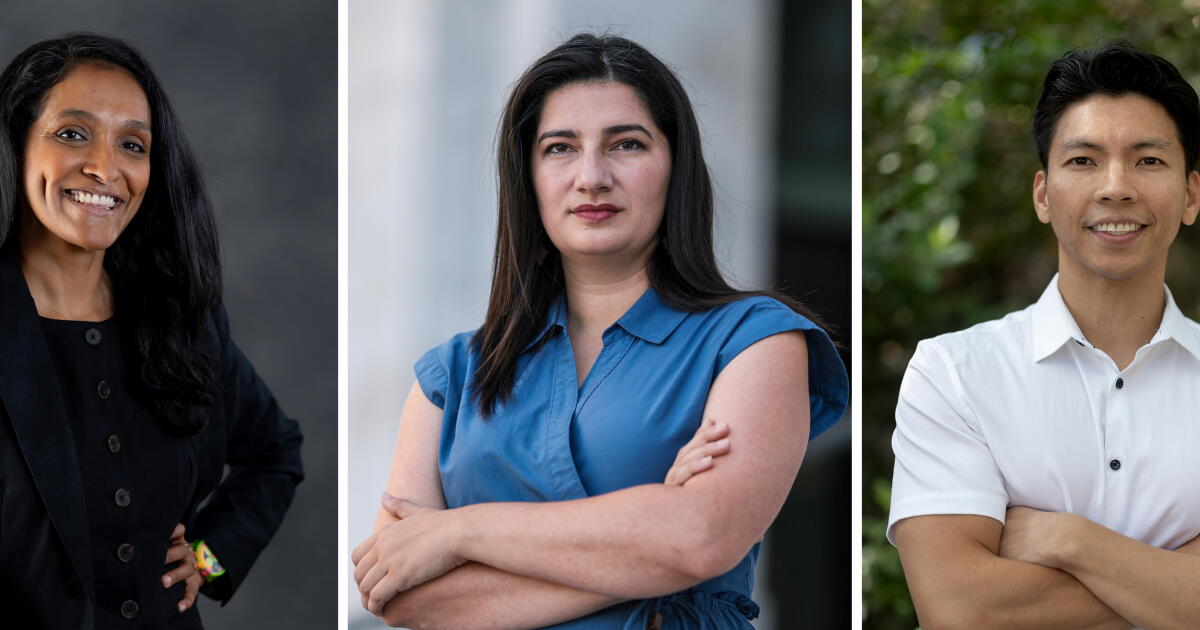
Asian Americans won all three of L.A.’s citywide elected offices this year
Last week’s midterm elections made history across the country, and Los Angeles was no exception: Asian Americans will now hold all three citywide elective offices — mayor, city attorney and controller — for the first time.
Mayor-elect Nithya Raman came to the U.S. from India as a child. City Atty.-elect Marissa Roy’s mother also emigrated from India. And City Controller Kenneth Mejia, who is Filipino, won reelection to a second four-year term in June.
“This is a historic moment for the nation and certainly for our city and state, and for [Asian American and Pacific Islander] communities,” said Manjusha P. Kulkarni, executive director of the AAPI Equity Alliance, which advocates for resources and funding for the coalition of community organizations it represents. “We feel that the work that we’ve done across many decades has come to fruition in seeing progressive Asian American representation in our city.”
Kulkarni noted that Asian American voters have trended more progressive over the decades, after years of being pigeonholed as largely conservative. Raman and Roy were both endorsed by the Democratic Socialists of America, and Mejia was recommended by the leftist group.
Across the country, voters made history at the ballot box: California voted in its first Latino governor, Texas elected its first Latina governor and Georgia will have its first Black female governor. Michigan elected Abdul El-Sayed, who will become the first Muslim in the U.S. Senate.
The two largest U.S. cities will now be headed by South Asian Americans: New York City’s Zohran Mamdani, born to Indian parents, and Raman, who arrived from India to the U.S. at the age of 6. Raman became the first Asian American woman and the first South Asian elected to the City Council when she won her seat in 2020.
In her first address as mayor-elect last week, Raman acknowledged the significance of voters putting their faith in her at a time when the Trump administration has terrified immigrant communities with mass deportations.
“This city has opened its arms to people to come and build their dreams here, and the idea that Angelenos voted for an immigrant to be their next mayor at this moment in American history is so deeply moving to me,” she said.
Roy frequently invoked her mother’s immigrant story and her Indian heritage on the campaign trail. As a founding board member of the Asian Democrats of Los Angeles County, she had key Asian American backers, including California Atty. Gen. Rob Bonta and San Francisco City Atty. David Chiu.
Roy, whose campaign was infused with Bollywood needle drops on Instagram, is also the co-creator of a “Raman Rager” Bollywood dance mix for a South Asian-themed fundraiser that has since taken on a life of its own.
Roy said in an interview that her win in last week’s election represents a moment for the city’s broader immigrant community. When she won, she received Whatsapp messages from family members in India who were watching closely and was featured in an India Weekly article.
“I think this is really a significant moment, not just for the Asian American community, but for the immigrant community to have an immigrant mayor, to have a city attorney who is the daughter of an immigrant,” Roy said. “This is Los Angeles sending a message about who it is.”
Asians are the fastest growing population in the U.S., outpacing Black, Latino and white populations, according to the Pew Research Center. Asian Americans and Pacific Islanders represent about 12% of the city’s population, according to the U.S. Census Bureau.
And they constitute more than 1 million eligible voters in L.A. County, according to an analysis of census data by Asian Americans Advancing Justice Southern California.
“Our communities have helped build Los Angeles, and it’s time our political leadership reflects the enormous role we play in shaping its future,” Dahni Tsuboi, chief executive of the organization, said in a statement.
On election night last week, Zahra Hajee, president of Asian Democrats of L.A. County, hopped from Roy’s election night party — which featured a henna station and a victorious Roy who flashed glittering bangles — to Raman’s, where Mejia gave an impassioned speech as a Raman win looked likely. After Raman took the lead by early Wednesday morning, Hajee, who is Pakistani American and Muslim, became emotional.
“To be able to see two South Asian women leaders — I didn’t think I’d see this in my lifetime,” Hajee said. “Being able to have those shared experiences with our next city attorney and next mayor is just such a surreal feeling and a connection I thought I’d never have.”
The group, which has about a thousand members, was among the first to endorse Roy’s campaign and supported Raman early on. The organization also has a working relationship with Mejia, who is a member of the Green Party. It also helped introduce Raman to key constituencies; she set up an event with small business owners in L.A.’s Little Bangladesh neighborhood near Koreatown, for example.
Nina Long, policy manager for AAPI Force, a progressive statewide coalition, said the candidates’ outreach reflected the nuances of the community, reaching groups including Chinese, Korean and Filipino voters.
“They did not treat AAPIs as a voter bloc to be taken for granted,” she said. “Each of the candidates was really savvy about the diversity of AAPI communities in Los Angeles.”
The dominance of Asian Americans in this election is also a display of the growing political influence of Asian American and Pacific Islander voters.
“For a very long time, the AAPI community was considered a quote unquote margin of victory in Democratic politics,” Hajee said. “We have shown our community is not just a margin of victory but a true base of voters.”
Mejia acknowledged the moment as a “huge feat” for progressive values being championed by Asian Americans.
“Representation is great, but it’s also showing that we have people running on great values centered on people, not special interests,” he said in an interview. “The fact that we are all AAPI is amazing, but the credit is what we stand for and what we believe in.”
He said his views were shaped by having parents who worked hard but were exposed to more conservative values and were expected to keep their heads down and not ask questions. But as life has become harder, more Asian Americans, especially young people, want better, he said.
“I believe what you’re seeing right now, this movement in politics, is that so many people are paying attention, especially those from immigrant communities,” he said.
There are currently three Asian Americans on the L.A. City Council, including Raman, who represents District 4. The other two are Ysabel Jurado of District 14 and John Lee of District 12.
Jurado became the first Filipina elected to the City Council when she won in 2024. In a statement, she said, seeing three Asian American leaders elected to citywide office felt deeply personal.
“It reflects generations of organizing by communities who fought to be heard and opened doors for those who would follow,” she said, adding that she looked forward to pushing for policies that would make living in L.A. more affordable. “We have an opportunity to show what greater representation can mean in people’s everyday lives.”
Times staff writers Noah Haggerty and Sonja Sharp contributed to this report.