Pakistan’s Kashmir votes: Why the election hinges on 12 disputed seats | Elections News
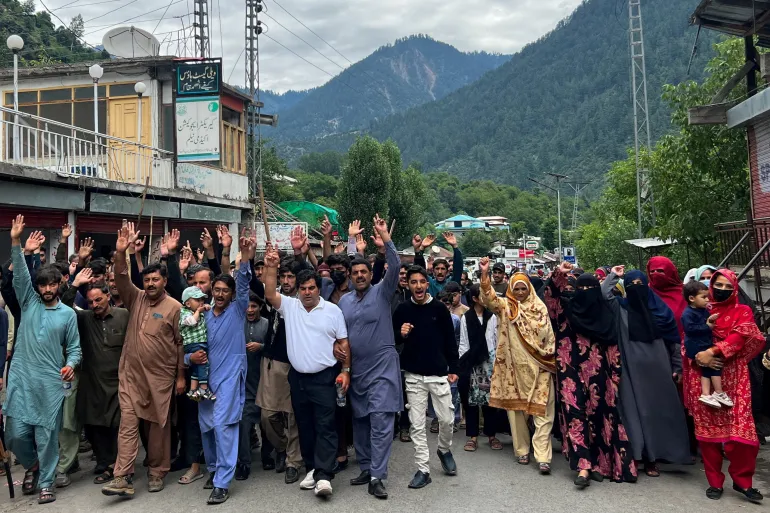
Islamabad, Pakistan – Pakistan-administered Kashmir, formally known as Azad Jammu and Kashmir (AJK), has spent the summer under an unofficial state of emergency.
Since early June, nearly 40 people have been killed in clashes between protesters and security forces, with sit-ins and road blockades regular features in the region over this period.
Recommended Stories
list of 4 itemsend of list
Banks remained shut for two weeks. Mobile and internet services remain suspended across most of the territory. Poonch division, which borders India and has been the epicentre of the unrest, was effectively sealed off for weeks, disrupting the supply of flour and other essentials to a region that depends heavily on them.
The Jammu Kashmir Joint Awami Action Committee (JAAC), the movement behind the protests, was banned by the local government on June 5, days before a planned demonstration.
Its leadership has since been arrested, has gone underground or has continued organising from sit-in camps in Rawalakot, the administrative headquarters of Poonch division.
Its demands, once centred on subsidised flour and cheaper electricity, have expanded to 38 points, chief among them the abolition of 12 assembly seats reserved for Kashmiri refugees.
All of this is unfolding as the region prepares to vote. Elections for the 45-seat Legislative Assembly, originally scheduled for July 27, have been split across three dates.
Mirpur division votes as planned, Muzaffarabad division and the 12 seats reserved for Kashmiri refugees follow on August 2, while Poonch division, where tensions remain highest, goes to the polls on August 10.
JAAC’s leadership is not on the ballot and has urged supporters to boycott the vote.
Of all the movement’s demands, one issue has proved impossible to resolve: the 12 refugee seats. The government says they cannot be touched without a constitutional amendment. JAAC wants them abolished outright.
Between those two positions lies a legal argument stretching back nearly a century, and a more fundamental question: who gets to decide who governs Muzaffarabad?
A dozen seats, one dispute
Of the AJK Legislative Assembly’s 45 elected seats, 33 are filled from constituencies within the territory.
The remaining 12 are reserved for refugees from Indian-administered Kashmir who now live in different parts of Pakistan.

The arrangement traces its roots to electoral arrangements introduced in 1960, reinforced through laws in 1964 and 1970, before being formalised in AJK’s 1974 Interim Constitution and reaffirmed by the constitution’s 13th Amendment in 2018.
Chaudhry Muhammad Ibrahim Zia, a former chief justice of the AJK Supreme Court, said the basis for the seats goes back further still, to the AJK government’s founding declaration of October 24, 1947, which he said reflected “the collective will of the people of the State of Jammu and Kashmir”.
Refugee representation, he told Al Jazeera, has “a firm historical basis” rooted in that document. He rejects any suggestion that the seats are unconstitutional.
“They have both historical grounding and constitutional support,” he said. “These seats cannot be described as unconstitutional.”
Pakistan-administered Kashmir’s electorate has grown from 3.2 million voters in 2021 to more than 3.8 million this year, according to Election Commission figures.
Within that, the 12 refugee constituencies account for roughly 439,000 registered voters, scattered across cities including Lahore, Rawalpindi and Sialkot, rather than concentrated in a single geographical area like AJK’s territorial constituencies.
And that’s a problem, says Kashif Abbasi, a JAAC committee member.
“This election is meant for people who actually live in AJK,” he told Al Jazeera. “These 12 seats sit outside AJK’s jurisdiction. This doesn’t happen anywhere else.”
From flour to the assembly floor
JAAC’s demands were not always centred on the refugee seats. Its original charter was almost entirely economic, focusing on subsidised flour, electricity at cost price, and a share in the benefits from the Mangla and Neelum-Jhelum hydropower projects.
The refugee seats first appeared in the group’s expanded charter, submitted in October 2025.
Even then, JAAC did not initially seek their outright abolition. In written proposals submitted on May 30 this year, the group offered two alternatives.
It proposed retaining symbolic refugee representation until the Kashmir dispute is permanently resolved or replacing the 12 assembly seats with four seats in the AJK Council, the Islamabad-chaired body that exercises legislative authority over AJK’s federal-facing affairs.
The 14-member council, chaired by Pakistan’s prime minister, oversees subjects including electricity, banking and parts of taxation, areas that largely fall outside the AJK assembly’s authority. The territory has no representation in Pakistan’s national parliament.
“Our suggestion was that these seat-holders should instead be given representation on the Kashmir Council, and that their assembly seats be eliminated, with that money used elsewhere in the territory,” Khawaja Mehran, a member of JAAC’s core committee, told Al Jazeera recently.
Both proposals were rejected at an All-Parties Conference in Muzaffarabad on June 3.
Constitutional barrier
In June, the AJK Supreme Court addressed the issue directly.
The court held that the seats are protected under AJK’s constitution and can only be abolished through a formal constitutional amendment. They cannot be removed through executive action or public pressure.
A constitutional amendment, the judges wrote, is “a solemn constitutional act, not a concession to be wrested from a government under duress”.
Zia, the former AJK chief justice, said the opinion changed little about the existing legal position.
“These seats simply cannot be abolished without a proper constitutional process,” he told Al Jazeera, adding that, with the outgoing assembly’s term having ended, no such process is possible until a new legislature is elected.
The government’s account
Abdul Majid Khan, AJK’s former finance minister and himself from a refugee family, rejects the idea that the seat holders form an unaccountable political bloc.

He points instead to the size of the territory’s budget. AJK’s roughly 310 billion rupees (about $1.1bn) budget last year, he said, far exceeds the development funds allocated to the 12 refugee constituencies – nowhere near enough, in his view, to make them the powerful bloc JAAC describes.
“These are people who migrated for a larger cause,” Khan told Al Jazeera, referring to Kashmiris who fled Jammu, across the border, during the violence of 1947 following the partition of the subcontinent and settled across Pakistan in the decades that followed.
Refugee representation, he said, has existed since AJK’s first parliamentary election in 1975, when the territory’s first prime minister was himself from a refugee family.
At the June 3 conference that rejected JAAC’s proposals, AJK Prime Minister Faisal Mumtaz Rathore said any decision on the seats “can only be taken by the elected representatives in the House”, adding that most of JAAC’s other demands had already been met.
Pakistan’s Defence Minister Khawaja Asif told the National Assembly on June 11 that the future of the 12 refugee seats should be decided by voters, not under pressure from street protests.
He urged JAAC to contest the issue in the election rather than demand its resolution beforehand, asking: “How could you exclude them from the electoral process?”
A senior government official in Poonch, whose division has witnessed the worst of the unrest, took an even harder line.
“This is no longer a rights movement,” the official told Al Jazeera, requesting anonymity since he was not allowed to speak to the media, adding that the protesters were not only “challenging the authority of the state”, but also provoking the public through “inflammatory speeches and actions”.
Who holds power?
In mid-July, JAAC leader Umar Nazir Kashmiri told supporters at a sit-in in Rawalakot, Poonch division, that the group had written directly to army chief Field Marshal Asim Munir after concluding that its concerns were not reaching him “through official channels”.
He thanked Munir by name for “understanding the grievances of the people of Kashmir”.
Shaheen was more direct. “We believe real authority currently sits with Rawalpindi,” he told Al Jazeera, referring to Pakistan’s military establishment rather than the civilian government. “That’s why we’re forced to negotiate through that channel, since nobody else actually holds the authority.”
Ershad Mahmud, a Canada-based researcher on Kashmiri displacement and politics, said that “Islamabad’s bureaucracy, military and intelligence establishment have reduced AJK’s elected leadership to a largely symbolic role”.
The current crisis, he told Al Jazeera, has once again shown that the local leadership “lacks the authority to negotiate a political settlement with its own people”.

Unmet promise?
The dispute over the refugee seats is unfolding within a framework that predates Pakistan-administered Kashmir itself.
Under a United Nations Commission for India and Pakistan resolution adopted on January 5, 1949, and endorsed by the UN Security Council, Kashmir’s final status was to be determined “through the democratic method of a free and impartial plebiscite”.
Nearly 80 years later, that has yet to happen on either side of the Line of Control.
Mahmud, who is also the author of Poonch: Identity, Politics and Resistance, argues the refugee seats endure partly because they continue to serve Islamabad’s interests.
“They let Pakistan maintain its position that AJK represents the entire former State of Jammu and Kashmir, not merely the territory it administers,” he told Al Jazeera. “And allows Pakistan-based political parties to influence government formation in Muzaffarabad.”
Islamabad, he said, treats the seats “as an instrument of its Kashmir policy and political influence”.
Hassan Kamal Wattoo, a Lahore-based constitutional lawyer, argues that giving greater autonomy to AJK “strengthens Pakistan’s case on the international stage”.
“There is no tension between real autonomy for AJK and an eventual plebiscite,” he told Al Jazeera.
Anam Zakaria, a historian and author of Between the Great Divide: A Journey into Pakistan-Administered Kashmir, however, argued that there was a deeper contradiction within AJK’s constitutional framework.
On the one hand lies India’s “longstanding and ongoing systemic violence and human rights abuses in [Indian-administered] Kashmir”, she said, arguing that nothing Pakistan has done or does in the part of Kashmir it administers can be compared with what’s happened in Indian-administered Kashmir, where tens of thousands of people have been killed in violence involving armed rebels and security forces since 1989.
At the same time, she pointed out, candidates seeking public office in Pakistan-administered Kashmir must first swear allegiance to AJK’s accession to Pakistan.
That requirement, she told Al Jazeera, also “in itself contradicts the right to self-determination” and sidelines Kashmiris who hold a different vision for the region’s future.