I went to the Santa Monica Mountains on the hunt for wildflowers.
I was nervous. What if I found absolutely nothing? I’d used data collected by plant lovers during previous blooms and checked on iNaturalist, a citizen science app, about where wildflowers had recently been noticed to discern where I’d be most likely to find blooms.
But, even then, I knew the unusual spring heat wave that prompted some wildflowers to bloom early could have also killed them. I knew the heat had already zapped the bright orange beauties at the Antelope Valley California Poppy Reserve. What if I’d already missed this annual springtime magic?
You are reading The Wild newsletter
Sign up to get expert tips on the best of Southern California’s beaches, trails, parks, deserts, forests and mountains in your inbox every Thursday
By continuing, you agree to our Terms of Service, which include arbitration and a class action waiver. You agree that we and our third-party vendors may collect and use your information, including through cookies, pixels and similar technologies, for the purposes set forth in our Privacy Policy such as personalizing your experience and ads.
It was with this level of eagerness and anxiety I recently entered the Santa Monica Mountains. I feel more than lucky to have discovered a resplendent rainbow of native plant blooms.
I hope you also witness this abundance on the three trails below. L.A. is forecast to have more springtime rain, and you know what they say about April showers!
If not, though, I want to underscore that regardless of their foliage, each hike offers its own unique adventure, one I’d take in any season.
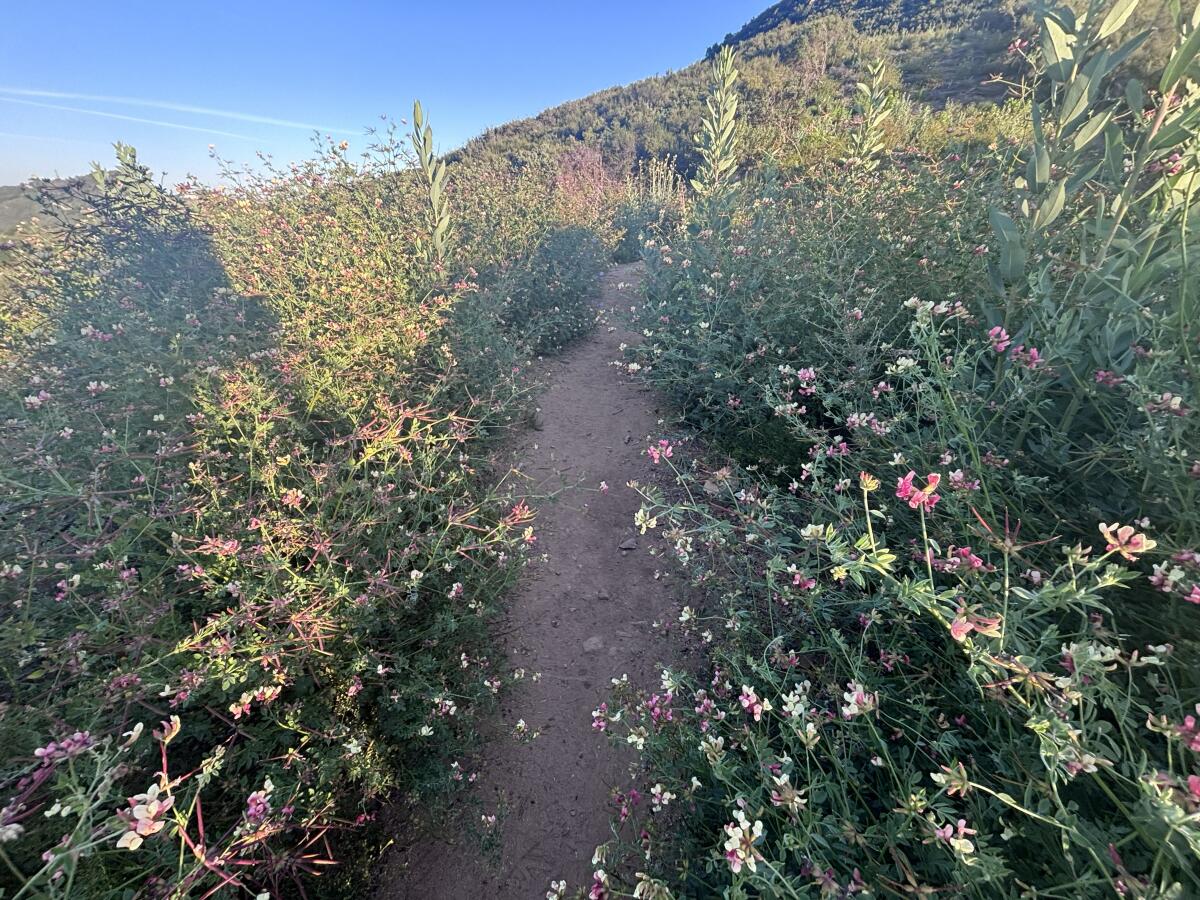
Chaparral bird’s-foot trefoil blooms in thick patches throughout the Saddle Peak Trail.
(Jaclyn Cosgrove / Los Angeles Times)
1. Saddle Peak via Backbone Trail
Distance: 3.3 miles out and back Elevation gained: About 860 feet Difficulty: Moderate Dogs allowed? No Accessible alternative:Inspiration Loop Loop ADA Trail at Will Rogers State Historic Park
This 3.3-mile route to Saddle Peak takes hikers up a lush hillside with sweeping views of the nearby Calabasas Peak, the San Fernando Valley and, toward the top, the Pacific Ocean. Visitors will observe a landscape that features not only a diversity of wildflower species but also ancient sandstone formations.
You’ll start your hike by parking on the side of Stunt Road, a winding paved street with sharp turns popular among cyclists and drivers of very fast sports cars. There is limited parking here, so it’s good to either arrive early or hike this trail on a weekday. Additionally, the parking area on the side opposite the trailhead is near a steep drop-off so take good care if parking there.
The Saddle Peak Trail features multiple stretches where wildflowers grow close to the trail.
(Jaclyn Cosgrove / Los Angeles Times)
The trailhead sits just south of the road and is well-marked with large signs, including one that warns you that smoking, bicycles and dogs are prohibited on the trail. (Apologies to your cigar-loving circus canine.)
You will first take the short Stunt Road connector trail about 0.2 miles before bearing left, or east, onto the Backbone Trail to Saddle Peak. You’ll immediately start noticing wildflowers.
Chaparral bird’s-foot trefoil, clockwise, mini lupine, purple nightshade, showy penstemon, golden yarrow and large-flowered phacelia.
(Jaclyn Cosgrove / Los Angeles Times)
I have dubbed myself a “lupine freak” because of my obsession with this genus of plants — not because I enjoy howling at the moon once a month — and I paused just a third of a mile into this trail. “You look like a tiny little lupine,” I said to the short plant with purplish blue petals near my right foot. Turns out it was indeed a miniature lupine!
This would be the first of many delights. Within a half mile on the trail, I’d already spotted golden yarrow, bush poppy, purple nightshade and black sage abundant with purple blooms. And canyon sunflower covers substantial portions of this trail. This suggests the trail burned in recent years, as canyon sunflower is a fire follower.
There’s also a fair amount of California sagebrush, which you can run your fingers along and smell its delicious aroma (which I think smells like spicy Italian salad dressing).
The view from a bench at a lookout point near the Saddle Peak Trail in the Santa Monica Mountains.
(Jaclyn Cosgrove / Los Angeles Times)
As I hiked onward, I started to feel like Julie Andrews in “The Sound of Music” because the hills really were alive! I squinted at one plant I had no memory of seeing, a pink and green plant with bright pink and lemon chiffon-colored petals. Had I finally stumbled upon one of California’s rare, threatened or endangered plants?
I was so eager to Google this floral mystery. Later, I learned it’s a not-so-rare (but oh-so-beautiful) chaparral birdsfoot trefoil. It grew thick throughout the second leg of this trail, a real visual feast!
I briefly hiked through a lull where the trail was beautiful but not bursting with colors outside green and brown. Then, I came around another corner to find more trefoil, large-leaf phacelia and showy penstemon, which would be a great native plants-inspired drag performer name.
A massive sandstone rock wall along the Saddle Peak trail.
(Jaclyn Cosgrove / Los Angeles Times)
Very suddenly, after staring at plants for more than an hour, I looked up and realized I’d reached the massive ancient boulders. I watched as white-throated swifts dived in and out of the rock’s pockets where it might be considered tafoni (maybe!). Fun fact: These birds use “their saliva to glue a little cup of twigs and moss to the vertical wall” to build their nests, according to Cornell Lab of Ornithology.
You’ll take a few well-maintained sets of rock steps up, also navigating some rocky and, at times, somewhat washed-out portions of the trail. Take good care to look before you reach toward a rock for leverage so you don’t end up grabbing a danger noodle (read: snake).
About 1.3 miles in, you will crest a hill and be greeted with gorgeous views of the deep-blue ocean. From here, you can continue up to Saddle Peak, which features more massive rock formations.
I hiked over to a bench at an overlook point just past a few (invasive but pretty) Spanish broom plants. Here, I took stock of the day, savoring both the burrito I packed and the good day I’d had. I don’t know whether anyone would label it “super,” but I found myself chuckling over simply calling it a superb bloom.
The Musch Trail in Topanga State Park.
(Jaclyn Cosgrove / Los Angeles Times)
2. Backbone Trail to Musch Trail Camp
Distance: 2 miles out and back (with option to extend via a loop back) Elevation gained: About 200 feet Difficulty: Easier end of moderate Dogs allowed? No Accessible alternative: Musch Trail road, a 0.6-mile out-and-back trek on a paved path from the parking lot
This two-mile, out-and-back jaunt through Topanga State Park takes you through lush meadows and chaparral where you’ll be near destined to spot wildflowers and wildlife.
To begin your hike, you’ll park at Trippet Ranch and pay to park before heading out. The Musch Trail starts in the northeast corner of the lot. You’ll take the paved path just 1/10 of a mile before turning east onto the dirt path, the Backbone Trail.
Caterpillar scorpionweed with southern bush monkeyflower nearby, clockwise, purple owl’s clover, canyon sunflower, dodder over black sage, California poppy and western blue-eyed grass.
(Jaclyn Cosgrove / Los Angeles Times)
The ranch was originally called Rancho Las Lomas Celestiales by its owner Cora Larimore Trippet, which translates to “Ranch of Heavenly Hills.” You’ll find, as you hike through those hills covered in oak trees, black sage, ceanothus and more, that the name still rings true today.
I also spied significant blooms of orange-yellow southern bush monkeyflower, canyon sunflower, golden yarrow, a species of Clarkia, light purple caterpillar scorpionweed and exactly one blooming California poppy plant (just past the pond).
A mile in, you’ll arrive at Musch Trail Camp, a small campground with picnic tables and log benches. As you pause, listen to the songs of the birds. California quail, Anna’s hummingbird and yellow-rumped warbler are commonly spotted. Stay quiet enough, and you might just spot a mule deer, desert cottontail or gray fox. On a recent visit, I went to refill my water bottle at a spigot next to the camp, only to discover a Southern alligator lizard lounging in the path.
From the trail camp, you can either turn around or continue northeast to Eagle Rock, which will provide panoramic views of the park. From Eagle Rock, many hikers take Eagle Springs Fire Road to turn this trek into a loop. Regardless of which path you take, please make sure to download a map beforehand.
As the sun sets, golden light blankets the hillsides in Leo Carrillo State Park.
(Jaclyn Cosgrove / Los Angeles Times)
3. The Willow Creek and Nicholas Flats Trails
Distance: 1.9 miles with an option to extend Elevation gained: About 630 feet (excluding extension) Difficulty: Moderate Dogs allowed? No Accessible alternative:Sycamore Canyon Road
This 1.9-mile loop is a mostly moderate jaunt connecting two popular routes in Leo Carrillo State Park. As a bonus, you can head over to the beach after your hike, either to cool down, explore the tide pools or both!
To begin, you’ll park at Leo Carrillo State Park. An all-day pass is $12, payable to the ranger at the gate or via the machine in the parking lot. Once parked, you’ll head northeast to the trailhead. You’ll quickly come to a crossroads. Take the Willow Creek Trail east to officially start your hike.
You’ll gain about 575 feet in a mile as you traverse the Willow Creek Trail. I took breaks along the way to gaze at the ocean, watching surfers bobbing on their boards and a kite surfer trying to gain traction. You might spot coast paintbrush and California brittlebush, a flowering shrub that features yellow daisy-like flowers, on the path, along with several lizards.
California poppies growing amid invasive weeds, left, Coulter’s lupine and longleaf bush lupine observed in Leo Carrillo State Park last May.
(Jaclyn Cosgrove / Los Angeles Times)
A mile in, you’ll come to a junction in the trail where you have three-ish options. You can continue west to a branch of the Nicholas Flat Trail that will take you a mile back down to the parking lot. You can head south onto an ocean vista lookout point (which, though steep, I highly recommend). Or you can turn north onto another branch of the Nicholas Flat Trail.
I did a combination, hiking 235 feet up the lookout path, where I had one of those “Wow, I get to live here” moments. The ocean was varying shades of blue, from turquoise to cerulean to cobalt. I could clearly see in all directions, including about eight miles to the east to Point Dume. I was, once again, amazed to be alone in a beautiful place in a county of 10 million people.
Once I finished at this awe-inspiring point, I headed north onto the Nicholas Flat Trail, taking it about 2.3 miles — and about 1,100 feet up 🥵 — through laurel sumac and other coast sage scrub vegetation into the Nicholas Flat Natural Preserve. Along the way, keep an eye out for deerweed covered in its orange and yellow flowers along with scarlet bugler (which hummingbirds love). Other common sights here include Coulter’s lupine and small patches of California poppies.
If you start this hike early enough in the day, you can simply trek back to your car and change into your swimsuit for an afternoon at the beach. And if the tide is out, you might also be able to walk around the tide pools. You could hang out in the same day with both lizards and starfish, and even spy an endangered bumblebee on the trail and an octopus at the beach.
Please, go have yourself a remarkable Southern California day!
3 things to do
A person takes in the sunset on the beach in Venice.
(Michael Blackshire / Los Angeles Times)
1. Watch the sunset with new friends in Venice Sunset Club L.A. will host a free community gathering at 6:15 p.m. Thursday at Venice Beach. Guests will meet in front of Fig Tree (431 Ocean Front Walk #2402) before setting up camp on the nearby beach to watch the sunset together. Learn more at the club’s Instagram page.
2. Take a peaceful jaunt in L.A. L.A. for the Culture Hiking Club will host an adventure at 10:30 a.m. Saturday through Griffith Park. The group will take a 2.6-mile hike that includes the Ferndell Nature Trail. Afterward, guests will hang out at the Trails Cafe near the trailhead. Register at eventbrite.com.
3. Find a new kind of ‘dume’ scrolling in Malibu California State Parks needs volunteers to help remove invasive plants from 9 a.m. to noon Saturday at Point Dume. Park workers will guide participants on removing weeds while cultural resource staff will teach volunteers about the ecological and cultural importance of the site. Register at eventbrite.com.
The must-read
The Griffith Park Pool has remained fenced in and closed for six years, but there are plans now to renovate and reopen the pool.
(Gina Ferazzi / Los Angeles Times)
Who is ready to take a dip at the Griffith Park historic swimming pool? That might become a reality by July 2029. Times staff writer Christopher Reynolds wrote that city officials aim to give the facility at Riverside Drive and Los Feliz Boulevard, which dates to 1927, a three-year, $40-million facelift. The new design will feature two new pools and rehabilitate the site’s pool house. Officials closed the pool in early 2020 amid COVID-19 shutdowns and later discovered when they tried to refill it that the pool wouldn’t hold water.
I cannot wait to take a hike and then a swim at the same public park!
Happy adventuring,
P.S.
Are you ready to transition from hiking around native wildflowers to planting them? Come meet experts from the Theodore Payne Foundation and the California Native Plant Society at the L.A. Times Plants Booth during The Times’ Festival of Books at USC on April 18 and 19. If you sign up for the L.A. Times Plants newsletter, you’ll receive Jeanette’s Mix, a special packet of sunflower and California poppy seeds named for our beloved L.A. Times plants writer Jeanette Marantos, who died in February. I am volunteering at the booth on April 18 and would love to meet you!
For more insider tips on Southern California’s beaches, trails and parks, check out past editions of The Wild. And to view this newsletter in your browser, click here.
Families heading off on the Easter holidays and days out face paying an average 150p a litre for petrol and as much as 180p for diesel – on top of the usual Bank Holiday misery of congested roads
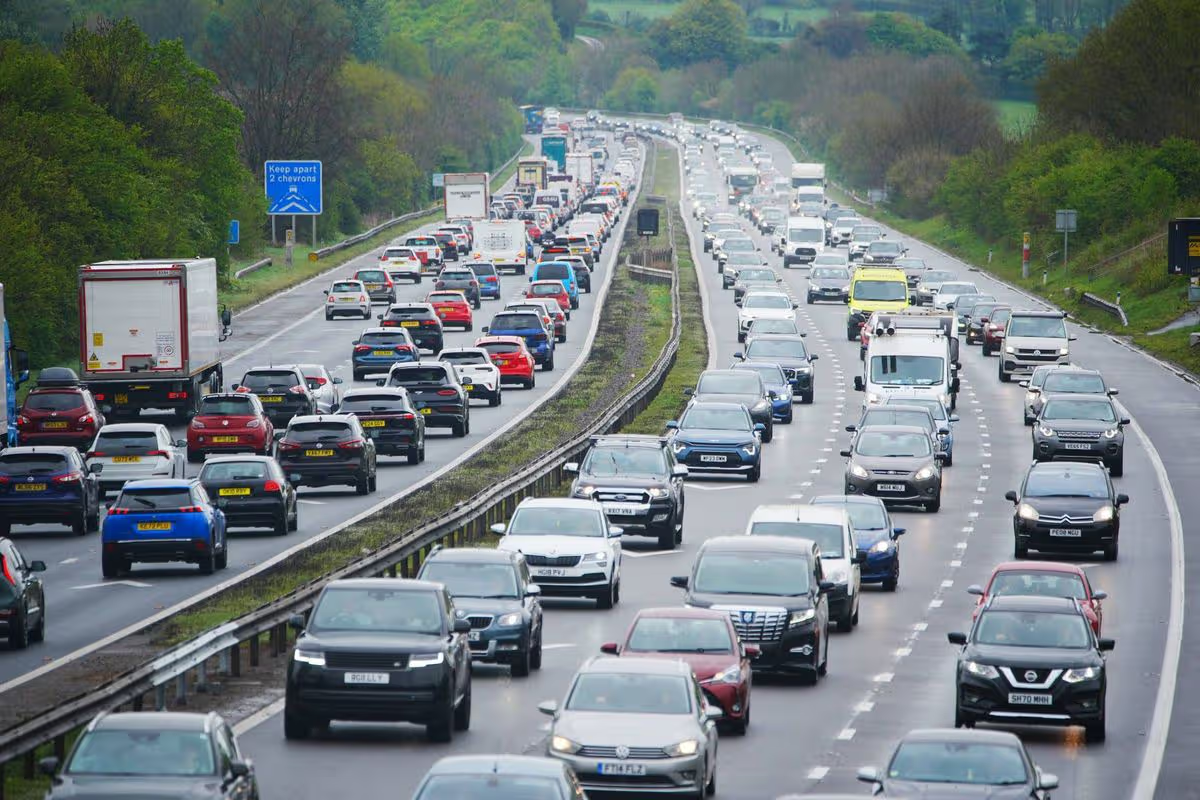
Bumper to bumper queues are expected over the Easter break – especially if there is fine weather(Image: PA)
Brits beginning the Easter getaway face price hikes and possible disruption.
The economic shockwaves from the Middle East war mean the millions taking the road are in for pain at the pumps when filling-up for long journeys. It came as petrol prices rose to close to 150p a litre and diesel nears the punishingly high 180p mark.
And there are warnings those planning to jet abroad face higher fares – if they have not booked ahead – and the risk of cancellations. That is all on top of the usual misery of queues on routes near holiday hotspots for those staying in the UK. The rush is expected to start from Friday as schools break up for the holidays, and will peak over the long Easter weekend.
The AA said more than 19 million people travelled on Good Friday last year, with 18.5 million on the Saturday and 18.2 million each on Easter Sunday and Easter Monday. Many will end up paying through the nose when they stop off to fill-up, given a sharp rise in fuel prices since the start of the Iran war at the end of March.
The nationwide average for unleaded has jumped to almost 150p a litre, up 17p since before the conflict erupted. Diesel drivers have been hit even harder, with diesel now averaging 176.66p per litre, a leap of 34p in recent weeks.
Motoring groups and ministers have urged drivers not panic buy fuel. Ministers insisted the UK was well stocked, despite Iran’s effective blockade of oil through the key Strait of Hormuz. A handful of forecourts have displayed signs saying they are out of fuel.
RAC mobile servicing and repairs team leader Sean Kimberlin said: “Fuel prices may have risen sharply in recent weeks, but our research with drivers shows they are still determined to make the most of the Easter break. Despite diesel costing around £19 more per tank than last year and petrol about £8 more, only a small number of people are actually changing their plans. For many, Easter is the first real chance to get away since Christmas, so we’re urging drivers to use the myRAC app to find the cheapest forecourts near them.”
He added: “This year we’re expecting one of the busiest Easter getaways since 2022, with planned leisure trips rising again for the second year running.
“Traffic is likely to build from Thursday as schools break up, with the M5 towards Devon and Cornwall and the M25 set to be particularly congested. The worst delays are expected from around 10am, so getting on the road early is still the best way to avoid the queues.”
National Highways said it was lifting around 1,500 miles of roadworks between next Thursday and Easter Monday, “meaning 98% of our motorways and major A-roads will be free of roadworks over the bank holiday,” it added.
Airports are also braced for a rush families taking advantage of the Easter break for a week in the sun. Yet it comes amid warnings of possible cancellations to some long haul destinations, partly due to fears of jet fuel shortages. The soaring cost of aviation fuel has also led to concerns that flight prices will rise.
Regulator the CAA says it expects over two million passengers through UK airports across the Easter break, including 1.6 million over the Easter weekend.
It is urging travellers to check the flight status with their airline and ensure they are up to date with the latest government foreign travel advice on any countries they are transiting through before you leave for the airport.
Anticipating possible disruption, it said: “If your flight is delayed or cancelled, you may be entitled to meals, accommodation or alternative travel arrangements provided by your airline.” It went on: “Travel insurance can protect against missed flights, medical emergencies, and lost or stolen belongings. Carefully review the terms and conditions to understand your coverage.”
Selina Chadha, group director for consumers and markets at the CAA, said: “With many UK travellers planning to get away over the Easter holidays, it’s important that those planning to travel know their rights and plan ahead to make their journeys as smooth as possible.”
Gatwick Airport says its near 60 airlines have flights to more than 220 destinations over Easter. “Short-haul breaks are expected to lead over the Easter holidays with bookings for Barcelona, Malaga, Alicante, Dublin and Geneva currently topping the most popular list,” a spokesperson said.
“Passengers are also preparing to travel further afield, with top long-haul options currently including Orlando, Shanghai and Cancun.” The airport’s busiest day over the holidays is set to be Easter Sunday.
March 24 (UPI) — The price of oil climbed back above $100 per barrel on Tuesday as hopes for de-escalation in the Iran war faded after Washington said the situation remained “fluid,” Tehran denied there had been any negotiations and a fire put a major Texas refinery out of action.
Claims by President Donald Trump of “major” progress in talks to halt the conflict on Monday sent oil prices tumbling and rallied stock markets, but benchmark Brent crude futures rebounded to more than $103 a barrel on Tuesday after the White House appeared to walk it back, saying no high-level formal meetings were scheduled and denying reports Vice President JD Vance may attend Pakistan-brokered talks.
“These are sensitive diplomatic discussions and the United States will not negotiate through the press. This is a fluid situation, and speculation about meetings should not be deemed as final until they are formally announced by White House press secretary Karoline Leavitt told the BBC.
Iran has, however, acknowledged there had been some contact between the sides regarding talks, with an Iranian foreign ministry official telling CBS that the regime had “received points from the United States.”
“We received points from the United States through mediators and they are being reviewed,” said the official.
The confirmation came amid claim and counterclaim after Trump walked back an ultimatum to destroy Iran’s power plants and energy infrastructure unless it allowed shipping to flow freely again through the Strait of Hormuz by Monday night.
Trump said he was giving Iran a five-day reprieve after “very good and productive” discussions with Tehran on Sunday and Monday but Iranian Parliament Speaker Mohammad-Bagher Ghlaibaf, who has been named as an interlocutor, described it as “fake news” and said there had been no talks.
With a blaze at the Velero Port Arthur refinery still burning after an explosion on Monday at the plant, 90 miles east of Houston, wholesale gasoline and diesel prices were up 10 cents and 16 cents per gallon, hikes Lipow Oil Associates president Andy Lipow said were due almost entirely to the incident, rather than the war.
The affected part of the plant makes diesel fuel and was likely to be out for an extended period, exerting pressure on diesel prices but gasoline production could come back online in the next few weeks as it was in a different area of the refinery, added Lipow who stressed he believed the incident was an accident and that there was no evidence of terrorist sabotage.
Analysts said the market remained fearful of the risk the Iran conflict could be an extended one with knock-on energy supply disruption impacts caused by associated strikes on critical energy production and storage facilities and shipping being unable to leave or enter the Persian Gulf.
“Despite the exuberance on Wall Street, ladies and gentlemen, oil is well off its lows after Tehran denied conducting any weekend negotiations with Washington,” Interactive Brokers senior economist Jose Torres wrote in a note.
“Additionally, in consideration of the vast number of attacks that have affected critical energy in the Middle East … there’s nervousness that there could be capacity and transportation disruptions that keep costs higher than at the beginning of the year even if there’s a deal,” added Torres.
Gulf oil-producing nations meet a large proportion of global oil and natural gas demand, about 20% of which — 20 million barrels a day — is exported on tankers that pass through the narrow Strait of Hormuz, a natural chokepoint effectively closed by Iran since the United States and Israel launched their airborne offensive on Feb. 28.
President Donald Trump presents the Commander in Chief’s Trophy to the Navy Midshipmen football team during a ceremony in the East Room of the White House on Friday. The award is presented annually to the winner of the football competition between the Navy, Air Force and Army. Navy has won the trophy back to back years and 13 times over the last 23 years. Photo by Bonnie Cash/UPI | License Photo
A woman passes by property prices displayed at a realtor’s office in Seoul, South Korea. Photo by YONHAP / EPA
March 20 (Asia Today) —This commentary is the Asia Today Editor’s Op-Ed.
With Seoul apartment values posting their biggest increase in five years, concerns are growing that a heavier property tax burden will spill into the Jeonse and monthly rental markets. Jeonse is a unique Korean housing lease system where tenants pay a large lump-sum deposit instead of monthly rent, and get it back at the end of the lease.
Landlords are already showing signs of passing higher holding costs on to tenants through steeper rents and larger Jeonse deposits. If the government now moves to raise taxes further, including on single-home owners whose properties are deemed non-residential, it risks worsening instability in the rental market.
According to the Korea Real Estate Board, Seoul apartment Jeonse prices rose for a 57th straight week as of the second week of March, with the cumulative increase reaching 4.79%. Monthly rents climbed even faster. In February, the average monthly rent for an apartment in Seoul stood at 1.515 million won, or about $1,010, up 12.5% from a year earlier.
The sales market, by contrast, has cooled. Apartment prices in Seoul’s three Gangnam districts and Yongsan-gu have fallen for four consecutive weeks. But the Jeonse and monthly rental markets are becoming more unstable as new apartment supply shrinks and listings for existing units tighten. The shortage has been aggravated by the reinstatement in May of a capital gains tax surcharge on owners of multiple homes.
Against that backdrop, higher officially assessed home values are likely to add even more upward pressure on rents. The Ministry of Land, Infrastructure and Transport said this year’s official values for multifamily housing in Seoul rose 18.67% from a year earlier. That was the third-largest increase on record, behind only 2007 and 2021, both periods of sharp home-price gains.
In the three Gangnam districts and the Mapo-Yongsan-Seongdong area, where assessed values climbed more than 20%, many homeowners could see property tax bills rise by more than 50%. Even without a revision to tax law, the annual burden can increase by as much as 50%. Once local education taxes and the rural special tax are included, the actual increase can be even greater.
The number of single-home owners subject to the comprehensive real estate tax also rose sharply. Homes assessed above 1.2 billion won, or about $800,000, now total 487,362, up 170,000 from a year earlier.
For many elderly homeowners living on national pension payments, interest income or dividends, annual property taxes running from several million won to tens of millions of won can be difficult to absorb. Assessed values are also used to calculate regional health insurance premiums and can affect existing pension burdens, making the overall impact even heavier.
South Korea has already seen what happens when landlords shift tax costs onto tenants. During the previous progressive administration, rising tax burdens contributed to sharp increases in monthly rents and Jeonse deposits. Past data show that when the property tax rate rises by 1 percentage point, about 30% of the additional burden is passed on through Jeonse deposits and roughly 40% to 50% through monthly rent.
Even so, the government is considering higher property taxes or smaller long-term holding deductions to curb what it calls high-value single-home investments used for non-residential purposes. But real estate taxation can have broad collateral effects. If efforts to suppress housing prices go too far, tenants may once again end up paying the price.
The government should scrap any reckless plan to raise property tax rates on single-home owners.
At the moment, most UK airlines won’t be affected because of hedging – essentially a fixed price for oil – which is keeping prices stable.
Depending on the length of time that the Iran conflict continues and if the Strait of Hormuz remains closed, there could be price hikes in the coming months.
This in turn will see airlines having to put up their fares for passengers.
Mr Jarvis said that he expects easyJet to be “good for three weeks.”
Meanwhile, Ryanair boss Michael O’Leary said that he doesn’t expect disruption as long as the ongoing conflict ends “in the next month or two.”
Unlike these airlines, US carriers aren’t hedged which has resulted in the rise in fare prices already.
Willie Walsh, director general of the International Air Transport Association (IAG) who owns British Airways, explained that fares across the North Atlantic are set to jump up.
Talking more on the issue, he said that due to the price increase of US airlines, “competitors at the other end will match the price increase. It’s the nature of the industry.”
Some airlines have already put the price of their fares up, or are preparing to.
AirAsia said it would temporarily raise ticket prices but said it would be revising fares at a later date.
Thai Airways said it expects tickets to go up by 10 – 15 per cent, while Qantas also said it would increase prices depending on the route.
And Scandinavian airline SAS has introduced a “temporary price adjustment”.
Air New Zealand has increased prices of its flights in response to rising fuel costs as well.
Domestic flights were going up by $10 (£4.37) one way, short haul by $20 (£8.74), and long haul $90 (£39.35).
YOUR holiday sangria or paella could be much more expensive on your next trip to the Spanish islands.
Officials have said that destinations like the Canaries and Balearics will experience a price hike when it comes to food and drink because of the ongoing conflict in the Middle East.
Sign up for the Travel newsletter
Thank you!
Price of food and drink on popular Spanish islands are set to increaseCredit: AlamyThe increasing price of fuel will impact goods heading to the Canary and Balearic IslandsCredit: Alamy
The Spanish islands are incredibly popular with Brits, especially during the summerholidays.
The Canary Islands welcomes up to six million British tourists each year and it’s where you’ll find the likes of Tenerife and Lanzarote.
Meanwhile, around three million tourists visit the Balearics – with over two million heading to Majorca alone.
Both locations are popular thanks to their high temperatures and direct flights from multiple locations across the UK.
Now, industry chiefs have said the increase in cost of food and drink at these destinations will be worse than 2022 when prices shot up after the war in the Ukraine began.
Urgent meetings are already being held in the Balearic Islands and in the Canaries which are very dependent on imports due to their more isolated locations.
In July 2022, inflation climbed to 10.8 per cent in Spain.
President of the Association of Food and Beverage Distributors of the Balearic Islands, Mr Bartolomé Servera is warning of severe increases, which will depend on the duration of the crisis in Iran.
Mr Servera said the new impact will be much greater if the conflict is prolonged as the weight of the Middle East is much greater, especially through the Strait of Hormuz, through which 20 per cent of oil and gas pass.
Mr Servera says carriers have already begun to raise prices because the price of fuel has skyrocketed.
Brits flock to the likes of Majorca each year with around two million visitingCredit: Alamy
Diesel has risen by 32 cents per litre, around 22 per cent; while Gasoline 95 has become between 18 and 20 cents per litre more expensive, which represents 12 per cent.
In addition, it is not ruled out that the barrel of Brent will continue to rise: this Wednesday (March 11) it is around 90 dollars, but this past Monday (March 9) it was close to 120 dollars.
This is likely to then effect everything on the island from hotels and resorts.
The association president said “Milk, eggs, bread, fruit will rise.
“Everything needs fuel for its production or transport, so they will not escape the escalation of costs and producers will have to pass them on to consumers.”
The Canary Islands also fear soaring prices and will meet with transport leaders shortly.
President of the Cabildo de La Gomera, Casimiro Curbelo said official need to be monitoring the impact of the war on the islands and prepare contingency plans.
The Government of the Canary Islands says it is “very attentive” to the consequences of the war in the Middle East and plans to hold a meeting with the transport sector in the coming days in view of the increase in fuel prices.
Faced with this situation, the Government of Spain is working on an aid package, as it did at the beginning of the war in Ukraine, to alleviate the looming rise in prices.