
Market expectations for an October Federal Reserve rate hike tumbled to just over 50% on Tuesday after New York Fed President John Williams indicated he is in no rush to increase borrowing costs next month.
After the Federal Open Market

Market expectations for an October Federal Reserve rate hike tumbled to just over 50% on Tuesday after New York Fed President John Williams indicated he is in no rush to increase borrowing costs next month.
After the Federal Open Market

Katharina13
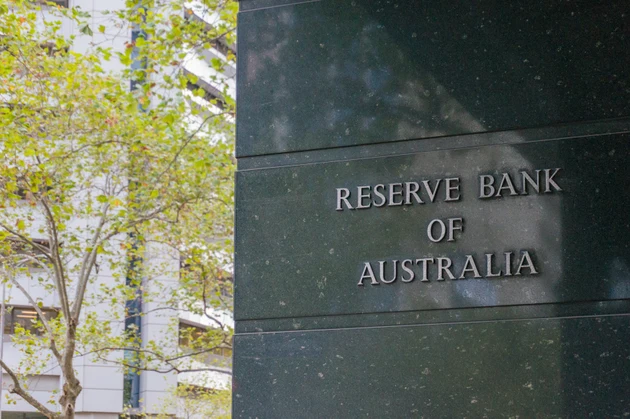
The Reserve Bank of Australia (RBA) unanimously raised its cash rate target by 25 basis points to 4.60% at its September 2026 meeting, matching market expectations. The move marks the central bank’s fourth rate increase this year, pushing borrowing costs to their highest level since 2011.
At 69, I had never hiked with a backpack and I had no idea what land art was. Nonetheless, when my friend Jackie, a nature documentary film-maker, invited me to join her and her friends Wendy and Sasha on a hiking trip to Refuges d’Art in the mountainous countryside of Haute-Provence, I said a resounding “yes”. We would be sleeping alongside sculptures by the renowned land artist Andy Goldsworthy.
First, I watch Rivers and Tides, a documentary on Goldsworthy’s work, and discover he has built exquisite ice sculptures and stone cairns in my own country, Canada. His work seems to speak to an older part of the soul. Then, I start walking up hills, gradually adding weights to my backpack until I can comfortably carry 9kg (20lb).
We meet in Digne-les-Bains, a bustling mountain town in the centre of the Unesco geopark of Haute-Provence, and the starting point for a 10-day, 150km (93-mile) hiking route that includes the possibility of staying overnight at seven reservable but free off-grid sleeping cabins. Goldsworthy worked alongside local teams to restore the abandoned shepherd huts, farmhouses, chapel and stone shelters, and created a site-specific artwork for each one. Over four days, we will visit three of these refuges and hike about 45km (28 miles).
Our first stop in Digne-les-Bains is Maison Alexandra David-Neél, a museum dedicated to the adventurous, peripatetic life of a woman who, in 1924, disguised herself as a beggar to become the first western woman to enter the Forbidden City of Lhasa in Tibet. The keys to the refuges are kept here, no doubt, to inspire hikers for the adventures that lie ahead.
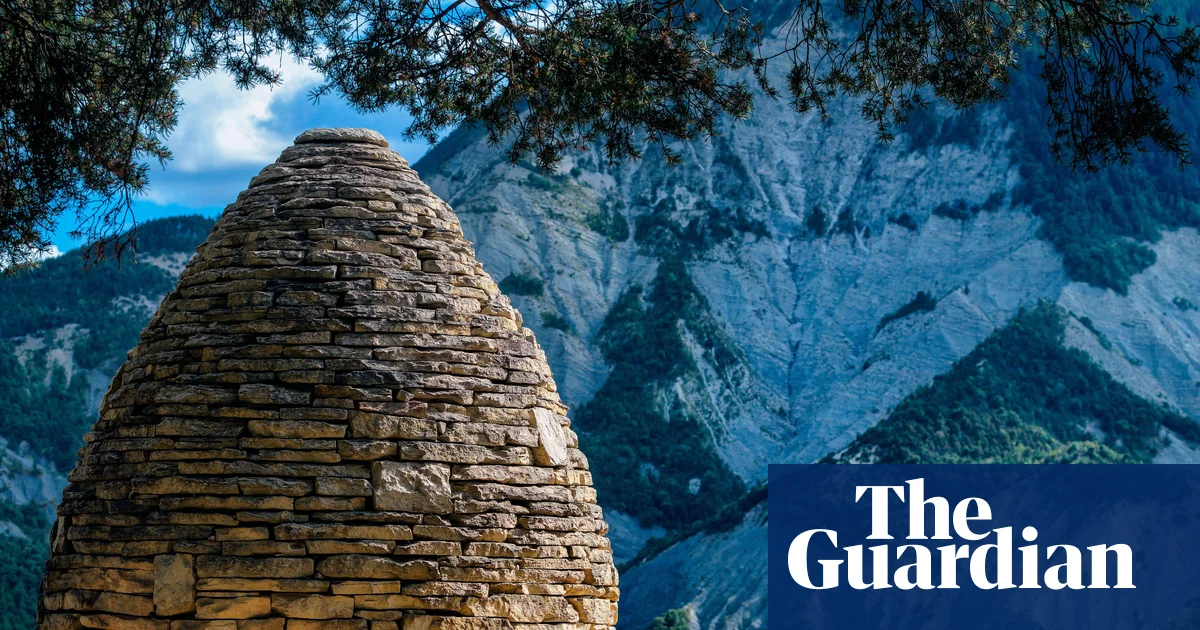
On the first day, we encounter one of three sentinels that sit like giant mysterious eggs watching over the route. These 2 to 3-metre tall cairns were made by Goldsworthy without mortar or cement and rely on fitting the right shapes and weights of the stones.
Jackie has told us the trail is mostly flat and indeed, we start on even gravel, chatting and laughing, getting used to the weight of our packs. After 5km, she says we should look for a path leading up the hill on our right. She checks her satnav and points to a goat path going straight up the rocks. I panic. My backpack suddenly feels extremely heavy. In desperation, I check further down the road and, to everyone’s relief, find a path marked with white and red horizontal lines signifying a grande randonnée, a trail certified by the French government.
We begin our ascent, pausing to photograph curlicued and wispy plants right out of Dr Seuss, yellow, scarlet and blue wildflowers, an orange moth sitting on purple brush. Spanish broom perfumes the air. We lift our gaze and see multiple valleys and unique geological formations. It’s easy to imagine our ice-age ancestors walking these trails 15,000 years ago and it’s gratifying to be travelling under our own steam, as they did.
We arrive at the first refuge, La Forest, as the sun is setting. The key unlocks the door. Inside, the air is cold. Our eyes adjust to the dark. A table and benches stand in front of us. To the left, a stairway leads to sleeping platforms. To the right, a doorway into a dark, empty room. From its depths glows a cylindrical obelisk, light falling on one large stone where someone could sit. It’s concave, constructed of light grey stone ending in a porthole to the sky. It’s illuminated by natural light and changes with the time, the weather, the season. This art is living and feels sacred.
That evening, we eat freeze-dried mushroom risotto in the flickering candlelight, play cards, eat chocolate, laugh and share stories. Sasha, who works in film in Germany, teaches us two words: der salzlose – someone who is bland and without flavour; and extrawurst – someone who always demands more. Neither apply to our group. The camaraderie and conviviality bring pure pleasure.
We climb the stairs to the sleeping platforms. Wendy and Sasha have brought sturdy sleeping mats on Jackie’s recommendation. We lay them out and say goodnight. The quiet is complete. Then, a tidal wave of sound erupts. Wendy and Sasha have rolled over. The friction on the technical fabric of their sleeping mats is deafening. The price of comfort has been revealed; they must lie like mummies.
The next day, we descend, picnic by a river on crackers, avocados and cheese, then start climbing again. Sasha and I subversively agree that it’s psychologically better to be told something is going to be hard and then it turns out easier. I console myself that climbing with a backpack is good for bone density and way less boring than lifting weights.
The next refuge, Le Vieil Esclangon, is in a mountain-top meadow. A majestic fan of lifted rock shines across the wide valley. Everywhere we turn there are more mountains and valleys. The first floor of the refuge is a large dark room split in two by a massive fireplace. Upstairs, the sleeping platforms look out on to a sunlit verge. Across from the fireplace, a tall serpentine shape made of dried mud loops back and forth like a meandering river, ending at the top in the source.
The wind picks up and the temperature drops. We gather wood and light a fire. In the flickering orange light, the sculpture comes to life, looking like one of Plato’s eternal forms. We eat our freeze-dried pad thai, the art and the hikers transient and temporary but together in this warm and cosy moment.
Later, we sleep to the sound of wind and rain, woken only by a mouse rave in the middle of the night.
We arrive at the third refuge, La Ferme Belon, in time for a late lunch. In the basement, huge interlinked semicircular stone arches look like a dragon’s body swimming through earth. Upstairs, the sleeping platforms are lovely except for one small detail. A colony of bats hang above. I can feign nonchalance because I know Wendy, who is quietly uber-capable, will find us a delightful B&B for the night. Over pizza and cold rosé, Sasha and I confess to Jackie that we would have rather known how challenging the hikes were going to be. “But you wouldn’t have come if I’d told you,” she answers with a twinkle in her eye.
Andy Goldsworthy said: “To me there is a tremendous difference between works of art that we observe in a museum just for a few minutes and works of art in which we live for a short while, in which we sleep. To sleep in a sculpture is a wonderful idea.”
In Digne-les-Bains we return the keys and soak our stronger bodies in the town’s hot springs. We’ve already said yes to Jackie’s next adventure, sight unseen.
Claudia Casper’s novel The Mercy Journals won the Philip K Dick award for distinguished science fiction in 2017 (Arsenal Pulp Press)
‘Achtung! Staatsgrenze!” OK, the signpost marking the “state border” didn’t have exclamation marks but, with its no-nonsense Prussian font, it did feel quite shouty. The only thing was, no one on the Feistritzer Alm – a peaceful sweep of Alpine pasture at the meeting of Austria and Italy – was paying any attention to it at all.
Hikers hiked straight past. Mountain bikers used it to prop up their cycles. Cows grazed willy-nilly. And the patrons of the Schutzhütte Oisternig enjoyed their cold beers regardless of which country they were in. While official boundaries may have changed in these parts over the centuries, the magnificence of the mountains has not.
My husband and I had woken that morning in Austria, in the Carinthian village of Feistritz. After breakfast at the old Gasthof Alte Post, we’d bought a loaf from the bäckerei, climbed past the 15th-century church as its bells called worshippers for prayers and continued up through pine forest to these high Alpine meadows – and into Italy.
We were hiking the Alpe Adria, a long-distance trail jointly developed by Austria, Slovenia and Italy that runs from the foot of Grossglockner (Austria’s highest mountain at 3,798 metres) to the Adriatic coast. At 750km (466 miles), the full trail is too long for most people’s summer holidays. But a 135km (84 mile) loop – moderate-graded, doable in a week, with walking days of 15-24km (9-15 miles) – has been created where the three nations meet, to offer a multicultural taster. It’s an appealing idea; hikers love circuiting multiple countries – just look at the numbers crowding the Tour du Mont Blanc these days. While the Alpe Adria loop isn’t quite as dramatic as that, it does offer a much quieter alternative.
We started our journey by catching an early Eurostar to Amsterdam, where there was time for canals, beer and crispy bitterballen before boarding the Nightjet sleeper to Salzburg. In our adjoining capsule-like cabins, we watched the Netherlands segue into Germany, and woke at dawn to pasture, pines and peaks. On the final train from Salzburg to Villach, where we were beginning the loop, the Alps pressed closer, drawing us in.
Now, on the Feistritzer Alm, a day and a half into the walk, Austria was behind us (for the time being) and Italy beckoned, beautifully. Just around the hill from the Schutzhütte Oisternig sat the chapel of Our Lady of the Snows (or the Chiesa Madonna della Neve/Almkapelle Maria Schnee, depending on your linguistic preferences); beyond spread deep-green foothills and the jagged Julian Alps, sawing into a hot-blue sky.
From here, the rest of the day was all downhill, a drop through blessed shade and butterflies, on paths weaving through the pines and peeping out to the peaks, to end in the village of Valbruna, at the Valbruna Inn. We had a wonderful room, and spent time on our balcony, gazing past the geraniums to the sheer Jôf Fuart range, which reaches up to 2,666 metres.
We also spent time in the hotel’s Julius Kugy Library, a cosy den of books on alpinism, named after a writer-mountaineer legend. Born in 1858 to a Slovenian family in Gorizia – then part of the Austrian empire, now in Italy – Kugy is credited with opening up the Julian Alps. He never lost his reverence for nature, always encouraging others to explore with respect, curiosity and awe. I picked up one of his books and read from his introduction: “[This] tries to describe the mountains as a source of happiness, because such they were in my life.”
I couldn’t have agreed more and, with great happiness, we continued the next morning, following the Alpe Adria from Valbruna, across the Saisera River and up through fir and spruce to the Sanctuary of Monte Lussari, a ridge-top pilgrim church and hamlet, where the Virgin Mary is said to have appeared in 1360. I was less moved by the miracle, or the shops selling branded tote bags, liqueurs and slippers, than by the mountains scattered far and wide. We lingered to enjoy the view, then descended via alpenrose and ambling goats to Tarvisio, finding a different kind of happiness in the town’s gelaterias. Then, later that evening, we sat with cold beers on our balcony at the Hotel Nevada, watching as a storm crashed through, briefly erasing every mountain.
The next day brought more joy as the trail took us along the woodland-weaving Sentiero del Orso and then via a busy cycle path to the Fusine lakes. These twin glacial bowls are so arrestingly blue-green you’d think they’d been AI-ed if you weren’t standing right there. We found a quiet spot to picnic, listening to the whinnying of little grebes and staring beyond the dazzling water to the afternoon’s challenge via the rocks ahead: the haul up to Rifugio Zacchi.
after newsletter promotion
The Alpe Adria loop usually ends each day in a valley bottom, where there are plenty of inns. But not tonight. Zacchi sits at 1,380 metres, tight-hugged by the intimidating peaks that mark the Slovenian border. After a muggy, magical ascent through forest to the refuge, I sat on the terrace, drinking a superb Aperol spritz, and stared at them, transfixed; a few booms of thunder rippled, just in case the power of nature had been in doubt.
The food at Zacchi was excellent – venison ragù, chargrilled peppers, potato-pancake-like frico, made with local montasio cheese. Also excellent was the fact that, in a stroke of luck, we had a dorm to ourselves. We woke, refreshed and ready for the next border hop.
The most striking route would have been over the forbidding-looking Vratca Pass. The Alpe Adria took us there, for views east into Triglav national park, but didn’t cross. Instead, the trail backtracked down on the Italian side to follow a path through the verdant Sava Valley to the outdoorsy town of Kranjska Gora.
It was a pleasant entrance into Slovenia; however, our exit was spectacular. To get back to Austria the next day, we had to cross the Karavanke Alps and conquer the highest point of our route, the 1,842-metre Schwarzkogel. It was an unrelenting climb, at first amid pasture and shingle roofs, with sublime views to the Julian peaks, then deep in forest serenaded by thrushes, streams trickling to our side.
As we neared the top, we could see south across Slovenia’s surging summits, north across Carinthia’s electric-blue lakes and low hills. Squat white marker-stones began to appear too, strung along the ridge’s spine – an international border marked more casually than most front gardens. We slalomed between the posts, enjoying both the freedom of movement and the majesty of nature. For millennia the Alps have been physical and cultural barriers. The Alpe Adria is a bringing together; a source of mountain happiness.
The trip was provided by Walks Worldwide; the eight-day, self-guided Alpe Adria Tri-Country Trek is from £895 B&B. Accommodation in London was provided by Generator (rooms from £75, dorm beds from £11)

Published on •Updated
Investors in Europe took the Federal Reserve rate hike in their stride.

Both the Euro Stoxx 50 and the broader pan-European Stoxx 600 traded over 0.6% higher at the start of Thursday’s session.
France’s CAC 40, Germany’s DAX 30, Italy’s FTSE MIB, Spain’s IBEX 35, the Netherlands’ AEX and Switzerland’s CH20, all traded between 0.2% and 0.7% higher than their Wednesday close.
The UK’s FTSE 100 led the pack and rose more than 1%.
Carmakers and industrials led the Paris index, with Renault gaining more than 2%, Stellantis 1.6% and Schneider Electric 1.3%. Technology went the other way, with Dassault Systèmes falling 2.4%.
The calm followed a rougher session in New York, where the Dow Jones Industrial Average closed 1.2% lower on Wednesday and the S&P 500 fell 0.4%, while the Nasdaq was broadly flat.
Asian markets were mixed overnight with Tokyo’s Nikkei 225 rising 0.2%, Seoul’s Kospi gaining 0.9%, while Hong Kong’s Hang Seng lost 0.7% and the Shanghai Composite 0.4%.
Reactions were “pretty much expected since the rate hike was also in line with market expectations”, said Lorraine Tan, director of equity research for Asia at Morningstar, adding that the Iran war is likely to keep pressure on inflation.
The more consequential moves were in currencies and bonds.
The US dollar climbed to its highest in seven weeks against a basket of major currencies, lifted by the jump in short-dated Treasury yields that followed the decision.
The euro was trading around $1.146, down 0.5% from Wednesday’s open.
A stronger US dollar makes European exports more competitive in American markets, but it also raises the cost of anything priced in dollars, which includes oil and gas, which compounds Europe’s energy bill at a difficult moment.
In bond markets, the two-year Treasury yield, the maturity most sensitive to rate expectations, jumped to around 4.72% from 4.67% before the decision, holding near that level on Thursday.
The 10-year sat close to 5%, reflecting both the war-driven energy shock and mounting investor concern about American government debt.
Traders now fully expect another rate hike by December and put the odds of a move as soon as October at around 50%. Goldman Sachs became one of the first major Wall Street banks to forecast consecutive hikes, reversing its previous view that this month’s move would be the only one.
Attention turns next to the Bank of England, which announces its decision later on Thursday and is expected to hold rates steady, and to the Bank of Japan on Friday, where a hike is anticipated.
Additional sources • AP

US President Donald Trump had tried to pressure the Fed to lower rates, but it voted unanimously to raise them instead. In response, Trump is now threatening to end trade with countries the US has a trade deficit with – namely Canada, Mexico and the European Union.
Published On 17 Sep 202617 Sep 2026
Share

Home  Private Credit Fed Rate Hike Squeezes an Already Stressed Private Credit Sector
Fed rate hikes threaten to further strain direct lenders as private credit default rates hit record highs.
The private credit industry keeps insisting it’s fine. The data keeps suggesting otherwise, and Wednesday’s interest rate hike from the Federal Reserve isn’t going to help the argument.
The Federal Open Market Committee officially raised the federal funds target range by 25 basis points to 3.75%-4.00%. The decision, which was unanimous among the 12 board members, marks the first rate hike since 2023.
“Whenever the Fed increases rates, the pressure on the liability side becomes very high,” David Yahalomi, chief operating officer and co-founder of Tel Aviv-based loan-management platform Hypercore, said in an email.
Companies that borrow through direct lending typically carry floating-rate debt, meaning their interest costs rise automatically whenever the U.S. central bank moves rates. The hike officially pushes up borrowing expenses at a moment when defaults are already climbing to levels not seen before.
“In the event of a prime rate increase, this structure shrinks [private credit portfolio company] margins,” Yahalomi added. And the squeeze is already showing up in the numbers.
A Fitch Ratings report from Monday shows that the U.S. Private Credit Default Rate, or PCDR, hit 6.3% for the 12 months ended in August. That’s up from 6.1% in July. The rate has now held at or above 6.0% since April. Here’s the credit rating agency’s breakdown of the findings:
While the overall PCDR blends middle-market CLO ratings (MCO) and insurer-monitored private ratings (PMR), August’s rise was driven by record stress in MCOs (5.6%), even as PMR rates eased slightly to an elevated 8.5%.

Harvey Tian, head of loan operations at Suntera Fund Services, said a size-weighted view changes how PIK interest should be read as well.
“Once the prime rate goes up, the terms on all the rates will increase, and it will definitely put pressure on the borrower side — the ones paying cash interest,” Tian told Global Finance on a call.
Loans structured with PIK options, however, aren’t paying cash interest at all, he noted. That insulates that particular pool of borrowers from a higher interest rate.
“I don’t see a huge effect on the underlying portfolio of PIK borrowers if it’s a one-time hike,” Tian said of Wednesday’s Fed announcement. A quarter-point increase would phase into the PIK rate structure over time rather than land all at once.
Multiple hikes are a different story, given the inflationary pressures caused by a worsening U.S.-Iran conflict.
Anthony Noto covers corporate finance and private credit. Contact him at anoto@gfmag.com.
Frankfurt will almost certainly move on Thursday.
Market odds put a quarter-point hike at close to certainty, which would lift the European Central Bank’s deposit rate from 2.25% to 2.5%.
What makes this a difficult call is not whether the ECB acts, but why, and whether the reasoning survives contact with the data.
The path here has been compressed as the ECB raised rates on 11 June for the first time in three years, lifting the deposit rate from 2% to 2.25% in response to the energy shock from the Iran war, and then held rates in July while Christine Lagarde pointed hawkishly towards September.
August’s inflation figures removed any remaining doubt with eurozone inflation hitting 3.3%, up from 2.9% in July and the highest since September 2023, as energy inflation surged to 14.3% from 10.3%.
Look beneath the headline inflation and the picture inverts.
Core inflation, which strips out energy, food, alcohol and tobacco, actually fell to 2.4% from 2.5%. Services inflation, the component most closely tied to wages and domestic demand, dropped to 3% from 3.3%.
In other words, there is still little evidence that expensive energy is feeding through into everything else. That is what economists mean by “second-round effects”, and their absence is the strongest argument against tightening.
The ECB’s own research also supports the distinction.
In a paper published on Tuesday, ECB economists found that adverse energy supply factors, driven by geopolitical tensions, accounted for around 90% of the rise in energy inflation between January and May.
“This time the energy supply shock dominates, while demand and public policy stimulus have minor roles,” the economists wrote, adding that “these differences are key to explaining why monetary policy responses differ.”
The 2021-22 surge, by contrast, came from “a combination of large and unprecedented supply and demand-side factors,” which is why the ECB then “raised interest rates forcefully and persistently” rather than gradually.
The national spread across the EU further underlines how uneven this is.
August inflation ran at 4.5% in Spain, 2.9% in Germany and 2.7% in France, three economies facing the same energy shock with very different results, all governed by one interest rate.
Economic growth is the other complication.
The eurozone has proved more resilient than expected, which ING attributes partly to luck, partly to Asian competitors suffering more from the closure of the Strait of Hormuz and partly to fiscal stimulus. However, resilience does not mean the growth could not, or should not, accelerate.
ING characterises Thursday’s expected move as “another insurance rate hike”, or “a dovish rate hike,” noting that even at 2.5% the deposit rate sits within the range the ECB itself considers neutral.
Going further would mean deciding restrictive policy is required, which would be a different judgement entirely.
The ECB is not acting alone, and that matters for the euro.
The Federal Reserve meets on 15 and 16 September, with Chair Kevin Warsh having used his first Jackson Hole address to argue that financial conditions are not restrictive and underlying inflation has not improved.
Investors had put the odds of a US hike at roughly one in three before those remarks, but now price a 60% chance the Fed hikes the target range from 3.5%-3.75% to 3.75%-4%.
The Bank of Japan follows on 17 and 18 September, with markets pricing an 80% to 90% chance of a move to 1.25%.
On the other hand, the Bank of England is expected to hold rates at 3.75% on 17 September as it currently maintains a much higher interest rate than the rest.
If the Fed were to hike while the ECB held, the dollar would strengthen against the euro and that would cut both ways for Frankfurt.
A weaker euro makes European exports more competitive, but it also makes imports dearer, and since oil and gas are priced in dollars, it would push up precisely the energy costs driving the inflation problem in the first place.
Overall, we can assume a September rate hike is a done deal for the ECB but we can also project that it won’t solve the central bank’s current dilemma of raising borrowing costs against an inflation it cannot reach, while withdrawing support an economy could still use.