High cost of living tops voter concerns, Becerra remains front-runner in governor’s race, new poll shows
SACRAMENTO — As Californians prepare to elect a new governor in November, the concern they want to be his top priority is reducing the state’s entrenched high cost of living, according to a poll by the UC Berkeley Institute of Governmental Studies and co-sponsored by the Los Angeles Times.
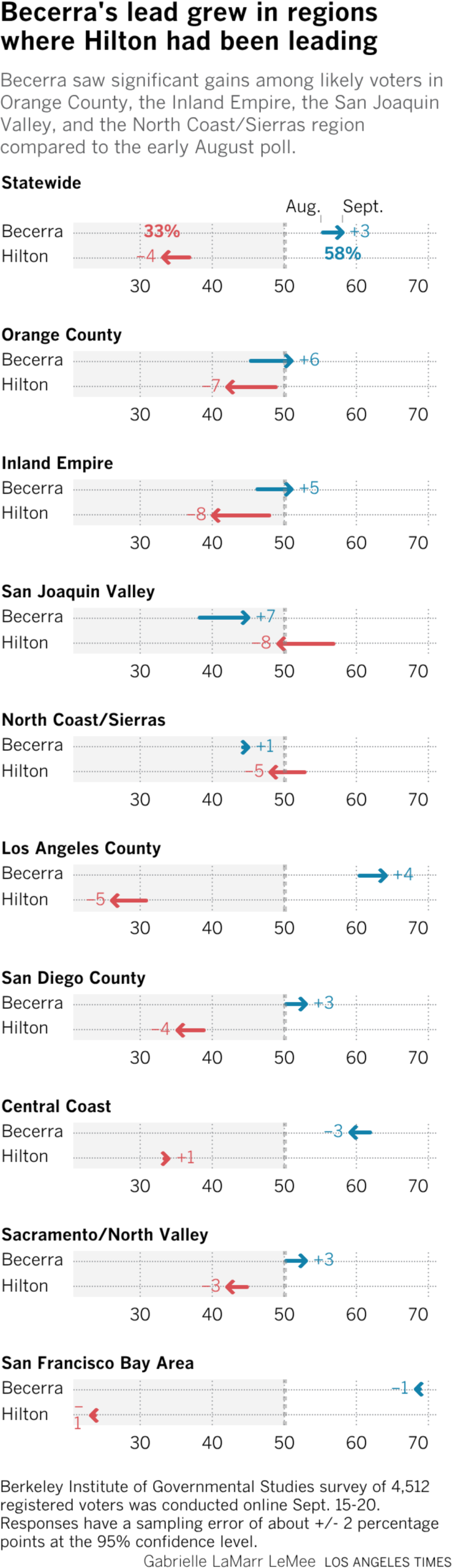
Not too far behind that is strong voter support for fighting the policies of the Trump administration. That may be among the many reasons 58% of likely voters surveyed support Democrat Xavier Becerra in the governor’s race compared to the 33% who back Republican Steve Hilton, whom the president endorsed.

“These results suggest that Becerra is in a commanding position heading to November,” said IGS co-director Eric Schickler. “With 2026 shaping up to be a strong Democratic year nationally, the headwinds facing Hilton in Democratic-leaning California are even stronger than usual.”
The poll found that Becerra’s lead over Hilton had increased slightly since an August IGS poll, and the Democrat now holds a 25-percentage-point advantage.
Despite an effort to reach out to Democrats and independent voters and making California’s high housing costs, top-in-the-nation gasoline prices and other increasing daily living expenses a central focus of his campaign, Hilton is struggling to gain ground in the race to replace Gov. Gavin Newsom, the poll found.
“The difficult thing is that Steve Hilton’s a Republican in California,” said Tim Rosales, a Republican strategist who previously advised GOP gubernatorial candidate John Cox in the 2018 race against Newsom. “On the scale of what’s more important to voters, the cost of living certainly is there, but those Democrats really aren’t willing to cast a vote or cross party lines to vote for a Republican.”
Asked to name one or two of their top concerns heading into the Nov. 3 election, 44% of likely voters cited the cost of living, 37% said it was important to push back against policies from the Trump administration and 30% said they wanted to help their political party win or maintain control of Congress.

“The November elections are being held at a time when the economic backdrop is worsening not only in California but across the nation, as prices are rising on most major household purchases, including groceries, gasoline, electricity and healthcare,” said IGS poll director Mark DiCamillo. “Pocketbook issues have traditionally played a big role in election politics and this year is no exception.”
Democrats, who make up nearly half of California’s 23 million registered voters, “understand the cost of living, and they feel it. They just feel like they need a new Democrat to deal with it,” Rosales said.
“Independent voters are a little bit different. They aren’t partisan but they are ideological and there is some opportunity there.” But Hilton would “need a whole lot of them in California in order to have a chance on a statewide level,” he said.
More than half of likely voters not registered with either the Democratic or Republican parties — most of whom declare themselves as “no party preference” — said they supported Becerra in the governor’s race, while 30% favored Hilton. The remaining 14% were undecided.
Hilton has made a slew of campaign promises to lower the cost of living, including $3 gasoline, no taxes on income below $150,000 and lowering energy bills by slashing climate-friendly regulations imposed by Democrats.
Both Rosales and DiCamillo agreed that while voters list affordability as a top issue, Democrats in particular are more motivated by the opportunity to push back on President Trump in the midterm elections.
“When you look at the Becerra voters on the issues or concerns that are important to them, it’s really framed by fighting Trump administration policies. I think that’s an indication of what’s happening in this election cycle,” DiCamillo said. “You’re seeing it across the country as well.”
The poll showed that 59% of Becerra supporters said fighting the Trump administration was a top priority, while 62% of Hilton supporters said reducing taxes was their main concern. More than 60% of undecided voters listed the cost of living as a top item.
Trump, who remains extremely unpopular among most Californians, endorsed Hilton for governor in April. Though the president’s backing helped the former Fox News host consolidate enough Republican support to finish second in the June primary, allowing him to advance to the November election, it may hurt his chance in the general election. A recent Public Policy Institute of California poll showed Trump with a 27% approval rating in the state, a record low across both of his terms.
Hilton has tried to court voters, especially Latinos and independents, who dislike Trump but are also dissatisfied with California’s Democratic leadership and its failure to alleviate some of California’s most incessant problems. The British-born Republican has also declined to criticize the president on issues including immigration enforcement or the Iran war.
Becerra’s wide lead is also boosted by his favorability rating — 48% of likely voters have a favorable opinion of him while 40% view him unfavorably and 11% have no opinion. Hilton’s rating is underwater; 51% of likely voters have an unfavorable opinion compared to 35% favorable and 13% with no opinion.
The Republican has criticized his opponent for doing few public events since the primary election and challenged Becerra to accept debate invitations from roughly a half-dozen news outlets around the state.
The two are scheduled to meet in a Sept. 30 nationally televised debate in Burbank hosted by CNN.
The poll was conducted online in English and Spanish from Sept. 15 to 20. Responses for the governor’s race poll came from a weighted sample of 4,512 respondents considered likely to vote in the November election, from a larger group of 6,989 registered voters throughout California. It has a margin of error of 2 percentage points in either direction.