High-Speed Aircraft Startup Hermeus Joins Forces With Northrop Grumman
Aviation startup Hermeus and established prime contractor Northrop Grumman say they are now working together toward the aim of delivering operational uncrewed aircraft capable of high-supersonic, if not hypersonic, flight to the U.S. military. Through a newly announced partnership, Northrop Grumman is set to integrate electronic warfare systems, sensors, autonomy packages, and other capabilities onto “next-generation” Hermeus drones.
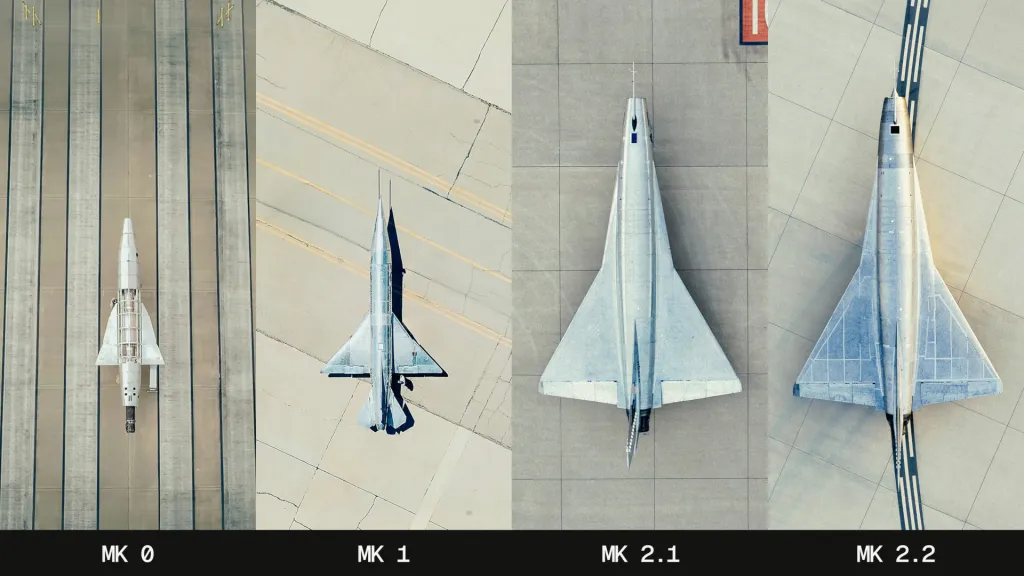
Hermeus and Northrop Grumman announced their team-up earlier today. Hermeus, which was founded in 2018, has already flown a succession of ever-more capable uncrewed jet-powered Quarterhorse demonstrator drones. The delta-winged Quarterhorse Mk 2.1 was the first of these to break the sound barrier during a test flight in May. The company is now working on a further evolved Quarterhorse Mk 2.2, which it hopes to push beyond Mach 2.

Hermeus’ stated end goal is a design capable of hypersonic flight. The company has also previously shown renderings of a planned “mission plane” prototype described as being capable of “high-Mach” flight and equipped with six underwing pylons, three under each wing, as well as one along the centerline.

Quarterhorse Mk 2.1 has already demonstrated the ability to release stores at high speed. In September, Hermeus also unveiled Ramjet-X, a smaller ramjet-powered platform that can be air-launched from Quarterhorse drones, ostensibly to support high-speed flight testing activities, but that could be adapted to operational missions.
Now, as part of the new partnership, “Northrop Grumman will provide integrated mission systems design, development, integration, and sustainment for Hermeus’ next-generation aircraft — reusable, unmanned high-Mach platforms designed to deliver affordable capability on relevant timelines,” according to a press release from Hermeus. “The collaboration creates a path to equip Hermeus’ aircraft with technology across sensing, communications, navigation, and command and control, allowing the aircraft to operate more intelligently and take on more complex missions” and “give warfighters faster, more survivable options in combat.”
“As the threat environment accelerates, the Department of War needs autonomous systems developed and fielded in months, not years,” per a separate Northrop Grumman press release. “Northrop Grumman and Hermeus will meet that need by pairing Northrop Grumman’s combat‑proven mission systems and ‘ready‑now’ electronic warfare, communication, sensing and autonomy expertise with Hermeus’ high‑speed Quarterhorse aircraft.”
“We’re building a new class of aircraft that gives the warfighter improved speed, range, and flexibility while integrating into the existing Force,” Zach Shore, CEO of Hermeus, also said in a statement. “Adding Northrop Grumman’s battle-tested mission systems will push what those aircraft can do in real world scenarios and help us field operational capability faster. Northrop brings decades of experience turning aircraft into effective mission platforms and that’s exactly what we want to tap into.”

Beyond the mention of electronic warfare, sensing, and communications capabilities, neither company’s press release elaborates more specifically on the kind of operational missions that future Hermeus drones could be tasked with. It is also unclear which branches of the U.S. military might be looking to fly them. TWZ has reached out for more information.
That being said, development of the Quarterhorse family has been supported in part through contracts from the U.S. Air Force and the Pentagon’s Defense Innovation Unit (DIU). The aforementioned stores release testing was conducted under the auspices of a DIU effort called High-Cadence Airborne Testing Capabilities (HyCAT).
Hermeus’ inclusion in HyCAT brought “a technical focus on turbine-based combined cycle [TBCC] propulsion and a pathway for dual-use, reusable hypersonic flight aircraft,” according to a DIU press release back in 2023. “Hermeus will emphasize demonstration of enabling technologies – aircraft sub-systems and mission integration – needed for future hypersonic aircraft.”
Hermeus has also been developing a TBCC propulsion system called Chimera. The company’s goal is to integrate that onto a future Quarterhorse Mk 3 design.

Hypersonic Engine Test Milestone
As we have written previously:
“A practical TBCC propulsion system has long been viewed as something of a holy grail for very high-speed aircraft design. Ramjets and scramjets typically used to propel air-breathing air vehicles to hypersonic speeds, typically defined as anything above Mach 5, do not work properly at subsonic speeds and can have trouble operating efficiently even at low-supersonic speeds. As such, a significant initial boost velocity, usually provided by a rocket motor, is required before those engines can kick in. A TBCC combines ramjets/scramjets with jet turbines that work at lower speeds and offers the ability to seamlessly shift from one mode to the other. An air vehicle with a TBCC propulsion system would be able to take off and land from suitably long existing runways, but cruise at high-supersonic or even hypersonic speeds, offering immense operational flexibility.”
Furthermore, the U.S. Air Force has been open in recent years about at least having an interest in reusable hypersonic air vehicles capable of performing strike and intelligence, surveillance, and reconnaissance (ISR) missions. The service has publicly pursued the development of relevant technologies, including advanced scramjet engines and TBCC propulsion concepts, and full-up demonstrators to prove them out, through several programs in recent years, but the outcomes to date remain unclear.
The Air Force did award Leidos a contract for the development of a full-up prototype reusable hypersonic air vehicle under its secretive Mayhem program back in 2022. That effort, which aimed to demonstrate a platform that could be adapted to hypersonic strike and ISR missions, ran into budget and other hurdles, and its status was decidedly murky as of 2024. That same year, a very similar-sounding project called Next Generation Responsive Strike (Next RS) emerged at the Defense Advanced Research Projects Agency (DARPA), in which the Air Force was also involved. As of 2025, the Next RS plan also included plans to acquire a flying prototype or demonstrator by 2030, but how that effort has advanced since then is unclear.

As we have also written in the past:
“A reusable uncrewed air-launched hypersonic strike and reconnaissance aircraft could certainly offer benefits in various operational scenarios. Such a system could be ideal for prosecuting time-sensitive targets, or just gathering intelligence on them, including deep in denied areas at extreme stand-off ranges. From an ISR perspective, spy satellites, which might be the only other option for collecting on the targets in question, could take too long to retask and are predictable, with the enemy knowing when they will pass overhead.”
“An air-launched reusable platform could offer additional flexibility in terms of vector of approach and timely arrival over a target area compared to regional ground and surface-launched concepts.”
Northrop Grumman’s press release today highlights the potential to add electronic warfare capabilities to the mix. It’s not clear whether the aim here is to provide self-production for the drone or to enable non-kinetic attacks, or both. An electronic warfare package could also allow the vehicle to act as a very-high-speed reusable decoy.
It’s also important to note that a design from Hermeus would not need to be capable of hypersonic flight, defined as anything above Mach 5, to be relevant in the roles described above. As mentioned earlier, even before today’s announcement, the company had plans for an operationalized ‘high-Mach’ drone. We have also already seen such capability fielded in China in the form of the WZ-8, a rocket-powered tactical theater reconnaissance drone.

Aircraft, crewed and uncrewed, that can fly at transitional speeds between the high-supersonic and fully hypersonic regimes are also set to be increasingly relevant for research and development and test and evaluation activities. This is the arena where Hermeus is working now through efforts like HyCAT. Growing demand for these kinds of high-speed flight test capabilities has also recently been underscored by reports that NASA is exploring returning a retired SR-71 Blackbird to flight as an experimental X-plane.
There is clearly work still to be done before any version of Quarterhorse, or a future design from Hermeus, emerges as an operational platform, hypersonic or not. At the same time, the new partnership with Northrop Grumman reflects a new and very explicit step toward that goal, which is building on work already being done with the support of the U.S. military.
Contact the author: joe@twz.com