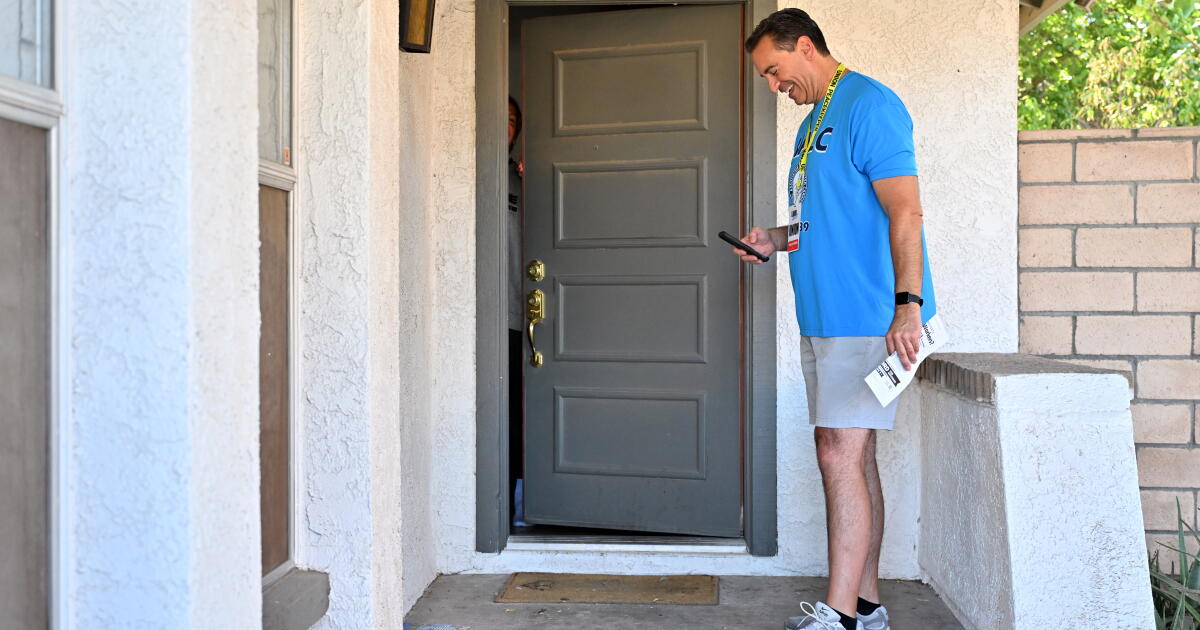
Ron, a West L.A. resident, thinks he knows why former reality TV star and political newcomer Spencer Pratt won so much support in his run for mayor.
People are frustrated, frightened and angry about homelessness “and the crime associated with it,” Ron said in an email. He added that he voted for Mayor Karen Bass, but “almost everything Pratt said about the homeless resonated with me. … The homeless run wild here, without consequence.”
“Many of us support him not because we think he’s perfect,” said Kathy, “but because we are deeply dissatisfied with the direction of Los Angeles and feel that traditional politicians have not delivered the results we were promised.”
Bob, “a left-leaning Palisades resident,” said the issue is not Pratt’s lack of credentials, but the failures of incumbents. “There was a columnist … who documented in depth the situation at MacArthur Park,” Bob wrote in reference to me. “What was his name and what happened to him? Did he change his tune?”
These are all fair points, and if Pratt holds onto one of the top two spots and makes it to the Nov. 3 general election, or he’s overtaken by late-charging Councilmember Nithya Raman, we’re going to hear a lot more about homelessness in coming months.
So whether we’re looking at a Bass-Raman contest or a Bass-Pratt showdown, here are some random musings, and I’ll begin by responding to Bob’s question about whether I have changed my tune.
Not in the least.
The situation in MacArthur Park — targeted Thursday in a crackdown that involved multiple arrests — has long been a disgrace, and the same is true of many other places I’ve written about for the past quarter of a century. Last month, I visited a Hollywood neighborhood where one frustrated resident hired her housekeeper to document chronic problems related to homelessness, illegal dumping and criminal activity.
Residents have good reason to ask why they haven’t gotten better results after responding to politicians’ pleas for more money over the years.
It’s no surprise that Bass had high unfavorability ratings and why, despite leading in the primary vote count, she’ll fall far short of the 50% needed to avoid a second election phase. I still can’t believe that when I first asked her about the sad state of MacArthur Park, she told me she was fully aware, because she often drove through the area on her way to work.
Then why hadn’t she led the charge to address the problems and return the park to the community?
It shouldn’t take months, let alone years, to take back control of public spaces, and Pratt’s criticism is warranted, no doubt. And my main issue is not the hypocrisy of him saying God wants him to be mayor while calling his opponents demonic entities and villainizing homeless people he intends to shoo away to Seattle. It’s that his “fixes” demonstrate a lack of understanding.
Let me make a confession. From one angle or another, I’ve been writing about the intersection of homelessness, mental illness and addiction for a couple of decades, and I still have a lot to learn.
And on a personal note, I lost my son to a drug overdose. He had a job and wasn’t homeless, but like a lot of people who struggle with depression and other demons, he was resistant to help, and even to the idea that he needed help.
There are a lot more substance users like him, living out of public view, than there are on the street. We notice only those who don’t have the means to pay the rent or the mortgage as housing prices rise. So when Pratt says we don’t have a homelessness problem, but a drug problem, he’s missing a critical component in understanding why L.A. has tens of thousands of unsheltered people.
Pratt said on his website that his “treatment first” approach would direct resources into mental health and drug treatment care, which sounds good except that those responsibilities are primarily under county jurisdiction, not city control.
He and others have attacked harm reduction practices, such as distribution of needles and other paraphernalia. And I have to admit that it seems counterintuitive to enable further drug use. But the idea is to prevent death, engage clients and start a relationship that might lead to transformative care.
The county reports that in 2024, fentanyl-related deaths decreased by 37% and meth-related deaths by 20%. Harm reduction can be “absolutely invaluable,” addiction specialist Rick Rawson told me when I was working in MacArthur Park, but we need much more than that.
“When you have someone who becomes so incapacitated that they can’t stand up,” Rawson said, “to say that you’re just going to provide them with harm reduction and hope they don’t die, I think that falls short of the responsibility we have to each other and to the sickest people.”
I’ll add here that I firmly believe we should intervene more aggressively with people who are gravely ill, or are a threat to themselves or others. I recently profiled two San Diegans who are advocating for use of an existing law to allow for deeper evaluations and longer-term treatment plans for people with chronic drug and mental health issues.
It’s worth noting that drug and alcohol rehab is seldom a quick or surefire remedy. As for mental illness, it took me one year, along with the help of trained professionals, to convince my friend Nathaniel to seek help after he’d spent decades on the street following a diagnosis of schizophrenia.
What I’ve found over the years is that many of those living in tents and cars and alleys and parks are damaged in numerous ways.
I’m less inclined to judge people from a distance after having met a man on Skid Row who said he fell apart after his young daughter drowned. I’ve met women who are victims of domestic abuse or sexual assault. People in the grip of killer drugs like meth or fentanyl don’t think as clearly as we’d like them to, and they repeatedly sabotage their own self-interest.
To see people take over public spaces, openly sell or use drugs, lash out and scare those around them is disturbing and sometimes scary. But to say they choose to live on the street, as Pratt has, is to miss the point, to excuse our own complicity, to overlook historic policy failures, and to choose contempt over compassion.
Homelessness can cause mental illness, and mental illness can cause addiction, and vice versa. One condition alone can be difficult to address, but intertwined maladies further complicate matters.
I recently checked in with a guy I wrote about who had been addicted and homeless in Koreatown, and he said his recovery took more than half a year. He was in residential treatment for a few months, then in intensive outpatient treatment. There are no shortcuts, he said.
I’m not here to defend Bass, or Raman and the rest of the City Council, which shares responsibility for the current state of the city. Limited progress has been made in the last 3½ years, with a marginally lower number of homeless people.
But there’s a long way to go in moving people indoors and restoring a sense of order and public safety. The many needs include smarter enforcement of existing laws, faster development of low-cost interim and permanent housing, better coordination of outreach and follow-up services and more people willing to do all of this work.
Let’s hope that in the coming months we’ll get an honest conversation about what’s working, what isn’t, and how to do better.
On the eve of his 25th birthday, Rams star receiver Puka Nacua said he was working on becoming a better person — and that if he continued on that journey the potential massive contract extension that appears to have stalled will take care of itself.
Nacua on Thursday addressed reporters for the first time since checking into a Malibu rehab facility in March. Nacua sought help after a string of incidents, which included a December incident that led to a civil lawsuit.
“Something that I feel like I’ve learned is, it’s OK to ask for support,” Nacua said after participating in an organized-team activity workout in Woodland Hills. “And then to recognize the platform that I have in being a professional football player, and trying to use that for the betterment of myself and for those around me.”
With an offense that features Nacua, quarterback Matthew Stafford — the reigning NFL most valuable player — and receiver Davante Adams, and a defense that includes edge rusher Jared Verse and All-Pro cornerback Trent McDuffie, the Rams are regarded as a favorite to play in Super Bowl LXI at SoFi Stadium.
Last season, Nacua led the NFL with 129 receptions and was voted All-Pro. The 2023 fifth-round draft pick is entering the final year of his rookie contract, and he is eligible for an extension that could surpass the $120-million deal the Seattle Seahawks gave receiver Jaxon Smith-Njigba.
But incidents last season and this offseason caused the Rams to put off talks about awarding Nacua an extension.
During a livestream last December, Nacua criticized NFL officials and made a gesture regarded as antisemitic. Nacua apologized, but after the Rams’ loss to the Seahawks a few days later, Nacua criticized officials in a social media post from the locker room. The NFL fined him $25,000.
Rams wide receiver Puka Nacua smiles after speaking to reporters during organized team activities at the training facility in Woodland Hills on Thursday.
(Gary Klein / Los Angeles Times)
His attorney has denied that Nacua made an antisemitic remark and said the bite resulted from “horseplay.”
On Thursday, when asked about the allegations, Nacua declined to comment specifically.
“With it being an ongoing legal battle, out of respect for the other party involved, don’t really have much to speak on,” he said, adding: “A moment for me to learn from, kind of some of the situations I was putting myself in, and then also having just an awareness of how I’m conducting myself in and out of this football field.”
Nacua said he made the decision to seek help with the support from those in his “inner circle.”
“I like to think of myself as a pretty happy outgoing guy that enjoyed life,” he said. “But there also were some difficulties of just being in this professional sport and just throughout my entire life.”
The rehab program was a “short stint,” but Nacua said he continues to meet with a team therapist and has adopted tools such as journaling.
Nacua, who became a father in October, said he was also motivated to continue self-improvement work as a way of sharing with and teaching his son.
“The great things I’ve been able to accomplish and to enjoy those moments, but then also to teach him in some of the mistakes that I’ve made,” he said. “So there’s an opportunity for him to learn before some of those wrong decisions can be made.”
Nacua’s “security in being able to be authentically honest about” seeking help was admirable, coach Sean McVay said.
“I think there’s real strength in some of the vulnerabilities,” McVay said, “and I’m really proud of him.”
Stafford, 38, said he talks with Nacua “nonstop” and that Nacua has looked “fantastic” during workouts.
“He’s a great person, a great kid, and just doing everything I can to try and give advice when it’s needed, or also just be his buddy too,” Stafford said. “I’m doing everything I can — I think everyone is, to just support him. … We’re happy he’s back doing his thing.”
Stafford spoke for the first time since signing a one-year, $55-million extension that keeps him under contract with the Rams through the 2027 season.
“Happy to have … next year taken care of if I decide to play — and they still want me back,” Stafford quipped. “Just excited to get that behind me, cause I just want to come out here and play and not think about that kind of stuff.
“So great to get that done sooner rather than later.”
Before Nacua’s string of incidents, the receiver also appeared on track to receive a possible extension before the 2026 season began.
Now, the Rams are expected to let him play out the season, and then possibly use the franchise tag for 2027 before making a long-term commitment.
Nacua said he could not imagine playing for another team.
“If I can continue to improve as a person, I know the coaches and the people around me are helping me improve as a football player,” he said. “So those are the things I can control, and hopefully allow those other things to handle themselves.”
Freshman pitcher Ainsley Jenkins is a big reason Sherman Oaks Notre Dame has advanced to the Southern Section Division 1 quarterfinals in softball. In the Knights’ first two playoff victories over Anaheim Canyon and Oaks Christian, she has been called out of the bullpen to pitch exceptionally well in relief.
Next up is a quarterfinal showdown with No. 2-seeded Norco on Wednesday at Encino’s Franklin Fields.
If Jenkins needs any help with writing for school work, she has two parents with distinguished writing backgrounds. Her father, Lee, was a highly regarded reporter at Sports Illustrated before becoming an executive with the Clippers. Her mother, Elizabeth, is a magazine writer.
Notre Dame is expected to face Norco’s top one-two pitching duo of Coral Williams and Peyton May. Jenkins will be available if needed. Mom and Dad are also available to write up a pleasing ending if the Knights pull off the upset.
This is a daily look at the positive happenings in high school sports. To submit any news, please email eric.sondheimer@latimes.com.
This might be the first time in the NFL’s modern era that Pittsburgh has hosted the draft, but the whole format was actually invented here.
Back in 1935, the league’s founders met at the Fort Pitt Hotel and voted unanimously to put in place a selection process in reverse order of the previous season’s standings. That would promote competitive balance, which has been a hallmark of the NFL ever since.
Ladies and gentlemen, meet the Las Vegas Raiders. The franchise went 21-41 over the past four seasons and its offense scored a league-worst 241 points last season.
Quarterback Fernando Mendoza, who led Indiana to a national championship, won’t be at the draft but almost certainly will hear his name called first. He’s likely to be the only quarterback selected in the opening round.
Indiana quarterback Fernando Mendoza is widely expected to be the No. 1 pick of the NFL draft.
(Eric Thayer/Los Angeles Times)
The rest of the first round figures to be heavy on edge rushers and receivers — the Rams are in the market for a pass catcher — with a couple of Notre Dame running backs who could also make a splash.
Every franchise is looking for that game-changing find. The goal: Be a Pittsburgh stealer.
A look at how the draft could unfold:
1. Las Vegas Raiders: Fernando Mendoza, QB, Indiana — Mendoza gets Tom Brady’s stamp of approval, and Raiders begin yet another reboot.
2. New York Jets: Arvell Reese, Edge, Ohio State — Pie in the sky, but the Jets are praying to find a Micah Parsons of their own.
3. Arizona Cardinals: David Bailey, Edge, Texas Tech — Amid rumblings that Cardinals might take a running back, they grab a pass rusher instead.
4. Tennessee Titans: Jeremiyah Love, RB, Notre Dame — Cam Ward needs help, and Love bolsters that Titans backfield with big-play burst.
Ohio State’s Caleb Downs is projected to be selected No. 5 by the New York Giants.
(Steph Chambers / Getty Images)
5. New York Giants: Caleb Downs, S, Ohio State — John Harbaugh loves those smart safeties who can play quarterback on the back end of the defense.
6. Cleveland Browns: Carnell Tate, WR, Ohio State — The Browns got an up-close look at this guy in college, and they need to score points in the worst way.
7. Washington Commanders: Sonny Styles, LB, Ohio State — The Commanders get a versatile leader in the middle who can play all four downs.
8. New Orleans Saints: Jordyn Tyson, WR, Arizona State — Chris Olave has been great for the Saints, but he’s prone to concussions. Tyson is insurance.
9. Kansas City Chiefs: Rueben Bain Jr., Edge, Miami — If the Chiefs don’t take a receiver, they would be perfectly happy with a do-it-all pass rusher.
LSU cornerback Mansoor Delane is projected to be the Giants’ second pick of the NFL draft.
(Michael DeMocker / Getty Images)
10. New York Giants: Mansoor Delane, CB, LSU — Giants will hold their breath making this pick as they have an illustrious history of drafting busts at corner.
11. Miami Dolphins: Keldric Faulk, Edge, Auburn — Dolphins are a trade-up candidate, but they are sorely in need of pass-rush help. Faulk is a good fit.
12. Dallas Cowboys: Dillon Thieneman, S, Oregon — The Cowboys surrendered a league-worst 30.1 points per game last season and need help all over.
13. Rams: Makai Lemon, WR, USC — The Rams have shown a knack for identifying receivers who will become stars. This would be a great landing spot.
USC receiver Makai Lemon, who made many acrobatic catches during his career with the Trojans, could be selected by the Rams.
(Gina Ferazzi/Los Angeles Times)
14. Baltimore Ravens: Francis Mauigoa, OT, Miami — With the best of the receivers gone, the Ravens look to bolster their offensive line. They need help at guard and tackle.
15. Tampa Bay Buccaneers: Akheem Mesidor, Edge, Miami — The Buccaneers haven’t had anyone with 10 sacks since 2021. Mesidor has that potential.
16. New York Jets: Denzel Boston, WR, Washington — The Jets need a bookend for Garret Wilson, and this gives Geno Smith a big target over the middle.
17. Detroit Lions: Spencer Fano, OT, Utah — Taylor Decker is gone. The Lions get a player who can line up on either side, opposite Penei Sewell.
18. Minnesota Vikings: Emmanuel McNeil-Warren, S, Toledo — Harrison Smith is in the sunset of his career, and if there’s a top-notch safety here, the Vikings need to grab him.
19. Carolina Panthers: Kenyon Sadiq, TE, Oregon — The Panthers take an elite safety if there’s still one around, but a target for Bryce Young would be nice too.
20. Dallas Cowboys: Jermod McCoy, CB, Tennessee — More help for the Cowboys defense. This could be Texas Tech linebacker Jacob Rodriguez as well.
21. Pittsburgh Steelers: Omar Cooper Jr., WR, Indiana — Steelers receivers coach is the brother of Indiana’s head coach. Pittsburgh knows this player well.
Penn State offensive lineman Olaivavega Ioane could be selected by the Chargers in the first round of the NFL draft.
(Michael Conroy / Associated Press)
22. Chargers: Olaivavega Ioane, G, Penn State — The Chargers have huge draft investments in their tackles, but they still need to fortify that offensive line.
23. Philadelphia Eagles: Kadyn Proctor, OT, Alabama — With Lane Johnson near the end of his career, the Eagles need to start developing a huge young successor.
24. Cleveland Browns: Monroe Freeling, OT, Georgia — Thanks to a trade with Jacksonville, the Browns have the draft capital to take a left tackle here.
25. Chicago Bears: Zion Young, Edge, Missouri — Lots of talent on offense, but the Bears need to do everything they can to fortify their defense. Young can get to quarterbacks.
26. Buffalo Bills: Cashius Howell, Edge, Texas A&M — SEC Defensive Player of the Year should be a nice complement to newly-acquired Bradley Chubb off the edge.
27. San Francisco 49ers: KC Concepcion, WR, Texas A&M — This receiver and return specialist fits the mold for Kyle Shanahan. A crisp route runner with speed to get deep.
28. Houston Texans: Kayden McDonald, DT, Ohio State — The Texans need help along the interior of both of their lines. McDonald can make an immediate impact.
29. Kansas City Chiefs: Colton Hood, CB, Tennessee — Chiefs need a corner, and if Jermod McCoy is gone, Hood would be a good alternative.
30. Miami Dolphins: Jacob Rodriguez, LB, Texas Tech — The reliable Rodriguez could go earlier – maybe to Dallas – but would help stabilize rebuilding Dolphins defense.
31. New England Patriots: T.J. Parker, Edge, Clemson — The Patriots have made no secret about their desire to beef up their rush off the edges.
32. Seattle Seahawks: Jadarian Price, RB, Notre Dame — The Seahawks didn’t re-sign Kenneth Walker III, so there’s opportunity for a young running back to fill the void.
Commentary: For mayoral candidates and all of L.A., here’s the homelessness conversation we must have
Ron, a West L.A. resident, thinks he knows why former reality TV star and political newcomer Spencer Pratt won so much support in his run for mayor.
People are frustrated, frightened and angry about homelessness “and the crime associated with it,” Ron said in an email. He added that he voted for Mayor Karen Bass, but “almost everything Pratt said about the homeless resonated with me. … The homeless run wild here, without consequence.”
“Many of us support him not because we think he’s perfect,” said Kathy, “but because we are deeply dissatisfied with the direction of Los Angeles and feel that traditional politicians have not delivered the results we were promised.”
Bob, “a left-leaning Palisades resident,” said the issue is not Pratt’s lack of credentials, but the failures of incumbents. “There was a columnist … who documented in depth the situation at MacArthur Park,” Bob wrote in reference to me. “What was his name and what happened to him? Did he change his tune?”
These are all fair points, and if Pratt holds onto one of the top two spots and makes it to the Nov. 3 general election, or he’s overtaken by late-charging Councilmember Nithya Raman, we’re going to hear a lot more about homelessness in coming months.
So whether we’re looking at a Bass-Raman contest or a Bass-Pratt showdown, here are some random musings, and I’ll begin by responding to Bob’s question about whether I have changed my tune.
Not in the least.
The situation in MacArthur Park — targeted Thursday in a crackdown that involved multiple arrests — has long been a disgrace, and the same is true of many other places I’ve written about for the past quarter of a century. Last month, I visited a Hollywood neighborhood where one frustrated resident hired her housekeeper to document chronic problems related to homelessness, illegal dumping and criminal activity.
Residents have good reason to ask why they haven’t gotten better results after responding to politicians’ pleas for more money over the years.
It’s no surprise that Bass had high unfavorability ratings and why, despite leading in the primary vote count, she’ll fall far short of the 50% needed to avoid a second election phase. I still can’t believe that when I first asked her about the sad state of MacArthur Park, she told me she was fully aware, because she often drove through the area on her way to work.
Then why hadn’t she led the charge to address the problems and return the park to the community?
It shouldn’t take months, let alone years, to take back control of public spaces, and Pratt’s criticism is warranted, no doubt. And my main issue is not the hypocrisy of him saying God wants him to be mayor while calling his opponents demonic entities and villainizing homeless people he intends to shoo away to Seattle. It’s that his “fixes” demonstrate a lack of understanding.
Let me make a confession. From one angle or another, I’ve been writing about the intersection of homelessness, mental illness and addiction for a couple of decades, and I still have a lot to learn.
And on a personal note, I lost my son to a drug overdose. He had a job and wasn’t homeless, but like a lot of people who struggle with depression and other demons, he was resistant to help, and even to the idea that he needed help.
There are a lot more substance users like him, living out of public view, than there are on the street. We notice only those who don’t have the means to pay the rent or the mortgage as housing prices rise. So when Pratt says we don’t have a homelessness problem, but a drug problem, he’s missing a critical component in understanding why L.A. has tens of thousands of unsheltered people.
Pratt said on his website that his “treatment first” approach would direct resources into mental health and drug treatment care, which sounds good except that those responsibilities are primarily under county jurisdiction, not city control.
He and others have attacked harm reduction practices, such as distribution of needles and other paraphernalia. And I have to admit that it seems counterintuitive to enable further drug use. But the idea is to prevent death, engage clients and start a relationship that might lead to transformative care.
The county reports that in 2024, fentanyl-related deaths decreased by 37% and meth-related deaths by 20%. Harm reduction can be “absolutely invaluable,” addiction specialist Rick Rawson told me when I was working in MacArthur Park, but we need much more than that.
“When you have someone who becomes so incapacitated that they can’t stand up,” Rawson said, “to say that you’re just going to provide them with harm reduction and hope they don’t die, I think that falls short of the responsibility we have to each other and to the sickest people.”
I’ll add here that I firmly believe we should intervene more aggressively with people who are gravely ill, or are a threat to themselves or others. I recently profiled two San Diegans who are advocating for use of an existing law to allow for deeper evaluations and longer-term treatment plans for people with chronic drug and mental health issues.
It’s worth noting that drug and alcohol rehab is seldom a quick or surefire remedy. As for mental illness, it took me one year, along with the help of trained professionals, to convince my friend Nathaniel to seek help after he’d spent decades on the street following a diagnosis of schizophrenia.
What I’ve found over the years is that many of those living in tents and cars and alleys and parks are damaged in numerous ways.
I’m less inclined to judge people from a distance after having met a man on Skid Row who said he fell apart after his young daughter drowned. I’ve met women who are victims of domestic abuse or sexual assault. People in the grip of killer drugs like meth or fentanyl don’t think as clearly as we’d like them to, and they repeatedly sabotage their own self-interest.
To see people take over public spaces, openly sell or use drugs, lash out and scare those around them is disturbing and sometimes scary. But to say they choose to live on the street, as Pratt has, is to miss the point, to excuse our own complicity, to overlook historic policy failures, and to choose contempt over compassion.
Homelessness can cause mental illness, and mental illness can cause addiction, and vice versa. One condition alone can be difficult to address, but intertwined maladies further complicate matters.
I recently checked in with a guy I wrote about who had been addicted and homeless in Koreatown, and he said his recovery took more than half a year. He was in residential treatment for a few months, then in intensive outpatient treatment. There are no shortcuts, he said.
I’m not here to defend Bass, or Raman and the rest of the City Council, which shares responsibility for the current state of the city. Limited progress has been made in the last 3½ years, with a marginally lower number of homeless people.
But there’s a long way to go in moving people indoors and restoring a sense of order and public safety. The many needs include smarter enforcement of existing laws, faster development of low-cost interim and permanent housing, better coordination of outreach and follow-up services and more people willing to do all of this work.
Let’s hope that in the coming months we’ll get an honest conversation about what’s working, what isn’t, and how to do better.
steve.lopez@latimes.com
Source link
Rams’ Puka Nacua talks about rehab, lawsuit, stalled mega deal
On the eve of his 25th birthday, Rams star receiver Puka Nacua said he was working on becoming a better person — and that if he continued on that journey the potential massive contract extension that appears to have stalled will take care of itself.
Nacua on Thursday addressed reporters for the first time since checking into a Malibu rehab facility in March. Nacua sought help after a string of incidents, which included a December incident that led to a civil lawsuit.
“Something that I feel like I’ve learned is, it’s OK to ask for support,” Nacua said after participating in an organized-team activity workout in Woodland Hills. “And then to recognize the platform that I have in being a professional football player, and trying to use that for the betterment of myself and for those around me.”
With an offense that features Nacua, quarterback Matthew Stafford — the reigning NFL most valuable player — and receiver Davante Adams, and a defense that includes edge rusher Jared Verse and All-Pro cornerback Trent McDuffie, the Rams are regarded as a favorite to play in Super Bowl LXI at SoFi Stadium.
Last season, Nacua led the NFL with 129 receptions and was voted All-Pro. The 2023 fifth-round draft pick is entering the final year of his rookie contract, and he is eligible for an extension that could surpass the $120-million deal the Seattle Seahawks gave receiver Jaxon Smith-Njigba.
But incidents last season and this offseason caused the Rams to put off talks about awarding Nacua an extension.
During a livestream last December, Nacua criticized NFL officials and made a gesture regarded as antisemitic. Nacua apologized, but after the Rams’ loss to the Seahawks a few days later, Nacua criticized officials in a social media post from the locker room. The NFL fined him $25,000.
In the lawsuit, a woman alleged that Nacua made an antisemitic remark during a group dinner and then bit her while riding in a vehicle.
Rams wide receiver Puka Nacua smiles after speaking to reporters during organized team activities at the training facility in Woodland Hills on Thursday.
(Gary Klein / Los Angeles Times)
His attorney has denied that Nacua made an antisemitic remark and said the bite resulted from “horseplay.”
On Thursday, when asked about the allegations, Nacua declined to comment specifically.
“With it being an ongoing legal battle, out of respect for the other party involved, don’t really have much to speak on,” he said, adding: “A moment for me to learn from, kind of some of the situations I was putting myself in, and then also having just an awareness of how I’m conducting myself in and out of this football field.”
Nacua said he made the decision to seek help with the support from those in his “inner circle.”
“I like to think of myself as a pretty happy outgoing guy that enjoyed life,” he said. “But there also were some difficulties of just being in this professional sport and just throughout my entire life.”
The rehab program was a “short stint,” but Nacua said he continues to meet with a team therapist and has adopted tools such as journaling.
Nacua, who became a father in October, said he was also motivated to continue self-improvement work as a way of sharing with and teaching his son.
“The great things I’ve been able to accomplish and to enjoy those moments, but then also to teach him in some of the mistakes that I’ve made,” he said. “So there’s an opportunity for him to learn before some of those wrong decisions can be made.”
Nacua’s “security in being able to be authentically honest about” seeking help was admirable, coach Sean McVay said.
“I think there’s real strength in some of the vulnerabilities,” McVay said, “and I’m really proud of him.”
Stafford, 38, said he talks with Nacua “nonstop” and that Nacua has looked “fantastic” during workouts.
“He’s a great person, a great kid, and just doing everything I can to try and give advice when it’s needed, or also just be his buddy too,” Stafford said. “I’m doing everything I can — I think everyone is, to just support him. … We’re happy he’s back doing his thing.”
Stafford spoke for the first time since signing a one-year, $55-million extension that keeps him under contract with the Rams through the 2027 season.
“Happy to have … next year taken care of if I decide to play — and they still want me back,” Stafford quipped. “Just excited to get that behind me, cause I just want to come out here and play and not think about that kind of stuff.
“So great to get that done sooner rather than later.”
Before Nacua’s string of incidents, the receiver also appeared on track to receive a possible extension before the 2026 season began.
Now, the Rams are expected to let him play out the season, and then possibly use the franchise tag for 2027 before making a long-term commitment.
Nacua said he could not imagine playing for another team.
“If I can continue to improve as a person, I know the coaches and the people around me are helping me improve as a football player,” he said. “So those are the things I can control, and hopefully allow those other things to handle themselves.”
Source link
Prep talk: Sherman Oaks Notre Dame pitcher Ainsley Jenkins knows who to call for writing help
Freshman pitcher Ainsley Jenkins is a big reason Sherman Oaks Notre Dame has advanced to the Southern Section Division 1 quarterfinals in softball. In the Knights’ first two playoff victories over Anaheim Canyon and Oaks Christian, she has been called out of the bullpen to pitch exceptionally well in relief.
Next up is a quarterfinal showdown with No. 2-seeded Norco on Wednesday at Encino’s Franklin Fields.
If Jenkins needs any help with writing for school work, she has two parents with distinguished writing backgrounds. Her father, Lee, was a highly regarded reporter at Sports Illustrated before becoming an executive with the Clippers. Her mother, Elizabeth, is a magazine writer.
Notre Dame is expected to face Norco’s top one-two pitching duo of Coral Williams and Peyton May. Jenkins will be available if needed. Mom and Dad are also available to write up a pleasing ending if the Knights pull off the upset.
This is a daily look at the positive happenings in high school sports. To submit any news, please email eric.sondheimer@latimes.com.
Source link
Sam Farmer’s final NFL mock draft is loaded with Ohio State alums
This might be the first time in the NFL’s modern era that Pittsburgh has hosted the draft, but the whole format was actually invented here.
Back in 1935, the league’s founders met at the Fort Pitt Hotel and voted unanimously to put in place a selection process in reverse order of the previous season’s standings. That would promote competitive balance, which has been a hallmark of the NFL ever since.
Ladies and gentlemen, meet the Las Vegas Raiders. The franchise went 21-41 over the past four seasons and its offense scored a league-worst 241 points last season.
Quarterback Fernando Mendoza, who led Indiana to a national championship, won’t be at the draft but almost certainly will hear his name called first. He’s likely to be the only quarterback selected in the opening round.
Indiana quarterback Fernando Mendoza is widely expected to be the No. 1 pick of the NFL draft.
(Eric Thayer/Los Angeles Times)
The rest of the first round figures to be heavy on edge rushers and receivers — the Rams are in the market for a pass catcher — with a couple of Notre Dame running backs who could also make a splash.
Every franchise is looking for that game-changing find. The goal: Be a Pittsburgh stealer.
A look at how the draft could unfold:
1. Las Vegas Raiders: Fernando Mendoza, QB, Indiana — Mendoza gets Tom Brady’s stamp of approval, and Raiders begin yet another reboot.
2. New York Jets: Arvell Reese, Edge, Ohio State — Pie in the sky, but the Jets are praying to find a Micah Parsons of their own.
3. Arizona Cardinals: David Bailey, Edge, Texas Tech — Amid rumblings that Cardinals might take a running back, they grab a pass rusher instead.
4. Tennessee Titans: Jeremiyah Love, RB, Notre Dame — Cam Ward needs help, and Love bolsters that Titans backfield with big-play burst.
Ohio State’s Caleb Downs is projected to be selected No. 5 by the New York Giants.
(Steph Chambers / Getty Images)
5. New York Giants: Caleb Downs, S, Ohio State — John Harbaugh loves those smart safeties who can play quarterback on the back end of the defense.
6. Cleveland Browns: Carnell Tate, WR, Ohio State — The Browns got an up-close look at this guy in college, and they need to score points in the worst way.
7. Washington Commanders: Sonny Styles, LB, Ohio State — The Commanders get a versatile leader in the middle who can play all four downs.
8. New Orleans Saints: Jordyn Tyson, WR, Arizona State — Chris Olave has been great for the Saints, but he’s prone to concussions. Tyson is insurance.
9. Kansas City Chiefs: Rueben Bain Jr., Edge, Miami — If the Chiefs don’t take a receiver, they would be perfectly happy with a do-it-all pass rusher.
LSU cornerback Mansoor Delane is projected to be the Giants’ second pick of the NFL draft.
(Michael DeMocker / Getty Images)
10. New York Giants: Mansoor Delane, CB, LSU — Giants will hold their breath making this pick as they have an illustrious history of drafting busts at corner.
11. Miami Dolphins: Keldric Faulk, Edge, Auburn — Dolphins are a trade-up candidate, but they are sorely in need of pass-rush help. Faulk is a good fit.
12. Dallas Cowboys: Dillon Thieneman, S, Oregon — The Cowboys surrendered a league-worst 30.1 points per game last season and need help all over.
13. Rams: Makai Lemon, WR, USC — The Rams have shown a knack for identifying receivers who will become stars. This would be a great landing spot.
USC receiver Makai Lemon, who made many acrobatic catches during his career with the Trojans, could be selected by the Rams.
(Gina Ferazzi/Los Angeles Times)
14. Baltimore Ravens: Francis Mauigoa, OT, Miami — With the best of the receivers gone, the Ravens look to bolster their offensive line. They need help at guard and tackle.
15. Tampa Bay Buccaneers: Akheem Mesidor, Edge, Miami — The Buccaneers haven’t had anyone with 10 sacks since 2021. Mesidor has that potential.
16. New York Jets: Denzel Boston, WR, Washington — The Jets need a bookend for Garret Wilson, and this gives Geno Smith a big target over the middle.
17. Detroit Lions: Spencer Fano, OT, Utah — Taylor Decker is gone. The Lions get a player who can line up on either side, opposite Penei Sewell.
18. Minnesota Vikings: Emmanuel McNeil-Warren, S, Toledo — Harrison Smith is in the sunset of his career, and if there’s a top-notch safety here, the Vikings need to grab him.
19. Carolina Panthers: Kenyon Sadiq, TE, Oregon — The Panthers take an elite safety if there’s still one around, but a target for Bryce Young would be nice too.
20. Dallas Cowboys: Jermod McCoy, CB, Tennessee — More help for the Cowboys defense. This could be Texas Tech linebacker Jacob Rodriguez as well.
21. Pittsburgh Steelers: Omar Cooper Jr., WR, Indiana — Steelers receivers coach is the brother of Indiana’s head coach. Pittsburgh knows this player well.
Penn State offensive lineman Olaivavega Ioane could be selected by the Chargers in the first round of the NFL draft.
(Michael Conroy / Associated Press)
22. Chargers: Olaivavega Ioane, G, Penn State — The Chargers have huge draft investments in their tackles, but they still need to fortify that offensive line.
23. Philadelphia Eagles: Kadyn Proctor, OT, Alabama — With Lane Johnson near the end of his career, the Eagles need to start developing a huge young successor.
24. Cleveland Browns: Monroe Freeling, OT, Georgia — Thanks to a trade with Jacksonville, the Browns have the draft capital to take a left tackle here.
25. Chicago Bears: Zion Young, Edge, Missouri — Lots of talent on offense, but the Bears need to do everything they can to fortify their defense. Young can get to quarterbacks.
26. Buffalo Bills: Cashius Howell, Edge, Texas A&M — SEC Defensive Player of the Year should be a nice complement to newly-acquired Bradley Chubb off the edge.
27. San Francisco 49ers: KC Concepcion, WR, Texas A&M — This receiver and return specialist fits the mold for Kyle Shanahan. A crisp route runner with speed to get deep.
28. Houston Texans: Kayden McDonald, DT, Ohio State — The Texans need help along the interior of both of their lines. McDonald can make an immediate impact.
29. Kansas City Chiefs: Colton Hood, CB, Tennessee — Chiefs need a corner, and if Jermod McCoy is gone, Hood would be a good alternative.
30. Miami Dolphins: Jacob Rodriguez, LB, Texas Tech — The reliable Rodriguez could go earlier – maybe to Dallas – but would help stabilize rebuilding Dolphins defense.
31. New England Patriots: T.J. Parker, Edge, Clemson — The Patriots have made no secret about their desire to beef up their rush off the edges.
32. Seattle Seahawks: Jadarian Price, RB, Notre Dame — The Seahawks didn’t re-sign Kenneth Walker III, so there’s opportunity for a young running back to fill the void.
Source link