Helipad

Trump Orders White House Helipad Construction Redo: Report

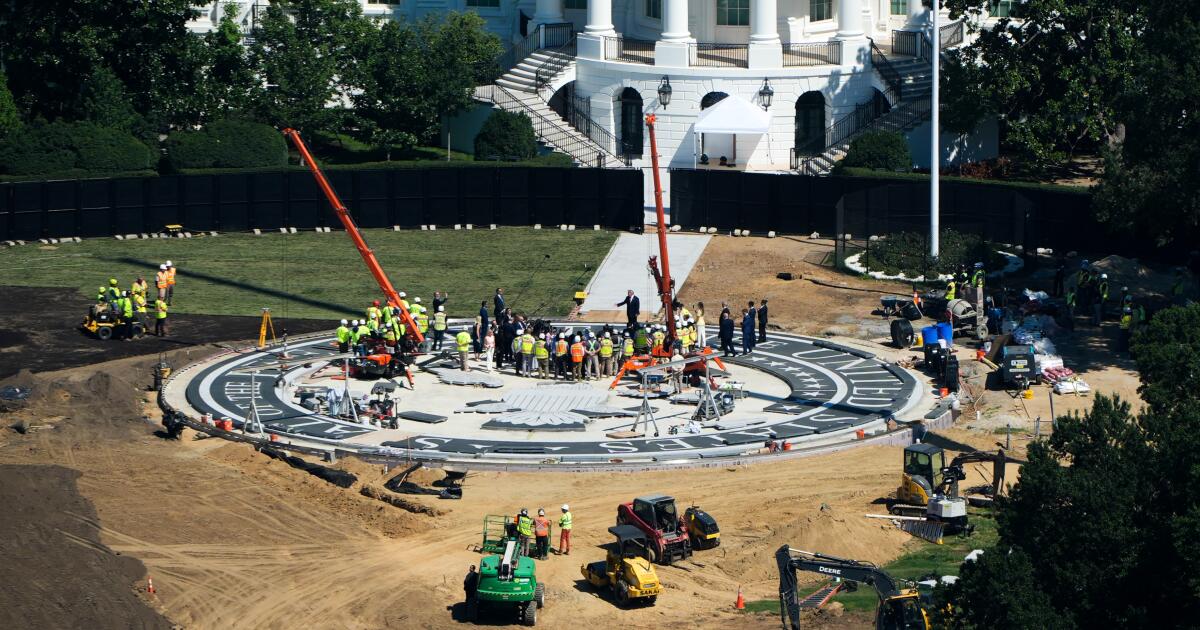
President Donald Trump has reportedly ordered contractors to rip up work on his planned White House South Lawn helipad and start over again. Nearly a month ago, Trump announced with great fanfare that he was building a granite helipad to protect the South Lawn from the intense exhaust heat and rotor wash generated by the new VH-92A Patriot helicopter that will shuttle him, the vice president, their families, and their closest advisors around, both at home and abroad. As we noted at the time, based on satellite imagery of the White House and from far closer to the ground, the helipad was already deep into construction. 

The $5 million to $6 million construction cost, Trump proclaimed in June, is being paid for by Sikorsky, the Lockheed Martin subsidiary that makes the VH-92A. It is unclear whether the company will be charged any additional costs or if the timeline for completion will change. We reached out to Lockheed Martin, Sikorsky, and Clark Construction, which is performing the work, for details. Lockheed Martin and Sikorsky referred us to the White House. Clark Construction did not immediately respond.

Photographs obtained by The Washington Post on Tuesday “show how contractors have taken apart their work, including a 100-foot-wide granite presidential seal that was beginning to take shape last week,” the paper pointed out. 

Trump ordered the helipad redo because he was “frustrated with its appearance and questioning whether the slope of the White House lawn needs to be changed,” the newspaper reported, citing two people who spoke on the condition of anonymity to discuss his private comments.

Construction crews have been working around-the-clock on the project in order to complete it before Chinese President Xi Jinping visits in late September, The Washington Post reported last month.  

Lettering spelling out "Seal of the President of the United States" is seen on the currently under construction helipad on the South Lawn of the White House in Washington, DC on July 30, 2026. The landing site aims to solve problems associated with the new fleet of presidential helicopters built by Sikorsky. (Photo by Kent Nishimura / AFP via Getty Images)
Lettering spelling out “Seal of the President of the United States” is seen on the helipad being built on the South Lawn of the White House in Washington, DC, on July 30, 2026. (Photo by Kent Nishimura / AFP) KENT NISHIMURA

A major issue is that the White House’s South Lawn, where the helipad is being built, “slants downward,” the newspaper explained. “Trump has expressed a desire for a landing pad that sits level with the horizon, prompting contractors to disassemble their work and consider whether to start by changing the lawn itself, the people said.”

Federal recommendations state that helipads should be flat for safety but do not need to be perfectly horizontal, to ensure water runoff. 

“The South Lawn, used for decades by helicopters that transport the president, slopes downward about 20 degrees in some places, the White House has previously said,” according to the Post. “That exceeds the recommended slant for helipads. The area chosen for the new helipad is flatter than other places.”

WASHINGTON, DC - JULY 2: Construction continues on a new helipad on the South Lawn of the White House to accommodate new Sikorsky VH-92A Patriot helicopters that will be used as Marine One on July 2, 2026 in Washington, DC. (Photo by Kevin Carter/Getty Images)
Construction continues on a new helipad on the South Lawn of the White House to accommodate new Sikorsky VH-92A Patriot helicopters that will be used as Marine One on July 2, 2026 in Washington, DC. (Photo by Kevin Carter/Getty Images) Kevin Carter

“For years, the White House has desperately needed a proper helipad on White House grounds that will allow the President to land safely and also protect the beautiful South Lawn grass from the fierce exhaust fumes of the incredible Marine One,” White House spokesman Davis Ingle told us. “Thanks to President Trump, the White House has never looked better, and it will only continue to get better under his leadership.” 

“We continue to make improvements and adjust accordingly as part of the ongoing project to best match the needs of the White House,” a White House official added, speaking on condition of anonymity to discuss the matter.

As we noted earlier in this story, the whole project now being fixed was in itself a fix for a long-standing problem.

“For 50 years we’ve been landing helicopters on grass,” Trump told reporters at the White House in June while announcing the helipad construction. “The grass is wet, soggy, and our other Marine Ones are about 40 years old.”

Aging VH-3Ds currently used for the mission are set to be retired completely sometime this year. However, the Marines expect to keep flying their VH-60Ns through at least 2030 because of their particular ability to operate in hot and/or high-altitude environments. 

The U.S. Marine Corps’ VH-3D helicopter, known as Marine One when the president is aboard. (NAVAIR photo)

The VH-92As “are about two and a half times more powerful than the old ones,” the American leader explained. “And when you land on the grass, it’s not that the grass gets discolored, it gets ripped out.”

The problems of downforce and heat generation, as we reported on for years, led to delays in the operational deployment of the VH-92A.

“This was a little bit of a planning mistake,” Trump explained. “So they landed the helicopter, and half of the grass was sitting in front of the Oval Office front door. The rest, it was scattered all over.”

The grass was also singed, Trump added.

“Everybody said, ‘well, we’ll keep using the old helicopters when we have to land at the White House, and for everything else we use the new helicopters.’ That’s a pretty expensive deal, you wouldn’t do that for your company.” 

Marine Helicopter Squadron One (HMX-1) runs test flights of the new VH-92A over the South Lawn of the White House on Sept. 22, 2018. (U.S. Marine Corps photo by Sgt. Hunter Helis) Marine Helicopter Squadron One (HMX-1) runs test flights of the new VH-92A over the south lawn of the White House in 2018. (U.S. Marine Corps photo by Sgt. Hunter Helis)

Upon learning that Sikorsky was footing the bill, Trump said he decided to go for granite.

“Let’s do a beauty, let’s not just do a piece of concrete and paint it white,” he proclaimed. “This one is a beauty. It’s got the seal of the White House, it’s beautiful, the eagle, and it’s carved out of granite stone by some of the most talented people you’ll ever meet. And you’re landing on granite, which is the strongest stone that we can like.”

Trump suggested that when the helipad isn’t being used for Marine One, it can be used for events or even press conferences. The president also stated that once the helipad is finished, “we’ll be able to finally retire 45-year-old helicopters.”

The helipad work isn’t the only construction project taking place on the White House grounds. Trump has also ordered the construction of a new fortress-like ballroom, which you can read more about here, among many other smaller projects.

WASHINGTON, DC - JULY 30: Construction continues on a new helipad on the South Lawn of the White House and the East Wing ballroom on July 30, 2026 in Washington, DC. (Photo by Kevin Carter/Getty Images)
Construction continues on a new helipad on the South Lawn of the White House and the East Wing ballroom on July 30, 2026 in Washington, DC. (Photo by Kevin Carter/Getty Images) Kevin Carter

In the meantime, Trump is using the Ellipse — a park south of the White House — as a temporary landing zone for Marine One.

Trump takes off in Marine One from the Ellipse as White House helipad construction continues thumbnail

Trump takes off in Marine One from the Ellipse as White House helipad construction continues


He did so again today as he flew to Joint Base Andrews, before departing for the West Coast, first for a fundraising event for the RNC in Los Angeles, and then to Nevada for an event to be held tomorrow, where he is expected to deliver remarks on the economy. 

How much longer this workaround will be needed isn’t clear. However, having to redo work on the White House helipad could mean that the first ‘White Top’ helicopter to land there will be pushed farther to the right of whatever timeline the White House had in mind.

Contact the author: howard@twz.com

Howard is a Senior Staff Writer for TWZ. He writes frequently about conflict, focusing heavily on the Middle East and Ukraine, and interviews with military and intelligence officials and industry leaders from around the globe. He lives near Tampa, Florida, home of U.S. Central Command, U.S. Special Operations Command.


Source link

VH-92 Patriot Getting Granite White House Helipad Will Finally Allow VH-3D Sea King To Retire

In the future, the iconic image of the commander-in-chief strolling through the grass of the White House South Lawn onto the Marine One helicopter will be a faded memory. President Donald Trump today said he had ordered a granite helipad be built on the South Lawn to protect it from the intense exhaust heat and rotor wash generated by the new VH-92A Patriot helicopter that will shuttle him, the vice president, their families, and their closest advisors, around, both at home and abroad. Based on imagery of the White House from satellite and far close to the ground, the helipad is already deeply under construction.

The helipad, he added, will be paid for by Sikorsky, the Lockheed Martin subsidiary that makes the VH-92A. The Wall Street Journal was the first to report that the White House building a helipad on the South Lawn.

WASHINGTON, D.C. - June 30: Construction at the future site of a helipad on the South Lawn of the White House on Tuesday, June 30, 2026 in Washington, D.C. (Photo by Al Drago/For The Washington Post via Getty Images)
Construction at the future site of a helipad on the South Lawn of the White House on Tuesday, June 30, 2026 in Washington, D.C. (Photo by Al Drago/For The Washington Post via Getty Images) The Washington Post

“For 50 years we’ve been landing helicopters on grass,” Trump told reporters at the White House today. “The grass is wet, soggy, and our other Marine Ones are about 40 years old.”

Aging VH-3Ds currently used for the mission are set to be retired completely sometime this year. However, the Marines expect to keep flying their VH-60Ns through at least 2030 because of their particular ability to operate in hot and/or high-altitude environments. 

The VH-92As “are about two and a half times more powerful than the old ones,” the American leader explained. “And when you land on the grass, it’s not that the grass gets discolored, it gets ripped out.”

Marine Helicopter Squadron One (HMX-1) runs test flights of the new VH-92A over the south lawn of the White House on Sept. 22, 2018, Washington D.C. (U.S. Marine Corps photo by Sgt. Hunter Helis)
Marine Helicopter Squadron One (HMX-1) runs test flights of the new VH-92A over the South Lawn of the White House on Sept. 22, 2018, Washington, D.C. (U.S. Marine Corps photo by Sgt. Hunter Helis) Sgt. Hunter Helis

The problem, as we reported on for years, led to a delays in the operational deployment of the VH-92A.

“This was a little bit of a planning mistake,” Trump explained. “So they landed the helicopter, and half of the grass was sitting in front of the Oval Office front door. The rest, it was scattered all over.”

The grass was also singed, Trump added.

“Everybody said, ‘well, we’ll keep using the old helicopters when we have to land at the White House, and for everything else we use the new helicopters.’ That’s a pretty expensive deal, you wouldn’t do that for your company.” 

Trump proffered that Sikorsky, who makes the new VH-92, is going to pick up estimated $5 million to $6 million construction costs.

“You know why?” Trump exclaimed, answering his own question. “Because they didn’t tell us how powerful these helicopters were, and they felt a little bit guilty.”

It isn’t clear how the same issue will impact how the VH-92s will be used when flying abroad, as using large fields as landing zones is not uncommon for such trips.

Trump didn’t offer a timeline for this project or name the company doing the construction work. Lockheed confirmed ⁠the contribution range shared by Trump.

“This specific contribution was made to the Trust for the National Mall, the National Park Service’s non-profit organization,” a ​Lockheed Martin spokesperson ​said in ⁠a statement.

“Our engagement with the federal government is guided by rigorous ethics and compliance standards and ​conducted in full accordance with all applicable laws ​and regulations.”

The “VH‑92A Patriot is a recognizable patriotic asset known around the globe for safety, security and reliability,” a Sikorsky spokesperson said. “It brings increased capabilities for the no‑fail mission supporting the Commander‑in‑Chief around the world. The helicopter delivers increased performance and reduced maintenance costs and time over the current fleet of presidential helicopters.”

Marine Helicopter Squadron One (HMX-1) runs test flights of the new VH-92A over the south lawn of the White House on Sept. 22, 2018, Washington D.C. (U.S. Marine Corps photo by Sgt. Hunter Helis)
Marine Helicopter Squadron One (HMX-1) runs test flights of the new VH-92A over the south lawn of the White House on Sept. 22, 2018, Washington, D.C. (U.S. Marine Corps photo by Sgt. Hunter Helis) Sgt. Hunter Helis

It’s worth noting that Trump has been a corporate customer of Sikorsky helicopters for decades and has lauded their capabilities and reliability, having multiple S-76s in his corporate fleet.

Upon learning that Sikorsky was footing the bill, Trump said he decided to go for granite.

“Let’s do a beauty, let’s not just do a piece of concrete and paint it white,” he proclaimed. “This one is a beauty. It’s got the seal of the White House, it’s beautiful, the eagle, and it’s carved out of granite stone by some of the most talented people you’ll ever meet. And you’re landing on granite, which is the strongest stone that we can like.”

Trump suggested that when the helipad isn’t being used for Marine One, it can be used for events or even press conferences. The president also stated that once the helipad is finished, “we’ll be able to finally retire 45-year-old helicopters.”

A U.S. Marine stands at ease next to a VH-60N Whitehawk executive transport helicopter as Air Force One lands at Buckley Air Force Base, Colo., April 24, 2012. President Obama is visiting the University of Colorado at Boulder to talk to students about a looming spike in student loan interest rates.
A U.S. Marine stands at ease next to a VH-60N Whitehawk executive transport helicopter as Air Force One lands at Buckley Air Force Base, Colo., April 24, 2012. (Photo by Tech. Sgt. Wolfram Stumpf) Master Sgt. Wolfram Stumpf

The destruction of the White House lawn wasn’t the only issue delaying the use of the VH-92A as the only presidential helicopter. Communications systems problems were one of the hurdles these helicopters had overcome on its long road to reaching operational service, which was supposed to occur years ago.

Sikorsky, which won a $1.24 billion contract, delivered the 23rd and final VH-92A Patriot to the Marines on Aug. 19, 2024. That same day, then-President Joe Biden took the first presidential trip on one of those aircraft.

US President Joe Biden and First Lady Jill Biden step off of Marine One, the new model Sikorsky VH-92A, upon arrival at Soldier Field Landing zone in Chicago, Illinois, on August 19, 2024. President Biden is delivering the keynote address at the Democratic National Convention opening night. (Photo by Brendan SMIALOWSKI / AFP) (Photo by BRENDAN SMIALOWSKI/AFP via Getty Images)
U.S. President Joe Biden and First Lady Jill Biden step off of Marine One, the new model Sikorsky VH-92A, upon arrival at Soldier Field Landing zone in Chicago, Illinois, on August 19, 2024. (Photo by Brendan SMIALOWSKI / AFP) BRENDAN SMIALOWSKI

The U.S. Marine Corps achieved Initial Operational Capability (IOC) for the VH-92A in December 2021, and HMX-1 commenced operational missions with the new aircraft in 2022.

U.S. Marine Corps VH-92A know as Marine One helicopter flying over Washington DC. Marine One is the call sign of any United States Marine Corps aircraft carrying the president of the United States part of the US presidential transport aircraft fleet. Marine Helicopter Squadron One HMX-1 Nighthawks operate the Sikorsky Lockheed Martin VH-92A Patriot, a militarized variant of the Sikorsky S-92. Washington DC, United States of America on November 8, 2024 (Photo by Nicolas Economou/NurPhoto via Getty Images)
U.S. Marine Corps VH-92A flying over Washington, D.C. (Photo by Nicolas Economou/NurPhoto via Getty Images) NurPhoto

Trump’s helipad declaration comes as he is already turning the former East Wing into a new ballroom/military center. It should be noted that while Trump initially said the project would cost $400 million and be paid for by private donors, the administration wound up seeking a billion dollars in new funding from Congress for the U.S. Secret Service. Of that money, $220 million would go toward the facility, while the rest would go to other efforts to enhance security around the complex. The spending plan is now caught up in a legal battle.

In our story about that project, we raised the question about whether Trump would use the roof of that building as a new helipad.

From that story: “Not long after the East Wing was torn down, we inquired with the White House if the ballroom’s roof would work as a helipad for Marine One. This inquiry was spurred by the chronic landing area issues with the new VH-92A Marine One helicopters. We never got a response, but the news hit this weekthat the White House is now looking to build a helicopter landing pad due to this issue. It isn’t perfectly clear if the ballroom could serve in this role or at least be used as an alternative landing site.

WASHINGTON, DC - MAY 19: U.S. President Donald Trump speaks to the media alongside posters of his proposed White House ballroom amid construction at the White House on May 19, 2026 in Washington, DC. The Senate parliamentarian ruled this week that taxpayer funds in the budget reconciliation package cannot be used for a $1 billion provision intended to fund security for Trump’s White House ballroom. (Photo by Chip Somodevilla/Getty Images)
U.S. President Donald Trump speaks to the media alongside posters of his proposed White House ballroom amid construction at the White House on May 19, 2026 in Washington, D.C. (Photo by Chip Somodevilla/Getty Images) Chip Somodevilla

It’s also worth noting that the manicured grass where the helipad is going was already damaged by the temporarily set up for UFC fight on Trump’s 80th birthday, so the timing for the helipad install does make sense.

WASHINGTON, DC - JUNE 14: Guests, including members of the U.S. military, attend the Ultimate Fighting Championship (UFC) Freedom 250 mixed martial arts event under the open-air "Claw" on the South Lawn of the White House on June 14, 2026 in Washington, DC. On his 80th birthday, President Donald Trump hosted a series of seven mixed martial arts fights on the South Lawn, which the White House is calling "a once-in-a-generation celebration of the American fighting spirit." (Photo by Chip Somodevilla/Getty Images)
Guests, including members of the U.S. military, attend the Ultimate Fighting Championship (UFC) Freedom 250 mixed martial arts event under the open-air “Claw” on the South Lawn of the White House on June 14, 2026 in Washington, DC. (Photo by Chip Somodevilla/Getty Images) Chip Somodevilla

We don’t know exactly when the new granite helipad will come online, but it will likely be this summer. And while it is yet be another way Trump has put his mark on the White House grounds, above all else, it will finally usher in the VH-92 as the primary Marine One helicopter and will allow the long-serving VH-3D Sea Kings to fly off into retirement once and for all.

Contact the author: howard@twz.com

Howard is a Senior Staff Writer for TWZ. He writes frequently about conflict, focusing heavily on the Middle East and Ukraine, and interviews with military and intelligence officials and industry leaders from around the globe. He lives near Tampa, Florida, home of U.S. Central Command, U.S. Special Operations Command.


Source link