Heights

I explored the gothic English region where Wuthering Heights was filmed with cosy pubs and scenic train rides

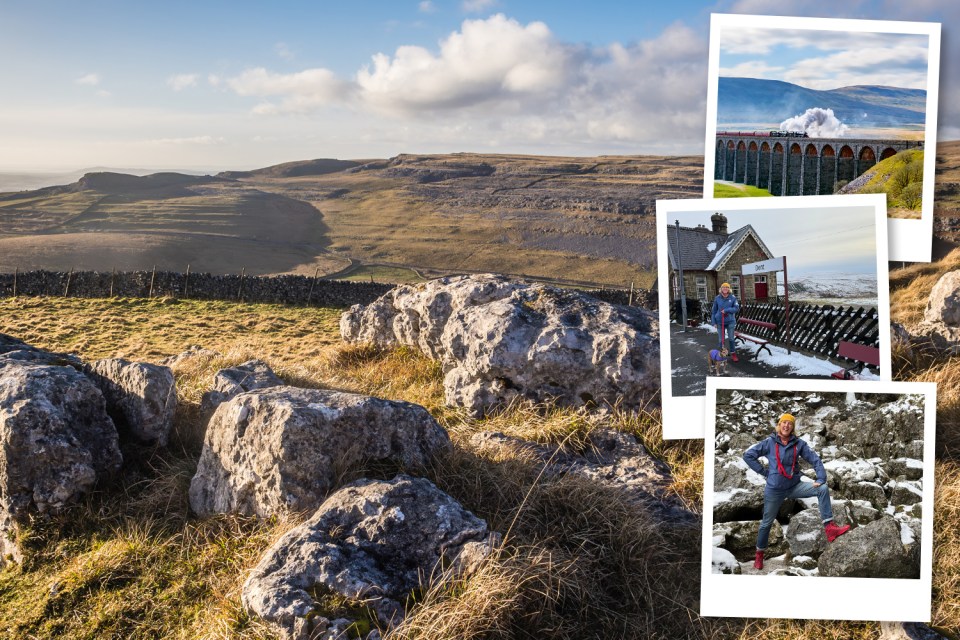
Collage of four photos depicting Yorkshire: a rocky landscape, a steam train on a viaduct, a person and a dog at Dent Station, and a person standing on snow-covered rocks.

EY up . . .  Heathcliff is not the only mysterious, brooding beast in Yorkshire.

The scenery provides just as much drama as the Wuthering Heights character.

The stunning limestone hills in the DalesCredit: Getty
The Sun’s Tracey Davies on a hikeCredit: Tracey Davies

With the recent film adaptation of Emily Bronte’s novel — starring ­Margot Robbie and Jacob Elordithe Yorkshire Dales is once again teeming with yearning Cathys and brooding young Heathcliffs.

And there I was too, like a budget Cathy, if she wore Gore-Tex and hiking boots rather than a generous bustle.

Largely shot on location in the Yorkshire Dales National Park — amid the landcapes of Swaledale and Arkengarthdale valleys and the peaceful village of Low Row — the movie shines a well-deserved spotlight on this glorious corner of England.

With its scarred limestone hills, scattered with rocks, and rolling green pastures, criss-crossed with drystone walls and peppered with honeyed-stone villages, this region is the picture of a period drama.

I WOOD

I found the perfect woodland staycation for Center Parcs vibes without the price tag


WEEKEND AWAY?

Six staycation deals across UK from Cotswolds cottages to lakefront lodges

While the rain barely lets up in the movie, Yorkshire welcomes me with beautiful blue skies, sunshine and even a light dusting of snow on the hills.

I’m almost disappointed.

I’ve brought along my own Heathcliff, my partner Toby, and my dog, Miss Babs, who loves a good romp across the moors.

We’re staying in Settle, a cute little market town in the heart of Bronte Country near the southern entrance of the National Park.

After the long journey, we hunker down with the first of many pints of local Thwaites ale in The Golden Lion – a coaching inn in the centre of town and our base for the weekend.

Rooms are cosy and comfy with a modern country feel.

Tracey at Dent, the highest railway station in EnglandCredit: Tracey Davies

Settle is a popular base for walkers.

Nearby is Ribblesdale, probably the best known walking area in the Yorkshire Dales National Park, not least for those conquering the Yorkshire Three Peaks — Whernside, Ingleborough and Pen-y-ghent.

As keen but fair-weather walkers, we opt for an easy route along the River Ribble, which still offers some spectacular views across the Dales.

Unlike in the 18th century, there’s no need to ride a bumpy old stagecoach around these parts.

Settle is the starting point of England’s most scenic railway journey.

Celebrating its 150th anniversary this year, the Settle–Carlisle Railway soars over viaducts and through heather-filled moorlands.

The magnificent Ribblehead Viaduct, which has 24 archesCredit: Getty

There are numerous stops on the 72-mile route, including the magnificent Ribblehead Viaduct, which has 24 arches.

It’s a bargain at £4.60 for a single journey.

We stayed on until Dent, the highest railway station in England, and walked part of the Dales Way, which runs from Ilkley to Lake Windermere, stopping for a pint (OK, three) at the Sportsman Inn before wobbling back for the train.

Back at the The Golden Lion, it’s time for dinner.

Choices include fat steaks (from £18.50), beer-battered fish and chips (£18.50) and Settle pudding, a traditional suet pudding oozing with steak and ale, which Toby gazes at with the lustful look of Heathcliff.

On Sunday morning, the weather turns moody.

Margot Robbie and Jacob Elordi in Wuthering HeightsCredit: Alamy

After a hearty Yorkshire breakfast, we drive five miles to Malham, a fine village with several easy-to-access walks.

We take a muddy trudge up to Malham Cove – a natural limestone amphitheatre – and then to Gordale Scar, a towering limestone gorge with a gushing waterfall, which featured in Netflix drama, The Witcher.

Dark, damp and deliciously Gothic, it’s a fitting end to our Wuthering Heights weekend.

Source link

I stayed in rugged UK town where every day is like a scene from Wuthering Heights

This little town in Yorkshire is ideal for fans of Emily Bronte’s gothic story thanks to its wild and rugged surroundings, and nearby attractions that might just be haunted…

Sometimes, when a storm hits the UK, rain batters the pavements and wind whips the trees, it’s easy to feel swept up in the kind of awe-inspiring conditions that helped Emily Brontë to write her classic novel, Wuthering Heights.

There is a little town in Yorkshire, 100miles from Cathy and Heathcliff’s home, but steeped in as much Gothic drama, where every day feels like you’ve tumbled into such dark Victorian melodrama.

As I stepped aboard my coach bound for Whitby, I imagined a sleepy seaside town, much like those down south that slowly emerge as you drive along the road towards the sea. What I got was very different.

Just getting to Whitby was a beautiful journey. The town is nestled between the rugged expanse of the moors and the wild thrashing of the North Sea. In days gone by, travellers would only be able to access it if they hiked for miles along the hills and valleys of the North York Moors or braved the violent waves of the sea. Now, we have cars and trains, but both still take you over the moors.

READ MORE: Stunning Welsh beach named best in in UK and will stop you in your tracksREAD MORE: I travel the world because of my divorce – now I always pack the same 2 items

As my coach sped through the twists and turns of the roads across the moors, I was like a child, with my face pressed against the window. There wasn’t a soul for miles, just acres and acres of heather. Once in Whitby, when you hear the waves crash against the sea defences and feel the wind whistle past your ears, it’s easy to see how someone might think a faint voice calling for Heathcliff was coming over their shoulder.

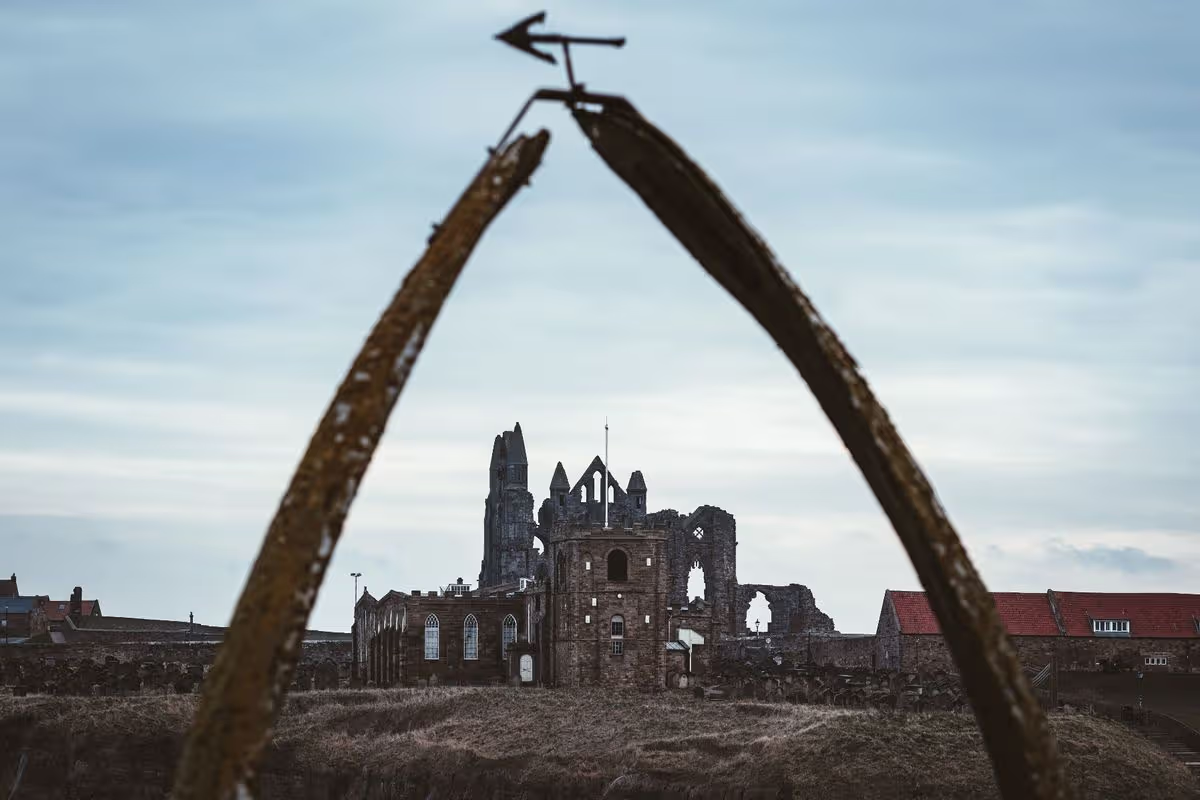
The town itself is split into two halves. The newer section was built following the Second World War, but much of the town is older and filled with Georgian terraces. Even older is Whitby Abbey, whose ruins stand proudly at the top of a cliff and have inspired many a tale, including Bram Stoker’s Dracula.

If you walk along the coast from the nearby villages of Saltmoore and Sandsend, the gothic ruins stay within your sightline. Lucky hikers will get to see the sea fog – which locals used to believe was the fiery breath of a dragon – come in to cover the abbey. You’ll feel like you’re trekking the same paths Heathcliff did as he searched for Catherine’s ghost, not least because Emerald Fennell’s new film was shot about two hours away, in the Yorkshire Dales.

The most remarkable sight comes when you walk back towards Whitby, as when the fog clears, the Abbey can be seen looming through a gap between the cliffs. It’s terrifying and awe-inspiring all at once. I felt drawn towards the ruins, much as Cathy is drawn to Heathcliff or as an entranced Lucy is drawn to Dracula. How could anyone resist such a terrible sight?

Indeed, not Whitby residents of years gone by. Whitby Storyteller, Rose Rylands, who tells of the myths of the moors. When Rose spoke about the ghostly figures said to appear on the hilltops, goosebumps pebbled my skin, as if I was walking with them myself.

The tale of Bram’s inspiration in Whitby was similarly haunting. During a holiday, the author stayed on the West Cliff, offering views of the Abbey, which he felt suited the Gothic atmosphere of his story. One day, he turned to the local library to research a shipwreck, only to discover the name ‘Dracula’ in the records. Its meaning in the Wallachian language, Bram learned, is ‘devil’.

When Rose told us these tales, the winter’s night pressing against the hostel windows, my heart started to beat faster. I began to wonder if I, too, would soon be hallucinating the ghost of lost love calling to me.

Of course, Heathcliff’s hallucinations of Cathy’s ghost all happen at night, and there really is nowhere better to see the stars than the North York Moors. The national park is a designated International Dark Sky Reserve, one of only 25 in the world, protected from light pollution and able to provide clear horizons, clouds permitting. As someone who grew up in London and finds it hard to sleep without the orange glow of streetlights coming in through the curtains, just standing in complete darkness is a wonder. When the stars are visible, there are no words.

We went to Castle Howard, a stately home that has served as a filming location for Brideshead Revisited and Bridgerton, to see the stars. Except for the enormous house, there is nothing around for miles, leaving the sky unpolluted by light. Inside, the house is equally beautiful.

The entrance hall is a vast space whose domed ceiling has been painted with the most gorgeous fresco of cherubs – it’s similar to Michelangelo’s painting The Creation of Adam, which decorates the Sistine Chapel. The whole place feels like an art gallery, really. I couldn’t wrap my head around the fact that people actually live there, but they do. The family is very involved in ensuring the house and its heritage remain standing strong.

Flouncing around the house, through the rooms, and then eventually into the cold and dark night definitely made me feel like I was Cathy after she had married Edgar Linton. Castle Howard has all the opulence of Thrushcross Grange, and it was easy to slip into the role of the new wife enjoying her surroundings. Heading out to see the stars, with the house behind me, had my heart racing, as though I could really see Heathcliff across the moors at Wuthering Heights.

If you want to really live in the kind of luxury that the Earnshaws did (without the madness and rooms where the wallpaper is modelled after Margot Robbie’s skin), the Saltmoore Hotel and Spa is the place to go. Just slightly removed from the touristy bustle of Whitby, the hotel is extremely peaceful. My room was a huge and managed to fit in a double bed, a giant shower (with underfloor heating) and two incredibly comfortable armchairs where you can sit and you listen out for ghosts at the window.

Additionally, the staff couldn’t be more helpful. They even lend you wellies for a walk along the beach. Fingers crossed the next time I go, I’ll be better prepared. And best believe, I will be back. For costume drama fans, there really is nowhere better to be.

Book it

Rose can be booked for walking tours of Whitby via her website.

You can find out more on visitengland.com and visitnorthyorkshire.com. Rooms at the Saltmoore Hotel and Spa start from £311 a night, based on two adults sharing.

Rooms at Saltmoore Hotel and Spa start at £236.

Ensure our latest lifestyle and travel stories always appear at the top of your Google Search by making us a Preferred Source. Click here to activate or add us as your Preferred Source in your Google search settings.

Source link

‘Wuthering Heights:’ Emerald Fennell film vs. Emily Brontë novel

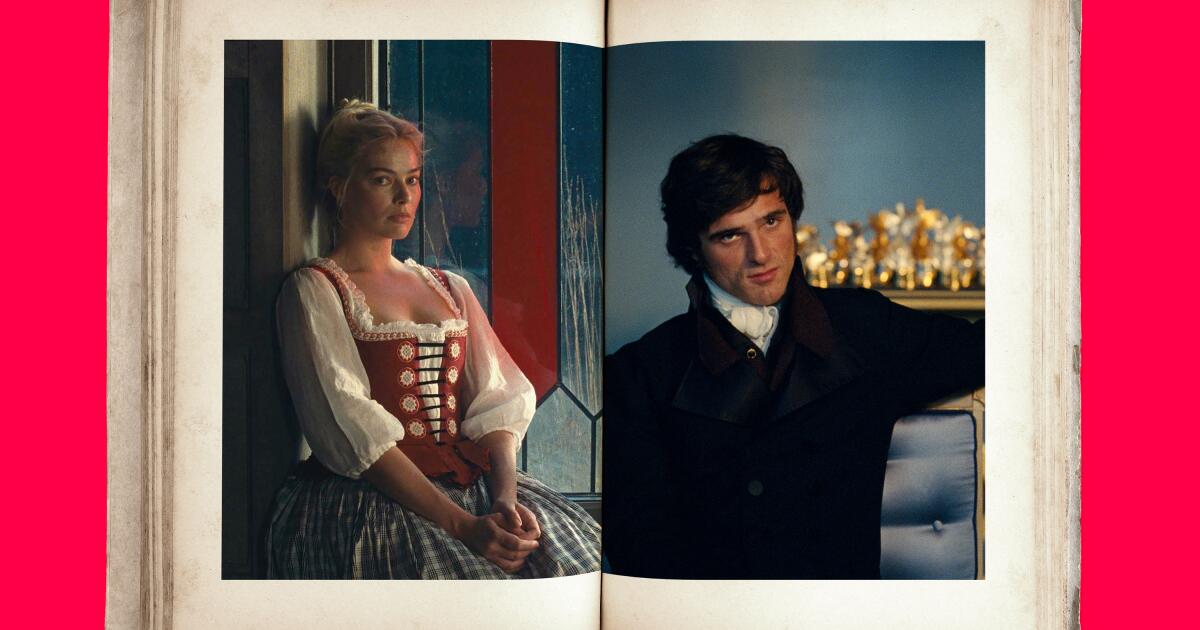
In its opening credits, Oscar-winning director Emerald Fennell’s “Wuthering Heights” self-identifies as “based on the novel by Emily Brontë.”

Yet as Fennell has proved in a slew of interviews about the already polemical film, released Friday, the relationship between Brontë’s Gothic epic and its latest adaptation is more complicated than that.

Penned by a young female author perpetually adrift in the dark world of fantasy, “Wuthering Heights” is a transgressive novel today and was exponentially more so at the time of its publication in 1847. Its protagonists are vengeful, and its romances — including Catherine Earnshaw (Cathy) and Heathcliff’s — are ridden with violence, both psychological and physical. While Fennell’s film anchors itself in Brontë’s narrative landscape, it also takes creative liberties in service of approximating the director’s personal experience reading it as a teen.

Whereas Brontë’s novel contains “mere glimmers of physical intimacy,” Fennell’s picture is erotic, laden with steamy scenes inserted from the director’s imagination.

“They’re part of the book of my head,” Fennell recently told The Times. “I think they’re part of the book of all of our heads.”

Some book purists beg to differ with Fennell’s interpretation. Well in advance of the film’s release, the director was criticized for casting her former “Saltburn” collaborator Jacob Elordi as Heathcliff, who is repeatedly described throughout Brontë’s novel as non-white. Brontë fans have also accused the director of reducing a complex work rife with social critique into a popcorn romance.

Perhaps anticipating such backlash, Fennell in a recent interview with Fandango explained her decision to enclose the film’s title in quotation marks, saying, “You can’t adapt a book as dense and complicated and difficult as this book.”

“I can’t say I’m making ‘Wuthering Heights.’ It’s not possible,” the director said. “What I can say is I’m making a version of it.”

Here are seven ways Fennell’s interpretation of “Wuthering Heights” differs from its source material.

Fennell’s Heathcliff is white

Brontë’s “Wuthering Heights” leaves Heathcliff’s racial identity ambiguous, with characters referring to him as a “gipsy brat,” “lascar” and “Spanish castaway” at different points throughout the novel. But one thing is clear: He is not white.

As the Lousiana State Unversity professor Elsie Michie writes in the academic journal article, “From Simianized Irish to Oriental Despots: Heathcliff, Rochester and Racial Difference,” Heathcliff’s racial othering is how “he becomes, for others, a locus of both fear and desire.” In other words, Heathcliff’s role in the novel, and thus his fraught romance with Cathy, is predicated upon his non-white identity.

Fennell’s film instead relies on class differences — and a meddling Nelly (to be discussed later) — to form the rift between its love interests.

Cathy’s brother dies young

When Mr. Earnshaw presents a young Cathy with her companion-to-be early in the film, she declares that she will name him Heathcliff, “after my dead brother.”

For the remainder of the film, Brontë’s character Hindley Earnshaw is subsumed into Mr. Earnshaw. Rather than Hindley, it is Mr. Earnshaw who devolves into the drunk gambling addict whose vices force him to cede Wuthering Heights to Heathcliff. Mr. Earnshaw’s abuse of young Heathcliff in the film makes the latter’s revenge plot more personal than his book counterpart’s against Hindley.

Cathy meets Edgar Linton as an adult

In Brontë’s novel, Cathy and Heathcliff first encounter their neighbors, the Lintons, after an outdoor escapade gone awry. Cathy gets bitten in the ankle by an aggressive dog and stays at the Lintons’ for a few weeks to heal.

Cathy sustains a similar injury in the film, but this time, she’s an adult woman, who falls from the Thrushcross Grange garden wall after attempting to spy on its grown residents Edgar and Isabella. (In the book, the two are siblings. Here, Isabella is referred to as Edgar’s “ward.”)

Aside from providing some comic relief, Fennell’s revision also fast-tracks the marriage plot that severs Cathy and Heathcliff.

Nelly is a meddler, and a spiteful one

Whereas Brontë writes Nelly as a largely passive narrator, Fennell abandons the frame narrative structure altogether and instead fashions the housekeeper into a complex character with significant control over Cathy’s life.

It is she who ensures Heathcliff overhears Cathy as she laments how marrying him would degrade her, causing him to flee Wuthering Heights and leave Cathy to marry Edgar. Nelly’s ploy comes shortly after Cathy demeans the housekeeper, claiming that she wouldn’t understand Cathy’s predicament given she’s never loved anyone, and no one has ever loved her. Thus, Nelly is characterized as vengeful toward Cathy — although, as the latter lies in her death bed, the two share a brief moment that complicates their relationship to each other.

Regardless, Fennell gives Nelly and Cathy’s relationship psychological depth that Brontë’s novel doesn’t seem to afford them.

Cathy and Heathcliff have sex (and a lot of it)

Brontë’s Cathy and Heathcliff never explicitly (in the text) consummate their professed undying love, save for a few kisses just before Cathy breathes her last.

Fennell’s “Wuthering Heights,” on the other hand, grants them an entire Bridgerton-style sex montage — they even get hot and heavy in a carriage. It’s nearly impossible to keep count of the “I love you”s exchanged during the pair’s rendezvous.

These smutty sequences certainly validate the Valentine’s Eve release.

Isabella is a willing submissive

One particular still of Alison Oliver’s Isabella is already making the rounds online, and for good reason. The shot, which depicts the young woman engaging in BDSM-style puppy play, is a stark contrast to Brontë’s characterization of Isabella as a victim of domestic violence.

In Brontë’s book, Isabella marries Heathcliff naively believing he might shape up into a gentleman and flees with their son when she realizes that is out of the question. In the film, Heathcliff is clear from their first romantic encounter that he does not love Isabella, will never love her and pursues her only to torture Cathy — and the young woman still chooses to be with him.

There is no second generation

Perhaps Fennell’s most glaring diversion from her source material is her complete omission of the second half of Brontë’s novel, which centers on a second generation comprised of Cathy and Edgar’s daughter Catherine Linton, Heathcliff and Isabella’s son Linton Heathcliff and Hindley and his wife Frances’ son Hareton Earnshaw.

In her introduction to the Penguin Classics edition of “Wuthering Heights,” Brontë scholar Pauline Nestor writes that many literary critics interpret the novel’s latter half as “signifying the restoration of order and balance in the second generation after the excesses and disruption of the first generation,” while others contend the violence that stains Cathy and Heathcliff’s relationship is bound to be replicated by their children. Either way, the structure of Brontë’s novel encourages readers to interpret each half through the lens of the other.

Fennell’s film instead ends where Brontë’s first act closes, hyper-focused on Cathy and Heathcliff. In the same way the doomed lovers see each other, Fennell figures them as the center of the world.


Source link