
heatwaves

Europe’s Heatwaves Expose Overcrowding Crisis in Ageing Prisons

Extreme Heat Intensifies Europe’s Prison Crisis

As record breaking heatwaves continue to sweep across Europe, prisons in France, Italy and Belgium are facing mounting pressure from overcrowding, ageing infrastructure and inadequate cooling systems, exposing what prison officials, inmates and rights groups describe as a growing humanitarian challenge.

With temperatures exceeding 37 degrees Celsius in many areas this summer, inmates and prison staff say prolonged heat has turned already overcrowded facilities into dangerous living conditions, prompting renewed calls for prison reforms and infrastructure upgrades.

Reuters spoke to more than 40 inmates, prison officials, doctors, lawyers, union representatives and activists across the three countries, many of whom said this summer’s extreme temperatures have highlighted longstanding structural weaknesses within Europe’s prison systems.

French Inmates Describe Dangerous Living Conditions

At Orleans Saran prison in central France, 29 year old inmate Manu said surviving the heat required constant improvisation. He placed wet towels over his barred window to cool his cell and spent most of the day lying still to conserve energy.

Stay ahead of the geopolitical week.

MD Briefing delivers expert analysis across five global fronts — the Indo-Pacific, energy, geoeconomics, European security, and the Middle East — every Monday morning. Free.

“You have to deal with it mentally,” he said.

France’s Chief Prison Inspector Dominique Simonnot said her office received an unprecedented number of complaints during the June heatwave, forcing it to recruit additional staff to handle the surge.

She described conditions in many prisons as unbearable, noting that three or four inmates are often confined inside nine square metre cells in ageing buildings without air conditioning.

One inmate at Limoges prison reportedly lost consciousness during the heat and suffered a head injury. While his lawyer attributed the incident to heat exhaustion, prison union representatives said he slipped while trying to reach a window for fresh air. Reuters could not independently verify either account.

French authorities said prisons increased access to drinking water, showers, sun cream and allowed inmates to purchase electric fans where possible.

Justice Ministry spokesperson Sacha Straub Kahn acknowledged that overcrowding remains a major obstacle to protecting prisoners during extreme weather.

Overcrowding Reaches Critical Levels

Government and prison monitoring data show prison occupancy has reached alarming levels across several European countries.

France recorded an average prison occupancy rate of 141.3 percent in July.

Italy’s prisons were operating at approximately 139.7 percent capacity, according to prison rights organisation Antigone.

Belgium reported an occupancy rate of 121 percent in August.

Experts warn that overcrowding significantly increases heat exposure by placing multiple inmates into small, poorly ventilated cells originally designed for far fewer people.

Italy Introduces Emergency Measures

Italian prison rights organisations staged coordinated visits to 34 prisons in July to highlight deteriorating conditions during the heatwave.

Antigone President Patrizio Gonnella criticised the lack of basic cooling facilities, arguing that inmates spending up to twenty hours each day inside their cells face increasingly unsafe conditions.

Italy’s Justice Ministry allocated 800,000 euros for prisons to purchase fans and refrigerators and pledged to create an additional 10,000 prison places before the end of the year.

However, official data show no new prison spaces have yet been completed.

Separately, Italy passed legislation allowing thousands of prisoners with drug or alcohol addiction to serve sentences under supervised rehabilitation programmes at home, aiming to reduce overcrowding.

Authorities also agreed to remove perspex window barriers from prisons in Cosenza after concerns that they restricted ventilation.

Belgian Prisons Report Rising Violence

Belgian prison officials say prolonged heat has increased tensions among inmates and staff.

At Ghent prison, Director Pieter Van Caeneghem said the facility currently houses 447 inmates despite having space for only 260.

He warned that every challenge associated with overcrowding becomes significantly worse during extreme heat.

At Merksplas prison, Director Serge Rooman said officials began relaxing certain security procedures several years ago by keeping windows open overnight and opening prison doors to improve airflow during heatwaves.

Those temporary measures have since become part of official prison guidance.

Rooman argued that the greatest problem remains outdated prison infrastructure, including poor ventilation and single glazed windows.

Governments Expand Heatwave Response

Authorities across Europe have introduced temporary measures to reduce health risks inside prisons.

France has expanded access to drinking water, showers and sun protection.

Belgium instructed prison directors to continue heat response measures into September, including increased water supplies and more frequent shower access.

Italy has focused on purchasing cooling equipment while pursuing legislative reforms aimed at easing prison overcrowding.

Despite these measures, prison officials and rights groups argue that temporary responses cannot resolve deeper structural problems affecting Europe’s correctional systems.

Europe’s prison systems are becoming another visible casualty of climate change, where rising temperatures are exposing decades of underinvestment in public infrastructure. Heatwaves have not created the prison crisis but have amplified existing problems such as overcrowding, ageing facilities and inadequate ventilation. While governments have responded with temporary measures including fans, additional showers and water supplies, these interventions do little to address the structural deficiencies that leave thousands of inmates vulnerable during periods of extreme heat. As climate driven weather events become more frequent, European governments may face growing legal, humanitarian and political pressure to modernise prison infrastructure while tackling chronic overcrowding that continues to undermine both inmate welfare and prison security.

With information from Reuters.

Source link

‘I ditched my dream Italy holiday for a ‘coolcation’ – UK heatwaves changed me’

EXCLUSIVE: Not wanting to risk the blazing temperatures of Sardinia, a heatwave fatigued mum wapped her dreamy Italian holiday for a milder ‘coolcation’, and has no regrets

A mum of one has shared how she swapped Mediterranean sun for a ‘coolcation’ and why she’ll do it all over again next year.

Monica Krenner and her husband, Peter, were on the brink of booking flights to Sardinia, Italy, on what was to be their young son Lewis’s very first holiday.

However, as the blistering heat took hold, the concerned parents didn’t fancy braving the 39-degree scorcher with a three-year-old, and so had a last-minute change of heart. The fatigue of parenting during the relentless London heatwaves this summer meant she couldn’t face more sweltering temps abroad.

Monica, 57, tells the Mirror: “It was the best decision we made.” Instead of dashing to the airport, the family made the five-and-a-half-hour journey from London to St Ives, Cornwall, back in June, where the relatively mild temperatures of between 16 and 24 degrees felt much more appealing.

Explaining how she came to the decision, nutritionist Monica says that after speaking with a few friends, as well as some clients from Sardinia, she began to worry about just how hot the famously beautiful Italian island would get.

“After talking with a lot of people, searching all the weather apps, I then said, ‘I cannot imagine going there, because then we have to be indoors the whole day, because it will be too hot to go outside’.

“And for the little one, the skin is very sensitive still. He’s also not an amazing sleeper yet. Then I thought, ‘Oh my God, if it’s then hot on top because the weather, and he’s not sleeping great, I’m already tired when I’m getting there, it won’t be better when we stay somewhere where it’s too hot this summer’.”

Once in Cornwall, Monica, Peter and Lewis were able to sleep comfortably at night after spending their waking hours walking in the fresh air and exploring the breathtaking Cornish coastline.

It was little Lewis’s very first time at the beach, and although Monica joked that “the seagulls didn’t make it easy”, it proved to be a very special, memorable trip.

Monica, who is originally from Vienna, Austria, says: “It was just relaxed, and in the evening, there was a nice breeze in your face. It felt like you could really breathe properly.

“We had a few drizzles, but even that was perfect. We had a very nice spacious room, so even if we didn’t want to rush out, we could stay inside and have the windows open looking at the ocean. It was just lovely.”

Monica says that the trip “completely changed” how the family now consider their summer holidays. Going forward, they’re far more interested in exploring a different options, “rather than chasing guaranteed sunshine.”

Next year, the family intend to head off on another ‘coolcation’, and they are already planning their adventures. Currently, Monica and Peter are eyeing up trips to the coast of Denmark or Sweden, while bonny Scotland is also a top contender.

And the couple aren’t the only ones looking for a crisp getaway. During the late June heatwave, Brits searches for cool-weather city breaks surged by as much as 33 percent compared to the previous week, according to online agent Opodo. Stockholm, Geneva and Gothenburg were the most coveted spots – world’s away from sunny Spain or Italy.

With four heatwaves in the UK already this summer, many holidaymakers are longing for gentle breezes rather than piercing sunbeams. So could it be that ‘coolcations’ are the new luxury in our climate change age?

Ahead of the fast-approaching August Bank Holiday weekend, Airbnb has revealed that a number of UK destinations are seeing a surge in interest this summer, with bookings in Scarborough up by 30 per cent.

Picturesque Dumfries and Galloway in Scotland, which has seen bookings soar by 29 per cent, has emerged as one of this year’s top ‘coolcation’ destinations, offering refreshing sea breezes and shady forest walks.

As for Monica, she’s noticed this trend within her own social circles and reckons it makes perfect sense, especially for parents of young children looking for an easier trip.

She explains: “People are looking for some cooler areas where they can breathe and enjoy being outside, not to cover up with 10,000 creams, and also with the little ones, not to cause them any sunburn.”

The term sunny escape has taken on a whole different meaning in recent times. Awaze, the European holiday rental brand behind cottages.com and Hoseasons, found that searches for “escape the heat” rose by 300 per cent over the last three months alone. Online searches for ‘coolcations’, they say, were up by 420 per cent.

Matthew Price, Awaze’s chief executive, notes that rising temperatures are “creating a new category of holidays”, adding that they are “increasingly seeing holidaymakers look further afield to destinations known for their cooler climate, such as Scotland, Yorkshire and the northwest of England”.

Heti Morus, Marketing Executive at StayCotswold has also picked up on this trend, telling the Mirror: “It’s no wonder ‘coolcations’ are growing in popularity here in the UK. I recently flew back from Bordeaux and saw the wildfires firsthand from the air.

“It just showed how quickly these situations can escalate, and it’s made me think twice about flying to that part of France again anytime soon. Cooler staycation destinations are certainly looking even more appealing this year.”

Do you have a story to share? Email me at julia.banim@reachplc.com
Source link

Dangerous summers: How heatwaves and wildfires change life across Europe | Weather

Europe’s summers are transforming. What were once considered exceptionally high temperatures, such as the near 40 degrees Celsius (104 degrees Fahrenheit) being experienced in Prague, are becoming the norm.

According to Europe’s Copernicus Climate Change Service, late May and June heatwaves brought daily average temperatures of more than 10C (18F) above the norm in parts of France, the United Kingdom and Spain.

Recommended Stories

list of 4 itemsend of list

Western European temperatures averaged 20.74C (69F) in June, 3.06C (5.4F) above the 1991-2020 average.

With some temperatures climbing well above 40C, prolonged droughts, destructive wildfires and shrinking rivers are no longer freak events but recurring features of European summers.

Scientists have repeatedly warned that climate change would increase the frequency and intensity of extreme weather. Heatwaves now last longer, arrive earlier and affect more countries simultaneously.

The consequences extend beyond uncomfortable temperatures. They are reshaping ecosystems, economies and daily life across much of the continent.

Wildfires: Larger, earlier and more destructive

Extreme heat dries vegetation, turning forests, scrubland and grass into fuel for fires. When strong winds combine with prolonged drought, fires can spread more rapidly and become ever more difficult to control.

Countries across the Mediterranean area – including Spain, Portugal, Greece, Italy and France – have a history of wildfires. But fire season now starts earlier, lasts longer, and affects regions that in the past faced a much lower risk.

The European Union recorded at least 1 million hectares (2.5 million acres) of land burned in the region last year, nearly double the historical average.

Some fires are so intense they generate their own weather systems. Known as pyrocumulonimbus clouds, these towering smoke clouds can produce powerful winds, lightning and embers that ignite new fires several kilometres away, making them even harder to contain.

Beyond the immediate destruction of homes and forests, wildfires damage biodiversity, release dangerous quantities of carbon dioxide and leave landscapes vulnerable to erosion and flooding when heavy rain eventually returns.


Water under pressure

Heatwaves also place enormous strain on Europe’s water resources. Higher temperatures increase evaporation from rivers, lakes and reservoirs while reducing soil moisture. Mountain snowpacks melt earlier in spring, leaving less water available during the hottest months.

Rivers such as the Rhine, Po and Danube have repeatedly experienced unusually low water levels during recent summers. Low rivers disrupt shipping, reduce hydroelectric power generation and can threaten industrial operations that rely on river water for cooling.

Agriculture is often among the hardest hit sectors due to high temperatures. Farmers across Southern and Central Europe are dealing with reduced crop yields, livestock heat stress and greater demand for irrigation at the same time water is becoming scarce.

A study released in May by the European Investment Bank and the European Commission projected that climate change threatens to increase annual European agricultural losses by as much as 66 percent by 2050, threatening the future of food production.

Some regions are already restricting water use during prolonged dry spells, a sign of how climate change is beginning to affect everyday life.

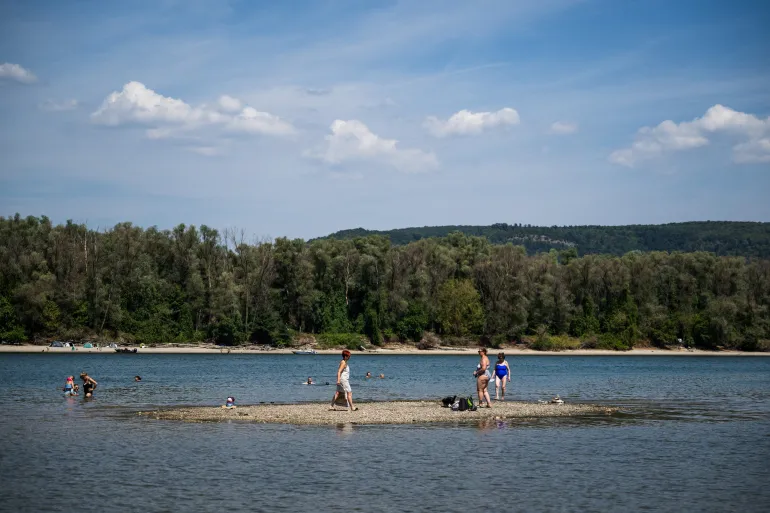
People spend time on a newly exposed island due to the low water level of the Danube River in Kisoroszi, Hungary, August 1, 2026. REUTERS/Marton Monus
People spend time on a newly exposed island due to the low water level of the Danube River in Kisoroszi, Hungary, on August 1, 2026 [Marton Monus/Reuters]


Health hazards, strain on energy systems intensify

Heat is among Europe’s deadliest natural hazards. Unlike floods or storms, the impacts are often less visible but more widespread.

Older people, children and people with existing medical conditions are most at risk. Hospitals see increased admissions linked to dehydration, heatstroke and cardiovascular illness during heatwaves.

Cities are especially vulnerable because concrete and asphalt absorb and retain heat, creating what is known as the urban heat island effect. Night-time temperatures remain high, preventing buildings and people from cooling down.

The growing use of air conditioning offers some protection but creates another challenge.

Electricity demand often surges during heatwaves as millions of people seek relief from the high temperatures. This coincides with a slump in efficiency in power generation as warmer rivers mean that the cooling of thermal and nuclear power stations is more of a challenge.

This creates a growing challenge for Europe’s energy systems as demand rises precisely when supply can become more constrained.

Economic costs escalate

The financial effects from this environmental crisis are mounting. The European Environment Agency estimates that extreme weather has already cost Europe 738 billion euros ($850bn) from 1980 to 2023. At least 162 billion euros ($190bn) of that was in the most recent three-year period.

The agency projected a lack of robust climate action could cost the European economy more than 5.6 trillion euros ($6.4 trillion) by 2050. These costs affect almost all sectors of the economy.

Wildfires destroy homes, tourism infrastructure and businesses. Drought reduces agricultural production while low river levels disrupt trade and manufacturing.

Outdoor workers in construction and agriculture face reduced productivity as extreme heat makes working safely more difficult.

Insurance losses from weather disasters have also risen sharply over recent decades. Three-quarters of Europe’s natural disaster losses are uninsured, according to the European Central Bank.

Meanwhile, governments face growing costs associated with responding to emergencies and rebuilding communities.

Many economists argued that investing in climate resilience today will be significantly cheaper than repeatedly paying the costs of more frequent disasters.

A person walks by an area burnt by fire, in Montfort-sur-Argens, in the Var department, amid worsening drought conditions following a heatwave and water shortages across much of France, August 2, 2026. REUTERS/Florion Goga
An area in Montfort-sur-Argens in the Var department of southern France burned in a wildfire amid worsening drought conditions after a heatwave and water shortages across much of the country [Florion Goga/Reuters]

Adapting as warming accelerates

Climate projections consistently indicate that Europe will continue to warm faster than the global average. Southern Europe is expected to experience hotter and drier summers, increasing the likelihood of severe drought and wildfires.

Even Northern Europe, traditionally associated with milder summers, is expected to experience more intense heatwaves. Cairngorms National Park in the Scottish Highlands recently witnessed wildfires that forced local communities to flee

Communities are already adapting to some extent. Cities are planting more trees to provide shade, redesigning streets to reduce heat, expanding early warning systems and have begun developing cooling centres for vulnerable residents.

Water conservation, improved forest management and more resilient infrastructure are becoming important parts of long-term planning. Agriculture is also changing as farmers experiment with drought-resistant crops, different planting schedules and more efficient irrigation systems.

But scientists stressed that adaptation alone will not be enough. Without significant reductions in greenhouse gas emissions, the conditions that create extreme weather are expected to become more common in the years ahead.

Europe’s recent summers are no longer viewed simply as isolated weather events. They offer a glimpse of what a warmer climate could mean.

The challenge lies in responding to today’s extremes and preparing populations for climates in which intense anomalies become normal.

Source link

Europe facing 50C horror heatwaves this summer as British tourists urged to rethink holidays

Experts have warned parts of Southern Europe could exceed 50C this summer or next, with holidaymakers urged to rethink holiday destinations or could be forced to spend their vacation indoors

A sweltering 50C heatwave could hit parts of Europe as experts warned British holidaymakers to prepare for dangerous conditions this summer.

Holidaymakers heading to the Mediterranean have been warned temperatures could soar to 50C, with experts saying the record-breaking heat seen across southern Europe may only be the beginning. Large parts of Spain have already endured temperatures of 44C in recent days, while the heat has fuelled wildfires across Spain and France, forcing thousands of people to flee their homes.

Professor Bill McGuire, Emeritus Professor of Geophysical & Climate Hazards at UCL said even hotter weather could be yet to come. He said: “It would be no surprise if 50C was exceeded, either later this summer or next year, when the heating impact of the unprecedented El Niño building in the Pacific will be at its greatest.”

He urged anyone travelling to the Mediterranean to be prepared to spend far more time indoors than they might have planned. He told the Daily Mail: “I wouldn’t say that they would be a total write-off, but I think holidaymakers will need to be prepared to spend a lot of time in air-conditioned hotel rooms, due to it simply being too hot to do anything outside.”

The highest air temperature ever officially recorded in Europe is 48.8C, set in Sicily in 2021. Before that, the record stood at 48C, recorded in Elefsina and Athens in 1977.

Professor Hanna Cloke, Regius Professor of Meteorology and Climate Science at the University of Reading, said parts of Spain and Portugal could see temperatures climb into the high 40s. She said: “Temperatures in the high 40s are possible in the hottest parts of Spain and Portugal. And where humidity is high it can feel even hotter than that, well above what the thermometer says. That’s the kind of heat that kills.”

She urged holidaymakers to take extra care if temperatures continued to climb. She said: “The old and vulnerable need to be very careful; keeping out of the sun and drinking plenty of water, as they can easily suffer and become ill in 40C+ temperatures.”

Professor McGuire said there was “no doubt whatsoever” climate change was driving the extreme heat. He said: “Europe is heating faster than any other continent as we continue to add more than 40 billion tonnes of CO2 to the atmosphere every year – equivalent to the weight of 800,000 Titanics.

“The average temperature of Europe is now more than 2°C hotter than it was 100 years ago, and high temperature extremes are going up even faster. Heatwaves are getting hotter and longer, and taking many thousands of lives every year.

“But this isn’t the new normal, this is just the beginning. Summers across the Mediterranean region are just going to keep on getting hotter as long as we continue to do next to nothing in terms of reining in carbon emissions.”

Source link

Seven of the UK’s most beautiful woods and forests to escape the heatwaves

WHILE many will be hitting beaches across the UK, we’ve got an idea to help you swerve the crowds.

These glorious woods and forests are perfect for escaping the current heatwave, with plenty of dappled shade for lovely treks and picnics.

Enjoy action with a bike trail in Haldon Forest Credit: visitdartmoor.co.uk
Children run for fun in Alice Holt Forest Credit: © Nick Whittle. All Rights Reserved.

Here, Sophie Swietochowski looks at seven great days out . . . 

WESTONBIRT ARBORETUM

One of the UK’s largest and most glorious arboretums, Westonbirt, in Gloucestershire, is much more than just a forest.

More than 2,500 species are thriving here and some of the trees in this 240-hectare space are so ancient, they’ve weathered almost 2,000 years of change.

Why not grab a sandwich from the cafe and take a pew next to the arboretum’s oldest tree — a small-leaved lime in the Silk Wood area.

WAIL OF A TIME

I drove Irish Route 66 with deserted golden beaches and pirate-like islands


TEMPTED?

Tiny ‘Bali of Europe’ town with stunning beaches, €3 cocktails and £20 flights

HALDON FOREST PARK

Devon’s beaches are likely to be packed in the coming weeks, but this fabulous park is a great alternative.

There are plenty of shaded areas, plus kids can be kept entertained along the Room on the Broom activity trail.

Pack a coolbox of goodies and take advantage of the many picnic spots.

BEDGEBURY NATIONAL PINETUM & FOREST

This haven in Kent is the largest pinetum in the entire world, and its collection of conifers is renowned globally.

Now is the best time to visit, as the team have mowed grassy paths to help visitors explore, while also sheltering beneath the giant trees.

HAMSTERLEY FOREST

Kids can slip off their shoes and go for a paddle after tiring themselves out at the outdoor Viking Wildplay, which is pretty well shaded
Hamsterley Forest in County Durham has a river running through its centre Credit: Alamy

If you would prefer to cool off by water, this forest in County Durham has a river running through its centre.

Kids can slip off their shoes and go for a paddle after tiring themselves out at the outdoor Viking Wildplay, which is pretty well shaded.

If you do want to stroll the trails, they are mostly wheelchair-accessible and pram-friendly.

ALICE HOLT FOREST

Worried about how you’re going to amuse the kids over the summer months?

Then make a beeline for this forest in Hampshire.

It’s an adventurer’s paradise with nature and play trails galore and even a Go Ape course, sheltered by the surrounding trees.

Make sure to check the events page ahead of your visit to find out what’s happening that week.

DELAMERE FOREST

This gorgeous spot in Cheshire is a wonderful spot for nature enthusiasts.

Major work has gone into restoring the hidden pools within the forest to encourage the return of the White-Faced Darter dragonfly — one of the rarest in the UK.

This forest is likely to be one of the coolest of the bunch, too, thanks to the many peat bogs and moss carpets that keep the forest floor damp.

FINESHADE WOOD

Both the kids and Fido will love this gloriously sheltered spot in Northamptonshire.

You’ll be sharing the 516 hectares with deer, dragonflies and butterflies, and keep an eye out through the tree canopy for the buzzards soaring overhead.

When the heat gets too much, the on-site Grounds Cafe is loaded with ice cream — and there’s even some doggy-friendly scoops, so no one misses out.

  • For more details on any of the sites featured on this page, head online to forestryengland.uk.

Source link

More than 2,700 deaths in UK linked to May, June heatwaves | Weather News

The UK has experienced two record heatwaves this year, with temperatures in England reaching 35.1C in May and 37.7C in June.

More than 2,700 deaths across England and Wales have been linked to unprecedented heatwaves in the United Kingdom in May and June, according to new research.

There were 550 heat-related deaths between May 21 and 29, and nearly 2,200 people died between June 18 and 28, scientists estimated in the study published on Monday.

Recommended Stories

list of 3 itemsend of list

Researchers from Imperial College London, the Met Office and the London School of Hygiene and Tropical Medicine used weather data, climate models and studies on excess deaths during the extreme weather to arrive at their estimate.

The UK Health Security Agency (UKHSA) said it would publish its official estimate of heat-related deaths in the coming weeks, based on death records from recent heatwaves.

Climate change driving heatwaves

The UK and much of Europe have already experienced two record-breaking heatwaves this year, with temperatures in England reaching 35.1C (95.2F) in May and 37.7C (99.9F) in June.

“They were extreme heatwaves for the UK, and for all parts of Western Europe, and they’re particularly exceptional for the timing and how early in the year they occurred,” said Mark McCarthy, the science manager at the Met’s climate attribution team.

Scientists emphasised the role of climate change in making heatwaves more intense and frequent.

They estimated that maximum daytime temperatures were up to 4C (7.2F) higher than they would have been without global warming.

The Climate Change Committee (CCC), the body responsible for advising the British government on climate change, warned last year that the UK was “not ready” to deal with the consequences of climate change.

Lea Berrang Ford at UKHSA’s Centre for Climate and Health Security says the study released on Monday would “help illustrate the scale of risk associated with extreme heat and the growing threat climate change poses to our wellbeing”.

In a report published in May, it estimated that 92 percent of British homes could be too hot by 2050.

It said the government should set maximum temperature limits in the workplace, as well as invest in air conditioning for public buildings such as hospitals and schools in preparation for extreme weather.

The research on heat-related deaths in the UK comes as data showed that more than 10,000 excess deaths were recorded across Europe during the heatwaves across the west ⁠of the continent ⁠in late June.

EuroMOMO, a network backed ⁠by the European Centre for Disease Prevention and Control and the World Health Organization, said most of those deaths were among people aged 65 and above, with 9,000 excess deaths reported in that age range.

Scientists pooled national mortality statistics from 27 European countries in June and concluded that, without other notable factors such as COVID-19 outbreaks, the heatwave is most likely to have ⁠contributed to the spike of 10,650 excess deaths between June 22 and 28.

Source link