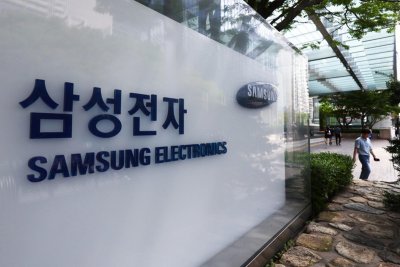
An exterior view of the Samsung Electronics headquarters in Seoul, South Korea. File. Photo by YONHAP / EPA
May 29 (Asia Today) — Samsung Electronics said Friday it shipped samples of its seventh-generation high-bandwidth memory chip, HBM4E, for the first time, demonstrating its competitiveness in advanced semiconductor technology.
The shipment came three months after Samsung began mass shipments of HBM4 in February, raising expectations that the company could expand its share of the HBM market.
Samsung said it supplied 12-layer HBM4E samples to global customers. The company did not identify the customers, but industry officials said the samples were likely supplied to Nvidia, a major buyer of AI chips.
Samsung said the HBM4E shipment goes beyond an expansion of its product lineup and could strengthen the company’s supply capacity and technological edge in the global AI infrastructure market, which is expected to grow rapidly for years.
Samsung said HBM4E operates at 14 gigabits per second to 16 gigabits per second per pin, more than 20% faster than the previous generation. It provides bandwidth of 3.6 terabytes per second in a single stack, improving computing speed for large language models and next-generation AI systems.
The 12-layer HBM4E offers 48 gigabytes of capacity, more than 30% higher than the previous generation. Samsung said it plans to expand the lineup to 32 gigabytes, or eight layers, and 64 gigabytes, or 16 layers, to meet different customer service environments.
The new HBM4E uses Samsung’s 1c DRAM, a sixth-generation 10-nanometer-class DRAM process, and its own 4-nanometer foundry logic die. Samsung said the combination improves process stability, yield and mass production capability.
The company also said low-power design and packaging optimization improved energy efficiency by 16% and thermal resistance characteristics by more than 14% compared with the previous generation.
Samsung’s position in the HBM market is expected to strengthen because the company appears to have moved ahead of competitors in shipping samples. Earlier sample shipments could help Samsung secure customer volume in the next-generation AI memory market.
Samsung ranked second in the global HBM market with a 22% share in the fourth quarter of last year, behind SK hynix, which held 57%, according to Counterpoint Research. Samsung’s share was down sharply from 40% a year earlier, but analysts say its HBM4 mass shipment this year could help it recover.
Global customers have given positive reviews of Samsung’s HBM4 in speed, power efficiency and overall performance, industry officials said. Samsung’s HBM4 received the highest rating in a system-in-package test in December after demonstrating an industry-leading speed of 11.7 gigabits per second.
Analysts say HBM4E could move into mass production quickly because Samsung is already mass-producing HBM4 using the same combination of 1c DRAM and a 4-nanometer base die.
Market watchers also remain optimistic about Samsung’s HBM business.
“The memory market in 2027 is expected to face a deeper supply shortage, and price increases are also likely to gain momentum,” said Kim Dong-won, an analyst at KB Securities. “HBM prices are expected to rise more than 50% from a year earlier as negotiations reflect the narrowing margin gap with general-purpose DRAM.”
Hwang Sang-joon, executive vice president and head of memory development at Samsung Electronics, said the company completed the HBM4E sample supply without disruption after successfully starting HBM4 mass shipments.
“This has clearly imprinted Samsung Electronics’ unmatched technology leadership in the market,” Hwang said. “We will continue to strongly lead growth in the global AI memory market based on overwhelming technology leadership and preemptive investment in production infrastructure.”
— Reported by Asia Today; translated by UPI
© Asia Today. Unauthorized reproduction or redistribution prohibited.
Original Korean report: https://www.asiatoday.co.kr/kn/view.php?key=20260529010008844