hazards

‘Deadly hazards’: Behind Sudan gold mine collapse, a wartime desperation | Sudan war News

A gold mine collapse in northern Sudan has killed at least 10 people and injured 21, according to survivors, bringing renewed attention to the dangers facing workers in one of the country’s most important and least regulated industries.

The collapse took place on Sunday at the Awny mining area near Sudan’s border with Egypt. Miners told the AFP news agency they had recovered 10 bodies and pulled 21 injured workers from the site, while the search continued for people believed to be trapped beneath the rubble. It is unclear how many people are trapped in the collapsed mine.

The disaster comes just days after another deadly accident at a gold mine in West Kordofan State. A collapse at the al-Zaraa mine near en-Nahud, a town in central Sudan, left at least 82 people dead.

Sudan is one of Africa’s top gold producers, recording 70 tonnes of production last year, according to the Sudanese government.

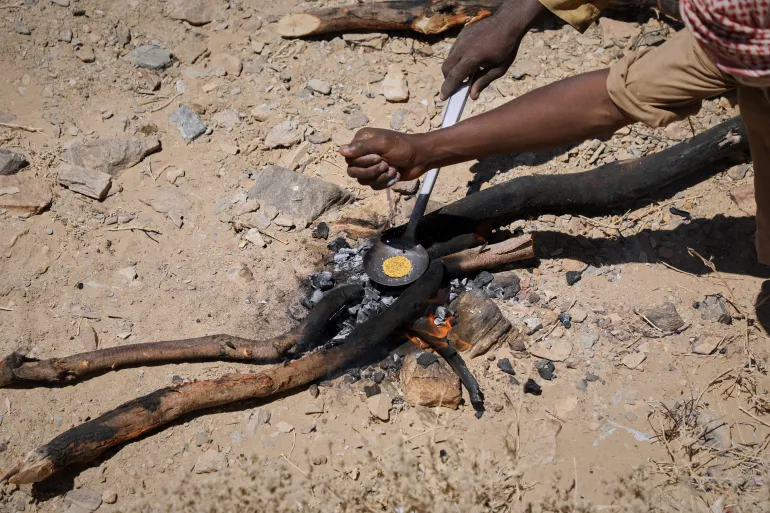
Miners heat processed gold concentrate over an open fire at an artisanal mining site in Dalago Mahas, Sudan's Northern State, Friday, May 8, 2026.(AP Photo/Mohnd Blal)
Miners heat processed gold concentrate over an open fire at an artisanal mining site in Dalago Mahas, Sudan’s Northern State, Friday, May 8, 2026 [Mohaned Bilal/AP Photo]

Since fighting broke out in April 2023 between Sudan’s army and the paramilitary Rapid Support Forces (RSF), businesses have been devastated, agriculture has been disrupted, millions of people have been displaced, and Sudan’s formal economy has weakened. In that environment, gold has remained one of the country’s most valuable sources of income.

In July 2025, it was reported by local agencies that Sudan’s gold production rose sharply despite the ongoing conflict, reaching 64 tonnes in 2024, 53 percent higher than the 41.8 tonnes recorded in 2022, and generating $1.57bn in legal export revenues.

However, the gold trade has also become a point of international scrutiny. Most of the gold exports end up in the UAE. In March 2025, Sudan went to the International Court of Justice (ICJ), accusing the UAE of supporting and funding the RSF using gold. The UAE has denied accusations that it supplies weapons to the RSF.

INTERACTIVE - Where is Sudan’s gold - NOV12, 2025-1763449902

Sudan’s gold deposits are spread across the country, with the majority in the northeast. Port Sudan, the country’s main port, is home to most of the deposits and has been largely controlled by the Sudanese Army since the war began. However, areas controlled by the RSF are also populated by gold deposits.

At the moment, “much of Sudan’s gold is taken out of the country through smuggling or illicit networks instead of passing through government channels that could directly contribute to public revenue,” said Joseph Tucker, senior analyst on the Horn of Africa at the International Crisis Group.

But amid that diplomatic battle and the accusations surrounding gold, the mining deaths in northern Sudan have also raised larger questions over how the country manages the sector, analysts say.

“This disaster is yet another example of the deadly hazards facing those working in Sudan’s gold mines,” Tucker told Al Jazeera. “Most of these (gold mines) are informal, artisanal mines in remote areas that are unregulated and lack modern mining technology, adequate infrastructure, and specialised safety equipment.”

This year, Sudanese Prime Minister Kamil Idris met with the minister of minerals and spoke on the policies for regulating traditional mining and the management and control of various mineral markets. According to French-based Sudanese media, Sudanese authorities called for swift action to address the environmental damage and public health hazards caused by mining activities across the country.

Yet, despite the dangers, Tucker said the state of the Sudanese economy made gold mining appear lucrative to many Sudanese.

During the war, the Sudanese currency’s value has crashed. Before the outbreak of fighting in 2023, about 570 Sudanese pounds could buy a US dollar. By April 2026, the currency had slid to a sixth of that value: It cost 3,500 pounds or more to afford a dollar. That has led to sharp food inflation and a surge in the costs of transport and fuel.

According to estimates by the United Nations Development Programme, Sudan lost $6.4bn of its gross domestic product (GDP) in 2023 alone: That’s a quarter of the country’s $26bn GDP that year. In August, the UN agency reported that 90 percent of the agrarian nation’s farmers had seen yields drop over the previous year.

That economic crisis, Tucker said, “fuels the demand for gold and willingness of miners to work in poor conditions” – even if it proves deadly.
Source link

Abandoned properties, fire hazards. Are L.A. mayor candidates part of the fix, or the problem?

Labor Day is behind us, election day is less than two months away, and the question before Los Angeles voters is this:

Can anyone run this city?

Two fires at abandoned properties, one in Studio City and the other on the eastern edge of Larchmont, offer windows into City Hall dysfunction as Mayor Karen Bass defends her job against a challenge by City Councilmember Nithya Raman.

Let’s start on Babcock Avenue, just south of Moorpark Street, where, for roughly five years, neighbors of a vacant house begged City Hall for attention to what had been a dumping ground, a fire hazard and a homeless hangout.

To no avail.

When they received any response at all, they got the runaround.

Resident Jon Manzanares told me he has supported Bass and Raman in the past. But in a spring 2025 email to City Hall, he said both “should be ashamed and resign in disgrace.”

Well, they didn’t. And following an Aug. 26 fire at the Babcock property, which damaged the rear of an adjacent home, Bass and Raman went after each other for not having addressed all those pleas for help.

“Nithya Raman wants to lead the whole city,” said a Bass campaign social media post, but after six years in office “she can’t even get a single lot cleaned up in her own district.”

Raman shot back, saying she had alerted the mayor’s office about the nuisance property 10 months earlier.

“I cannot call her about the 200-plus issues that we’re dealing with that are at this level of risk,” Raman snapped.

The finger-pointing doesn’t inspire confidence, does it?

At least, said Manzanares, a retired lawyer, L.A. found out what it takes to get a response from the two mayoral candidates.

“The news crews showed up” to cover the fire, Manzanares told me, “and it finally got some attention because of the election.”

But festering eyesores are everywhere, as Bass herself indicated when she called in to KTLA-TV.

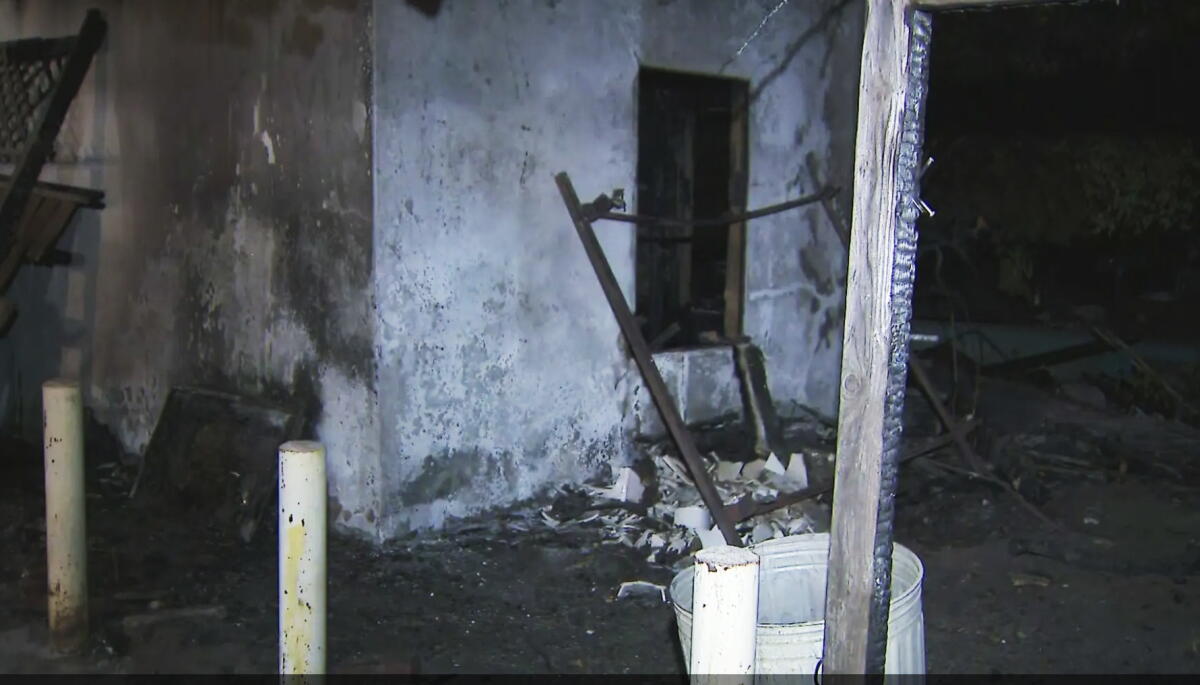
Fire damage is seen at an abandoned Studio City property following a overnight blaze

Fire damage is seen at an abandoned Studio City property following a overnight blaze on Aug. 26.

(KTLA-TV)

“You know,” she said, “this is a situation that unfortunately exists all over the city.”

A for honesty. F for failing to clean up all those messes, regardless of whether the problem is departmental failure or communications breakdowns with council members.

The fire in Studio City spread to a neighboring property and damaged a structure that Kayt Miranda uses for storage and as a home office. I spoke to Miranda on the front porch of her home, and she said she had filed multiple complaints about the nuisance property over a five-year period.

Five years.

“And we never heard back,” Miranda said, telling me she had seen people set up camp at the property, bringing in mattresses, book shelves and clothing racks. “Then we went to Raman’s office … They would send responses, but … we never saw any action.”

Manzanares showed me an email from a Raman staffer last month that said, “unfortunately, there is not a clear and expeditious path forward on this case.”

Why not? Was it going to take another five years?

Miranda said exasperated neighbors had banded together to put up more lighting and cameras to protect their properties, “but it really did feel like this is forever, because nothing was going to happen.”

When I was done in Studio City, I drove across town to meet with construction worker and pastor Juan Galicia, whose house was torched in March when fire jumped from an adjacent abandoned property.

I had first heard about Galicia in April, when I toured a nearby Hollywood neighborhood for a column about a homeowner who had hired her housekeeper to report illegal dumping, help bag up the daily mess and try to reduce the fire risk around encampments. The city wasn’t doing its job, Stefanie Keenan had told me, so she was spending her own money to protect herself and neighbors. And she still is.

Galicia didn’t get the protection he needed, despite multiple contacts with police and city offices — by him, relatives and neighbors —regarding the empty dwelling next door to his on North St. Andrews Place. Galicia said squatters were in and out of the house, with periodic fighting and drug use. Police would come, he said, but when they left, the trouble would return.

Galicia was preaching at his church in South L.A. when flames engulfed his home, where he lived with an extended family of 10.

“Eighteen years,” he said of his time in the house. “And in 10 minutes, you have nothing.”

I followed him into the house, with its charred walls, ceiling and flooring. Galicia wore a somber expression, as if still suffering from the shock, and he saw new evidence of trespassers, along with some fresh graffiti.

Galicia told me, as he told The Times’ Seamus Bozeman in July, that he intends to rebuild. But his insurance settlement won’t cover the cost of rebuilding, and he’s still paying $2,000 a month on the mortgage, plus $6,200 for temporary lodging in a rented house.

Meanwhile, as he struggles with a crushing financial problem he did not create, he’s aware that millions are being spent on homelessness without significant progress.

Aerial view of Larchmont home belonging to Pastor Juan Galicia that was destroyed by a fire.

Aerial view of Larchmont home belonging to Pastor Juan Galicia that was destroyed by a fire that began at a vacant property next door.

(Robert Gauthier/Los Angeles Times)

“I don’t understand,” Galicia said.

A spokesperson for City Councilmember Hugo Soto-Martínez told me his office became aware of Galicia’s issue in January, but because of paperwork and the complexity of legal records, could not track down the owner of the adjacent property before the fire.

In L.A., people trip and fall in droves and successfully sue the city for millions. I wondered if Galicia might have a liability case against the city, but two attorneys told me going after the next-door property owner could be more fruitful.

In a Sept. 5 press release, Bass said she was directing city crews to clean and secure nuisance properties citywide. OK, fine, but what took her so long?

Bass also said she had earlier signed legislation initiated by Councilmember Monica Rodriguez to speed the process of cracking down on negligent property owners and to hit them with stiffer penalties.

Those fines ought to go into a fund to assist Juan Galicia and others like him.

Between 2018 and 2024, according to the L.A. Fire Department, homelessness was a factor in about one-third of all fires in the city.

“I feel for these people, I really do. I’m not unsympathetic,” Jon Manzanares told me in Studio City. “But by the same token, we need to do something constructive and not have these encampments that start fires.”

With less than two months to go before the election, it’s on Bass and Raman to convince voters they can make a difference.

The finger-pointing is useless.

steve.lopez@latimes.com

Source link