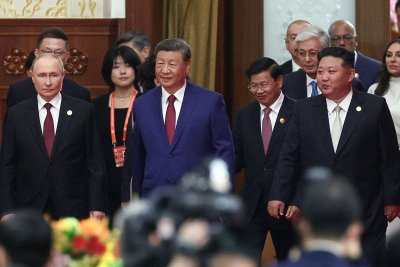
North Korean nuclear status hardens amid China, Russia shift

July 6 (Asia Today) — North Korea is using tacit support from China and Russia to harden its status as a nuclear-armed state, raising pressure on South Korea to rebuild the kind of international sanctions coordination that brought Pyongyang back to negotiations in 2018 and 2019, analysts said Monday.
North Korea has repeatedly stressed the “constant expansion and strengthening” of its nuclear forces and the “thorough exercise” of its status as a nuclear-armed state, signaling that it has no intention of returning to talks premised on denuclearization.
Diplomatic observers in Seoul say North Korea is taking advantage of a turbulent international environment to consolidate its nuclear status.
Russia, which has become a close partner of North Korea since the war in Ukraine, vetoed the renewal of the U.N. panel monitoring sanctions on North Korea in March 2024. At the Nuclear Non-Proliferation Treaty review conference in May, Russia also opposed including language on North Korea’s nuclear program in a consensus document, according to the report.
China, which has long maintained a formal position supporting denuclearization of the Korean Peninsula, did not mention the issue during a North Korea-China summit in June.
The North Korean nuclear issue has become even more difficult to resolve as U.S. attention remains focused on the Middle East and the U.N. Security Council has become increasingly ineffective, analysts said.
Experts say South Korea should pursue denuclearization by maintaining sanctions on North Korea, strengthening its military capabilities in response to Pyongyang’s nuclear buildup and securing diplomatic means to apply pressure through China and Russia.
Kim Tae-woo, former president of the Korea Institute for National Unification, said South Korea must acquire capabilities that can offset North Korea’s growing nuclear threat.
“As North Korea’s nuclear threat grows, South Korea must secure corresponding capabilities to neutralize that threat,” Kim said. “Only when North Korea recognizes that an intensifying arms race will be harmful to both Koreas can nuclear arms control negotiations begin.”
Kim said South Korea should quickly move forward with security consultations under the Korea-U.S. joint fact sheet. He said Seoul should pursue the construction of nuclear-powered submarines, secure what he called “nuclear latent capability” and push for stronger U.S. extended deterrence.
Analysts also said Seoul should wage a more active diplomatic campaign toward China and Russia, which retain significant influence over North Korea.
They said South Korea should work to recreate the diplomatic environment of 2016 and 2017, when the U.N. Security Council unanimously adopted a series of strong sanctions resolutions in response to North Korea’s nuclear tests and intercontinental ballistic missile launches.
Experts say those sanctions were the key factor that pushed North Korea into inter-Korean and U.S.-North Korea denuclearization talks in 2018 and 2019.
A former senior South Korean diplomat, who requested anonymity, said sanctions remain one of the few long-term sources of leverage over North Korea.
“Every area of North Korea except its nuclear program remains backward because of sanctions,” the former official said. “As long as sanctions are not abandoned in the long term, I believe there is still hope for North Korea’s denuclearization.”
— Reported by Asia Today; translated by UPI
© Asia Today. Unauthorized reproduction or redistribution prohibited.
Original Korean report: https://www.asiatoday.co.kr/kn/view.php?key=20260707010002164