Backlash over data centers hits California, and the midterms
HANFORD, Calif. — Darian Orduno bounced her baby boy on her chest, looking down at his thick black hair and bright eyes. What might pollution from a data center do, she wondered, to his growing lungs?
That question had brought Orduno, 25, to a community meeting opposing a possible data center here, and her fears, she said, likely would influence her vote in the midterm election too.
“I just had him, and now it’s concerning if he’s going to be able to grow up here,” Orduno said, or “if I’m going to have to relocate.”
As about 100 residents filed into a church for the meeting in late August, under a Central Valley sky hazy with air pollution, many shared the same worries — that a facility pitched for the local fairgrounds could further worsen the area’s air quality and strain its water supply.

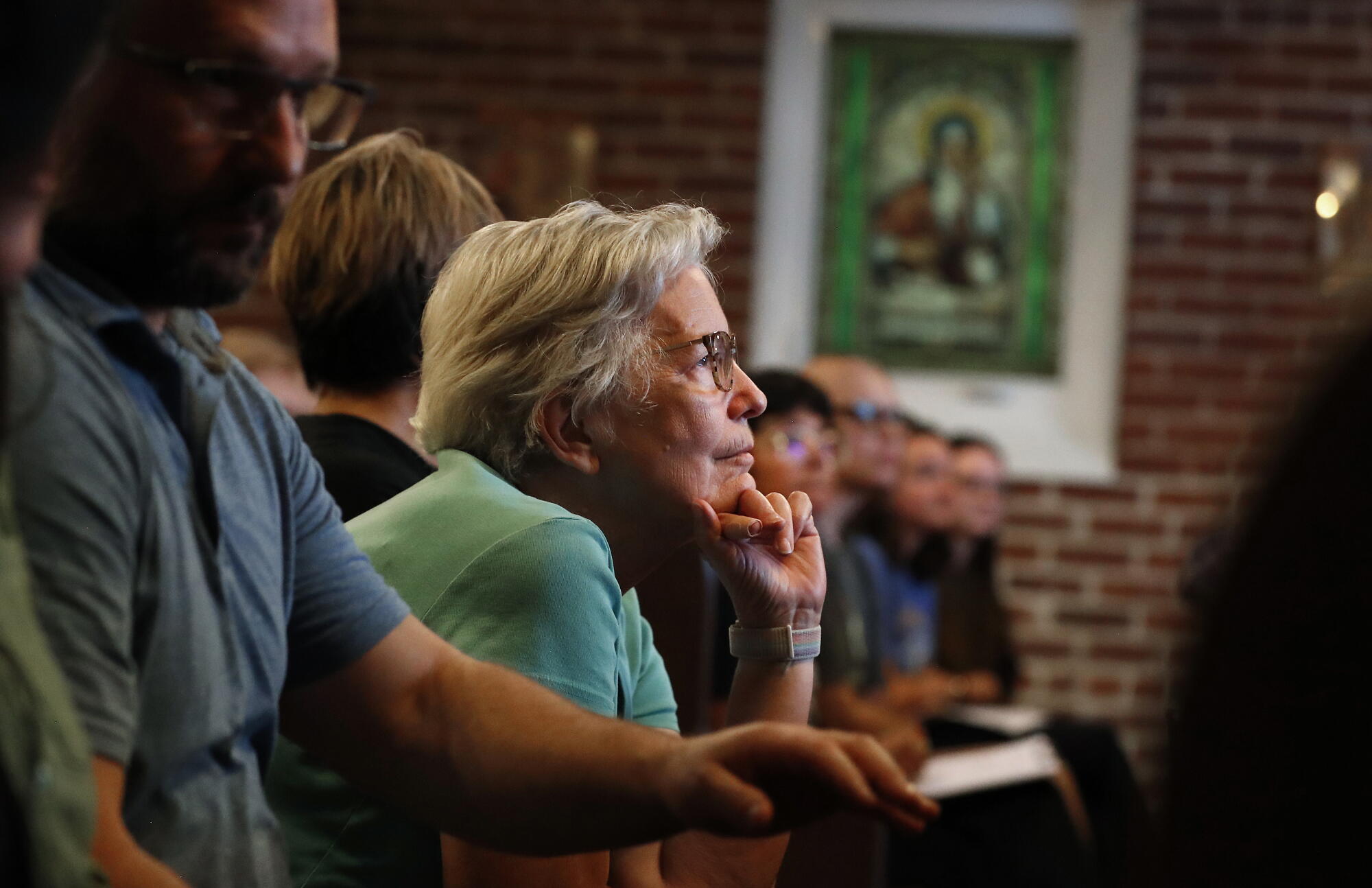
Barbara Castle listens to speakers during a town hall meeting on a possible small-scale data center in Hanford.
Nationwide, such concerns are fueling a backlash to data centers from both the left and the right as tech companies flood the country with thousands of proposals for the facilities in nearly every state from California to Maine.
Data centers have become an unusually bipartisan flash point in the midterm elections, as candidates race to delineate policy platforms and respond to public opinion. The issue stands to influence swing voters and motivate turnout at the polls.
Here in the 22nd District, home to the state’s most competitive congressional race, how significantly the issue will affect voters’ decisions remains to be seen. But one thing is clear: Anxiety about data centers is mounting.
“It’s a national concern, it’s now a state concern, and now it’s bled into the local concern,” Hanford Mayor Mark Kairis said. “It’s a very emotionally charged issue right now.”

Residents in Hanford who oppose data centers say they are worried about the region’s air and water quality, concerns echoed by rural communities across the country.
Demand for data centers, which house the computer systems powering artificial intelligence and the internet, has surged as AI use has ballooned. As of April, more than 1,500 new data centers were in development across the United States, according to a Pew Research Center analysis, largely in rural areas.
The centers require intense cooling, which often demands high water and power use and creates the potential to affect the environment and to pass on utility costs to consumers. But they power technology that is becoming increasingly integrated into American business. They also create jobs, though with limitations.
Democrats see the data center uproar as fitting into their affordability messaging, and candidates generally agree data centers should be regulated, though their positions vary on how aggressively. For Republicans, whose party has backed AI innovation, responding to worsening public opinion has been trickier — particularly given President Trump’s championing of AI and data centers.
Vice President JD Vance on Thursday acknowledged negative polling on data centers but framed the issue as a question of American industrial dominance, saying the country can’t shy away from development. Earlier in the week, Trump asserted that the only reason communities should reject data centers is if they want to be “backwards and poor.”
The public may see data centers as a physical manifestation of AI advancement in general, said Camille Crittenden, executive director of the Center for Information Technology Research in the Interest of Society, a University of California research center. Opposing data centers offers people a way to vent their broader concerns about the technology’s increasing dominance.

Priest Luke Martinez expresses concerns during the community meeting .
“This is a very specific focal point for a general anxiety about AI,” she said. “People see these data centers, and they’re thinking, ‘AI’s going to take my job.’”
The backlash from residents in the Central Valley to the possibility of even a small-scale data center demonstrates how acutely the issue has put many Americans on edge.
“It really is terrifying,” said Lucy Gomez, 57, of Hanford, a retired teacher. “I feel like we’re being guinea pigs when we don’t want to be.”
Increasing influence
Community anger about the facilities has prompted close attention from California lawmakers, who passed legislation in Sacramento on Monday to regulate energy use by the data center industry and impose other requirements.
California is home to the third-most data centers of any state, though it has experienced a relatively smaller new boom because of its high electrical prices and other factors. Still, 54 new facilities were in the works for the state as of April, according to Pew.

Hanford Councilwoman Kimber Regan speaks with Mayor Mark Kairis during the meeting. Hanford’s zoning ordinances do not allow data centers, but the city does not have jurisdiction over the county fairgrounds site where Global Stack is evaluating its proposal.
In Georgia and Pennsylvania, New York and Texas, Nevada and Virginia, the issue has become hot-button in elections at all levels. Ads about data centers run on the airwaves in states with key congressional races. Gubernatorial candidates jockey over it; both New York Gov. Kathy Hochul, a Democrat, and Texas Gov. Greg Abbott, a Republican, put temporary moratoriums on new data centers.
A memo from the Republican senatorial campaign arm underscored how critical the question was becoming last month, when it warned AI companies that data centers could be the deciding issue in the close race between Ohio GOP Sen. Jon Husted and former Sen. Sherrod Brown, his Democratic challenger.
Data centers “are the anchor hanging around Husted’s neck,” said the memo, which was first obtained by Axios. “If he loses and data centers get the blame, politicians across the country will take notice — and they will not go near the next one.”
Sixty-one percent of Americans would oppose a data center being built where they live, a late August poll by the Economist and YouGov found.
Though Democrats and independents were more likely to oppose the centers, 47% of Republicans also said they would oppose it, and 52% of people who voted for Trump in 2024 said they believed construction of a new data center would increase their electrical bills.
Data centers encapsulate existing concerns among red and blue voters across the nation and in California about their quality of life and the influence of major tech companies, said Sonoma State University political science professor David McCuan.
“California has a lot of communities that have been struggling and trying to find a way forward, and the data center debate captures those voters’ frustrations,” McCuan said.
Political winds

The historic Bastille, which served as Kings County’s jail and sheriff’s office from 1897 until 1964, stands tall next to the courthouse in Hanford’s Civic Center Park.
The idea for a center on the Kings County fairgrounds is part of a broader pitch by developer Global Stack USA to boost the state’s emergency infrastructure by installing small-scale data centers, helipads and parking garages at fairgrounds around the state.
Global Stack Chief Executive Dan Kang said the goal was strengthening the state’s emergency response capabilities while helping fairgrounds financially. The company’s early materials envisioned operating 70 sites by 2030.
The company has not made any formal proposals, but in Kings and Tulare counties, the issue caught attention after fair officials agreed to allow Global Stack to evaluate their sites. The idea also prompted some residents to voice opposition in Ventura County last month.
The facilities would include what’s known as an edge computing data center, which typically is much smaller than traditional data centers and which Global Stack says would require lower utility use and no municipal water connection.
Concerns about water and energy use by data centers are legitimate, said Shaolei Ren, a UC Riverside engineering professor who studies AI. Centers like the one proposed by Global Stack do not guzzle water the way larger ones do, but they still can use extra power or generate air and noise pollution, Ren said.
In Kings County, the project potentially could benefit the fairgrounds as a long-term revenue source, said Dena Rizzardo, chief executive of the fair board, a state entity that would have final say over any proposal. Because fairgrounds are state property, local and county officials don’t have jurisdiction.
Kang said he is committed to working with local communities to ensure “any path forward reflects local needs and California’s broader resilience priorities.”
In the district’s congressional race, which could help decide control of the House in November, Democratic nominee Randy Villegas said he has been getting questions about data centers from voters. Last month, he released a set of policy points and called for a data center moratorium of at least a year to give Congress time to pass regulations.

Democratic congressional candidate Randy Villegas urged meeting attendees to lobby federal lawmakers to pass legislation regulating data centers.
“The advancement of technology … should not be an excuse to throw our communities under the bus,” Villegas said at the Hanford meeting, where he addressed the friendly crowd without identifying himself as a congressional candidate. A College of the Sequoias professor, he is attempting to unseat Republican Rep. David Valadao.
Valadao, in a statement to The Times, said data center construction requires a “responsible approach” that includes local input and ratepayer protections.
“Data centers play an important role in our economy and national security, but Central Valley families are already facing high electric bills and concerns about our water supply,” Valadao said. He did not answer questions about the proposal in Hanford.
Several attendees at the Hanford meeting, who ranged from Gen Z to elderly, said the issue would affect their midterm votes, though most said they already were leaning to the left.
Gomez, the retired teacher, was not happy with either party but planned to vote for Democrats because she viewed them as taking more action to protect public health than Republicans.

Ember Gomez listens to speakers while her father, Filiberto, looks on during the meeting. Filiberto Gomez said he was concerned a data center would affect children’s health.
Courtney Hawkins, 40, said the data center issue “absolutely” would carry weight in his votes.
“I believe that AI is good for propelling technology in general,” Hawkins said, “but I don’t believe we should be pursuing it without regulations and at the cost of the environment.”