WASHINGTON — Andy Soma, 24, doesn’t identify with either political party, and he’s been skipping elections since he became old enough to vote. But this year, disappointed with the economy and President Trump’s war with Iran, he cast his midterm ballot for Roy Cooper, the North Carolina Democrat now headed to the Senate.
“I would describe it as the first time that I’ve truly felt the need to vote,” said Soma, who is pursuing a Ph.D. in mathematics at North Carolina State University. He said he wanted to “kind of take a stand, if you will.”
Young voters overwhelmingly turned their backs on Republicans on Tuesday, erasing the gains Trump had made in the 2024 presidential election. Voters under age 30 moved left by double digits in nearly all the major Senate races compared with two years earlier.
It was a similar story in House campaigns across the country. The AP Voter Poll, a survey of more than 100,000 midterm voters, showed that about three-quarters of voters under 30 supported their local Democratic candidate, while about one-quarter voted for the Republican.
The support for Democrats outpaces even 2018, when Trump’s Republican Party suffered midterm losses during his first term, and is a dramatic shift from 2024, when young voters were roughly split between Trump and Democrat Kamala Harris, according to AP VoteCast, a survey of more than 120,000 voters that year.
For Soma, the tipping point was Trump’s broken pledge that he would keep the U.S. out of Middle East conflicts, a sentiment that student after student echoed in interviews on the university’s Raleigh campus the day after the election.
Other young voters who broke for Democrats this year said their choices were motivated by personal experiences, including working multiple jobs to get by and watching artificial intelligence data center projects advance into their communities.
“I’m trying to save money and buy a house and all that, but it’s difficult right now,” said Corey Herzog, 28, an independent-turned-Democrat in the traditionally conservative town of Celina, Ohio. Herzog works at Walmart during the day and bartends at night, all while building out a small side business selling house plants.
John Della Volpe, a pollster who regularly surveys U.S. youth for the Harvard Kennedy School’s Institute of Politics, said the whiplash over the past two elections suggests that young voters aren’t a generation of Democrats or Republicans.
“They’re up for grabs,” he said. “Especially given the state of the economy and their concerns about the future.”
In 2024, Trump won over young men. This year, many sat out or backed Democrats
To win back the presidency two years ago, Trump courted young men who felt disillusioned by economic stagnation, interventionist foreign policy and the government’s focus on diversity, equity and inclusion. He attended football games and UFC matches and appeared on podcasts with comedians who rebuffed “cancel culture.”
More than half of male voters under 30 supported him in 2024, according to AP VoteCast.
But once in office, Trump started the war with Iran and rammed through tariff policies that continued to drive up inflation. He also resisted releasing documents about convicted sex offender Jeffrey Epstein and launched an immigration crackdown that faced widespread criticism.
“This was the perfect cocktail for disaster,” said Charlie Sabgir, director of the Washington-based Young Men Research Project.
Young voters’ unhappiness on every major issue in the midterm election was palpable. Voters under 30 were more likely than older age groups to say the cost of living was crucial for their vote for Congress, and to say the U.S. was wrong to take military action against Iran.
About half of young voters said they were angry about the way things were going in the U.S. today, compared with only about one-third of voters 65 and older.
The anti-Trump backlash was particularly strong among young voters
Even in a year when anti-Trump backlash was one of the major themes, young voters stood out.
Only about one-quarter of voters under 30 said Trump is a strong leader or has the mental capacity to serve effectively as president, according to The AP Voter Poll. That’s a sharp contrast with 2024, when about half of voters under 30 felt Trump was a strong leader and mentally fit. The decline was larger than in any other age group.
“This cultural coalition and cultural cache that Trump had behind him going into 2024 — they’ve clearly soured on him,” Sabgir said.
About 6 in 10 voters under 30 said one reason for their House vote was to express opposition to Trump.
A national consortium of college Republican groups put out a statement making their dissatisfaction clear, writing that young Republicans “were not given what they were promised.”
“In the wake of last night’s election results, the College Republican Patriot Coalition unequivocally lays the blame for the greatest Republican defeat by Democrats since 1974 at the feet of the Trump administration and the Republican Party,” the group said in a statement.
Kidus Girma, campaigns director for the left-leaning Sunrise Movement, said that while he was knocking on doors in Michigan, he met young men who may not typically turn out in a midterm election but did this time because they were disappointed by Trump.
He recalled one person who complained that he was struggling to find a job even though Trump was insisting the economy is going great.
“It’s like this deep disillusionment with the statements the president makes versus the material impacts people are facing in their everyday lives,” Girma said.
Gen Z voters get their ‘millennial optimism’ moment. But to keep them, Democrats must deliver
Sarah Stull, an 18-year-old student at the University of Texas at Austin, thought it was funny that so many of her classmates spent Halloween dressed up as “millennial optimism,” wearing skinny jeans and infinity scarves with grins on their faces to satirize the elder generation for being unabashedly hopeful.
Stull got the joke. Like others her age, she described herself as “very sarcastic, very jaded — and do sometimes expect the worst.”
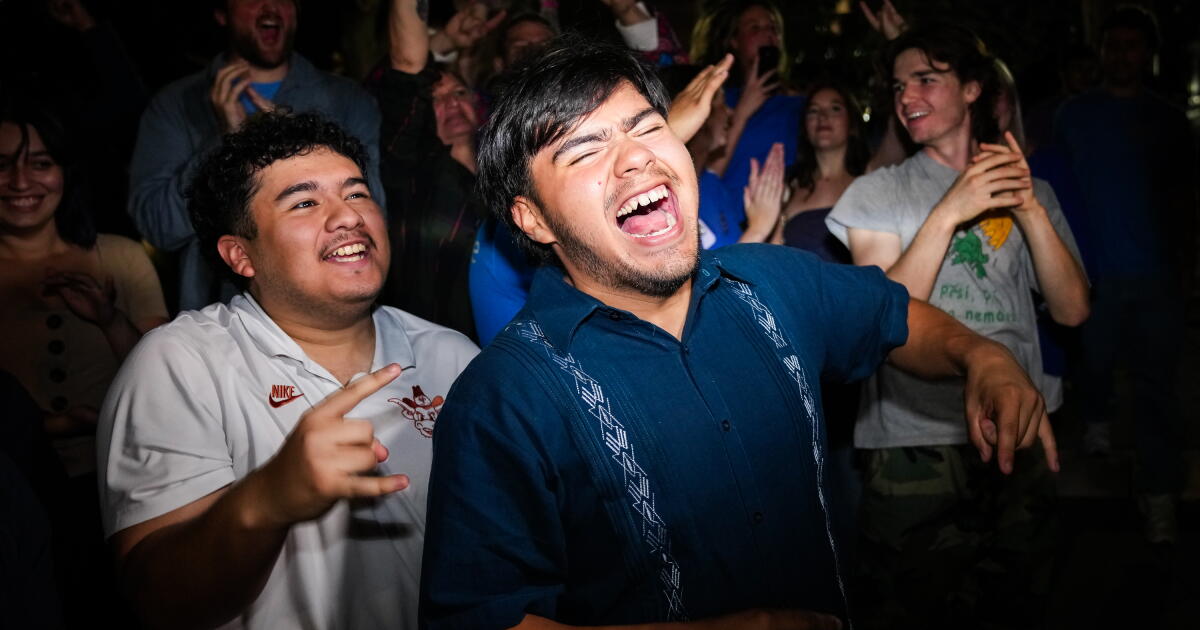
But Tuesday night, sitting in a dorm room with friends watching election results stream in, that all went out the window.
“We were freaking out, all of us were crying,” said the young Democrat, who voted for James Talarico for Senate and Gina Hinojosa for governor. “I just felt this sense of community that I had never felt before.”
She posted a video of herself and friends on TikTok, literally jumping for joy outside the Texas Capitol, captioning it “millennial optimism cause texas went blue.”
Young adults like Stull — who was 7 when Trump rode down the escalator in New York’s Trump Tower in 2015 to announce his first presidential campaign — have only ever known “the Trumpification of politics,” said Katherine Haenschen, a political science and communication professor at Northeastern University. Now that era seems to be coming to a close, bringing hope for the first time to left-leaning young people.
But it’s a fragile moment.
Dakota Hall, executive director of the progressive youth political organization Alliance for Youth Action, said he thinks young voters could shift to the right again if Democrats leading Congress don’t do enough to lower the cost of living, regulate AI and address government corruption.
“Young people have a very short leash,” Hall said. “If you do not deliver, ’28 will be a rough road ahead.”
Swenson, Rankin and Thomson-Deveaux write for the Associated Press. Rankin reported from Raleigh, N.C.