half year

They completed all of L.A. Times’ 101 Best California Experiences

By December of 2023, Paul Preston realized that his girlfriend Susan Huckle was a big fan of road trips and lists. So for Christmas, he gave her L.A. Times’ ”101 Best California Experienceszine, a traveler’s bucket list highlighting my top destinations throughout my four decades of traveling the state.

The gift, I’m delighted to hear, was a hit.

Preston and Huckle went through it and checked off locations they’d seen already. Then they hit the road.

And now, after two and a half years of roaming the state between work assignments, they’re back to report that they’ve covered all 101 locations on that list. Though the two have also traveled beyond state lines, the quest to cover California “totally informed our lives for the last two or three years,” said Huckle, who sent me a note of thanks after ticking the last box.

After the note arrived, I was eager to call them and learn more. I caught the couple, of course, in the middle of a day trip.

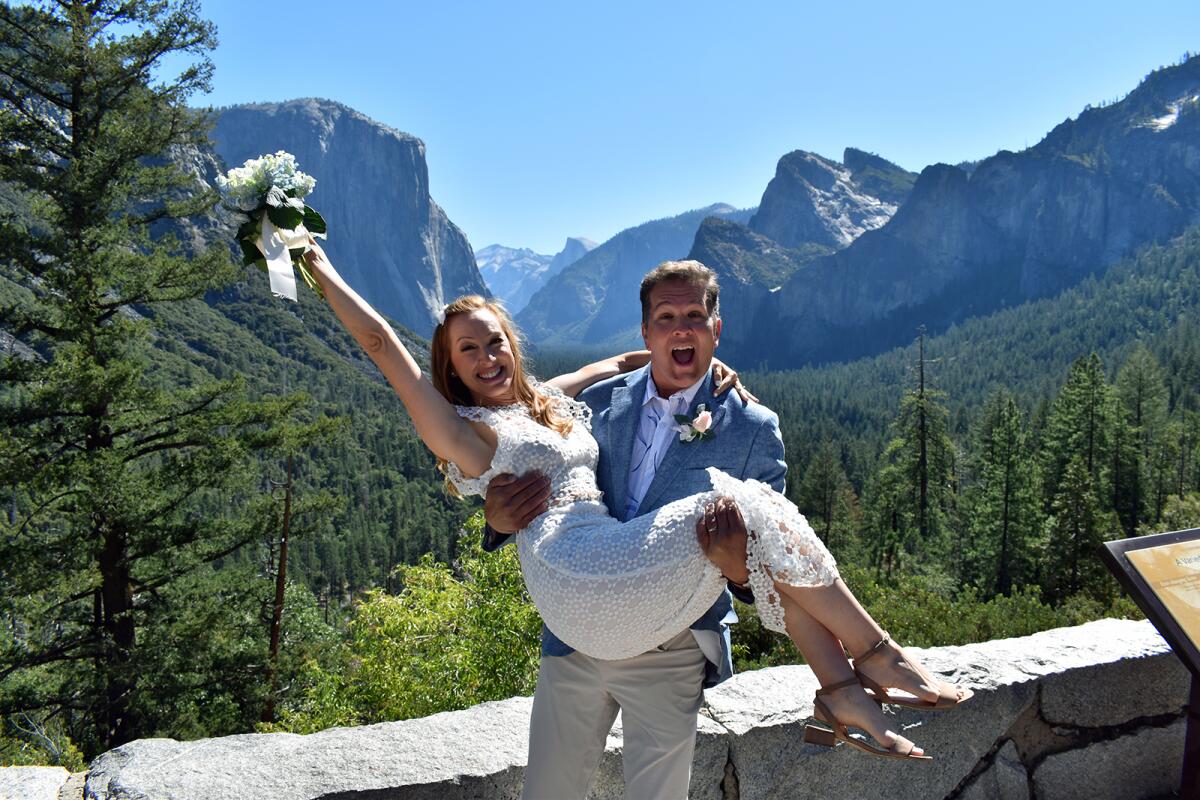
Susan Huckle and Paul Preston, visiting locations on a California bucket list, married in Yosemite Valley.

Susan Huckle and Paul Preston set out to visit every spot on the L.A. Times’ 2023 list of “101 Best California Experiences.” Along the way, they got married in Yosemite Valley.

(Nick Wuthrich)

“We’re out exploring,” Preston said. “So you’re getting what we’re about.”

They’re also now married. That happened last July in Yosemite Valley, which, yes, was on the list.

Huckle, 41, an actress, a host on “L.A. This Week” on Channel 35, a Universal Studios performer and an author, grew up in Santa Maria on California’s Central Coast.

Preston, 56, is also an actor. He leads movie location tours and hosts podcasts, movie trivia nights and special events. He grew up and went to college on the East Coast, so he had fewer California miles under his belt when the couple met in 2020.

Their California 101 travels began in early 2024 with a trip to Paso Robles, where they saw the green slopes along Highway 46, Morro Rock and the elephant seals at Piedras Blancas near Hearst Castle.

“And then,” Preston said, “we just kept going.”

Some of their most satisfying stops, the two agreed, were places they hadn’t heard of, such as Orange Works in the Central Valley town of Strathmore and Angel Island State Park, sometimes known as the Ellis Island of the West. Huckle called Angel Island “a marriage of natural beauty with great, powerful, historic information.”

By early this year, there were only a few destinations left to check.

In April, they did the Indian Canyons and Sunnylands estate near Palm Springs, the Integratron near Joshua Tree and the Cheech Marin Center for Chicano Art & Culture in Riverside. In June, they rafted the South Fork of the American River, along with stops in Old Sacramento and, last of all, Columbia State Historic Park. Then they made their own favorites lists.

Susan Huckle’s top 10:

Yosemite Valley
Badwater Basin
Mammoth Mountain
Angel Island State Park
Cheech Marin Center
Joshua Tree National Park
American River South Fork
The Marshall Store on Tomales Bay
Santa Cruz Island
Sunnylands

Paul Preston’s top 10:

Yosemite Valley
Hollywood Bowl
Griffith Observatory
Catalina
Mammoth Mountain
American River South Fork
Erick Schats’ Bakery in Bishop
Huntington Library and Gardens
Palm Springs Aerial Tramway
Balboa Park, San Diego

Now that they’ve seen so much of the state, I had questions. For one, which spots not on the list would they have included?

Alcatraz, they agreed. Also, as an admirer of redwoods, Preston liked Calaveras Big Trees State Park. As an avid cyclist, Huckle liked the 22-mile Marvin Braude Bike Trail from Torrance to Pacific Palisades.

And was anything on the list a disappointment?

“The Carmel Mission,” Huckle said quickly. “It’s beautiful and the missions are an important part of California history.” But she said the mission’s account of its own history seemed “whitewashed,” saying little about the Native loss and trauma that historians are increasingly recognizing in accounts of the missions.

Said Huckle: “I was like, ‘C’mon guys, nobody really thinks this any more, right?’”

Now that they’re done with the Times’ “101 Best California Experiences,” what what will shape their next trips?

They have a list for that. Huckle picked up an L.A. guide, Danny Jensen’s “Secret Los Angeles,” and the couple plans to start where the book does, with the Triforium, a many-colored sculpture that went up outside City Hall in 1975 (and once featured music).

After that? Maybe the Faces of Elysian Valley, a traffic circle sculpture that Huckle said “looks like Easter Island in the middle of Cypress Park.”

That will leave only about 138 more destinations in the book to cover.

If anybody can do it, it’s these two.
Source link

5 can’t-miss items at the Huntington’s America 250 exhibit

A cross section of a 250-year-old Pasadena oak tree that was uprooted in a 1993 windstorm is among the first things visitors will see upon entering the Huntington’s new exhibit, “This Land Is…” Jagged cracks in the trunk, which was once rooted in the Huntington’s lawn, are feebly held together by wooden joints.

It’s a fitting emblem of what’s to come in a long-planned show curated to coincide with the country’s upcoming semiquincentennial, and crafted to pose land itself as central to the country’s complex past. After taking in the exhibit, attendees can draw their own conclusions about the land’s role as a “geographical and metaphorical space of promise, struggle, and belonging.”

  • Share via

On a recent late afternoon, the Pasadena sun drilled down on the facade of the Huntington’s MaryLou and George Boone Gallery, where the show’s organizers waited beside four chiseled columns with their hands tucked behind their backs, swaying in anticipation.

“It’s the first time anyone is seeing it,” said Linde B. Lehtinen, the museum’s senior curator of photography.

Joining her are Josh Garrett-Davis, curator of Western American history, and Armando Pulido, assistant curator for special projects. All three smile with excitement.

For the better part of the last two and a half years, Lehtinen and Garrett-Davis have spearheaded the curation of “This Land Is…,” which opens Sunday and runs through early next year.

For them the fallen oak tree represents hope amid disturbance: Another once-towering elder on the museum’s North Vista was uprooted during a windstorm in 2025 — one of its acorns has since sprouted and now stands more than 6-feet tall.

Still, it only brushes the surface of an exhibition that seamlessly draws upon a plethora of works crafted across U.S. history. Want to plan a visit? Here are five things you shouldn’t miss seeing.

Woody Guthrie’s guitar, inscribed with ‘This Machine Kills Fascists’

In 1940, Woody Guthrie sat in a Midtown Manhattan hotel, toiling over lyrics for what would become “This Land Is Your Land.” Today, it’s been adopted as a quasi-anthem for the U.S. and the epitome of American progressivism.

For this exhibition, the museum acquired Guthrie’s C.F. Martin and Co. guitar, a seamless blend of spruce, mahogany, celluloid, ebony and mother-of-pearl. On its back, a carved inscription reads, “This Machine Kills Fascists.”

“The idea for ‘This Land Is…’ emerged … because the scope and breadth of his voice in terms of his activism and how prolific he was … and thinking about how he reflected on and experienced American land,” Lehtinen said.

Alongside the guitar is a copy of the Declaration of Independence, annotated by John McKesson, secretary of New York’s Fourth Provincial Congress, in the days following July 4, 1776. According to Lehtinen, the two objects were paired as instruments of protest and change.

“We talked to [Guthrie’s] granddaughter Anna Canoni, and she said to us at one point that he used guitars like pens or tools, and that was so appropriate to how we were thinking about its relationship to this document,” she added.

A map of the Butte Community, Gila River Relocation Center drawn by an internee.

A map of the Butte Community, Gila River Relocation Center drawn by an internee.

(Robert Gauthier/Los Angeles Times)

Japanese flower farmers photographed before, during and after internment

Not far from the Guthrie guitar is a panoramic portrait of the Kuromi family, posing amid a flower farm that stood where Los Feliz Boulevard is now. To its right is a watercolor painting of the Gila River War Relocation Center in Arizona, where many members of the family were forcibly transported to and imprisoned during World War II.

“I was looking at a historic preservation report, and the name was the same as my mechanic in Los Feliz,” Garrett-Davis said. “The next time I went to get my oil changed, I took a printout of that panorama and was going to show it to them and ask, ‘Do you know anything about this? Is this related?’

“I walked into their office, and a copy of that photo had been on their wall for years. In 10 years, I had never noticed it,” he said with a laugh.

After their internment, the Kuromi family returned to their farm in 1945 to find their equipment stolen. The process of regaining access to their land was slow, but they eventually settled back in, and operated the farm until losing their lease in 1961.

‘A Harvest of Death’ and mail from home on the Civil War front

One of the most grotesque displays on view is an albumen print of an 1863 photo titled “A Harvest of Death,” taken by Timothy H. O’Sullivan after the Battle of Gettysburg. Within its frame lies the bodies of fallen soldiers, sprawled out and lifeless on the grass.

“That evocative title signals some of the other things that we have been thinking about, whether it’s looking at gardens or loss … in this case, these are bodies that have been left, and they’re decomposing,” Lehtinen said.

Paired with the print is a letter from a young woman named Harriet Bailey to her uncle on the front lines of the Civil War, containing seeds delicately etched with drawings of a ship, facesand a dog. The two pieces represent a stark contrast in experiences during the same conflict, once again touching upon the theme of hope amid disturbance.

“This is a remnant of home that he’s actually being sent while on the battlefield,” she continued. “So, the joy and lightness to what is an incredibly somber moment in American history.”

A creative, photo-laden map of the Colorado river Otis R. "Dock" Marston on display at the "This Land Is…" Exhibition.

“Archiving the Watershed” is a collection of artifacts from the Colorado River assembled by Otis R. “Dock” Marston on display.

(Robert Gauthier/Los Angeles Times)

The Colorado River, mapped out through an adventurer’s eyes

This display is described as a “tiny slice” of the Huntington’s archive on Otis Reed “Dock” Marston, a historian and river runner who made it his life’s goal to collect information on the Colorado River. According to Garrett-Davis, Marston had around 185 binders full of photographs, often placed on a cut-out map of where they were taken and organized mile-by-mile, from below the U.S.-Mexico border all the way into Utah.

This taps into a focal point of the exhibition: adapting it to a West Coast perspective. In this way, the idea of independence is viewed expansively as it unfolds across time and place.

“The Huntington has a wonderful collection of presidential papers and documents relating to the Colonial era, but we also have materials on California … from the lens of the West,” said Huntington President Karen R. Lawrence.

“We can show the West’s visual culture at the same time that we can show the original copies of the Declaration of Independence … we have a breadth that’s quite rare.”

Noni Olabiisi's, "Troubled Island" mural on canvas, depicting the struggling of the Haitian revolution in reds and blacks.

Artist Noni Olabiisi’s, “Troubled Island” mural on canvas, depicting the struggling of the Haitian revolution.

(Robert Gauthier/Los Angeles Times)

‘Troubled Island’ and a mirrored struggle

The Haitian Revolution may seem out of place in an exhibition celebrating the U.S., but Haiti was the second independent nation in the Western Hemisphere. Its independence from the French was proclaimed in 1804, just two decades after the American colonies signed the Treaty of Paris.

In the mural “Troubled Island,” Noni Olabisi chronicles the Haitian struggle for independence, including how suffering under French colonists led to the 1791 slave rebellion. The piece was first painted for the William Grant Still Arts Center in West Adams in 2003, referencing an opera of the same name.

The opera was composed by Still with a libretto from the Missouri-born poet, playwright, novelist and social activist Langston Hughes, who connected Haiti’s struggle for freedom to his home country’s.

“We wanted to focus on parts that might seem peripheral but are actually quite central to American history,” Garrett-Davis said.

Three years later, Olabasi would render the same powerful mural on canvas.

‘This Land Is…’

Where: The Huntington
When: June 14 to Jan. 11, 2027
Cost: $29 to $34, depending on date and season
Info: huntington.org

Source link