Half Term

Perfect walk for kids this half-term with gorgeous views and Harry Potter bridge

The trail is an 8.5-mile family-friendly walk through the Peak District with stunning viaduct views, tunnels and plenty of cafes along the flat, accessible route perfect for pushchairs

Featuring views of a bridge looking like something straight out of Harry Potter, this Peak District ramble will delight youngsters without being too demanding on their small legs this half-term.

The Monsal Trail is a beloved Derbyshire spot that traces the route of the old Manchester to London Midland Railway line, which closed down in the 1960s.

These days, it serves a different function – guiding ramblers along the path, through tunnels and across the magnificent railway viaduct.

A recent visitor described their experience on TripAdvisor, stating: “For enthusiasts of railway walks, this route stands out as one of the finest in the UK.

It offers a captivating combination of stunning views, numerous tunnels, and impressive viaducts that showcase the area’s historical and engineering heritage.”

Along the way, there are three cafés-two conveniently located directly on the trail and one set slightly back-providing excellent opportunities to rest and refresh. “

The Route

To reach the trail’s starting point, you’ll need to begin behind Hassop Station, walking past the front of the building and proceeding beneath the bridge.

The route then continues as you pass Longstone Station, Headstone Tunnel and the Monsal Viaduct – all standout and characteristic features of this walk.

Best Derbyshire holiday cottage deals

This article contains affiliate links, we will receive a commission on any sales we generate from it. Learn more
Sykes Cottages

From £32 per night

Sykes Cottages

See the deals

Derbyshire is known for its dramatic Peak District landscapes, historic market towns and stately country houses. Sykes Cottages has hundreds of places to stay, with prices from £32 per night.

Two shorter tunnels await before you arrive at Miller’s Dale Station. To reach the trail’s end, you’ll need to press on along the viaducts, bearing left beneath the dramatic cliffs of Chee Tor towering above – completing an 8.5-mile route.

What makes this walk so beloved and ideal for a half-term outing is how accessible it is; suitable for pushchairs, wheelchairs and young children alike.

The level terrain allows for an effortless stroll through the dales, whilst the multiple refreshment points dotted along the way make it perfect for little ones requiring a quick loo stop or energy boost.

Cafés

Before your adventure even kicks off, you can pop into Hassop Station for breakfast, all-day brunch, lunch and loads of sweet treats.

Alternatively, you can simply pause for a cuppa, getting fuelled up before a lengthy ramble through the Peak District at this handily positioned café.

It also features shops for a quick browse, stocking books, accessories, homeware and more. Plus, as it’s the trail’s starting point for many visitors, they offer bike hire to tackle the route in style.

One customer commented: “Visited the café three times in our week. By far the best place for breakfast, lunch, coffee and cake. Also the best Bakewell slice we had! The trail is stunning and such a great café to visit before and/or after was a great find we’ll be returning for!”

The refurbished Refreshment Room at Millers Dale Station provides another excellent place to pause for delicious food and refreshments during your journey.

The building stands as a stunning homage to the railway history of the trail and provides ample room to relax or shelter from the weather, complete with toilet facilities and refreshments.

One visitor said: “Stopped here for a bite to eat after a walk, absolutely wonderful café! The coffee was one of the best I’ve tried! Lovely customer service by all staff. Will 100% be going back.”

Where to stay

The Monsal Trail lies in the heart of the Peak District, with Bakewell positioned at one end and Blackwell Mill, near Buxton, at the opposite end.

This positioning makes it a favoured route for visitors exploring these major towns who fancy extending their stroll into a weekend break. Alternatively, it’s just over an hour’s drive from Derby city centre.

Bakewell is famous for the much-loved Bakewell Tart, available in practically every café and coffee shop throughout the town. The area also boasts numerous pubs offering more substantial meals following a lengthy day’s ramble.

Buxton, meanwhile, is a spa town, renowned for its natural spring water and status as Britain’s highest market town. Visitors typically choose a weekend break here for the spa facilities, tranquillity and easy access to excellent walking and cycling routes.

Source link

2 key passport checks Brits must do before February half-term holidays

If you’re heading abroad this year you’ll need to make sure your passport is valid – and that includes checking two key dates on your document before booking a trip

There are crucial passport checks you need to be mindful of before jetting off abroad, especially with the February half-term looming.

Over the past year, travel rules have undergone significant changes, including hikes in passport fees, the introduction of digital-only boarding passes, and rises in tourist taxes. However, one of the most frequent blunders is neglecting to properly check passports prior to reaching the airport.

If a passport is within its expiry date, it’s easy to assume it’s good to go. But what many Brits may not realise is that their passport must have at least three months’ validity when travelling to the EU.

This is calculated from the return date, not the departure date. So, if your holiday spans from 25 July to 1 August, your passport must be valid until at least 1 November 2026.

While some countries demand six months of validity, the EU only requires three, so it’s essential to verify your passport’s validity, reports the Express.

READ MORE: Brits warned of holiday chaos as flights are ‘full’ with little wiggle room

Another important check is to confirm your passport was issued within the last 10 years. The ’10 year rule’ has tripped up travellers, particularly those who received a passport prior to September 2018, as these were valid for 10 years and nine months.

Although the passport might seem valid, it could actually be over 10 years old and thus invalid for flying. Meanwhile, passports issued after September 2018 are valid for 10 years, with the ’10 year’ rule applying to all passports.

Should you discover your passport has lapsed for either reason, you can arrange a renewal via the government website. If time is tight, there’s an option to fast-track the application, though it’s advisable to submit your renewal request at the earliest opportunity.

In related travel news, the European Union (EU) introduced the new Entry/Exit System (EES) for non-EU travellers entering and leaving the Schengen zone last year. For British passport holders, this means that instead of receiving stamps, your biometric data, including fingerprints and a photograph, will be captured at the border when visiting a Schengen area country.

The Schengen zone encompasses many of Britain’s favourite holiday spots, including destinations anticipated to be particularly busy during February half-term as families jet off for sunshine breaks.

The Schengen area countries are: Austria, Belgium, Bulgaria, Croatia, Czech Republic, Denmark, Estonia, Finland, France, Germany, Greece, Hungary, Iceland, Italy, Latvia, Liechtenstein, Lithuania, Luxembourg, Malta, Netherlands, Norway, Poland, Portugal, Romania, Slovakia, Slovenia, Spain, Sweden, and Switzerland. Meanwhile, the Republic of Ireland and Cyprus fall outside the Schengen area, meaning EES doesn’t apply when travelling to these nations.

This adjustment came into force on October 12, 2025, designed to boost security whilst speeding up border processing. Holidaymakers needn’t take any extra steps before reaching the border, and EES registration carries no additional charge.

Author avatarAmy Jones

READ MORE: Wizz Air launches £46 flights to iconic island with incredible sunset views

Nevertheless, to guarantee a seamless holiday departure and prevent missing your outbound flight, passengers are encouraged to factor in extra time when turning up at EU airports or other points of entry. The digital EES remains valid for three years, after which travellers must supply fresh fingerprints or have another photograph taken at the border during entry and exit.

Whilst no extra preparation is required, it’s crucial to be mindful of this modification so you’re prepared for fingerprint and photo requirements when crossing into a Schengen zone. Additionally, understanding this change means you’ll anticipate potential hold-ups as the EES is implemented.

The new framework isn’t yet operational at every EU airport, so it’s advisable to verify beforehand and build in additional time. Full implementation across all Schengen nations is scheduled for April 10, 2026.

Meanwhile, ETIAS (European Travel Information and Authorisation System) is expected to go live later this year for those visiting the EU. The new visa waiver scheme will oblige Britons to complete an ETIAS application prior to their EU holiday, costing €20 per person.

Nevertheless, once granted following a pre-screening process, the ETIAS will remain valid for three years, or until your passport runs out. The rollout of the new scheme, which mirrors the United States’ ESTA system, hasn’t been confirmed yet, but it’s anticipated for Q4 of this year.

Source link

Two UK attractions set to introduce phone ban for families over half term

Adventure Leisure, operator of Mulligans indoor crazy golf and Ninja Warrior UK venues, is introducing a mobile phone ban during February half term week to give families more time to connect without smartphone distractions

We’re all aware that excessive screen time can negatively impact our mental wellbeing, yet stepping away from our devices entirely remains a challenge. Even during family outings, many of us can’t resist a quick peek at emails or a scroll through social media.

That’s why the company behind two popular UK attractions has revealed plans to ban mobile phones across its venues this half term, allowing families to spend quality time together free from smartphone distractions. Adventure Leisure, behind the move, describes the initiative as the first of its kind in Britain, with a ‘phone patrol’ ensuring guests keep their devices tucked away.

Adventure Leisure operates Mulligans, a chain of indoor crazy golf centres that also features activities ranging from pool to virtual reality experiences, alongside five Ninja Warrior UK venues. Throughout February half term week – running from February 16 to 22 – its locations will transform into ‘no phone zones’, with families requested to switch their mobiles to airplane mode upon entry.

According to a company statement, the initiative will enable “uninterrupted time to create lasting memories” for parents and children alike. Instead, families can immerse themselves in Mulligans’ entertainment offerings, including themed crazy golf, electro-darts, rebound shuffleboard, and karaoke.

READ MORE: Brits face ‘horrendous’ 3-hour queues on tarmac at Tenerife after huge changes in airport

Meanwhile, at Ninja Warrior UK, families can tackle numerous challenges at adventure parks boasting climbing frames, inflatables, and various physical activities inspired by the hit television programme. Families visiting Mulligans this February half-term will receive a 50% discount voucher valid for a return trip in March.

The mobile phone ban for the forthcoming February school holidays follows concerns raised by Catherine, Princess of Wales, who warned that excessive screen time is fuelling an “epidemic of disconnection”.

Writing alongside Professor Robert Waldinger from Harvard Medical School, she highlighted the damaging impact of smartphone overuse, cautioning: “We’re physically present but mentally absent, unable to fully engage with the people right in front of us.”

READ MORE: UK’s worst towns for 2026 as tourists slam concrete centres and humdrum atmosphereREAD MORE: Cheapest dates to travel during the 6-week summer holidays – including ‘golden’ week

Recent research revealed that British adults now spend more time glued to their mobiles than watching television, clocking up an average of seven and a half hours of daily screen time. The findings also exposed the relentless nature of phone usage compared to TV viewing.

Whilst television consumption peaks outside working hours, mobile phone activity remains constant throughout the day, making it a persistent distraction during both professional and personal time.

Stephen Brown, Chief Operating Officer at Adventure Leisure, commented, “We know how important spending quality time with your family is, so we wanted to create the best environment where our guests can make their memories. We’re really proud to be the first leisure operator to introduce an official ‘No Phone Zone’, and we hope to see others following suit in the future.”

Source link

Brits travelling from London to 5 UK cities told to make simple change to save up to £50

Londoners can save more money on weekend breaks to five popular UK cities by opting for one particular method of transport over the train, new research has revealed

New research has revealed that anyone travelling from London to five UK cities can save up to £48 per journey, simply by making their journey via coach instead of the train.

The study, conducted by minibus and coach hire company SMC Coach Hire, analysed travel costs from the capital city to major UK destinations, comparing ticket prices against total mileage to identify where passengers are facing the most expensive rail fares.

The research showed Cardiff as the prime location for making travel savings. While a train journey from London Victoria to the Welsh capital costs an average of £61.39, the equivalent coach journey is just £13.35, a staggering saving of £48.04.

At just 10p per mile, opting to travel by coach offers a fraction of the rail cost for the 131-mile trip.

The top 5 best value routes

The North and Scotland also showed significant disparities, with long-distance travellers set to gain the most from making the journey on a coach:

  1. Cardiff: £48.04 saving (£13.35 coach vs £61.39 train)
  2. Aberdeen: £47.69 saving (£47.80 coach vs £95.49 train)
  3. Leicester: £41.74 saving (£7.35 coach vs £49.09 train)
  4. Glasgow: £37.34 saving (£39.45 coach vs £76.79 train)
  5. Newcastle: £26.79 saving (£19.50 coach vs £46.29 train

However, distance doesn’t always have a direct impact on the savings. Leicester, one of the shortest routes on the list at just 89 miles, ranked third for total savings. Passengers can make the journey for as little as £7.35 by coach, compared to nearly £50 via rail.

  1. Cardiff – train price to London – £61.39, train per mile – £0.47, coach price to London – £13.35, coach per mile – £0.10, approx distance (miles) 131.33, price difference – £48.04
  2. Aberdeen – train price to London – £95.49, train per mile – £0.24, coach price to London – £47.80, coach per mile – £0.12, approx distance (miles) 398.15, price difference – £47.69
  3. Leicester – train price to London – £49.09, train per mile – £0.55, coach price to London – £7.35, coach per mile – £0.08, approx distance (miles) 89.38, price difference – £41.74
  4. Glasgow – train price to London – £76.79, train per mile – £0.22, coach price to London – £39.45, coach per mile – £0.11, approx distance (miles) 345.20, price difference – £37.34
  5. Newcastle – train price to London – £46.29, train per mile – £0.19, coach price to London – £19.50, coach per mile – £0.08, approx distance (miles) 247.73, price difference – £26.79
  6. Derby – train price to London – £38.19, train per mile – £0.34, coach price to London – £11.85, coach per mile – £0.10, approx distance (miles) 113.09, price difference – £26.34
  7. Bristol – train price to London – £37.99, train per mile – £0.36, coach price to London – £13.35, coach per mile – £0.13, approx distance (miles) 106.38, price difference – £24.64
  8. Leeds – train price to London – £43.89, train per mile – £0.26, coach price to London – £21.30, coach per mile – £0.13, approx distance (miles) 169.47, price difference – £22.59
  9. Nottingham – train price to London – £35.89, train per mile – £0.33, coach price to London – £13.35, coach per mile – £0.12, approx distance (miles) 109.35, price difference – £22.54
  10. Brighton and Hove – train price to London – £24.69, train per mile – £0.53, coach price to London – £5.40, coach per mile – £0.12, approx distance (miles) 46.89, price difference – £19.29
  11. Manchester – train price to London – £31.29, train per mile – £0.19, coach price to London – £12.75, coach per mile – £0.08, approx distance (miles) 163.22, price difference – £18.54
  12. Liverpool – train price to London – £30.19, train per mile – £0.17, coach price to London – £11.85, coach per mile – £0.07, approx distance (miles) 178.62, price difference – £18.34

Stephen Chesters, Director at SMC Coach Hire said: “With the cost of living still a major concern for many, these figures highlight just how much ‘rail tax’ people are paying for their commute or weekend breaks.

“Choosing the road over the rail isn’t just about the journey; it’s about keeping nearly £50 extra in your pocket. Whether you’re planning a romantic getaway for Valentine’s or looking ahead to a half-term break for the family, coach travel is a great alternative to save some money.”

Source link

TUI, easyJet, Ryanair and Jet2 warning over common children’s toy that’s banned on flights

TUI, easyJet, Ryanair and Jet2 warning over common children’s toy that’s banned on flights – The Mirror


reach logo

At Reach and across our entities we and our partners use information collected through cookies and other identifiers from your device to improve experience on our site, analyse how it is used and to show personalised advertising. You can opt out of the sale or sharing of your data, at any time clicking the “Do Not Sell or Share my Data” button at the bottom of the webpage. Please note that your preferences are browser specific. Use of our website and any of our services represents your acceptance of the use of cookies and consent to the practices described in our Privacy Notice and Terms and Conditions.

Source link

Brits warned of holiday chaos as flights are ‘full’ with little wiggle room

Flights are fuller than ever with UK load factors reaching 85-90%, increasing the risk of passengers being ‘bumped’ from overbooked planes during the busy February half-term break

Within just a few weeks, thousands of British families will be jetting off during the February half-term break, with airports bracing themselves for exceptionally high passenger volumes. However, holidaymakers have been cautioned about possible travel chaos during this period, as flights are operating at peak capacity.

The aviation sector is experiencing unprecedented growth, with more aircraft taking off each year to whisk passengers away to sought-after destinations. The industry has witnessed remarkable expansion in its scale, capabilities, and global connectivity, showing no indication of easing off.

Last summer proved particularly remarkable, with over 90 million travellers passing through UK airports between July and September alone – the busiest three-month stretch ever recorded, according to figures from the UK Civil Aviation Authority. Furthermore, ACC Aviation reports that a staggering 3,593 new flight routes were introduced across various carriers throughout 2024 and 2025 to meet surging passenger demand.

READ MORE: Spain holiday warning for Brits after major clampdown this week

Despite February half-term being a considerably shorter holiday window, flights are still anticipated to be jam-packed as families escape abroad for a winter getaway. Yet lurking behind this travel boom could be an unseen hazard for passengers, as aircraft are being booked out more heavily than at any point previously.

Figures from the International Air Transport Association (IATA) published last week showed that the global passenger load factor – the proportion of available seats occupied by travellers – hit an all-time high of 83.6 per cent in 2025, marking a 5.3 per cent increase. Breaking down the statistics, European carriers recorded a load factor of 84.1 per cent, whilst UK airlines routinely surpassed 85-90 per cent, according to Air Advisor, reports the Express.

READ MORE: Cheapest dates to travel during the 6-week summer holidays – including ‘golden’ week

Looking ahead, travel demand in 2026 is projected to climb further, meaning more than 83 out of every 100 seats could be taken, leaving minimal spare capacity. This not only complicates rebooking cancelled flights but may also see passengers denied boarding at airports altogether.

Carriers routinely overbook flights to offset no-shows, however when capacity runs high, this practice can trigger significant issues. Air Advisor highlighted that if a carrier anticipates 10 per cent of passengers won’t turn up and overbooks accordingly, but only 5 per cent actually miss their flight, it could end up with more passengers than available seats.

Furthermore, airlines may struggle to accommodate all confirmed passengers if they deploy a smaller aircraft than originally scheduled. With aircraft fuller than ever before, the likelihood of overbooking incidents has substantially increased.

This means certain passengers could find themselves being asked – or even compelled – to surrender their seat on the aircraft. According to the Civil Aviation Authority (CAA) website: “If this happens to you, it means you have been ‘bumped’ from your flight. It is also called ‘denied boarding’. Often, you can volunteer to be bumped, but sometimes airlines will bump you without your agreement.”

However, passengers who voluntarily agree to be ‘bumped’ will receive compensation from the airline, ranging anywhere from £110 to £520. Furthermore, travellers – whether they volunteered or were involuntarily ‘bumped’ – will be provided with either a refund or an alternative flight, though the wait time for the next available departure can differ based on flight availability.

The increased appetite for travel, resulting in fuller planes, also creates additional challenges. It becomes significantly more difficult to secure an upgrade, reduces the number of available empty seats, and can occasionally affect last-minute bargains.

To minimise the risk of being ‘bumped’, holidaymakers are encouraged to check in online as soon as it opens, choose their seat in advance and turn up at the boarding gate with time to spare.

Do you have a travel story to share? Email webtravel@reachplc.com

Source link

Exact hour to book last-minute February half-term holidays

It’s never too late to book a last-minute escape during the upcoming February half-term, even more so as an expert has revealed the exact time to secure the best deal – and it’s this week

The February half-term is just around the corner, with mere weeks until schools across the country have the first break since Christmas. Ahead of the week off, many families will be looking to book an escape to catch some winter sun, and an expert has revealed it’s not too late to book, as one upcoming date will offer the best savings.

When it comes to booking a getaway, whether that’s a last-minute escape or planned in advance, many of us search for the most affordable flights available, and if any package holidays are on offer. A vast number of airlines and travel booking sites offer excellent deals, helping us save even more cash without sacrificing a holiday.

Yet another efficient way to save money is by booking a getaway on a specific date.

READ MORE: UK’s best restaurants named with vibrant city outside London having four — full listREAD MORE: PAW Patrol land first look as Chessington seeks children to test rides

Ahead of the half-term, from February 16 to 20, travel booking expert Chris Bradshaw at AttractionTickets.com has revealed the exact date and time to book a last-minute holiday that will maximise savings. The expert predicted that Sunday, 8 February, at around 6am will be the best day to book.

Chris Bradshaw, director and travel bookings expert at AttractionTickets.com, explained: “It’s a common misconception that earlier always equals cheaper. In reality, airlines continuously adjust fares based on demand, and savvy travellers can benefit from those fluctuations, even just one or two weeks ahead. There’s still time to save on last-minute half-term travel if you know when to book.

“Our analysis of historical pricing patterns, alongside industry travel reports, shows that Sunday is likely to be the most cost-effective day of the week to book. Airlines typically release discounted fares and adjust inventory over the weekend, and booking on a Sunday has been known to save travellers up to 23% versus Fridays.”

He continued: “Industry data also suggests that booking flights within a window of 8 to 23 days before departure can offer some of the most competitive prices for international travel, especially when it comes to places like Florida, so this timeline is essential to consider.

“Alongside this, we see a consistent trend that early morning is likely to be the best time for snagging low fares. Flights booked around 6:00 a.m. (your local time) tend to be more affordable, as it’s often when airlines drop fresh fares before the day’s search traffic spikes.

“Taking all these factors into consideration, Sunday, 8 February, falls perfectly in alignment, making this the optimal date to give you the best chance of securing those last-minute affordable family holiday bookings ahead of this half-term.”

The expert’s tips for booking a last-minute escape during the February half-term:

Best day to book: Sunday, 8 February

Best time to book: Around 6:00 am (local time)

Avoid: Booking on Fridays, when prices typically spike due to business travel and higher demand

Do you have a travel story to share? Email webtravel@reachplc.com

Source link

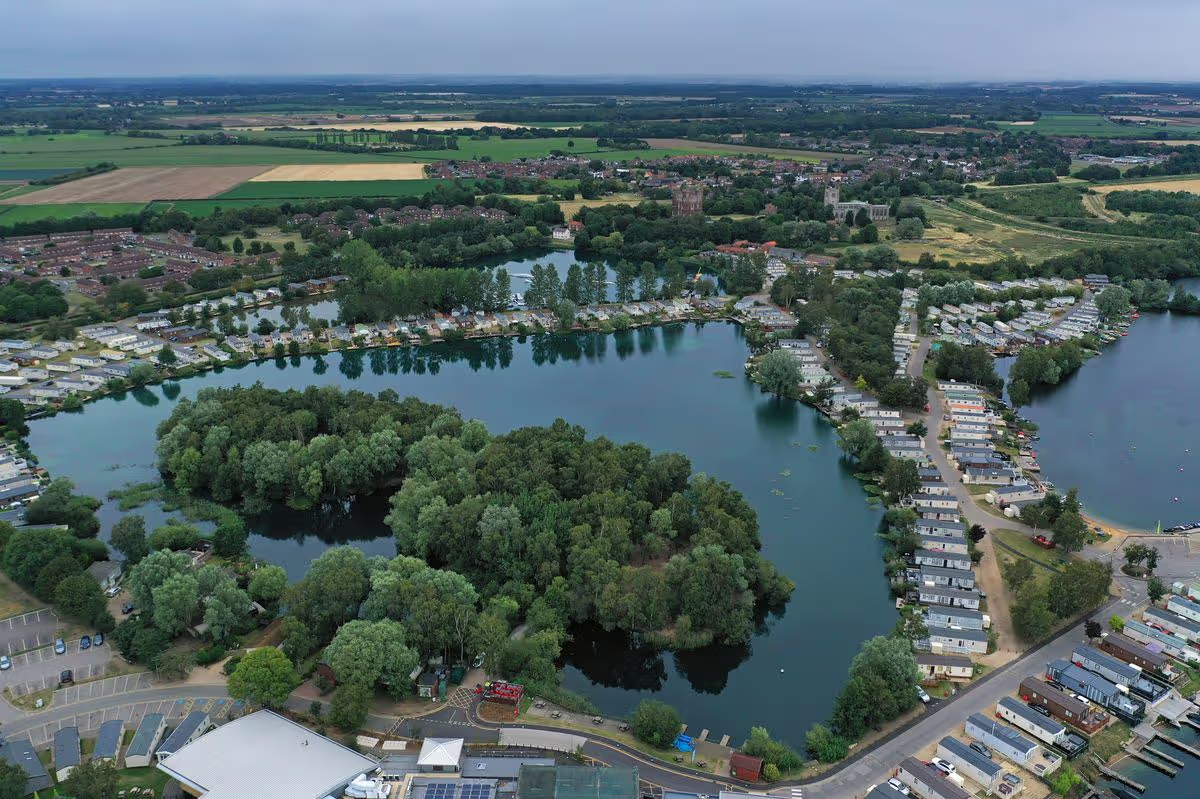
Stay overnight at Alton Towers, Chessington or Legoland and get year’s free entry to top theme parks

This offer means families could enjoy an entire year of theme park thrills across more than 20 Merlin attractions in the UK ensuring that the kids are kept entertained throughout the school holidays

February half-term is coming up soon, and as all parents know, this is just the first of many school breaks where you’ll be scrambling around to find something to keep the kids entertained. While taking them to theme parks may seem like a pricey option, there is a deal that means you enjoy many more days out during the school holidays in 2026.

Merlin Entertainment, who own huge attractions across the UK such as Thorpe Park, Alton Towers, Chessington, Warwick Castle, and LEGOLAND, is offering a deal they call ‘Stay for a night, play for a year’. Families who book a short break this February for certain spring dates can get a free Essential Merlin Annual Pass (MAP) for each guest, giving them free access to its theme parks throughout the year.

Bookings need to be completed before March 1, and stay dates for this offer include:

  • LEGOLAND and Alton Towers – stays between March 14 and June 26
  • Chessington – stays between March 20 and June 26
  • Thorpe Park and Warwick Castle – stays between March 27 and June 26

Look for a banner next to the hotel name that says ‘Merlin Pass Included’ when booking to see if it’s eligible for the offer.

Depending on which resort and hotel you choose, guests can enjoy facilities such as themed accommodation, breakfast included in the price, plus two days of fun at the theme park of your choice. You’ll also find perks such as access to the 9-hole golf course at Alton Towers and access to the SEA Life centre at Chessington.

And once you check out, you still have a year of fun family adventures to enjoy. You’ll get a Merlin Annual Pass delivered to your inbox when you book, offering 339 days of experiences and fun, which includes access to family-friendly days out like the London Eye, Madame Tussauds, and The London Dungeon. Simply activate the pass and it’s valid for 12 months with a few restriction dates.

Other attractions where the annual pass can be used include SEA Life centres across the UK, Cadbury World, Shrek’s Adventure! London and LEGOLAND’s Discovery Centres give plenty of options for days out.

Passholders can also nab 10% off Fastrack passes for days when you want to skip the queues, plus 10% off food and drink at the parks.

You can even redeem your pass before your stay and start using it elsewhere, so if you book now, you could use it on weekdays during the February half term to take the kids to one of Merlin’s attractions.

So, how much could families save? It depends on which hotel stay you book and how much you use the pass. A family of four could book a night at the Chessington Safari Hotel on Saturday, March 28 for £418 and get four free passes included. Buying Merlin Essential passes would usually cost £139 each, adding up to £556 for four people, so this is already a cheaper option if you’ve been considering buying the passes anyway.

READ MORE: PAW Patrol land first look as Chessington seeks children to test ridesREAD MORE: UK airports that have scrapped 100ml liquid rule ahead of half-term

Day passes to Alton Towers, as an example, cost £32 online and as much as £68 if you buy on the gates, so if you plan just a handful of theme park visits, this offer could save you hundreds over the year.

Full list of attractions where Merlin’s annual pass can be used

  • Alton Towers Resort
  • Chessington World Of Adventures Resort
  • LEGOLAND® Windsor Resort
  • The London Eye
  • Thorpe Park
  • SEA LIFE London
  • National SEA LIFE Centre Birmingham
  • SEA LIFE Manchester
  • SEA LIFE Blackpool
  • SEA LIFE Brighton
  • SEA LIFE Weymouth Adventure Park
  • SEA LIFE Great Yarmouth
  • SEA LIFE Sanctuary Hunstanton
  • SEA LIFE Scarborough
  • SEA LIFE Loch Lomond
  • Warwick Castle
  • Madame Tussauds London
  • Shrek’s Adventure! London
  • LEGOLAND® Discovery Centre Birmingham
  • LEGOLAND® Discovery Centre Manchester
  • The London Dungeon
  • The York Dungeon
  • The Edinburgh Dungeon
  • Cadbury World

Have a story you want to share? Email us at webtravel@reachplc.com
Source link

UK airports that have scrapped 100ml liquid rule ahead of half-term

UK airports that have scrapped 100ml liquid rule ahead of half-term – The Mirror


reach logo

At Reach and across our entities we and our partners use information collected through cookies and other identifiers from your device to improve experience on our site, analyse how it is used and to show personalised advertising. You can opt out of the sale or sharing of your data, at any time clicking the “Do Not Sell or Share my Data” button at the bottom of the webpage. Please note that your preferences are browser specific. Use of our website and any of our services represents your acceptance of the use of cookies and consent to the practices described in our Privacy Notice and Terms and Conditions.

Source link