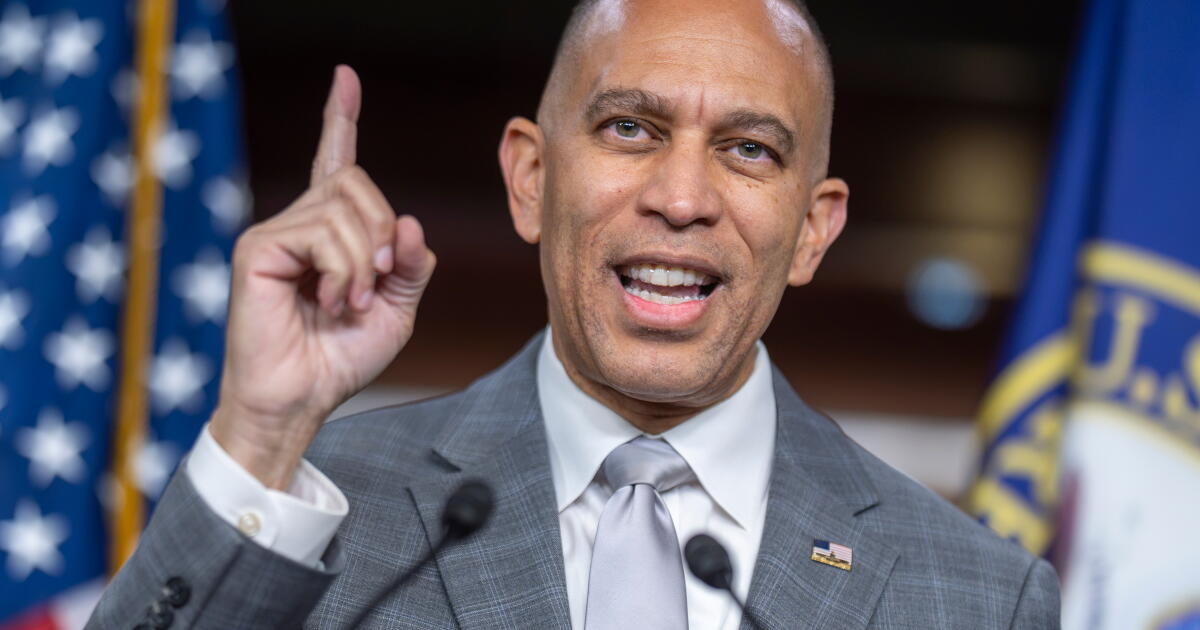
Hakeem

Hakeem Jeffries could become the first Black House speaker after Democratic nomination

Democrats overwhelmingly nominated Hakeem Jeffries on Wednesday to be speaker of the House, as he brushed past most skeptics and was on track to make history as the nation’s first Black lawmaker with the gavel.

Jeffries secured the nod during closed-door voting, 251-11, ahead of a full House vote when the new Congress convenes in January. Among those opposing him were a group of progressive newcomers, who said in a statement there is “still work to be done” to ensure their priorities.

Afterward, Jeffries vowed to work hard, through every corner of the Democratic caucus, in a country that gives each generation the opportunity to “show up, speak up, stand up, and help the country march toward a more perfect union.”

“Our job is to fight MAGA extremism, not each other,” he said, “and to get big things done for the American people.”

Jeffries, of New York, ran unopposed but faces a restive party eager for a change in Congress after voters ousted Republicans in a rebuke of President Trump and the party in power. Phone calls and social media campaigns have been flooding the offices of Democrats in both the House and the Senate, demanding a fresh start. Protesters heckled Jeffries last week during a Democratic conference in Denver.

Ahead of Wednesday’s vote, Jeffries said he was taking nothing for granted. He met with the caucuses that make up the House Democrats and talked to almost all members. Yet having led the Democrats to one of the biggest incoming House majorities in decades, he has room to spare as he works to shore up support and tamp down dissent.

Those opposing Jeffries, including some backed by the Democratic Socialists of America, signaled that talks are underway as they work to deliver Medicare for All, stop harsh Immigration and Customs Enforcement actions, get money out of politics and end Israel’s war in Gaza.

“We have worked to secure commitments from Leader Jeffries in good-faith conversations,” they said in a joint statement. “Those conversations are ongoing.”

Signing on were members-elect Darializa Avila Chevalier of New York, Adam Hamawy of New Jersey, Frederick Haynes of Texas, Melat Kiros of Colorado, Donavan McKinney of Michigan, Chris Rabb of Pennsylvania and Claire Valdez of New York.

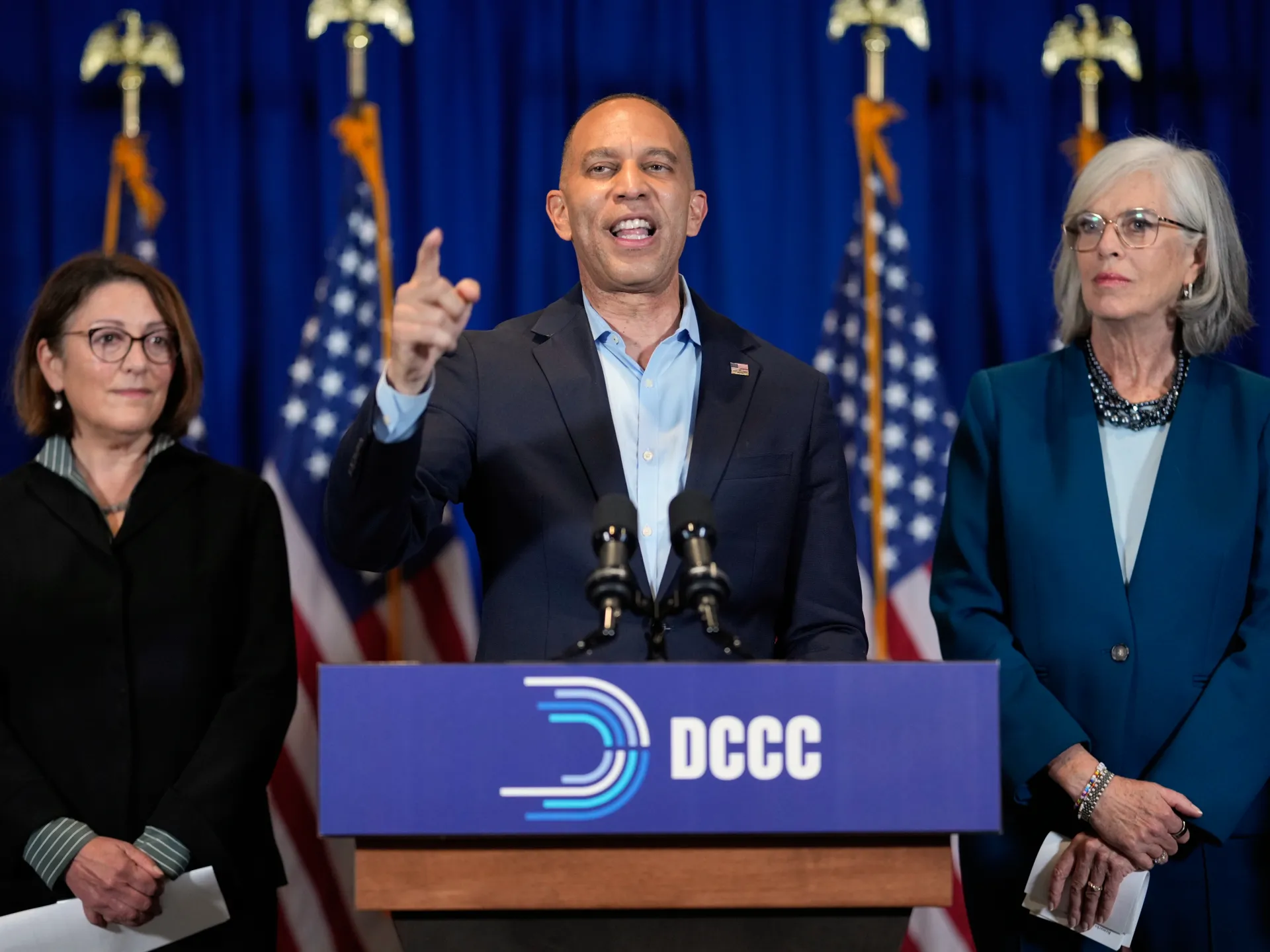
Jeffries is part of a leadership trio with Rep. Katherine Clark of Massachusetts and Rep. Pete Aguilar of California, who would all be historic firsts — Clark as the first female majority leader and Aguilar as the first Latino to serve as the majority whip. They also ran unopposed and were elected, as was Rep. Ted Lieu of California, as chairman of the House Democratic caucus.

Jeffries will face a separate roll call of the whole House to become speaker when the new Congress convenes on Jan. 3, 2027 — which would be a milestone for a nation that has struggled to create a representative democracy, since the first Black lawmaker was elected to the House more than 150 years ago.

At that time, he will need 218 votes, a majority, to secure the gavel.

Skeptics question whether leaders are up to the job

Wednesday’s vote was the first of their careers for dozens of members-elect, before they’re even sworn into office in January.

Jeffries was nominated for House speaker by five Democrats essentially representing all aspects of the caucus, including freshman Rep.-elect Rebecca Bennett of New Jersey.

Among those delivering nominating speeches was Rep. James Clyburn, the legendary lawmaker from South Carolina.

“This is a historic moment for our nation,” Clyburn told the room, according to his private remarks that invoked leaders past and voters’ outpouring for a change in the country.

Rep. Rosa DeLauro, D-Conn., discounting the naysayers and said, “It is a day in the history of this nation that cannot be diminished in any way. I could never be more proud to be a Democrat than I am today.”

Rep. Kweisi Mfume of Maryland, who first came to Congress in 1987 with the late Rep. John Lewis of Georgia, said: “It just means so much in terms of moving the ball forward. Somebody’s got to break the glass, and in this instance that’s exactly what has happened.”

The tally, with 262 votes cast, included those elected to the new Congress and the House delegates.

Returning Rep. Emily Randall of Washington said earlier she heard questions about House leadership during town halls in her district and had been watching direct messages stream into her Instagram feed about the leadership election. So she decided to start dialing them back.

“People have messaged me asking if Bernie Sanders could be the speaker of the House,” she said, referring to the Vermont independent senator who caucuses with Democrats. “Technically yes, and it would be probably difficult.”

(It’s true that the House can elect anyone speaker, but it’s unlikely to be Sanders because he already has his day job in the Senate.)

She said she was voting for Jeffries. Lawmakers pointed to the livestream that Rep. Alexandria Ocasio-Cortez of New York did trying to explain the role of the speaker and her support.

“There is one candidate in this race: Hakeem Jeffries,” Ocasio-Cortez said earlier at the Capitol.

First leaders of a post-Pelosi era

Jeffries, Clark and Aguilar have risen together, as a team, as the first new generation of leaders of the post-Pelosi era and will soon serve as leaders in the majority for the first time.

When Rep. Nancy Pelosi of California decided to step aside from leadership in 2022 after the party’s electoral defeat that handed Republicans the majority, it set the stage for this era.

A similar upheaval with Democrats angling for change is happening in the Senate, where Senate leader Chuck Schumer of New York faces a challenge from Sen. Chris Van Hollen of Maryland in elections next month.

Schumer insisted Wednesday he had the votes: “I will be reelected as majority leader.”

Returning Rep. Yassamin Ansari of Arizona said the situations in the Senate and the House “are quite different.”

She said Jeffries has been a collaborative leader who is listening to ideas from progressive caucus members like her and others. “His job is to reflect all of us, not just a faction,” Ansari said.

Rep. Shomari Figures of Alabama, who pulled off a stunning victory in a redrawn district favoring the Republican candidate, said before the vote that he’d be supporting Jeffries.

“It’s not even like a complex question,” he said about Jeffries, who he said “led us through what is likely the most tumultuous two-year tenure of any presidency in the history of this nation.”

“I’m not going to not stand by him right here on the precipice of history,” he said.

Mascaro writes for the Associated Press. AP writers Kevin Freking and Mary Clare Jalonick contributed to this report.

Source link

Who is Hakeem Jeffries, the Democrat poised to become House speaker? | US Midterm Elections 2026 News

With Democrats’ decisive victory in the United States’ midterm elections on Tuesday, House Minority Leader Hakeem Jeffries of New York is on the verge of making history as the first Black speaker of the US House of Representatives.

For the 56-year-old congressman, it would be the culmination of almost two decades in office, giving him a central role in Democrats’ efforts to rein in Republican US President Donald Trump in the final two years of his presidency.

Recommended Stories

list of 3 itemsend of list

But as Jeffries celebrated the “blue tsunami” that swept Democrats back into power the day after the election, some within the party were not convinced that the congressman, known for his cautious approach to politics and longstanding support for Israel, was the right man for the moment.

An online petition on Change.org calling on lawmakers to choose another speaker had collected more than 980,000 signatures by Saturday morning, while several newly elected progressive lawmakers have not said whether they will support him.

“We believe the Speaker should represent the Democratic voters, not just the Democratic establishment,” the petition reads.

“This is not a foregone conclusion,” it continues, urging others to run for the job.

Jeffries, who has spent years cultivating relationships within the Democratic caucus, now finds himself at the centre of a bigger fight within the party, as its growing progressive wing pushes for a more confrontational approach to Trump and a break with some of the ideas that have defined the Democrats for decades.

From Brooklyn to Democratic leader

Jeffries grew up in Crown Heights, Brooklyn, in the 1970s and 1980s, as the neighbourhood was grappling with the crack cocaine epidemic.

“There was a lot of dysfunction and pain that surrounded the communities that I was raised in, but also a lot of love and compassion from family and friends, and community folks,” he told NYU Law in 2019.

The son of two social workers, Jeffries eventually became a lawyer, tracing his decision to pursue a career in law back to the 1992 riots that erupted in Los Angeles after four white police officers were acquitted in the beating of Rodney King, a Black man.

“It crystallized the fact that we still had a long way to go to eradicate social and racial injustice,” he said.

Jeffries went on to work as a corporate lawyer before entering politics, losing two runs for the New York State Assembly before winning a seat in 2006 and eventually being elected to Congress six years later.

In Washington, he helped broker a bipartisan criminal justice reform law signed by Trump in 2018. Two years later, during Trump’s first impeachment trial, he argued that Trump should be removed from office as one of seven House impeachment managers who presented the case to the US Senate.

Rising quickly through the Democratic ranks, Jeffries became caucus chair in 2019 before making history three years later, when he was unanimously chosen to succeed former Speaker Nancy Pelosi as the party’s House leader, becoming the first Black politician to lead a party in either chamber of Congress.

Can Jeffries unite his party?

Jeffries and Pelosi have been compared for their distinct leadership styles. While Pelosi was known for her commanding, top-down approach, Jeffries has built a reputation for quietly and deliberately building consensus among his colleagues.

That approach has frustrated some Democrats, who say Jeffries has been too reluctant to take firm positions and who question whether he is prepared to confront Trump and Republicans in Congress aggressively enough.

Those concerns were on display after Jeffries declared after the election that “the American people don’t want us to get even; they want us to get things done on their behalf.”

Among those who pushed back was left-wing political commentator Hasan Piker, who reposted a video of Jeffries’s comments, saying: “No, we definitely ARE looking for justice and accountability.”

Jeffries also faced criticism after reports emerged in August that he had privately met Trump’s son-in-law Jared Kushner, who does not have a formal role in the administration but has been involved in diplomatic efforts in the Middle East and in Russia.

Jeffries defended the meeting, saying Kushner had requested it and that he had used it to discuss the affordability crisis. But critics argued that rather than meeting privately with Kushner, Jeffries should have been preparing to investigate his business dealings.

Ahead of the election, Axios reported on a plan by some incoming progressive lawmakers – informally known as “The Bloc” and including Claire Valdez and Darializa Avila Chevalier of New York and Melat Kiros of Colorado – to use the upcoming speaker vote to win concessions from Jeffries on issues such as Medicare for All, cutting funding for ICE, and weapons shipments to Israel.

That may be harder now that the Democrats have a comfortable majority, with Jeffries less dependent on progressive newcomers to secure the speakership. But the result also makes it harder for Jeffries to argue, as he has in the past, that Republican control of Congress is hindering the Democrats’ ability to advance their agenda and hold Trump accountable.

Jeffries’s Israel stance divides Democrats

Of all the sources of tension between Jeffries and his party’s progressive wing, the hardest divide to bridge may be over his longstanding support for Israel and ties to the American Israel Public Affairs Committee (AIPAC).

At a conference hosted by the group in 2020, Jeffries opposed putting conditions on US aid to Israel and described Jerusalem as New York City’s “sixth borough”.

He has also been one of the top recipients of financial support from AIPAC and its network of donors, earning the nickname “AIPAC Shakur” from New York radio host Charlamagne tha God.

In a celebratory post after the elections congratulating the candidates it had supported, AIPAC singled out Jeffries and Senate Democratic leader Chuck Schumer by name.

But Jeffries’s steadfast support for Israel throughout its genocidal war on Gaza has put him increasingly at odds with his own party, and he recently signalled that his position may be changing.

In July, even as he voted against an amendment that would have cut $3.3bn in annual military aid to Israel, he acknowledged the need for a reset in US-Israel relations.

“A meaningful change in direction is needed,” he wrote in a letter to colleagues.

Jeffries appears to have the speakership all but secured, with no serious challenger emerging so far.

However, with Trump still in the White House, a party grappling with its own divisions, and voters expecting change on everything from the cost of living to the war on Iran, the bigger test for Jeffries will come once he is on the job.

Source link

Hakeem Jeffries promises ‘affordability’ focus after Democratic midterm win | Donald Trump News

Democratic leader says party expects at least 255 House seats and promises to deliver on affordability.

Democratic House leader Hakeem Jeffries has celebrated his party’s sweeping victory in the United States midterm elections, calling the results an “American tsunami” as Democrats have taken control of both chambers of Congress.

“It wasn’t simply a blue wave. It was an American tsunami,” Jeffries said at a news conference on Wednesday, a day after Democrats pulled off upsets in several Republican strongholds.

Recommended Stories

list of 4 itemsend of list

Jeffries said Democrats expect to win at least 255 House seats once all vote counts are final, giving the party what he described as a historic majority.

“The American people have chosen common sense over corruption, chaos and cruelty,” he said.

Jeffries, who is set to become the first Black Speaker of the House when the new Congress takes office in January, said the results showed Americans wanted a change in direction.

“We’re humbled by the outcome,” he said, promising a “relentless effort to make life more affordable for everyday Americans”.

Speaking earlier on MS Now’s Morning Joe, Jeffries said Democrats would focus on getting things done rather than seeking revenge against President Donald Trump and his allies.

“We ran on affordability. We won on affordability. And now it’s our job to govern on affordability,” he said.

Democrats campaigned on bringing down the rising costs of groceries, petrol, housing and healthcare, which have left Americans feeling increasingly squeezed. But with Trump’s threats to use his presidential veto to block legislation he’s opposed to, Democrats may struggle to push through new laws even with a majority in Congress.

Jeffries pointed to a bipartisan housing affordability bill passed in July as an example of the types of legislation Democrats could pursue. The bill became law without Trump’s signature after he dismissed it as “a yawn” and “so unimportant”.

Jeffries also said Democrats would work to hold the Trump administration accountable for any wrongdoing, even as he acknowledged Americans wanted them to get things done, not “get even”.

“There’s a cost to corruption,” he said, adding that Democrats would follow the facts and the law, and “let the chips fall where they may”.

Source link