haitians

US ends deportation protections (TPS) for Haitians and Syrians | Politics News

NewsFeed

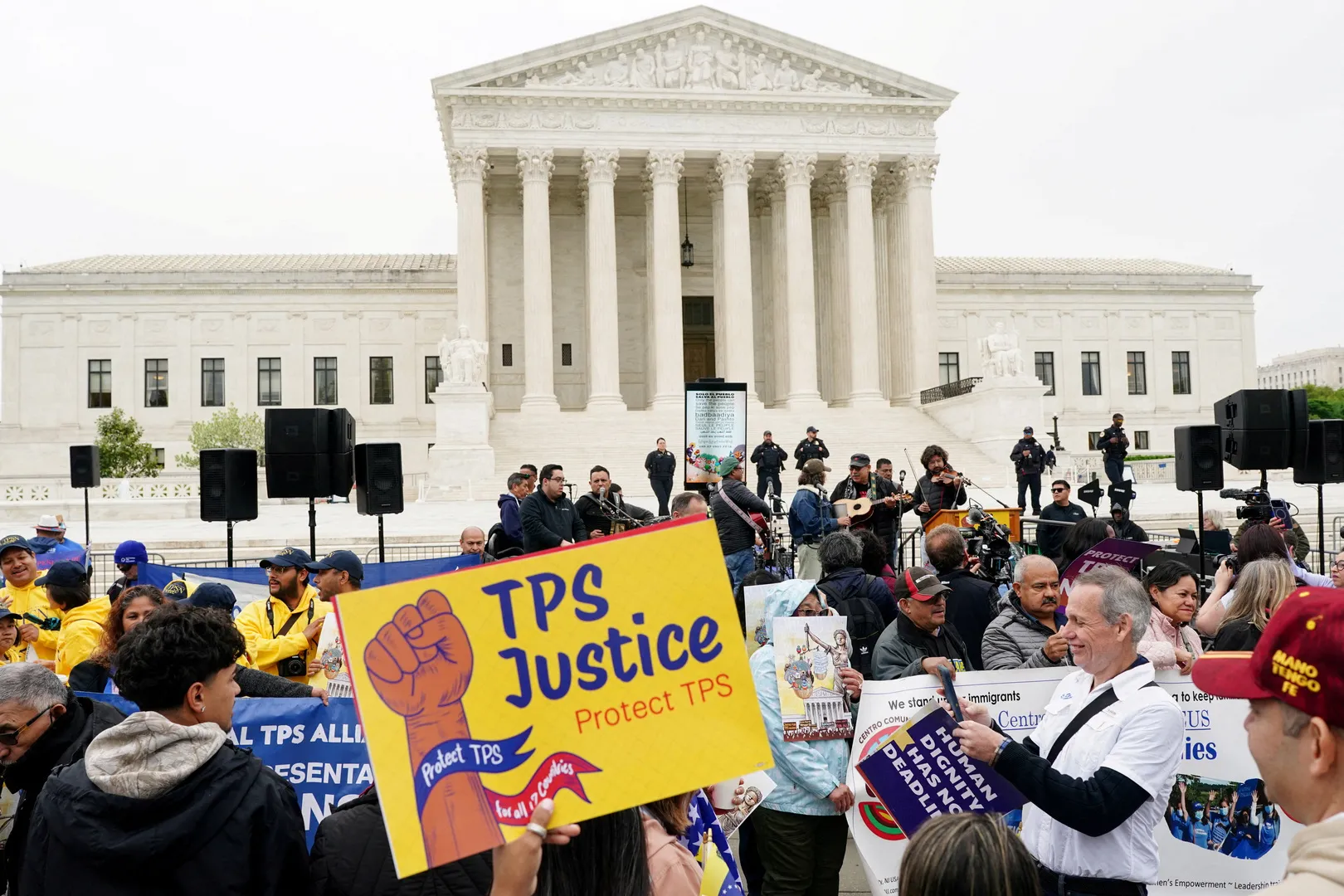
The US Supreme Court has sided with the Trump administration in its bid to end Temporary Protected Status (TPS) for Haitians and Syrians. The ruling allows the policy to take effect before the courts have reached a final decision on its legality.

Source link

Supreme Court rules Trump may end legal protection for Haitians and Syrians

The Supreme Court ruled Thursday that the Trump administration may end the Temporary Protected Status granted to more than 350,000 Haitians and Syrians whose home countries remain unsafe.

In a 6-3 decision, the court’s conservative majority said Congress gave the administration, not judges, the power to cancel or renew this temporary protection for non-citizens who are living and working here.

In a second win Thursday for the Trump administration, the court also upheld the administration’s policy of blocking asylum seekers at the southern border.

By the same 6-3 vote, the court said migrants do not have a right to apply for asylum if they are not already in the United States.

The decision on Temporary Protected Status could affect up to 1.3 million non-citizens who are in the country.

In 1990, Congress authorized this emergency humanitarian relief for non-citizens whose home countries were wracked by armed conflict, natural disasters or other extraordinary disruptions.

Under the law, the Department of Homeland Security may grant this protection for 6, 12 or 18 months and either renew or extend it for a similar period.

But this legal authority has been under dispute since Trump returned to the White House last year and targeted the 1.3 million people with TPS from 17 countries who were living in the United States.

Trump’s lawyers said the law made clear there was “no judicial review” of the government’s decision to cancel the grant of temporary protection.

However, immigrant rights lawyers argued the government failed in its duty to consult the State Department and assess whether it was safe for migrants to return home.

Repeatedly, U.S. district judges agreed with the challengers and ruled the administration’s decisions were “arbitrary” and unreasonable. But in nearly every case, the Supreme Court granted emergency appeals from the administration and set aside those orders.

Since TPS was created, the government has ended the protected designation for citizens of 18 countries.

DHS under then-Secretary Kristi Noem ended TPS for Honduras, Nicaragua, Afghanistan and Venezuela. A spokesperson for the agency previously said the Haiti designation became “a de facto amnesty program” and that allowing Syrians to remain is contrary to national interest.

Advocates for the immigrants argue that the administration failed to conduct the required process to properly evaluate each country’s conditions and instead acted on political grounds driven by racial animus.

State Department travel advisories for both countries warn people against traveling to either because of the risk of terrorism, kidnapping and widespread violence. But Federal Register notices announcing the terminations said country conditions had improved enough.

Recently released internal documents show that DHS decided to terminate protections for Haitians without any input from the State Department.

Citing the documents, which were obtained by the National TPS Alliance in a separate lawsuit, lawyers for the Haitians asked the Supreme Court to dismiss the case and send it back to lower courts. They argued that the justices should first consider the communications before issuing a decision.

Internal emails show that homeland security officials sought a recommendation from the State Department in May 2025, ahead of Noem’s early June deadline on whether to extend protections for Haiti. But by the time Noem signed what appears to be a final decision memo, U.S. Citizenship and Immigration Services had not received input from the State Department, the emails show.

“State recommendation for Haiti TPS has not come in despite of many outreach,” a homeland security deputy assistant secretary wrote in a June 2, 2025, email. A recommendation “would be helpful to have,” the person added.

Eleven days later, a USCIS project manager wrote in an email that Noem “recently elected to terminate Haiti without country conditions from DOS.”

USCIS initially recommended automatically extending protections before Homeland Security decided to terminate them, earlier versions of the memo indicate.

The June decision was blocked by a federal judge. In November, DHS issued another notice terminating TPS protections for Haitians.

That time, according a previously publicized email, a homeland security senior counselor asked a State Department official for the agency’s views on the country conditions in Haiti. The official, Spencer Chretien, didn’t address the country conditions but responded that “there would be no foreign policy concerns.”

Lawyers for the Haitians argued that response didn’t meet the legal standard for a sufficient consultation, though the Trump administration disagreed.

Source link

Supreme Court leans in favor of Trump’s bid to end protections for Syrian, Haitian migrants

The Supreme Court’s conservative majority sounded ready Wednesday to rule that the Trump administration may end the temporary protection that has been granted to more than 1.3 million immigrants from troubled countries.

Congress in 1990 authorized Temporary Protected Status, or TPS, for noncitizens who could not safely return home because their native country was wracked by war, violence or natural disasters. If those people passed a strict background check, they could stay and work legally in this country.

But President Trump came to office believing too many immigrants had been granted permission to enter and stay indefinitely.

Last year, his Department of Homeland Security moved to cancel the temporary humanitarian protection for immigrants from 13 countries, including Venezuela, Haiti, Syria, Honduras and Nicaragua. Court challenges on behalf of Haitians and Syrians were consolidated into a single case, Mullin vs. Doe, which the justices heard Wednesday.

Immigrant-rights advocates challenged those decisions as political and unjustified, and they won orders from federal judges that blocked the cancellations.

But Trump’s lawyers filed an emergency appeal at the Supreme Court arguing the judges had overstepped their authority. They pointed to a provision in the 1990 law that bars “judicial review” of the government’s decision to end temporary protection for a particular country.

The justices ruled for the administration and set aside the lower court rulings in a series of 6-3 orders.

Faced with criticism over its brief and unexplained orders, the justices agreed to hear arguments on the TPS issue on the last day of oral arguments for this term.

But the ideological divide appeared to be unchanged.

Solicitor Gen. D. John Sauer said Congress had prohibited “judicial micromanagement” of these decisions, and none of six conservatives disagreed.

UCLA law professor Ahilan T. Arulanantham, representing several thousand Syrians, said the Homeland Security secretary had failed to consult the State Department, which says it is unsafe to travel there.

He said the government “reads the statute like it’s a blank check … to give the secretary the power to expel people who have done nothing wrong.”

Chicago attorney Geoffrey Pipoply, representing more than 350,000 Haitians, said the cancellations were driven by “the president’s racial animus toward non-white immigrants.”

The court’s three liberals argued the administration failed to follow the procedural steps required under the law. But that argument failed to gain traction.

Justice Amy Coney Barrett and her husband adopted two children from Haiti who are citizens. Like most of the conservatives, she asked few questions during the argument.

Source link

House passes a bill to protect Haitian immigrants, in slap back to the Trump administration

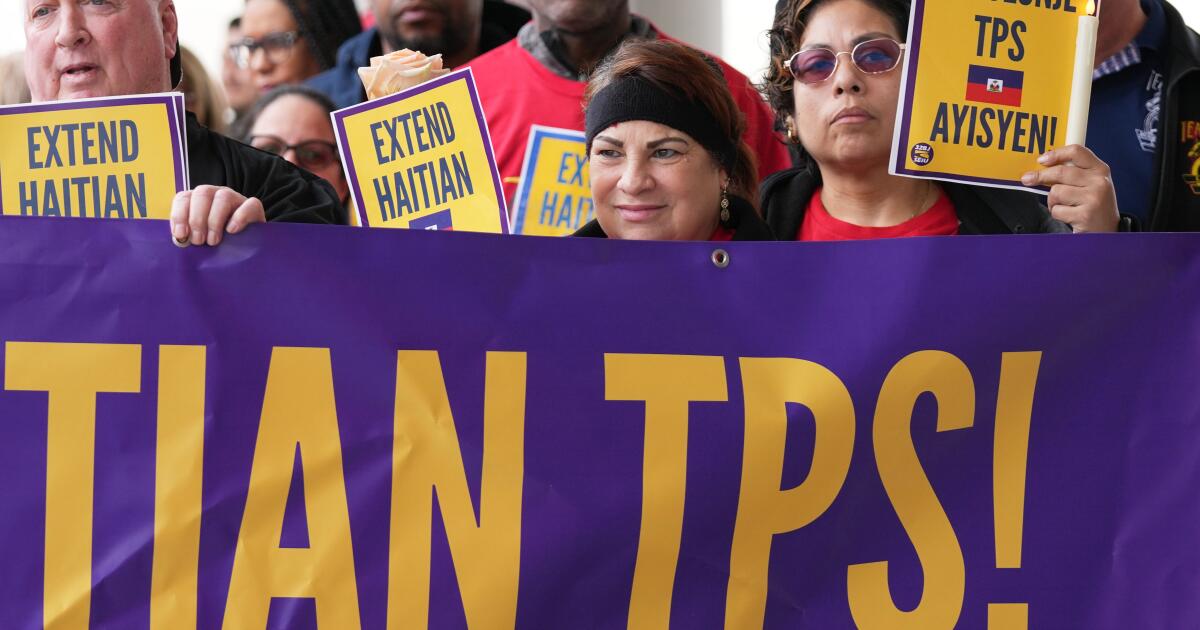
In a rare bipartisan moment, the House passed legislation Thursday that would extend temporary protections for Haitian immigrants, a long-shot effort fighting back against President Trump’s attempts to end the program.

The bill, pushed forward by House Democrats with a group of Republicans over the objections of the GOP leadership, would require a three-year extension of temporary protected status for Haitians by the Trump administration. That would allow hundreds of thousands of qualifying immigrants to remain in the United States without fear of deportation.

The vote was 224-204, drawing applause in the chamber. But it faces uncertainty in the Senate, and the Republican president would almost certainly seek to veto it.

“I know firsthand how important our Haitian neighbors are to our communities, to our civic life, to our culture, to our workforce, to our economy,” said Democratic Rep. Ayanna Pressley of Massachusetts, who is co-chair of the House Haiti Caucus and represents one of the largest Haitian communities in the country.

During the debate, she recounted the number of Haitian immigrants working in healthcare, housing construction and other industries. Haitians with temporary legal status “are not the problem, quite the contrary, they are part of the solution,” she said.

Pressley has said deporting Haitians back to the troubled Caribbean country would be a “death sentence,” given the effects of natural disasters and gang violence. “Congress can do the right thing,” she said.

Ten Republicans, many from districts with large numbers of Haitian residents, joined all Democrats and one independent in voting for passage.

Congress tries to act before the Supreme Court does

The effort to help 350,000 Haitians living lawfully in the United States comes as the administration is working to end the temporary legal status for several groups, exposing them to deportation.

In less than two weeks, the Supreme Court is prepared to consider a fast-track case that would end the protected status for Haitian and Syrian immigrants in a challenge widely seen as threatening the broader program. The administration filed emergency appeals after lower courts stopped the immediate end of the program.

It is part of the administration’s efforts to strip certain immigrant groups of legal status as the White House works to fulfill Trump’s campaign promise of conducting the largest mass deportation operation in history. Some 1.3 million people fleeing countries around the world have been granted temporary protected status in the U.S.

The protections for Haiti, first approved after a devastating 2010 earthquake, have been extended multiple times. The State Department warns Americans not to travel to Haiti “due to kidnapping, crime, terrorist activity, civil unrest.”

Guerline Jozef, executive director of the Haitian Bridge Alliance, an advocacy organization, fought back tears as she described the fear of deportations coursing through the community.

“We are asking, where will you be? On the right side of history?” she said at a news conference outside the Capitol. “Or continuing to cause trauma to people who are asking for nothing other than safety and protection?”

Trump has described migrants from poorer countries in vulgar terms, and he has falsely accused Haitian migrants in Ohio of eating their neighbors’ cats and dogs.

The conservative majority court has allowed the end of temporary legal status for a total of 600,000 people from Venezuela while lawsuits play out, leaving them to face potential deportation.

Lawmakers debate whether to help Haitians or stick with Trump

Rep. Laura Gillen (D-N.Y.) whose district includes Long Island’s Haitian community, said she promised constituents she would work to protect their status. She introduced the legislation with Republican Rep. Mike Lawler of New York as soon as she took office last year.

“It’s cruel to expect Haitians to be forced to return to these deadly, dangerous conditions,” she said at a news conference. “Human lives are at risk.”

Lawler said there are differences of opinion on immigration policy, but that Haitian immigrants have become vital to his community and forcing them out would be unjust and unwise.

“They are small business owners, they are nurses, they are caregivers, they participate in our economy and take care of American citizens,” he said. “Congress has a responsibility to act.”

But Rep. Jim Jordan (R-Ohio) decried the number of immigrants, including Haitians, who have entered the U.S., and cited Democratic efforts to halt funding for enforcement and deportation efforts.

“Make temporary permanent,” he said, “that’s their plan.”

Rep. Brandon Gill (R-Texas) said the program was “backdoor amnesty” for foreigners.

To Rep. Tom McClintock (R-Calif.), the temporary status first granted under the Obama administration has become “an open-ended invitation” for immigrants to enter the country, including some illegally, and remain.

“The Trump administration has heeded the cries of the American people,” he said.

Using a discharge petition to force votes

The vote was the latest effort by House Democrats to maneuver past the Republican majority using a discharge petition — once a rare tool, but now used increasingly to form bipartisan coalitions.

The discharge petition process forces the bill to the House floor for consideration, powering past House Speaker Mike Johnson (R-La.) and GOP leaders. It was used to help pass legislation that required the Justice Department to release the files of the sex trafficking investigation of Jeffrey Epstein.

Republicans hold a slim majority in the House and are typically able to swat back such efforts from Democrats. But Democrats and Republicans have formed bipartisan alliances to reach the majority needed on the discharge petitions.

Pressley’s effort to discharge the bill won support from four Republicans on the initial petition, and several more once it came to the floor vote.

Mascaro writes for the Associated Press.

Source link

House extends deportation protection for Haitians in the United States

April 16 (UPI) — The House on Thursday passed a bill to extend temporary protected status for people from Haiti who are living in the United States through 2029.

Rep. Ayanna Pressley, D-Mass., who is co-chair of the House Haiti Caucus, introduced a discharge petition to advance a bill to extend protection for Haitian nationals.

The legislation was initially introduced by Rep. Laura Gillen, D-N.Y., whose Long Island district — as well as the rest of Long Island and New York City — have large Haitian populations, and is the first bill she introduced after her election to the House.

After the discharge petition succeeded, with bipartisan support, the bill passed the full House with 10 Republicans voting in support of it.

“This is a critical step forward in our fight for immigrant justice and delivering our Haitian neighbors the protections they deserve — and it’s a testament to the strength of our broad, diverse and bipartisan coalition,” Pressley said in a statement after the motion to discharge was agreed to.

“I am grateful to my colleagues on both sides of the aisle who supported our discharge petition,” she said.

After the vote, Gillen in a statement encouraged the Senate “to take up this measure and show the compassion and good sense to protect our Haitian community members.”

“Not only would this threaten the lives of our neighbors, it would also have a devastating effect on our economy,” Gillen said, noting that the extension protects “law-abiding and tax-paying Haitians who would face horrific condition if forced back to Haiti.”

The bill, however, faces a battle in the Republican-run Senate and, if it does get passed, the White House has indicated that it will veto the legislation, reports have said.

Although former Homeland Security Secretary Kristi Noem had attempted to end TPS for at least half a million Haitians last Fall, a judge in February blocked the Trump administration from carrying it out.

As a result of the ruling, TPS for people from Haiti expired on Feb. 3, its original expiration date, according to U.S. Citizenship and Immigration Services, which Pressley said made the discharge petition to force a vote on the bill so crucial.

The Supreme Court also is due to rule on the Trump administrations efforts to end TPS for Haitians, as well as for people from Syria, who have protected status because of the dangerous situation in that country.

First lady Melania Trump speaks during a House Ways and Means Committee roundtable discussion on protecting children in America’s foster care system in the Longworth House Office Building near the U.S. Capitol on Wednesday. The bipartisan group of lawmakers are looking to address challenges children in foster care face, including barriers to education and educational advocacy, housing, employment opportunities, financial independence, and technology. Photo by Bonnie Cash/UPI | License Photo

Source link