Two days with no games allowed the Lakers to fully reset as they prepare for the final stretch of the regular season and a playoff run.
They have eight games left, starting with the NBA lottery-bound Washington Wizards at Crypto.com Arena on Monday. The Lakers will play without star guard Luka Doncic because he’s serving his one-game suspension for reaching the league limit of 16 technical fouls.
The Lakers had an early practice Sunday and that gave them a chance to make adjustments with fresh bodies and minds.
“Yeah, for me, I think, based on all of them wanting to come in at 10 a.m. on a Sunday, I think it is as much mental and spiritual and emotional,” Lakers coach JJ Redick said after practice. “We didn’t want to have these guys in here long today. But we got a lot done, watched some film and cleaned some stuff up. But there is these two days for us. It’s a great reset for us.”
Doncic got his 16th technical foul of the season Friday night during a win over the Brooklyn Nets after an exchange with Ziaire Williams, when both were given double technical fouls in the third quarter of that game.
For Doncic, who earns $45.9 million per season, the suspension will cost him about $264,000.
If he gets two more technical fouls between now and the end of the regular season, he will be automatically suspended for an additional game.
Doncic is eligible to return for the Lakers on Tuesday night when they host the Cleveland Cavaliers.
“I mean, he’s disappointed,” Redick said of Doncic. “He wants to be there for his teammates, and again, I’ve talked about this all year, like he plays. He’s not a guy that takes games off. He can be banged up and he’s gonna play. He was like that when I was his teammate in Dallas. For tomorrow, we’ve gotten, I think, some great contributions from guys that haven’t necessarily been in the nine-man rotation when we’ve been fully healthy.”
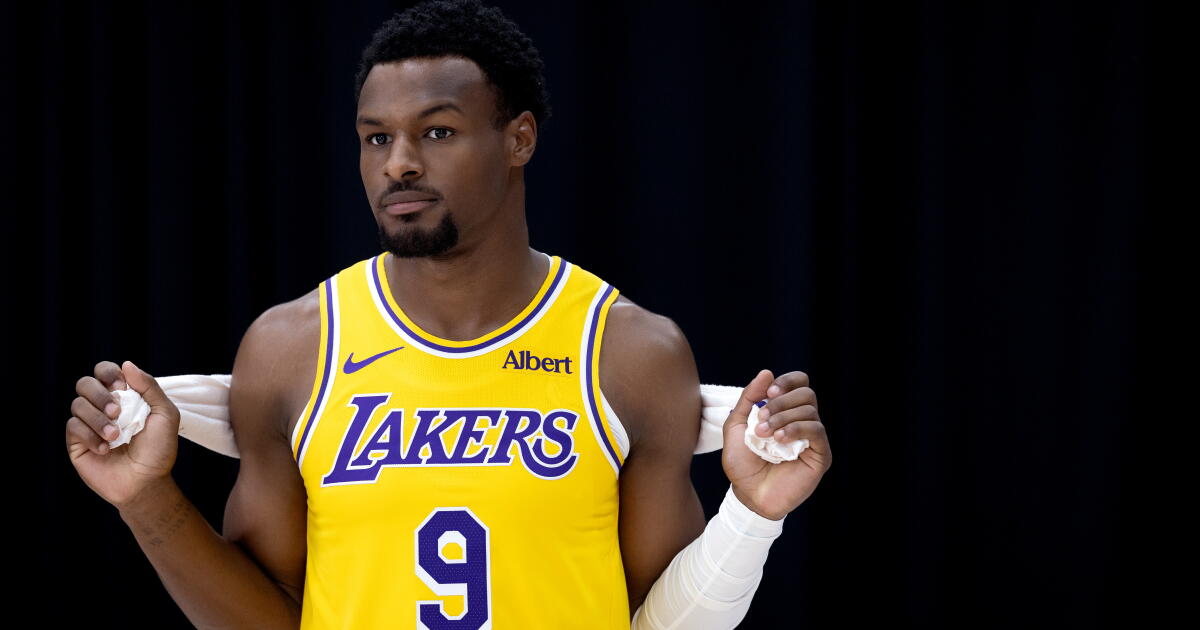
Redick spoke about how Bronny James, Jarred Vanderbilt and Maxi Kleber have all had “good moments” when they were called on for duty.
And with Doncic out, Redick said it will take a group effort to beat the Wizards.
“But we’re gonna need everybody tomorrow,” Redick said.
The Wizards have the third-worst record in the NBA at 17-56. They are second to last in the league in points allowed, giving up 124 per game.
Still, this is all about the Lakers and how they get ready for the playoffs during the final few games of the season .
Half of the eight games are against teams with records below .500.
The Lakers will face a Cavaliers team that’s making a push for better positioning in the Eastern Conference. They will twice face an Oklahoma City team that has the best record in the league and a Suns team that has a 3-1 record against the Lakers.
“That’s the thing I’ve talked about all year is you need great effort and you need great execution,” Redick said. “I think the effort part has been there very consistently for weeks now. Sometimes when the games are stacked together and travel and all that, there can be some small details, execution-wise, that can have slippage, and I think for us, especially on the defensive end, we can do some things better. But I mean, look, the last 16 games we are where we are because we’ve been really good on both ends.”
Etc.
Redick said guard Marcus Smart (right ankle contusion) and forward Adou Thiero (left knee soreness) are in “that day-to-day camp” with their injuries.
“So we’re just kind of waiting for them to feel like they’re good enough to go,” Redick said.
Ranting about the decline of comedy specials while releasing a new one at the same time feels a bit like an oxymoron. But somehow it still makes sense coming from alt-comedy pioneer David Cross, who isn’t just complaining; he’s finding his own route to making specials feel special again. The only way to do that is by putting one out in the manner he’d like to see more often — starting by making the whole crowd stand up too.
Capturing the energy of a concert at the famous 40 Watt Club in Athens, Ga., was the first step in differentiating “The End of the Beginning of the End” from the typical hour you watch on a big streamer. And, with this new special, Cross is able to get back to his own beginnings of touring across the country with love bands as his openers, performing for crowds for as long as he could until he had to run offstage to pee.
Premiering the special earlier this month on his website (and on April 7, it will be available on YouTube via production company 800 Pound Gorilla), Cross is hoping the special connects with comedy fans in a way that we’ve forgotten specials could.
This interview has been edited for length and clarity
Your new special is called “The End of the Beginning of the End.” What does that title mean to you as it relates to the impending doom of what we’re all living right now.
David Cross: Well, you can look at it in a couple different ways. To me, it signifies that the beginning of the end has occurred. And we are now at the end of the beginning of the end. And from where you go with that, that’s for you to decide.
One of the things I love about the special is the fact that you shoot it at a club in the style of a live–music concert.
I’ve shot specials in theaters and it’s just different, not that one is better than the other, but they’re just different. You have a different relationship with the audience. When I first started touring, I would go to music venues and I’d have a band open for me and then I would just go up and pretty much [perform] as long as I could until I had to pee. Sometimes I’d have a band playing, sometimes two bands, then I’d go out. And I did that a couple of times, and then stopped doing that and did theaters, and I decided for the last two specials I’m going to go to, when I shoot it, I’ll go to a music venue, and I was at the 40 Watt Club in Athens this last time, I was at the Metro in Chicago before that, both places I played on earlier tours, and, you know, it’s not seated. People are standing there at the stage, and I prefer it. It’s more fun. It’s not as lucrative but, to me, a more fun show to do.
Comedian David Cross
(Jason Armond / Los Angeles Times)
The ambience of it was great.You can hear people shouting and drinking and having a good time, and the crowd work is also a little more spontaneous and fun than it would be in a regular venue.
Yeah, well, there’s more opportunity for that. But my thing has never been about crowd work. I like engaging with it, it’s kind of a nice distraction from the set that you’ve been doing 100 times, 150 times at that point. So it’s always fun to have that thing happen and that feeling of spontaneity. And like the guy [who I talk to in the crowd during the special], I could not have asked for [someone better]. I mean, even if it was scripted, it wouldn’t have been as good. The guy who [I talk to] during the stuff about hiking Machu Picchu [with Bob Odenkirk], that’s just… [chef’s kiss].
Speaking of Bob Odenkirk, you guys have this long relationship. How would you describe the dynamic of working with Bob and just how you guys bounce ideas off each other?
I mean, it’s great. We have an inordinate amount of respect for each other, both as people and as creative partners. And so there’s never any real issues. There’s things we will definitely disagree with, but we’re both decent people. So you know somebody backs off and says, “OK, let’s do it that way.” But even then, there aren’t that many of those [issues]. We just have really worked well at building something or molding it, creating it and shaping it. And our aforementioned hike to Machu Picchu, we have a documentary about that, that will be premiering at a fancy festival at some point in the near-future. And so we got that doc and we’ve been working on that. And for the way we work now, because he lives in L.A. and I live in New York, and it’s been like that for a while, he’ll write a bunch of stuff, I’ll make notes, I’ll write my things, send it back. And so we’re able to do that and not necessarily have to be in the same room because we’ve had 30-plus years of working with each other.
It’s a kind of like an unspoken language you guys probably have in terms of comedy, which is super important, I imagine, just for collaborating.
Yeah, and it’s something we discovered very early on … before there was even “Mr. Show,” what would ultimately become “Mr. Show,” when we got together to write sketches for this bigger kind of comedy collective thing, and these shows that we would all do with each other, for each other, and the stuff that we would write together was just, like, really good, easy writing — again, one person adding this thing and one person saying here’s a switch yeah and another person adding this thing in. It was fun, it’s cool, still is. One thing he doesn’t get credit for is he’s a really decent human being. And with all the awfulness in the world that’s magnified, every sense is bombarded with it — it’s just good to be hanging with somebody whose energy is a good person, a decent person and an equitable, nice guy, so that’s good as well.
Comedian David Cross poses for a portrait ahead of his comedy special “The End of the Beginning of the End.”
(Jason Armond / Los Angeles Times)
One thing you guys also have in common is you both have kids, and he has a comedy show for kids called “The Appropriate Show.” Have you taken your daughter to see it?
It’s a sketch show [in which] all the sketches are appropriate for kids to watch. And the sketches have been done in other sketch shows onstage, live. And he puts together this thing once, twice a year here in L.A. And I took my daughter to it last year. It’s just sketches that kids can [understand]. At least if they don’t understand the actual references they get the archetype. “Oh, that’s the boss, that’s that uh… And it’s great, it’s a really cool idea uh… “ And would an ass— think of [a show like] that? No, one good decent person; a good man. But listen, this interview isn’t about me, it’s about Bob Odenkirk, so let’s get back to that.
Well, speaking of having comedy geared toward kids, your daughter’s at an age where she’s probably consumed or seen some of your comedy at this point.
Not, not really. No, no.
Do you shield her from your stuff, or are you not so concerned about it?
I don’t actively shield her, but I don’t introduce her to anything. So I was a little bummed out, and I got over it pretty quickly, but when I found out that she had seen a little bit of “Alvin and the Chipmunks,” and only because I don’t want to spoil the enjoyment of what movies are and what kids’ movies are and how things work. And I feel like that would introduce an element of reality that I want her to be able to just enjoy these things without — she’s seen “Kung Fu Panda”when she was younger, like, I don’t know, three, four, five times, has no idea that I’m in that, that my voice is in there. She knows I do stand-up, she gets that now. And when she was younger, she’d say, “Daddy’s silly for a living.” … I’m just trying to ride the balance of letting her have those childhood joys and experiences.
Comedian David Cross.
(Jason Armond / Los Angeles Times)
Does having a kid make you think about what’s coming up in the future of comedy, or what kids are gonna maybe find funny, or what they find funny now? Do you have any thoughts on kid comedy in general?
Not really. I mean, I can see that she and her friends, who are kind of like-minded, are naturally funny, and then that’s kind of encouraging and heartwarming and they’re silly, but I’ll be long gone when that generation is is providing comedy. And I’m still, although I’ve kind of given up, I’m still trying to grasp what works now. I mean, it’s short-term TikTok, Instagram stuff. There are some amazing, like really, really great things being done as far as film sketches for YouTube channels. “Almost Friday,” they’ve got genius-level stuff. I mean, really good. And where the sketch goes in a place, you’re never ahead of it, goes in a place where you’re not expecting. It’s really well written and well performed.
What are your thoughts on what a comedy special is nowadays or what it should be?
I mean, that’s a great question. I think anybody who plays with the form, whether I think it’s that funny or not, is different. But I’m happy when anybody kind of tries at least to play with a form. I just went to Rory Scovel‘s taping last week of his latest special. I don’t know when that’ll air, but if you’ve seen the beginning to his first special, stuff like that where you’re like, “Wait, what’s happening? What’s going on?” I love stuff like that.
I still get excited to watch specials by some of my favorite comics, but there’s a quality that’s missing. And these are stand-ups I love, and they’re not that great. They’re not bad but they’re not special, you know? And all those guys I mentioned, and more, have great specials. Like, you can go back and they’re great. And I don’t know why that is. I mean, there’s still funny stuff, but I don’t ever want to get to that place where its just feels a little phoned-in a little bit… that is, in part, why the last two specials were shot in this more intimate setting that feels special. And … as I said, the energy’s different, it’s a little bit different, and it’s less slick. It feels like you’re in the moment. You don’t need a million dollars to shoot a special. You don’t 28 camera angles, it‘s just bull—. And it takes something away.
Comedian David Cross
(Jason Armond / Los Angeles Times)
It all should feel the right amount of unsafe as well, I think.
That’s never gonna happen at a theater show. You’re never gonna feel that. And I don’t know, it really does feel almost like maybe we peaked in a sense, like there’s too much, and because of that, these things aren’t special. They’re not revelatory, they’re not unique. I dunno, can 18,000 people in an arena really relate to a … billionaire talking about how they’re gonna get canceled. I mean, is that a thing I guess? Those other big, slick specials that are shot in, like, a 3,200-seat, 3,500-seat theater, it just feels like, “Oh this person is up there and I’m listening to their jokes.” There’s nothing wrong with that. They’re often very funny jokes, but it doesn’t go beyond that. It’s just like, “All right, tell me your joke.” It might as well be an audio thing, you know?
Well, hopefully the robots aren’t coming for your job anytime soon.
Absolutely not. I mean, this could be naive, but I feel 100% safe that you are never going to replicate an evening of stand-up at a nigtclub like that. And not sitting down at tables while you’re having drinks and waitresses are coming by. I’m talking about everybody’s up on the stage, sold-out, maximum capacity; everybody’s there, focused, we’re all sharing that thing. You can’t. AI’s not going to be able to do that.
Yeah, the robots can’t do that, Terminator can’t do that..
Oh, I forgot about Terminator. He could do that. G— it.
Three weeks into spring practice, USC football coaches are making one thing clear: 95% of their best will not be accepted or tolerated. Wednesday’s practice started with some of the players doing up-downs after forgetting equipment.
“It was a good message from some of our staff and leaders in terms of the approach that we need to have every day that we come out here,” Trojans coach Lincoln Riley said.
A sentiment that was shared by junior defensive tackle Jide Abasiri: “We just have to be better prepared.”
After the hiccup, Riley said the team responded well and it was back to business.
USC defensive tackle Jide Abasiri (97) is pushing himself to be a more vocal leader as a the Trojans help young players get acclimated to the program.
(Gina Ferazzi/Los Angeles Times)
After a spirited day on the field on Tuesday following a one-week spring break, Wednesday’s practice was scripted with the intent to cause stress and create discomfort — stacking multiple two-minute drills after a 6 a.m. team meeting. The goal is to build a no-excuses program.
“It’s invaluable time, invaluable reps,” Riley said. “Coming out and working plays and the techniques, great. When you start putting those guys in real-life situations and you make it really difficult on them, you really start to see who rises up and they’re great teaching moments for these guys and for the team in terms of what we want to be and what we want them to be.”
Regardless of the mental challenges Riley applied, the Trojans’ morale remains positive as players compete for spots in the lineup. The energy of the team comes from within, Riley said.
“It allows us as a staff to really hone in on pushing these guys, and coaching and critiquing and correcting,” Riley said. “And they’re taking it well.”
Attention to detail has always been important at USC, but Abasiri said this year there is an extra emphasis being placed on play-specific details. The staff has implemented drills that focus on a player’s specific movement or job during various plays.
Entering his third season with the Trojans, Abasiri said he felt like he needed to be a team leader. USC landed the No. 1 class in the nation for the first time since 2006. With so many new young players joining spring practice and a limited number of Trojans with three years of experience, Abasiri felt it was his job to lead.
“Just being an older guy, I feel like it’s important for me to … help them just come along,” Abasiri said.
So far, his advice has been to “just have fun with it.”
“I mean, obviously, stay on top of everything and all your stuff, but I feel like people get so stressed and so caught up in what they’re doing that they forget that this is supposed to be enjoyable,” Abasiri said.
The coaching staff, meanwhile, is balancing teaching schemes and the playbook.
“You have to be able to do both at this level,” Riley said. “The new guys that came in did have a pretty good foundation. A lot of them came from really good programs. A lot of them had a pretty good working football knowledge to where when we got started with them, it wasn’t like you felt like you were starting from literal square one.”
Return game is still unsettled
USC is still working to identify its top kickoff and punt return options.
“We haven’t done a lot of live returns yet,” Riley said. “We’re just trying to figure out who really fields the ball well, who understands it, who makes decisions and honestly, the returners, they’re showing us a lot of what they can do just in the offensive and defensive periods.”
The coaching staff has a pretty good idea who some of the best players in that position are, but at the moment, they just want to develop the skills, from a return standpoint.
PHOENIX — Dodgers right-hander Yoshinobu Yamamoto went into his final start of the spring with a focus on throwing first-pitch strikes, while also hoping to test his composure with men on base.
He achieved both Friday, limiting the traveling half of the Padres’ split squad to three hits in five scoreless innings. The next time Yamamoto takes the mound for a game, it’ll be on opening day at Dodger Stadium against the Arizona Diamondbacks on Thursday.
“There were a few things I wanted to try,” Yamamoto said through an interpreter after his part of the Dodgers’ 4-3 win. “And [Friday] I was able to get into the game very nicely.”
The game featured a possible preview of the Dodger’s opening-day lineup — “I don’t know, we’ll see, it’s some good players,” manager Dave Roberts said with a smile.
Few roster decisions remained, after camp cuts Wednesday included right-handers Kyle Hurt and River Ryan, and infielder Ryan Fitzgerald.
“They’re always difficult with guys hoping, expecting to break with us,” Roberts said of his conversations with cut players. “There’s obviously some good ones where you tell a guy that he’s going to make the club. But I think the main thing that just shouldn’t get lost is, it’s not always just about starting. It’s where you finish.”
As of Friday, Hyeseong Kim and Alex Freeland were still locked in a second-base battle. And the Dodgers had to sort out roles at the back end of the rotation.
Roberts said he expected to carry a swingman who would likely pitch multiple innings out of the bullpen early in the season, when the Dodgers’ schedule includes frequent off days, and later serve as a sixth starter.
Yamamoto, however, had been the clear choice to lead the rotation, long before Roberts made it official Monday.
“It’ll be nice to hand the ball to him and it’s not an elimination game,” Roberts said, referencing Yamamoto’s World Series MVP performance. “That’ll be fun for me.”
Coming off pitching meaningful games in the World Baseball Classic, Yamamoto had one last chance Friday for a tuneup.
He struck out the first three batters he faced, with first-pitch strikes to each.
The next inning, Yamamoto gave up back-to-back one-out singles. He escaped the jam with two more strikeouts. Yamamoto tallied seven strikeouts in an overall smooth performance.
“He came out, really, with a purpose,” Roberts said. “And I thought everything looked good, the fastball — the life to it, the command of it — the cutter, slider, curve ball was good, the split, everything was good. And very efficient. And pretty effortlessly got through five innings, so that was really good to see.”
Aden Holloway, the second-leading scorer for the Alabama men’s basketball team, was arrested Monday on a felony drug charge and may not be available for the Crimson Tide during March Madness, pending the university’s investigation into the matter.
Alabama coach Nate Oats said that after he told his players about the situation, the team went out and had “a really good practice” four days ahead of its first-round NCAA tournament game against Hofstra.
“Aden’s one of our guys, and everybody wants to wrap their arms around [him],” Oats said Monday during an appearance on the Crimson Tide Sports Network. “Everybody makes some mistakes in life, but [the players] also understand we’ve got to move on … and the team’s got to go play Friday.
“So I thought we did a good job of that this morning, kind of addressing the situation, what we currently knew at the time, and got our guys focused on practice.”
Holloway’s arrest came after the West Alabama Narcotics Task Force searched a residence near campus and “recovered more than a pound of marijuana, paraphernalia and cash,” the Tuscaloosa Police Department said.
The 21-year-old player is facing a first-degree charge of marijuana possession, not for personal use, which is a Class C felony and carries a penalty of up to 10 years in prison and a maximum fine of $15,000.
Police said Holloway also will be charged with failure to affix a tax stamp, another felony. Holloway was taken to jail shortly before 10 a.m. and was released less than an hour later on a $5,000 bond.
Alabama said in a statement Monday: “The University is aware of the allegations and is working to gather more information. The student has been removed from campus pending further investigation by the UA Office of Student Conduct.”
Oats said players need to be held accountable if they fail to meet the standards set by the program.
“So, you know, we had to suspend [Holloway] pending the investigation by the UA office of student conduct,” Oats said. “And we’re certainly disappointed in his behavior. But that being said, we still love him. He’s still our guy. We’re helping him get the help he needs, and we’re going to continue to help him whatever way we can.”
Meanwhile, the Crimson Tide, the No. 4 seed in the Midwest Region, continues to prepare to face 13th-seeded Hofstra on Friday without a player who averages 16.8 points a game. Sophomore guard Labaron Philon Jr. leads the team with 21.7 points a game, and sixth-year senior Latrell Wrightsell Jr. is averaging 12.8 points.
“I did tell our team, this team more than any team I’ve ever coached is better equipped to handle a situation like this,” Oats said. “I don’t know how many games we went into where we had a game time decision. Guy goes, warms up, and we got to decide whether he’s going to play or not an hour before the game. … We’ve won plenty of games with guys not available, so our guys will be ready to go against Hofstra.”
No. 7-seed UCLA’s (22-11) push for another deep NCAA tournament run begins Friday against No. 10-seed Central Florida (21-11) in Philadelphia in the East Regional. If the Bruins win, they will face the winner of No. 2 Connecticut (29-5) versus No. 15 Furman (22-12).
Cronin was hoping the Bruins, who flew home from the Big Ten tournament in Chicago on Sunday morning, would get a break and open postseason play Friday rather than Thursday. He recalled playing in the American Athletic Conference tournament championship on Sundays and still getting assigned Thursday NCAA tournament games, but Purdue coach Matt Painter told Cronin on Saturday night that he should be in line for a Friday NCAA tournament opener and the forecast proved accurate.
Cronin said the universal UCLA program focus on NCAA tournament success drove his decision to hold forward Tyler Bilodeau and guard Donovan Dent out of a 73-66 Big Ten semifinal loss to Purdue on Saturday night at the United Center. Bilodeau’s injury was a minor knee sprain suffered in the win over Michigan State on Friday, while Dent suffered a minor calf strain early in the game against the Boilermakers. Both are expected to be ready to play Friday.
“Tyler could have played [against Purdue.] You know, Donny could have played. They would have been playing hurt,” Cronin said after the loss to the Boilermakers. “I wouldn’t have played them in a regular season game. I just try to take care of guys.”
The coach said the extra minutes played by Eric Freeny, Xavier Booker, Steven Jamerson II and Brandon Williams will help the Bruins when the full lineup is in place for NCAA tournament games.
He called the team’s effort to push eventual Big Ten champion Purdue valiant, but the games ahead in March simply mean more to the Bruins.
“With all due respect to the Big Ten, you could see how hard our guys are trying to win,” Cronin said. “But our guy are well aware, because they practice under 11 banners that say national championship every day. They warm up under another banner with 19 Final Fours on it. We don’t even have one with conference championships cause there’s 36 or something. There’s so many. So [this] week is what it’s about for us.”
UCLA enters the tournament on a 4-1 streak, looking especially strong since the calendar hit March.
“I was happy with the way we competed,” Cronin said when asked whether he learned anything about his players during a spirited Big Ten tournament run. “… We got talent, we just haven’t always had our mind on defense, which is very rare for teams that I coach. We got great guys. Since March 1 or whenever the heck we played Nebraska, it’s been a noted change in our team, we’ve just got to keep it up. And we’ve got to get some rebounds out of the five spot.
”… We’re at UCLA, no matter who we take the floor against in the NCAA tournament, we’re going to be the ones wearing the baby blues and four letters. So we believe in ourselves.”
UCF is coached by former Duke star Johnny Dawkins. Point guard Themus Fulks is a key leader for the Knights, earning third team All-Big 12 honors after averaging 14.1 points and 6.7 assists per contest during the regular season.
UCF posted top-25 wins over Kansas, Texas Tech and Brigham Young.
Makai Lemon got another chance Thursday to demonstrate his skills for NFL scouts.
About 50 of them — representatives from each of the 32 teams — gathered at USC to spend a few hours evaluating the school’s latest class of draft prospects. Lemon, who won the Biletnikoff Award last fall as college football’s top receiver, had everyone’s attention.
“Running good routes, catching the ball, running fast,” he said of his objectives for the day. “Whatever I showcase, let them know I can do it at a high level.”
It was a more comfortable setting than Indianapolis. At the scouting combine, Lemon’s performance at the podium drew scrutiny — not for anything he said, but for how he said it. He swayed. He was measured, unhurried, visibly unbothered. Some read it as detached. Others saw something else entirely.
“We don’t want a guy who’s phony and coached up,” said one team executive, speaking on condition of anonymity. “We want a guy to be his authentic self. As long as he’s not a jerk, we love it.”
Rams general manager Les Snead, who attended Thursday’s workout of 17 USC players, put it another way. “At the combine you’re usually getting some version of a personality,” he said. “A lot of times it’s, ‘This is my interview personality,’ and that’s not necessarily who they are 365 days a year.”
USC receiver Makai Lemon catches pass during a drill at the NFL combine in Indianapolis last month.
(Julio Cortez / Associated Press)
The other USC prospects who participated in Thursday’s workouts were receivers Ja’Kobi Lane, Jaden Richardson and Jay Fair; running back Eli Sanders; tight end Lake McRee; offensive linemen J’Onre Reed and DJ Wingfield; defensive linemen Anthony Lucas and Keeshawn Silver; linebacker Eric Gentry; cornerbacks DJ Harvey and DeCarlos Nicholson; safeties Bishop Fitzgerald and Kamari Ramsey; punter Sam Johnson; and long snapper Hank Pepper.
Former Trojan linebacker Mason Cobb, who was on the team in 2024, also participated.
Lemon’s credentials are not in dispute. He finished last season with 79 catches for 1,156 yards and 11 touchdowns. At 5-foot-11 and 192 pounds he’s not big for the position, and according to a school release ran the 40 in 4.46 seconds, which is fast but not blistering. But those aren’t his main strengths.
“One of the underrated aspects when you’re watching wide receivers is toughness, and he kind of oozes toughness,” said Daniel Jeremiah, lead draft analyst for NFL Network. “He catches everything. He’s super strong physically and super strong to the ball.”
The technical detail that stands out for Jeremiah: Lemon doesn’t leave his feet to catch unless he has to. He stays grounded, keeps himself in position to do something after the ball arrives. Receivers who lunge and cradle in the air have nowhere to go. Receivers who catch with their feet under them turn completions into more yards.
“He’s got a really good feel for the game,” Jeremiah said. “I think he’s going to be a high-volume guy. I think he’ll catch 90-plus balls every year and be the quarterback’s best friend.”
Snead, who has a history of finding productive receivers that others miss — among them Cooper Kupp and Puka Nacua — is skeptical of the 40 as a measuring stick.
“You rarely see a route in football where the receiver runs straight for 40 yards and then makes his break,” he said. “Even on a go route you’re usually trying to get an edge on the defender, so you’re not running straight. The 40 might tell you how many gears you have in your body. But sometimes you need to run a route in third gear and then shift into fourth or fifth, or decelerate.”
Jeremiah ranks Lemon among the two best receivers in this draft, giving a slight edge to Ohio State’s Carnell Tate, who projects as more of a down-the-field, big-play threat. Comparisons to Detroit’s Amon-Ra St. Brown (also a former USC player) and Tampa Bay’s Emeka Egbuka have circulated. Jeremiah sees those, but also reaches back to Jarvis Landry, the former Louisiana State standout who made five Pro Bowl appearances.
“I actually think Lemon is a better player than Jarvis Landry coming out,” Jeremiah said. “When you’re instinctive, you’re tough and you catch everything, that’s a pretty high floor. Absolute worst case, you’re going to have a steady, dependable, reliable player.”
Watching from the sideline Thursday was Marqise Lee, who won the Biletnikoff in 2012 — the only other USC player to do so — and was a second-round pick of the Jacksonville Jaguars in 2014. He has spent much of the past several months as a mentor to Lemon, and when the combine criticism arrived Lee wasn’t surprised by any of it.
“My biggest thing to him was just enjoy it,” Lee said. “I know he got a lot of backlash about the media stuff and things like that, but when you know the guy, he’s not a big talker. He’s calm, he’s all about business.”
Lee believes Lemon has the skills to thrive at the next level, but knows how much context matters once a player gets there.
“The league is different until you actually get there and get the opportunity to practice and go through it,” Lee said. “Some people have a hard time adapting. Once he gets on a team I’ll be texting him: ‘How’s the comfort level? How’s the offense?’ Because that stuff matters. Offensive coordinator, people loving you — all that matters.”
Lemon, for his part, already sounds like someone who has thought about this.
“I want to go in there and be myself,” he said. “Don’t want to try to be anybody else.”
Trent McDuffie was a young high school player in Southern California when the Rams returned from St. Louis to Los Angeles in 2016.
During Rams training camp that summer, McDuffie watched HBO “Hard Knocks” episodes about the team with his parents, and they were enamored by coach Sean McVay.
“I remember just being like, ‘Dang, I would like to play for that guy,’” McDuffie said Thursday.
McDuffie, an All-Pro cornerback acquired by the Rams in a blockbuster trade, recalled those thoughts during an introductory news conference at the team’s facility in Woodland Hills after he signed a record-breaking four-year extension that reportedly includes $100 million in guarantees.
“Fast forward all these years, and now I’m here and it’s just a full-circle moment,” he said of getting to play for McVay. “Watched this guy, wanted to play for this guy and now this guy wants me.”
To land McDuffie, Rams general manager Les Snead sent the Kansas City Chiefs the 29th overall pick and fifth- and sixth-round picks in this year’s draft, and a 2027 third-round pick.
The moves were a complete departure from last year, when the Rams wrongly gambled that a young and aggressive pass rush could offset their decision to not make a single upgrade to the secondary.
The additions of McDuffie and Watson to an already deep and talented roster that features reigning NFL most valuable player Matthew Stafford, the Rams will be a favorite to play in Super Bowl LXI at SoFi Stadium in February.
And make no mistake: Like they did in 2021, the Rams will do anything possible to ensure that owner Stan Kroenke is walking the Super Bowl sideline in the stadium he built in Inglewood.
McDuffie noted that the Rams have been “knocking on the door, year-in and year-out” since his rookie season with the Chiefs in 2022. A winning culture already is in place.
“This team is ready to go,” said McDuffie, a first-round pick out of Washington who starred in high school at Anaheim Servite and Bellflower St. John Bosco highs. “I don’t think I’m coming in here with a team that doesn’t understand the value that they have.
“So those little nuggets that I feel I can just pour into guys that can get us over the hump, I’m going to do everything I can.”
Rams cornerback Jaylen Watson speaks during his introductory news conference in Woodland Hills on Thursday.
(William Liang / Associated Press)
McDuffie and Watson, a 2022 seventh-round pick, were part of Chiefs teams that won two championships in three Super Bowl appearances.
“We really learned what it takes to win a Super Bowl, get to the Super Bowl, the preparation and the time it takes to be detailed in your craft,” McDuffie said.
When news about the trade broke last week, one of the first calls McDuffie answered was from Rams star receiver Puka Nacua, a former Washington teammate.
“He was just screaming at the top of his lungs,” McDuffie said. “I’m like ‘Puka, bro, I miss this energy. I miss what you bring.’ I’m just excited to be back on the field with him.”
McDuffie and Watson also are excited about continuing their partnership, which began when they were among five defensive backs drafted by the Chiefs four years ago.
Watson, 27, grew up in Georgia but played two seasons at Ventura College before finishing his college career at Washington State.
Like McDuffie, he is happy to be back in Southern California weather.
“Everyone’s just so nice here,” Watson said of the region, before quipping, “then you’ve got your taxes.”
The 5-foot-11 McDuffie and the 6-2 Watson will give secondary coach Jimmy Lake — who coached McDuffie in college — options for matchups.
“That’s why I think me and Trent complement each other so well,” Watson said. “His strengths are short-area quickness, the small shifty guys. And my strengths are the big receivers.
“So we should be pretty diverse. We should be able to match up pretty well against a lot of different looks we get.”
McDuffie and Watson join a cornerback group that includes Emmanuel Forbes Jr. The Rams have until May 1 to determine if they will exercise a fifth-year option on Forbes, a 2023 first-round draft pick by Washington who was claimed off waivers by the Rams in 2024.
Forbes will earn about $2 million this season, but would be guaranteed $12.6 million if the Rams exercise the option.
The Rams will begin offseason workouts in April.
McDuffie is happy to be back home.
“It’s hot, the sun’s out,” he said. “It’s a beautiful thing.”
Travis Kelce is on his way back to the NFL for a 14th season, and it was reported Monday that his destination will be a return to the Kansas City Chiefs, the only team for which he has played.
The Chiefs don’t have as much money to spend in free agency as many other teams, but Kelce, 36, is expected to turn down more lucrative offers to stay with the Chiefs, NFL Network Insider Ian Rapoport said.
The Chiefs have $23 million–$25 million in available salary cap space. The team created room after restructuring quarterback Patrick Mahomes’ contract, releasing veteran tackle Jawaan Taylor, and trading elite cornerback Trent McDuffie to the Rams.
Kelce, one of the most popular players in the NFL and a certain Hall of Famer, contemplated retirement after the 2025-26 season. The Chiefs cratered to a 6-11 record, losing their last six games and finishing a distant third in the AFC West behind the Denver Broncos and Chargers. They missed the playoffs for the first time since 2014.
Kelce admits to having lost a step, but he still finished with 76 receptions on 108 targets and 851 receiving yards. He was voted to the Pro Bowl for the 11th year in a row and moved up to eighth on the all-time receiving list. He has more career receptions (1,080) than any tight end besides Tony Gonzalez (1,325) and Jason Witten (1,228).
His decision to return for one more season followed weeks of discussion with Chiefs Coach Andy Reid, teammates, family and close confidantes — including his fiancé and music megastar Taylor Swift. Kelce co-hosts the popular “New Heights” podcast every Wednesday during the NFL season with his brother, former Philadelphia Eagles six-time All-Pro center Jason Kelce.
Kelce, who has made about $112 million in salary, is expected to take a pay cut and play the 2026-27 season for about $10 million. His two-year, $34.25 million contract extension expired after last season, making him a free agent.
“I just love this team,” Kelce said in January after the Chiefs’ last game. “I’m proud of the way we finished this, even though it ended the way it did. The guys still showed up and gave it their all. That’s all you can ask for, man. I’ve got so much love for this team, this organization and the people here.”
A week earlier, he admitted retirement had crossed his mind after the Chiefs’ last home game.
“A whole lot of emotions,” he told reporters. “You’ve got everybody in the world watching you. You get to go out there with the young guys on prime-time television. Young guys getting an opportunity to taste what this NFL life is like.”
Yet he also savored the moment, and hinted that he might enjoy the adulation of Chiefs fans a bit longer.
“You only get a few of those where you get to stand there and appreciate 70,000 Chiefs fans cheering for you,” he said. “I always embrace that moment.
“You feel the generations of happiness and the love [the fans] have. It’s a beautiful thing, man.”