It’s relatively easy to find USC and UCLA fans in Southern California, but where can proud Georgia, Michigan, Florida or Alabama fans go to watch games in the Los Angeles area with like-minded sports expats?
Look no further than the Los Angeles Times’ ultimate SoCal college football sports bar guide.
If you’re an alum or fan of teams from the Power Four conferences — the ACC and ally Notre Dame, Big Ten, Big 12 and SEC — this guide will lead you to your tribe. No longer will you be the only person cheering and clapping at the bar when Oklahoma scores a touchdown or walk into a bar wearing Michigan blue and only seeing others decked out in Ohio State gear.
Find your home away from home on game day.
Scroll down or filter through location to find where fan bases for most Power 4 schools hang out during the game.
Normally we stay around Plaka, so Anana is the coffee shop I go to most often. There’s also Behold The Man in Exarchia, which is one of the coolest coffee shops I’ve been to. Exarchia has a really rebellious, anti-establishment feel and this place completely fits that – it has great music, great coffee and it’s just very cool. I don’t think there’s a coffee shop in London that’s quite like it. DC
‘Casual and low-key’: Anäna Cafe, Plaka, Athens.
My favourite is also Anana; It’s casual and low-key, with somewhere to sit down and relax. I’ll have a freddo espresso (espresso shaken over ice), which is basically the Greek national coffee now. NM
For pastries, Akra is one of the best places in Athens. The food itself is rustic, simple and delicious, and the pastries are unbelievably technical. There’s something almost incongruous about it – you eat very simple savoury food and then a dessert arrives that’s incredibly elaborate. It shouldn’t necessarily work, but it does. DC
Roll up! No Crumbs bakery.
No Crumbs opened this year and I’ve already been a few times. It’s a little outside the centre, but it’s where I’d go for breakfast or something to eat on the move. In central Athens, I also like Fillo, which specialises in traditional pies from around Greece. Last time I went, they had three different spanakopitas from three different regions. NM
Breakfast
I don’t really do breakfast in Athens. We’ll normally get coffee, then at about 11am go to Diporto, which is usually our first proper stop. It’s this incredible, old, rundown restaurant near the market: cash only, orders taken with a pen, massive wine barrels in the room, no choice of wine. They just put wine and water on the table. The food is incredibly simple: chickpeas, beans, vegetables cooked down slowly, sometimes grilled sardines or fish from the market. You could recreate a Greek taverna in London, but you could never recreate Diporto. There’s such magic in it. DC
If I want to start the day properly, I go to Ipiros inside the meat market, at about 10.30am. It’s not really breakfast; it’s a proper meal. They serve slow-cooked dishes in huge pots and we usually get the tripe soup, which is good for a hangover, with loads of bread. Then we walk around the corner to Diporto and have the opposite: braised beans, chickpeas, salad and, whatever time it is, wine. NM
Traditional tavernas
Whenever we fly into Athens, we try to go straight to Taverna To Trigono in Kalyvia, out by the airport. It’s as magic as a taverna gets. One side of the menu is salads, tzatziki, cheeses and breads; the other is grilled meat such as sausage, spit-roast lamb, offal, lamb chops, sheep chops. Everything is cooked to order and served with incredible abundance and generosity. It’s very simple: good produce, salt, oregano and lemon; nothing is over-embellished. I wouldn’t go to Athens without going there. DC
Chop-chop! Manári restaurant, Athens.
Manári is a proper meat chop house in central Athens. It’s relatively new, but it feels as traditional as possible, and you don’t need to travel into the mountains outside the city to find meat that good. I order the lamb chops, pasta with meat juices and tomato salad. The lamb chops are as good as – if not better than – a good dry-aged steak. Another favourite is Tavern Spanos in Kato Patisia, for lamb chops and meats cooked slowly on the spit. Once they run out, they run out. NM
New-wave restaurants
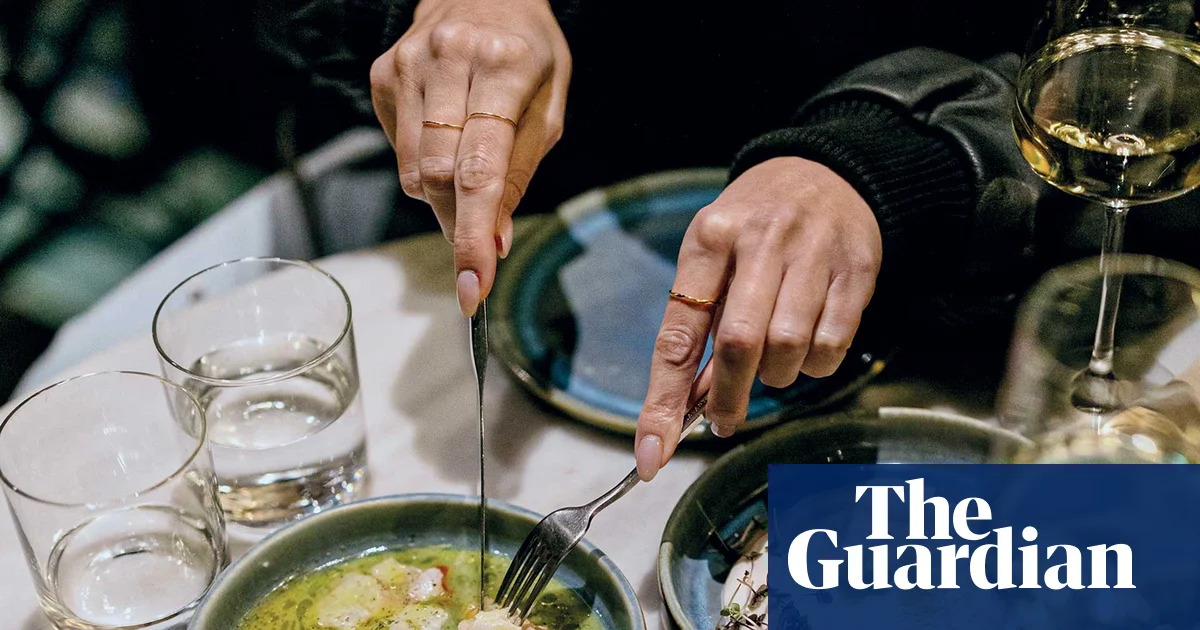
Linou Soumpasis & Sia is probably the most forward-thinking restaurant in Athens right now, and probably one of the best in Greece. It takes quite humble, seafood-led food and gives it a fine edge without losing its simplicity. The room is incredibly simple and every detail is really considered. Last time I went, they served a version of kakavia, the traditional fish soup, which was essentially a beautiful fish and vegetable broth with olive oil. Something that simple, done that well, is incredible. DC
‘Restrained and modern’: Linou Soumpasis and Sia restaurant, Athens.
Linou is one of my go-tos, too. It reminds me a bit of Lyle’s meets Brat. It has a restrained approach to food that still feels very modern. I’d also go to Pharaoh, particularly for the vegetables and whatever they’re doing with fermented wheat, and Ateno, which we went to twice in two days on my last trip. Get the Greek salad, stuffed vegetables and fries with mushrooms and eggs. I also really like Ex Machina: their saganaki is fried cheese but served cold, and I always want to see what [the chef] Adam Kodovas is doing with the seafood broth because the dish changes every few months, while the formula remains the same. I go to Akra for lunch because they serve smaller portions and I can order as many dishes as possible. NM
Seafood
Travolta is banging; it’s old-school and a bit like Bentley’s in London. You get huge plates of crudo and whole fish, and they have an amazing prawn and squid skewer with squid ink and olive oil that they mix at the table. It can get expensive (fish is incredibly expensive in Greece), but if you’re really into seafood it’s very cool. Phita is another good seafood place, a little further out. DC
Travolta would be my choice for more classic seafood, too. If you want something more elevated, I’d go to Iodio near Kolonaki. There’s one dish I’ll always remember, which is raw fish served cold with a crisp sheet of rice paper on top and a warm avgolemono sauce – a classic Greek sauce made with egg and lemon. You grab everything together in one bite and it’s great. NM
Cheap eats
For souvlaki, the best is often at little roadside or market stalls. Last time we were in Exarchia, we found a tiny souvlaki stall mainly serving the market vendors. For souvla, the bigger rotisserie-style meats, we go to Psitopoleio Peloponnhsos. They serve huge pieces of meat, lamb heads; all sorts of pretty gnarly stuff cooking on the rotisserie. DC
Gyros are a dangerous subject for Greeks because everyone has their favourite. Achilleas in Neos Kosmos is one of the few places that still makes their own [meat rotisserie] (rather than buying it ready-made). In the centre, I really like Hoocut. They aren’t technically gyros because they slice the meat raw, cook it and then chop it again into small strips, but the mentality is similar. For a late-night version, go to Mandraki in Kaisariani. They’re open until about 2am and cook meat on spits late into the night. Their gyros are huge and often sell out. It’s cheap, traditional and the sort of thing people actually eat every day. NM
Wine and cocktails
Wine is Fine is really good for a pre-dinner drink, and I also love Epta Martyres, from the people behind Loggia [on Sifnos]; I’d been to both loads of times before I even realised they were connected. In Greece, I tend to want wines that are light and bright. Assyrtiko is the obvious one; in that climate you want something really zippy. DC
Baba Au Rum, Athens.
Pharaoh has a great wine list, and Tanini Agapi Mou is an amazing wine bar. A Greek grape I discovered this year is Vidiano. Vidiano can lean quite dry but still feels really pleasant and crisp; depending on where it’s grown, the fruit and minerality change a lot. It’s easygoing but complex at the same time. NM
Line Athens is quite molecular and it’s the kind of place you stay for the night. The cocktails are some of the best I’ve ever had in my life, let alone Athens. Baba au Rum is right in the mix, too. There’s also Rumble in the Jungle behind The Bar in Front of the Bar. The first is a bar where you walk in and think, “This is cool,” then go through another door into the second, even cooler bar hidden behind it. It’s very Athens. DC
You have to mention Line and The Bar in Front of the Bar. At Bar in Front, they’re trying to be as zero waste as possible, and you basically order through a window in a wall and sit drinking in the street. I choose what to drink according to the weather – last time I had a frozen martini that was almost like a slushie. At Line, the Paloma is usually my go-to, although on my last two visits I had one of their punches, which changes regularly. NM
We always go to Athens’ central fish and meat markets. I particularly recommend being in Athens on a Saturday because that’s when you find all these farmers’ markets around the city. Some of my best times in Athens have been wandering around those. DC
Preparing fish ahead of a busy day at the central fish market. Photograph: Image Professionals GmbH/Alamy
Near Diporto there’s Miran, a charcuterie shop with a huge range of cheeses and cured meats that they make themselves. Buy something there, pick up some bread and take it home. There’s also a huge farmers’ market every Saturday around Exarchia with outstanding produce. NM
Out of town
I really like Vouliagmeni, down on the coast where the Four Seasons is. We used to drive down there in the morning for sunrise, or chase the sunset if we were filming. Lake Vouliagmeni is there, too. It’s much more suburban, with huge houses and tree-lined boulevards, and it’s absolutely beautiful. You probably need a car. I don’t have one particular restaurant to send you to; for me it’s the area itself. DC
Lake Vouliagmeni, near Athens. Photograph: Nito/Shutterstock
For meat, go out towards the airport to Kalyvia. There are two enormous tavernas, Christoforos and To Trigono. During the week they can be completely empty, but at the weekend you’ll struggle to get a table. People tend to swear allegiance to one or the other; I don’t have a favourite. It normally depends on who’s driving me and where they want to go. Although the last few times I’ve been to Christoforos. NM
As a kid growing up in rural Oklahoma, I feared what lurked beneath the lake water.
I’d listen as my family spun yarns about the massive catfish they’d discovered while noodling. I was terrified that, despite their docile nature that not a single adult told me about, an alligator gar would eat me while I bobbed in the lake. Old timers would recount finding a water moccasin in their boat. And I’ve still never recovered from the concept of a “breeding ball,” which a friend’s cousin’s cousin claimed to have run into while water skiing.
Despite the fact that nothing bad ever happened to me in a lake, my fear stayed with me into adulthood. I’ve met several Californians who hold fears similar to mine, but rather than lakes, their outsized anxieties lie within the ocean. It not only keeps them from swimming at our local beaches but also from venturing beyond the shallow shoreline.
An underwater view near Terranea Resort on the Palos Verdes Peninsula.
(Allen J. Schaben / Los Angeles Times)
In this week’s edition of The Wild, our weekly outdoors newsletter, I will discuss how to safely tackle those fears and start exploring with a snorkeling kit. Get ready to learn about the incredibly diverse and colorful world that lives beneath our local waters — you’re about to feel like Ariel exploring a whole new world! Let’s dive in.
You are reading The Wild newsletter
Sign up to get expert tips on the best of Southern California’s beaches, trails, parks, deserts, forests and mountains in your inbox every Thursday.
By continuing, you agree to our Terms of Service, which include arbitration and a class action waiver. You agree that we and our third-party vendors may collect and use your information, including through cookies, pixels and similar technologies, for the purposes set forth in our Privacy Policy such as personalizing your experience and ads.
I spoke to Ralph Buck, who founded Barnacle Busters, an L.A.-based LGBTQ scuba club, with two others almost 40 years ago. Buck’s passion for helping others learn how to safely explore the ocean was so infectious that by the time we ended our call, I was seriously considering whether I should get my scuba certification (which is a story for another day).
Here’s what Buck advised regarding snorkeling.
The Wild writer Jaclyn Cosgrove snorkels among what appear to be grunion or topsmelt near the coastline of the Palos Verdes Peninsula.
(Allen J. Schaben / Los Angeles Times)
1. Get the right gear
Generally you will need the following gear to get started:
A wetsuit (with booties, as a bonus, to protect your feet): Generally, 7 mm is a great thickness for Southern California, although our water is warmer because of our El Niño season (and climate change).
A life jacket or flotation device: This is considered optional, as the wetsuit will help you float, but there’s absolutely no shame in being extra safe! (And if you don’t have a wetsuit, please do wear a life jacket.)
Fins: It might be too strong to suggest they’re “optional,” but they can be awkward for those new to snorkeling and not necessary if you’re in calm enough waters or an overall strong swimmer.
Camera: Very, very optional. While out at Santa Cruz Island two weeks ago, I took some terrible underwater photos with my iPhone and wished I’d just left it on the shore.
Weight belt: If you want to dive, you might need a weight belt to help you go under. That said, this is a more advanced tool, and it’s good to just focus on the basics as you get more comfortable in the water.
One thing new snorkelers might not realize is the level of buoyancy that a wetsuit gives you. Both times I’ve been in the past month, I wore a 7-mm suit and loved how easy it was to float above the eel grass at Santa Cruz Island and the kelp on the coast of Palos Verdes. I love a sport that includes just lying around.
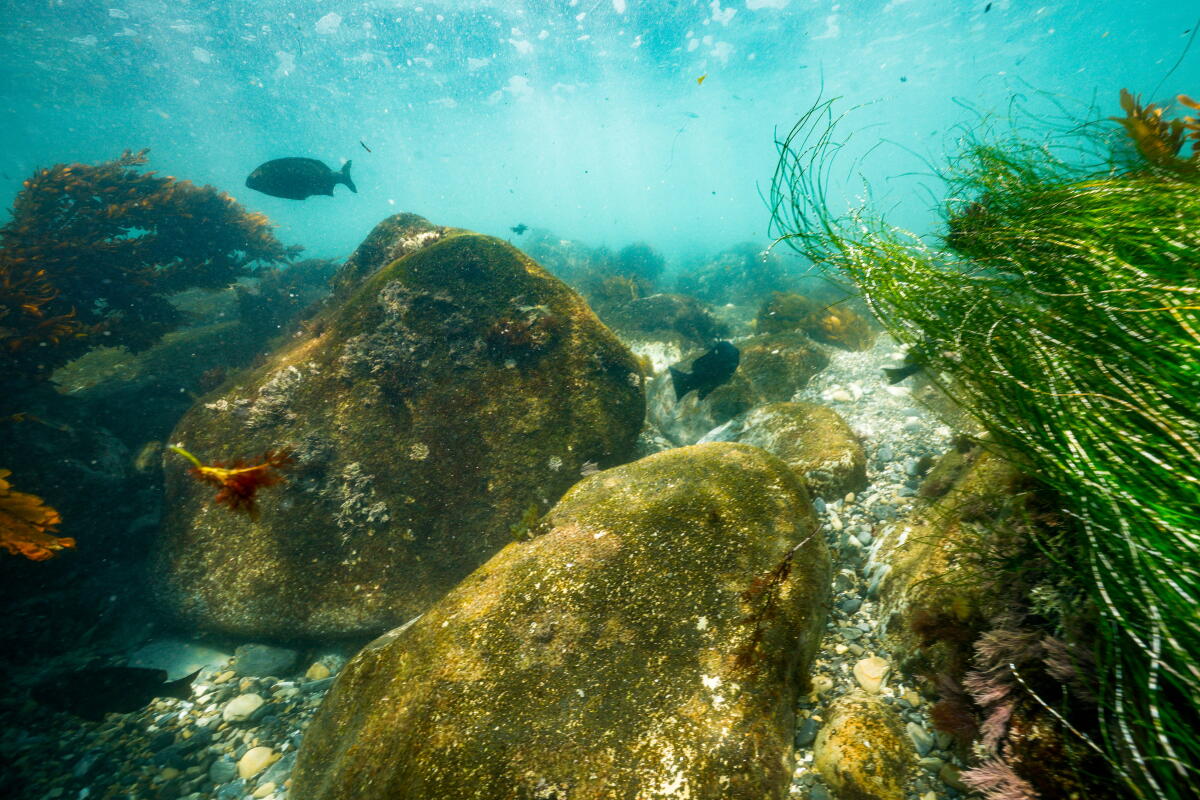
Kelp, sea grass and various algae grow beneath the water at Terranea Beach Cove in Rancho Palos Verdes.
(Allen J. Schaben / Los Angeles Times)
2. Plan for getting your wetsuit on
For anyone on the shore of Prisoners Harbor two weeks ago, they got the pleasure of watching me groan (and curse) as I maneuvered into a thick wetsuit without anything but my swimsuit on. I told my friend I knew what sausage felt like as it’s shoved into its casing.
Zach Cantrell, owner of Ventura Dive and Sport, gave me a tip I will be eternally grateful for: Bring a plastic bag or something else that will help you slide into your wetsuit, as it helps reduce the friction between your body and the wetsuit. I brought one with me when my colleague, Allen J. Schaben, and I went out last week, and getting my wetsuit on was a breeze. No human sausage vibes (or cursing).
Buck suggested other options might be pantyhose or a long-sleeved unitard. Anything to help you slide into your wetsuit!
3. Before going out, practice in a pool
“I would suggest before hitting the open water, go hop in a pool and maybe find an experienced snorkeler to go with you simply because there are some subtle little pieces to the puzzle, which are” easy to miss for a new snorkeler, Buck said.
That includes the direction to point your snorkel. If it’s pointing too far forward, you will likely find yourself breathing straight saltwater as the waves hit you. But if you point it straight up or tilt it a bit backward, it’ll help your breathing apparatus stay clear.
A variety of marine life living around the rocky bottom of Terranea Beach Cove in Rancho Palos Verdes.
(Allen J. Schaben / Los Angeles Times)
4. Never snorkel alone
You look out at the ocean and see calm waters. You hear the siren’s call. You are alone. Resist.
Despite looking like a fairly chill activity, snorkeling still comes with significant risks that will be exacerbated if swimming alone. While out with my colleague off the coast of Rancho Palos Verdes, he pointed out a massive rock that I thought I could maneuver around. I timed my movements wrong and whacked right into it. I was fine, but also glad someone had my back if I wasn’t.
5. Assess the day’s conditions
Check the weather. If it is a particularly windy day, it’s likely not a good day for snorkeling, not only for safety reasons but also visibility.
Before entering, scan the shore to assess the movement of the water.
Learn how to spot rip currents. Rip currents “most commonly form at low spots or breaks in sandbars and near structures such as groins, jetties, and piers,” according to the National Oceanic and Atmospheric Administration.
“If you’re a beginner, and the waves are higher than knee high, I would just go to brunch,” Buck said. “If the surf’s too big, your visibility is going to suck anyway.”
I do love any excuse to have waffles.
The Wild writer Jaclyn Cosgrove carefully enters the water at Terranea Cove Beach in Rancho Palos Verdes.
(Allen J. Schaben / Los Angeles Times)
6. Choose an area that’s easy to enter and exit
This includes sandy beaches, where you can easily wade into the water without losing your balance. At Prisoners Harbor, I fell over several times because the shore is covered in various fist-sized rocks. (I need to work on my balance.) Snorkeling off the Palos Verdes Peninsula, I took my time, watched the waves and slowly moved into the water as the waves allowed. I found that, when there are rocks around, walking into the water like I’m navigating a balance beam is a good approach.
Also, in terms of looking for the best spots to snorkel, look for kelp forests and rock reefs. And because you’re newer, I would stick to spotsknown for snorkeling.
7. Plan for fog
Buck said before the COVID-19 pandemic, the Barnacle Busters, like most diver clubs, would recommend a simple solution to fog in your goggles: Spit. They still recommend using your spit in bodies of water where your germs won’t immediately affect other swimmers like in the ocean.
You can also buy an anti-fogging agent for your goggles. If you take your goggles off at any point as you snorkel, you’ll need to reapply either spit or anti-fog spray.
While I was out snorkeling, I was amazed at how well spit worked. (And if you want to understand the science behind why this works, check out this blog post from Scuba.com.)
A garibaldi, California’s state fish, at Casino Point Dive Park on Catalina Island in 2016.
(Allen J. Schaben / Los Angeles Times)
8. Check in with yourself and your partner
You should check in with your partner every 30 seconds. That might feel like it’s way too frequent, but you’ll be amazed at how far apart you can float from your friend in that time frame. It can be as simple as making sure you see them and they see you.
9. Keep an eye out for hazards
When entering the water, you’ll want to do the “stingray shuffle” to ensure you alert any nearby rays of your presence. Around L.A. County, you’ll also want to watch out for sea urchins because their spines can prick your skin, which will require treatment if you bump into them.
As our county lifeguards point out, L.A. beaches aren’t typically places you’ll find the most dangerous jellyfish. “Jellyfish in Southern California are usually smaller in scale and have a more mild sting than other species found around the world,” according to the agency’s website.
(And don’t worry. Electric eels don’t live in the ocean.)
I asked Buck how often he and his fellow divers check for hazards like sharks.
He told me that outside of rocks, high surf and going out too deep for one’s skill level, he and his diving partners don’t think too much about hazards in our local waters.
Purple sea urchins grow on a rock near the shore of Prisoners Harbor on Santa Cruz Island in the Channel Islands National Park.
(Jaclyn Cosgrove / Los Angeles Times)
“Well, we don’t consider sharks to be a hazard at all. My husband and I blame Steven Spielberg for the irrational fear of sharks,” Buck said, referencing Spielberg’s 1975 film “Jaws” and the adverse effects the film had on white sharks.
Buck said he and his husband rarely see sharks. He does give some weight to the argument that divers in wetsuits can resemble seals and sea lions when floating on the surface.
“But in areas where you’ll probably be snorkeling, you’ll probably be snorkeling on shallow rocky reefs or shallow kelp. It’s not even a consideration for us,” he said.
Lastly, if you or your partner start to shiver, get out.
The Wild writer Jaclyn Cosgrove snorkels at Terranea Cove Beach in Rancho Palos Verdes.
(Allen J. Schaben / Los Angeles Times)
10. Don’t touch anything
Practice Leave No Trace in the ocean too. “That’s our philosophy for diving too,” Buck said. “Look, but don’t touch.”
And never feed the marine life.
11. Have fun!
Since learning to snorkel, I’ve already found two friends who also enjoy it, and I plan to ping them to go out soon. If you don’t have anyone in your circle who snorkels yet, consider joining a local club.
In a world that feels hard right now, I felt like I had a two-hour vacation as I floated above the bright green sea grass and golden yellow kelp, watching garibaldi and what appeared to be grunion or topsmelt bob and dive around me. I came out refreshed and grateful to live here.
3 things to do
The hike to Eaton Canyon Falls in the San Gabriel Mountains before the 2025 Eaton fire.
(Myung J. Chun / Los Angeles Times)
1. Learn about Eaton Canyon’s future in Arcadia L.A. County Parks and Recreation will host From Ashes to Action: Reimagining Eaton Canyon from 5 to 7 p.m. Wednesday at the L.A. County Arboretum’s Ayres Hall (301 N. Baldwin Ave. in Arcadia). Attendees will learn about design concepts for the next Eaton Canyon nature center along with the latest work completed in the natural area. The event is free, but registration is required. Register at arboretum.org.
2. Service sage in San Pedro Cabrillo Marine Aquarium (3720 Stephen M. White Drive) needs volunteers from 9 to 10:30 a.m. Saturday to work on its native plant garden. Participants will learn about plants as they work. All ages welcome. Learn more at cma.recreation.parks.lacity.gov.
3. Launch into Latino Conservation Week in L.A. The Audubon Center at Debs Park will kick off Latino Conservation Week from noon to 6 p.m. Sunday at Metabolic Studio (1745 N. Spring St.). Activities include a bachata class, panel discussion and guided nature hike. Learn more at act.aubudon.org.
The must-read
Burn damage to the Torrey pine grove at Santa Rosa Island, as seen from a ferry on June 8.
(Kayla Bartkowski / Los Angeles Times)
Last week, the National Park Service announced that up to 80% of the rare Torrey pines on Santa Rosa Island in the Channel Islands National Park could die after being harmed by a wildfire in May. Times staff writer Corinne Purtill wrote that initially park officials were hopeful that because the fire, which charred through 40% of the 18,000-acre island, burned at low intensity through the grove, the trees could recover. Research found the fire hurt the mature trees’ exposed root systems. However, I am holding onto hope — for a few reasons. “Park staff have also collected more than 14,000 seeds released from the pine cones. Viable seeds will be planted and raised in a nursery until the seedlings can be planted in the grove,” Purtill wrote.
Another reason is that volunteers are already actively working to save these trees. You can help with that. The California Institute of Environmental Studies needs volunteers to help with recovery as well as with Channel Islands Restoration. You can also donate to the Channel Islands Park Foundation’s Santa Rosa fire resilience fund.
Now more than ever, it’s on us to protect our public lands.
Happy adventuring,
P.S.
While out kayaking off the coast of Santa Cruz Island last month, I yanked a plastic wrapper out of the ocean. I frequently pick up plastic snack wrappers and corners of wrappers that people have accidentally dropped on the trail. And not infrequently have I found thick plastic bags — those said to be reusable — floating in shallow water near the beach. In recent years, California lawmakers have passed laws to address our state’s plastic consumption, including the Plastic Pollution Prevention and Packaging Producer Responsibility Act, or Senate Bill 54. Starting in 2027, the state will receive $500 million every year for 10 years to address plastic pollution, and state leaders want to hear from you how to best spend that money. You can submit your thoughts through Sept. 30 using this form or send your message using the email listed on the form’s webpage. Times staff writer Susanne Rust recently wrote about how there’s a secretive multimillion-dollar campaign to crush California’s landmark plastics law. If the battle over single-use plastic in California is something you’re passionate about, consider subscribing to Boiling Point, where my Times colleagues explore what’s happening to our climate-changed world. They’ll definitely keep you posted!
For more insider tips on Southern California’s beaches, trails and parks, check out past editions of The Wild. And to view this newsletter in your browser, click here.
I wasn’t born in Los Angeles, but it’s the city that raised me. I moved here fresh out of college with a doe-eyed dream of stepping into the kind of art scene I’d read about in history books. Instead, it quickly became clear that I wasn’t going to be able to just waltz in with my Southern charm and big smile; there would need to be some sort of hack into the art world — a place rife with unspoken roles and gatekeeping — if I wanted to get anywhere as a non-nepo artist.
After years of blister-inducing heels-on-the-ground gallery hopping and late-night schmoozing, I found myself falling in love with this city and slowly realizing that the best parts of L.A. were rarely found in mainstream spaces. There’s an inventiveness here that comes from the sprawl of the city — artists like myself who are constantly improvising, building their own ecosystems because nothing is handed to them. I fell in love with how “never-ending” the artist’s practice can feel in Los Angeles, how a studio visit can veer into an hours-long conversation about life. It made the city feel less like a scene to fit into and more like a living, breathing network you have to contribute to before receiving anything back.
In 2014, Alex Benzer and I decided to put our hard-earned knowledge to work by creating Curate LA: a community-driven platform designed to pull back the curtain on the Los Angeles art world by mapping under-the-radar exhibitions and adventurous artist-run spaces, and connecting our audiences directly with artists, curators, galleries and collectors through candid interviews, weekly guides and real-time event recommendations. Because despite appearances, an art scene isn’t held up by pristine white walls; it’s built by the artists sharing a cig and an idea outside on the sidewalk, the gallerists stocking the free booze and championing new voices, and the person you meet sitting at the front desk who tells you about the cute spot around the corner with affordable bites.
For me, an ideal L.A. weekend is a little bit of all of that: a great studio visit that turns into an unexpected conversation, stumbling onto an unconventional exhibition of an artist I’ve never heard of, eating something delicious with friends who I ran into at a show opening, and ending the night at a bar where half of the room just spilled out from the gallery down the street. What I’ve made for you is my personal, slightly circuitous, weekend guide to Los Angeles’ sprawling creative landscape. These are my snapshots of the places and people that I return to, the ones that have fed me, surprised me, taught me something or made a long day of circling the block to find parking impossible to forget.
FRIDAY: Downtown → MacArthur Park → Koreatown
Greg Ito with “Personal Effects,” 2026, “The Spectrum Within,” 2025 and “Love is a Vessel,” 2026.
My first stop is visiting Greg Ito at his DTLA studio. I love the way his work draws me into a layered dreamscape and rearranges my sense of time and space. Greg is also a great storyteller. Pulling from archival family photos and childhood memories as a fourth-generation Angeleno in West L.A., his work weaves together a certain kind of nostalgia that always makes for a heartfelt studio visit. DM @gregitooo for availability and address.
Eduardo Medrano at John Doe Gallery.
From there, I head over to John Doe Gallery, which is run by two artists, Eduardo Medrano Jr. and Alfonso Gonzalez Jr. They show some of the best up-and-coming artists in Los Angeles, and their openings are always a good time. It’s the kind of place where I’m just as likely to run into someone I know as I am to discover someone I don’t, which in my opinion is exactly what a good art space should do. 107 E. 11th St., Los Angeles. DM @johndoegallery for open hours.
Vita Kari in front of “My Girlfriend Named Herself After a Water Bottle,” 2024, at their DTLA studio. Kari wears Barrio Drive.
You might recognize Vita Kari as “The craziest thing about being creative” personality from IG, but what you might not know is that they completed their MFA with a thesis on “Virality as Form,” wherein lies the proof in the pudding, a.k.a. their art. Vita uses textiles, performance and video to speak about internet culture, along with stunning visuals that incorporate their family’s Middle Eastern diaspora and history. DM @vitakari for availability and address.
Samala Meza in her DTLA studio with works in progress.
I make my way over to Samala Meza, who creates soft, sexy paintings that look like she literally breathed a secret into them. Her studio is situated at Princess Castle, an artist-run studio space, so you can pop over to some other great artists while you’re there. DM @samalameza for availability and address.
Devin Troy Strother on the roof of his studio overlooking DTLA.
Devin Troy Strother is an L.A.-born and -based artist and co-founder of Coloured Publishing, a printing press making books, zines, T-shirts and other editioned works, all by artists of color. Nestled among the produce district, there’s never a dull moment in Devin’s studio. Often working all hours of the night, there’s usually a cast of characters coming in and out, similar to the subjects you’ll see throughout his paintings. DM @devintroy for availability and address.
Commonwealth and Council Team (L to R clockwise): Isabel Einaudi, Audrey Bui, Brenda Reyes-Chavez, Oliver Sweet and Young Chung.
What began as an artist-run exhibition space in Young Chung’s apartment 15 years ago has grown to be one of L.A.’s most championed emerging artist safe havens, Commonwealth and Council. I’ll always make time for this space if I’m in the neighborhood. 3006 W. 7th St., Suite 220, Los Angeles, door code: 01220 (please note that this space is not wheelchair–accessible). Thursday to Saturday, 10 a.m. to 5 p.m., @commonwealthandcouncil
Holcomb in front of the Prince. Styled by Jocelyn Corona, wearing AYANEGUI, TANAMACHI and Vacr.
To round out the day, I recommend decompressing at the Prince in K-Town, a place where you can spot celebrities and L.A. artists under one roof. Many galleries have had their after-parties here, where you can catch up on the night’s gossip in a dimly lit booth over a kimchi pancake. 3198 1/2 W 7th St., Los Angeles. Call before your visit to confirm hours and dining details (this space is also not wheelchair–accessible). princektown.com
SATURDAY: Beverly Hills → Hollywood → Eastside
Jerson Hondall in the library of Gagosian Gallery, Beverly Hills.
I start the day by visiting one of my favorite people in the L.A. art scene, Jerson Hondall. Jerson worked for Curate LA back in the day, but now you can find him working as an artist liaison at Gagosian Gallery and serving on the board of LACE. He is a literal art encyclopedia, which you can see through his Instagram series #dosisdiariadearte, and he is one of the loveliest people you will find, so don’t be afraid to approach him if you see him out and about. DM @jersonhondall for availability.
Jonny Negron in his Los Feliz studio featuring works in progress “virtue signal” and “tellurian lube.”
Next, I head east to Los Feliz to visit Jonny Negron at his home studio. His paintings make you feel like you’re sitting across the bar from some of the coolest people in the room. You might recognize his work, which was commissioned for Rosalía’s single “Dolerme.” There’s something about seeing his works in the exact place where they were made that makes the paintings feel even more alive. DM @jonnynegron777 for availability and address.
LAST Projects exterior in Lincoln Heights with co-founder Ilona Berger and pup.
I then make my way to Lincoln Heights and visit LAST Projects, an alternative space and gem. This gallery has given many artists in L.A. their first shows in their early careers (myself included). It’s one of those places where I know I’m going to see something that makes me pause, even if I have no idea what I’m walking into beforehand. 206 S. Ave. 20, Los Angeles. Open Thursday, 1 to 5 p.m. and Sunday, 1 to 6 p.m. @last_projects
Next I visit Drex, owned and curated by Vivian Hicks, a vintage homeware store tucked into Cypress Park. With a knowledge of designers that is truly unmatched, Vivian scours the internet and estate sales to hand-select some of the most desired American Modern, Italian and French design collectibles ranging from the early 20th century to the early 2000s. DM @drex.drex.drex for an appointment and address.
Huevos a la Mexicana breakfast burrito at Lupita’s Restaurant in Cypress Park.
I skipped breakfast, so Vivian recommends I go around the corner to Lupita’s Restaurant, and they do not disappoint with their huevos a la Mexicana breakfast burrito. Simple but effective. 2634 Idell St., Los Angeles. Open daily 7 a.m. to 2 p.m.
Ever Velasquez outside of Charlie James Gallery on Chunk King Road, Chinatown.
Satiated, I hop over to Chinatown to visit curator Ever Velasquez at Charlie James Gallery. While her name might not be on the door, Ever is the star of the show, putting together show after show of L.A.’s hottest rising artists. 969 Chung King Road, Los Angeles. Open Tuesday to Saturday, 11 a.m. to 5 p.m. and by appointment. @charliejamesgallery@ever.a.k.a.thegirlabouttown
Human Resources exterior in Chinatown.
A few blocks away, there is Human Resources. An L.A. staple, HRLA has been around for 16 years now and continues to showcase some of the most experimental works coming out of the city. This space is truly a breeding ground for pure creativity and expression. Make sure to check the calendar on their website to see what’s happening. 410 Cottage Home St., Los Angeles. @humanresourcesla
Drinks at El Prado in Echo Park.
Finally, I end the day at El Prado, a local artist watering hole. Nick Fisher, the owner, used to bartend his personal bar called FISHTANK at gallery openings and come up with the craziest drink concoctions and home-brewed beers on theme with whatever exhibition was opening that evening. With names like the Loudspeaker cocktail and a Blood and Fire Smoked Lager, they were sure to get you litty. You can still sample his creations at the bar, albeit they might not be as experimental as they once were. 1805 Sunset Blvd., Los Angeles. Open Monday to Friday, 5 p.m. to 2 a.m., Saturday to Sunday, 2 p.m. to 2 a.m. @ficknish, @elpradobar
SUNDAY: South L.A. → Mid-City → Pico
Aleza Zheng in her South L.A. studio featuring “The Unbearable Lightness of Being,” 2026, “Of Providence,” 2026 and “All That Is In Heaven,” 2026.
I start Sunday with Aleza Zheng at the artist-run Tlaloc Studios. Much like her artwork, she is quite the whimsical, spontaneous person. The first time we met, I was deep in the trenches of L.A. Art Week, starving at my probably fifth art event of the day. I was ready to call it quits when Aleza popped out of her car, dressed to the nines, with multiple bags of In-N-Out. She’s been feeding me ever since. DM @alezazheng for availability and address.
Dominique Clayton at Harun Coffee in Leimert Park.
From there I spend some time with Dominique Clayton in the heart of Leimert Park, where she was born and raised. Dominique is an L.A. native, curator and woman about town. She’s currently organizing Mom’s Night Out at Harun Coffee, a bimonthly meetup of mothers looking to connect with other creatives and artist moms. I love the way Dominique thinks about community — not as some abstract art world buzzword, but something you have to actually cultivate IRL. DM @lookatdominique to connect.
Jamal Hasef in front of his mural “Sky is the Limit,” 2026 on 11th & Vernon in Leimert Park.
I make my way to see Jamal Hasef, who uses paint to move between the personal and the political, digging into the complex and sublime afterlives of the African diaspora in his canvases and portraits. You can check out his mural on the corner of 11th and Vernon or visit him at his studio in nearby Baldwin Hills. @_hasef_ DM for availability and address.
Holcomb in front of Watts Towers in Watts, wearing Desigual and styled by Jocelyn Corona.
If you haven’t heard of or visited the fairy-tale world of Simon Rodia’s Watts Towers, you’re in for a treat. Next door to the famous landmark is the Watts Towers Arts Center, a historical site of political activism and assemblage art, most notably by L.A. legendary artist Noah Purifoy, who once ran the gallery. I love bringing people here because it reminds me of why I’m so enamored with the city: It’s weird, completely handmade and unlike anything else. 1727 E. 107th St., Los Angeles. Gallery hours are Wednesday to Saturday, 10 a.m. to 4 p.m., but you can check out the towers from the street any day of the week. wattstowers.org
Books purchased from Reparations Club in Mid City (L to R): “Assata: An Autobiography,” “Love Poems’ by Nikki Giovanni, “Directed by Desire: The Collection of Poems” by June Jordan and “Communion: The Female Search for Love” by bell hooks.
By now I’m ready for some retail therapy, so I head to Reparations Club in Mid-City, my absolute favorite bookstore in Los Angeles. I could buy the entire store if my wallet and storage would allow, but on this particular trip my haul was “Assata: An Autobiography” by Assata Shakur, “Love Poems” by Nikki Giovanni, “Communion: The Female Search for Love” by bell hooks and “Directed by Desire: The Collected Poems of June Jordan.” Considering the state of literacy we are facing in this AI-driven world, I’d say we all could benefit from frequent visits here. 3054 S. Victoria Ave., Los Angeles. Open Monday to Saturday, 11 a.m. to 7 p.m., Sunday 11 a.m. to 5 p.m. @reparations.club
And finally, I end the weekend with pure sustenance. My last stop is Merkato, an Ethiopian cafe where the walls are filled with eclectic knickknacks and the plates are eat-with-your-hands style, packed with flavorful goodness; it’s the kind of meal that makes you want to linger. If you have the time, don’t skip out on the traditional Ethiopian coffee. 1036 1/2 S. Fairfax Ave., Los Angeles. Open daily 11 a.m. to 11 p.m.
Shelley Holcomb is an artist, curator, writer and cultural leader, whose work spans painting, installation, storytelling, advocacy and making art more accessible.
It was a Thursday evening, and I was performing Gloria Gaynor’s 1978 hit “I Will Survive” for my audience of three on an ocean pier as we waited for the partial lunar eclipse.
As we shimmied to ‘70s hits via a Bluetooth speaker, I boasted about winning a talent competition in my tiny town thanks to my rendition of the disco classic. “We need to see these dance moves!” a fellow camper proclaimed.
Somehow, we had this island all to ourselves.
This was one of several memories I made last week when I traveled to Santa Cruz Island in Channel Islands National Park to stay at Prisoners Harbor Campground on its opening night. When the National Park Service announced that reservations would open Aug. 18, I spent 11 hours that day refreshing the page, waiting for my chance. At last, site No. 1 was mine.
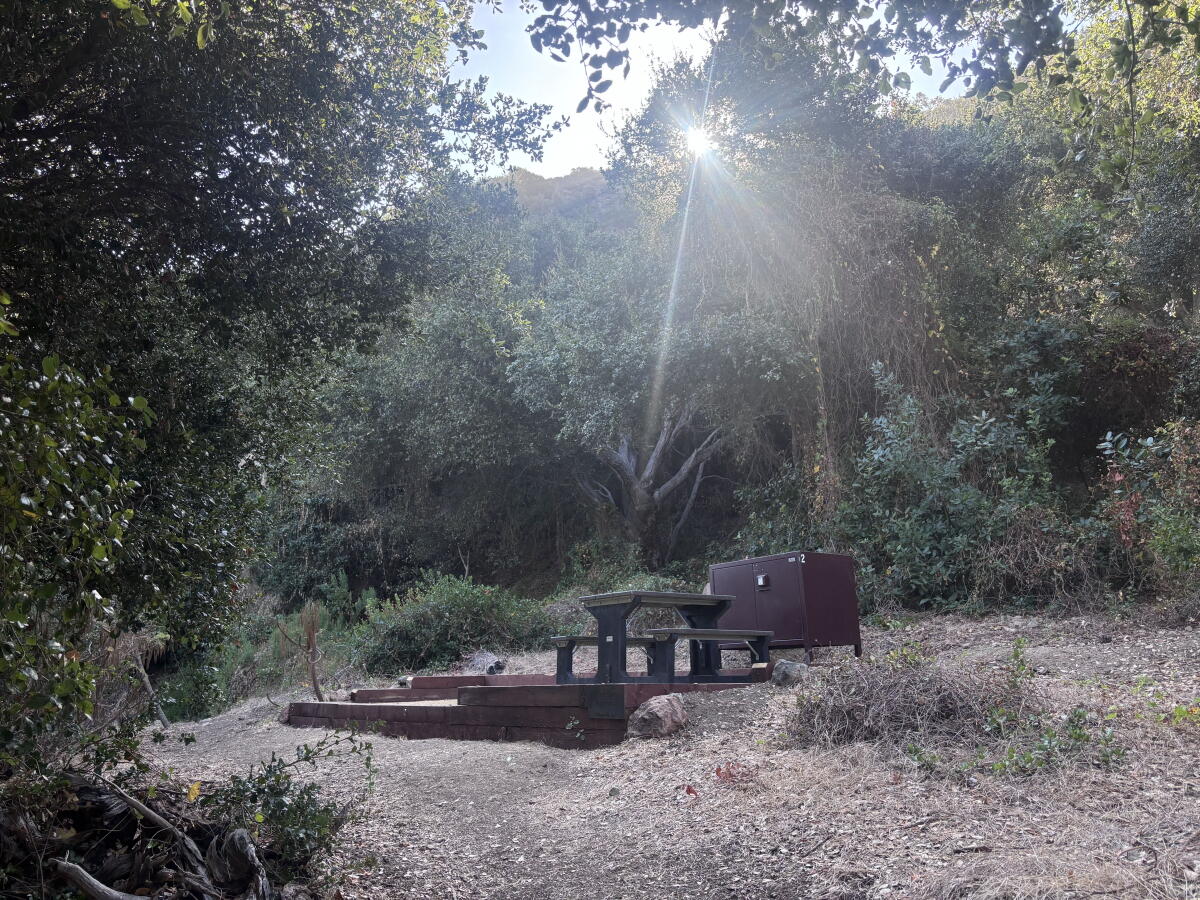
Campsite No. 2 at the Prisoners Harbor Campground on Santa Cruz Island.
(Jaclyn Cosgrove / Los Angeles Times)
In this edition of The Wild, I lay out how you can create your own memories at this quiet campground on a lesser traveled side of Santa Cruz Island. I will explain how to book your site and ferry, what to pack and what you can do while on the island.
You are reading The Wild newsletter
Sign up to get expert tips on the best of Southern California’s beaches, trails, parks, deserts, forests and mountains in your inbox every Thursday.
By continuing, you agree to our Terms of Service, which include arbitration and a class action waiver. You agree that we and our third-party vendors may collect and use your information, including through cookies, pixels and similar technologies, for the purposes set forth in our Privacy Policy such as personalizing your experience and ads.
Step 1: Book your campsite ⛺
Prisoners Harbor Campground is a small, rustic campground open year-round on Santa Cruz Island, the largest island in California. Although the National Park Service lists the campground as having six sites, it technically has seven. Reservations can be made for $15 a night through Recreation.gov.
Prisoners Harbor Campground is about a 13-mile hike southwest from Scorpion Canyon Campground, the popular 31-site spot where most folks visiting the island camp. Unlike Scorpion Canyon, Prisoners Harbor does not have any water on site and is a more DIY experience. There are also fewer tours and experiences led by outfitters on this side of the island.
The map of Prisoners Harbor Campground.
(Jaclyn Cosgrove / Los Angeles Times)
Each campsite at Prisoners Harbor has a dirt-packed tent pad, a picnic table and metal food storage containers that everyone called “fox boxes,” as the island fox is the largest land predator on the island (and will absolutely steal your food, and maybe your shoes).
From the pier, you’ll walk about one-fifth of a mile on a mostly flat dirt road, passing the brick Prisoners Harbor warehouse and two pit toilets. You will cross the Cañada del Puerto, which was dry during our visit but can swell to 3 feet and become impassable, according to the park service.
I was pleased to find that site No. 1 is tucked away in the campground’s northern corner. It is shaded by oak trees and surrounded by thick brush, offering privacy and the feeling like you exist only in this one little corner of the world.
Site No. 2 is on the path to site No. 1 and isn’t presently bookable on Recreation.gov. (I’m guessing the park service will remedy that soon, as the site exists and is ready for campers!)
The shaded campsite No. 6 at Prisoners Harbor Campground.
(Jaclyn Cosgrove / Los Angeles Times)
Sites No. 3, 4, 5 and 6 are all positioned in a row on the southwestern corner of the campground. Similar to site No. 1, site No. 6 is tucked under thick tree canopy. I think it’s probably shaded for most, if not all, of the day. Sites No. 3, 4 and 5 also have some shade.
Site No. 7 is the accessible campsite and has a ramp leading up to it. It is fairly exposed, appearing to have the least amount of shade and privacy. It is closest to the pit toilet, though, which also has a ramp leading up to it.
As I was getting ready for bed, I noticed the soothing sound of ocean waves. My friend Christine was already cozy inside the tent, and I asked her if she’d turned on an ambient soundtrack on her phone to fall asleep. “No, that’s just the ocean!” she said.
Step 2: Book your ferry ⛴️
There are only two ways to get to Santa Cruz Island: Take a private boat or, the more popular route, book a ferry through Island Packers, leaving out of Ventura Harbor.
A roundtrip ferry to Prisoners Harbor costs $72 for children ages 3 to 12, $96 for campers ages 13 to 54, $91 for those 55 and older. It is also $91 for members of the U.S. military.
Upon booking your ferry, you must read the rules that Island Packers emails to you. I cannot stress that enough. There are weight limits (i.e. no single item may weigh more than 45 pounds) and limitations about what you’re allowed to bring. That said, it’s all fairly easy to follow — like not packing your water or fuel inside your bag, as those both are packed in specific places on the boat.
Christine, a friend of The Wild, paddles along the coastline of Santa Cruz Island near Prisoners Harbor.
(Jaclyn Cosgrove / Los Angeles Times)
Step 3: Plan out what you’d like to do on the island 🚣😎
With Prisoners Harbor being more of a DIY experience than Scorpion Canyon, one of the most important things you can do is plan ahead and book your activities at least a full day — ideally a few days — before your trip.
I knew I wanted to try snorkeling, but I don’t own gear — yet. Thanks to a recommendation from Island Packers, whose staff graciously answered all my questions, I contacted Ventura Dive and Sport to see what was doable. Owner Zach Cantrell was helpful and accommodating, setting me up with everything I needed, including a 7-mm wetsuit that made me feel like an actual marine mammal thanks to my ability to float while wearing it. Cantrell also made it easy to return my gear since the ferry was returning after his shop was closed.
Outside of snorkeling, you can also rent a kayak through Channel Islands Kayak Center. Or you can bring your own kayak, keeping in mind that Island Packers has specific rules around which kayaks you’re allowed to bring. You should also take a look at the National Park Service’s safety guidance regarding the risks of ocean kayaking.
The hike along Navy Road offers nice views of ocean and mountain ranges on the mainland.
(Jaclyn Cosgrove / Los Angeles Times)
You can also swim near the Prisoners Harbor pier, but you should keep in mind:
The beach here is not sandy, but rather covered with rocks of varying sizes; pack swim shoes to protect your feet
The waves can get choppy, so make sure not to swim alone
There are stingrays in the area, so enter the water doing the stingray shuffle
There are sea urchins on some rocks in the area, so watch out for those as well, as their sting also hurts
On the island, there’s, of course, hiking. There are two trailheads at Prisoners Harbor:
The 4-mile out-and-back Pelican Bay hike, a challenging trek that traverses along the coastline, offering seemingly endless views of the area, before ending at the bay and Tinkers Harbor, another spot where you can swim and snorkel; The hike is on Nature Conservancy land, an environmental nonprofit that owns 76% of the island, and the conservancy requires that you sign a waiver and only traverse the hike when an Island Packers staffer is present on the trail.
A hike along Navy Road that you can take to the backcountry Del Norte campground, or to a variety of other spots on the island, should you pack a paper map or download a map before your trip.
Christine and I had originally planned to check out the Pelican Bay hike on Friday morning, but then a kind island visitor said we could borrow their kayaks for free. That was an irresistible offer.
I’ve kayaked several times on rivers and in lakes but never on the ocean, so I wanted to be fairly cautious. We paddled northwest along the island’s coast, taking in the island’s jagged rocky cliffs. We spotted what appeared to be a small sea cave but agreed it wasn’t a good idea to explore without a guide who knows the island. You should always be ready on any adventure to check in with yourself and your travel companions about your skill and comfort levels. If the reason you’re wanting to do something is really just “FOMO,” ask yourself if it should instead be a “NO-GO.” (Yes, I just made that up.)
Kayakers leave out of Scorpion Anchorage on Santa Cruz Island.
(Jaclyn Cosgrove / Los Angeles Times)
I saw repeatedly on the National Park Service website that the island’s weather conditions can change rapidly, including while out on the kayak. Christine was out front and noted the wind was picking up. We swiftly paddled back, carried in part by the waves, which pushed our kayaks along in a similar sensation to surfing. I quickly fell in love with that feeling!
Despite the campground being fully booked, there were only two other campers during our trip — retired educators and travel besties Kim Eaton and Annemarie Lee, both of Riverside. They’d visited the Channel Islands multiple times, including Anacapa, Santa Rosa, San Miguel and had made previous trips to Santa Cruz, and they’d always wanted to do the Pelican Bay hike.
We were all on the island when it was particularly hot and humid, so the duo chose to go halfway and turn around.
The cloudy night sky, as seen from the Prisoners Harbor pier.
(Jaclyn Cosgrove / Los Angeles Times)
“The views were beautiful,” Eaton said, noting how clearly they could see the rugged coastline and waves. “We saw you guys kayaking!”
“The color of that ocean is beautiful,” Lee added.
Rocky outcroppings near Scorpion Anchorage.
(Jaclyn Cosgrove / Los Angeles Times)
Step 4: Plan what you’ll pack, including all your water
Everything you pack in, including your trash, you must pack out. There is no food for purchase, and there is no water at Prisoners Harbor, so you must bring whatever you plan to use for drinking and other purposes. I brought 4 gallons, and Christine packed 2. As I said, it was pretty hot, and we left the island with about a gallon and a half left.
I didn’t realize coolers were allowed. Nearby in campsite No. 4, Kim and Annemarie not only had a cooler but large ice cubes they’d frozen specifically for the trip, which last longer thanks to their size. “So if you like your cocktails, you’ll have ice” for multiple days, Kim said.
Step 5: Don’t miss the boat!
Island Packers requires campers to check in an hour before the boat leaves.
I left my home just before 6 a.m., picked up Christine and boogied to Island Packers, parking just before 8 a.m. Parking at Ventura Harbor is free Monday through Thursday, and $10 for a full-day pass Friday through Sunday and on major holidays.
After checking in, we worked with Island Packers staffers to load our gear onto the boat. I also thankfully had time to buy a four-shot latte next door at Freedom Coffee. Island Packers has several items for sale in their gift shop, including waterproof phone cases and other items you might have forgotten at home.
As you board the boat, make sure you remember wherever you tuck your return ticket. Our departure time from the island was 4:15 p.m. Friday, which gave us the better part of the day to explore.
An island fence lizard rests on a log at campsite No. 1, scoping out the new visitors to its island.
(Jaclyn Cosgrove / Los Angeles Times)
Step 6: Have fun!
Full of motion-sickness drugs and glee, we boarded the boat. I tried to keep my expectations low for what we’d see on the trip to the island. I’ve been on three whale watching excursions out of Long Beach, including once when we didn’t see any whales.
A bottlenose dolphin swims alongside the Island Packer boat on its journey to Santa Cruz Island.
(Jaclyn Cosgrove / Los Angeles Times)
However, shortly into our trip, our boat was visited by bottlenose dolphins that swam next to us. As we neared Scorpion Anchorage to drop off the passengers day-tripping and camping there, we saw so many common dolphins, it felt like an organized and official welcoming celebration.
A humpback whale near the coastline of Santa Cruz Island.
(Jaclyn Cosgrove / Los Angeles Times)
But the real magic happened shortly before we docked at the Prisoners Harbor pier when our captain Pancho spotted at least one (maybe two) humpback whale. We paused for a bit to take in the majestic animal’s movements. Christine and I agreed it was easy to see how sailors believed in sea monsters, given how otherworldly the humpback’s body appears as it slithers in and out of the water.
Before leaving for the island, I’d read about how the island foxes will approach you while you’re eating, and that they’ll come into your campsite to try to snag your food. We didn’t have that experience, thankfully, as the campground is so new, and the animals aren’t used to people being there yet.
These tiny canines remained rather elusive — until just before we left. We were headed to the restroom when I gasped. An island fox, about the size of a large house cat, was busy foraging for food in the leaves. It made me happy to see it act naturally, rather than begging us for human food.
An island fox roots through leaves in pursuit of a meal.
(Jaclyn Cosgrove / Los Angeles Times)
The fox cautiously walked a few feet past us on its journey for bugs and other snacks. It was a last bit of island magic before we left.
Although the beauty and biodiversity of the island is a major reason to visit, I carried something else with me back to the mainland, though. To a person, everyone was kind to each other. Prisoners Harbor, through its simple design, offers you the opportunity to move slower, notice more and just enjoy life in a way that’s harder to do when you have cellphone service.
For those looking for a simple escape near L.A., Prisoners Harbor Campground is that and so much more. Late-night karaoke is not required — but highly recommended.
3 things to do
Declan Beck, left, his brother Colson and friend Dayna Monbello visit Malibu Creek State Park near Calabasas.
(Mel Melcon / Los Angeles Times)
1. Celebrate biodiversity around L.A. and beyond California Biodiversity Day, which actually runs for a week from Saturday through Sept. 13, will include several opportunities to get outside and learn in L.A. County. Malibu Creek State Park and UCLA Stunt Ranch are both hosting one-day data collection events, called bioblitzes. Friends of Ballona Wetlands will offer a freshwater marsh tour on Sept. 12 in Playa Vista. And Arroyos & Foothills Conservancy will host a native plant walk. Find events near you at californianature.ca.gov.
2. Celebrate the black walnut in Ascot Hills Coyotl wan Macehualli and several other local groups will host a “Black Walnut Day” from 10 a.m. to 4 p.m. Saturday at Ascot Hills Park. The annual gathering will include plant adoptions, a bird walk, a community bike ride, hiking and more. Learn more at the organization’s Instagram page.
3. Plant seedlings near Agoura Hills The Santa Monica Mountains Fund, a local nonprofit, needs volunteers from 9 a.m. to noon Saturday to work at Cheeseboro Canyon. Volunteers will plant hundreds of live plants grown from locally collected seed. Register at eventbrite.com.
The must-read
(Ryan Gillett / For The Times)
Falling during a hike can lead to a serious injury, or even worse. This is why it’s crucial that hikers not only wear appropriate footwear but also ensure their ability to balance isn’t being hampered by underlying health issues. Times staff writer Deborah Vankin recently wrote “Get A Leg Up,” a multipart series on improving our balance. First, you read about how to test your balance IQ to discern any issues you might have. Then, you can use exercises that Deborah explains to improve your balance. “Knowing your balance ability is a critical component of self-care,” says Mike Teater, director of balance for Fyzical, a national network of clinics specializing in balance and dizziness, “so you can age gracefully and do the things you want to do — and enjoy the life you built for yourself.”
Happy adventuring,
P.S.
The L.A. River community is mourning the loss of Steven Appleton, founder of the LA River Kayak Safari. A longtime L.A. River supporter, Appleton died July 25 at his Elysian Valley home following an 18-month battle with a rare and aggressive form of esophageal cancer, according to a GoFundMe page launched to help his family. Times staff writer Doug Smith wrote of Appleton in 2019, “For more than a decade, he has been launching kayak expeditions just upstream from his newly acquired parcel. He has literally blazed water trails by moving broken chunks of concrete to eliminate obstacles to wading and kayaking.” Money from the GoFundMe fundraiser will help Appleton’s family cover his memorial and final expenses. Thank you, Steven, for doing your part to help our local river.
For more insider tips on Southern California’s beaches, trails and parks, check out past editions of The Wild. And to view this newsletter in your browser, click here.