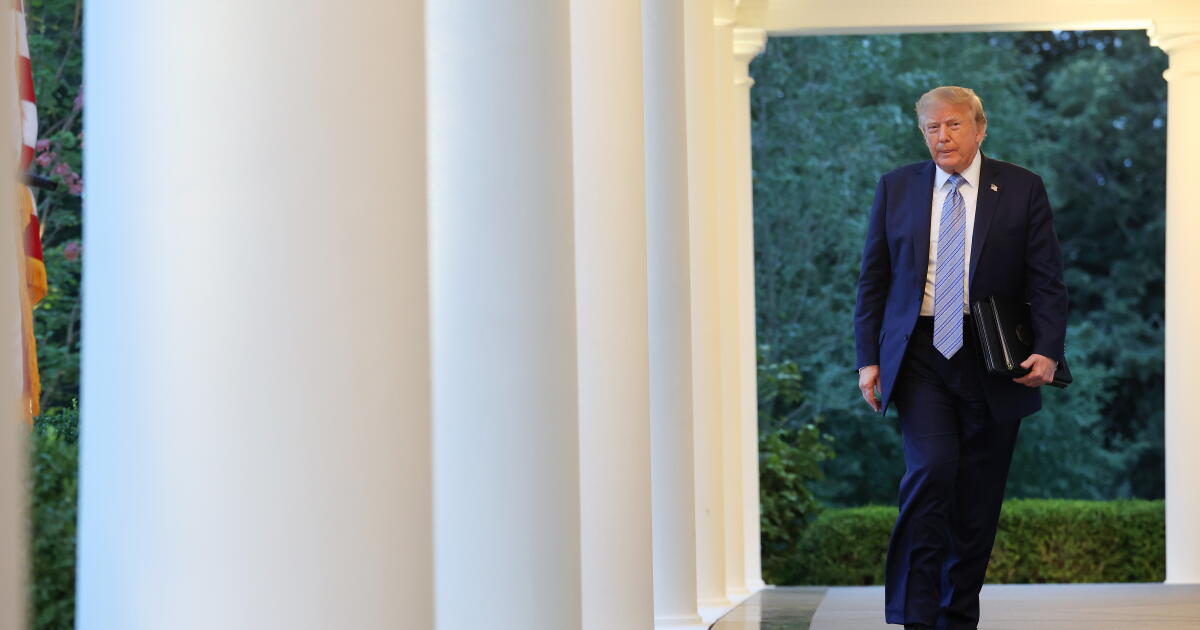
SACRAMENTO — To hear President Trump tell it, the 60% or more of Americans who worried that unchecked artificial intelligence poses a risk to humanity are just a bunch of suckers buying the latest election-rigging conspiracy peddled by his foes.
“The AI Hoax being perpetrated by the Radical Left Dumocrats is reminiscent of their Global Warming Scam of not so long ago, where everyone was going to die from extreme heat. What happened?” Trump posted recently, apparently unaware that heat-related deaths continue to rise.
By the end of the week, his circle of sycophants had adopted that language, along with the strange take that Trump alone would be able to control the rise of superintelligence should it occur. David Sacks, often billed as Trump’s AI whisperer, echoed the hoax line at a Politico event, adding that there was an “orchestrated media campaign” meant to “alarm the public.”
Meanwhile, Vice President JD Vance called the pleas for regulation from inside the industry, including from CEOs such as Dario Amodei and Sam Altman, a “Trojan horse.” He argued that “Americans shouldn’t be scared of anything,” seemingly backing Trump’s absurd declaration that “The only control or ‘guardrails’ that AI needs is a STRONG AND SMART (High IQ!) PRESIDENT, and the U.S.A. has that, in spades!.”
As someone who has covered this issue, let me just say the concern is not a hoax, not a marketing ploy meant to juice the value of companies about to have an IPO, and not a vast and sprawling plot by Trump’s adversaries.
But it is a complicated, fraught problem in a pivotal moment. The president’s confusion and inaction pose an immediate risk of slamming shut our small window of opportunity to make meaningful decisions about a technology that will almost certainly change the course of history and humanity.
So why exactly is Trump demanding this unfettered charge at oblivion, and what are the options for putting guardrails up despite him?
Trump’s reasoning
The pacifying but slightly terrified response of Anthropic co-founder Jack Clark to Trump hints at just how alarmed those deepest in AI development seemingly feel about both the president’s attitude and the unregulated future he demands.
“We’re grateful for the president’s attention,” Clark said on Fox News. “What we’re saying here is we need to get a sensible, commonsense safety framework … and we don’t roll the dice on some kind of accident.”
Or, as Sen. Ruben Gallego (D-Ariz.) put it, “If the only guardrail AI needs is a ‘strong and smart president,’ we’re doomed.”
Like all things Trump, his position involves money. AI is currently a driving force behind the American economy, and if we just cover every inch of open space with data centers, it could keep an otherwise slumpish outlook bright.
OpenAI and Anthropic are also planning IPOs in the not-distant future.
Because these companies are valued at astonishing, 12-zero amounts and because certain stock listing rules will now require that these companies quickly be included in index funds favored by many pensions and retirement accounts, anything that crashes their value — such as investors’ jitters from regulation — could jam up the stock market.
That could affect the lives (and votes) of average Americans.
So despite the long-term risks, the short-term political benefits of the AI gravy train are substantial for Trump.
Then there is the place where Trump actually has a fair point: China. Current AI reflects the values of its creators. It would be disastrous for the free world if superintelligence were trained to favor authoritarianism.
The logic here is if we don’t build “good,” Western-values AI first, we will be at the mercy of “bad” AI, so the possibility of harming great numbers of people is a reasonable, maybe even necessary, risk.
Picking the best path
But is it? Is there a way to instead pursue both geopolitical dominance and safety?
This is where things get messy, and many folks — oligarchs in particular — become invested in keeping the general voter confused.
There is no consensus on a best course of action because we are in uncharted territory and there is actually no way to reliably predict what happens next.
Picking the best path forward, then, starts with picking a camp, a tribe, an outlook. In the broadest sense, there are three possibilities: We attempt to stuff the cat back in the bag; we all try to play nice, as companies and countries, and create rules on the fly; or we just accelerate at full speed, let it rip and what happens happens.
There are obvious problems with each of those.
As an excellent paper by the nonpartisan Rand Corp. explains, which of those camps a person chooses depends largely on just how imminent the danger feels, how feasible it seems to control development of AI and how realistic it is to bank on cooperation — or whether we believe we should and could aim to just continually win a technology war against humans or machines.
These camps, therefore, have little to do with traditional politics. Voters are feeling this issue on a visceral level, one that only a few years ago would have been deemed paranoid and fantastical, and it’s making for strange bedfellows.
Speaking at an conference this week, avowed lefty Sen. Bernie Sanders (I-Vt.) called for a pause on AI development because he’s in the camp that believes it’s currently too dangerous to go forward without a plan.
At the same conference, ultraconservative Trump loyalist Stephen K. Bannon made a similar point. He also urged Americans not to trust “anything” said by AI oligarchs, and to reject the idea championed by Trump that slowing down is dangerous or un-American.
“If you’re not accelerationist, you are supporting China,” Bannon said. “If you’re not accelerationist, you want America to lose. If you’re not an accelerationist, you’re bad, dumb and evil. Well, the last week has shown we’re none of that, and now we need the time to make the right decision.”
The issue is almost certainly going to be huge and problematic in the midterms — potentially for both parties.
For Republicans, navigating it means tiptoeing between Trump’s egomaniacal, short-term approach and voters who are increasingly intolerant of it. House Speaker Mike Johnson (R-La.), who regularly refuses to cross Trump, has been clear he doesn’t want Congress taking up the issue — despite calls from MAGA stalwarts such as Sens. Ted Cruz (R-Texas) and Josh Hawley (R-Mo.) to do so.
“If you’re about to destroy the world, how about, don’t,” Cruz quipped during a hearing on Capitol Hill this week during which he opposed waiving some antitrust rules, as AI companies have suggested — a move that could decrease their accountability if something goes awry.
For Democrats, coming out hard for safety should be an easy decision, seemingly popular with voters. But for a party that had made trademarks of infighting, flailing and uncertainty, it remains to be seen if they can muster the unity to capitalize on this silver-platter strife.
For both parties, it also means finding the courage and will to fight the enormous sums of money AI companies are funneling into elections to ensure any regulations are ones they approve. Politico reported that some Democratic strategists are warning to go soft on the issue to avoid angering those election buyers, because it turns out that even companies clamoring for rules only want the ones they choose.
Ultimately, though, it’s Bannon who cut to the chase with the most important point: Trump holds all the power here.
Congress can’t fix this. Regulation won’t be a single bill but years of work, in a moment when maybe we don’t have years. And more important, the national security aspect has to be handled by the president.
Without the U.S. president leading on a national and global solution, nothing meaningful gets done.
Trump’s position isn’t fostering innovation or safety. He’s simply sending a message of indifference, that he doesn’t really care what happens next — to oligarchs, China or American voters.
What else you should be reading:
The must-read: Unrestrained: Inside L.A. County’s system for issuing and enforcing restraining orders
The California angle: Barabak: As Newsom winds down in California, things heat up in Nevada
The L.A. Times Special: AI crisis heightens the stakes of Xi’s visit to Washington
Stay Golden,
Anita Chabria
—
Was this newsletter forwarded to you? Sign up here to get it in your inbox.