California Gov. Newsom a focus of Nevada’s gubernatorial race
There are many states in America where a governor shares the ticket with his or her running mate. Nevada is not one of them.
That, however, is but a small detail.
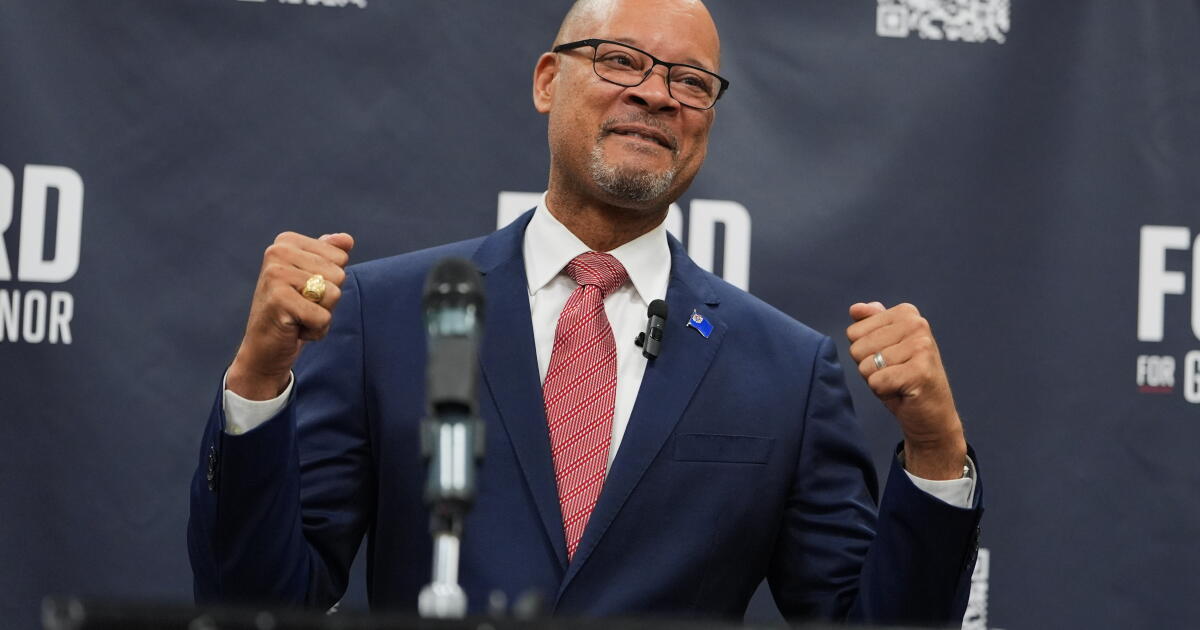
Joe Lombardo, Nevada’s Republican governor, is seeking election to his second term. His chief opponent is Aaron Ford, Nevada’s Democratic attorney general.
But to hear Lombardo and his allies tell it, Ford’s guru, his doppelganger, his soulmate and political inspiration — if not his actual running mate — is the Democratic governor living next door. It’s almost as if Lombardo is facing Gavin Newsom in November.
Look, there, along the streets of Las Vegas, you’ll see California’s governor on billboards, grinning alongside Ford.
Stop at the gas pump, wince at the pain and ask yourself why? It’s not President Trump and the muddle-headed war he started over in Iran. Blame Newsom.
Higher taxes and more spending? Only if Newsom, er, Ford, has his way.
“It’s official,” a chirpy announcer says in one pro-Lombardo campaign spot. “Shared vision. Shared values. Aaron Ford: Gavin Newsom’s choice for Nevada.”
Lombardo seemed, for a time, the most politically vulnerable Republican governor in the country. Things have looked up. He’s built a big financial advantage over Ford. But anti-Trump sentiments are keeping the Democrat in contention, which is what happens when an incumbent is running shackled to a ball and chain.
Enter Newsom.
A familiar playbook
It’s not at all surprising he would endorse a member of his own party, especially in Nevada, which is holding one of the first contests of the 2028 presidential race. Newsom, if you haven’t heard, has been positioning himself for a potential White House bid for years. Backing Ford is a way of collecting chits, as they say in gambling and politics.
It’s also not surprising that Lombardo would try to deflect from the unpopular Trump by yoking his opponent to Newsom. Select a polarizing member of the opposite party and suggest your rival is their slavish devotee; it’s a strategy as well-thumbed as a Los Angeles-to-Las Vegas road atlas. (Google it, kids.)
In Nevada, the attack can have added resonance when the offending politician is from California, which has long been viewed, by some at least, as an overpriced, tax-happy, left-wing lunatic asylum.
“There’s a tendency in Nevada to worry about what’s called ‘Californication’ and this has gone on quite a while,” said Michael Green, a historian at the University of Nevada, Las Vegas, who suggested it’s a particular slice of California, not the moderately conservative Central Valley but rather outré San Francisco, that Lombard is trying to convey.
For the governor, Newsom-bashing is a return to form.
Four years ago, as the sheriff of Clark County — that’s Las Vegas — Lombardo said the Democratic incumbent, Steve Sisolak, cared “more about copying Gavin Newsom than governing in the best interest of Nevadans.”
This time, Lombardo has focused on high fuel prices, a particular torment in a vast state with a lot of long, gas-guzzling stretches of rural highway. In March, he sent an open letter to Newsom blaming California’s environmental policies for running up energy costs. (Nevada relies on California for nearly 90% of its transportation fuels, which mainly flow from Southern California refineries to Las Vegas.)
In April, he explicitly blamed “Gavin Newsom’s energy policies” for “driving higher gas prices for Nevada families” and said Ford refused to push back because “he doesn’t want to risk his relationship with his biggest ally.”
Newsom vs. Lombardo
Turnabout being fair play, the Ford campaign has responded by tying Nevada’s governor to the unpopular president.
“Joe Lombardo is endorsed by Donald Trump and is running on a platform of raising costs and is laser-focused on taking care of Trump’s billionaire friends and padding the pockets of greedy corporations,” said spokesperson Tai Sims, who suggested the governor was relying on a “failed MAGA playbook” because “he’s too busy embracing Trump’s cost-raising agenda to acknowledge the economic pain caused by the Lombardo-Trump economy.”
Newsom and Lombardo have also gone at it.
“Since I took office, Nevada has created more jobs than California,” Lombardo boasted in a July posting on X that, of course, tied Ford to Newsom. “As Governor, I’ll never let Nevada become an extension of California’s failed agenda.”
“FALSE!” Newsom’s press team replied, with a Pinnochio-nosed emoji and a link to Federal Reserve data. “Using the same official jobs measure your office cites, California added about 340,900 jobs from December 2022 through June 2026. Nevada added 100,800.”
Lombardo hasn’t just focused on economics. Playing on old animosities, he told a Jewish Republican audience in Las Vegas last month that a certain California governor “wanted to pass two holidays for the Muslim community, agnostic to the Jewish community.” (Legislation that would add Eid al-Fitr and Eid al-Adha to the list of state holidays is on Newsom’s desk, for him to sign or veto.)
“That’s not going to happen in the state of Nevada,” Lombardo said to applause, and so much for appealing to the better angels of our nature.
In the end, will the forced marriage of Newsom and Ford matter?
Probably not a whole lot. There are doubtless many things that matter more to your typical Nevadan than whether California’s governor hearts the state’s attorney general.
Wait until 2028. If Newsom is on the ballot, then we’ll find out what Nevada truly thinks of its next-door neighbor.
What else you should be reading
Get smart: Questions swirl over Trump’s pledge to give $5,000 payouts if GOP wins
The deep dive: Will the economy motivate voters? This Central Valley swing district could be a test
The L.A. Times Special:California provides tax breaks to Hollywood. Why not struggling news outlets?
Until next time,
mzb
—
Was this newsletter forwarded to you? Sign up here to get it in your inbox.