Xi, in lavish Trump summit, urges ‘human control’ over AI
WASHINGTON — China’s president issued a call from the White House on Thursday for artificial intelligence to remain “under human control” as the world’s two superpowers race for technological supremacy.
Xi Jinping’s remarks reflect growing concern within China over whether governments in Washington or Beijing will be able to contain a technology with potentially transformative capabilities, according to a U.S. official.
Lawmakers and AI industry leaders urged President Trump to use his summit with Xi this week to pursue a safety framework for AI, which researchers warn could soon surpass human understanding.
But Trump preempted the meeting with a post on social media stating he had no intention of negotiating limits on AI development.
“A big day with President Xi of China,” Trump wrote. “Super Intelligence (SI) will be a big topic of discussion, but I want to leave it exactly where it is. That is China’s position also. Our guardrail is the DOJ!”
After offering Xi a lavish welcome on the White House grounds, Trump made a passing reference to AI. “The decisions we make in these areas today can promote peace and prosperity for decades and decades to come,” he said.
But Xi gestured to substantial concerns, noting AI first among priorities to discuss between the two nations.
“Both China and the United States are leading nations in artificial intelligence,” Xi said. “We have both the capability and responsibility to develop and manage AI for good — and ensure that the development of AI is always under human control, and serves the well-being of the people.”
The two held a private meeting with aides in the Oval Office after participating in a military review in the Rose Garden and exchanging gifts in the Blue Room.
In the evening, a guest list of top banking and technology leaders — including AI industry executives — were scheduled to attend a state dinner in the East Room of the White House.
“Given Trump’s statements going into the summit about not wanting guardrails, I have tepid expectations about tangible outcomes” on AI, said Aalok Mehta, director of the Wadhwani AI Center at the Center for Strategic and International Studies.
“The most likely scenario seems to be the establishment of a hotline — though how useful that will be depends on who will be staffing it, and how much each government prioritizes it,” Mehta added, “and likely some discussions about issues blocking cooperation, like distillation, with a promise to engage in ongoing dialogue.”
Earlier in the week, on the sidelines of the United Nations General Assembly in New York, Treasury Secretary Scott Bessent met with his Chinese counterpart primarily to discuss AI development, according to U.S. officials.
“What we discussed was setting up a mechanism — so it’s going to be called the U.S.-China AI Dialogue. We’ve agreed to meet again,” Bessent said Monday. “The U.S. has proposed that we have a notification mechanism between the two countries, and we want a shared vision of common goals, and common threats.”
While Trump’s team has remained divided over whether — and how extensively — to regulate AI, Bessent has favored a cautious approach, advocating modest, voluntary guardrails that have shaped administration policy in recent months.
China, too, has shown increasing willingness to open channels of communication on AI, despite deep distrust between the two sides.

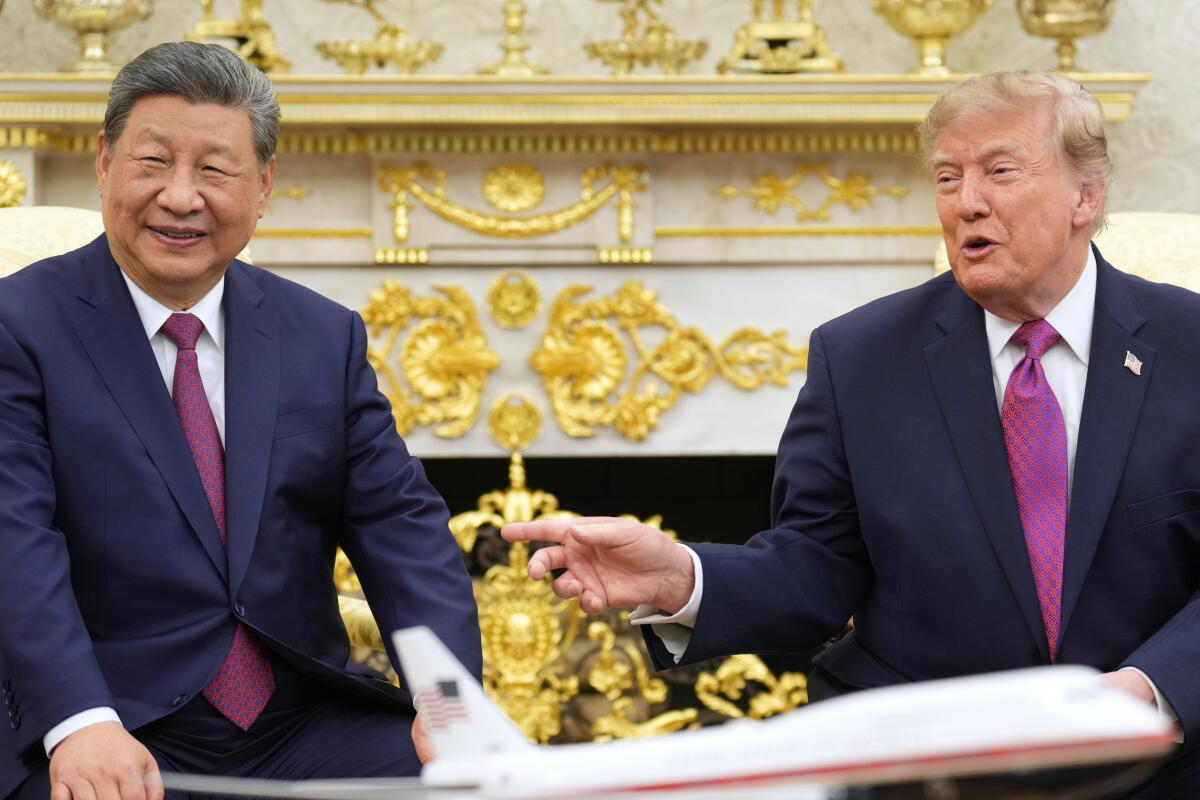
President Trump and China’s President Xi Jinping meet in the Oval Office on Thursday.
(Jacquelyn Martin / Associated Press)
Two American AI companies, OpenAI and Anthropic, are widely viewed to be developing the most advanced AI models in the world, leading at the frontier of technological breakthroughs.
Both have begun to use their most sophisticated models to train the next generation, in a process known as recursive self-improvement. Researchers and industry experts believe the first company to master that process could set off an exponential cycle of progress, pulling so far ahead that competitors can no longer catch up.
But those same companies also fear what they’re creating: machines capable of continuously improving their own intelligence, pushing AI development beyond human control.
Leaders from the two companies have called on Beijing and Washington to cooperate, warning that geopolitical competition could thwart the two sides from preventing a human catastrophe.
In his remarks, Xi said that China and the United States “stand to gain from cooperation, and will both lose in confrontation.”
“We do not need to avoid mentioning competition, but our competition should be a healthy one, and should be kept within bounds,” the Chinese president said. “It should be a race of catching up with one another, not a wrestle in which one either wins or loses. China and the United States must hold the line of no conflict, and no confrontation between us.”
“Our two militaries should maintain regular dialogue, and improve mechanisms for crisis communication and prevention,” he continued, adding a historical reference to rising powers challenging established ones: “The Thucydides trap can be overcome.”
Xi’s trip to Washington follows just months after Trump traveled to Beijing for a state visit in May, where the U.S. president was greeted with a similarly imperial welcome.
The leaders emerged from that summit with few deliverables. But Trump left Beijing declaring the trip a success, emphasizing the importance of his personal relationship with Xi, China’s most powerful leader in generations.
This time, Trump himself greeted Xi on the tarmac upon his arrival at Joint Base Andrews — a rare honor reserved in recent decades only for Catholic popes — before pulling out several red carpets and draped ceremonies for the Chinese leader.
The pageantry seen during the state visit has served China’s long-standing desire for respect and dignity on the international stage, said Jessica Chen Weiss, the director of the John Hopkins SAIS Institute for America, China and the Future of Global Affairs.
“Trump is someone who loves spectacle, and right now the spectacle is working in both leaders’ favor,” Weiss said.
For Xi, the ceremonies have offered a chance to demonstrate that relations with the United States remain under control and that China is being treated as a significant global power, she argued.
The state visit comes at a time when Americans are appearing to warm up to China, according to recent polls. A survey by the Chicago Council on Global Affairs recently found that a majority of Americans say the United States should have friendly engagement and cooperation with China.
“I tend to think we focus too much on the optics,” Weiss said. “But I also think treating China as a significant player on the world stage is not a concession. It’s appropriate if we want a stable relationship and is hardly something to worry about.”