Satirical anti-Trump video game console lands in Greenland
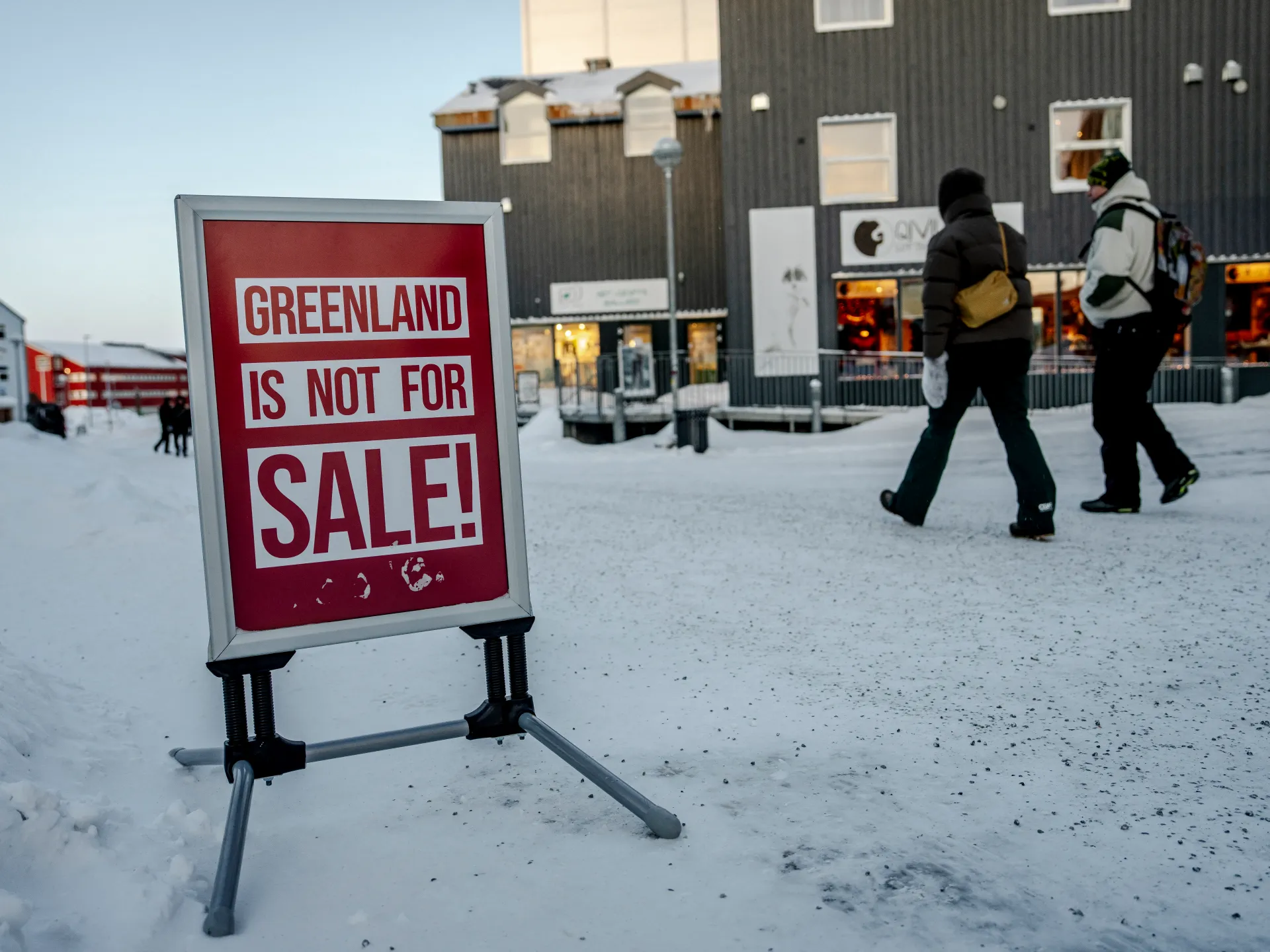
The anonymous arts group known as Secret Handshake has gone international with its piquant form of satirical anti-Trump artwork, this time placing a playable video game console called “Nuuk ‘Em All” in, yes, Nuuk, Greenland. The group sent a picture of the console to The Times. It sits alone on a barren cliff above the sea, with a smallish iceberg visible in the water below. The peaked roofs of a nearby town can be seen in the distance.
Secret Handshake has created more than a dozen pieces of guerrilla art mocking Trump since last year — all of which appeared on the National Mall in Washington, D.C., until July when a golden, 10-foot tall “Iran War Participation Trophy,” cropped up in New York City. That piece arrived at the Minnesota State Capitol in early August.
Greenland is ambitious though, even for a collective that revels in creating outsize splashes with its work (see the Trump-Epstein “Best Friends Forever” sculpture). Asked via email how the group transported the full-size video game console to the country — which has weathered a series of unwelcome overtures from Trump to become part of the U.S. since he retook office early last year — a representative wrote, “You have no idea — it was honestly very difficult. A true ‘planes, trains, and automo … ships’ situation. Did you know that the arctic is actually quite far? And they’re not used to whipping over arcade games.”
“Nuuk ‘Em All” is the second satirical video game Secret Handshake has released since July when it first introduced the world to “Operation Epic Furious: Strait to Hell,” which finds Trump waging a futile war with Iran while making all kinds of bumbling choices including whether to order a Diet Coke or bomb the country.
The game arrives in Greenland shortly after the Trump administration signed an agreement with the country and Denmark to expand the U.S. military presence in the Arctic while seemingly dropping threats to annex the semi-autonomous Danish territory.
Three additional cabinets of the game were simultaneously placed at the D.C. War Memorial on the National Mall, and can be played online on any old computer. The game begins with an animation of the White House, its lawn covered with cranes and backhoes. “The year is 2026,” the scrolling text reads. “The White House is under constant construction, reconstruction and construction of the reconstruction.”
The action moves to Trump’s Mar-a-Lago headquarters where Trump is approached by Defense Secretary Pete Hegseth, who apologizes for waking Trump from his “tactical nap” to tell him about some “issues with Iran.” Trump asks if the Strait of Hormuz is 100% open and Hegseth replies, “Yes, sir. It’s so open that we’ve used up all our missiles, and gas now costs more than bourbon.”
I haven’t had the chance to play the game for long, but Secret Handshake’s email details what to expect, “In this game, Iran is going great (spoiler — it’s not), so Trump heads north to check on his new frozen frontier. Along the way, he battles unthinkable evils like Fully Vaccinated Children, Woke Yetis, and the happiest people on Earth, the Danish. All the while, the player’s greatest challenge is trying to keep President Trump from falling back asleep.”
Secret Handshake didn’t have any information about how Greenland has responded to the game, with the rep noting, “I think there is a lot of hope and relief over there right now that this agreement is the end of the barrage of bullying and threats from the US. But our feeling—and I truly hope we’re wrong— is that it’s just the beginning. Especially with Trump refusing to answer if an invasion is completely off the table now.”
Regardless of what happens in Greenland, the rep continued, “the thing I really like the most about this new game is that between all the satire, and jokes, and silliness, it actually ends up back in reality — the character is still stuck in an endless loop of war in Iran. And that, sadly, is still just as true as when we released the Iran game almost half a year ago.”
I’m Arts editor Jessica Gelt screaming into the void. This is your arts and culture news for the week.
The week ahead: A curated calendar
FRIDAY
Boston Marriage
David Mamet’s 1999 epigram-filled comedy about two women sorting out their affairs while maintaining their standard of living at the turn of the 20th century. Directed by Bernardo Cubría. With Nicole Pacent, Heather Wake and Dulce Valencia.
8 p.m. Fridays-Saturdays (and one Thursday, Oct. 22): 2 p.m. Sundays, through Oct. 24. European House LA, 12355 Rye Street, Studio City. ticketsource.com
Yvette Janine Jackson With Radio Opera Workshop
The ensemble integrates electronics, acoustic instruments, voice and images to produce new music by the award-winning composer and sound artist. Presented by CAP UCLA in collaboration with the UCLA Herb Alpert School of Music and the UCLA Center for Musical Humanities.
8 p.m. The Nimoy, 1262 Westwood Blvd. cap.ucla.edu

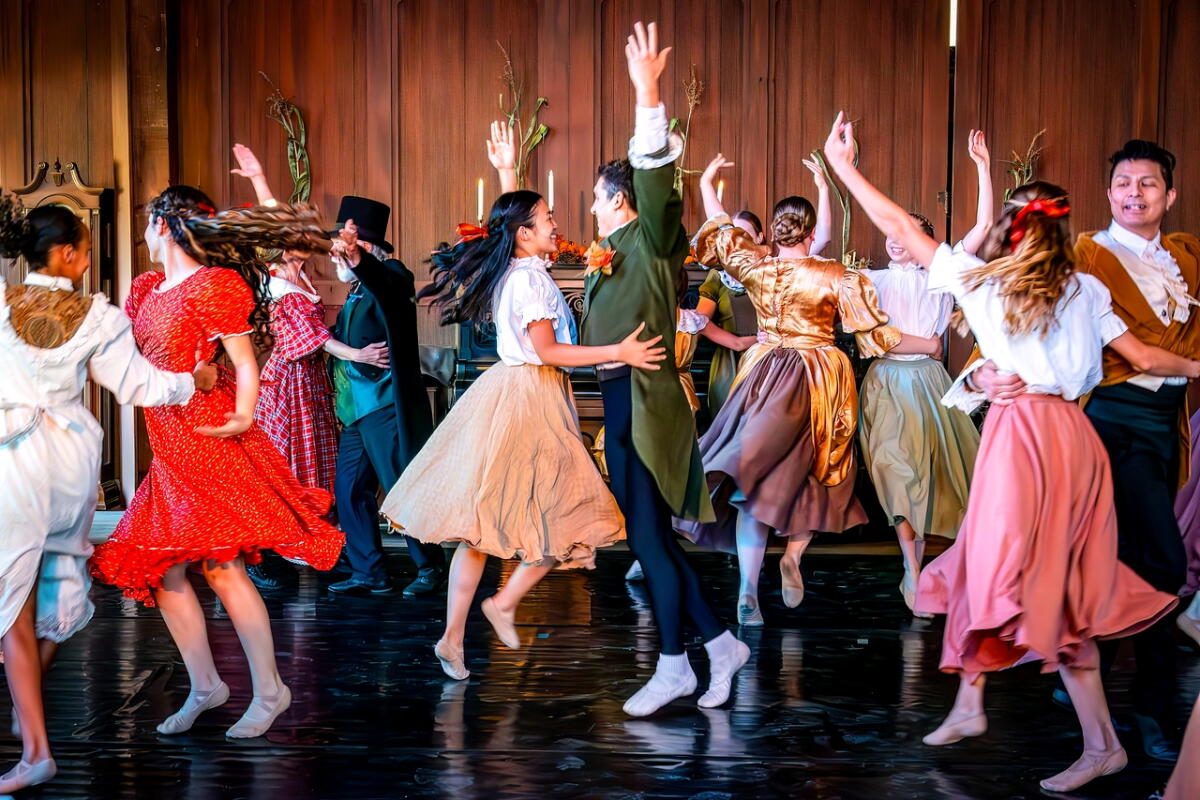
The Little Women Ballet in action.
(Edie Tyebkhan-Melissa O’Gara)
Little Women Ballet
The dance troupe’s Autumn Immersive Experience brings audiences into the world of Louisa May Alcott through movement amid Victorian Era architecture.
6:30 p.m. Friday, 3 and 6:30 p.m. Saturday-Sunday. Heritage Square Museum, 800 Homer St., Montecito Heights. littlewomenballet.org
Outside Mullingar
An Irish romance written by Pulitzer Prize and Academy Award winner John Patrick Shanley that premiered on Broadway in 2014 finds a middle-age man and woman, longtime neighbors, circling an uneasy relationship in uncertain times. Michael Kirby, Liza Seneca, Armin Shimerman and Kitty Swink star. Directed by Matthew Leavitt.
8 p.m. Fridays-Saturdays, 2 p.m. Saturdays, 4 p.m. Sundays, through Oct. 25. Sierra Madre Playhouse, 87 W. Sierra Madre Blvd. sierramadreplayhouse.org
Gretchen Parlato
The jazz singer-songwriter performs music from her new album, “The Wise Ones,” joined by her band Alan Hampton on bass and guitar, Mark Guiliana on drums and percussion and Gerald Clayton on piano and keyboards.
8 p.m. Carpenter Center, 6200 E. Atherton St., Long Beach. carpenterarts.org
SATURDAY

Isaiah Collier performs Saturday at the Segerstrom Center for the Arts.
(Johanna Brinckman)
Isaiah Collier Plays Coltrane
The rising jazz musician and composer pays tribute to the saxophone legend by applying his own sound and reaffirming the music’s ability to evolve.
7:30 p.m. Segerstrom Center for the Arts, Samueli Theater, 600 Town Center Drive, Costa Mesa. scfta.org
Democracy Sessions 2026
Music collective Wild Up expands upon its successful election-themed 2024 event examining how art can function as a democratic practice in this time of censorship, polarization and shifting public trust. The new month-long festival was developed in partnership with MOCA, REDCAT and CalArts, with related programming independently conceived and presented by Clockshop, 2220 Arts + Archives, Human Resources, Performance Art Museum and Living Earth, for the run-up to the Nov. 3 midterms.
Saturday through Nov. 3, various locations. wildup.org

A calavera mask designed by artist Leo Limon and a paper marigold for Self Help Graphics & Art’s Dia de los Muertos Community Art Workshop Series in October 2026.
(Self Help Graphics & Art)
Día de los Muertos Community Art Workshop Series
Self-Help Graphics & Art launches the holiday season with five free Saturday community art workshops. Participants of all ages will learn crafts to honor ancestors and loved ones. Each week features papel picado (tissue paper with cutout shapes) and a paper marigold craft activity, plus a special project: Stamp collages with SHG Lead Printer Dewey Tafoya (Oct. 3); Calavera (skull) masks featuring a design by artist Leo Limon (Oct. 10); Recuerdo (memory) posters with Victoria Delgadillo (Oct. 17); “Living candle” mini paintings with Ivan Zuno (Oct. 24); and Candle decorating with Nupur Behera (Oct. 31).
Noon-3 p.m. Saturdays through Oct. 31. East Los Angeles County Library, Community Room, 4837 E. 3rd St. selfhelpgraphics.com
Woof
A revised version of “Go Play,” written and directed by Barra Grant, featuring the same loquacious dogs with new insights into their clueless owners.
Previews, 2 and 7 p.m. Saturday, 2 p.m. Sunday and Oct. 10; opens 7 p.m. Oct. 10; 2 and 7 p.m. Saturdays, 2 p.m. Sundays, through Nov. 8. Odyssey Theater, 2055 S. Sepulveda Blvd. odysseytheatre.com
SUNDAY
Come From Away
The award-winning Broadway hit musical, written by the husband-and-wife team of Irene Sankoff and David Hein, tells the true story of a Canadian town that sheltered thousands of airline passengers whose flights had been diverted on Sept. 11, 2001. Directed by Julia Rodriguez-Elliott, with music direction by Rod Bagheri.
Previews, 2 p.m. Sunday, 7:30 p.m. Wednesday, Thursday and Oct. 9; opens Oct. 10 through Nov. 8. A Noise Within, 3352 E. Foothill Blvd. Pasadena. anoisewithin.org
WEDNESDAY
The Best Medicine
Caroline Aaron stars in the West Coast premiere of this solo comedy by playwright Robin Gerber and directed by Jane E. Unger.
Previews, 8 p.m. Wednesday-Friday; Opening, 8 p.m. Saturday; 8 p.m. Fridays-Saturdays, 2 p.m. Sundays, through Nov. 15. Odyssey Theatre, 2055 S. Sepulveda Blvd. odysseytheatre.com
B+ Mom (An Enthusiastic Guide to Imperfect Parenting)
Melissa Greenspan wrote and performs this solo comedy directed by Guy Picot.
7:30 p.m. Wednesdays, through Oct. 28. Rogue Machine at the Matrix Theatre, upstairs on the Henry Murray Stage, 7657 Melrose Ave. roguemachinetheatre.org
Charlemagne Palestine
The Brick and Piano Spheres presents the visual artist and musician performing “Strumming Music,” which he describes as “an evolutionary liquid sound continuum process” and performed hundreds of versions over the last 50+ years.
8 p.m. The Brick, 518 N. Western Ave. the-brick.org
THURSDAY
Ronald K. Brown / Evidence
The landmark African diasporic dance company led by choreographer Brown recently celebrated its 40th anniversary. West Coast fans will have the chance to experience the New York-based company’s unique blend of contemporary, African and African American dance traditions with this program of four pieces that includes tributes to some of Brown’s most enduring collaborators. (Eloise Rollins-Fife)
7:30 p.m. Thursday-Oct. 10. The Wallis, 9390 N. Santa Monica Blvd., Beverly Hills. thewallis.org
Wives
East West Players presents the Southern California premiere of Jaclyn Backhaus’ feminist comedy examining a selection of “great men” in 16th century France, 1920s India and 1960s Idaho. A primarily South Asian and South Asian American cast, under the direction of Hypokrit Live Arts NYC co-founder and artistic director Arpita Mukherjee, brings this redress of women’s erasure in history to astringent comic life. (Charles McNulty)
Through Nov. 1, check website for specific dates. East West Players, Union Center for the Arts, David Henry Hwang Theater, 120 Judge John Aiso St. eastwestplayers.org/wives
Yamel Cucuy
Austin’s Glass Half Full Theatre returns with this production, last seen in L.A. at the Latino Theater Company’s 2024 Encuentro theater festival. The tale of a girl on the verge of adulthood facing the threat of immigration agents and haunted by specters from Mexican folklore is told through live actors, sophisticated puppetry and an original score of Indigenous percussion. Written by Gricelda Silva, Indigo Rael and Caroline Reck, with additional writing by Jesus I. Valles and Connor Hopkins. Directed by Reck.
8 p.m. Thursdays-Saturdays, 2 p.m. Sundays, through Nov. 1. Los Angeles Theatre Center 514 S Spring St. latinotheaterco.org
The SoCal scene

Wendy Raigosa, 27, Long Beach, uses repurposed materials in her art project at Kate Ingold’s bi-monthly Samizdat Sundays workshop at the Wende Museum.
(Carlin Stiehl / For The Times)
Times contributor Miranda Huang wrote about bi-monthly classes at the Wende Museum called “Samizdat Sundays” in which teacher Kate Ingold teaches participants samizdat, “a practice in which Soviet dissidents hand-typed literature, criticism and poetry to bypass state censorship. Each week, Ingold opens the workshop with a new prompt related to speech suppression — an issue with renewed currency today.”
Vincent Price Art Museum is currently staging a unique exhibit featuring the work of Anida Yoeu Ali, a Cambodian-born artist who lives in Tacoma, Wash. It’s called “The Buddhist Bug” and features a 328-foot-long orange insect, which Ali will occupy on opening day, and again on closing day. “Ali’s numerous performance-based exhibits explore her Cambodian American identity and Buddhist and Muslim religions. The bug is her ‘totally humorous take on hybridity’,” writes contributor Siran Babayan.

(Ed Ruscha)
Times staff writer Laura Zornosa headed to LACMA over the weekend to attend a private lunch featuring filmmaker Alejandro González Iñárritu, Tom Cruise and Ed Ruscha, for the unveiling of a poster Ruscha made for Iñárritu’s new film, “Digger,” starring Cruise.
Segerstrom Center for the Arts turned 40 last month and Times contributor Jenelle Riley made the drive to interview the organization’s leaders, including President and Chief Executive Casey Reitz, about how the campus grew out of windswept lima bean fields to become the epicenter of art and culture in Orange County.
Contributor Leah Ollman had such a hard time narrowing down her list of must-see shows for our Fall Arts preview, that we asked her to create another list of 14 off the beaten path shows that art lovers should be sure to see.

RM, leader of the K-pop group BTS, speaks at SFMOMA in advance of an art show he curated featuring many pieces from his personal collection.
(Mags Ng)
RM, the leader of K-pop supergroup, BTS, is also a serious art lover with a collection of more than 400 pieces. This month he is co-curating a show at SFMOMA featuring more than 100 pieces from his private stash paired with art from the museum meant to compliment its themes.
Architecture critic Sam Lubell went to the Lucas Museum of Narrative Art last weekend and was sorry to see that the museum has erected gates around its main courtyard. Lubell, like many, had been under the impression that the courtyard was meant to function as a grand civic plaza, so he penned a piece of commentary questioning the founders’ motives for cordoning off the area. “It’s hard not to wonder whether these barriers represent something more than security: the extension into public space of the gated, closely guarded world inhabited by co-founders George Lucas, Mellody Hobson and those in their orbit,” Lubell writes.
Enjoying this newsletter? Consider subscribing to the Los Angeles Times
Your support helps us deliver the news that matters most. Become a subscriber.

A rendering of the Las Vegas Museum of Art, designed by architect Francis Kéré.
(Kéré Architecture / Las Vegas Museum of Art)
Culture News
Earlier this week the long-gestating Las Vegas Museum of Art hosted a preview of its Grand Central Galleries — a multipurpose media lab and exhibition space located in Symphony Park down the street from the museum’s future main building. Scheduled to open in April 2027, the 15,000-square-foot space will act as an entry point to the museum and is slated to host a variety of exhibitions and programs while the museum’s Francis Kéré-designed building remains under construction through 2029.
The Grand Central Galleries exhibition program was organized by the LVMA in collaboration with LACMA, and will open with “A Shared Light: Monet, Impressionism, and the American Landscape,” organized by Shannon Vittoria, LACMA’s associate curator of American art, along with David Bardeen, LACMA’s assistant curator of European painting and sculpture. It features nearly 60 works by artists including Claude Monet, Paul Cézanne, John Singer Sargent, Pierre-Auguste Renoir and James McNeill Whistler.
— Jessica Gelt
And last but not least
Yes, they did that. The Food staff compiled a list of 20 of its favorite sundaes and banana splits in L.A. Since summer is never going away, this seems like the perfect time.