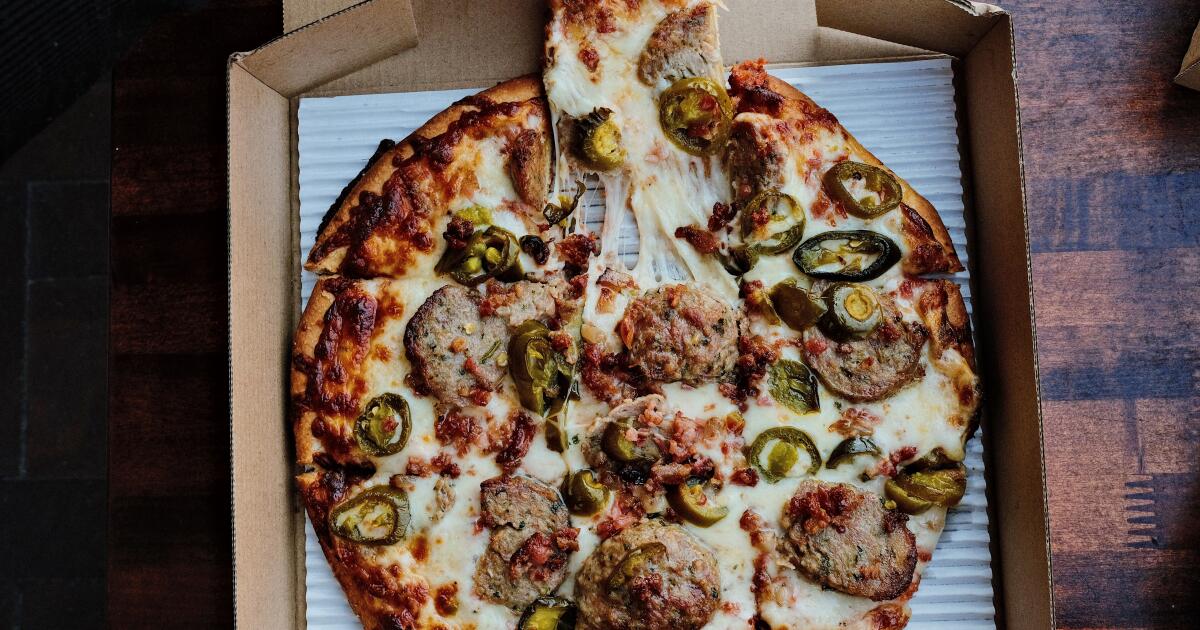
Growing up in suburban Detroit, there was deep-dish square pizza and there was round pizza. The round style was the kind of pizza you’d find at your local bowling alley, roller rink, arcade or neighborhood sports bar. It was thin, super crispy and you could pick it up and eat it with just a napkin.
I wasn’t aware that any of my hometown pizzas were considered trendy until 2016 when Detroit-style pies exploded in NYC and then, during the pandemic, in Los Angeles. But much like the square pizza, the thin, crispy, round pies have an identity as well: Tavern-style pizza has many names (party cut, bar pie, etc.) but it’s the slightly lesser known, thin-crust style of pizza born in the Midwest. And lately, it’s been having a moment in Los Angeles.
“It was the kind of pizza they served you at whatever bar you were at,” says fellow Michigan native Aaron Lindell of Echo Park’s Quarter Sheets. “I wasn’t aware then that it was its own style,” he says.
What makes it a Midwest-style tavern pie exactly? Essentially it’s a lower-moisture, higher-fat dough resulting in a thin, crackery, flaky pizza crust. Typically bar pies go lighter on tomato sauce and caramelize the mozzarella significantly, resulting in a molten matrix of cheese and sauce that takes me back to my childhood with each bite.
Despite its prevalence in Michigan and other parts of the Midwest, tavern-style is most commonly associated with the Chicagoland area, thanks to places like Vito & Nick’s. Lindell developed his own recipe for bar pie in 2023 that combines Midwest tavern style with those of the northeast to bump up business on slower nights. Now, the nights that Quarter Sheets has bar pies on the menu are some of the busiest of the week.
However, Lindell was far from the first to offer a take on tavern-style pizzas here in L.A. Eagle Rock’s Casa Bianca Pizza Pie opened in 1955 with the intention to bring Chicago thin-crust to Los Angeles. Fresh Brothers Pizza opened in 2008 in Manhattan Beach specializing in tavern-style pies and wings and the chain quickly expanded to 20 locations in the SoCal area. In 2013, Rance’s Chicago Pizza opened in Costa Mesa offering both Chicago deep dish and tavern-style (and eventually expanded to Long Beach in 2017). Midwest icon Gino’s East of Chicago even opened in Sherman Oaks in 2019, also offering their take.
And since the pandemic, newer spots have been doing their own versions much like Quarter Sheets.
Here are nine places to try tavern-style pizza around L.A. right now.
With average gas prices topping $6 in Los Angeles, it can be painful to watch your fuel gauge creep toward “E” during a day out around town. It’s time to stop the car and walk. And where better to do that than in the most walkable city in California?
For more than a decade, West Hollywood has been designated a “Walkers Paradise” by Walk Score, earning a 91 out of 100 on the popular walkability index that looks at distance to amenities, pedestrian friendliness, population density and road metrics. The small city within a city scores two points above the state’s second most walkable city, San Francisco. It’s also a full 22 points above Los Angeles, which has a middling score of 69.
But you don’t need a formula to know that West Hollywood’s well-maintained sidewalks dotted with cafes, shops and historic sites is a great place for walking. Take a stroll around the city and you can find out for yourself.
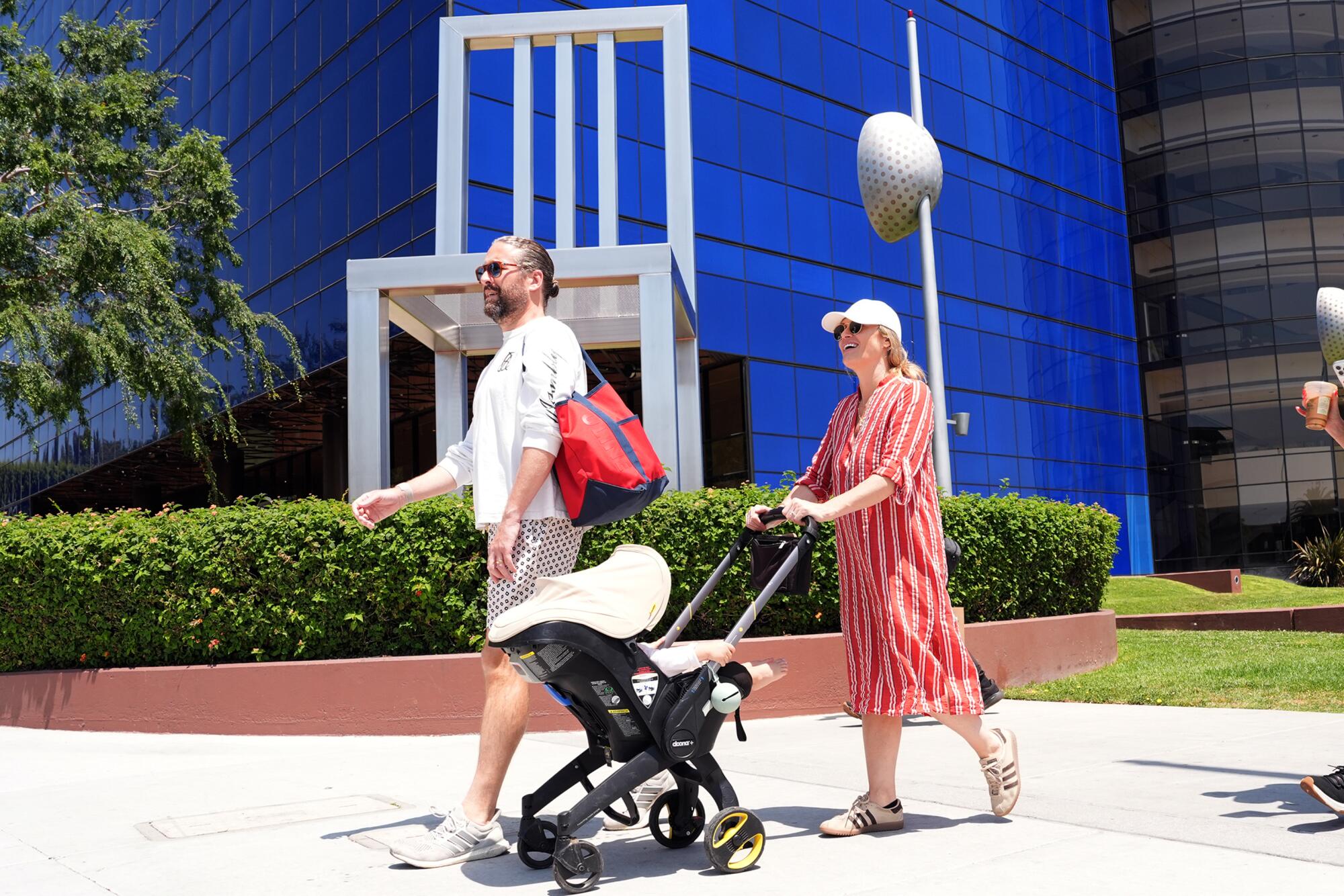
That’s what I did on a recent Friday afternoon, where I met locals like Kimberly Beauchaine out in the neighborhood — yes — walking. “We really don’t use our car here,” Beauchaine said, pushing her 18-month old in a stroller past the Pacific Design Center on Melrose Avenue. “It’s very walkable and very central.”
Alex Uihlein and Kimberly Beauchaine walk down Melrose Avenue with their 18-month-old on their way to the West Hollywood Aquatic & Recreation Center.
(Scott Strazzante / For The Times)
While West Hollywood is easy to navigate on foot, getting there without a car can be a challenge. The closest Metro stop is along the just-opened D-line on Wilshire Boulevard, a two-mile hike from the West Hollywood border. Fortunately, West Hollywood has ample public parking. I found a spot in a public lot on North San Vincente Boulevard, where I paid $12 for the whole day.
The hardest part about planning a fun day in West Hollywood might be choosing a place to start. According to Walk Score, there are about 339 restaurants, bars and coffee shops in the city and you can walk to an average of 13 of them in 5 minutes.
I asked Eric Parker, director of PR and communications for the city of West Hollywood, why there’s such an abundance of spots to eat and drink in the tiny city. He explained that West Hollywood serves not just residents who live within its borders but also the many folks who live in the residential neighborhood of the Hollywood Hills.
“They need a place to live their lives too,” he said. “Beverly Hills has become a little jam-packed with tourists, so West Hollywood has become the heart of L.A. in many ways.”
My journey began at the Butcher’s Daughter on Melrose Avenue, a cheerful and bright plant-forward cafe a few blocks from where I parked my car. The croissant I ordered was fine, but the atmosphere was lovely — open and airy with a communal wood table inside and green and white bistro chairs outside. Pedestrians of all ages strolled by on the wide flat sidewalks, many with small dogs in tow. Trees along the street offered dappled shade, and there were several other cute restaurants nearby, many with outdoor spaces of their own.
Adisa Aditheparot, left, and Mari Muay enjoy a light lunch at the Butcher’s Daughter on Melrose Avenue after walking over from a nearby Pilates class.
(Scott Strazzante / For The Times)
Moving on from the Butcher’s Daughter I headed one block east to the corner of Melrose and San Vincente to take in the rolling lawns and massive green, red and blue glass buildings of the 14-acre Pacific Design Center, which first opened to the public in 1975 and currently houses nearly 100 showrooms. Across the street on San Vincente, I strolled past the excellent West Hollywood Library, the luxurious rooftop West Hollywood Public Pool, and the green expanse of West Hollywood Park where young children were shrieking on the playground.
The vibe shifted as I continued north toward Santa Monica Boulevard. Here, the city’s identity as a gay haven was in full view. The crosswalks were painted with stripes and triangles celebrating the full range of queer identity and although the many colorful bars were quiet on this early Friday afternoon, it was easy to imagine them filled with revelers after the sun set. On the weekends, a free bus runs down this street every 15 minutes, connecting the Troubadour to Formosa Cafe. The area felt fun and funky, but I was only passing through, determined to get to my next destination.
To be fair, walking in West Hollywood is not ideal for everyone. After having lived in Boston, New York and Santa Monica, Sean Patrick Gallagher points out that the hills are real.
“It’s walkable if you are walking east to west,” said Gallagher, who has lived in the city for two years. “If you have to venture north or south, you are destined to hit inclines that are not for every able body.”
Pedestrian traffic outside Book Soup on Sunset Boulevard.
(Scott Strazzante / For The Times)
At the same time, daily conveniences are generally in easy walking distance for many residents. “Most people in West Hollywood can walk to the gym, the grocery store and the laundromat,” he said. “There are enough things on each street that cater to your needs.”
Parker describes West Hollywood as a place where history is hidden in plain sight. I certainly felt that as I passed onto the quiet, shaded streets of Norma Triangle, a historic neighborhood in West Hollywood where Dorothy Parker and Christopher Isherwood once lived. The sidewalks here are more narrow but well maintained, and the streets are filled with locals walking dogs of all sizes. The homes and apartment buildings, many of which date to the mid-20th century, are beautifully landscaped and clearly tended to with care, but I was searching for one in particular — the Lloyd Wright Home and Studio, designed in 1927 by Frank Lloyd Wright’s eldest son who also worked as an architect.
The house was not a disappointment. It’s not open to the public, so I was only able to see the exterior, but it was worth it. The desert landscaping on the corner lot is on point and the building itself, a two-story space that makes use of the organic textile-block pattern popularized by Lloyd Wright’s father, has a unique interlocking design of stylized Joshua Trees. I loved it. It’s also located in deep shade, which is very welcome on a hot day.
With that done, I made my way up to Sunset Boulevard, which is loud and unshaded and not nearly as pleasant a place to walk as some of West Hollywood’s more green and leafy streets. However, there are some cultural landmarks here that I felt should not be missed along with a surge of oval-eyed delivery robots (seriously, so many). This is the famous Sunset Strip where you’ll find the Roxy Theatre, the Whisky a Go Go and the Viper Room. All very cool, but this writer was most excited about getting to spend some time in Book Soup, the iconic bookstore with a real-life magazine stand outside that celebrated its 50th anniversary last year. Down a narrow alley right next door is the more esoteric Mystery Pier Books, which specializes in first editions and is beloved by celebrities.
Taking a walk down Sunset Boulevard in West Hollywood.
(Scott Strazzante / For The Times)
I had ambitious plans to amble past more spots in West Hollywood. More than one friend suggested I go to Mamie on Sunset and Fairfax for Italian sandwiches (the focaccia is supposed to be amazing). I considered ending my day at the perfect patio at Chateau Marmont on the border of the Hollywood Hills. But reader, I was tired, and walkability is not about exhausting yourself. It’s about enjoying your time car-free. So instead, I headed back toward where I started, walking past the high-end shops of Melrose Place before arriving at Zinque for a simple prosciutto and cornichon sandwich and an Arnold Palmer. At 4 p.m., a waiter came past my table to tell me happy hour had officially begun and asked if I’d like a drink.
There is more than one reason why it makes sense to live in a walkable community.