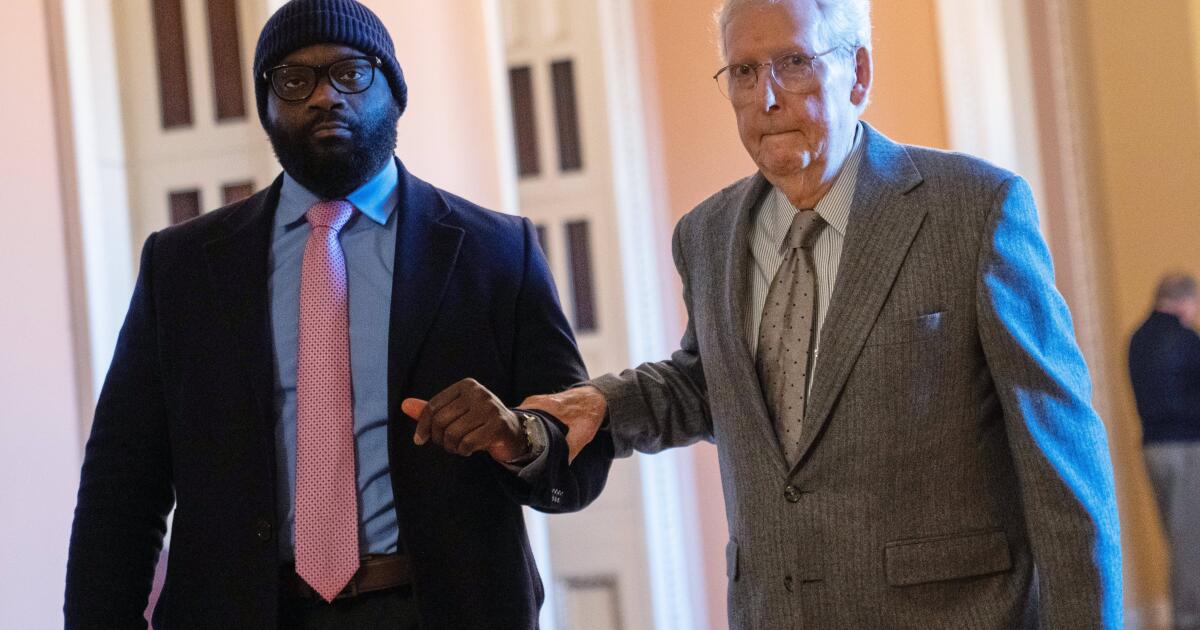
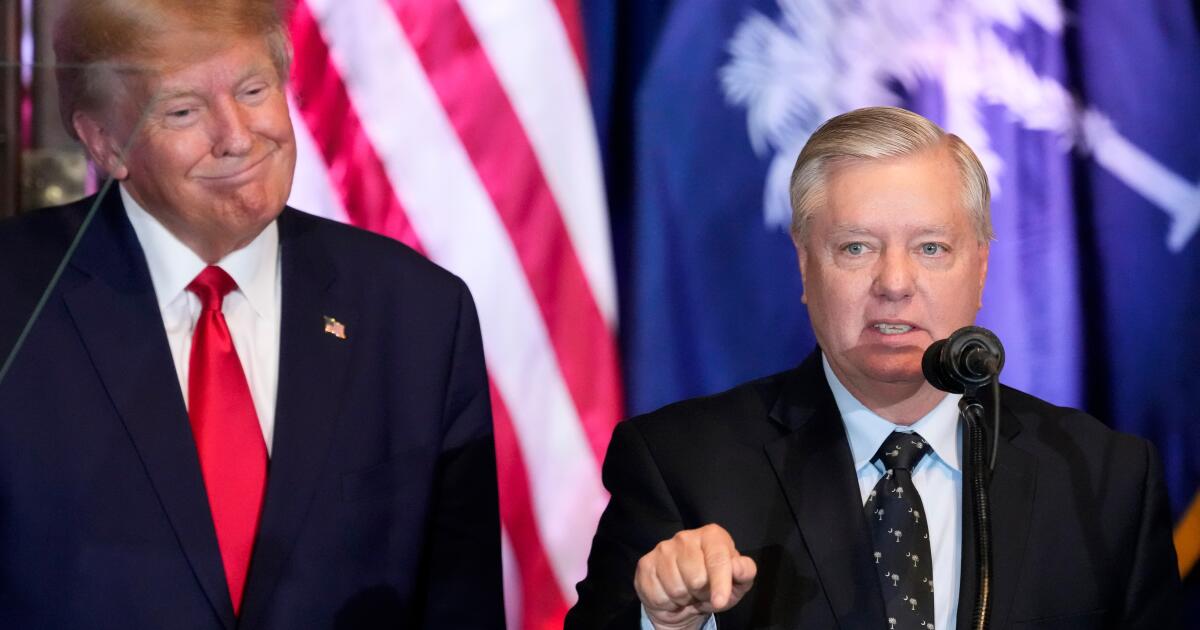
Hundreds of mourners have paid their respects to the late Senator Lindsey Graham of South Carolina.
The Republican lawmaker and key ally of President Donald Trump unexpectedly died on July 11.
Graham was elected to the US Senate in 2002 and was re-elected in 2008, 2014 and 2020. In 1994, he was elected to the US House of Representatives, the lower house of the US Congress, for South Carolina’s third congressional district. He recently served as chairman of the Senate Budget Committee. Graham also served as a member of the Senate Committee on Appropriations, the Senate Judiciary Committee and the Senate Committee on Environment and Public Works.
He was a strong supporter of the 2003 US invasion of Iraq and had long pushed for military action against Iran.
Graham was a longtime backer of Israel and supported Trump’s ongoing war on Iran. In a planned documentary, Graham told the filmmakers he “almost cried” after the US and Israel began strikes on Iran in February.
He also vocally supported Ukraine after Russia invaded the country in 2022.
Israeli Prime Minister Benjamin Netanyahu, Ukrainian President Volodymyr Zelenskyy and several other world leaders attended Graham’s funeral service on Tuesday afternoon at the Washington National Cathedral in Washington, DC.
Trump gave remarks, calling Graham a force in the world and US politics. He called Graham “a beloved friend” and said that he “died doing the work he was born to do”.
“For more than 30 years, nothing of consequence happened in this capital without Lindsey Graham knowing about it. Nothing of significance happened anywhere in the world without Lindsey Graham having a view on it,” Trump said. “And no bill became law in the most exceptional republic in human history without Lindsey Graham having a say in it.”
He added: “He was a man who gave America the full measure of his good and mighty heart until that heart itself just gave out.”
COLUMBIA, S.C. — Sen. Darline Graham (R-S.C.) said Monday she’s running for a full term to replace her late brother Lindsey Graham’s Senate seat.
“I’ve made a decision,” Graham told Fox News Channel host Sean Hannity, according to a clip released of an interview set to air Monday. “I’m in.”
The entrance of Graham — sworn in last week to fulfill the remaining months of her late brother’s term, which expires in January — into the Republican scramble to select a new Senate nominee further complicates an already rushed process after Lindsey Graham ‘s death this month.
A weeklong filing period opens Tuesday for the special Republican primary, which will be Aug. 11. On Friday, President Trump said that Darline Graham had his “Complete and Total Endorsement” to seek the nomination, adding, “RUN, DARLINE, RUN!”
Last week, Gov. Henry McMaster appointed Graham to serve the remainder of her brother’s term.
In his announcement, McMaster made no reference to Graham as a placeholder or symbolic appointment, although a person familiar with McMaster’s thinking but unauthorized to speak publicly said the governor had never contemplated that she would run for the seat herself.
Before the emergence of Graham — and their Oval Office meeting after she was sworn in — Trump had suggested he could back a potential candidacy from Republican Rep. Russell Fry, who said Monday he would officially enter the special primary.
Funeral services for Lindsey Graham are scheduled to be held next week in Washington and South Carolina.
The millions in Graham’s campaign account aren’t funds that Darline Graham could directly access in a run of her own, said Bradley A. Smith, a former chairman of the Federal Election Commission.
Under federal rules, Lindsey Graham’s campaign would be limited to transferring just $2,000 to a potential Darline Graham candidacy.
However, Smith said there is no limit on how much it could transfer to the National Republican Senatorial Committee, which could — thanks to a Supreme Court decision last month — “spend an unlimited amount in coordination with Darline’s campaign.”
Three days after the sudden death of Republican Senator Lindsey Graham, his sister, Darline Graham Nordone, was sworn in on Tuesday to fill his vacant Senate seat at the suggestion of United States President Donald Trump.
Announcing his selection of the deceased senator’s sister on Monday, South Carolina Governor Henry McMaster introduced the new senator as Graham’s “darling little sister” who would “finish his work for him now”.
Recommended Stories
list of 4 itemsend of list
Graham had been among the most influential of senators in the US Congress, using his seat in South Carolina to pursue a consistently hawkish line on foreign policy as well as offering unflagging support to his formerly bitter political rival, President Trump.
Among the Senate’s strongest advocates of Israel’s genocidal war on Gaza, Graham repeatedly argued against imposing limits on US military support and rejected calls for a ceasefire. He also pressed for a tougher stance on Iran, championing harsher sanctions, backing military action against Tehran’s nuclear programme and warning that the US should be prepared to use force to prevent Iran from acquiring a nuclear weapon.
After dying unmarried and without children, his position has now been inherited by his sister, Darline, formerly active in South Carolina’s local government, but with no experience in elected political office.
So, who is Darline Graham Nordone, how significant is this, and are US political powers often inherited? Here’s what we know.
Who is Darline Graham Nordone?
She is Lindsey Graham’s younger sister.
Graham and his sister lost both their parents within 15 months of each other.
At the time, Graham was 22 and his sister was 13. She went to live with relatives, but the pair remained close as Graham studied law and later served in the Air Force.
Years later, Graham legally adopted his sister, saying the move would ensure she was eligible for his military benefits if he died and would be eligible to serve as first lady if he were ever elected president.
Darline Graham Nordone has never held elected office. Neither she nor Governor Henry McMaster has said whether she intends to seek a full six-year Senate term or serve only as a caretaker until January 2027.
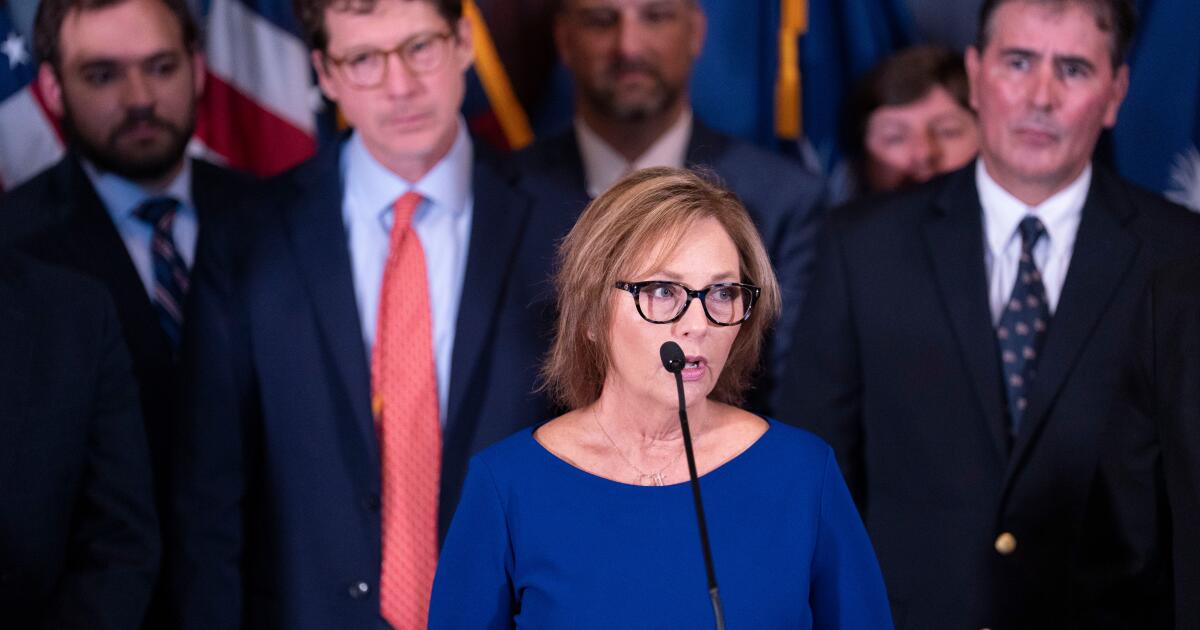
“I promise to work hard over the next several months to support the president and carry forward the efforts of my brother on behalf of the citizens of South Carolina and the United States,” she said in brief remarks during the announcement of her appointment on Monday. “I think this is what Lindsey would have wanted, and I plan to honour him in this way.”
Senator Lindsey Graham with his formerly bitter political rival, US President Donald Trump [Joe Raedle/Getty Images via AFP]
What powers has Darline Graham Nordone inherited?
Although Darline Graham Nordone inherits her brother’s Senate seat, she does not automatically inherit his influence.
As a senator, she will be able to vote on legislation, approve presidential appointments, influence foreign policy and help shape US spending priorities.
However, her brother’s committee positions, seniority and political networks were built over decades of negotiating and dealing in the Senate’s corridors of power, and will not transfer to her.
Republican leaders will decide her committee assignments, leaving her to establish her own standing in Washington.
Are US political powers often inherited?
It happens more than you might think.
The practice of relatives stepping into the seats of deceased lawmakers has a long history in US politics, with family members often appointed to complete the remainder of a term.
Figures from the US House of Representatives show that, as of 2025, 45 widows have directly succeeded their late husbands in Congress – including 38 who entered the House and eight who served in the Senate.
Supporters of such appointments point to a long tradition in US politics. Known historically as “widow’s succession”, the practice involved governors appointing the spouses of lawmakers who had died in office, allowing them to serve as temporary custodians until a special election was held. The system also provided an early pathway for women to enter Congress, helping expand female representation in the 20th century.
In modern Washington, inherited seats have, more often than not, served as bridges between one era of family influence and the next, such as the way that the powerful Kennedy family has preserved its influence over past decades.
Has there been any backlash?
Some.
Senior elected officials have yet to comment on Graham Nordone’s appointment, while details of her willingness to run in the midterms remain unknown. However, social media users in the US have reacted angrily to what they see as the unelected transfer of power.
Journalists such as Ben Binday of The Washington Post have also questioned Graham Nordone’s lack of political experience, commenting that nothing is known of her position on key issues such as abortion, foreign policy and healthcare.
NEW YORK — The sudden death of Sen. Lindsey Graham, a top ally of President Trump and one of Washington’s best-known politicians, is renewing focus on the country’s aging lawmakers.
Graham, a South Carolina Republican who had turned 71 just two days before dying on Saturday, was far younger than many of his Senate colleagues and appeared to have been in good health. He suffered a tear in his aorta, according to a preliminary report from the medical examiner.
It was the second time in less than a month that emergency personnel were dispatched to the home of a U.S. senator. In early June, Mitch McConnell of Kentucky, the former Republican Senate leader, was hospitalized for undisclosed reasons.
After weeks of increasingly dire speculation about his health, he finally revealed on Sunday that he had fallen and suffered from mild pneumonia. He released a photo, complete with a copy of the day’s newspaper.
Graham’s death and McConnell’s hospitalization have come amid an ongoing reckoning about the nation’s aging leaders, two years after the disastrous presidential debate that sparked widespread panic among Democrats about then-81-year-old President Biden’s capacities and accusations of a cover-up.
Some politicians have continued to obscure details about their health challenges, asking for privacy despite their public positions, and fueling conspiracy theories.
“I think we need some transparency,” Sen. John Cornyn (R-Texas) said Monday. “I wish Sen. McConnell and his team would have done that earlier. I think it would have resolved a lot of questions.”
McConnell is admitted to a hospital
McConnell, who at 84 is only the third-oldest member of the Senate, was admitted to the hospital on June 14 with barely any explanation. Aides said he was “receiving excellent care” but offered no details about his condition.
The dearth of information fueled a wave of speculation about his prognosis, with Laura Loomer, a Trump ally and conspiracy theorist, claiming on social media that a “high level source close to the White House” had told her he was “officially brain dead.”
But McConnell, who will retire from Congress at the end of January after serving as the longest-ever Senate leader, said in a statement that he is on the mend. He said a fall had led to his hospitalization and that he was “briefly unconscious” and treated for mild pneumonia.
“You all know how folks of my generation often hesitate to share the vulnerability that comes with growing older,” he said. “Even in the public eye, I feel that same instinct — I can’t help it.”
That wasn’t enough to put speculation to rest. On social media, many refused to believe the veracity of a photo his office released that included the front page of the sports section of the Washington Post.
Conspiracy theories about McConnell’s health are “a symptom of our times,” said Sen. Rand Paul, a Republican who is also from McConnell’s home state of Kentucky. Paul said people should “give him a break.”
“People think they have a right to know everyone’s medical problems,” he said, “but I don’t know, where does it begin and where does it end?”
Trump’s medical reports offer limited details
The oldest person ever elected president, at age 78, has long offered only the rosiest picture of his health.
“Everything checked out PERFECTLY,” he boasted after his last physical in May, adding that he took yet another cognitive test aimed at detecting early dementia and has “aced them all.”
His past medical reports have been criticized for offering limited detail and including statistics that some health professionals have viewed with skepticism.
When he first ran for president in 2016, Trump declined to release his health records, breaking with longtime precedent. He instead offered a four-paragraph note from his doctor declaring that he would be “the healthiest individual ever elected to the presidency.” Rep. Ronny Jackson (R-Texas), White House doctor during Trump’s first term, later drew headlines when he extolled the president’s “incredibly good genes.”
When he was infected with COVID-19 in the midst of his 2020 reelection campaign, Trump’s doctors and aides withheld key details of his treatment and tried to downplay the severity of his illness.
And after an attempted assassination at a Pennsylvania rally, Trump aides kept the public in the dark for days, declining to discuss the extent of his injuries or release medical records after assuring he was “fine.”
Kean Jr. goes absent for months
The obfuscation extends beyond the septuagenarian and octogenarian set. New Jersey Republican Rep. Tom Kean Jr. spent four months missing without explanation before he finally disclosed late last month that he had been in treatment for depression.
He said in a brief floor speech after his return that he had remained silent about his condition because he is a “private person by nature.”
He won an uncontested primary during his absence, despite missing more than 100 votes in the House, and is running for reelection.
The approach stood in contrast to Sen. John Fetterman, a Pennsylvania Democrat, who disclosed his hospitalization for clinical depression the day after he was admitted to Walter Reed National Military Medical Center for treatment. He also suffered a stroke while running for office.
Biden’s stumbles doom his reelection effort
Biden’s halting gait, frail appearance and frequent verbal stumbles eventually doomed his 2024 reelection campaign. After a debate in which he frequently lost his train of thought, he chose to withdraw from the race, sparking an unprecedented swap at the top of the Democratic ticket that ultimately paved the way for Trump’s return to office.
Many others have refused to retire. California Sen. Dianne Feinstein, a Democrat, died in office in 2023 at the age of 90, after years of declining health, including a bout of shingles. Though she returned to the Senate after her illness, she appeared frail and confused at times. It was later revealed that her office had failed to disclose in real time that she had contracted encephalitis while recovering.
Longtime Republican Rep. Kay Granger of Texas spent the final months of her more than two decades in Congress, when she was in her early 80s, suffering from what her office called “unforeseen health challenges” that made travel to Washington difficult.
Eleanor Holmes Norton, 89, the longtime House delegate for the District of Columbia, announced earlier this year that she would not run for reelection amid questions about her competency.
Colvin writes for the Associated Press. AP writers Mary Clare Jalonick and Lisa Mascaro in Washington contributed to this report.
The death of United States Senator Lindsey Graham has created fresh uncertainty over the future of Washington’s support for Ukraine at a critical stage in the war with Russia. Graham was one of Kyiv’s strongest advocates in Congress and one of the few Republican lawmakers with direct access to President Donald Trump, allowing him to influence White House policy on sanctions, military aid, and strategic cooperation.
While many lawmakers have pledged to continue Graham’s initiatives, analysts say replacing his unique political influence will be difficult. His death comes as Ukraine faces intensified Russian attacks, renewed debates over military assistance, and uncertainty over whether Congress will approve tougher sanctions on Moscow.
Who Was Lindsey Graham for Ukraine?
For more than two decades, Lindsey Graham was one of the Republican Party’s leading foreign policy voices. Since Russia’s full scale invasion of Ukraine in February 2022, he emerged as one of Kyiv’s most consistent supporters in Washington.
Unlike many lawmakers, Graham maintained a close personal relationship with both President Donald Trump and Ukrainian President Volodymyr Zelenskiy.
Stay ahead of the geopolitical week.
MD Briefing delivers expert analysis across five global fronts — the Indo-Pacific, energy, geoeconomics, European security, and the Middle East — every Monday morning. Free.
He visited Ukraine 10 times during the war, regularly met Ukrainian officials, and publicly argued that continued United States support was essential for European security and for deterring authoritarian powers worldwide.
His greatest political advantage was his ability to communicate directly with Trump at times when many other Republican supporters of Ukraine struggled to influence the president.
The Russia Sanctions Bill
One of Graham’s most important priorities was the Sanctioning Russia Act, legislation designed to significantly increase economic pressure on Moscow.
The bill seeks to punish countries that continue purchasing Russian:
Its objective is to reduce Russia’s energy revenues, which remain a key source of funding for its military campaign.
Although the legislation gained 85 bipartisan co sponsors in the Senate, it remained stalled because of resistance from the White House.
Just one day before his death, Graham announced that he had finally secured an agreement with the Trump administration to move the legislation forward.
Many senators now hope Congress will pass the bill both as a strategic measure against Russia and as a tribute to Graham’s legacy.
Military Aid Could Face Greater Challenges
Beyond sanctions, Graham consistently advocated stronger military assistance for Ukraine.
He supported:
Patriot air defense systems
Missile production cooperation
Expanded weapons transfers
Long term security commitments
Intelligence cooperation
His lobbying helped improve relations between Kyiv and Trump during periods of political tension.
Last year he also played a central role in negotiating a critical minerals agreement that gave the United States preferential access to future Ukrainian mineral projects in exchange for investment.
More recently, Trump announced that Ukraine would receive licenses to manufacture Patriot interceptor missiles domestically, an initiative Graham strongly supported.
However, Ukraine continues to emphasize that immediate deliveries of defensive weapons remain more urgent than future production capacity.
Why Graham Was Difficult to Replace
Analysts argue that Graham’s influence extended far beyond committee hearings or public speeches.
He served as an informal bridge between:
Congress and the White House.
Republicans and Democrats.
Kyiv and the Trump administration.
Few Republican lawmakers enjoyed comparable access to Trump.
His ability to persuade the president privately often proved more valuable than public congressional debates.
This influence became especially important as many Republicans adopted a more cautious approach toward supporting Ukraine after Trump’s return to office in January 2025.
Several other senior Republican supporters of Ukraine, including former Senate leader Mitch McConnell, are also preparing to leave Congress, further reducing Kyiv’s network of experienced allies.
Will United States Policy Change?
Despite concerns, Graham’s death does not automatically mean a reversal of United States policy toward Ukraine.
Several factors suggest continued support:
Strong bipartisan backing
The Russia sanctions legislation already enjoys overwhelming bipartisan support in the Senate.
Institutional momentum
Military cooperation between Washington and Kyiv now involves long term industrial partnerships, intelligence sharing, and defense production agreements that extend beyond any single politician.
Trump’s recent policy shift
In recent weeks Trump has adopted a noticeably more supportive tone toward Ukraine.
He has endorsed licensed production of Patriot interceptors and appears increasingly willing to allow Congress to vote on tougher sanctions against Russia.
Nevertheless, uncertainty remains.
Without Graham acting as an intermediary, disagreements between Congress and the White House could become more difficult to resolve.
Political Reactions
President Volodymyr Zelenskiy described Graham’s death as a personal loss, noting they had remained in constant contact and met twice during the senator’s final visit to Ukraine.
Democratic Senator Jeanne Shaheen and several Republican lawmakers have proposed passing the Russia sanctions bill as Graham’s legacy, with some suggesting it should even bear his name.
Senate Majority Leader John Thune also called passage of the legislation an appropriate tribute to Graham’s decades of public service.
Why This Matters
Lindsey Graham represented something increasingly rare in Washington’s polarized political environment: a Republican with both strong pro Ukraine views and significant influence over President Trump.
His death removes one of Kyiv’s most effective advocates at a time when the war is entering another difficult phase. While institutional support for Ukraine remains substantial, personal relationships often play an outsized role in shaping United States foreign policy, particularly under the Trump administration.
Whether Congress can maintain bipartisan momentum without Graham may influence not only future sanctions but also military assistance and broader diplomatic engagement with Ukraine.
Analysis
Graham’s passing is unlikely to produce an immediate shift in United States policy, but it could gradually reshape the political dynamics surrounding Ukraine. His influence was rooted less in his legislative position than in his personal relationship with President Trump, allowing him to bridge the gap between a White House that has often been skeptical of deeper involvement in Ukraine and a bipartisan coalition in Congress seeking stronger action against Russia.
The sanctions bill may still pass because of its broad bipartisan support and the symbolic significance it has acquired following Graham’s death. However, future military assistance could face greater political hurdles. Weapons transfers and funding packages require sustained presidential backing, and without Graham serving as an intermediary, advocates for Ukraine may find it harder to persuade Trump during moments of disagreement.
At the same time, the institutional relationship between Washington and Kyiv is now far more developed than it was in the early years of the war. Joint defense production, intelligence cooperation, and long term industrial partnerships have created strategic ties that extend beyond the influence of any individual lawmaker. These structures provide a degree of continuity even as political leadership changes.
Looking ahead, the direction of United States policy will depend less on finding a direct replacement for Graham and more on whether other Republican leaders choose to embrace his internationalist approach or align more closely with voices advocating reduced American involvement overseas. The outcome will shape not only Ukraine’s military position but also the credibility of Western efforts to sustain long term pressure on Russia.
South Carolina governor chooses Darline Graham Nordone to serve the rest of the late US senator’s term until early 2027.
Published On 13 Jul 202613 Jul 2026
South Carolina Governor Henry McMaster has picked Darline Graham Nordone to succeed her late brother Lindsey Graham in the United States Senate after President Donald Trump backed her for the role.
The appointment on Monday ensures the seat is quickly filled to maintain the 53-senator Republican majority in the 100-member chamber. Nordone will serve the rest of Graham’s term, until January 3.
Recommended Stories
list of 4 itemsend of list
The interim senator, who leads the South Carolina Commission for the Blind, has no formal political experience. But she has appeared at campaign rallies and in political advertisements alongside her late brother, including when he ran for president in 2016.
On Monday, she suggested that her tenure would be a continuation of her brother’s work. The late senator was a staunch supporter of Israel and a vocal cheerleader of the US-Israel war on Iran.
“I promise to work hard over the next several months to support the president and carry forward the efforts of my brother on behalf of the citizens of South Carolina and the United States,” Nordone said.
She did not indicate whether she will run in the election for the full Senate term.
Republicans will hold primaries next month to replace Graham, who had won the party’s nomination earlier this year as he sought re-election. The Republican candidate will then face off with Democratic paediatrician Annie Andrews.
Earlier on Monday, Trump called on McMaster to appoint Nordone to fill the vacant Senate seat.
“I recommended, to Governor Henry McMaster, Lindsey Graham’s wonderful sister, Darline, to serve as interim Senator from the Great State of South Carolina,” Trump wrote on his Truth Social platform.
“This would be a fabulous tribute to Lindsey, who loved her dearly!”
Graham had no wife or children. While running for president in 2016, he said Nordone would be part of his support network if he won.
“If she took a role on, she would be a great representative of our country,” Graham, who died on Saturday at age 71, said at that time.
“I can’t think of a better person to represent our country in an event than my sister.”
Nordone was a pre-teen when both of her parents died, and Graham, who was in his early 20s, helped raise her.
On Monday, McMaster heaped praise on the late senator as he announced the appointment, calling him “irresistible” and “irreplaceable”.
“Lindsey took care of his little sister in years long departed. It’s my honour to ask his little sister, Darline Graham, to finish his work for him now,” the governor said.
CHARLESTON, S.C. — President Trump said Monday he’s recommended that Lindsey Graham’s sister be named as his temporary replacement in the U.S. Senate.
Trump posted on social media that Gov. Henry McMaster should appoint Darline Graham Nordone to fulfill the rest of Graham’s term, which expires in January. Graham died over the weekend at age 71, and McMaster is expected to announce his pick later Monday.
After their parents died at a young age, Graham was left to raise his sister, whom he later adopted. The pair were very close, and Graham’s sister was by his side as he filed reelection paperwork earlier this year.
A special election will be held next month to pick a new Republican nominee in the general election for Graham’s seat. He had been seeking a fifth term this year.
The rare open Senate seat has ignited a scramble among South Carolina’s most ambitious conservatives, who have been eager to climb the political ladder.
Republicans just finished a sprawling and bruising contest to figure out their nominee for succeeding McMaster, who is wrapping up his second term. State Atty. Gen. Alan Wilson won the nomination, overcoming a field that included Lt. Gov. Pamela Evette, Rep. Nancy Mace and Ralph Norman — all of whom are now eyeing Graham’s seat following his death over the weekend.
How will a special primary work?
According to South Carolina law, a one-week filing period for a special primary election begins on the second Tuesday after the candidate’s death, or July 21.
The special primary election would be held on the second Tuesday after that filing period closes, or Aug. 11. Any necessary runoff would follow two weeks after that, or Aug. 25.
From that point, the new nominee would have just over two months to campaign for the general election on Nov. 3.
All of this is problematic according to federal law, which requires military and overseas ballots to go out 45 days before any federal election. For the general election primary, that would have been June 27. Federal Election Commission officials didn’t immediately return a message seeking clarity about the process.
Who could replace Graham?
Graham died on Saturday night, and a preliminary medical examiner report said he suffered a tear in his aorta, known as an aortic dissection.
In the hours after Graham’s death was announced, South Carolina’s Republican circles were already swirling with rumors about possible replacements. Given the proximity of November’s election, it’s likely that whomever McMaster appoints could be a top contender in the special primary, although it’s possible that McMaster’s choice will only serve as a temporary caretaker.
Evette, who has served nearly eight years alongside McMaster and received his endorsement in the governor’s race, is one possibility. She lost the June 23 runoff to Wilson.
A person with knowledge of Evette’s thinking but not authorized to discuss it publicly said that she was getting encouragement from across the state and feels she would have good chances in the special primary.
It’s unlikely that any House member would be appointed to finish Graham’s current term, since Republicans have such a slim majority in the chamber.
U.S. Rep. Joe Wilson, a rumored replacement, said he assured Trump on Sunday that “my goal is to remain in the House to keep his two-vote majority for the American people!!!”
However, that doesn’t mean that House members won’t run for the next full term. A person with knowledge of Mace’s thinking but not authorized to speak about it publicly said she was considering the race. Mace is not running for reelection to the House.
But another Republican from the state, Rep. Russell Fry, could be a possibility. The two-term lawmaker represents the growing area around Myrtle Beach, and he’s been a top Trump ally.
A spokesman for businessman Mark Lynch, whom Graham defeated in the primary, didn’t return a message Sunday.
Treasury Secretary Scott Bessent, who lived in South Carolina before joining the Trump administration, has fielded calls about potentially replacing Graham but doesn’t have interest in the role, according to a person who insisted on anonymity to describe private conversations.
How does Graham’s death affect the general election?
No Democrat has won a Senate seat in South Carolina in decades, and Republicans in recent history typically take statewide seats by double digits. When he last ran in 2020, Graham defeated his Democratic opponent, Jaime Harrison, by a 10 percentage point margin.
So while history suggests that Graham was en route to a fifth term, Republicans are carefully surveying the landscape.
Charleston pediatrician Annie Andrews won the Democratic nomination last month and has raised more than $8 million in the race, and she had just under $3 million cash on hand at the end of May, according to federal filings. Graham had taken in $6 million, with just over $4 million on hand.
In a statement Sunday, Andrews called on South Carolinians to join her “in setting partisanship aside and offering gratitude” to Graham for his service.
Harrison, noting that he and Graham “had our share of political disagreements,” wrote on social media that he “always appreciated that even in our fiercest political battles, we could still share a conversation, a laugh, and a mutual respect for South Carolina and the institutions we were both privileged to serve.”
What happens to South Carolina’s Republican clout?
Graham leaves a major void in the Senate, where seniority can determine influence. He served more than two decades in the chamber, positioning himself to lead committees and set the agenda.
Sen. Tim Scott, South Carolina’s junior senator, has been in office only since 2012 — short by the state’s standards. Fritz Hollings served for 38 years, and Strom Thurmond was there for 47.
Scott, who co-chaired Graham’s reelection effort, described his former colleague as “irreplaceable.”
“America lost a statesman, but I lost a friend,” he told ABC’s “This Week.”
Kinnard writes for the Associated Press. AP writer Fatima Hussein in Washington contributed to this report.
WASHINGTON — The sudden death of Sen. Lindsey Graham, the veteran South Carolina Republican lawmaker, is scrambling the state’s U.S. Senate race as Republicans face a fast primary election to replace him on the ballot.
Graham, 71, who died Saturday after what the D.C. medical examiner called an aorta rupture, was seeking a fifth term in the Senate. Even as his political allies publicly mourned his loss, jockeying began over the vacancy, and President Trump signaled an intention to weigh in.
“I have somebody that I think would be great, but I don’t want to say it now because it’s just, you know, it’s too soon with Lindsey,” Trump, who ordered American flags to be lowered to half-staff in Graham’s honor, said Sunday on NBC News’ “Meet the Press.” “I don’t want to even talk about anybody, but I do have somebody that I think is really good.”
Graham’s death eats into Republicans’ voting majority in the Senate, as does the absence of Sen. Mitch McConnell of Kentucky, who has been hospitalized for weeks. It adds new uncertainty for the GOP at a time when the party is contending with Trump’s declining popularity among Americans and tensions have been high among Senate Republicans at odds with Trump.
Graham’s death creates the second major shakeup of a Senate race in a week, following Democratic candidate Graham Platner’s dropping out in Maine. Like that state’s Democrats, South Carolina Republicans now face a snap process for choosing a new nominee four months before the November midterms.
But whereas Maine Democrats are expected to decide Platner’s replacement at a convention in two weeks, South Carolina Republican voters will choose Graham’s replacement next month at the ballot box.
Whether the absence of an incumbent could tighten the race or force the GOP to funnel extra money into it remains to be seen. South Carolina is a reliably red state and Graham’s seat was not widely seen as competitive; the race has been rated as solidly Republican by Cook Political Report.
“I expect we’ll have a good November,” said Drew McKissick, chairman of the South Carolina Republican Party, but, he added: “You never take anything for granted, and that’s the last thing I would do in a situation like this.”
McKissick remembered Graham as dedicated to helping his party across levels and in sometimes little-noticed ways, assisting county organizations and down-ballot candidates.
“His time [was] spent on so many issues that were incredibly important to our party,” McKissick said. “He was a staunch pro-life senator with no equal.”
To replace him on the November ballot, the party must hold a special election, according to state election law. Republicans who want to vie for the seat will be able to file starting July 21, and the primary election will be Aug. 11, with a possible Aug. 25 runoff.
Graham was opposed by Democrat Annie Andrews, a pediatrician, who in a statement Sunday called the senator “a man of great faith who proudly served our nation.”
“I hope that South Carolinians will join me in setting partisanship aside and offering gratitude to Senator Lindsey Graham for his service to the great state of South Carolina,” Andrews wrote.
Because it is now an open seat, that changes the race, said Jay Parmley, executive director of the South Carolina Democratic Party.
It will require the “rejiggering” of campaign strategy built around opposing Graham, but the Democrats’ big-picture approach of countering Trump and MAGA Republican values will stand regardless of who becomes the new nominee, Parmley said. He predicted the race would be competitive.
“This absolutely is in play,” Parmley said of the seat. “I think it was in play before … but now, I think it’s game on.”
Democrats must retain their seats in three competitive states and flip seats in at least four others. The party has largely focused on Maine, Alaska, Iowa, North Carolina, Ohio and Texas for possible flips.
South Carolina remains a stretch for Democrats, so Graham’s death likely doesn’t change the party’s calculus, said Democratic strategist Andrew DeStefano.
“The math is still very clear and doable,” DeStefano said. “I would rather be Dems than Republicans right now, even with the Senate math and even playing in some tough states.”
Under South Carolina law, Gov. Henry McMaster, a Republican, can appoint someone to fill Graham’s vacant seat until January. In a statement, McMaster said Graham was “irreplaceable,” calling him “the fiercest of fighters for South Carolina and America.”
If a member of the South Carolina congressional delegation were to be appointed to the seat, it would erode the party’s slim margin in that chamber — something some House Republicans were reportedly seeking to avoid. At least one, Rep. Joe Wilson, said Sunday he had told Trump would not seek the seat in order to preserve the House majority.
In Kentucky, McConnell is set to retire at the end of this term, and a race is underway to fill his vacant seat in November. If he were to die before the new session of Congress begins in January, it could set off a legal fight over an untested Kentucky state law requiring a special election to fill a Senate vacancy, but would not affect the November race.
On Sunday, McConnell said in a statement he had been hospitalized after a fall. Little information had been released from his office about his condition, causing questions to swirl. “Just tell us what’s going on,” Kentucky Gov. Andy Beshear, a Democrat, urged Saturday on X.
In Maine, Democrats last week announced a July 25 convention where 601 county delegates and state party members will select a nominee to replace Platner.
“The circumstances are different between the two states,” said David Farmer, a Maine-based Democratic strategist, “but it’s certainly shaping up to be a strange midterm election with enormous stakes for the country.”
WASHINGTON — After the Capitol riot on Jan. 6, 2021, Sen. Lindsey Graham said he had finally had enough of the man who was championed by the mob that stormed the pillar of American democracy: President Trump.
“Trump and I, we’ve had a hell of a journey. I hate it to end this way. Oh, my God, I hate it. From my point of view, he’s been a consequential president,” an emotional Graham said once authorities cleared the rioters and allowed senators to reclaim their chamber to certify Joe Biden’s election win. “All I can say is count me out. Enough is enough.”
It wasn’t, of course.
Graham, the South Carolina Republican who died unexpectedly Saturday night at 71, realized that his party’s future was inextricably tied to Trump and quickly reverted back to being a staunch defender. The shift made what had once seemed like a final rupture into just another twist in the topsy-turvy relationship between the powerful senator and the president who came to dominate their party.
“Can we move forward without President Trump? The answer is no,” Graham said in May 2021, just four months after the Jan. 6 insurrection. “I’ve determined we can’t grow without him.”
Trump, who called Graham a “true American Patriot” in a social media post Sunday, appeared shocked by the senator’s sudden death.
“I just can’t believe it,” the president said on NBC’s “Meet the Press.” “He was like a member of the family.”
Graham often advised Trump on foreign affairs, particularly on matters pertaining to Israel, Ukraine and Iran. He was a frequent visitor at the White House.
“At the end of a particularly thrilling and rollicking meeting in the Oval Office, Lindsey Graham turned to the room and said: ‘I’ve never had this much fun in my life,’” Deputy White House Chief of Staff Stephen Miller wrote on X. He said such gatherings “were filled with camaraderie, kinship and uproarious laughter.”
Trump recalled that during his last conversation with Graham, he told his friend, “We’ll see you soon, come over anytime you want.”
‘Unfit for office’
The senator and Trump first clashed while competing for the 2016 presidential nomination.
Graham described Trump as “unfit for office,” and was angered when Trump denigrated the military service of Graham’s close friend Sen. John McCain (R-Ariz.). Trump, while talking about McCain’s years as a prisoner of war in Vietnam, said, “I like people that weren’t captured.”
Trump got mad enough at Graham to release the senator’s personal cellphone number. That prompted a viral video in which the senator dramatically destroyed a series of flip phones. He smashed one with a meat cleaver and another with a golf club, then used lighter fluid, a blender and toaster oven to pulverize others before tossing one off the roof.
Graham eventually likened Trump’s winning the nomination to “being shot in the head” and said he refused to vote for Trump that November. But the pair later bonded over golf and what Graham described as a mutual and irreverent sense of humor.
Trump and Graham began so frequently hitting the links together that the senator started seeing it as something of a career builder, leaning heavily into the kind of over-the-top flattery Trump relishes. In 2017, Graham joked that Trump had beaten him “like a drum” on the course, even worse than in the presidential primary.
“Their true friendship could only be seen behind the curtain,” Sen. Tim Scott (R-S.C.) said on ABC’s “This Week.” Scott said that relationship was forged as political adversaries but was strengthened by spending 100-plus hours golfing together.
During Trump’s first term, Graham helped advance Trump’s nominees to the Supreme Court, lent credibility to the White House’s legislative agenda and even at times became part of the president’s inner circle. He frequently said Trump was maturing in politics and growing on the job.
Graham’s political divergence with McCain, who died in 2018, was never more clear than in 2017, when McCain voted against a Trump-backed plan to overturn the Affordable Care Act, former President Obama’s signature healthcare law. The effort had been co-sponsored by Graham.
A short-lived split, an alliance reignited
In his floor speech after the Capitol attack, Graham said that “he’d never been so humiliated and embarrassed for the country.” But the break with Trump ended quickly.
Weeks later, Trump invited Graham for golf and dinner at the president’s Mar-a-Lago estate in Florida, reigniting their alliance. During Trump’s 2024 campaign, Graham was a frequent Trump surrogate on television, promoting U.S. military strength that he said would advance “America first” policies.
Graham never shed his more traditional Republican foreign policy views, including outspoken support for Ukraine after the Russian invasion — even as Trump frequently wavered in supporting Kyiv, sometimes castigating Ukrainian leader Volodymyr Zelensky and praising Russia’s Vladimir Putin.
The senator was also a leading voice pushing the White House to more fully embrace Israeli Prime Minister Benjamin Netanyahu and take a harder line against Iran, and he was a leading advocate of Trump’s ongoing war with Iran. After the U.S. and Israel attacked in February, Graham staunchly defended the action and working to counter many among Trump’s “Make America Great Again” base who supported the president’s longtime assertions that “America first” meant avoiding such military conflicts.
“To those who say Iran is stronger now than before, that is an insult to the American military and it is delusional thinking because the Iranian economy is in shambles,” Graham posted on social media June 19.
Graham’s admiration for Trump went far beyond Iran. When the senator clinched the South Carolina Republican primary last month, he suggested the president was just short of a deity.
“I want to start with a bunch of thank yous. I want to thank the big guy, God. Trump comes later,” Graham laughed. “Mr. President, you’re not far behind God, but we’re gonna start with him.”

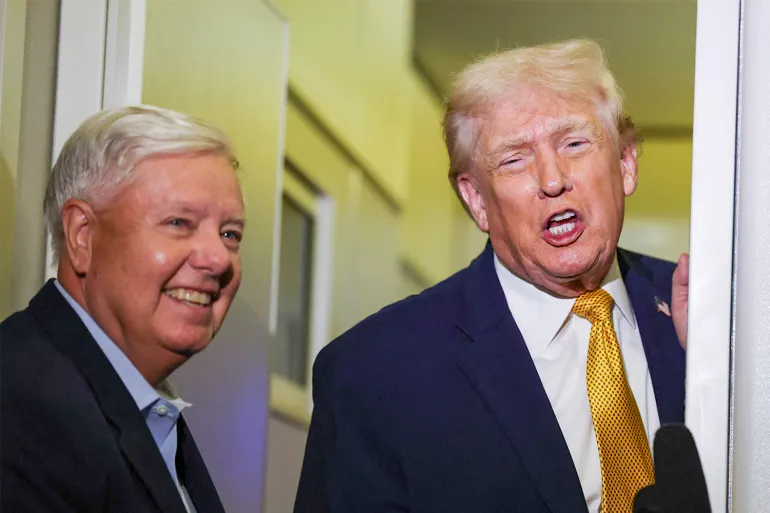
![US President Donald Trump, right, and Senator Lindsey Graham speak to reporters on board Air Force One, January 4, 2026 [Joe Raedle/Getty Images via AFP]](https://i0.wp.com/www.aljazeera.com/wp-content/uploads/2026/07/AFP__20260105__2254685896__v4__HighRes__PresidentTrumpReturnsToTheWhiteHouseAfterSpe-1-1783948241.jpg?w=640&ssl=1)