Governors

Becerra sees momentum, money and movement in the polls in governor’s race

Xavier Becerra, a former cabinet secretary in President Biden’s administration, appears to be surging in the curiously unsettled California governor’s race.

Until recently, the former U.S. Health and Human Services secretary had been mired in the single digits in polling to replace termed-out Gov. Gavin Newsom and lead the nation’s most populous state.

But after former Rep. Eric Swalwell, (D-Dublin) dropped out of the race earlier this month amid accusations ofsexual assault and other misconduct Becerra has seen a boost in polls, fundraising and endorsements.

On Tuesday, Assembly Speaker Robert Rivas endorsed Becerra alongside 14 Democratic members of the legislative body.

Arguing that Californians are under constant threat from President Trump’s policies, Rivas cited Becerra’s decades-long record in public office, including defending Obamacare and young immigrants, or dreamers, to argue that Becerra is best positioned to lead the state.

“There’s no time to learn on the job — we need a governor who’s ready to fight back on day one,” Rivas said in a statement, noting that Becerra sued the Trump administration 122 times while he was California’s attorney general. “We have a strong Democratic field for governor. But right now, we need someone ready on day one. Xavier Becerra is that leader.”

Becerra said he was honored to receive the legislators’ backing.

“I look forward to working with the Speaker and legislators on Day One to tackle the problems Californians care about most — from the skyrocketing cost of groceries and housing to our unyielding fight against the Trump Administration’s disastrous policies,” he said in a prepared statement. “Californians need an experienced and trusted leader who doesn’t need on-the-job training.”

Despite Becerra’s long tenure in state and federal office, the unflashy politician is not well-known among California voters. He was among the underdogs in the 2026 gubernatorial race. Swalwell, by contrast, was among the leading Democratic candidates.

Amy Thoma, a former Republican strategist who is no longer affiliated with a political party, noted that Becerra’s surge comes at a critical moment in the election, shortly before ballots land in Californians’ mailboxes.

“Voters are starting to tune into the race. Yes, they want someone who will stand up to Trump, but it also seems they want someone with experience who can address the very real issues facing the state,” Thoma said.

She added that Becerra’s life story is “incredibly compelling.”

“The word authentic is overused, but every time he talks about his love for this state, for his family and wanting to make California work for everyone, it comes across incredibly sincere,” Thoma said. “Voters can see through candidates who fake it.”

Becerra was respected by colleagues across the aisle, including former GOP legislative leader and state Republican party chairman Jim Brulte. Both men were elected to the state Assembly in 1990 and though their politics often sharply differed. However, they had a warm relationship.

“He was progressive and I am a conservative,” Brulte said. “We never agreed much on policy, but he is a good man with a great heart.”

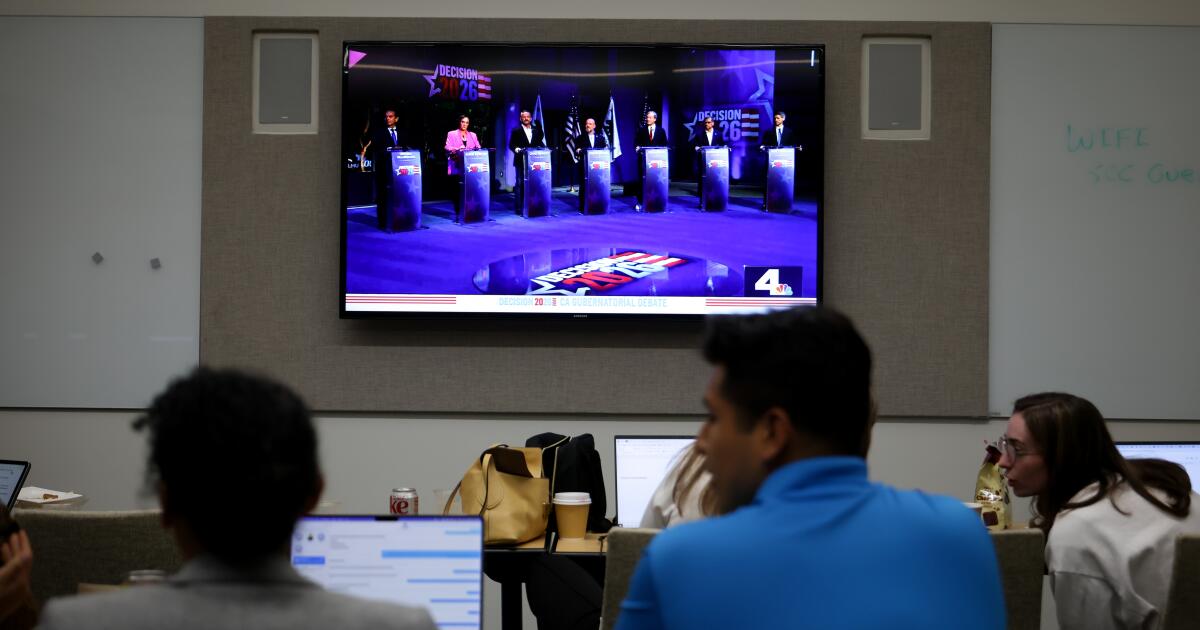
The 2026 governor’s race has been unlike any in recent memory, with no clear front-runner in a crowded field of candidates and voters just beginning to pay attention to the contest shortly before the June 2 primary.

There were two prominent Republicans and eight prominent Democrats in the race, leading to fears among Democratic leaders in the state that their party’s candidates could be shut out of the governor’s race in the general election because of California’s unique primary system. The two candidates who win the most votes in the June 2 primary will move onto the November general election, regardless of party affiliation.

Democratic leaders remain concerned that despite California’s sapphire-blue tilt, the number of their party’s candidates in the race could lead to a splintering of Democratic voters that results in two Republicans advancing to the November ballot.

Six prominent Democrats remain in the race, after Swalwell and former state Controller Betty Yee dropped out.

The race — lacking a global superstar such as Arnold Schwarzenegger or the scion of a storied political family and former governor like Jerry Brown — is ephemeral. Anything can happen before the June 2 primary.

But Becerra is having a moment. In addition to the new endorsements, he has seen notable movement in polls, most recently in a survey released Monday by the state Democratic party. Becerra jumped nine points from the party’s last poll, tying with billionaire Tom Steyer at 13%.

While Becerra will never be able to match Steyer’s deep pockets, he raised more than $1 million on ActBlue, the top Democratic fundraising platform, in the week ending on April 18, making him the biggest fundraiser on the site in the nation.

“Ninety-seven percent were first-time donors,” Becerra’s campaign said in a statement. “This is not a donor base being recycled. It is a movement being born.”

Source link

Governor’s race wildly unpredictable two weeks before Californians receive ballots

The most unpredictable California governor’s race in recent history took another set of dizzying turns on Monday, with former Health and Human Services Secretary Xavier Becerra surging after former Rep. Eric Swalwell dropped out in the face of sexual assault and misconduct allegations, and former state Controller Betty Yee ending her bid.

The race to replace termed-out Gov. Gavin Newsom is the first in a quarter of a century with no clear front-runner and a sprawling field of candidates who have been jockeying for the attention of Californians, who are just beginning to pay attention to the campaign two weeks before ballots arrive in their mailboxes.

“I certainly could not have imagined the twists and the disturbing turns that this race has taken,” Yee said as she announced she was dropping out. “But through it all, my values and my vision for California has never wavered.”

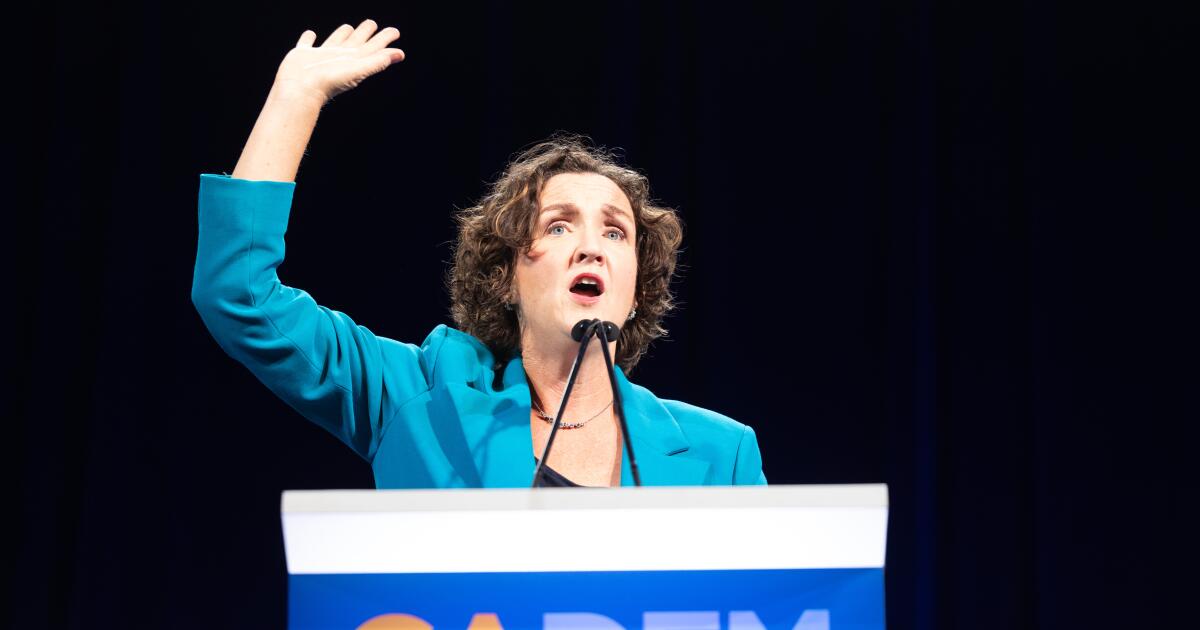
A poll released Monday by the state Democratic Party — its first since Swalwell (D-Dublin) dropped out — showed Becerra’s support jumped nine points to 13%, placing him in a tie with Tom Steyer, the billionaire hedge fund founder turned environmental warrior. Former Rep. Katie Porter of Orange County saw a slight bump to 10% from 7%, while the remaining Democrats in the contest were mired in the low single digits.

The party began the surveys out of concern that Democrats could be shut out of the governor’s race because of California’s unique primary system, where the top two vote-getters in the June 2 primary move on to the November general election regardless of political party.

“I continue to believe there are too many Democrats in the field,” California Democratic Party Chairman Rusty Hicks told reporters Monday. “My call for candidates to honestly assess the viability of their candidacy and campaigns still stands, especially if you are stalled in the single digits, seeing financial resources dry up and/or are failing to pick up additional support.”

Hicks and other party leaders and allies had unsuccessfully urged low-polling candidates to reconsider their candidacies before the filing deadline in an attempt to cull the field and avoid splintering the Democratic vote. Though most did not name candidates who they thought should think about their viability, Yee was widely believed to be among them.

Yee became emotional as she said on Monday that she decided to withdraw from the race because she wasn’t able to raise the resources necessary to compete in the state. She also said her message of competency and experience wasn’t resonating among voters who were seeking a fiery foil to President Trump, not “Boring Betty,” as she dubbed herself. Yee said she would assess the field before making an announcement on whether she would endorse one of her fellow Democrats.

Becerra was another candidate believed to be a target of party leaders’ efforts to shrink the field. But he held on and apparently benefited from Swalwell’s downfall.

“I’m not the richest candidate, I’m not the slickest candidate, but I am the guy that’s got you,” Becerra said, rallying supporters in Los Angeles on Saturday.

The audience was filled with members of labor groups backing the longtime politician, and Becerra told them he’d serve as a “union man” in the governor’s office.

Pro- and anti-Becerra forces tussled outside the town hall after two people, who declined to identify whom they were working for, passed out fliers highlighting critical media investigations of the U.S. Department of Health and Human Services during the migrant crisis when the agency was led by Becerra.

Pro-Becerra attendees grabbed the fliers and told the men to go away, prompting a security guard to intervene.

The question is whether Becerra, who also served as state attorney general, a member of Congress and a state Assembly member, can raise the funds necessary to compete in a state with some of the nation’s most expensive media markets. And he was tied in the state party poll with a billionaire who dumped an additional $12.1 million of his own money into his campaign last week.

Steyer’s total investment in his bid reached $133 million, according to the California secretary of state’s office. He also received the endorsement of Our Revolution, a progressive political organization founded by U.S. Sen. Bernie Sanders (I-Vt.).

“We’ve never endorsed a billionaire — but Tom Steyer is using his position to upset the system,” the group posted on X on Monday. “As Our Revolution executive director Joseph Geevarghese told @theintercept, ‘He’s been a partner in the movement. Most billionaires have used their wealth and privilege to lock in the status quo. Tom is doing the opposite.’”

San Jose Mayor Matt Mahan, who is also running for governor, accused Steyer of hypocrisy for the hedge fund he founded profiting from investments in private prisons being used to house ICE detainees, and Steyer calling for the abolishment of ICE.

Steyer got “rich investing off the ICE infrastructure he now wants to abolish,” Mahan posted on Instagram.

Steyer, who sold his stake in the hedge fund in 2012, has said he ordered the company to divest from the private prison company and has repeatedly expressed remorse about his former firm’s ties with the detention company.

Mahan also appeared Monday at a Hollywood production lot to announce his proposal for a special fund to lure sporting events, concerts and other productions to California as part of his plan to help the struggling film and television industry.

An independent effort supporting Mahan has also raised roughly $11 million since Swalwell left the race.

Mehta reported from Los Angeles and Nixon from Sacramento. Times staff writer Dakota Smith contributed to this report.

Source link

Former state Controller Betty Yee drops out of the governor’s race

Former state Controller Betty Yee dropped out of the 2026 governor’s race on Monday, citing low levels of support from voters and donors.

Yee, a Democrat, was part of a sprawling field of politicians vying to replace termed-out Gov. Gavin Newsom. But despite the bevy of prominent candidates running to lead the nation’s most populous state and the world’s fourth-largest economy, this year’s governor’s race has long lacked a clear front-runner well known by the electorate.

“The whole notion that voters are looking for experience and competence is not a top priority, and that’s been really my wheelhouse in terms of how we grounded this campaign was based on my experience,” she said in a virtual press conference Monday morning. “The donors have felt the chill of the polling … and it really just came down to where I’m not going to have sufficient resources to get us to the finish line.”

The former two-term state controller did not immediately endorse another candidate and said she would take a few days to assess the field before making an announcement.

The race was upended earlier this month when then-Rep. Eric Swalwell, among the leading Democrats in the race, was accused of sexual assault and other misconduct. The East Bay Democrat, who is facing multiple criminal investigations, promptly ended his gubernatorial bid and resigned from Congress.

Yee, 68, was well regarded by Democrats during her tenure in Sacramento. And she highlighted her no-drama persona on Thursday.

“California — had enough chaos, fear and horrendous political scandals? Ready for calm, cool, collected change? Some may consider that boring. But that’s the point. We need Boring Betty,” Yee posted on the social media site X. “No crisis. No circus. Just competent, drama-free leadership you can trust. #BoringisBetter”

But she never had the financial resources to aggressively compete in a state with many of the most expensive media markets in the nation.

Yee reported raising nearly $583,000 for her gubernatorial bid in 2025, according to campaign fundraising reports filed with the California secretary of state’s office. Yee’s announcement that she is dropping out of the race came days before the latest financial disclosures will be publicly reported.

Despite being elected to the state Board of Equalization twice and as state controller twice, Yee was not widely known by most Californians. She never cracked double digits in gubernatorial polls.

Her name will still appear on the ballot. She was among the candidates who rebuffed state Democratic Party leaders’ request earlier this year to reconsider their viability amid fears that the party could be shut out of the November general election because of the state’s unique primary system. The top two vote-getters in the June primary will move on to to the November general election, regardless of party affiliation.

Though California’s electorate is overwhelmingly Democratic, the makeup of the gubernatorial field makes it statistically possible for Republicans to win the top two spots if Democratic voters splinter among their party’s candidates. Yee said fear of that scenario playing out “kind of took over” the gubernatorial race.

“Was it possible? Yes. Was it plausible? No, we’re in California. That was not going to happen,” she said, adding that the top-two primary system should be done away with.

Still, Yee was beloved by Democratic Party activists, and previously served as the party’s vice chair.

No Democratic candidate reached the necessary threshold to win the party’s official endorsement at its February convention, but Yee came in second with support from 17% of delegates despite calls for her to drop out of the race.

“Every poll shows that this race is wide open, and I know this party,” she said in an interview at the convention. “Frankly, I’ve been in positions where it’s been a crowded field, and we work hard and candidates emerge.”

The gubernatorial primary will take place June 2, though voters will start receiving mail ballots in about two weeks.

Source link

Businessman Checchi Enters Governor’s Race

Mega-millionaire businessman Al Checchi launched the biggest takeover bid of his career Tuesday, declaring his candidacy for governor by promising a less political approach to political office.

Checchi, who built a vast personal fortune plying his financial wizardry in the corporate world, styled himself as a campaign insurgent removed from the ways of Washington and Sacramento.

“My experience outside politics is precisely why I’m running,” the 49-year-old former Northwest Airlines executive told members of a Sacramento civic group, who served as extras for his announcement. “You don’t have to be a politician to succeed in government. And the truth is that for too long, politicians leading our government have failed.”

Touting his “real-world experience,” the Democrat said, “I reject the conventional politics that evades hard choices, that obscures controversial issues and seeks to offend no one except the powerless and marginal.”

He pledged to “tell the people of this state exactly where I stand and, during the months ahead, to set forth real and specific proposals for change.”

To wit, Checchi said that as governor he would cut the state bureaucracy by 10% to raise $5 billion more for education, boost the state cigarette tax by 25 cents a pack to expand health care for the uninsured, and require statewide competency testing of both students and teachers.

Further, Checchi called for expansion of the death penalty to include serial rapists and repeat child molesters, offered a ringing endorsement of affirmative action, endorsed abortion rights and promised to outline a “major” gun control proposal in the months ahead.

“As you can see, my positions aren’t cut to fit any ideological pattern,” Checchi said in his 18-minute address to about 200 members and guests of the Comstock Club, who interrupted his speech with sporadic applause. “The test for me is simple: What will meet the needs of California and move it forward, not what will satisfy the political establishment or big campaign contributors.”

Checchi’s independence comes at no small personal expense. The former airline executive (whose name is pronounced CHECK-ee) has vowed to spend as much as $30 million of his own money to finance his campaign.

His long-expected decision to enter the contest follows a months-long period of study–a sort of California 101 crash course–in which he met with scores of experts, from civic leaders to special pleaders, to learn about everything from agriculture to the impact of welfare reform.

Venturing forth from his gated Spanish-style mansion in Beverly Hills, Checchi visited about 50 cities and met with about 350 individuals as part of his tutorial. A few of the everyday people he met–including a Central Valley farmer and a San Fernando Valley man, Blinky Rodriguez, who lost a son to gang violence–were among those who attended Tuesday’s speech and were cited in Checchi’s remarks.

Such Reagan-like theatrics aside, Checchi’s lack of political sophistication has shown through more than once.

Despite his ambitions, Checchi conceded earlier this year that he failed to vote in four of the last six statewide elections, including the last governor’s race. Tuesday, chastising himself, he said he was simply too busy.

Another time, at a spring gathering of major California water officials, Checchi acknowledged that he didn’t “know anything about water.”

“Before preparing for this meeting, I thought the delta was an airline,” the former Northwest co-chairman joked.

In his speech Tuesday, Checchi predicted that he would probably make more “rookie mistakes” like that between now and the June primary. But all such humility aside, Checchi is no political naif.

Over the years he has contributed hundreds of thousands of dollars to assorted candidates and political causes, occasionally tip-toeing into the gray area that shrouds the political-finance system.

He also demonstrated his ample skill moving legislative levers when he persuaded–bludgeoned, critics say–lawmakers in Minnesota to approve hundreds of millions of dollars in tax breaks and other concessions to help rescue Northwest from bankruptcy in the early 1990s.

Raised in suburban Washington, the son of a high-level bureaucrat for the Food and Drug Administration, Checchi went to work for the Marriott Corp. straight out of college, putting his Harvard MBA to work in a series of creative and highly lucrative ventures.

In 1982, he joined the Bass Brothers investment firm and played a major role in helping save the then-struggling Disney Corp. Checchi and his family moved to California in 1985.

Four years later, he made his biggest financial play–and a financial killing–with a $3.65-billion takeover of Minneapolis-based Northwest.

After narrowly averting bankruptcy, the company thrived as the airline industry came soaring back from recession. Checchi’s relatively small investment–the Dutch airline giant KLM put up most of the cash for the deal–helped him build a fortune today estimated in excess of $550 million.

Checchi continued to lead Northwest as the airline’s co-chairman until stepping down in April to focus full time on preparing for the governor’s race.

He enters the contest as a mere asterisk in the polls and a phantom to most California voters. A random sampling of audience members before Checchi spoke showed that most people knew he was involved in the airline industry, had a lot of money and was interested in high office.

Beyond that–what airline, what position he held, what office he sought, even which party he belonged to–were a mystery.

“He seems to be successful and seems to have his own stash,” said Maxine Milner-Krugman, who knew that much about Checchi but confessed that she couldn’t properly pronounce his name.

More than a few compared him to Republican Michael Huffington, the former Santa Barbara congressman who narrowly lost the 1994 Senate race to Democrat Dianne Feinstein after spending $29 million of his fortune.

Asked later if he was concerned that voters would perceive him as another wealthy dilettante trying to buy his way into office, Checchi professed not to worry. “Most people don’t object to someone spending their own money,” he told reporters.

With Tuesday’s announcement, Checchi became the second declared Democrat for governor, joining Lt. Gov. Gray Davis, who made clear his intention to run a few months after taking office in 1995. Last week, state Sen. John Vasconcellos (D-Santa Clara) launched an exploratory effort to determine whether to mount a full-blown campaign.

Feinstein, the front-runner in the polls, is still trying to make up her mind whether to run and has said a decision may be months away. Coincidentally, one of Checchi’s major co-investors in the 1989 Northwest deal was Feinstein’s husband, financier Richard Blum, who sank $100 million into the deal–five times Checchi’s personal investment.

On the Republican side, state Atty. Gen. Dan Lungren is running unopposed for his party’s nomination. Gov. Pete Wilson, who has served two terms, is ineligible for reelection.

(BEGIN TEXT OF INFOBOX / INFOGRAPHIC)

Profile: Alfred A. Checchi

Al Checchi seeks to parlay his success in business into a desk in the California governor’s office. Checchi, 49, is no newcomer to politics, having donated almost $325,000 to various political campaigns over the years. But the 1998 race for governor will mark the first bid for elective office for the Democrat.

* Born: 6/6/48, in Boston.

* Residence: Beverly Hills

* Education: Undergraduate degree in economics and American studies from Amherst. MBA from Harvard Graduate School of Business.

* Career highlights: He rose through the ranks at the Marriott Corp., directing one of the nation’s largest real estate development businesses, then became a principal with the Texas-based Bass Bros. Enterprises. There, he worked on the firm’s acquisition of a major stake in Disney. In 1989, he and his longtime associate Gary Wilson engineered the purchase of Northwest Airlines. Checchi resigned as co-chairman of the airline last April to pursue his bid for governor. He retains a 10% stake in Northwest.

* Interests: Reading, golf

* Family: Married to attorney Kathryn Checchi, three children.

* Quote: “I reject the conventional politics that evades hard choices, that obscures controversial issues and seeks to offend no one except the powerless and the marginal.”

Source link