A potential Democratic wave looms over Trump. Where does MAGA go after the midterms?
WASHINGTON — The specter of a Democratic wave on Tuesday and retreat of Republican power has quietly sparked conversations within GOP circles about President Trump’s eventual exit from the political stage — and the future of a party that has revolved around him for the past decade.
Heading into the vote, Trump faces the lowest job approval ratings of his career. Factions of the Republican Party long loyal to his brand are beginning to break ranks. Candidates who have aligned themselves most closely to the president are among the most imperiled. From the shores of Lake Ontario to rural Kansas, signs point to a voter coalition under strain, as Republicans grappling with a troubled economy question the party’s direction.
Recent polls show that 67% of Trump’s 2024 voters approve of his job performance, down from 95% early in his second term. The steepest drops are among younger voters and Latino support, according to a Pew Research Center poll.
While a majority of Republicans still want to see the next leader of the party follow Trump on most issues, a third want to see the next GOP presidential nominee take a different approach, according to a New York Times/Siena poll in May.

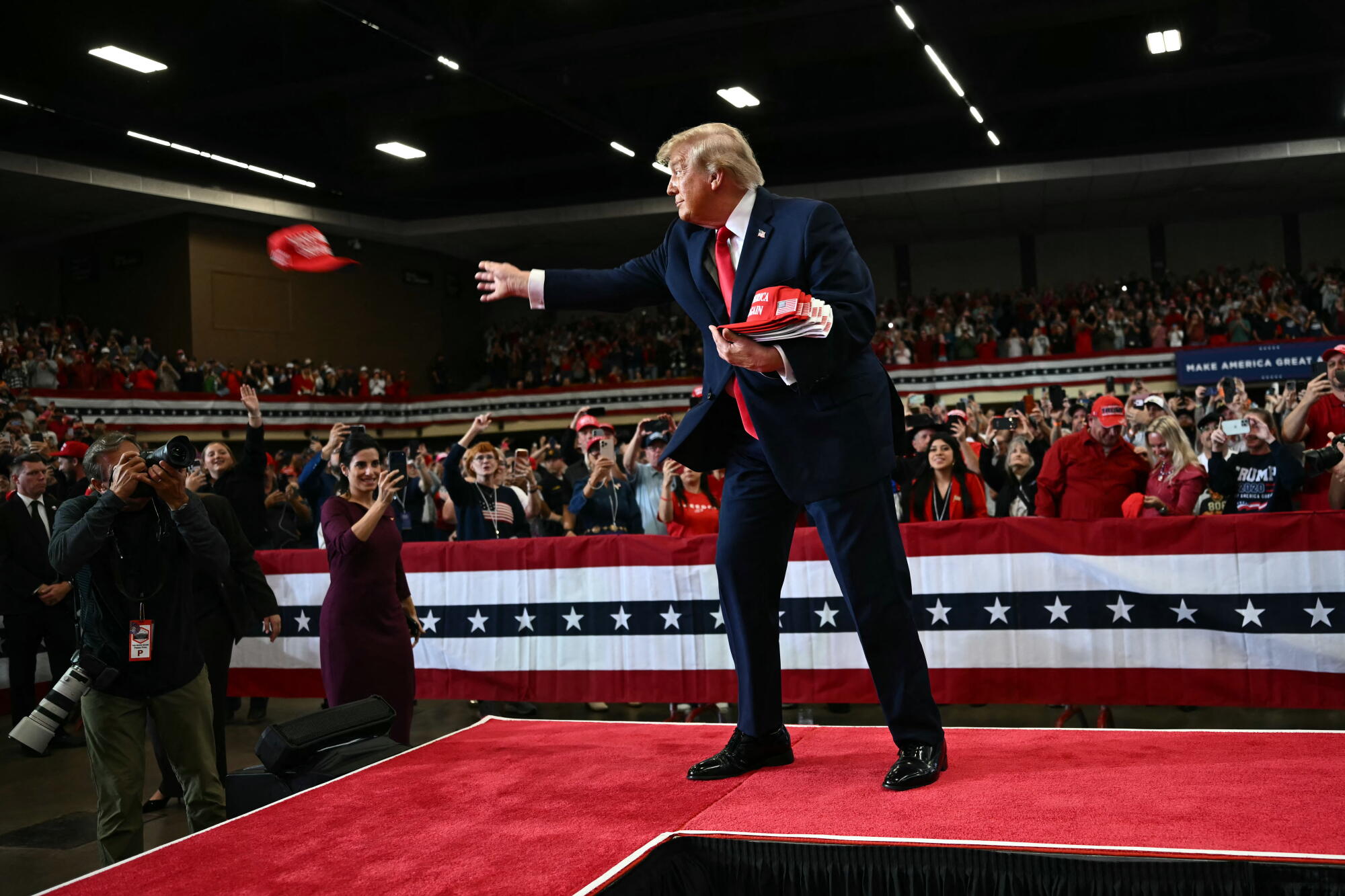
President Trump throws MAGA hats to supporters during a midterm campaign rally at Lubbock Memorial Civic Center in Lubbock, Texas, on Oct. 27.
(Kent Nishimura / AFP via Getty Images)
Marc Short, who served as Trump’s first White House director for legislative affairs, said that Republicans were “essentially in triage mode” entering the midterms, citing “inflation challenges” and an “avalanche of corruption stories.” Bryan Lanza, a former communications director for Trump, expressed concern last week that Republican enthusiasm has reached such lows that races in Mississippi and Texas are genuine toss-ups.
The Republican reckoning tests a party infrastructure reshaped around the president since his insurgent rise in 2015 transformed the GOP.
At the top of the party, warning signs of a splintering coalition have not changed the view that Trump still maintains the grip on the GOP’s future — and that any future decisions should take that into account.
“I think he’ll help decide who the next president is going to be,” Republican National Committee Chairman Joe Gruters said. “I think he’ll be super involved with not only the party but the process, and I welcome that as the chairman.”
Gruters called Trump “the single most important person in the Republican Party” and said he doubts the movement will reshape itself into a different kind of coalition based on the outcome of Tuesday’s election.
“I think it will continue to be Trump’s movement for as long as he’s alive,” he said. “It will be Trump’s movement.”
Others in Trump’s inner circle are making the same bet. His team is still staking Trump’s movement on the same thing that has defined it in the past: Trump himself.
“We’ve been with him for 10 years,” the official said. “Do you think he’s going away after the next two? No.”
What comes after that, the official wouldn’t say.

A person wears a sequined jacket as President Trump speaks on stage during an election rally on Oct. 9 at the Oncenter in Syracuse, N.Y.
(Alex Wong / Getty Images)
“Everyone wants to jump ahead and ask what 2028 looks like and what does beyond look like,” the official said. “I think the really smart thing about the president, and he’s even admitted it about himself, he’s always focused on the now, and he just works his a— off at the task at hand.”
The question of who inherits the movement is already taking shape, but Trump has avoided saying much when asked who he thinks should be the heir apparent.
Asked in the Oval Office last month whether he would endorse Vice President JD Vance — who had said a day earlier that he expected Trump’s backing if he decides to run for president in 2028 — Trump called Vance a “very talented person” and a “very good person,” but would not commit.
“I don’t think we’ve ever talked about it,” Trump said. “It’s early, very early right now. We have to get through the midterms.”
A New York Times/Siena poll released last week found that Republican primary voters favor Vance or Secretary of State Marco Rubio to be the party’s next nominee. Underscoring Trump’s grip on the party, the poll found, 8% said they want it to be Trump, who cannot run because of term limits.
The challenge for Republicans in the future will be to figure out a way to capture the MAGA base without isolating themselves from more mainstream Republican voters, said a GOP lobbyist with ties to Trump speaking on condition of anonymity to speak candidly.
“I think it would be foolish to ignore the MAGA base for any future candidate,” the lobbyist said. “The movement can evolve, but you need those voters to come out and vote.”

People wait for President Trump to arrive at a political rally at Freeman Coliseum in San Antonio on Oct. 7.
(Sam Owens / San Antonio Express-News via Getty Images)
Mike Madrid, a longtime Republican political strategist and co-founder of the Lincoln Project, which staunchly opposes Trump, argued that the future of the GOP will be influenced more by right-wing media personalities than policy because Trump consciously upended the party’s ideology over the last decade.
“The Republican Party is far, far more likely to balkanize than split along ideological lines because there is no ideological glue holding the GOP together anymore,” he said. “That’s gone.”
Madrid doubts Trump will change course even if Republicans suffer big losses on Tuesday night.
“Donald Trump is not going to adjust. He’s not capable of that. He never has. He never will,” Madrid said. “It doesn’t even occur to him. And even if it did, he wouldn’t know how to do it.”
If Democrats win a majority in Congress, history shows that it can be an opening for a president to pivot.
“What often happens in the last two years [of a term] is presidents bounce back,” said Christopher Warshaw, a Georgetown University public policy professor.
Presidents who “lose control of Congress and get shellacked in the midterms” often pivot to the political center, and tell voters “we’re going to try a new approach,” Warshaw said.

“MAGA” merchandise is for sale as supporters listen to President Trump speak at a midterm campaign rally at Guardian Centers of Georgia in Perry, Ga., on Oct. 24.
(Brendan Smialowski / AFP via Getty Images)
President Clinton did that after Republicans swept Congress in 1994, Warshaw said. President Biden did not after the 2022 midterms, a choice Warshaw said probably hurt Democrats in 2024, when Trump was elected. If Democrats win on Tuesday, Trump has signaled that he would be open to working with them to get things done.
“I hope that won’t be the case, but if it is, that has happened before with many presidents,” he told reporters. “You have strong veto and you end up working out deals.”
However Trump might deal with a divided Washington, the coalition he built is unlikely to dissipate when he leaves office, said Lynn Vavreck, a political science professor at UCLA.
“They want to build a very specific kind of world,” Vavreck said. “Those desires are not going to go away next Wednesday, or in 2028.”
Times staff writer Justine McDaniel contributed to this report.