good record

Edwin Díaz meltdown blows Dodgers’ lead in loss to Brewers

The second pitch Edwin Díaz threw Thursday night sailed above the strike zone, at about eye-height on Milwaukee’s William Contreras. It was an early indicator that the Dodgers closer was about to have a brutal ninth inning.

By the end of his third blown save in four appearances, even Díaz wasn’t sure what his role would be going forward.

“Now I’ve just got to see what they want to do,” he said after the Dodgers’ 5-4 loss to the Brewers. “I want to do the best thing for the team. At the end of the day, if they give me the ball in the ninth I will try to do my job. If they give me the ball in another inning, I will try to do my job. Got to get better, be consistent.”

Manager Dave Roberts, however, as he looked at the state of his bullpen, wasn’t ready to take the closer title from Díaz.

“Give me another option,” Roberts said. “To be quite honest, none of those guys really are throwing the baseball great. So that’s just kind of the way it is.”

The series opener between the Dodgers and Brewers, two of the top teams in the National League, saw Roki Sasaki give up just two runs over six innings despite battling command issues. It included a record-setting go-ahead home run from Max Muncy, his 131st at Dodger Stadium, breaking a tie with Eric Karros for the most all-time at Chavez Ravine.

Then Díaz, who has been working through an evolving set of issues since returning from the injured list (arthroscopic elbow surgery) a couple of weeks ago, took over with a two-run lead. And the game went sideways.

The Dodgers (73-49) fell two games back of the Brewers (75-47) and half a game behind the Braves (73-48).

“A loss is a loss, but there’s certain losses that are more costly,” Roberts said. “And when you use five relievers and you lose a game, that’s costly.”

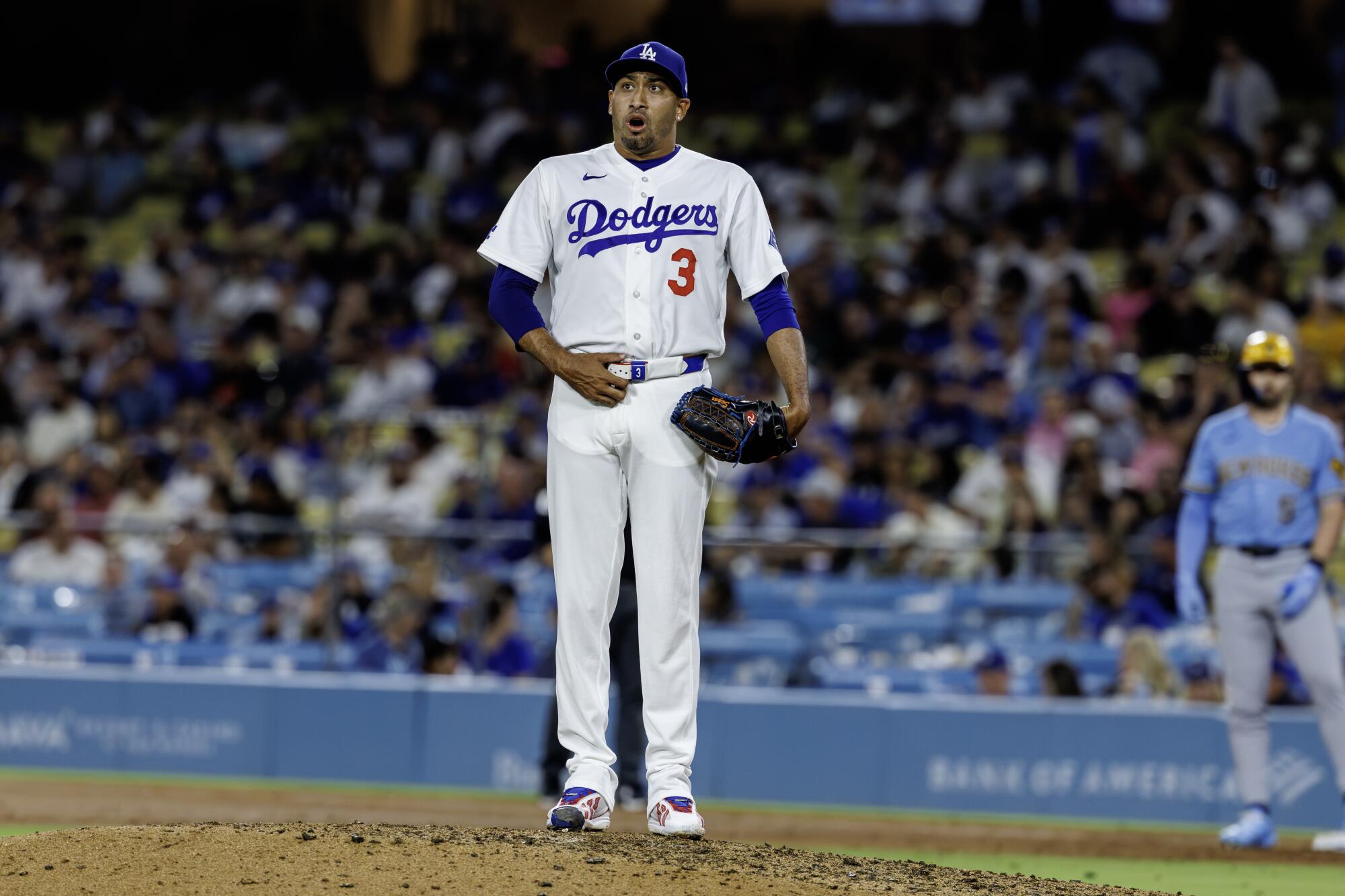
Dodgers pitcher Edwin Díaz reacts after giving up the tying run in the ninth inning against the Brewers on Thursday.

Dodgers pitcher Edwin Díaz reacts after giving up the tying run in the ninth inning against the Brewers on Thursday.

(Gina Ferazzi / Los Angeles Times)

Though Díaz’s command issues flared early, he struck out Contreras to begin the inning. Then he gave up four consecutive singles.

“I think my fastball command today — I was throwing strikes, but right in the middle,” Díaz said. “Every big league hitter can hit it right in the middle, [even if you] throw 200 miles an hour. I’ve got to get better at that.”

Milwaukee’s Joey Ortiz and David Hamilton both hit center-cut fastballs to put runners on the corners for the top of the order.

Then Jackson Chourio’s and Garrett Mitchell’s RBI singles — to cut the Dodgers lead to one run and to tie the score, respectively — came on sliders. That was the pitch Díaz struggled to get a feel for in Arizona last weekend.

“I think it was better today,” he said. “I think I made good ones. When you miss your fastball in the middle, they see better pitches.”

Díaz then struck out right-handed hitting Gary Sánchez on three pitches, but Roberts had seen enough. He turned to left-hander Alex Vesia.

With two outs and runners on first and second, Vesia got Jake Bauers to hit a ground ball to the right side of the field, but it found a hole to drive in the go-ahead run. And the Dodgers offense didn’t counter in the bottom of the ninth.

“It’s frustrating because I know my ability,” said Díaz, who has an 11.57 ERA since joining the Dodgers last offseason on a three-year, $69-million deal. “I know what I can do on the mound. To not be able to do it sucks. I’ve just got to come tomorrow and try to keep getting better.”

The Dodgers’ bullpen situation has flipped dramatically since his return from injury. Less than three weeks ago, Roberts said his high-leverage relievers made up “as big a trust tree as we’ve had in quite some time.”

When pressed Thursday on why he planned to stick with Díaz in save situations, Roberts’ tone had changed.

“Who’s the other option?” Roberts said. “You look back at the last week, and guys have struggled. … Everyone’s got a role, they all have jobs to do, and they all have to do their job. That’s it.”

One factor has been health. Brock Stewart (right shoulder discomfort) and Will Klein (right elbow loose bodies) have been placed on the IL since Roberts’ “trust tree” comments.

Then there’s the issue of performance.

Scott (2.25 ERA, 16 saves), who served as the closer in Díaz’ three-month absence, has been dealing with inconsistent velocity. But he has three straight holds. On Thursday, he faced only Christian Yelich, who hit a long fly ball into the left-field corner, but Kiké Hernández made the catch before running into the wall.

Vesia surrendered two runs in ⅔ of an inning against the Chicago Cubs on Aug. 4, but he had held opponents hitless with three walks over three appearances before facing Milwaukee.

Evan Phillips seemed to have righted the ship after a rocky return from the IL, but he gave up two earned runs in ⅓ of an inning Tuesday.

What about taking a closer-by-committee approach?

“We’ve got to get other guys on track to even have that be even a valid conversation, to be honest with you,” Roberts said.

So, Díaz will continue working to regain his effectiveness on the mound, without changing roles.

“He’s got to find his way,” Roberts said. “And he’s got to have a runway to find his way. But then it gets to a point where — I’m not there yet, but … I’m betting on the fact that the stuff will kind of right, and he’ll figure it out.”
Source link

The Dodgers’ most pressing question: Can Shohei Ohtani stay healthy?

Dodgers pitching coach Mark Prior was worried. But how worried? He couldn’t say at first.

The team had taken major steps to address Shohei Ohtani’s lingering left knee condition, presenting him with a plan to skip his last start before the All-Star break and have his knee drained that Sunday. And he’d co-signed it.

The swelling in Ohtani’s knee, however, had been more persistent than the team expected. And pitching seemed to irritate it.

“I would say, moderately concerned,” Prior eventually said in a conversation with The Times last weekend. “But no more concerned than I probably am with anybody else who’s had to deal with aches and pains. Hopefully, this break and this rest will get it to calm down a little bit, and then we’ll see where we’re at next weekend.”

Coming out of the All-Star break, the Dodgers face the most pressing question for their second half: Will they be able to manage Ohtani’s knee condition?

Of course, plenty of other questions loom: What approach will the Dodgers take at the trade deadline? Will the pitchers coming off the injured list in the second half provide enough depth? Can they maintain the best record in the majors?

But naturally, Ohtani’s health is tangled up in all those answers.

The Dodgers have enough star power and enough of a lead in the division to still make the playoffs without Ohtani replicating his first half on the mound (8-2, 1.79 ERA). And they showed last year that they can win a World Series even if their postseason path begins with a wild-card series.

They’d prefer, however, to take a different route, with a strong second half that ensures home-field advantage all the way through the postseason.

“At the end of the day, it’s just trying to expect the best of your ballclub,” manager Dave Roberts said before the break. “And with the talent that we have, we expect to have the best record in baseball, and so that’s our standard. And so, what falls out of it is X, Y and Z. So that’s what we’re playing for.”

That’s also what they need a healthy Ohtani for.

Workload is part of the equation, and an aspect that’s garnered plenty of attention in Ohtani’s first full season balancing two-way duties since 2023.

“I’ve been much more open and watching … his workload, and not just taking for granted that he can be a two-way player, take every at-bat, pitch like a normal pitcher,” Roberts said. “I think that would be unfair. So for me, if anything, it’s just, keep having those conversations with him, bringing them to him, and saying, ‘Hey, this is what we see. This might be a different option, a better option for your best interest and our best interest.’ And I think that with that, he’s responded really well.”

That approach will continue in the second half. But refining Ohtani’s mechanics also will be vital to keeping his knee from becoming an issue again.

Ohtani said it himself, through interpreter Will Ireton, last week: “I have to kind of find a way to adjust my mechanics so that my knee doesn’t get affected.”

He’s been trying to do so since the swelling in his knee first cropped up.

“I think we’ve identified the issue,” Prior said. “Sometimes the fix isn’t always the easiest, especially with a guy who doesn’t spend probably the same amount of time on the mechanics of it.”

As a two-way player, Ohtani doesn’t have the “physical bandwidth,” as Prior put it, for things like multiple bullpen sessions between starts, even if they are a week apart. He has to keep the long, grueling season in mind when he’s also in the lineup every day.

Looking back at Ohtani’s pitching start against the Pittsburgh Pirates last month, the day before he exited the series finale because of inflammation in his knee, the Dodgers observed his right leg landing a little farther across his body in his delivery, probably putting extra strain on that plant leg as he moved around it.

“He fixed it, and then I’m wondering if it got aggravated just in-game,” Prior said. “These guys are extreme compensators, and in the moment they don’t necessarily know what they’re doing, but they’re finding other ways to pitch, and then afterwards you find out that things are a little sore.”

Ohtani had a dominant first half, but, whether because of the knee condition or mechanics or some combination of the two, he wasn’t quite as sharp in his last four starts (4.38 ERA).

“If he can fix the delivery, then he can fix a little bit more of the execution,” Prior said.

But will the delivery adjustment, All-Star break intervention and attention to workload fix Ohtani’s knee at least through the postseason? The Dodgers’ second-half trajectory will be tied up in the answer.

Source link

Summer football notebook: Running back AJ McBean transfers to Gardena Serra

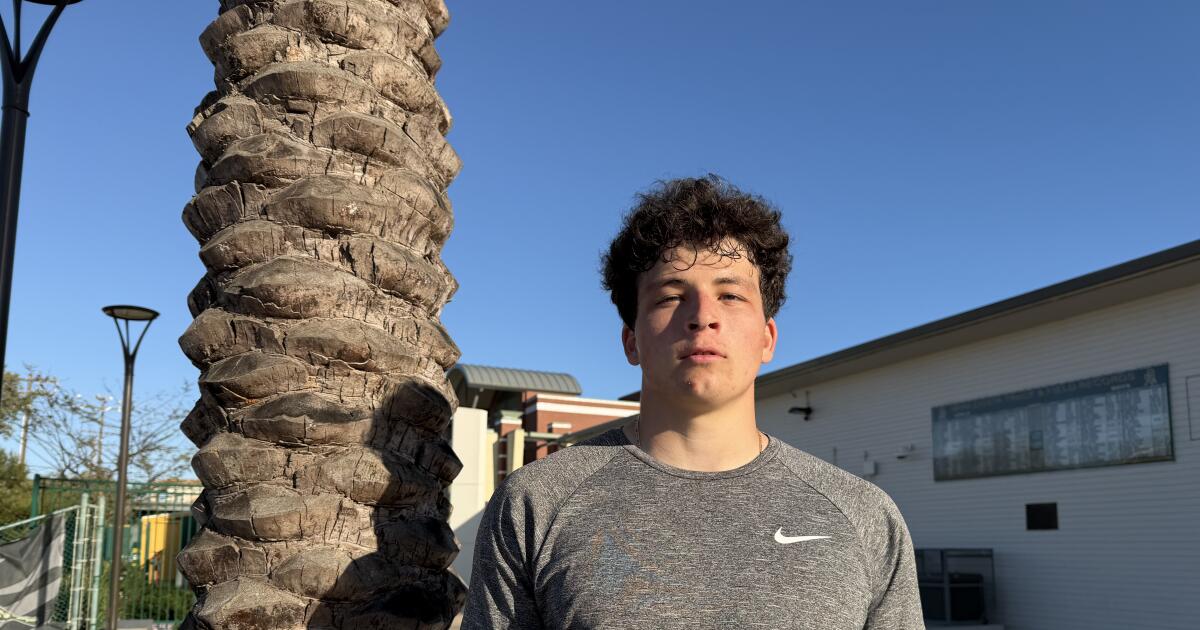
There have been dozens of football transfers in Southern California during the offseason, but the one transfer who could make the greatest impact is running back AJ McBean, who announced he was leaving Mira Costa High for Gardena Serra.

McBean, who ran 10.55 seconds in the 100 meters this spring thanks to Mira Costa’s track program and his commitment to getting faster, joins a Serra offense that returns all five starters on the offensive line. He’s got the speed and strength to help the Cavaliers make up for not reaching the Southern Section playoffs last season out of the extremely competitive Mission League.

He’s been a longtime resident of Hermosa Beach, so what would motivate him to leave Mira Costa after recently making a commitment to Stanford? He apparently wants to prepare for college by being used in a more versatile role catching passes out of the backfield to show off his many skills. At least that’s what his family told coach Scott Altenberg. Mira Costa was changing its offense to better feature him, so it’s a tough loss for the Mustangs.

McBean will have to move to become eligible immediately.

Hope at Whittier

Former Garfield coach Lorenzo Hernandez, in his first season at Whittier, has already discovered a talent he can’t wait to develop. Offensive and defensive lineman Joseph Medina from the class of 2028 has made quite a first impression on Hernandez.

Medina didn’t play last season, “and in three months that we have been here, he is off the charts,” Hernandez said.

Hernandez calls him “a great technician and amazing leader.”

Agoura QB depth

Never has coach Dustin Croick of Agoura had more quality depth at quarterback than what he will have this season thanks to two newcomers.

Junior Kris Carranza has transferred from Sierra Canyon to Agoura and is a top candidate to start. The Chargers are also adding incoming freshman quarterback Emerson Andrews, whose father, David, played tight end at Ohio State and was a member of the 2002 national championship team. He is director of athletic performance for UCLA’s men’s basketball program. If anyone has a strength and conditioning question, submit it to Emerson, who knows someone.

Commitments rolling in

With college recruiters headed on vacation, lots of players decided to make commitments to make sure they have a “certain” destination. There’s also a new trend of players announcing on social media posts that they are “shutting down” their recruitment, which is supposed to mean their decision is final. Then how come others keep recruiting them? Because it’s never final in this era of NIL.

Quarterback Chris Fields, the City Section player of the year from Carson, committed to Georgetown. Offensive lineman Micah Butler from Hamilton committed to Sacramento State. Kicker Gabriel Goroyan of Westlake committed to Stanford. Defensive back Wesley Ace from Gardena Serra committed to San Jose State. Safety Jaden Walk-Green from Corona Centennial has committed to Washington and teammate Brett Smith has committed to UNLV. Running back Kamden Tillis of Los Alamitos has committed to San Diego State.

Man among boys

USC recruiters deserve praise for identifying the best in Southern California and pursuing them with great intensity. There’s no doubt that Damien safety Gavin Williams, a USC commit, will be the standard for excellence this coming season. He’s fast and strong and players who don’t adjust to his physical skills are in for a surprise.

Damien won the Chaminade seven-on-seven passing tournament on Saturday, beating Crespi in the final. On the first play, Williams caught a long touchdown pass, sprinting well past the defender who had no idea how fast he runs.

First-year coaches galore

It’s going to be fun tracking the progress of first-year football coaches this season because there are so many at well-known programs. The question of who will have the best record should be debated all summer.

Iggy Porchia became the latest new hire, replacing his mentor, the late Angelo Gasca, at Venice.

There should be a competition on which new private coach will have the best record and which new public school coach will have the best record. There are so many candidates with new coaches at JSerra, Orange Lutheran, Servite, Los Alamitos, St. Francis, St. Bernard, Bishop Montgomery, Oaks Christian, Whittier Christian, Bishop Alemany, Muir, Pasadena, Long Beach Poly, Arroyo, North Hollywood, Sun Valley Poly and on it goes.

Transfer issues coming

It appears the Southern Section will be busy again this fall after last year’s eligibility scandal when it declared 19 transfer students ineligible at Bishop Montgomery, resulting in the varsity season ending after one game and forcing the Archdiocese of Los Angeles to clean up what looked like a preventable mess.

This time, it could be public schools facing scrutiny. The same rumors that started last summer about schools loading up on transfers are circulating again this summer. Principals who don’t act after multiple transfers seemingly out of nowhere start showing up to play football only have themselves to blame.

And schools that delay submitting transfer paperwork until the last minute thinking investigators will be too busy to spot an error don’t understand the process.

City Section commissioner Vicky Lagos has a policy that she immediately schedules a meeting with the administration, athletic director, coach and parents when one school receives multiple transfers to review paperwork. The Southern Section deployed AI last fall to help it catch parents submitting false information.

So prepare for more exciting times. It’s like a cat-and-mouse game. And don’t forget about the anonymous emails identifying parents not living at the official address they put on their transfer paperwork.

Source link