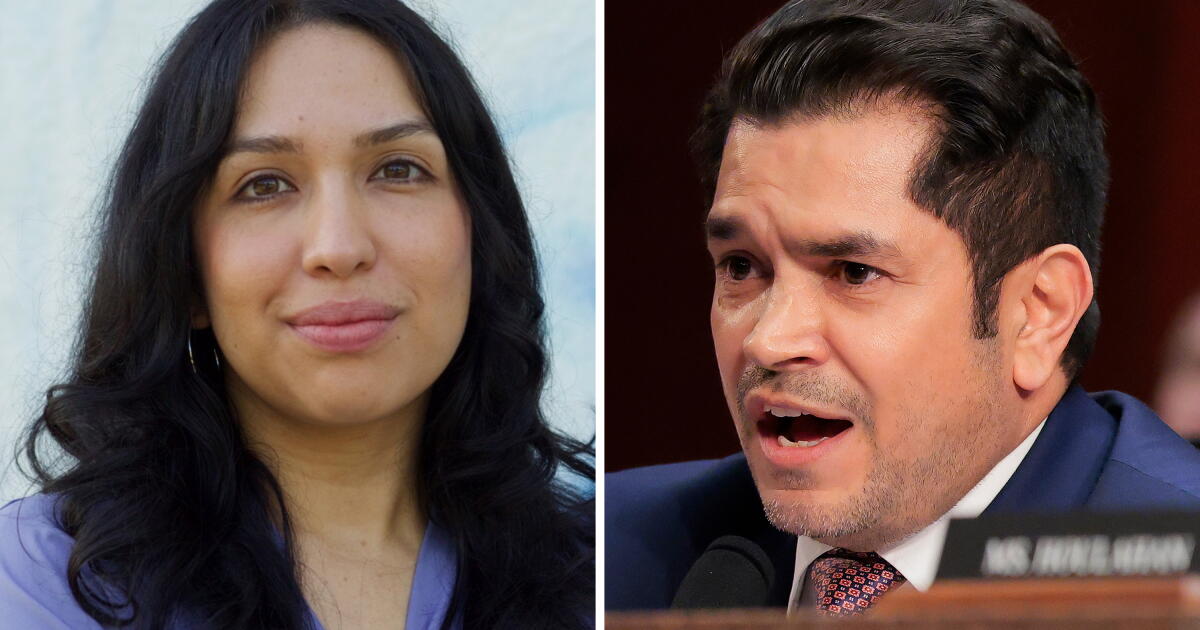
A progressive candidate could topple an incumbent for a Los Angeles House seat. But she has her own critics.
Rep. Jimmy Gomez’s reelection bid, once helped by his high-profile fight against President Trump’s immigration policies, is in peril as he tries to recover from allegations of sexual misconduct.
The accusations, which Gomez denies, have left the 51-year-old Eagle Rock Democrat vulnerable to an upstart challenger from Highland Park who earned a reputation for antagonism while serving on the area’s neighborhood council.
Angela Gonzales-Torres, 31, is seizing on Gomez’s issues in the race to represent California’s 34th Congressional District, a Latino-majority territory spanning Koreatown, Boyle Heights, East Los Angeles, Glassell Park and adjacent neighborhoods.
Gonzales-Torres, who has worked part-time jobs as an academic counselor for formerly incarcerated students and at an affordable housing development, is backed by the Democratic Socialists of America and counts support from other national progressive organizations.
Over the last week, she campaigned at UC Berkeley alongside fellow progressive Rep. Ro Khanna (D-Fremont), appeared on left-wing streamer Hasan Piker’s show and rallied in Los Angeles with Parkland, Fla., school shooting survivor and activist David Hogg.
Gonzales-Torres has linked the accusation against Gomez to the politician’s onetime ally former Rep. Eric Swalwell, a Bay Area Democrat who saw his campaign for governor derailed when several women came forward with allegations of impropriety. Swalwell has also denied wrongdoing.
“We’re going to take on this apparent culture in Congress in which men appear to abuse their positions of power and abuse women and younger staffers,” she said on Piker’s show.
In August, attorneys representing a woman released a statement accusing Gomez of sexual assault. Days earlier, the House Ethics Committee had announced an inquiry into Gomez, elected in 2017, over alleged “inappropriate sexual contact with a House staffer.”
Gomez denied wrongdoing while acknowledging mistakes outside his marriage — a sharp contrast with his image as the lawmaker who founded the Congressional Dads Caucus to champion family-friendly policies and famously carried his infant son in a baby carrier during the protracted votes for House speaker in 2023.
Gomez has avoided the public eye since the accusations surfaced, declining media interviews and campaign appearances, giving further momentum to his opponent.
“They’re trying to fly so far under the radar to not bring attention to the [allegations] or to me,” Gonzales-Torres said during a get-out-the-vote event in Eagle Rock.
Gonzales-Torres’ history in Highland Park
Gonzales-Torres, who graduated from UCLA, has described a childhood in Highland Park, where she was raised by her mother after her father was deported to Mexico following a domestic violence charge.
Reflecting the anxieties of thirtysomethings like herself, she’s talked about going without health insurance, working multiple low-wage jobs and questioning whether she can afford children.
In 2023, she was elected to the Historic Highland Park Neighborhood Council, on which she served two years advising City Hall on issues and policy matters. She opposed new liquor licenses and took stances against gentrification, a hot-button issue in Highland Park, where some longtime business owners and residents feel squeezed by rising rents.
Her year as president on the area council proved contentious, prompting several former colleagues to issue a statement Saturday criticizing her congressional bid.
Jens Jonasson, a member of the neighborhood council’s board of directors, characterized her tenure as chaotic, arguing that her unwillingness to compromise derailed board initiatives, including a proposed resolution supporting the Gaza Strip.
“She is not ready for the office she is asking voters to entrust to her,” Jonasson and three other board members said in the joint statement.
Darren Gold, who succeeded Gonzales-Torres as board president, alleged that she falsely accused him of shaking her. Gold was briefly removed from the board during an inquiry but reinstated after a city investigation.
In a 2024 podcast interview with Hear in L.A., Gonzales-Torres referred to Gold as a “very Zionist gentrifier man, a white man” and a “threat to my community.”
Gold told The Times he had never publicly staked out a position on Israel or Gaza.
“If she assigned me that label because I’m Jewish, that is antisemitic,” Gold said. “My concern is less about what she called me than whether she can turn her rhetoric into results and treat people respectfully when they disagree with her.”
Another board member, Caroline Aguirre, filed a police report in 2024 accusing Gonzales-Torres of aggressively pointing a finger at her during a meeting. The report did not result in an arrest or charges.
Gonzales-Torres declined to comment on the incidents involving Aguirre and Gold.
In 2025, Gonzales-Torres mounted a bid for one of 13 at-large neighborhood council seats, finishing last in a field of 23.
Her supporters pointed to her dedication to Highland Park and the work she’d done to help previously incarcerated youths.
Jesse Rosas, a Figueroa corridor business leader, echoed her concerns about neighborhood displacement and wants a representative more involved in the area.
“She’s a young lady who can bring change to the community for the better,” Rosas said. “I’ve seen her trying to do the best that she can.”
State Sen. Sasha Renée Pérez, a Pasadena-area Democrat who met Gonzales-Torres through her work as an academic counselor, said she’s impressed with her interest in challenging federal immigration laws.
“She’s had a firsthand account into some of the way that the immigration raids are directly impacting our students,” Pérez said.
Gomez runs on anti-Trump record
Despite the abuse allegations, Gomez has the power of incumbency and name recognition in a vast and diverse district.
A spokesperson pointed to his lawsuit challenging the Trump administration over access to immigrant detention centers as well as his advocacy for tenant protections and affordable housing.
If reelected, Gomez said in a statement, he aims to reverse federal healthcare cuts, lower living costs for working families and push for an end to the Iran war.
“Anyone can promise to stand up to Donald Trump, but I’ve proven I can take him on and win, whether it’s in Congress, on the picket lines, or in the courts,” Gomez said.
Both candidates back progressive priorities such as a Green New Deal and Medicare for all. Gomez advocates redirecting funding away from Immigration and Customs Enforcement, while Gonzales-Torres calls for abolishing ICE.
Gonzales-Torres is also criticizing Gomez for receiving financial support from the American Israel Public Affairs Committee. An AIPAC-affiliated political action committee spent more than $1.7 million supporting his 2024 campaign, and the group helped direct donations this cycle.
For some voters in the district, neither candidate is ideal.
Ray Rios, president of the Hillside Homeowners Assn. in El Sereno, wants to see more from Gomez when it comes to federal funding for the district. He also voiced skepticism over the DSA’s anti-policing platform and questioned whether Gonzales-Torres can build the institutional relationships needed to deliver federal resources.
“Her lack of experience is a consideration, a big consideration,” said Rios, who intends to vote for Gomez.
While Gomez beat back progressive challengers in recent election cycles, the local DSA chapter has built momentum across the district, winning City Council seats, noted Fernando Guerra, director of the Center for the Study of Los Angeles at Loyola Marymount University.
“Even without the allegations, this would be a competitive race,” Guerra said. “Then you add that, and that really hurts him.”