‘To sleep in a sculpture is a wonderful idea’: a hike along Andy Goldsworthy’s epic art trail in Haute-Provence | France holidays
At 69, I had never hiked with a backpack and I had no idea what land art was. Nonetheless, when my friend Jackie, a nature documentary film-maker, invited me to join her and her friends Wendy and Sasha on a hiking trip to Refuges d’Art in the mountainous countryside of Haute-Provence, I said a resounding “yes”. We would be sleeping alongside sculptures by the renowned land artist Andy Goldsworthy.
First, I watch Rivers and Tides, a documentary on Goldsworthy’s work, and discover he has built exquisite ice sculptures and stone cairns in my own country, Canada. His work seems to speak to an older part of the soul. Then, I start walking up hills, gradually adding weights to my backpack until I can comfortably carry 9kg (20lb).
We meet in Digne-les-Bains, a bustling mountain town in the centre of the Unesco geopark of Haute-Provence, and the starting point for a 10-day, 150km (93-mile) hiking route that includes the possibility of staying overnight at seven reservable but free off-grid sleeping cabins. Goldsworthy worked alongside local teams to restore the abandoned shepherd huts, farmhouses, chapel and stone shelters, and created a site-specific artwork for each one. Over four days, we will visit three of these refuges and hike about 45km (28 miles).
Our first stop in Digne-les-Bains is Maison Alexandra David-Neél, a museum dedicated to the adventurous, peripatetic life of a woman who, in 1924, disguised herself as a beggar to become the first western woman to enter the Forbidden City of Lhasa in Tibet. The keys to the refuges are kept here, no doubt, to inspire hikers for the adventures that lie ahead.
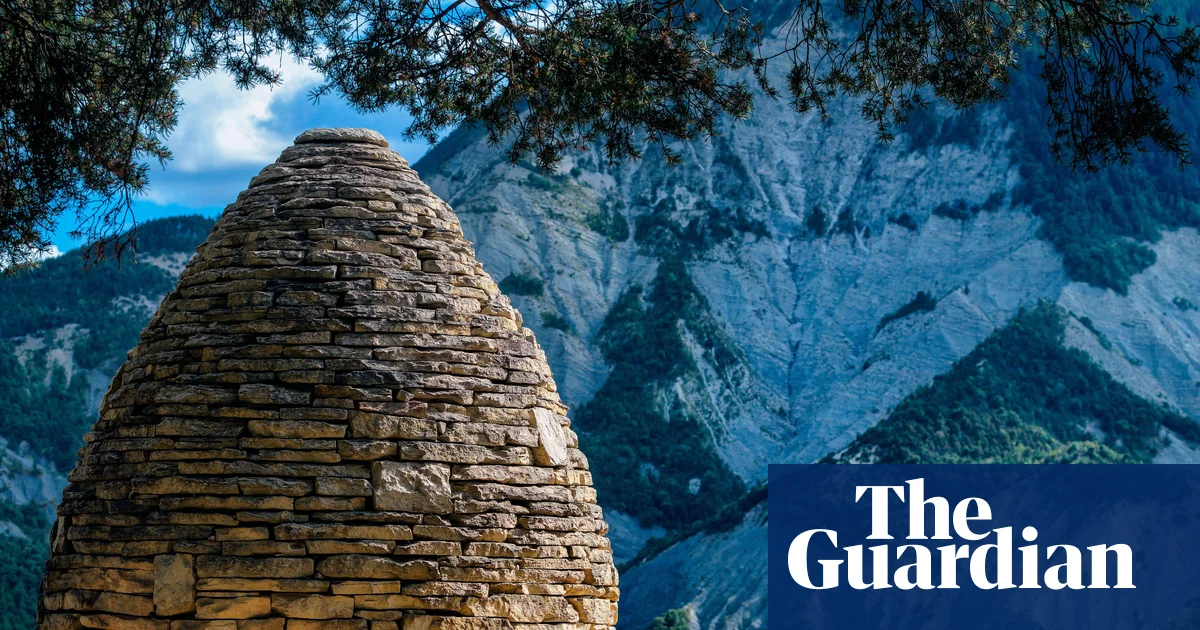
On the first day, we encounter one of three sentinels that sit like giant mysterious eggs watching over the route. These 2 to 3-metre tall cairns were made by Goldsworthy without mortar or cement and rely on fitting the right shapes and weights of the stones.
Jackie has told us the trail is mostly flat and indeed, we start on even gravel, chatting and laughing, getting used to the weight of our packs. After 5km, she says we should look for a path leading up the hill on our right. She checks her satnav and points to a goat path going straight up the rocks. I panic. My backpack suddenly feels extremely heavy. In desperation, I check further down the road and, to everyone’s relief, find a path marked with white and red horizontal lines signifying a grande randonnée, a trail certified by the French government.
We begin our ascent, pausing to photograph curlicued and wispy plants right out of Dr Seuss, yellow, scarlet and blue wildflowers, an orange moth sitting on purple brush. Spanish broom perfumes the air. We lift our gaze and see multiple valleys and unique geological formations. It’s easy to imagine our ice-age ancestors walking these trails 15,000 years ago and it’s gratifying to be travelling under our own steam, as they did.
We arrive at the first refuge, La Forest, as the sun is setting. The key unlocks the door. Inside, the air is cold. Our eyes adjust to the dark. A table and benches stand in front of us. To the left, a stairway leads to sleeping platforms. To the right, a doorway into a dark, empty room. From its depths glows a cylindrical obelisk, light falling on one large stone where someone could sit. It’s concave, constructed of light grey stone ending in a porthole to the sky. It’s illuminated by natural light and changes with the time, the weather, the season. This art is living and feels sacred.
That evening, we eat freeze-dried mushroom risotto in the flickering candlelight, play cards, eat chocolate, laugh and share stories. Sasha, who works in film in Germany, teaches us two words: der salzlose – someone who is bland and without flavour; and extrawurst – someone who always demands more. Neither apply to our group. The camaraderie and conviviality bring pure pleasure.
We climb the stairs to the sleeping platforms. Wendy and Sasha have brought sturdy sleeping mats on Jackie’s recommendation. We lay them out and say goodnight. The quiet is complete. Then, a tidal wave of sound erupts. Wendy and Sasha have rolled over. The friction on the technical fabric of their sleeping mats is deafening. The price of comfort has been revealed; they must lie like mummies.
The next day, we descend, picnic by a river on crackers, avocados and cheese, then start climbing again. Sasha and I subversively agree that it’s psychologically better to be told something is going to be hard and then it turns out easier. I console myself that climbing with a backpack is good for bone density and way less boring than lifting weights.
The next refuge, Le Vieil Esclangon, is in a mountain-top meadow. A majestic fan of lifted rock shines across the wide valley. Everywhere we turn there are more mountains and valleys. The first floor of the refuge is a large dark room split in two by a massive fireplace. Upstairs, the sleeping platforms look out on to a sunlit verge. Across from the fireplace, a tall serpentine shape made of dried mud loops back and forth like a meandering river, ending at the top in the source.
The wind picks up and the temperature drops. We gather wood and light a fire. In the flickering orange light, the sculpture comes to life, looking like one of Plato’s eternal forms. We eat our freeze-dried pad thai, the art and the hikers transient and temporary but together in this warm and cosy moment.
Later, we sleep to the sound of wind and rain, woken only by a mouse rave in the middle of the night.
We arrive at the third refuge, La Ferme Belon, in time for a late lunch. In the basement, huge interlinked semicircular stone arches look like a dragon’s body swimming through earth. Upstairs, the sleeping platforms are lovely except for one small detail. A colony of bats hang above. I can feign nonchalance because I know Wendy, who is quietly uber-capable, will find us a delightful B&B for the night. Over pizza and cold rosé, Sasha and I confess to Jackie that we would have rather known how challenging the hikes were going to be. “But you wouldn’t have come if I’d told you,” she answers with a twinkle in her eye.
Andy Goldsworthy said: “To me there is a tremendous difference between works of art that we observe in a museum just for a few minutes and works of art in which we live for a short while, in which we sleep. To sleep in a sculpture is a wonderful idea.”
In Digne-les-Bains we return the keys and soak our stronger bodies in the town’s hot springs. We’ve already said yes to Jackie’s next adventure, sight unseen.
Claudia Casper’s novel The Mercy Journals won the Philip K Dick award for distinguished science fiction in 2017 (Arsenal Pulp Press)