New Angel City FC midfielder Ally Sentnor said she believes the team can break out of its slump and win during her introduction to the fans.
“Angel City has so many tools and opportunities at their disposal and it’s right there,” Sentnor said during a season-ticket holder party Saturday. “And it’s just pushing over the edge of just little things that are gonna make this team a constant top-of-the-table contender.”
Angel City traded for Sentnor, bringing her to her third National Women’s Soccer League team. Sentnor was selected by the Utah Royals with the first pick in the 2024 draft. She was acquired by the Kansas City Current in August 2025 and helped them finish atop the table.
This season, she has started 12 league matches, earning two goals and two assists.
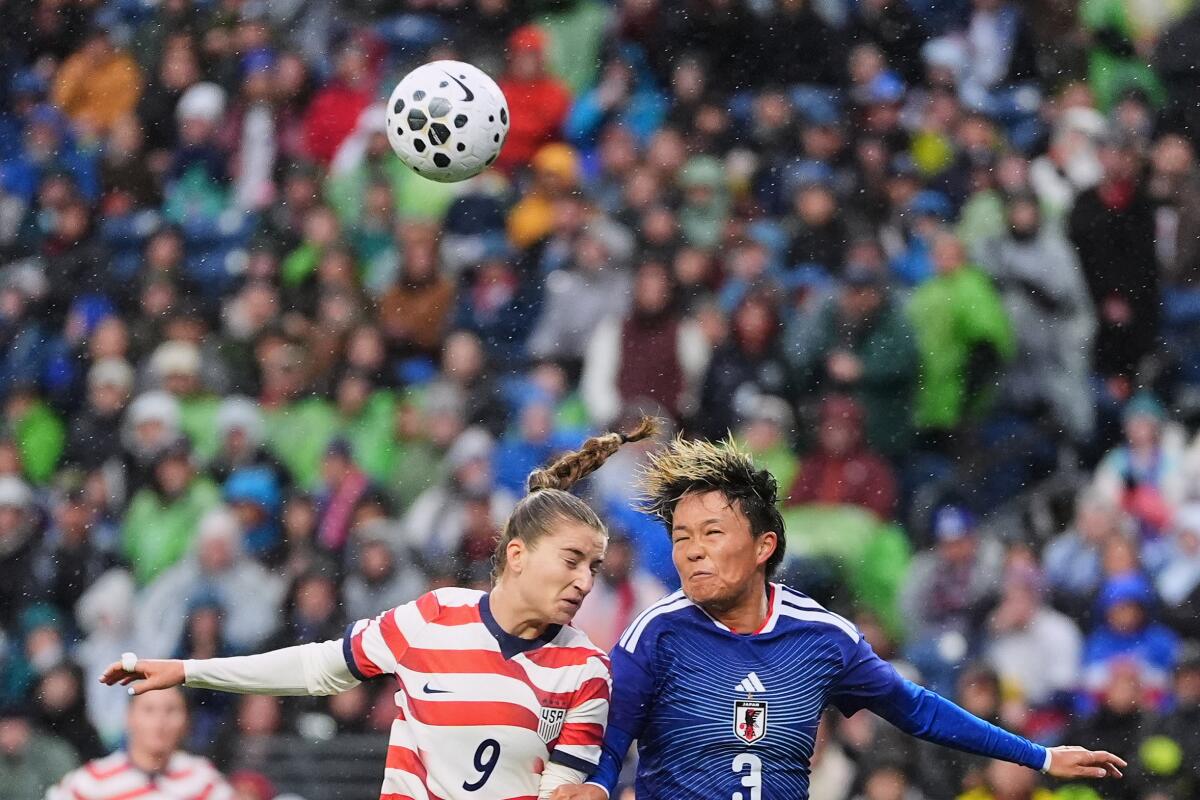
U.S. midfielder Ally Sentnor and Japan defender Moeka Minami go up for the ball during a friendly on April 14 in Seattle.
(Lindsey Wasson / Associated Press)
“This is an important moment for our team and we are very excited to welcome Ally to Los Angeles,” Angel City sporting director Mark Parsons said. “Ally is one of the world’s top young talents, has senior U.S. women’s national team experience and has built up important minutes in the NWSL.”
She arrived the same week Angel City sent midfielder Kennedy Fuller to Bay FC and fired coach Alexander Straus. The team went on a 1-6-1 slide before the World Cup break and sits in 12th place in the 16-team league.
Parsons said it was important to make the coaching change with 19 games remaining and a chance to move up the standings. Assistant Leif Gunnar Smerud was named interim coach while the team searches for Straus’ replacement.
“We’d been really clear over the last 12 months when we made the hire that this is a team heading in a direction to be able to make the playoffs,” Parsons said, noting the coach has to be able to continue to develop players and put them in position to succeed.
Sentnor hopes to add a new layer to the team, making a difference on and off the field.
“Most of the team style speaks for itself on the field, and all these girls are absolutely incredible and I’m excited to go in those relationships,” Sentnor said. “The energetic, passionate style of play is something really exciting.”
Sentnor, 22, brings experience to the Angel City roster at a relatively young age. She grew up in the national team system since age 12. She recalled traveling from Massachusetts to Colorado to attend camps and take the next steps in her career.
She has 22 appearances with the national team, recording seven goals and three assists.
The Massachusetts native hasn’t lived on the East Coast in years and has enjoyed traveling the country. She’s looking forward to the weather in California.
“It’s so fun for me to be able to try out different cities across the United States and immerse myself in different cultures,” Sentnor said.
She said her family attends many of her games, helping her feel comfortable anywhere she plays.
“Home is where the people are, so when my family travels and comes out here, it feels like home. So wherever my people are is where home is,” Sentnor said.
During a live BBC News broadcast, reporter Paul Njie interviews a Cape Verde fan when the country suddenly scores its first ever World Cup goal against Uruguay in the 2026 World Cup.
The 2026 FIFA World Cup is well into the second run of group play, with every team still eager to post wins and most looking to secure a place in the knockout stage.
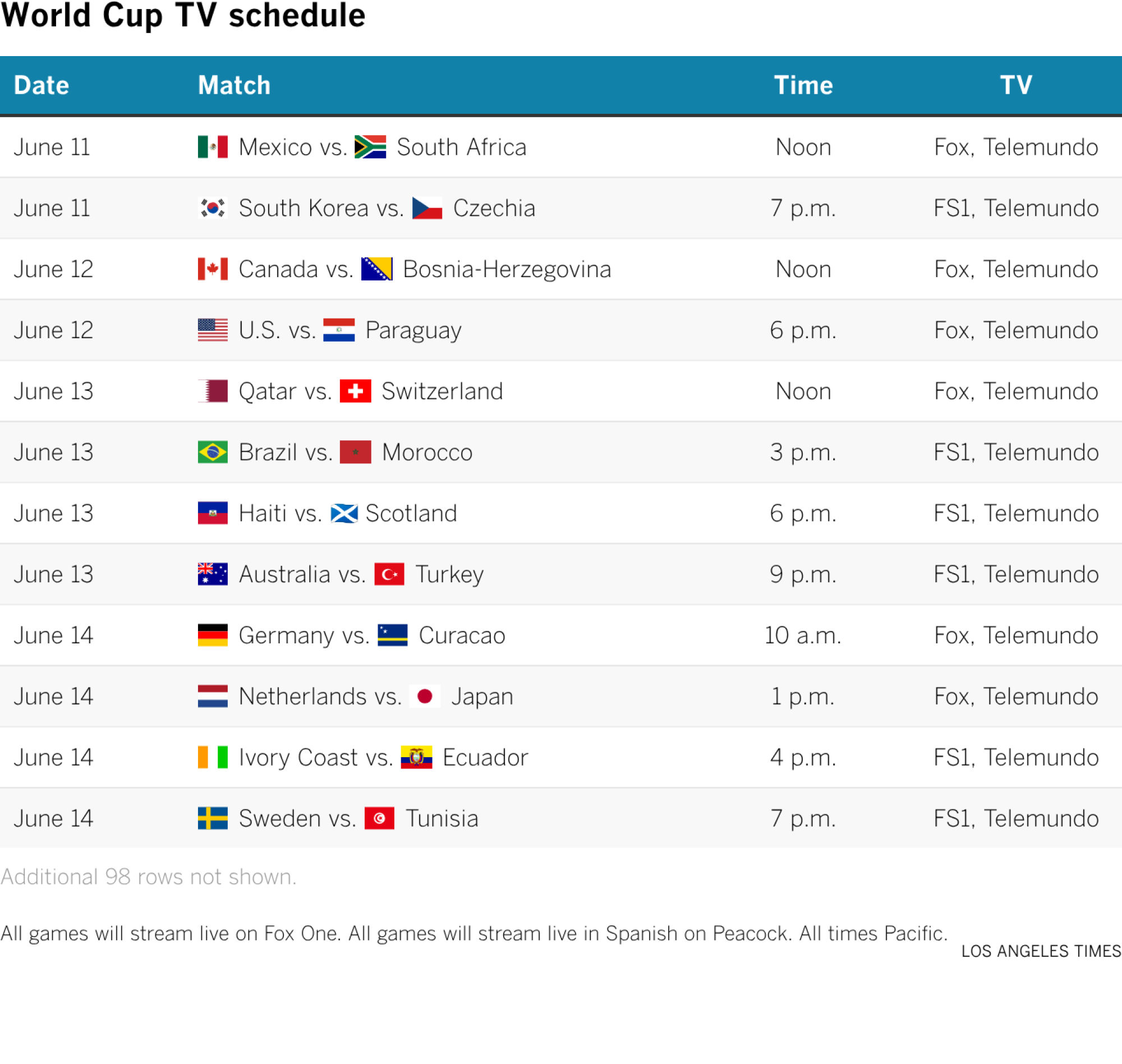
Here’s everything you need to know about matches being played Sunday, Monday and Tuesday in the 48-team tournament across the U.S., Mexico and Canada (all times Pacific). Tuesday’s matches will conclude the first two games of group play for every team at the World Cup.
Sunday’s Group G matchups:
Belgium vs. Iran
Belgium’s Romelu Lukaku, right, is challenged by Egypt’s Ramy Rabia during a World Cup Group G match on June 15.
(Alex Grimm / Getty Images)
Where: SoFi Stadium Time: noon TV: FS1, Telemundo
The buzz: Iran twice rallied from deficits to draw with New Zealand in its first game, while Belgium, outplayed by Egypt in its opener, was lucky to escape with a point on an own goal early in the second half. Belgium’s aging golden generation of Romelu Lukaku, Kevin De Bruyne, Thibaut Courtois, Thomas Meunier and Axel Witsel is going to need to do much better if they hope to avoid another early World Cup exit.
New Zealand vs. Egypt
New Zealand’s Callan Elliot, left, and Iran’s Mehdi Ghayedi battle for the ball during a World Cup Group G match on June 15.
(Andre Penner / Associated Press)
Where: BC Place, Vancouver Time: 6 p.m. TV: FS1, Telemundo
The buzz: One of these teams could make history since neither has ever won a World Cup game. New Zealand earned its first point in the World Cup since 2010 with a draw against Iran. The winner likely advances to the next round.
Sunday’s Group H matchups:
Spain vs. Saudi Arabia
Spain’s Mikel Oyarzabal, top, challenges for the ball during a draw with Cape Verde on June 15.
(Mattia Ozbot / Getty Images)
Where: Mercedes-Benz Stadium, Atlanta Time: 9 a.m. TV: Fox, Telemundo
The buzz: Both teams opened the World Cup with surprising results. Second-ranked Spain was unable to score in a draw with No. 67 Cape Verde. Saudi Arabia was 10 minutes away from upsetting Uruguay, only to settle for a tie. Spain desperately needs a win to get its World Cup back on track, while another good performance from Saudi Arabia — unbeaten in its last three games — would have the Arabian Falcons in position to reach the knockout stage.
Uruguay vs. Cape Verde
Cape Verde goalkeeper Vozinha holds the nation’s flag after a draw with Spain on June 15.
(Buda Mendes / Getty Images)
Where: Hard Rock Stadium, Miami Gardens, Fla. Time: 3 p.m. TV: FS1, Telemundo
The buzz: With all four teams playing to draws in their openers, the group is wide open. That creates a rare opportunity for tournament debutant Cape Verde, the second-smallest country to qualify for a World Cup. Vozinha, Cape Verde’s goalkeeper, made seven saves to shut out Spain. If he can frustrate Uruguay the same way, Cape Verde could be through to the round of 32.
Monday’s Group J matchups:
Argentina vs. Austria
Argentina’s Lionel Messi reacts after scoring his third goal against Algeria at the World Cup on June 16.
The buzz: Argentina opened its World Cup title defense with a 3-0 win over Algeria on a hat trick from Lionel Messi. The Argentina captain, playing in his record sixth World Cup, is tied with Germany’s Miroslav Klose for the most career World Cup goals (16). Austria, meanwhile, would all but assure itself of a spot in the knockout round with a point.
Jordan vs. Algeria
Algeria’s Zineddine Belaïd kicks the ball during a World Cup loss to Argentina on June 16.
The buzz: Little was expected of Jordan, making its first appearance in the World Cup. And it delivered little in a 3-1 loss to Austria. But Algeria, ranked 28th in the world, entered the tournament with high hopes and one of African soccer’s most potent attacks. However, it had only one shot on goal in its loss to Argentina and needs a big rebound to avoid an early trip home.
Monday’s Group I matches:
France vs. Iraq
France’s Kylian Mbappé celebrates after scoring against Senegal on June 16.
(Adam Hunger / Ap Photo/adam Hunger)
Where: Lincoln Financial Field, Philadelphia Time: 2 p.m. TV: Fox, Telemundo
The buzz: Kylian Mbappé proved his fitness with a brace in France’s opening win over Senegal, giving him 14 World Cup goals, tied for fourth on the all-time list. He has a great chance to pad that total against an Iraq team that gave up four goals to Norway. Iraq still is looking for its first-ever World Cup point.
Norway vs. Senegal
Norway’s Erling Haaland celebrates after scoring against Iraq on June 16.
The buzz: Norway, playing in its first World Cup this century, made up for lost time with a 4-1 win in its opener, getting two goals from Erling Haaland. Norway probably will move on to the next round no matter what happens, but a point would lock down a spot. Senegal and Sadio Mané, on the other hand, desperately need a win.
Tuesday’s Group K matchups:
Portugal vs. Uzbekistan
Portugal’s Cristiano Ronaldo walks on the field during a match against the Democratic Republic of the Congo on June 17.
The buzz: Cristiano Ronaldo entered this World Cup with visions of winning his first title. But he’ll go home early and empty-handed unless fifth-ranked Portugal improves on the listless performance it had in a draw with the Democratic Republic of the Congo. Uzbekistan, playing in its first World Cup, was not intimidated by the big stage, weathering a withering Colombia attack in a 3-1 loss. Expect it to bunker in again against Portugal.
Colombia vs. DR Congo
Yoane Wissa, left, celebrates with teammates after scoring for the Democratic Republic of the Congo against Portugal on June 17.
The buzz: The Democratic Republic of the Congo’s only other World Cup appearance came in 1974, when the country was known as Zaire; it lost all three games and didn’t score a goal. It’s already done better with Yoane Wissa’s score in first-half stoppage time giving the team a point against Portugal. A win here and it’s through to the knockout phase. The same is true of Colombia, which got a 65th-minute goal from Luis Díaz and another from substitute Jáminton Campaz deep in stoppage time to beat stubborn Uzbekistan.
Tuesday’s Group L matchups:
England vs. Ghana
England’s Harry Kane celebrates after scoring against Croatia on June 17.
The buzz: England opened its World Cup with a surprisingly comfortable win over Croatia behind two goals from captain Harry Kane. But the Three Lions are only equal atop the table with Ghana, which got a goal deep in stoppage time from Caleb Yirenkyi to beat Panama. If there’s a winner here, it probably will decide the group. A point likely sends both teams through.
Panama vs. Croatia
Where: BMO Stadium, Toronto Time: 4 p.m. TV: Fox, Telemundo
Panama’s Ismael Díaz attempts a shot against Ghana on June 17.
(Kevin C. Cox / Getty Images)
The buzz: Croatia has played in two straight World Cup semifinals, but that streak is in jeopardy after a 4-2 loss to England. Panama outshot, outpassed and outpossessed Ghana in its first game but came away with nothing after conceding a goal in stoppage time, leaving the Central Americans still looking for their first World Cup win.
Tunisia goalkeeper Aymen Dahmen makes an “unbelievable save” to prevent Japan from doubling their lead by the finest of margins, in their 2026 World Cup match at Estadio Monterrey.
Germany come from behind to beat Ivory Coast 2-1 in Group E, sealing FIFA World Cup 2026 knockout place.
Published On 20 Jun 202620 Jun 2026
Deniz Undav scored two goals off the bench as Germany pulled off a thrilling comeback to beat Ivory Coast 2-1 in their World Cup Group E match, securing their place in the knockout stage for the first time since they won the title in 2014.
After having two goals disallowed in the first half on Saturday, Germany did not lose focus and used intricate passing to find their way, while the West Africans produced their dynamic brand of attacking football in a wild Group E clash.
Recommended Stories
list of 4 itemsend of list
Undav levelled the score with a controlled, volleyed finish in the 68th minute and struck again when he received a pass on the turn, before swivelling and firing home a ball that Yahia Fofana had no chance at stopping.
The versatile striker now has nine goals in his last eight matches.
Simon Adingra had a late chance for Ivory Coast, but he failed to get a shot off in the area before Germany charged back down the field and Fofana blocked a low shot from Nathaniel Brown.
Ivory Coast had opened the scoring in the first half when Franck Kessie slotted home a rebound off a shot by Amad Diallo on a play created when Yan Diomande charged down the left side and sent in a cross.
With more than 100,000 people of German ancestry living in Toronto, Julian Nagelsmann’s men enjoyed plenty of support but were a frustrated group at the interval with nothing to show for their eight attempts on goal.
Germany looked to have opened the scoring when midfielder Aleksandar Pavlovic rose to meet a short corner in the 25th minute but was deemed to have fouled Fofana in the process.
The ruling left Pavlovic with his hands atop his head in disbelief while Fofana received some attention after the collision, and the partisan German crowd made their disdain for the referee’s decision known.
Shortly after, it was Ivory Coast who finally broke through with Kessie’s goal. The West Africans have scored in their last seven matches at the tournament – the longest such sequence on the global stage in their history.
Germany once again put the ball in the back of the net, but their celebrations were cut short as the referee determined that Jamal Musiala had fouled Odilon Kossounou in the buildup.
Germany top Group E with six points and are through to the last 32, while Ivory Coast remain on three after two matches. Ecuador and Curacao meet in Kansas City later on Saturday.
Germany will close out the group stage against Ecuador on Thursday in New Jersey, while Ivory Coast face Curacao in Philadelphia.
Ismael Saibari scored the fastest goal of the World Cup 2026 so far after just 71 seconds as Morocco beat Scotland 1-0 to close in on a place in the knockout rounds.
Saibari scored in Morocco’s opening 1-1 draw with Brazil last weekend, and his clinical finish with just over a minute gone settled a hard-fought, physical contest at Boston Stadium on Friday.
A crowd of 64,146 fans turned up at the venue in Massachusetts, United States.
The 25-year-old, who was born in Spain and raised in Belgium, is reportedly on the brink of a $63m transfer from Dutch champions PSV Eindhoven to Bayern Munich.
The quality of his strike past goalkeeper Angus Gunn showed why he is attracting such interest, and it was telling that Scotland lacked the same quality in the opposition box — that helps explain why Morocco are ranked fifth in the world, and Scotland 40th.
With four points from two games, Morocco are now primed to advance to the last 32 as they aim to at least match their historic run to the semifinals in Qatar in 2022.
However, it was a sobering evening for Scotland and their army of fans who have taken over Boston during this World Cup, as their team never really tested Morocco goalkeeper Yassine Bounou.
The laboured 1-0 win over Haiti in their opening game at the same stadium last weekend — which was their first victory at a World Cup since 1990 — gave them a platform to build on and reason to believe they can progress beyond the group stage at a World Cup for the very first time.
Another win here would have secured progress from Group C, but their chances of going further remain up in the air going into their next match against Brazil in Miami next Wednesday.
Moroccan coach Mohamed Ouahbi went with an unchanged starting lineup here following the Brazil clash, but opposite number Steve Clarke made three changes.
Clarke sought to reinforce his defence, meaning striker Lawrence Shankland dropped out as defender Kieran Tierney came into the side to make a back five.
But that was of little use as Morocco went ahead practically from kickoff.
The assist came from Real Madrid’s Brahim Diaz, and Grant Hanley played Saibari onside as the latter latched onto the ball over the top, controlled it and rifled high into the net.
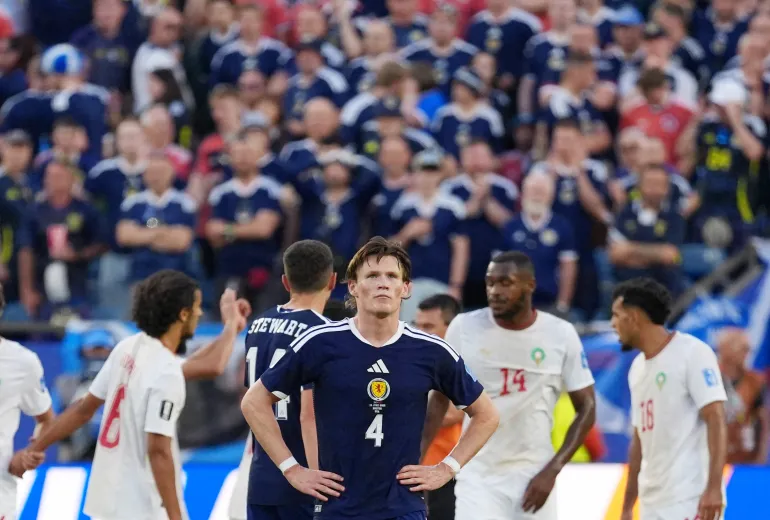
Scotland’s Scott McTominay looks dejected after the match [David Butler II/Reuters]
Morocco, who defeated Scotland 3-0 when the teams met at the 1998 World Cup, threatened to overrun their opponents every time they got forward but were wasteful, with Bilal El Khannouss squandering a good chance on 36 minutes.
Scotland were as stodgy in attack as they have been for a long time, and it took until first-half stoppage time for them to create anything dangerous.
That was a cross whipped in from the left by skipper Andy Robertson that John McGinn was unable to make anything of, and the opening period ended without Bounou needing to make a save.
Morocco hit the woodwork five minutes into the second half as Saibari met a cutback by El Khannouss, and his attempt was deflected onto the bar by Jack Hendry.
Moments later, Gunn made a fine stop to keep out an El Khannouss header from a corner taken by Hakimi, who was regularly booed by the crowd.
Morocco nevertheless seemed content to see the game out and soak up what Scotland could throw at them.
Ryan Christie fired over on 64 minutes after being teed up by Scott McTominay, who hit the side-netting late on, but a Scotland goal proved elusive.
Morocco face Haiti in Atlanta on Wednesday, while Scotland face Brazil in Miami.
Morocco fans celebrate their team’s win at a watch party in New York [Caean Couto/Reuters]
Why was Achraf Hakimi booed?
Morocco’s captain Achraf Hakimi was named in the starting lineup hours after it was confirmed he must stand trial in France on rape charges.
Loud boos rang out from the Scottish fans when Hakimi’s name was read out and every time he touched the ball during the game.
The Paris Saint-Germain (PSG) defender said in a statement earlier in the day that he faced trial on a rape charge and welcomed the opportunity to put across his point of view.
Hakimi had appealed his referral to a criminal court.
French media reported earlier that the Versailles appeals court had rejected the appeal, paving the way for his trial in a criminal court at some point in the future.
“Today, a story that isn’t mine is being told at the expense of my family, my life, and above all, the truth. Sometimes I feel like I’ve become an easy target,” Hakimi wrote in a post on the social media platform X.
“I’ve been waiting for this trial since day one. And now I’m looking forward to it. Finally, I’ll be able to speak out.”
Achraf Hakimi celebrates Morocco’s win [Martin Meissner/AP Photo]
SEATTLE — The World Cup is only a little more than a week old, but it’s already a historic one for the U.S.
With Friday’s 2-0 win over Australia, the U.S. matched its best World Cup performance ever with two victories. Their six goals match the most the U.S. has ever scored in the group stage and its goal differential of plus-five is also its best ever in the tournament. The U.S. also clinched a spot in the round of 32.
Most impressive of all, however, is how the U.S. achieved most of that without their best player, Christian Pulisic, who had an electric first half in the U.S. opener against Paraguay but hasn’t seen the field since. And while Pulisic, who is nursing a calf injury, was missed Friday, he wasn’t needed, with the U.S. outpossessing, outpassing and outshooting Australia by wide margins.
The Americans hardly needed any help, but Australia gifted the U.S. its first goal anyway when defender Cameron Burgess deflected in a cross from Folarin Balogun in the 11th minute. The sequence started with Antonee Robinson pushing the ball forward for Balogun from just inside the halfway line. Balogun ran onto the ball then turned on the jets, making a dash up the left wing before turning toward the penalty area and bending a pass toward Sergiño Dest in the six-yard box.
Australian goalie Patrick Beach, guarding the post, reached out his left hand but missed the ball, allowing it to strike Burgess’ left foot and carom into the roof of the net igniting a red, white and blue-clad crowd of 66,925 inside Seattle Stadium (Lumen Field) and tens of thousands more who gathered outside the stadium and at viewing parties spread throughout the city.
The first U.S. score in its opener with Paraguay came on an almost identical own goal, with Paraguayan midfielder Damián Bobadilla getting his right foot on a pass Weston McKennie had aimed at Balogun.
Australia tried to deal with the Americans’ superior speed and technical abilities by getting physical, rough play that German referee Felix Zwayer largely allowed. But Australia paid dearly for that just before the intermission when Alex Freeman, who was leveled by Australia’s Paul Okon-Engstler moments earlier, climbed off the turf to head in a loose ball to give the U.S. a 2-0 lead at the break.
A look at how the U.S. scored its goals in a 2-0 win over Australia.
That sequence started with a free kick following a foul by Burgess. Robinson left-footed the ball to an unmarked Dest at the top of the box, a shot that was blocked in the wall, then arced toward the goal. Freeman and Balogun raced Beach to the ball, with Freeman getting there just ahead of the Australian goalie to nod it in.
The goal was originally negated by an offside that was quickly overturned by the VAR official.
Australia tried to make a game of it in a second half that turned increasingly chippy, but the U.S. defense held firm.
The U.S. — and Pulisic — have five days to prepare for their group-stage finale with Turkey on Thursday at SoFi Stadium, where the potential for even more history awaits.
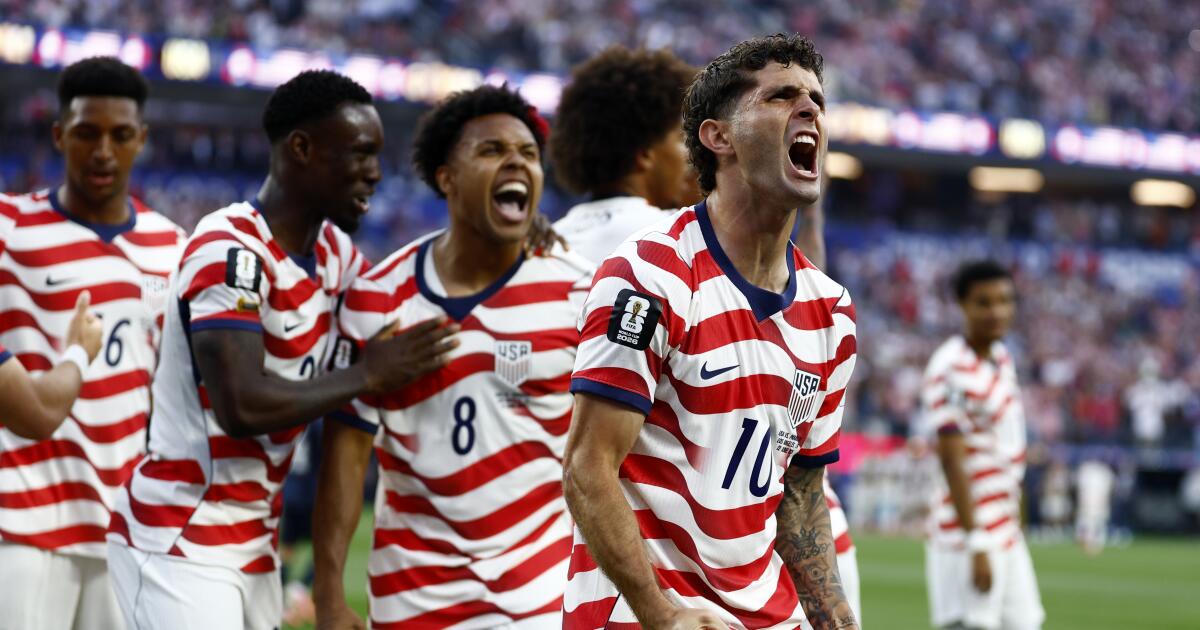
U.S. fans react after a 2-0 win over Australia at Seattle Stadium (Lumen Field) on Friday in World Cup Group D play.
SEATTLE — The 2026 FIFA World Cup is well into the second run of group play, with every team still eager to post wins as they look to secure a place in the knockout stage.
Here’s everything you need to know about matches being played on Friday, Saturday and Sunday in the 48-team tournament across the U.S., Mexico and Canada (all times Pacific).
Friday’s Group C matchups:
Scotland vs. Morocco
Morocco’s Soufiane Rahimi controls the ball during a World Cup match against Brazil on June 13.
The buzz: Scotland opened its World Cup with a win over Haiti — its first in 10 tournament games against teams from the Americas — on John McGinn’s goal midway through the first half. A win or draw here will probably be enough to send the Scots on to the knockout stage for the first time. Morocco came away from its first match with a well-earned point in a 1-1 draw with Brazil. That game was nearly as equal statistically as it was on the scoreboard. Morocco’s score came from Ismael Saibari in the 21st minute.
Brazil vs. Haiti
Vinicius Junior celebrates after scoring against Morocco in the World Cup on June 13.
(Adam Hunger / Associated Press)
Where: Lincoln Financial Field, Philadelphia Time: 5:30 p.m. PDT TV: Fox, Telemundo
The buzz: Haiti outpossessed and outshot Scotland in its opening loss but it couldn’t score, leaving it needing at least a point here to keep its hopes of advancing alive. Brazil got a 32nd-minute goal from Vinícius Júnior in its opener.
Friday’s Group D matchups:
United States vs. Australia
U.S. midfielder Gio Reyna celebrates with defender Chris Richards after a 4-1 win over Paraguay at the World Cup on June 12.
The buzz: The only time the U.S. won two games in the group stage was 1930; the Americans can equal that with a win here after thrashing Paraguay in its opener. Folarin Balogun’s two goals in that game equaled another record from 1930, which was the last time a U.S. player had multiple goals in a World Cup game. Australia opened with a 2-0 win over Turkey. A win or draw here will likely send the Socceroos to the next round for a second straight World Cup.
Paraguay vs. Turkey
Paraguay head coach Gustavo Alfaro talks with his players during a training session on Thursday.
The buzz: Neither team can afford a loss if they hope to advance. Turkey dominated its opener, outshooting Australia 30-9, taking 51 touches in the penalty area and completing 90% of its 635 passes. But it had nothing to show for it in a 2-0 loss. Paraguay was never in its opener, falling behind the U.S. 3-0 in the first half of a 4-1 loss.
Saturday’s Group E matches:
Germany vs. Ivory Coast
Ivory Coast’s Yan Diomande celebrates a goal against Ecuador in the World Cup on June 14.
The buzz: Germany pounded tiny Curaçao 7-1 in its opener. The last time Germany won 7-1 in a World Cup was in 2014 when it routed Brazil en route to its fourth title. The Ivory Coast started its tournament with a 1-0 upset of Ecuador on substitute Amad Diallo’s goal in the 90th minute. Ivory Coast limited the South Americans to just one shot on goal.
Ecuador vs. Curaçao
Curaçao’s Livano Comenencia shoots against Germany during a World Cup match on June 14.
The buzz: Neither team can afford another loss after falling in their openers, but Curaçao has the bigger hill to climb after surrendering 26 shots — 12 on target — in a one-sided loss to Germany. The only bright spot was Livano Comenencia scoring Curaçao’s first-ever World Cup goal. Ecuador had few scoring changes in its loss to Ivory Coast. It will need to do better if it hopes to get out of the group stage for just the second time.
Saturday’s Group F matchups:
Netherlands vs. Sweden
Sweden’s Yasin Ayari (18) celebrates with teammates after scoring against Tunisia in the World Cup on June 14.
The buzz: Yasin Ayari scored the first and last of Sweden’s goals in the 5-1 win over Tunisia last week. The Netherlands twice lost leads in its 2-2 draw with Japan. The Dutch haven’t been eliminated in the first round of a World Cup since 1938, but a loss here could put that streak in jeopardy.
Tunisia vs. Japan
Japan’s Daichi Kamada controls the ball in front of the Netherlands’ Teun Koopmeiners during a World Cup match on June 14.
The buzz: Tunisia will play its first game under interim coach Hervé Renard, who managed the team from 2019-22. He replaces Sabri Lamouchi, who was fired after Tunisia’s listless loss to Sweden. Japan earned a point in its opener, twice rallying from deficits to draw the Netherlands on Daichi Kamada’s goal in the 88th minute.
Sunday’s Group G matchups:
Belgium vs. Iran
Belgium’s Romelu Lukaku, right, is challenged by Egypt’s Ramy Rabia during a World Cup Group G match on June 15.
(Alex Grimm / Getty Images)
Where: SoFi Stadium, Inglewood
Time: noon PDT
TV: FS1, Telemundo
The buzz: Iran twice rallied from deficits to draw New Zealand in its first game while Belgium, outplayed by Egypt in its opener, was lucky to escape with a point on an own goal early in the second half. Belgium’s aging golden generation of Romelu Lukaku, Kevin DeBruyne, Thibaut Courtois, Thomas Meunier and Axel Witsel are going to need to do much better if they hope to avoid another early World Cup exit.
New Zealand vs. Egypt
New Zealand’s Callan Elliot, left, and Iran’s Mehdi Ghayedi battle for the ball during a World Cup Group G match on June 15.
The buzz: One of these teams could make history since neither has ever won a World Cup game. New Zealand earned its first point in three World Cup appearances with a draw against Iran. Egypt’s tie with Belgium was its third draw in eight games. And there could be an added bonus to that history since a victory likely sends the winner on to the next round.
Sunday’s Group H matchups:
Spain vs. Saudi Arabia
Spain’s Mikel Oyarzabal, top, challenges for the ball during a draw with Cape Verde on June 15.
The buzz: Both teams opened the World Cup with surprising results. Third-ranked Spain was unable to score against No. 64 Cape Verde in a game that ended in a draw. Saudi Arabia was 10 minutes away from upsetting Uruguay, only to settle for a tie. Spain desperately needs a win to get its World Cup back on track while another good performance from Saudi Arabia — unbeaten in its last three games — would have the Arabian Falcons dreaming of a spot in the knockout stage.
Uruguay vs. Cape Verde
Cape Verde goalkeeper Vozinha holds the nation’s flag after a draw with Spain on June 15.
(Buda Mendes / Getty Images)
Where: Hard Rock Stadium, Miami Gardens, Fla. Time: 3 p.m. PDT TV: FS1, Telemundo
The buzz: With all four teams playing to draws in their openers, the group is wide open. That creates a rare opportunity for tournament debutante Cape Verde, the second-smallest country to qualify for a World Cup. Vozinha, Cape Verde’s goalkeeper, made seven saves to shut out Spain. If he can frustrate Uruguay the same way, Cape Verde could be through to the round of 32.
GUADALAJARA, Mexico — Three and a half years after its biggest failure on the World Cup stage in half a century, the Mexican national team needed only two games to advance to the knockout round of this year’s tournament as winner of Group A.
Mexico’s defense held off a spirited final push by South Korea, earning a 1-0 win on Thursday night at Guadalajara Stadium in front of a fiery announced sellout crowd of 45,522.
Goalkeeper Kim Seung-gyu made a mistake in the 50th minute, failing to stop what appeared to be a simple cross and bobbling the ball. That allowed Mexico’s Luis Romo to easily tap the ball into the net and claim a 1-0 lead.
South Korea put pressure on the Mexican team throughout the game. Late in the scoreless first half, Jae-sung Lee came close to giving South Korea the lead. Mexico coach Javier Aguirre hoped his team would shake off nerves following the emotional opener at Azteca Stadium and show more bite in its second game against South Korea, but his team didn’t have much power behind its attack during the game’s first 45 minutes.
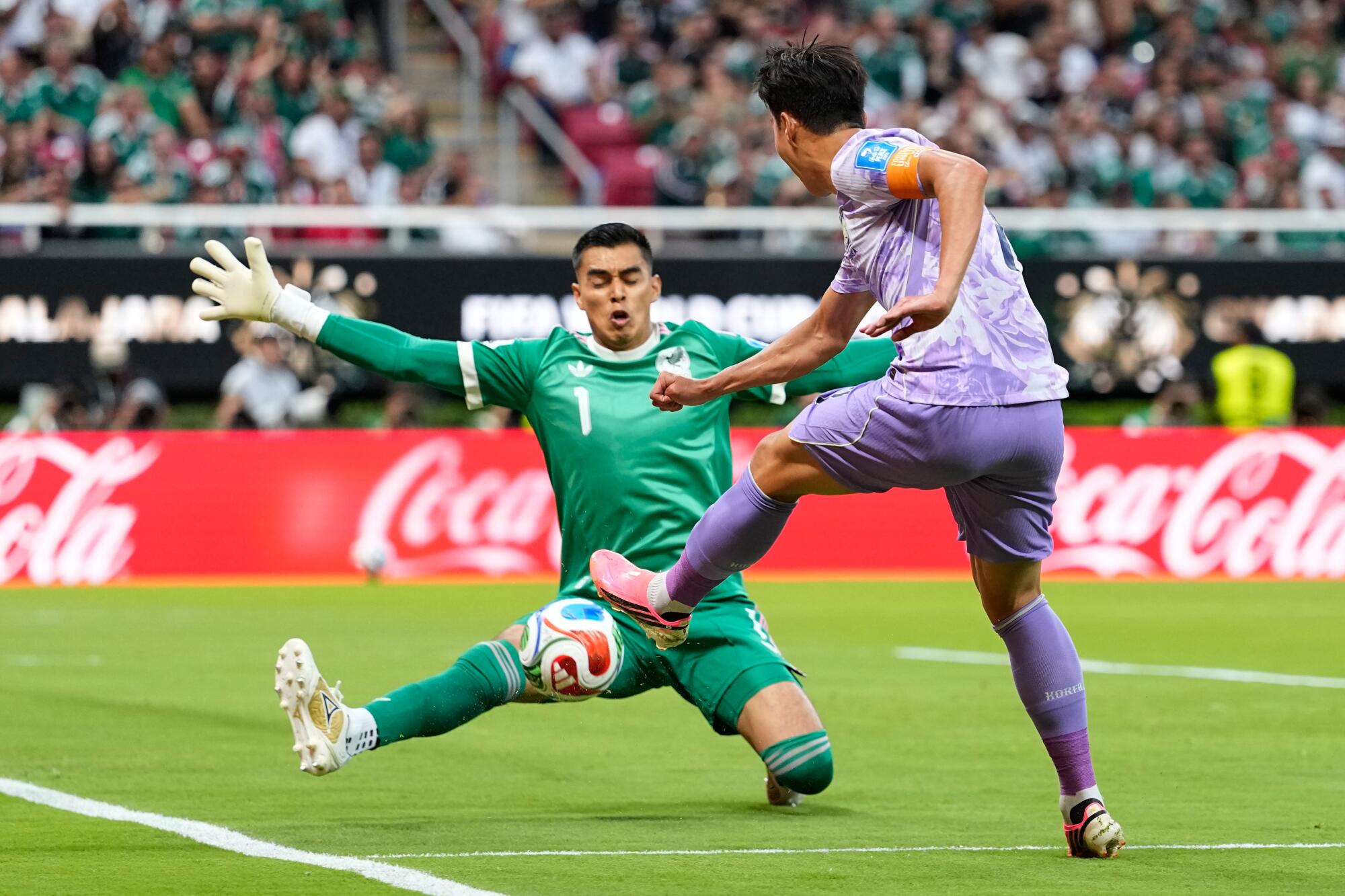
Mexico goalkeeper Raúl Rangel blocks a shot from South Korea’s Son Heung-min during their World Cup match at Guadalajara Stadium on Thursday.
(Natacha Pisarenko / Ap Photo/natacha Pisarenko)
The crowd in Guadalajara grew frustrated and began booing the Mexican national team’s performance at the end of the first half.
Mexico, however, won back their cheers when it capitalized on South Korea’s costly mistake and converted it into a goal.
El Tri earned a win without any other goals thanks, in part, to a great night by goalkeeper Raúl Rangel, who stopped a header by Cho Gue-sung in the 87th minute. Captain Edson Álvarez helped turn away South Korea’s attack late, holding up relatively well despite having left ankle surgery during the past year.
South Korea finished controlling possession 58% of the time, but it only earned two shots on target.
Mexico was coming off a comfortable 2-0 victory over South Africa, while the South Koreans had defeated the Czech Republic 2-1, marking their first World Cup opening-match win since 2010.
During the 2022 World Cup in Qatar, Mexico was eliminated in the group stage for the first time since 1978, breaking a streak of seven consecutive appearances in the knockout rounds. However, playing on home soil, the team’s goal is to emulate El Tri’s achievements in 1970 and 1986, when they reached the quarterfinals — the country’s best World Cup finish.
Due to the new 48-team format, Mexico would need to win two knockout-round matches and reach a sixth game to realize its goals.
Mexico’s Luis Romo celebrates with his teammates after scoring during a match against South Korea at Guadalajara Stadium on Thursday.
(Natacha Pisarenko / Associated Press)
After the win over South Korea, Mexico will close out group play against Czechia at Azteca Stadium in Mexico City on Wednesday. El Tri will get to play the first two games of the knockout round — should it win the first one — at Azteca Stadium, a venue where it has never lost a World Cup game.
South Korea has four points and will be favored when it plays South Africa Wednesday in Monterrey. If South Korea wins the match, it would be the Group A runner-up and advance to play the Group B runner-up on June 28 at SoFi Stadium.
The first six days of the 2026 FIFA World Cup are over, with the U.S. and Mexico each winning their group stage openers. However, several teams in the World Cup field are still looking to hit the competitive pitch for the first time.
Here’s everything you need to know about matches being played on Wednesday and Thursday in the 48-team tournament across the U.S., Mexico and Canada (all times Pacific).
Wednesday’s Group K games:
Portugal vs. DR Congo
Portugal’s Cristiano Ronaldo celebrates after scoring during a World Cup qualifying match on Oct. 14.
The buzz: The Democratic Republic of the Congo is back in the World Cup for the first time since 1974 — when the country was known as Zaire — and in its first game it faces fifth-ranked Portugal and Cristiano Ronaldo, the greatest goal scorer in soccer history. Ronaldo, 41, is playing in the tournament for a sixth time, and this likely is his last chance to win the one prize that has eluded him — a World Cup title.
As for the Congo, it qualified by beating Jamaica in extra time of an inter-confederation playoff in March. But its final pretournament tuneup, with Chile this month, was canceled in Spain because of health concerns linked to the Ebola outbreak in Congo, then relocated to France, where Les Leopards lost 2-1. Before that, the team’s only two losses in the last year had been to World Cup qualifiers Senegal and Algeria.
Uzbekistan vs. Colombia
Uzbekistan’s Eldor Shomurodov controls the ball during an international friendly against the U.S. in September 2023.
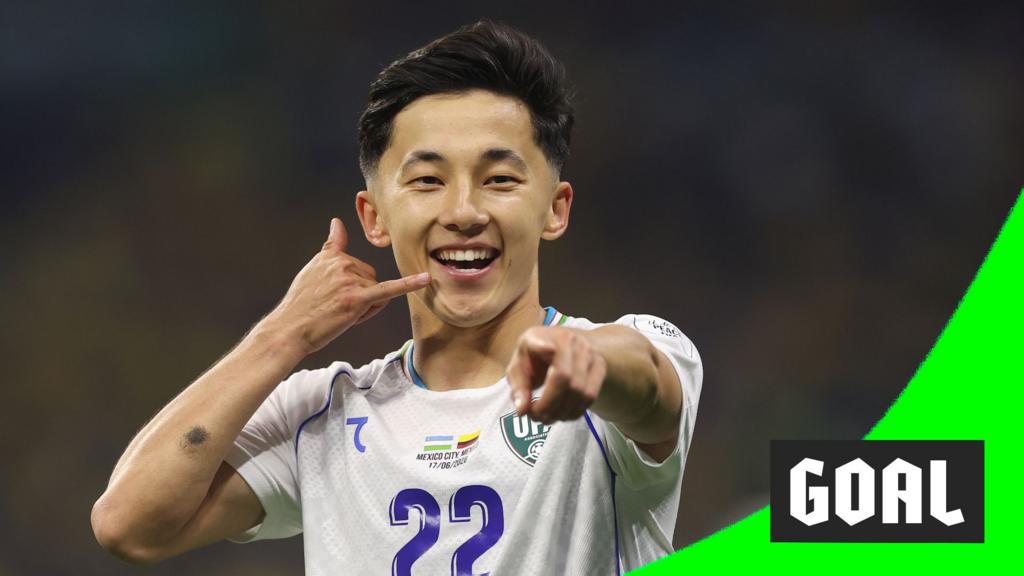
The buzz: Uzbekistan, a former Soviet republic, is another first-time World Cup qualifier, having punched its ticket for the tournament by finishing second to Iran in its Asian Confederation qualifying group. Its best player is forward Eldor Shomurodov, the team’s all-time leader in goals and the active leader in appearances who shared the lead in Turkey’s Super Lig with 22 scores this season.
Colombia is returning to the World Cup after missing the 2022 tournament. That led to the hiring of Argentine manager Néstor Lorenzo, who guided Colombia to a 28-game unbeaten streak between 2022 and 2024.
Wednesday’s Group L games:
England vs. Croatia
England’s Harry Kane takes part in a team training session on Saturday.
The buzz: The last time these teams met in the World Cup was in the 2018 semifinals, where Croatia won in extra time. Since making its first World Cup as an independent country in 1998, Croatia has finished third or better three times, making the final in 2018 and the semifinals in 1998 and 2022. Only France has fared better in the last two tournaments. England, a quarterfinalist in Qatar, made the final of the last two European Championships and, like Croatia, comes into this tournament with an aging core led by captain Harry Kane, England’s all-time leader in goals.
Ghana vs. Panama
Panama’s Ismael Diaz, center, controls the ball during an international friendly against Brazil in May.
(Silvia Izquierdo / Associated Press)
Where: BMO Field, Toronto Time: 4 p.m. TV: FS1, Telemundo
The buzz: Panama made its first World Cup appearance in 2018, and seven players from that team are back looking for their first win in the tournament. Prolific goalscorer Ismael Diaz is one of those holdovers as is San Diego FC midfielder Anibal Godoy, the team captain. Ghana, meanwhile, has qualified for five of the last six World Cups but hasn’t gone beyond the group stage since 2010. Its best player is Leicester City forward Jordan Ayew, Ghana’s all-time leader in caps and its active leader in goals.
Thursday’s Group A games:
Czechia vs. South Africa
Czechia’s Ladislav Krejci, center, celebrates with teammates after scoring against South Korea on June 11.
(Matias Delacroix / Associated Press)
Where: Mercedes Benz Stadium, Atlanta Time: 9 a.m. TV: Fox, Telemundo
The buzz: Both teams lost their openers, meaning neither can afford another setback. But South Africa will be without two key players in midfielders Yaya Sithole and Themba Zwane, who both drew red cards in the team’s loss to Mexico. Ladislav Krejci’s second-half goal gave Czechia the lead briefly in its loss to South Korea. It was the country’s first World Cup lead since a 3-0 win over the U.S. in group play in 2006.
Mexico vs. South Korea
Mexico’s Raúl Jiménez celebrates after scoring against South Africa at the World Cup on June 11.
The buzz: After both teams opened their World Cup with wins, a victory here likely will mean advancing to the knockout rounds as the group champion. Mexico has a one-goal lead in goal differential but will be facing South Korea without defender César Montes, who drew a silly red card in stoppage time of El Tri’s win over South Africa.
Thursday’s Group B games:
Switzerland vs. Bosnia and Herzegovina
Switzerland’s Breel Embolo scores on a penalty shot against Qatar at the World Cup on June 13.
The buzz: Switzerland dominated its first game, outshooting Qatar 26-6 and putting seven tries on target. But it dropped two important points on an own goal deep in stoppage time, turning a potential 1-0 win into a 1-1 draw. Despite all that offense, Switzerland’s only goal came on Breel Embolo’s penalty shot. Bosnia also let a lead — built on Jovo Lukic’s header in the 21st minute — get away late in its draw with Canada.
Canada vs. Qatar
Canada’s Cyle Larin (9) celebrates with teammates after scoring against Bosnia-Herzegovina at the World Cup on June 12.
The buzz: Cyle Larin scored two minutes after coming off the bench late in the second half of Canada’s opener, giving the country its first point in a World Cup match. A win against Qatar almost certainly would be enough to see Canada through to the second round, but the team once again will be without its best player, injured winger Alphonso Davies. Qatar also earned its first World Cup point against Switzerland, with keeper Mahmud Abunada making five saves, enabling the team to draw on an own goal in stoppage time.
Country singer Tyler Farr is recovering after he missed his weekend show.
The “Rednecks Like Me” singer was slated to perform at the Goshen Stampede in Goshen, Conn., on Saturday, but the festival announced just hours before gates opened that Farr had an accident on his Chapel Hill farm, about 45 minutes outside of Nashville.
“Due to a motor vehicle incident on his farm, Tyler Farr was taken to a local hospital and diagnosed with a severe concussion,” read the Instagram post. “Tyler Farr will no longer be able to perform at the Goshen Stampede on June 13, 2026. We appreciate everyone’s understanding and will share additional event information as it becomes available. We wish Tyler a speedy recovery.”
David Foster and the All Stars took Farr’s place in the lineup. The event featured two rodeos with bull riding and steer wrestling, monster trucks, carnival rides and country music. Farr shared Goshen Stampede’s post to his since-expired Instagram stories but hasn’t shared any further updates.
Representatives for the country musician did not immediately respond to The Times’ request for comment.
This isn’t the country music star’s first rodeo. Farr, who released “Quit Bein’ Country” last fall, stopped by Taste of Country’s podcast to promote his new EP and told the outlet that he got into a car wreck on the way there and said his truck was too high.
“There’s a big lift on it, and if it had been a normal vehicle, it’d probably been something you could have just buffed out, but the reinforced-steel, ultra off-road bumper I have broke a taillight and knocked the bumper off [the other vehicle],” he said, adding that his truck didn’t have a scratch. “Luckily the person was cool, cop was cool.”
Apparently the last time he was in an accident (before the one in December), his 2013 hit “Redneck Crazy” went to No. 1 on the charts.
The singer has also been candid about his love for country living and turkey hunting.
“When I moved to Nashville, it wasn’t to be in the Hall of Fame,” he told Land.com last year. “That wasn’t a goal … I’m a pretty simple person. My goal was literally to be on the Opry, have a hit song, little country house in the woods, some land, a tractor.”
Buckle in because the training wheels are OFF for this improv drop-in. So Much Improv, created and led by comic Joe Fahey, focuses on getting in your reps by doing back-to-back improvised scenes. Classes are held at Kingsley Studios, which can be difficult to spot. The two-level complex is located right in front of a liquor store, and the studio is on the second floor behind gated doors. The studio looks like a cute living room, with a couch against one wall and plants across another.
The class size tends to be small (my class included five people), but that allows more time to improvise per person. The class is mostly regulars, so there is already a good rapport between Fahey and the students. That means he can give more specific feedback. After completing other beginner courses, this one felt the scariest, but I leaned in. After a few reps, I felt more confident in my ability to improvise and develop tactics to work with my scene partner. By implementing his feedback, I was able to fine-tune my improv skills.
This class is perfect for those who want more practice. The type of reps can differ each class, but the week I went centered on UCB auditions (it was that time of year). Since the class is small, you get a more catered experience.
Best for: Back-to-back practice on intermediate or advanced drills Cost: $20 Time commitment: Two hours Parking: Street parking Pro tip: Bring water because you will be talking a lot, and something caffeinated to beat the late-night crash for this evening class that requires your full attention.
LAS VEGAS — Carolina spent the first part of the Stanley Cup Final surviving, finding ways to overcome deficits and play a high-scoring game that didn’t fit the Hurricanes’ typical style.
But when it came down to doing what it takes to win the Cup, the Hurricanes’ defense put its stamp on this series, shutting down the Vegas Golden Knights and not letting up.
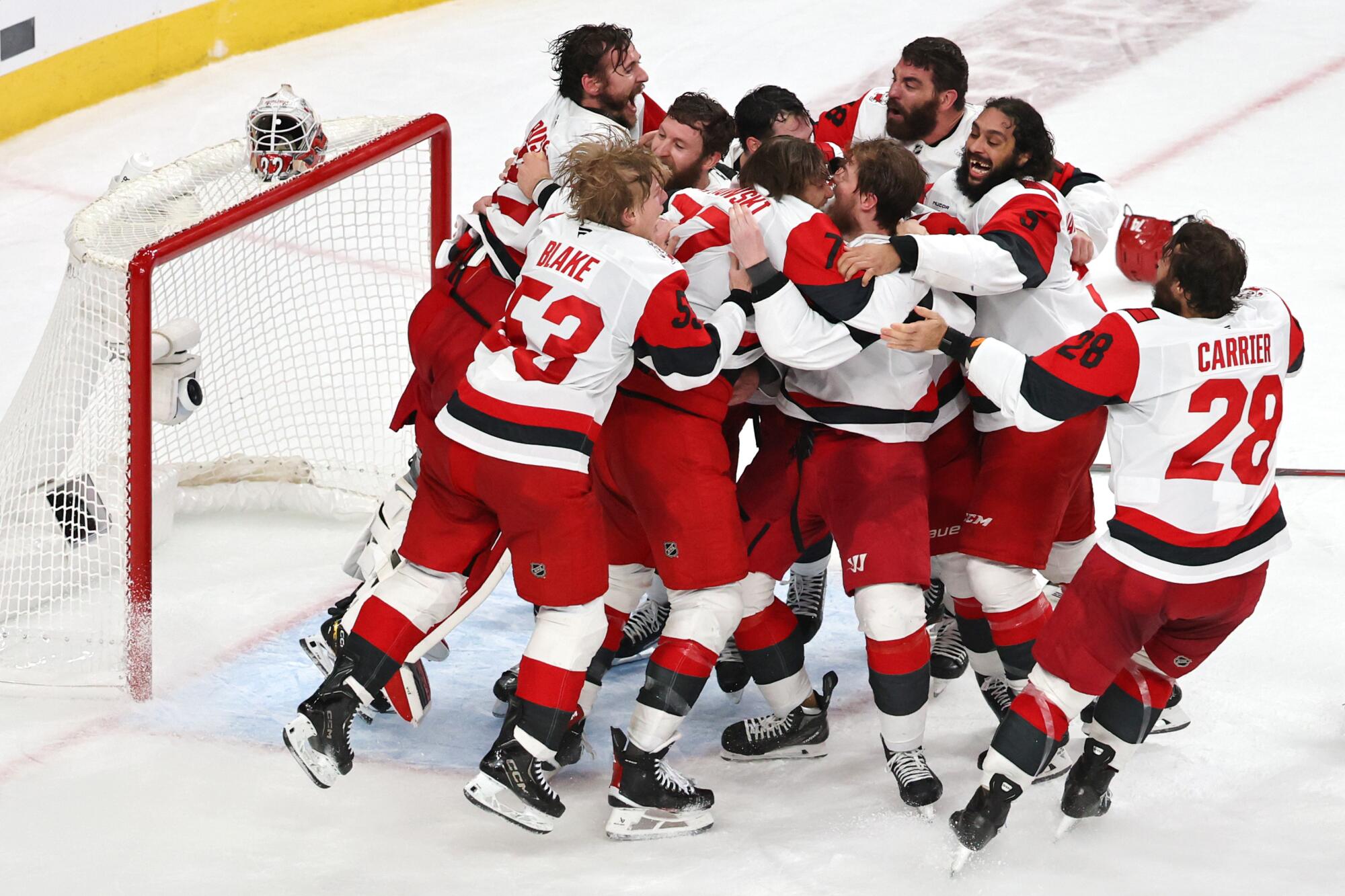
The Hurricanes held Vegas to five total goals in Games 4 and 5 and used a suffocating defense in a 3-0 shutout in Sunday night’s clinching Game 6 to win their first championship in 20 years.
“That’s a lot of years,” said Carolina center Jordan Staal, who received the Conn Smythe Trophy as playoff MVP. “It’s amazing. This is something I’ve been going after ever since we got the first one. You want to win it again and again and again. What a feeling, what a battle. The boys were grinding today, my goodness. So many individual efforts just to keep the puck out of our net. It was an amazing ride. I’m just so proud of these guys.”
Carolina Hurricanes players celebrate after defeating the Vegas Golden Knights to win the Stanley Cup on Sunday.
(Ethan Miller / Getty Images)
Brandon Bussi, whose entrance late into Game 3 helped turn around the series for Carolina, recorded his first career playoff shutout in stopping 22 shots. Jackson Blake had a goal and assist, and Taylor Hall scored just 3:47 into the game to set the tone. Nikolaj Ehlers added an empty-net goal.
“Your mind wanders the last couple of days and wonder what it may be like out here (on ice after winning) and it’s better than I could have expected,” Hall said. “My career has taken a lot of different turns, but to end up here with this group of guys and to do this is amazing.”
The Golden Knights, who made an unlikely run just to reach the final, struggled badly to muster any kind of offense in Game 6 and went 18:37 between shots on goal in the second and third periods. Playing in their third Cup final, this is the first time they have been shut out.
This clinching game was what many observers expected the series to be like between the defensive-minded teams, but each side watched leads of two-plus goals disappear in the first three games.
Now, the Cup belongs to the Hurricanes, led by coach Rod Brind’Amour, who also captained Carolina to its 2006 title.
This was the first game of the series that Vegas goalie Carter Hart didn’t allow four goals in a game. He finished with 20 saves.
Carolina Hurricanes forward Nikolaj Ehlers celebrates after scoring an empty-net goal in the third period against the Vegas Golden Knights on Sunday.
(John Locher / Associated Press)
The Hurricanes began to assume control of the series after falling behind by the score of 4-0 in Game 3. They came back force overtime, and though the Hurricanes lost, they outplayed the Golden Knights from there on out.
Reflecting the do-or-die situation for the Golden Knights, they made several lineup changes, with Brett Howden replacing the injured William Karlsson at second-line center. Mitch Marner could have moved there, but remained at right wing.
Original Golden Knight Reilly Smith made his Cup final debut at third-line right wing, and Braeden Bowman made his playoff debut at fourth-line right wing. Kaedan Korczak replaced Dylan Coghlan on the third defensive pairing.
This title is a testament to Carolina’s resilience as a franchise that kept coming close to winning the Eastern Conference, but couldn’t quite get through until now.
Brind’Amour made sure the Hurricanes kept getting back up after losing in the conference final twice in the past three years and three times in their current eight-year playoff run. The talent was clearly there, but there was always a stumbling block.
Not anymore.
After dispatching Montreal in five games to make the final, the Brind’Amour-led Hurricanes then faced perennial power Vegas and took care of business there too. Now, he will get his name on the Cup for the second time.
So will 37-year-old Staal, who also won the title in 2009 with Pittsburgh. He planted himself in front of Hart and dared the Golden Knights to knock him out of the way. Staal scored in each of the first five Cup final games, the first time that has happened.
The Hurricanes got off to a fast start with a goal just 25 seconds into Game 1, only to lose 5-4 on a late goal from Tomas Hertl. And the Golden Knights were on the verge of taking complete control as minutes ticked down in Game 2 while holding a 2-0 lead and appearing as if they would take a two-game advantage back home.
Then, it all changed. Carolina showed a fight that not only brought the Hurricanes back into the series by rallying to win 4-3 in overtime on Seth Jarvis’ one-timer, but would serve as their signature throughout the series.
That was especially true the following game when the Golden Knights took a 4-0 lead into the third period and the Hurricanes seemed to have no answers. Brind’Amour even appeared to wave the white flag by removing goalie Frederik Andersen and replacing him with Bussi.
Carolina Hurricanes coach Rod Brind’Amour hugs Jordan Staal after the team’s Stanley Cup win on Sunday.
(Ethan Miller / Getty Images)
But the Hurricanes weren’t simply trying to get to Game 4. They sent a message, going on a remarkable rally to force overtime. Though Carolina lost, it was inflection point, with Bussi backstopping a team that was only growing stronger. Carolina then went on to win the next two games and moved within a victory of the championship.
The Hurricanes got it done against the Golden Knights team that was on a heater after John Tortorella replaced Bruce Cassidy with eight games left in the regular season. Vegas then went from third in the Pacific Division to first, knocked off Utah and Anaheim in six games apiece in the playoffs and shockingly swept Presidents’ Trophy-winning Colorado to win the West.
Now, the Golden Knights have some notable questions to ask, including at the top of the list whether to make Tortorella a full-time coach. He didn’t have any guarantees of coaching in Vegas beyond this season, but getting to the Cup final is a good argument to run it back.
Golden Knights management will make the final call on that, and they don’t always follow league norms.
Ecuador looked strong before Diallo broke through in the 90th minute with a clinical left-footed shot to seal the win.
Published On 15 Jun 202615 Jun 2026
Amad Diallo scored in the 90th minute to lift Ivory Coast to a 1-0 victory over Ecuador in their first World Cup appearance in a dozen years.
The teams combined to hit the crossbar three times before the Manchester United winger broke the deadlock to secure three points for his team at the Philadelphia Stadium on Sunday.
Recommended Stories
list of 4 itemsend of list
Diallo – who entered as a substitute in the 56th minute – broke through with a left-footed shot from just inside the penalty area that beat diving goalkeeper Hernan Galindez. Wilfried Singo set up the goal with a strong run down the right side.
Making their fourth appearance in the World Cup and the first since 2014, Ivory Coast took a big step towards reaching the knockout stage for the first time.
Elye Wahi hit the crossbar in the 52nd minute for Ivory Coast, after Ecuador’s John Yeboah and Nilson Angulo did the same in the opening half.
Ecuador, making their fifth World Cup appearance and looking to reach the knockout round for the second time, were playing a virtual home game at the stadium, otherwise known as the Lincoln Financial Field, with most of the capacity crowd of 68,274 wearing the yellow shirts of La Tri.
Ecuador looked strong before Diallo’s goal. Their best chance after halftime came in the 68th minute on Gonzalo Plata’s hard shot from about 25 yards out, which was parried away by goalkeeper Yahia Fofana.
Ivory Coast were bolstered by the forward play of Yan Diomande as the Leipzig attacker created several scoring chances, particularly down the right side. That included Wahi’s near-goal on a flick following Diomande’s hard cross.
Ivory Coast, who did not concede a goal while going 8-0-2 in 10 qualifying matches, will next face four-time World Cup champions Germany, who defeated Curacao 7-1 earlier on Sunday in Group E.
Ecuador will meet Curacao. Both matches will be played June 20 .
The first three days of the 2026 FIFA World Cup are done, with the U.S. and Mexico each winning their group stage openers. However, most of the World Cup field is still looking to hit the competitive pitch for the first time.
Here’s everything you need to know about matches being played on Sunday, Monday and Tuesday in the 48-team tournament across the U.S., Mexico and Canada (all times Pacific).
Sunday’s Group E games:
Germany vs. Curacao
Germany’s Antonio Rudiger and Deniz Undav walk on the field before a friendly against the U.S. in Chicago on June 6.
The buzz: This is David vs. Goliath. Germany, a four-time champion ranked 10th in the world, against Curaçao, the smallest country to qualify for a World Cup. But remember David won that first battle, and Curaçao, with a roster full of Dutch-born-and-bred players and an experienced coach in Dick Advocaat, at 78 the oldest manager in the tournament, won’t be a pushover.
Ivory Coast vs. Ecuador
Ecuador’s Piero Hincapie controls the ball during a World Cup qualifier against Argentina in September 2025.
(Franklin Jacome / Getty Images)
Where: Lincoln Financial Field, Philadelphia Time: 4 p.m. TV: FS1, Telemundo
The buzz: Ecuador hasn’t lost since September 2024, a run that’s been fueled by the European-based back line of Willian Pacho (Paris Saint-Germain), Piero Hincapié (Arsenal), Pervis Estupiñán (AC Milan) and holding midfielder Moisés Caicedo (Chelsea). Ivory Coast is the youngest team in the World Cup, with an average age of 25.4 years, but it beat France in its final tournament tuneup. In three previous World Cups, the Elephants failed to advance out of the group stage.
Sunday’s Group F games:
Netherlands vs. Japan
Netherlands standout Frenkie de Jong looks on during an international friendly against Algeria on June 3.
The buzz: The eighth-ranked Dutch, arguably the best team never to win a World Cup, come into this tournament with a golden generation led by defenders Virgil van Dijk and Nathan Ake, midfielder Frenkie de Jong and coach Ronald Koeman. Japan’s only loss in the last 12 months came to the U.S. in a friendly last September; after that it beat fellow World Cup qualifiers England, Scotland, Ghana and Brazil and played Paraguay to a draw. The Dutch have lost just twice, to Algeria and Germany, in the last 23 months.
Sweden vs. Tunisia
Tunisia’s Hannibal Mejbri warms up before an international friendly against Belgium on June 6.
The buzz: Tunisia played in five of the last seven World Cups without getting out of group play, but this time it brings a roster that blends international veterans such as midfielders Hannibal Mejbri (Burnley) and Elias Achouri (Copenhagen) and young talent, including teenager Rayan Elloumi of the Vancouver Whitecaps, the ninth-youngest player in the tournament. Sweden beat Ukraine and Poland in a pair of UEFA playoff games this spring to grab a place in this tournament. Aston Villa defender Victor Lidelof is the most experienced player with 76 caps, including four World Cup appearances.
Monday’s Group G games:
Belgium vs. Egypt
Belgium’s Joaquin Seys, left, and Axel Witsel celebrate after defeating the U.S. in an international friendly on March 28.
The buzz: Belgium hasn’t lost in more than a year, but it also hasn’t played a top-10 team since 2024. It has a veteran core of four players — midfielders Axel Witsel and Kevin De Bruyne, goalkeeper Thibaut Courtois and forward Romelu Lukaka — with more than 100 international caps. Egypt, Africa’s oldest national team, is playing in a World Cup for the fourth time and is still looking for its first win. Liverpool forward Mohamed Salah, the team’s active leading scorer, is the only player on the roster with a World Cup goal.
Iran vs. New Zealand
Iran’s Amirhossein Hosseinzadeh plays the ball during an international friendly against Gambia on May 29.
The buzz: For the first time in World Cup history a tournament qualifier, Iran, will play in a country with which it is at war, the U.S. The Iranians, with the second-oldest roster in the tournament, are playing in their fourth straight World Cup. Only a 1-0 loss to the U.S. kept them from advancing out of group play in 2022. New Zealand, playing in its third World Cup, was winless the first two times — although it didn’t lose in its last visit in 2010, playing Slovakia, Italy and Paraguay to draws. The Kiwis are the only team this century not to lose in group play while also failing to advance.
Monday’s Group H games:
Spain vs. Cape Verde
Spain’s Ferran Torres scores during an international friendly against Iraq on June 4.
(Manu Fernandez / Associated Press)
Where: Mercedes-Benz Stadium, Atlanta Time: 9 a.m. TV: Fox, Telemundo
The buzz: Cape Verde is one of four nations making its World Cup debut and it will open against second-ranked Spain, a tournament favorite which has lost just once since March 2024. Every player on Spain’s roster plays for a top European team; four of them played in last month’s Champions League final.
Saudi Arabia vs. Uruguay
Uruguay’s Federico Valverde heads the ball past Brazil’s Joao Gomes during a Copa America quarterfinal match in 2024.
(Godofredo A. Vásquez / Associated Press)
Where: Hard Rock Stadium, Miami Gardens, Fla. Time: 3 p.m. TV: FS1, Telemundo
The buzz: Saudi Arabia, playing in its third straight World Cup, began its last visit by beating eventual champion Argentina in one of the most stunning upsets in tournament history. And the last time the World Cup was held in the U.S., in 1994, the Arabian Falcons became the first Arab-Asian team to reach the round of 16. Uruguay, a quarterfinalist in 2018, comes into this World Cup with an experienced roster led by Real Madrid midfielder Federico Valverde and Atlético Madrid defender José María Giménez.
Tuesday’s Group I games:
France vs. Senegal
France’s Kylian Mbappe works out with teammates in Waltham, Mass., on Friday.
The buzz: France, ranked third in the world by FIFA, played in the last two World Cup finals and is favored to make it back again this year. Its best player, captain Kylian Mbappe, holds the tournament record with four goals in World Cup finals, including a hat trick in Qatar four years ago. Senegal is led by former African player of the year Sadio Mane, the country’s all-time leader in goals. Senegal made the quarterfinals in 2002 and the round of 16 in Qatar.
Iraq vs. Norway
Norway’s Erling Haaland controls the ball during a World Cup qualifier against Moldova in March 2025.
The buzz: Norway is playing in the World Cup for the first time this century which means Manchester City‘s Erling Haaland will finally make his tournament debut. A three-time Premier League scoring champion, Erling has more goals for club at country at 25 than either Lionel Messi or Cristiano Ronaldo had at that age. Iraq has gone even longer between World Cups, making its only appearance in 1986 when it lost all three games. Iraq won its way back with a 2-1 victory over Bolivia in an inter-confederation playoff last March. The winning goal came from forward Aymen Hussein, the team’s active leader in goals and appearances among outfield players.
Tuesday’s Group J games:
Argentina vs. Algeria
Argentina’s Lionel Messi, fourth from left, practices with teammates in Kansas City, Kan., on Thursday.
The buzz: Top-ranked Argentina was upset by lowly Saudi Arabia in its World Cup opener four years ago, then ran the table to give Lionel Messi the one title he was missing. Argentina returns 17 players from its world championship team, among them Messi, the golden ball winner; goalkeeper Emiliano Martínez, the golden glove winner; and midfielder Enzo Fernández, the 2022 tournament’s best young player. Algeria is ranked 28th in the world, it best ranking in more than a decade, and has lost just twice in the last two years. Its roster features 16 players from first-division clubs in Europe.
Austria vs. Jordan
Mousa Al-Tamari of Jordan controls the ball during the international friendly match against Switzerland on May 31.
The buzz: Jordan played its first international match in 1953 but it hasn’t played in World Cup until now, finally qualifying by finishing second to South Korea in its Asian group. Its best player is captain Musa Al-Taamari, a dynamic winger known as the “Jordanian Messi” who leads active players with 91 international caps. Austria is playing in the World Cup for the first time this century and it hasn’t won a game here since 1990. Its best player in Real Madrid defender David Alaba, a four-time Champions League winner and 10-time Austrian footballer of the year.
It was a game eight years in the making. The first World Cup match on American soil in more than a generation and the start of a tournament that has the potential to alter the direction of soccer in this country for the next generation.
And the U.S. seized on every bit of that opportunity Friday, with Christian Pulisic setting up two goals and Folarin Balogun scoring twice in his World Cup debut, sparking an impressive 4-1 victory over Paraguay in a game that was far more one-sided than the score indicated.
The U.S., which needed a big effort to start the tournament, was on the front foot from the start, going in front to stay in the seventh minute — although it was Paraguayan midfielder Damián Bobadilla who got credit for the goal after stepping in front of Balogun and deflecting in a cross from Weston McKennie.
Pulisic, the American star who is under intense pressure to perform in this tournament, set up the goal, pushing the ball between a pair of defenders before poking it on for McKennie in the center of the box. Bobadilla then did the rest, inadvertently sticking his right foot in front of the ball and bouncing it by Paraguayan keeper Orlando Gil.
Balogun appeared to double the lead coming out of the hydration break midway through the opening half, but the goal was negated by an offside call. That only delayed the second goal, however, with Balogun making it 2-0 by one-timing in a perfect feed from Pulisic from the penalty spot in the 31st minute.
Balogun added to the U.S. advantage just before the intermission, running on to a perfectly weighted through ball from Malik Tillman, stepping through a challenge from Omar Alderete entering the penalty area and turning around Paraguayan captain Gustavo Gómez before left-footing a shot into the top left corner to complete his first brace for the national team.
Gil was just a spectator on the play, with no chance to best the save. The goal marked the first time Paraguay had given up three scores in a World Cup game — much less one half — since 2002 and it came at the end of what was arguably the best opening 45 minutes a U.S. team has played in the tournament in decades.
Gio Reyna scored the fourth U.S. goal on the final play of the game.
Pulisic left in favor of Sebastian Berhalter to start the second but the U.S. continued to dominate in every way it was possible to dominate, controlling the ball for nearly 60 of the 90 minutes and completing more than twice as many passes. Paraguay’s first shot on goal didn’t come until the 73rd minute when Mauricio, a halftime substitute, took advantage of a slow-reacting U.S. defense to pull a goal back.
U.S. coach Mauricio Pochettino also got a solid game out of center back Chris Richards, playing for the first time since tearing two ligaments in his left ankle a month ago.
The Americans will face Australia in the second of three group-stage games next Friday in Seattle, where a draw will all but guarantee them a spot in the round-of-32, something Pulisic said should be just the first objective for this team.
This World Cup is the largest and most ambitious sporting event in history, with three host countries — Canada and Mexico, in addition to the U.S. — and a record 48 teams playing 104 games in 16 cities spread across four time zones. A long run by the American team, playing on home soil, could excite a nation and give soccer the kind of boost it hasn’t seen since 1994, the last time a World Cup was played here.
It could also change the narrative of a tournament whose run-up was clouded by outrageously high ticket prices, travel bans, the threat of ICE raids at tournament venues and the war in the Middle East, the first to pit a World Cup host against a World Cup qualifier.
And the U.S. portion of that tournament opened with pomp despite those circumstances, with Thai pop star Lisa, Nigerian recording artist Rema and Brazilian singer Anitta headlining a 10-minute mini concert staged before a massive replica of the World Cup trophy set over a blue map of the U.S. Katy Perry mounted a stage of her own an hour later to debut her song “Wonder” as the flags of the 48 participating countries circled around her.
President Trump did not attend the game, just as Mexican president Claudia Sheinbaum skipped her country’s opener Thursday in Mexico City and prime minister Mark Carney missed Canada’s first game Friday in Toronto. Secretary of State Marco Rubio took Trump’s place in the Hollywood-heavy crowd of 70,492 that packed SoFi Stadium, one which included Tom Cruise, David and Victoria Beckham, Halle Berry, Rob Lowe, Becky G, Jaime Foxx, Paris Hilton, Bill Gates, Justin Trudeau and Kareem Abdul-Jabbar.
That crowd was a sea of blue and red — the U.S. and Paraguay share the same colors — but the cheering was primarily for the Americans since Paraguay rarely mounted a threat.
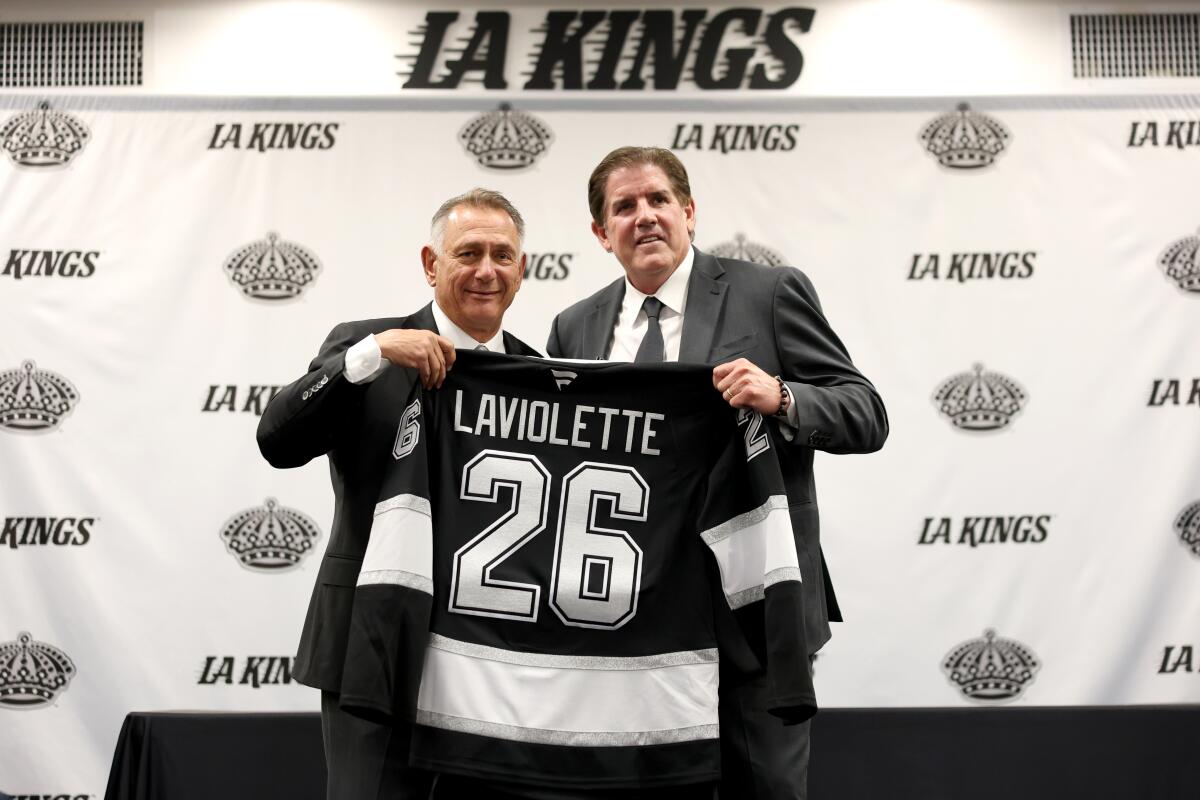
When Kings’ new head coach Peter Laviolette took a tour around the Los Angeles area, he thought he was only going to get a one-bedroom home with a view of the water. His children, though, piped in: “Make sure you get a four-bedroom,” Laviolette remembered his three children saying.
During Laviolette’s time away from the sport, the 61-year-old traveled to Scotland and watched his son play in the East Coast Hockey League. The time away has given Laviolette time to rethink his coaching, and after 30 years of coaching, including 23 as a head coach in the NHL, he’s bringing a trident approach to reshape culture and win games. Centering a hockey family is one part.
“For me, there’s three real important pieces,” Laviolette said. “First, build a family inside the locker room, inside the organization. Secondly, to really work to try and build the culture to get players and organizations to think about the choices they make and how that can affect the culture. And then the third part is the actual game on the ice, just making sure that every day from the start of training camp we work at the game.”
Los Angeles hired Laviolette to a three-year contract after he spent a year away from the sport. Laviolette’s coaching experience stretches 1,594 games, the ninth-highest career total, with six teams: the Capitals, Flyers, Islanders, Hurricanes and Predators. Most recently, he was fired by the Rangers in 2025 after two years with the team.
His postseason success might be the biggest draw for the Kings, who have seen middling success in the years since their second Stanley Cup title in 2014. Los Angeles made the playoffs each year since the 2021-22 season, but the team did not advance past the first round.
Meanwhile, Laviolette is only the fourth coach in hockey to lead three teams to the Stanley Cup Final. He last won with Carolina in 2006, but he earned two President’s Trophies in 2017-18 and 2023-24 with the Predators and the Rangers.
Kings general manager Ken Holland, left, and Peter Laviolette pose for a photo during the new coach’s introductory news conference Wednesday at the team’s training facility in El Segundo.
(Eric Thayer / Los Angeles Times)
Still, Laviolette, despite his track record of first-year turnarounds, is joining a team in flux. The Kings fired coach Jim Hiller after the Olympic break. Interim coach D.J Smith helped guide the team to an 11-6-6 finish, aided in part by a trade for Rangers winger Artemi Panarin, whom Laviolette has also coached.
“I had a really good relationship with Artemi in New York,” Laviolette said. “He’s one of the most talented players I’ve ever coached, and I’m really happy to get to work with him again. He’s an amazing talent.”
Using the winger to go on the prowl is one of the small changes Laviolette plans to bring. The Kings have historically prioritized defense in a league that has shifted to attacking. Los Angeles fell to 30th in goals per game last season (2.68), the first time the Kings averaged fewer than three goals since the 2021-22 season. The team was also 28th in power-play percentage at 17%. Laviolette acknowledged that Los Angeles needed to change, highlighting that an attack-forward mindset has been a keystone of his coaching.
“I don’t think it should be irresponsible to defense,” he said. “But through my experiences, and even just watching the playoffs right now, this is an attack-oriented game, and you have to be willing to move.”
Where does Panarin fit?
“He has the ability to be a game-breaker and a difference-maker,” Laviolette said. “He’s not just a goal scorer. He’s not just a playmaker. He’s elusive. He’s shifty.”
The goal for next season is to score 250 times, according to Kings’ vice president and general manager Ken Holland. The team scored 220 last season.
“We’ve got to get back to scoring more goals,” Holland said. “Part of that’s going to be personnel driven, part of that’s going to be probably style‑of‑play driven, mentality, and certainly the head coach has a lot to do with it.”
As Laviolette meets current staffers and decides whom to bring in, Holland is managing the phones to reach out to assistant coaches and players. Smith has definitively moved on. Phil Housley, whom Laviolette described as an “excellent coach,” could be another potential candidate. Housley worked with Laviolette as one of the Rangers’ assistant coaches between 2023 and 2025.
Still, it’s hard to say the Kings will be a Cup contender with Laviolette. His teams tend to dramatically decline two or three seasons after his hiring. He struggles to develop younger players, instead relying on veterans to carry the weight. Laviolette will have to amplify players like Quinton Byfield and Brandt Clarke, each a talented 23-year-old with high ceilings.
The Kings’ success will rest in how well Los Angeles adapts to Laviolette’s coaching trident. The veteran coach, to his credit, projected confidence.
“When you put those three things together,” he said. “You can really become an unstoppable force.”
The 2026 FIFA World Cup is set to start Thursday with Mexico facing South Africa in Mexico City and South Korea taking on Czechia in Guadalajara, Mexico.
The tournament then heads north on Friday, with Canada facing Bosnia-Herzegovina in Toronto before the United States opens Group D play against Paraguay at SoFi Stadium.
Here’s everything you need to know about the matches through the opening days of the 39-day, 48-team tournament across the U.S., Mexico and Canada.
Here’s a look at Thursday’s matchups (all times Pacific):
Mexico vs. South Africa
Mexico’s Raúl Jiménez, left, celebrates after scoring during an international friendly against Serbia on June 4.
The buzz: Although the World Cup will be shared by three countries for the first time, Mexico gets the honor of playing the opening game. No country has played host to more World Cups than Mexico, which also staged the tournament in 1970 and 1986. Both times the first game was played in the iconic Azteca Stadium, where the World Cup kicks off again. The first two times the World Cup was played in Mexico, the home team made the quarterfinals and El Tri, playing under coach Javier Aguirre, a midfielder on the 1986 team, seems poised for another long run. Mexico is unbeaten in eight games this year, including wins over World Cup qualifiers Panama, Ghana and Australia and draws with Belgium and Portugal. Mexico has given up just one goal in the past eight months. South Africa, which played Mexico to a draw in the opening game of the 2010 World Cup, is winless in 2026.
South Korea vs. Czechia
South Korea’s Son Heung-min controls the ball in front of El Salvador’s Brayan Landaverde during an international friendly match on June 3.
The buzz: South Korea is one of five countries to have played in the past 11 World Cups — and it’s the only one of the five never to have won the tournament. And the only two times South Korea played in a North American World Cup, in 1986 and 1994, it failed to win a game. Still, with an offense led by LAFC’s Son Heung-min, the MLS leader in assists, and a defense anchored by Bayern Munich center back Kim Min-jae (aka The Monster), the Taegeuk Warriors are a formidable foe. Czechia, playing in the World Cup for just the second time as an independent nation, has been unimpressive in its tournament warm-ups; its last win over a World Cup qualifier was a 2-1 win over Norway 27 months ago.
Here’s a look at Friday’s matchups:
Canada vs. Bosnia-Herzegovina
Bosnia’s Edin Dzeko heads the ball during a World Cup qualifying match against Italy on March 31.
The buzz: Alphonso Davies has been ruled out of Canada’s World Cup opener in the hope that he will be available for the rest of the tournament. And his absence will be felt since Davies, sidelined since May 6 with a hamstring injury, is not only the team’s best player but also its captain. The injuries are piling up for Canada, which lost center back Moïse Bombito and forward Marcelo Flores to injuries after the World Cup roster had been determined. Under American coach Jesse Marsch, the team entered the top 30 in the FIFA world rankings for the first time, losing just five times in 29 matches, but still looking for its first victory in a World Cup match.
Bosnia, playing in the World Cup for the second time since gaining independence, is led by 40-year-old Edin Dzeko, the country’s all-time leader in caps and goals. It qualified for the World Cup by drawing Wales, then Italy, and beating both on penalty kicks in a pair of UEFA playoffs in March.
United States vs. Paraguay
U.S. forward Christian Pulisic controls the ball in front of Senegal’s Krepin Diatta during an international friendly on May 31.
(Jamie Squire / Getty Images)
Where: SoFi Stadium | Inglewood Time: 6 p.m. TV | Streaming: Fox, Telemundo | Fox One, Peacock
The buzz: With a goal and an assist in the Americans’ penultimate warm-up with Senegal, Christian Pulisic broke out of a career-long scoring drought and proved himself ready for the World Cup. But he’ll need help from his supporting cast if the U.S. is to get out of group play and this game could be key to that goal. Paraguay’s schedule over the past year featured several games with World Cup qualifiers, including wins over Mexico and Uruguay, draws with Japan and Ecuador and one-score losses to Brazil, Morocco and the U.S. Its leading scorer is midfielder Miguel Almirón, who plays in MLS with Atlanta United.
Here’s a look at Saturday’s matchups:
Qatar vs. Switzerland
Qatar’s Akram Afif plays during an international friendly against El Salvador on June 6.
(Luiza Moraes / Getty Images)
Where: Levi’s Stadium, Santa Clara Time: noon TV | Streaming: Fox, Telemundo | Fox One, Peacock
The buzz: Qatar made its World Cup debut four years ago and became the first host to exit the tournament without a point, losing all three group-play games by two goals each. The team has improved dramatically since then, beating Mexico to reach the quarterfinals of the 2023 CONCACAF Gold Cup. But its World Cup preparations were disrupted by war in the Middle East, which forced the cancellation of scheduled friendlies with Serbia and Argentina. As a result, the team has played just twice in the last seven months and hasn’t scored a goal since last December.
Switzerland, meanwhile, is ranked in the top 20 in the world by FIFA, has lost just twice — to No. 2 Spain and No. 10 Germany — in its past 17 tries and made the quarterfinals of the past two Euros.
Brazil vs. Morocco
Brazil’s Casemiro, right, celebrates with teammate Vinicius Junior after scoring against Panama during an international friendly match on May 31.
(Bruna Prado / Associated Press)
Where: MetLife Stadium, East Rutherford, N.J. Time: 3 p.m. TV | Streaming: FS1, Telemundo | Fox One, Peacock
The buzz: Group C gets off to a compelling start with sixth-ranked Brazil, the tournament’s only five-time champion, facing No. 7 Morocco, the surprise team of 2022. And both come in hot: Morocco has lost just one of its past 45 games, dating to January 2024, while Brazil has beaten World Cup qualifiers Egypt, Panama, Croatia, Senegal, South Korea, Paraguay, Colombia, Ecuador and Mexico over the past 24 months.
Barring a major stumble, both will make it out of group play but this game will likely determine which will go through as a group champion, giving it a much easier path through the knockout rounds.
Haiti vs. Scotland
Haiti’s Frantzdy Pierrot controls the ball in front of Tunisia’s Mohamed Amine Ben Hamida during an international friendly on March 28.
(Vaughn Ridley / Getty Images)
Where: Gillette Stadium, Foxborough, Mass. Time: 6 p.m. TV | Streaming: FS1, Telemundo | Fox One, Peacock
The buzz: Though lacking the sizzle of Brazil-Morocco, Group C’s other first-day matchup is no less important. With eight third-place teams advancing out of group play, a win here would give either Scotland or Haiti a solid shot at going through while a draw could doom both.
Haiti, participating in the World Cup for just the second time — and the first time since 1974 — hasn’t played at home in five years because of violence and instability in Haiti. But it thumped New Zealand 4-0 in one of its final World Cup tuneups and lost to three other World Cup qualifiers — the U.S., Saudi Arabia and Tunisia — by just a goal in the past year. All but three of the players on Haiti’s roster play for first- or second-division teams in Europe or the U.S.
Scotland had an easier time in qualifying and won its past two World Cup tuneups, beating Curacao and Bolivia by a combined score of 8-1. Its top player is Liverpool defender Andy Robertson but its oldest is goalkeeper Craig Gordon, at 43 the most senior player in the tournament.
Australia vs. Turkey
Australia goalkeeper Mathew Ryan warms up before an international friendly match against Mexico at the Rose Bowl on May 30.
(Luiza Moraes / Getty Images)
Where: BC Place, Vancouver, Canada Time: 9 p.m. TV | Streaming: FS1, Telemundo | Fox One, Peacock
The buzz: Turkey could be one of the surprise teams in the tournament after qualifying for the World Cup for the first time since 2002 with a pair of 1-0 wins over Romania and Kosovo. Turkey has risen five spots, to No. 22, in the FIFA world rankings in the past ninth months, its best showing in a decade. And in the last year it has beaten the U.S. and tied No. 2 Spain. Its best player is Inter Milan midfielder Hakan Calhanoglu, Turkey’s active leader in caps and goals.
Australia had its best-ever World Cup four years ago in Qatar, winning twice and advancing to the round of 16 for the first time since 2006. But it has struggled of late, losing four of its past six games to fellow World Cup qualifiers.
LAS VEGAS — Jordan Staal scored his second goal of the game while stretched out on his stomach at 6:32 of the third period to put the Carolina Hurricanes ahead for good in their 5-3 victory on Tuesday night over the Vegas Golden Knights and even the Stanley Cup Final after four games.
Game 5 is Thursday night at Carolina, which will potentially have two games on home ice to win its first Cup in two decades. The Golden Knights are searching for their second in four years.
This was the first game not decided by one goal.
A two-goal lead has disappeared in all four games in what has been a remarkable series in which momentum often changes at a moment’s notice. Each team has led by at least that many twice.
Staal became the first player in 44 years to score at least one goal in each of the first four games of the final and the ninth overall. Mike Bossy in 1982 with the New York Islanders against the Vancouver Canucks was the last player to score in the first four games of a final.
Nikolaj Ehlers added an empty-net goal and two assists for the Hurricanes, Jackson Blake had a goal and an assist, and Logan Stankoven scored a goal.
Brandon Bussi started in place of Frederik Andersen in goal and made 18 saves. Hurricanes coach Rod Brind’Amour told ABC that Andersen, who did not dress, needed the rest. Pyotr Kochetkov was the backup goalie with Andersen serving as the emergency goaltender.
“Let [Andersen] rest,” Brind’Amour said. “Give him as many days here as we can.”
Mark Stone, William Karlsson and Brett Howden scored goals for the Golden Knights, and Carter Hart made 23 saves. Karlsson also had an assist.
The Hurricanes outplayed the Golden Knights in the period, outshooting Vegas 14-6. But the Golden Knights, according to Natural Stat Trick, had four high-danger chances to three for Carolina.
The difference was the Hurricanes took advantage of their chances.
Brind’Amour replaced Andersen with Bussi trailing 4-0 after two periods in Game 2 on Saturday, and he saved the first 18 shots he faced as the Hurricanes mounted a furious rally. Bussi failed to save the 19th shot when Shea Theodore knocked the puck off the boards and it bounced off Bussi’s skate for a Golden Knights victory.