
gloves

California restricts hiring of former ICE agents, bans shock gloves

In a show of defiance to the Trump administration’s crackdown on immigrants, California lawmakers on Monday voted to ban federal immigration agents from being hired for many local and state government jobs and to outlaw electric-shock gloves similar to those that may be distributed to federal officers.

The two bills were among a slate of legislation approved by the Democratic-led state Legislature to thwart certain tactics and tools used by Immigration and Customs Enforcement agents, such as arresting people who appear at courthouses for scheduled immigration hearings.

“We have the fourth largest economy in the world because of our immigrant and undocumented community, and they’re being penalized and targeted by the Trump administration,” said Assemblymember Mark Gonzalez (D-Los Angeles). “This package of immigrant bills that we’ve sent [to the governor] is trying to say that we are here to defend you.”

Gonzalez is the author of a bill to prohibit agents and contractors involved in immigration enforcement from being employed in the future by the state, cities, counties, school districts and other public entities. It was supported by Assembly Speaker Robert Rivas (D-Hollister) and called the “Get the Feds Out” Act, or “GTFO.”

It would allow an exception for officers who are accepted to a police agency and take the state’s basic police training course, but notes that “suitability shall be determined on a case-by-case basis.”

State Sen. Lena Gonzalez (D-Long Beach), chair of the Latino Legislative Caucus, said the state “expects its public employees to be moral” and to defend the state and U.S. constitutions.

“Anyone who is participating in the raids have shown that they do not live up to the bar that Californians deserve from their public servants. This bill says that individuals who participated in immigration enforcement activities will be disqualified from holding state, county or local public employment in California” except in certain circumstances, she said.

A separate bill by Assemblymember Isaac G. Bryan (D-Los Angeles) would block police and other law enforcement officers from taking second jobs or working as contractors on federal immigration enforcement.

“If you sign up to protect and serve our communities during the day with a local law enforcement agency, you cannot moonlight with ICE,” Bryan said.

During a June hearing, state Sen. Kelly Seyarto (R-Murrieta) said the bill was “based on anger at an issue” that “a lot of people disagree on,” which Republican lawmakers commonly cited when debating the immigration-related bills.

“It opens up this can of worms of interpretations that are sometimes not based on reality,” he said.

State and federal law enforcement officers will be banned from using electric-shock gloves until 2030, and the state Department of Justice will be required to study their safety, under a bill passed Monday night. The last-minute legislation was introduced last week after a report that the U.S. Department of Homeland Security planned to purchase the gloves for use in immigration enforcement.

The bill “draws a clear line,” said state Sen. Jesse Arreguín (D-Berkeley): “Public safety technology must be proven safe and accountable before it’s deployed, not after someone is killed or seriously injured.”

Republicans opposed the bill, arguing the gloves could be a safer way to subdue suspects than firearms.

“If electric shock is a better alternative than actually shooting someone, I don’t think we should take it off the table,” said state Sen. Tony Strickland (R-Huntington Beach). “Law enforcement deserves the tools they need to keep us safe.”

Lawmakers on Friday approved legislation to ban federal immigration agents and other law enforcement officers from wearing masks in the state. The measure, Senate Bill 1004, was introduced by Sen. Scott Wiener (D-San Francisco) to fix an earlier law that was struck down as unconstitutional by a federal judge.

Other bills would prohibit arrests of people traveling to or from court, as federal agents have arrested people who show up for immigration hearings; impose a 25% tax on income earned by companies operating immigration detention centers; and allow individuals to file lawsuits against federal agents over alleged civil rights violations such as excessive force, unlawful home searches and interfering with the right to protest.

Critics argued that some bills might not stand up to legal challenges.

“This seems to fit the general pattern that California will bend over backwards to protect people who are in the country illegally, even if it means putting the public at risk,” said Ira Mehlman with the Federation for American Immigration Reform, a group that advocates for strict immigration limits.

Gov. Gavin Newsom has until Sept. 30 to sign or veto bills approved by the Legislature.
Source link

ICE awards $16.7 million no-bid contract for shock gloves

Immigration and Customs Enforcement officers stand by as they check the documentation of a construction worker during a random stop in Minneapolis on Jan. 9 ICE has awarded a $16.7 million no-bid contract to Compliant Technologies for 6,000 shock gloves to be used to detain people by force. File Photo by Craig Lassig/UPI | License Photo

Aug. 28 (UPI) — U.S. Immigration and Customs Enforcement has awarded a $16.7 million no-bid contract to Compliant Technologies for 6,000 shock gloves to be used to detain people by force.

The agency is ordering the product Generated Low Output Voltage Emitter, or GLOVE, a glove that delivers an electrical current when contacting a person’s skin. The gloves cost $2,495 each, the contract published on a federal database on Thursday reads.

ICE said it “requires a non-lethal, de-escalation device” to “diffuse situations or high-stress environments where physical altercations are likely.”

Along with the gloves, the contract also grants ICE support and equipment services from Compliant Technologies.

“This technology is vital to meeting mission demands, ensuring officer safety, and achieving the President’s public safety and immigration enforcement priorities,” the contract reads.

Compliant Technologies is a Kentucky-based company. Its instruction manual says that users should “always give the subject(s) a reasonable opportunity to comply before force is used.”

A group largely consisting of Democratic senators is opposing the use of the gloves, penning a letter to ICE’s acting Director David Venturella on Thursday.

“Over the past year, ICE personnel have been involved in numerous well-documented incidents of excessive force and civil rights violations,” the letter reads. “These incidents have shown the American people that ICE personnel are not adequately trained or accountable for their interactions with civilians.”

The incidents of excessive force referred to in the letter include the killings of U.S. citizens, including Renee Good and Alex Pretti within weeks of each other in the Minneapolis metropolitan area earlier this year.

“The American people have made it clear that ICE must de-escalate its immigration enforcement operations,” the letter reads.

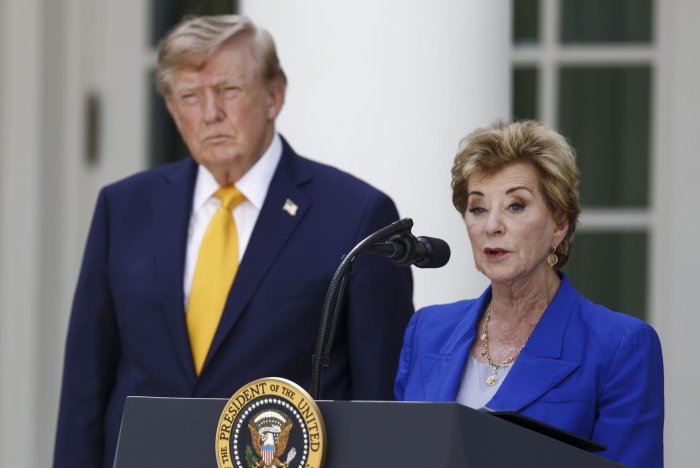
President Donald Trump looks on as Secretary of Education Linda McMahon speaks during a back-to school event in the Rose Garden of the White House on Monday. The event focused on education and the Trump administration’s education policies. Photo by Will Oliver/UPI | License Photo

Source link

California lawmakers push bill to ban shock gloves for federal agents

After an outcry from immigrant and civil rights advocates over plans to equip immigration officers with gloves capable of delivering electric shocks, California lawmakers on Thursday unveiled a bill that would ban the use of shock gloves by any law enforcement agent in the state.

The gloves deliver can an electrical shock strong enough to drop a strong man to his knees in an instant, and proponents say the gloves provide a fast and non-lethal way to subdue a person.

Two weeks ago, the Associated Press reported that the Department of Homeland security planned to use $10 million to $20 million to procure the gloves from Compliant Technologies of Lexington, Ky., for Immigration and Customs Enforcement agents. The department defended its decision, saying it was “made with careful consideration” and that other law enforcement agencies in the country already use the technology.

Civil rights organizations including the American Civil Liberties Union accused the department of attempting to intimidate the public by arming agents with another use-of-force option. They noted that ICE already is contending with criticism for multiple deaths in custody and during arrests.

Assembly Bill 2760, authored by state Assemblymember LaShea Sharp-Collins (D-San Diego), would prohibit local, state and federal agencies from possessing, using or procuring electric taser gloves in the state or with state funds.

“We cannot spend state money or tax dollars on technology that is not to better our state,” Sharp-Collins said during a news conference with other lawmakers in Sacramento. “It cannot be used on our children, it cannot be used on our teachers, our business owners, it cannot be used on anyone.”

The CTG-5 G.L.O.V.E — standing for Generated Low Output Voltage Emitter — resembles a thick work glove and can be activated to emit a 380-volt shock upon contact with a body. Compliant Technologies has maintained that the gloves are weaker than traditional tasers, but critics say they can be life-threatening in the hands of ICE.

“Many people try to say weapons like this are about de-escalation, but I don’t know how many people have put hands on someone and said that’s de-escalation,” state Assemblymember Alex Lee (D-Alameda) said. “There’s already a spectrum of non-lethal, less-than-violent weapons out there that exists… ICE and law enforcement don’t need another tool.”

The gloves have been adopted in detention centers, law enforcement agencies and jails across the country, though apparently none in California. Last week, AP reported that Omaha police agreed to stop using the shock gloves after parents realized they’d been adopted by departments that monitored schools.

Sharp-Collins said she prepared the legislation in consultation with the state attorney general’s office and legislative council to ensure it would withstand a challenge from the Trump administration if it became law.

The Senate voted 30-9 on Monday to approve a rule change that would allow for the bill to pass quickly before the end of the legislative session on Aug. 31.

Source link