In the gloaming, the trees stand dark and impenetrable on either side of the path. An owl, wide-faced and pale as a spectre, glides out of the pines ahead of me. Heart pounding, I pick up speed and continue uphill, the silence thick around me.
Just a few minutes earlier, I had been scuffing my feet in the sand by the loch shore, watching as the clouds draped themselves across the top of the Grampians. In the absence of other people, Loch Laidon, silvery in the half-light, had been mine to enjoy; in the woods, however, my solitude feels unnerving.
It is not long before I break out of the trees, following rough boards over boggy moorland to reach the top of the nearest hill. Below, past the green viaduct that carries the West Highland Line, stretches the eastern edge of Rannoch Moor, with layer upon layer of Perthshire’s hills beyond that. Out in the open, my fears dissipate – there is no one here, except for me and the fieldfares that fly squeakily away at my approach.
I have come to Rannoch station to spend two nights alone in a place that is, by most people’s standards, remote. A dead-end sign at the western end of Loch Rannoch had marked the last part of my drive here, with the words “No road beyond Rannoch station” below. The station and the very small community around it lie five slow miles further on, with the road running first through the flat strath (valley) of the River Gaur, and then up and over the moors as mountains dip in and out of view.
The small but perfectly formed Star Hut. Photograph: Emma Gibbs
My accommodation, the Star Hut, sits on a small slope just a few hundred yards from the station, its face turned towards Rannoch Moor. It is a small and perfectly formed wooden structure, housing a double bed, two chairs, a fold-up table, microwave and fridge, plus essentials such as OS maps, binoculars, compass, torch and a decanter of Scotch. There is, however, no shower, and the toilet facilities are the ones on the station platform – using the bathroom before bed means walking past a skittish herd of hinds, whose wide eyes glitter in my torch light. It’s no real struggle, though, particularly when I’m woken the next day by a streak of yolk-yellow sun and a view across the empty moor.
There are two main reasons visitors come out to the end of the road here: for the walking and the station tearoom. As the first customer of the day, I have my pick of the tables and choose a window seat, from which I can look out over the tracks and Loch Laidon beyond. Despite it being the tail end of the season, within half an hour the small space is packed with people grabbing breakfast before the next train. When I go to pay, I ask for a slice of the pink cake on the counter and the owner, Sylvia, lowers her voice to tell me about the other cakes out back. “If I put them out now, they’ll all disappear,” she says, conspiratorially.
Corrour, the highest and most remote railway station in the UK. Photograph: Sarah Grigor/Alamy
With a huge, somewhat clandestine, slice of carrot cake tucked into my rucksack, I take the 11.09 train one stop north to Corrour, a spectacular 12-minute journey through the moor. The highest railway station in the UK, Corrour is also the most remote, accessible only by train, bike or on foot – a fact that feels rather at odds with just how busy it is on the platform and in the adjoining restaurant.
It is 11 miles from here back to Rannoch station, on a clear path that cuts across Rannoch Moor. I pass a couple walking their dog at a leisurely pace, and two cyclists going in the opposite direction, but as I climb up above Loch Ossian the track is blissfully empty.
It is a glorious Highland morning, the sun warm on my face and the shadows of the cotton-wool clouds dancing across the slopes of the surrounding hills. Walking alone makes my focus keener: the browns and greens of the moor seem more intense; the cry of a buzzard as it circles overhead more eerie; the crunch of the gravel beneath my feet and the whistle of the wind in the grass louder. It’s just me and the landscape, and the subconscious act of putting one foot in front of another. In my normal, at-home life, my head is always full of the countless things I need to do and remember; out here, that running commentary is silenced. As I climb further up, I turn around and take in the view: Loch Ossian like a sheet of metal below, and in the distance a staggering lineup of mountains that includes Ben Nevis. My “wow” gets swallowed up by the wind.
It is around the four-mile mark that I start flagging, all too aware that I still have almost double those miles ahead of me. The hills opposite, flanking Blackwater Reservoir, are shrouded in a mist that makes a hasty approach towards me, and the rain arrives when I am partway through putting on my waterproofs. And then it passes, so quickly it’s almost as if I’ve imagined it, taking my low mood with it. When I reach a ford that is too deep to cross without soaking my boots, I whip them and my socks off to wade through the ice-cold water with the glee of a three-year-old.
Rannoch’s moorland wilderness. Photograph: Adam Burton/Alamy
In the five hours the route takes, I only meet three people: a French couple who are picnicking so quietly by the side of the path that I am taken by complete surprise, and a hiker from Northumberland walking the route in reverse. “I just can’t get enough of the Highlands,” he says, and I agree enthusiastically as we stare out at the undulating moor, littered with jewel-like pools that shine under the constantly changing sky.
When I arrive back at Rannoch station, its little cluster of buildings feels like the height of civilisation after the moor. I bump into Bill, the Star Hut’s owner, who tells me that he and his wife, Jenny, are two of only four permanent residents here. “But our community stretches to Kinloch Rannoch [16 miles east] and beyond,” he says. “Everyone knows everyone.” I think of my own cul-de-sac back home, where I know the names of only about half a dozen people, and think perhaps my perception of remote is entirely wrong.
Back at the hut, I sit on the steps and finally dig into my carrot cake, looking out at the landscape I have just crossed. Last night, so much of it had seemed forbidding and unknown; today, it feels anything but. Being alone out here feels like the ultimate luxury.
The Star Hut can be booked through Airbnb (two nights from £170). Rannoch Station Tea Room is open from late March to late October (Saturday to Wednesday); a 24/7 honesty box is open on the station platform all year, for hot and cold drinks and snacks, as well as the bathroom and shelter. ScotRail services run to Rannoch from Glasgow Queen Street, and the station is also on the Caledonian Sleeper route between London Euston and Fort William
There really is something about Mary. I’m talking, of course, about Mary Todd Lincoln of Cole Escola’s runaway camp hit, “Oh, Mary!,” which opened Thursday at the Ahmanson Theatre.
Escola, who won a Tony Award for playing Mary, has created a role that has become a holy grail for the most fearless and demented of naughty clowns. Bowen Yang is starring in the play on Broadway, and Betty Gilpin, Maya Rudolph and Tituss Burgess are among the luminaries who have staggered to great acclaim in the character’s high heels.
In the show’s Los Angeles premiere, singer, actor, drag star and winner of “RuPaul’s Drag Race All Stars 2” Alaska Thunderf— commandeers this camp ship with the authority of a pirate armed with an AK-47. She’s undeterrable — and exactly what the production needs to live up to its frenzied hype in a venue as large as the Ahmanson.
But just who is this Mary Todd Lincoln sprung from Escola’s feverish imagination? Well, she’s a frustrated first lady and a desperate lush, married to a man who is busy fighting two Civil Wars, one against the South and the other against his homosexual urges. (And like the South, those urges keep threatening to rise again.)
By her account she’s “a rather well-known niche cabaret legend,” whose career was “cut short by a love affair gone horribly right.” Mary’s Husband (delectably played by John-Andrew Morrison) has another take on Mary’s aborted stint in showbiz. But his main concern is making sure that she doesn’t get her hands on any more booze and embarrass him when his political fate is hanging by a thread.
The South wants him out and the North isn’t much happier. The stress is maddening, and his young male assistant (Michael Lepore) is so eager to please that the president can barely control himself.
A chaperone (Pooya Mohseni) has been engaged to keep Mary in line, but an exorcist would be more in order. This goody two-shoes, with an erotic fetish for ice cream that she mistakenly shares, is defenseless against Mary’s unbridled assault.
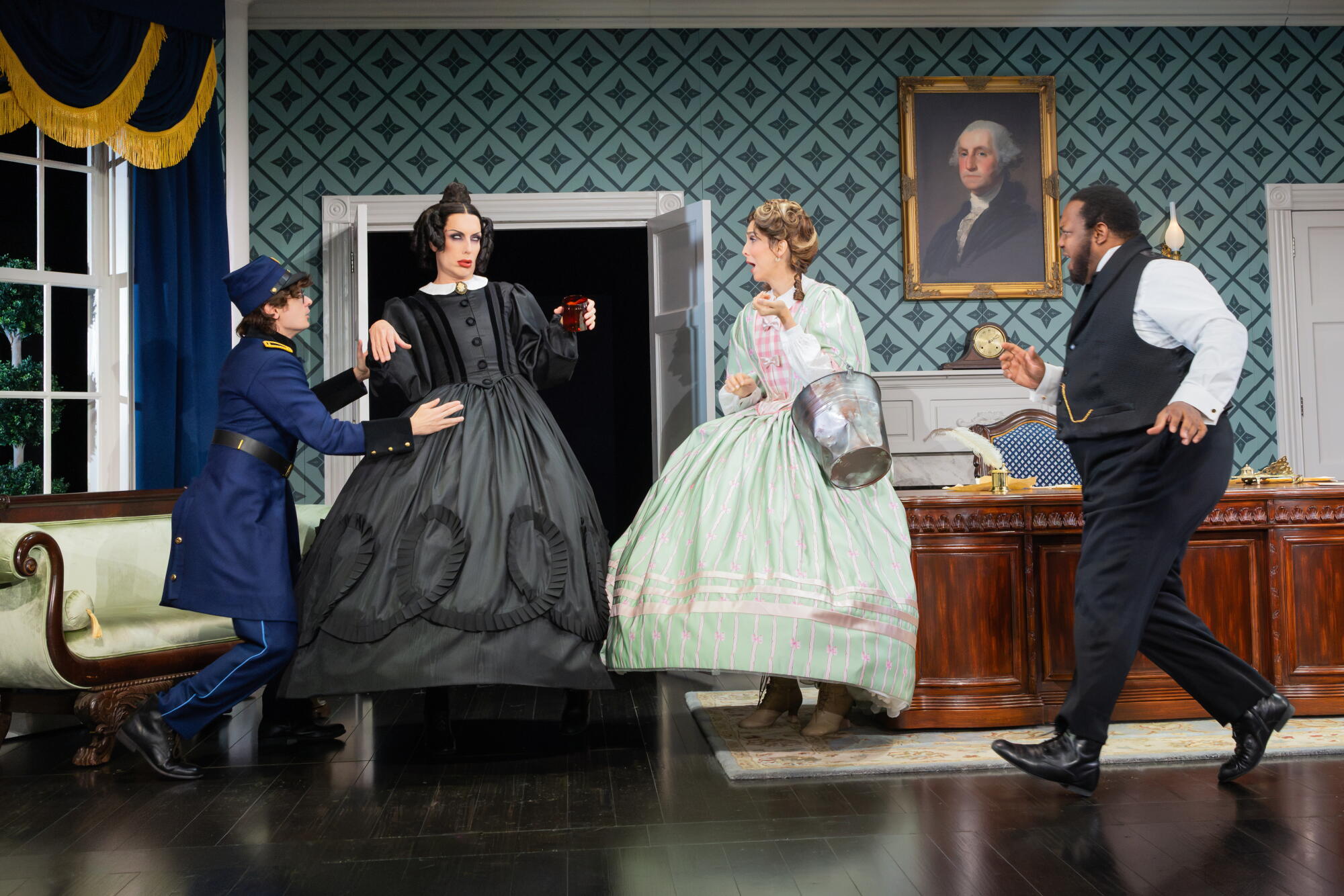
Standing tall in a mourning hoop gown and Shirley Temple curls, Alaska’s Mary is like a cross between “The Bad Seed” and “Mommie Dearest.” Joan Crawford herself would back down in a standoff.
Her savagery knows no check. Bored, she amuses herself by throwing her chaperone down a flight of stairs, setting fire to her house and spilling the poor woman’s dirty secret, which she has pried out of her as though it were another bottle of booze locked in her husband’s desk drawer.
An acting teacher (Wesley Taylor) has been brought in to keep Mary from basically destroying the White House. But her talent for reciting Shakespeare is even less obvious than her self-proclaimed gift for cabaret medleys.
“Oh, Mary!” has its L.A. premiere at the Ahamanson Theatre.
(Evan Zimmerman for MurphyMade)
What a polymorphously perverse web Escola weaves! Everywhere you look, there are furtive sexual shenanigans afoot. Does Mary want to run off with her acting teacher? Does her chaperone have designs on Mary’s Husband? Does Mary‘s Husband really want to kill off his gay compulsions?
The production, directed by Tony winner Sam Pinkleton, treats the play like a Victorian toy melodrama. Blackouts and clanging piano music italicize the sardonic tension.
The scenic design by dots and the costumes by Holly Pierson create a dollhouse world of inverted morality. Pinkleton ensures that the arch aesthetic of the mise en scène is rigorously observed in the playing.
The cast is terrific across the board, with Alaska and Morrison valiantly leading the madcap charge. Morrison’s lusty humor brings the Oval Office temptations of his character fiendishly to life. His aide’s obedient presence is like a casserole that has been especially prepared to derail Mary’s Husband from his abstemious diet.
Alaska struggles to make one bit of physical comedy work. (She may be too tall for the seduction scene with her teacher in which she has to somehow gracefully slide off her husband’s desk.) But I loved the malicious spin she inflects on her lines, the voice of a cat fiddling with its prey before sinking in its murderous claws.
I can’t pretend that “Oh, Mary!” is my idea of comic heaven. I grew up watching brilliant drag acts during my days in the New York clubs in the 1980s and early ’90s, and my theatrical sensibility was shaped by the peerless camp parodies of the Ridiculous Theatrical Company.
In becoming more mainstream, drag has lost some of its dangerousness. “Oh, Mary!” owes as much to “The Carol Burnett Show” as it does to a queer tradition of underground performance. Had Alaska stormed out wearing curtains with the rod still attached, à la Burnett in the famous “Gone With the Wind” send-up, I would not have been at all surprised, even though I’ve seen the play twice before, both times with Escola.
But “Oh, Mary!” is a welcome diversion — a revisionist lark with an irreverent LGBTQ+ spirit. The success of the production hinges in large part on its impressive tonal execution. Pinkleton’s production hits every mark of Escola’s alt-comedy.
Audiences are clearly eager to buy what “Oh, Mary!” is selling — athletically performed cheeky fun. Maybe the third time for me was the charm. Instead of longing for more depth, I let the mildly subversive high jinks carry me away on a much-needed holiday from reality.
‘Oh, Mary!’
Where: Ahmanson Theatre, 135 N. Grand Ave., Los Angeles
When: Ends Dec. 6. Check website for days and times.
The idyllic town features traditional Scandinavian architecture and breathtaking scenery
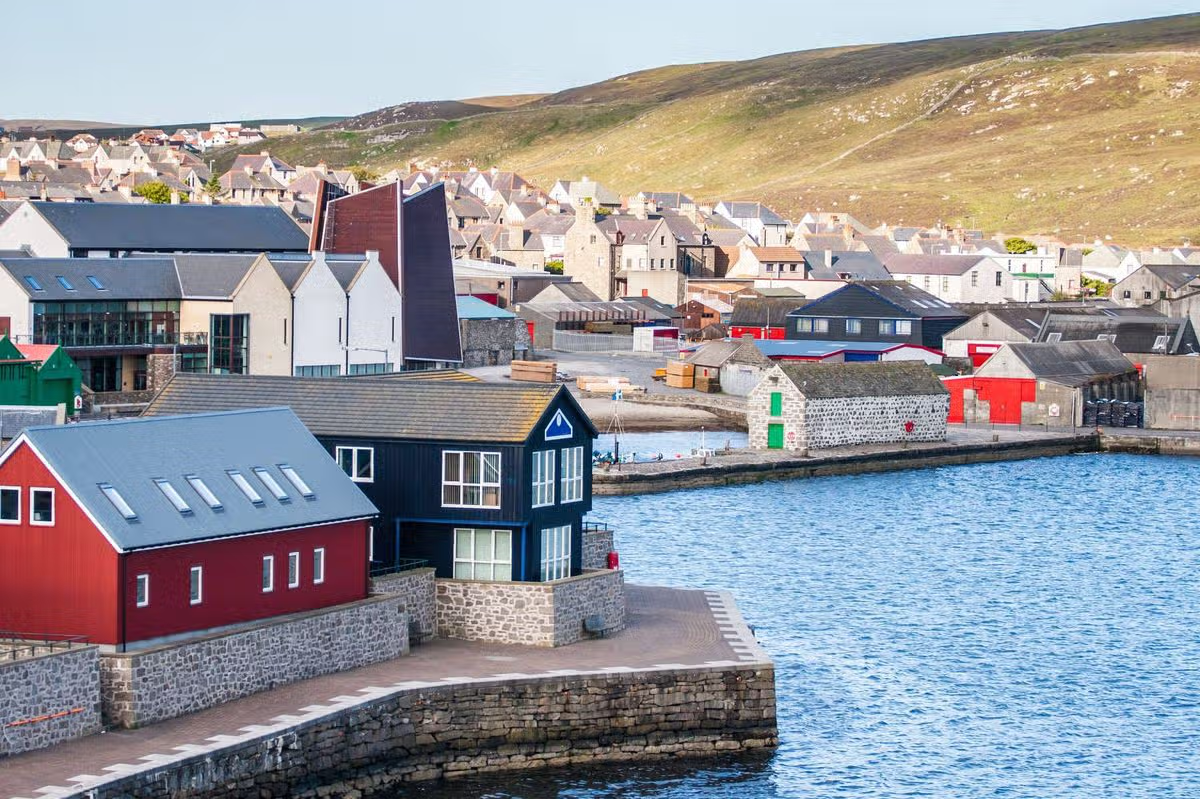
The village looks similar to coastal Norwegian towns, featuring the Scandinavian architecture.(Image: Getty)
Lerwick, located on the Shetland Islands in Scotland, is frequently dubbed “Little Norway” thanks to its historical connections with the Scandinavian nation. The town remained under the Kingdom of Norway until 1469, with the name “Lerwick” translating to “bay of clay” in Norwegian.
During World War 2, Lerwick functioned as a crucial base for the “Shetland bus – Little Norway” operation, with small Norwegian fishing vessels docking in the town to carry out secret missions and evacuate refugees fleeing Nazi-occupied Norway. Lerwick resembles Norwegian coastal towns, showcasing traditional Scandinavian architecture and red timber-framed houses.
Lerwick is a charming, scenic town and an ideal winter destination for those seeking authentic Norwegian landscapes without venturing abroad.
On Facebook, some visitors said that “the landscape looks much more like Norway than Scotland”.
Another visitor said on Tripadvisor that Lerwick has “numerous fascinating buildings including old warehouses which go right down to the edge of the water”.
Another one commented that Shetland is “a fantastic set of islands with wonderful scenery”. And a third one added: “Shetland is wonderful. It’s all about scenery. Along with Orkney, it has a completely different feel to the rest of Scotland with its Norse heritage. (They both belonged to Norway until 1472.) The Shetland Museum in Lerwick is excellent.”
According to Shetland’s official website, there’s plenty to do in the town, and it’s ideal to discover on foot.
“Lerwick is a stunning town full of history and beautiful buildings, all telling a story. Some of the most interesting buildings are the Lodberries overlooking Lerwick Harbour.
“Lerwick offers many opportunities for beautiful walks, exploring fascinating historical attractions and enjoying fun family activities.”
Make sure our latest DWP headlines always show at the top of your Google Search by making us a Preferred Source. Click here to activate or add us as Preferred Source in your Google search settings.