Over the course of Sunday, a dozen B-1B bombers took off from Royal Air Force (RAF) Fairford in western England and flew home to the United States. Their departure abruptly ended the base’s role as a launchpad for US strikes on Iran, which began on February 28.
The base, roughly 160km (100 miles) west of London, is the US Air Force’s only European airfield for heavy bombers and a key forward operating location for deployed bombers.
Over the past two weeks, six people were arrested on suspicion of “terrorism”. They were all released on bail.
US President Donald Trump said on Monday the bombers were moved because “there were some threats”, which he believed were linked to Iran. “So we moved them around a little bit, not very far,” he told reporters at the White House.
Hours earlier, US Secretary of State Marco Rubio played down any link to the alleged plot, saying it was “not unusual to see rotations happen” and that he had confidence in the security of US bases.
What happened at RAF Fairford?
On September 27, police arrested five men on suspicion of plotting to plant explosives near Fairford in the United Kingdom. They were released on bail a day later.
Investigators found petrol but no explosive devices in their vans, though UK officials say the men remain under investigation. On Thursday, police arrested a 25-year-old UK-Iranian dual national in London on suspicion of plotting an attack on the airbase. He was also released on bail on October 3.
UK Prime Minister Andy Burnham suggested that “Iran played a part” in the alleged plot but declined to give details. Iran has denied any such scheme and summoned the UK ambassador in Tehran in protest at the arrests.
What bombers does the US have?
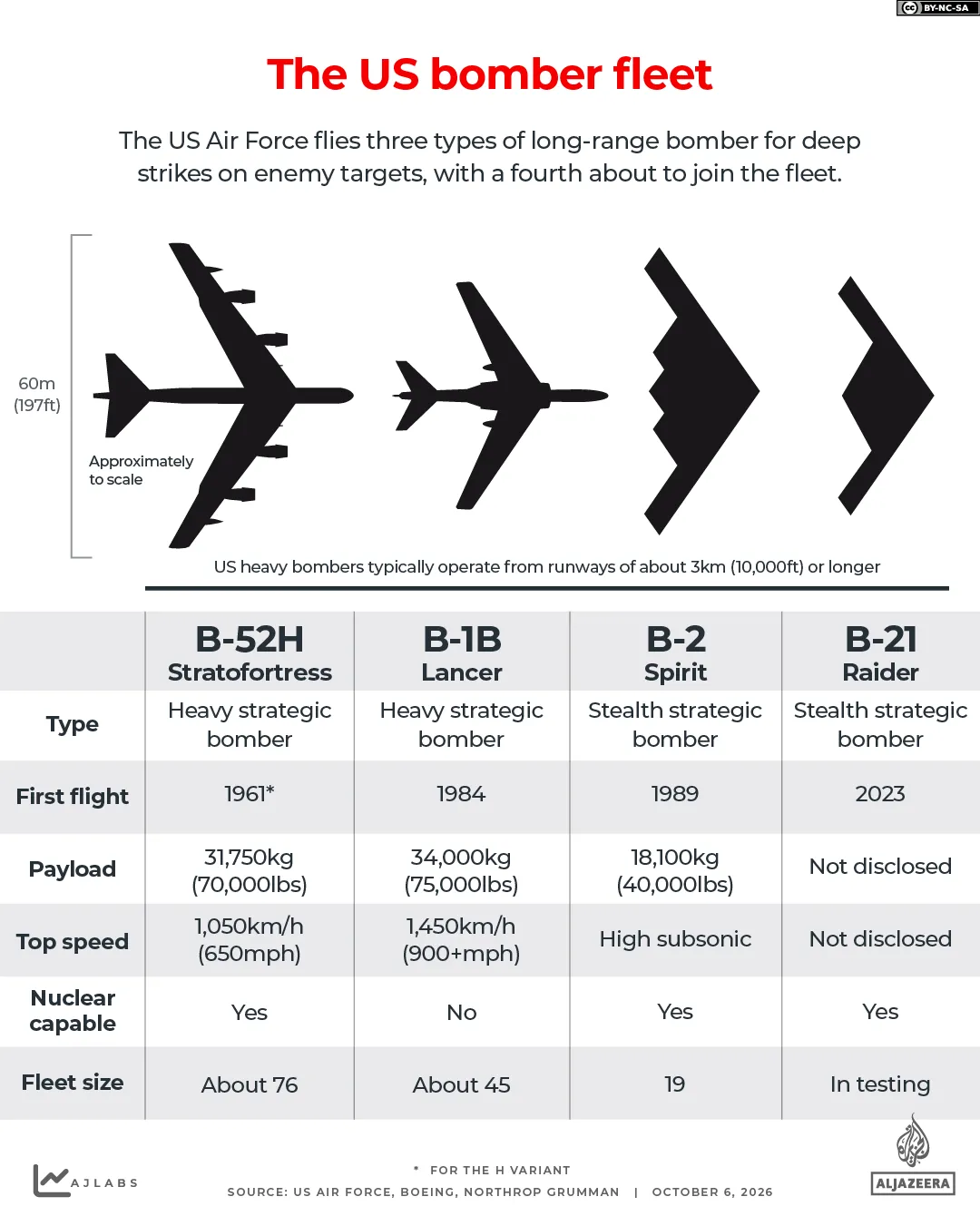
The US Air Force flies three types of bombers, with a fourth on the way.
The B-52 Stratofortress is the oldest. The B-52H model currently in service was built in the early 1960s. With a wingspan of 56 metres (185 feet), it is the largest US bomber and can carry about 31 tonnes of weapons, including nuclear bombs and cruise missiles.
A B-52 Stratofortress takes off from RAF Fairford on March 19, 2026 [Leon Neal/Getty Images]
The B-1B Lancer, which entered service in the mid-1980s, is the fastest of the three. It can reach 1.2 times the speed of sound and has a swing-wing that sweeps back for high-speed flight. It carries the largest conventional payload, about 34 tonnes, but no longer carries nuclear weapons. These were the aircraft that left Fairford.
The B-2 Spirit is a flying-wing stealth bomber designed to slip past air defences. Only 20 were built, of which 19 remain in service. It can carry both nuclear and conventional weapons, including the 13,600kg (30,000lb) “bunker buster” bomb used in US strikes on Iran’s nuclear sites in June 2025.
The B-21 Raider, a smaller stealth bomber, is still in flight testing, and it remains on track for delivery in 2027. Over the next decade and a half, the air force plans to replace the B-1B and B-2, leaving a future fleet of B-21s and upgraded B-52s.
The B-21 Raider, a new high-tech stealth bomber developed for the US Air Force, is seen in an undated photograph in Palmdale, California, US, released on December 2, 2022 [Handout/US Air Force via Reuters]
Where do these bombers fly from?
All US bombers are permanently based in the US, at five main airbases:
B-52H: Barksdale Air Force Base in Louisiana and Minot Air Force Base in North Dakota
B-1B: Dyess Air Force Base in Texas and Ellsworth Air Force Base in South Dakota
B-2: Whiteman Air Force Base in Missouri
B-21: Due to arrive at Ellsworth in South Dakota in 2027
All of these bases have long, wide runways, typically exceeding 10,000 feet (3,048 metres).
That makes bomber runways about as long as those at a big international airport. What limits where bombers can operate is not tarmac but security, weapons storage and support.
For missions abroad, the US rotates bombers through a handful of forward bases. Other important overseas operating locations include Andersen Air Force Base in Guam and Diego Garcia in the Indian Ocean.
Beyond these, the air force sends small groups of bombers to allied airbases for a few weeks at a time, in what it calls Bomber Task Force deployments. Recent rotations have included B-52s at Moron in Spain, B-1Bs at Orland in Norway and Misawa in Japan, and B-52s at Tindal in northern Australia, which arrived in September.
The bombers can also go on a strike mission from the US with the help of aerial refuelling. Bomber missions during the US-Israel war on Iran lasted more than 30 hours there and back. Each group of three bombers needed six to nine tanker aircraft to refuel them along the way.
This image released by the US Navy shows an aerial view of Diego Garcia [File: US Navy via AP]
Ant International’s Agentic Mobile Protocol is rolling out across the global mobile payment ecosystemBusiness Wire
Article content
With payment leaders accelerating adoption, the Alipay+ ecosystem — with 50+ mobile payment partners, over 10 national QR schemes and serving over 2 billion consumer accounts — is evolving into the world’s largest agentic payment network for mobile commerce.
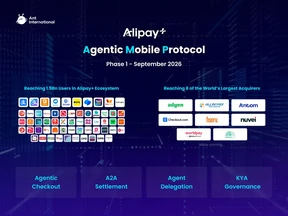
During Phase I in 2026, AMP partners up with 10 leading Alipay+ digital wallets that together serve 1.5 billion user accounts, as well as 7 leading acquiring partners including Adyen, Allinpay, Checkout.com, Fiserv, Global Payments, Nuvei, and Worldline.
Ant International, Mastercard, and Visa have begun collaboration on a Know-Your-Agent (KYA) interoperability framework, designed to help card networks, digital wallet ecosystems, agent platforms and marketplaces streamline agent onboarding and identification across networks, based on shared principles while preserving each network’s own verification and decisioning processes.
THIS CONTENT IS RESERVED FOR SUBSCRIBERS ONLY
Subscribe now to read the latest news in your city and across Canada.
Exclusive articles from Barbara Shecter, Joe O’Connor, Gabriel Friedman, and others.
Daily content from Financial Times, the world’s leading global business publication.
Unlimited online access to read articles from Financial Post, National Post and 15 news sites across Canada with one account.
National Post ePaper, an electronic replica of the print edition to view on any device, share and comment on.
Daily puzzles, including the New York Times Crossword.
SUBSCRIBE TO UNLOCK MORE ARTICLES
Subscribe now to read the latest news in your city and across Canada.
Exclusive articles from Barbara Shecter, Joe O’Connor, Gabriel Friedman and others.
Daily content from Financial Times, the world’s leading global business publication.
Unlimited online access to read articles from Financial Post, National Post and 15 news sites across Canada with one account.
National Post ePaper, an electronic replica of the print edition to view on any device, share and comment on.
Daily puzzles, including the New York Times Crossword.
REGISTER / SIGN IN TO UNLOCK MORE ARTICLES
Create an account or sign in to continue with your reading experience.
Access articles from across Canada with one account.
Share your thoughts and join the conversation in the comments.
Enjoy additional articles per month.
Get email updates from your favourite authors.
THIS ARTICLE IS FREE TO READ REGISTER TO UNLOCK.
Create an account or sign in to continue with your reading experience.
Access articles from across Canada with one account
Share your thoughts and join the conversation in the comments
Enjoy additional articles per month
Get email updates from your favourite authors
Sign In or Create an Account
or
Article content
Article content
SHANGHAI & SINGAPORE — As Ant International builds out its Agentic Mobile Protocol (AMP) with deeper interoperability and open-source initiatives, fintech and payment leaders are deploying the protocol globally at an accelerated pace, to enable trusted agentic transactions in large-scale commercial scenarios.
Article content
Article content
Top Stories
Get the latest headlines, breaking news and columns.
By signing up you consent to receive the above newsletter from Postmedia Network Inc.
Thanks for signing up!
A welcome email is on its way. If you don’t see it, please check your junk folder.
The next issue of Top Stories will soon be in your inbox.
We encountered an issue signing you up. Please try again
Article content
Towards building the World’s Largest Agentic Payment Network
Article content
The AI economy is built on the ability of the financial industry to ensure AI agents interact to make decisions and execute transactions end-to-end for consumers and businesses, securely, smoothly and with full authorisation across all payment rails, especially in prevalent mobile payment scenarios through QR scans, card swipes or phone taps.
Article content
Launched in April 2026, the AMP is an open payment protocol built by Ant International for digital wallets, super apps, smart devices, and other mobile interfaces to enable payments executed by AI agents. Today, adoption is rolling out across Ant International’s Alipay+ ecosystem, a mobile payment network serving 50+ mobile payment partners and over 10 national QR networks, connecting 150 million merchants to 2 billion consumer accounts globally.
Article content
In Phase I, the following partners will work with AMP to advance their own agentic commerce strategies:
Article content
Phase I Wallet partners:
Article content
10 Alipay+ mobile wallet partners will support AMP in their own agent security architecture in Phase I. They are:
Article content
Alipay (China), AlipayHK (Hong Kong SAR, China), DANA (Indonesia), GCash (Philippines), KakaoPay (South Korea), MPay (Macao SAR, China), TNG eWallet (Malaysia), TrueMoney (Thailand), Toss (South Korea), and Starryblu (Singapore)
Article content
Phase I Acquiring partners:
Article content
Adyen, Allinpay, Checkout.com, Fiserv, Global Payments, Nuvei, and Worldline
Article content
Cross-Sector Partnership on Trust with Card Networks, Monetary Authority of Singapore
Article content
Building a truly global, inclusive infrastructure for agentic commerce calls for cross-sector and public-private collaboration on trust and governance mechanisms.
Article content
Ant International, Mastercard, and Visa have begun collaboration on a Know-Your-Agent (KYA) interoperability framework, designed to help card networks, digital wallet ecosystems, agent platforms and marketplaces streamline agent onboarding and identification across networks, based on shared principles while preserving each network’s own verification and decisioning processes.
Article content
Article content
Building on the Safeguards for Agentic Finance at Runtime (SAFR) framework, Ant International, Mastercard and Visa will collaborate through BuildFin.ai to advance common approaches for AI agent verification, accountability and risk management across payment ecosystems in Singapore. BuildFin.ai is an industry platform convened by the Monetary Authority of Singapore (MAS) to bring together financial institutions, technology providers and researchers to develop and scale responsible AI solutions for financial services.
Article content
The effort aims to support secure and scalable agentic commerce, enabling AI agents to operate safely and reliably across payment ecosystems while maintaining strong safeguards for consumers, merchants and financial institutions.
Article content
To maximise industry co-building, AMP is now officially open-sourced on GitHub, with source code, developer SDKs, and related technical documentation available to global developers, AI platforms, wallets, acquirers, and financial institutions.
Article content
Agents as Trusted Actors across Markets and Payment Rails
Article content
“AMP has been created to enable agents to enter existing mobile payment systems as trusted actors. We are inspired to see how, a few months into its launch, more and more wallets and payment partners are accelerating their AI strategy by bringing this exciting capability to users in the real world,” said Jiang-Ming Yang, Chief Innovation Officer at Ant International.
Article content
Key features
Article content
of the Agentic Mobile Protocol include:
Article content
End-to-end agentic transactions across devices: No need to switch apps or change payment habits across mobile interfaces like smartphones and AR glasses.
Faster agent integration cuts steps required to link a payment agent to a wallet by 50%.
Clear boundaries of permissions for users to authorise the task, not hand over the account, with real-time visibility and control of agents.
Full-spectrum Know-Your-Agent (KYA) Framework establishes an agent’s digital identity and certifies its authorised capabilities, with Agent Trust Rating controlling levels of autonomy for agents.
AgentSafePay provides money-back guarantee for merchants against agentic-specific risks.
A high-frequency nano-grade agent-to-agent (A2A) settlement mechanism enables automated, ultra-small transactions as tiny as $0.000001 between AI agents.
Article content
“Meanwhile, agentic commerce will only have a real path to mass adoption when supported with a deep foundation of trust. While AMP continues to invest in our own security solutions like AgentSafePay, we are also committed more than ever to strengthening collaboration with card networks, policy leaders like MAS and other stakeholders on new accountability mechanisms, to ensure all agentic transactions are protected by our collaborative agent identity and authorisation capabilities across markets and rails,” said Yang.