Global economy

Arab News | IMF says global growth on track to reach 3% in 2026, but risks remain high

WASHINGTON: The IMF said the global economy had weathered the energy shock caused by the war in the Middle East better than feared and global economic output was still expected to expand by about 3 percent in 2026, but it cautioned that risks remained high.

Julie Kozack, spokesperson for the International Monetary Fund, said oil and gas prices remained elevated and the energy shock from the war was not over.

Global debt pressures were also mounting and the disinflation process over the 2022 cost-of-living crisis had stalled.

Global inflationary expectations have risen but remain well-anchored ‌over the longer ‌run, Kozack told a regular IMF briefing.

“So far, despite six months of ‌war in the Middle East, the global economy has been resilient,” Kozack said, adding that the use of oil and gas reserves had allowed some countries to cope with energy shocks caused by the war, while others had shifted to new energy sources or acted to curb demand.

“We remain on track for world growth of around 3 percent but uncertainty, as we’ve been saying for quite some time, continues to remain high,” she said.

The IMF in July forecast 2026 global growth at a sluggish 3 percent, compared with an average of 3.5 percent seen in 2024 and 2025, and its April forecast of 3.1 percent.

At the time, it said that forecast assumed ‌the war would wind down in mid-July, but Iran and ‌the US have both escalated their attacks and the war has widened with increased military activity in Yemen.

The ‌global lender will release an updated forecast during the annual meetings of the IMF and the ‌World Bank in Bangkok from Oct. 12 to 18.

Pulled in opposite directions

Kozack said the global economy was being pulled in opposite directions by the negative energy supply shock that was driving prices of energy, fertilizers, food and other commodities sharply higher, while the AI-led technology cycle was providing a positive demand shock.

Risks remain high, with many countries needing to ‌restock their oil and gas reserves, and energy demands set to rise as winter approaches in the Northern Hemisphere, she said.

Pressures are also mounting on global public debt, which is already at nearly 100 percent of gross domestic product — the highest level since World War Two — and is set to rise further, Kozack said. Many advanced economies have particularly high public-debt-to-GDP ratios.

Liquidity problems are also building in developing countries, including in Africa, partly due to a reduction in bilateral assistance, Kozack said.

The IMF is urging central bankers to stick to their price stability mandates, while encouraging fiscal policymakers to develop medium-term consolidation plans, she said.

“We’re not in a situation where fiscal consolidation needs to take place overnight, but having a clear, laid-out plan and strategy for how deficits and debt are going to come down is very important for fiscal authorities,” Kozack said.

The IMF was also urging authorities to focus on lifting growth prospects through structural reforms and removing “self-inflicted” barriers to growth, she said.

Kozack said the IMF would look closely at the impact of new US sanctions against Iran, including secondary sanctions aimed at firms in third countries that support Tehran.

A fuller report was expected in the upcoming global outlook, she said.


Source link

The richest country in Europe has more money than UK and 2 other nations combined

This country rakes in trillions every year

When you think about wealthy countries, places like Dubai, China and the US might spring to mind. However, Europe has its fair share of rich countries too. The wealthiest of all has been revealed in new data this year, and it’s not Luxembourg or Sweden.

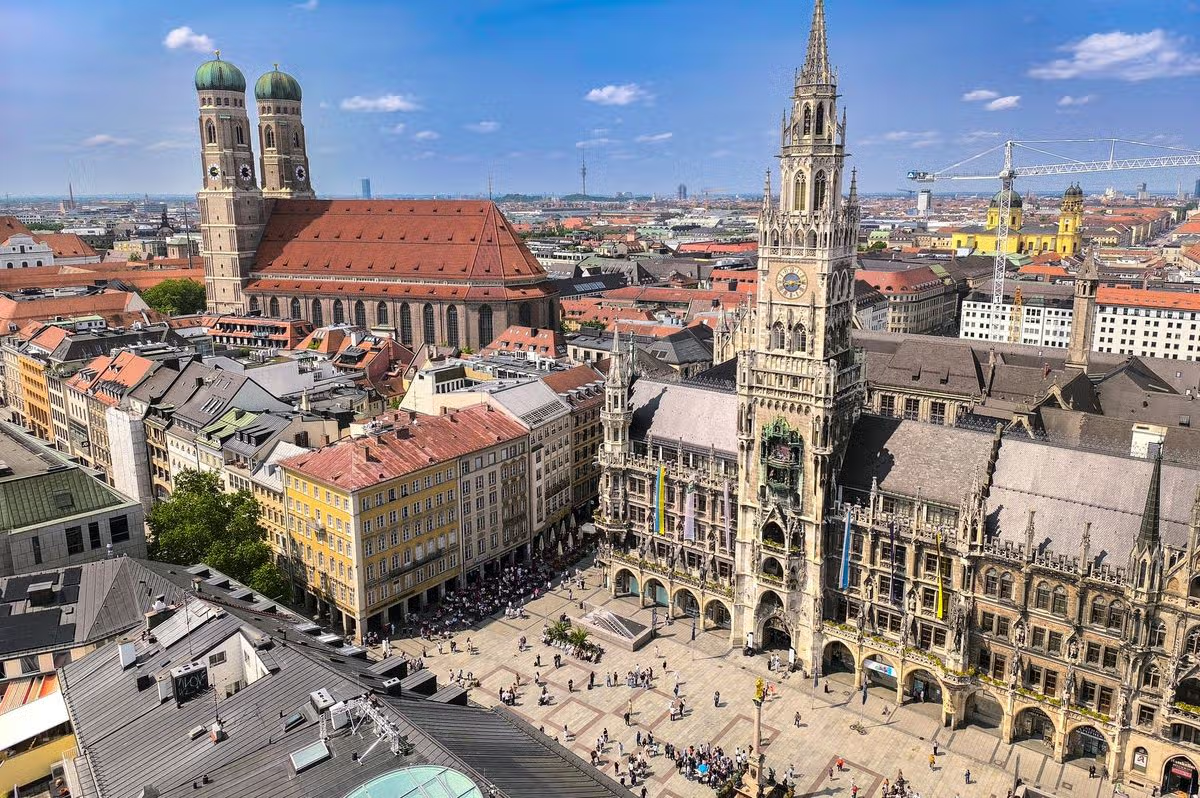
According to figures from the World Population review, Germany is Europe’s wealthiest country when judged by gross domestic product (GDP). Germany has a GDP of $5.45trillion (£4.026T).

What is GDP?

GDP is a way to measure a country’s productivity and prosperity. The GDP of a country is the total monetary value of all goods and services which that country produced within its borders over a year.

To calculate it, economists take the spending of everyday consumers, the investment of businesses in the country, and government spending and net exports to figure out the final calculation.

If GDP is rising year on year, it’s a good sign that the country is doing well financially. If it is consistently lowering, it’s a sign of an incoming recession.

Is it accurate?

GDP is not a very accurate indicator of the prosperity of a country’s people. It does not indicate how the wealth is distributed, nor the happiness or individual wealth of people.

These flaws are why GDP is often calculated alongside other metrics such as the Human Development Index, which measures the economy as well as life expectancy and education to get a better idea of how a country is functioning.

There’s also the Inclusive Wealth Index, which measures the “savings account” of a country by looking at infrastructure, natural resources and workforce alongside its finances.

How does the UK compare?

According to the most recent data, the UK is in second place with a GDP of $4.23trillion (£3.148T).

France is in third place with $3.17trillion (£2.654T), Italy fourth with $2.42trillion (£2.021T), and Russia fifth with $2.21trillion (£1.962T).

In the case of Germany’s GDP, it is larger than two other European nations combined. Portugal has $380.6billion (£281.0B), and Greece has $307.6billion (£227.1B).

Source link